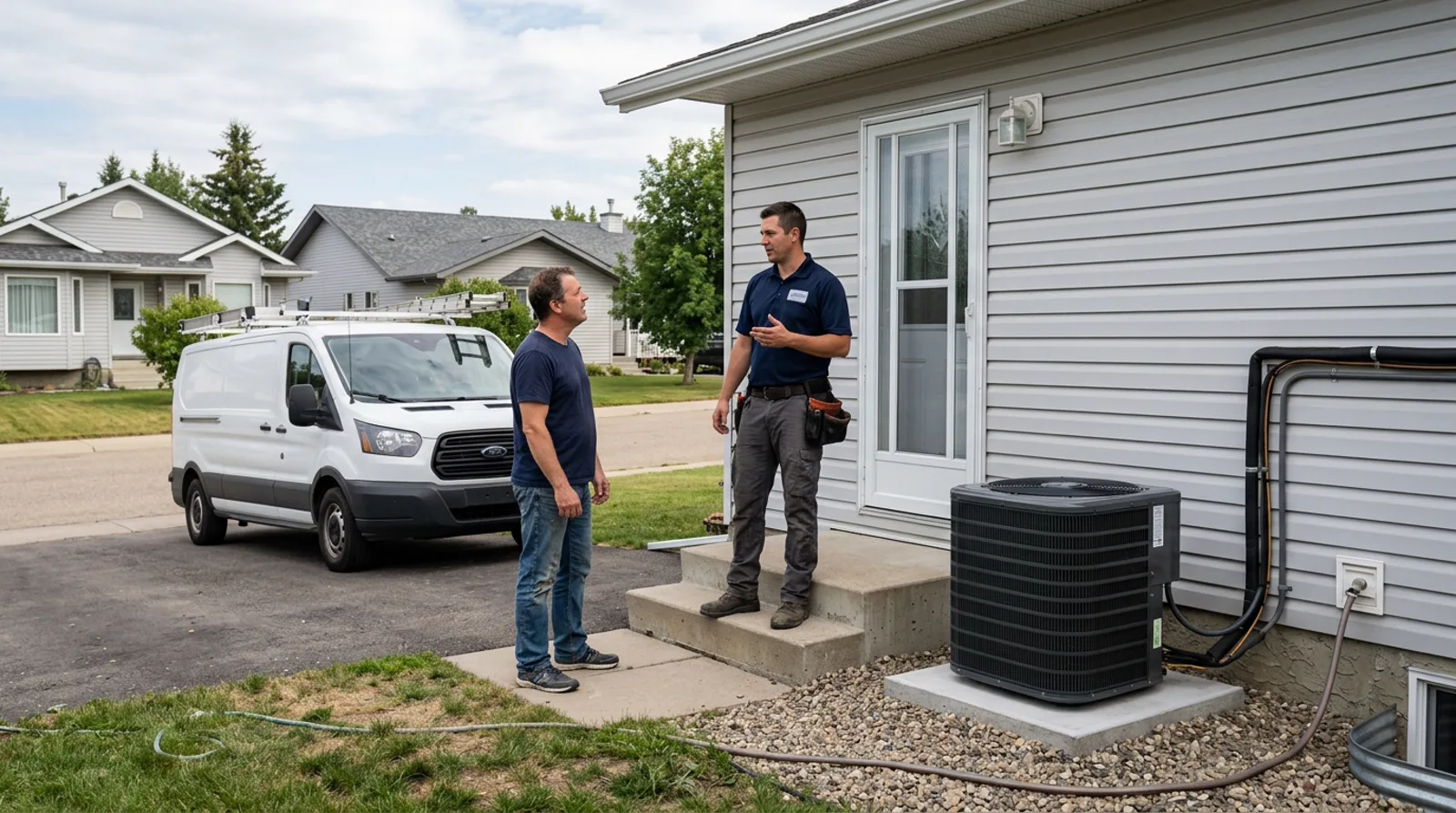
Air Conditioner Installation Built for Alberta Summers.
We size, permit, and install central AC systems that handle the hottest Parkland County days without breaking your power bill.
Complete Central AC Installation Services
From load calculation to final startup, local pros handle every step of bringing central air to your Spruce Grove home.
Manual J Load Calculation & System Sizing
We measure every room, window orientation, insulation level, and occupancy pattern. Oversized units short cycle and waste power. Undersized units never catch up on 32°C days. We size to your exact home, not square footage rules of thumb.
New Central AC System Install
Complete turnkey installation: outdoor condenser on pad or wall bracket, indoor evaporator coil, refrigerant line set, condensate drain, electrical disconnect, thermostat upgrade, and city permits. Includes startup, leak check, and airflow verification. Price varies by tonnage, SEER2 rating, and whether we're adding to existing forced air or new ductwork.
AC Replacement & Upgrade
Swap your aging or failed system for a modern high efficiency unit. Local pros remove and dispose of the old equipment, upgrade the pad and electrical if needed, reuse existing lineset when viable, and match the new indoor coil to your furnace. Most replacements complete in one day.
Ductwork Modification & Zoning
If your home has hot spots, undersized returns, or poor airflow, we redesign and modify ductwork before the AC goes in. Includes adding return air drops, upsizing trunk lines, balancing dampers, and installing bypass ducts for variable speed systems. Critical for two storey homes and additions.
Electrical Service & Disconnect Upgrade
Modern AC units pull significant current. We verify your panel has capacity, install a dedicated 240V breaker, run the wire to code, and mount a weatherproof disconnect at the condenser. Licensed electrician coordination included. Required for permit approval in Spruce Grove and Stony Plain.
Mini Split & Ductless AC Installation
For additions, garages, bonus rooms, or homes without existing ductwork. We mount the indoor head units, run refrigerant lines through exterior walls, set the outdoor compressor, and commission the system. Single zone or multi zone configurations available. Heat pump models work year round.
Why AC Installation Is Different Here
🌡️ Short Cooling Season, High Peak Load
We get maybe 60 to 80 days above 25°C, but July afternoons hit 32°C and homes with south exposure bake. Systems must handle the peak without being so oversized they cycle every five minutes in June. Manual J accounts for our latitude, sun angle, and typical window U values in Parkland County builds.
🏗️ City of Spruce Grove & Stony Plain Permit Rules
Both municipalities require an HVAC permit for new AC installation and refrigerant system work. The contractor pulls the permit, submits the load calc and equipment specs, arranges the inspection, and closes it out. Unpermitted work shows up on insurance claims and home sales, and the city can issue stop work orders.
💨 Hail and Wind Exposure on Rooftop & Ground Units
Parkland County sees severe hail every few summers, and chinook winds gust to 90 km/h. Local pros install condenser guards on rooftop units, use reinforced pads for ground mounts, and anchor with concrete or helical piles in frost susceptible soil. Prevents tipping, hail damage to coil fins, and vibration noise.
❄️ Furnace and Coil Compatibility in Cold Climate Installs
Your AC evaporator coil sits on top of your furnace. Alberta furnaces run 80% to 96% AFUE and need specific coil matches for airflow and condensate management during heating season. We verify blower motor capacity, plenum height, and ensure the coil doesn't restrict airflow when the furnace runs in winter.
What it costs here
Everything You Need to Know About AC Installation in Spruce Grove
How sizing works, what permits cost, how long it takes, and what to expect on install day.
How Central Air Conditioner Installation Actually Works in Spruce Grove Homes
Installing a central air conditioning system in a Spruce Grove home involves far more than bolting an outdoor unit to a concrete pad and calling it done. The process requires careful integration with your existing forced air furnace system, precise refrigerant line installation through walls or attics, electrical work that meets Alberta electrical code, and proper condensate drainage that accounts for our freeze thaw cycles. A complete installation typically takes one to three full days depending on whether you have existing ductwork, the complexity of your home's layout, and whether structural modifications are needed to accommodate new equipment. Professional installers must coordinate HVAC components, electrical systems, building envelope penetrations, and municipal permit requirements while ensuring the system will perform reliably through both our sweltering July afternoons and our unpredictable shoulder seasons.
The heart of the system is a matched pair: an outdoor condensing unit that sits on a stable pad outside your home, and an indoor evaporator coil that mounts directly on top of or beside your furnace plenum. These components must be precisely sized to each other and to your home's cooling load, which factors in square footage, insulation levels, window orientation, ceiling heights, and the number of occupants. Refrigerant lines connecting these units run through your home's structure, typically through exterior walls, rim joists, or attic spaces. These copper lines must be properly insulated, secured, and pitched to allow oil return to the compressor. In Spruce Grove's climate, where outdoor temperatures can swing from minus 30 in winter to plus 32 in summer, the installation must account for dramatic expansion and contraction of these materials.
The electrical portion involves running a dedicated 240 volt circuit from your main panel to a disconnect box near the outdoor unit, plus low voltage thermostat wiring that integrates with your existing or new thermostat. Alberta electrical code requires specific wire gauges, conduit types, and protection methods based on your home's construction and the route the wiring takes. The condensate drain line carries moisture removed from your indoor air to a floor drain, sump, or exterior location. In our region, this drain must be trapped properly to prevent sewer gas entry and must discharge to a location that won't create ice hazards in spring and fall. Many Spruce Grove installers route condensate to the same drain used by high efficiency furnaces, but this requires careful attention to trap configuration and venting to prevent problems when both systems operate simultaneously.
Why Alberta's Extreme Climate Makes Quality AC Installation Critical
Spruce Grove sits in a climate zone that challenges air conditioning equipment in ways that milder regions never experience. Our summer humidity levels fluctuate wildly, from bone dry conditions during heat waves to suddenly humid air when weather systems move through from the northwest. This variability means your AC system must handle latent cooling loads (moisture removal) that can spike unpredictably, requiring proper sizing that doesn't just focus on temperature. Undersized systems run constantly during July heat but never adequately dehumidify. Oversized systems cool too quickly, short cycling before removing enough moisture, leaving your home feeling clammy at 22 degrees. The installation must account for these realities through accurate load calculations, not just rules of thumb based on square footage.
Our dramatic temperature swings create unique installation challenges that inexperienced contractors often miss. When outdoor temperatures climb above 30 degrees, refrigerant pressures increase significantly, stressing joints, fittings, and connections that weren't installed with proper technique. Conversely, spring and fall shoulder seasons where we might run AC one day and heat the next put thermal stress on every connection point and seal in the system. Refrigerant line sets that aren't properly supported can work loose from vibration and expansion. Electrical connections that weren't torqued to specification can develop high resistance points that fail during peak demand. The outdoor unit must sit on a pad that remains stable through frost heave cycles, typically requiring crushed rock base extending below frost line or a proper concrete pad with footings.
Parkland County and the acreages surrounding Spruce Grove face additional considerations that urban installations don't encounter. Properties on well water often have different humidity profiles than those on treated municipal water, affecting dehumidification requirements. Homes with significant tree cover experience different solar gain patterns and may need adjusted equipment sizing. Rural properties sometimes have electrical service that's marginal for adding a large AC load, requiring service upgrades before installation can proceed. Dust from gravel roads and agricultural operations means outdoor coils need more frequent maintenance and installations should consider coil orientation and protective measures. These aren't minor details, they directly impact system longevity and performance in our specific geography.
Clear Warning Signs That You Need New Air Conditioner Installation
The most straightforward indicator is a complete system failure where your existing AC won't run at all or runs but produces no cool air. However, waiting for total failure often means sweltering through the hottest days of summer while scrambling to find available contractors during their busiest season. Smarter homeowners recognize the earlier warning signs that indicate replacement makes more sense than continued repairs. If your air conditioner is 15 years old or older, uses R22 refrigerant (which is now prohibited for new production and extremely expensive), and requires a repair exceeding $1,200, you're typically better served by new installation. The combination of age, obsolete refrigerant, and significant repair cost creates a financial tipping point where investing in repairs simply delays the inevitable while throwing money at dying equipment.
Chronic performance problems that technicians can't resolve point directly toward replacement. If your system runs continuously on hot days but never brings your home below 24 or 25 degrees, the unit likely lacks sufficient capacity for your home's current cooling load. Many Spruce Grove homes built in the 1980s and 1990s had minimal AC systems installed when air conditioning was considered a luxury rather than necessity. Subsequent additions, finished basements, or improved insulation and windows can all change your home's cooling requirements. Similarly, if you experience wildly uneven cooling where your main floor feels comfortable but upper bedrooms remain stuffy and warm despite balanced airflow, your existing equipment may lack the capacity or staging capability to handle the load distribution. Single stage systems simply turn on and off, while proper comfort requires variable output that matches changing conditions throughout the day.
Rising energy costs signal declining efficiency that makes replacement economically sensible even when the system still technically functions. If your summer electricity bills have climbed 30 to 50 percent over three to five years while your usage patterns haven't changed, your AC system is likely losing efficiency through refrigerant leaks, compressor wear, or failing components that increase runtime. Modern systems with SEER ratings of 16 to 20 use 30 to 40 percent less electricity than older 10 SEER units common in systems over 12 years old. A system that costs $180 monthly to operate in July could cost $110 to $125 monthly with new efficient equipment, creating payback through energy savings over six to eight years. When you factor in improved comfort, better humidity control, and quieter operation, the case for replacement becomes compelling before complete failure forces your hand.
Physical Deterioration and Safety Concerns
Visible damage to the outdoor condensing unit indicates problems that installation can't repair and shouldn't ignore. Hail damage is common in our region, particularly in Stony Plain and western Parkland County where severe storms track regularly. Dented condenser coil fins reduce airflow and efficiency, but more critically, hail impacts can crack refrigerant tubing inside the coil, leading to slow leaks that worsen over time. Bent or damaged fan blades create vibration that destroys bearings and can eventually cause the fan motor to fail catastrophically. Rust and corrosion on the cabinet, particularly around the base where water collects, suggests the unit has reached end of life where further repairs become impractical.
Electrical issues represent genuine safety hazards that warrant immediate replacement rather than temporary fixes. If your breaker trips repeatedly when the AC starts, if you see scorch marks around electrical connections, or if the disconnect box shows signs of overheating, the system poses fire risk. Compressor starting components can fail in ways that draw excessive current, damaging your home's electrical system. Capacitors can rupture, leaking dielectric fluid that's both messy and potentially hazardous. These aren't situations for another bandaid repair when the underlying equipment has reached the point where electrical components are failing from age and wear. Modern systems include much better electrical protection and monitoring that reduces these risks substantially.
The Complete AC Installation Process From First Call to Final Startup
The process begins with an in home assessment where a qualified contractor performs actual heat load calculations rather than guessing based on square footage. This involves measuring your home's dimensions, documenting insulation levels in attic and walls, counting and measuring windows and doors, noting orientation and shading, and evaluating your existing ductwork system. The contractor should inspect your electrical panel to verify capacity for the new AC load, examine potential locations for the outdoor unit considering noise impact on neighbours and clearance requirements, and identify the best routing for refrigerant lines that minimizes visible penetrations and maintains proper pitch. A thorough assessment takes 60 to 90 minutes and produces a written load calculation showing exactly why specific equipment was recommended. Beware of contractors who quote prices after a 10 minute walkthrough, they're guessing and you'll likely end up with wrong sized equipment.
Once you've selected a contractor and signed a contract, they submit permit applications to Spruce Grove or Parkland County as required. Installation of central AC typically requires both a mechanical permit for the HVAC work and an electrical permit for the new circuit and disconnect. Permit fees generally run $200 to $350 depending on jurisdiction and system complexity. The contractor should handle all permitting, and you should verify permits are actually pulled before work begins. Some less scrupulous contractors skip permits to save time and money, leaving you liable if problems arise or when you eventually sell your home. Permit requirements exist to ensure installations meet code and are inspected by qualified officials who verify safety and proper installation practices.
On installation day, the crew typically arrives early and begins by protecting your home's interior with floor coverings, removing existing equipment if present, and setting up tools and materials. They install the outdoor unit pad if needed, position and level the condensing unit, then begin running refrigerant lines through the structure. This involves drilling through exterior walls or rim joists, typically using 2.5 to 3 inch diameter holes that accommodate insulated line sets. Lines must be supported every 4 to 6 feet, protected from physical damage, and routed to avoid potential water infiltration points. Inside, they remove your furnace's lower access panel, cut into the plenum to install the new evaporator coil, and seal all joints with proper mastic. The condensate drain gets installed with appropriate trapping and routed to an acceptable discharge point.
The electrical work involves running new wire from your main panel to a disconnect box mounted near the outdoor unit, then low voltage wiring from the furnace to your thermostat location. The electrician (who may be part of the HVAC crew if properly licensed, or a separate trade) installs a dedicated breaker, runs appropriately sized wire through walls or attic space, and makes all connections per code. Once physical installation is complete, the refrigerant lines get pressure tested with nitrogen to verify no leaks exist, then evacuated using a vacuum pump that removes all air and moisture from the system. This evacuation must pull a vacuum of at least 500 microns and hold that level for 30 minutes, proving the system is completely sealed. Only then does the technician introduce refrigerant, using precise scales to charge the system to manufacturer specifications rather than relying on pressure readings alone.
- Pre installation assessment with Manual J load calculation: 60 to 90 minutes, verifies proper sizing
- Permit application and approval: 3 to 10 business days depending on jurisdiction workload
- Equipment delivery and staging: Typically same day as installation for residential projects
- Physical installation: 6 to 16 hours of actual work depending on home complexity and crew size
- System evacuation and refrigerant charging: 2 to 3 hours minimum for proper procedure
- Startup, testing and commissioning: 1 to 2 hours verifying all functions and settings
- Customer walkthrough and thermostat training: 20 to 30 minutes covering operation and maintenance
- Final inspection by municipal authority: Scheduled after installation, usually within one week
What Happens After the Installation Crew Leaves
The work isn't truly complete when installers pack up their tools. Municipal inspection must occur within days of installation completion, where an inspector verifies refrigerant line installation, electrical work, condensate drainage, clearances around equipment, and proper venting if the installation affected your furnace venting system. The contractor should coordinate this inspection, but you're responsible for ensuring someone provides access to your home. Inspections typically take 15 to 30 minutes. If deficiencies are identified, the contractor must correct them and arrange re inspection before the permit can be closed. Operating your system before final inspection approval technically violates your permit, though most inspectors understand you need cooling and focus on safety items.
Your new AC system requires a break in period where you monitor performance and note any concerns. Don't expect perfect comfort in the first few hours, systems need time to remove built up humidity and reach equilibrium. However, by the second or third day of operation, you should notice consistent temperatures, good humidity control, and relatively even comfort throughout served areas. Unusual noises, short cycling (system turning on and off every few minutes), or inadequate cooling warrant immediate callback to your contractor. Reputable companies provide warranty coverage on both equipment and installation workmanship, typically one year on labor and 5 to 10 years on equipment parts. Register your equipment warranty directly with the manufacturer within 90 days of installation to ensure coverage is active and properly documented in their system.
What Central Air Conditioner Installation Really Costs in Spruce Grove, Stony Plain and Parkland County
A complete central air conditioner installation in the Tri-Region typically runs between $4,200 and $9,500 for most homes, though the range can stretch from $3,600 for a basic 1.5 ton system in a smaller bungalow to over $12,000 for a premium multi-stage unit in a larger two-storey. The final number depends on system size measured in tons, efficiency rating (SEER), brand tier, complexity of the installation including ductwork modifications, and how much existing infrastructure your contractor can reuse. A straightforward replacement where the old furnace and coil are compatible with the new condenser will land at the lower end, while a full matched system upgrade with new evaporator coil, disconnect, lineset and pad pushes the price higher. These figures reflect real Alberta pricing in 2025, including GST, permits, and labour from licensed professionals who carry proper liability insurance and liability insurance.
System capacity drives a major chunk of the cost. Most homes in Spruce Grove and Stony Plain need between 2 and 4 tons of cooling. A 2 ton system for a well-insulated 1,200 square foot bungalow might cost $4,500 to $6,200 installed, while a 3.5 ton unit for a 2,000 square foot two-storey typically lands between $5,800 and $8,400. Sizing must account for Alberta's wildly variable climate, where a June heatwave can push outdoor temperatures to 32 Celsius while your indoor target stays at 22. Contractors use Manual J load calculations that factor in your home's insulation levels, window area, orientation, ceiling height, and how many west-facing windows bake in afternoon sun. An undersized unit runs continuously on hot days and never achieves comfort, while an oversized system short-cycles, wastes energy, and fails to dehumidify properly during our occasional humid spells. Proper sizing is not guesswork, and any contractor who estimates tonnage by square footage alone without inspecting your home should raise a red flag.
SEER rating, which measures cooling efficiency, adds another price layer. Basic 14 SEER units meet current minimum standards and cost $800 to $1,400 less than 16 to 18 SEER models for the same tonnage. Higher efficiency pays back through lower electricity bills during cooling season, which in the Tri-Region runs roughly mid-May through early September depending on the year. A 16 SEER system uses about 14 percent less power than a 14 SEER model under identical conditions. Over a 15 year lifespan, that difference can add up to $600 to $1,100 in savings, making the upfront premium worthwhile if you plan to stay in the home long term. Variable-speed and two-stage compressors add $1,200 to $2,800 to equipment cost but deliver superior comfort by running at lower speeds most of the time, reducing temperature swings and noise. They also pair better with high-efficiency furnaces that have variable-speed blowers, creating a truly optimized system. Budget-conscious homeowners often choose a mid-tier 15 or 16 SEER single-stage unit as the sweet spot between cost and performance for our climate.
Hidden Costs and Add-Ons That Appear During Installation
Ductwork modifications represent the most common surprise expense. Many older homes in Parkland County and rural Spruce Grove have undersized return air, inadequate supply registers in upper bedrooms, or flex duct that has collapsed or disconnected over decades. Proper airflow is critical for AC performance and longevity. Your new condenser might be rated for 1,200 cubic feet per minute, but if your return can only pull 900 CFM because of a restrictive filter grille or crimped trunk line, the evaporator coil will freeze, the compressor will strain, and the system will fail prematurely. Adding a return air run costs $450 to $900 depending on accessibility. Sealing and insulating exposed ductwork in an unconditioned attic adds $600 to $1,400 but prevents the massive efficiency loss that happens when cold air leaks into 45 Celsius attic space during July. Contractors should identify these issues during the quote, but some wait until installation day to mention them, putting you in a tough spot.
Electrical upgrades sometimes become necessary, especially in homes built before 1990. A central air conditioner requires a dedicated 240-volt circuit with appropriate breaker sizing, typically 20 to 40 amps depending on the unit. If your panel is full, outdated, or lacks capacity, an electrician will need to add a breaker or upgrade the panel, adding $400 to $2,200 to the project. The outdoor disconnect box, which provides a shut-off point near the condenser, costs $180 to $320 installed if not already present. Some contractors include this in their base quote while others list it as an add-on, so clarify during estimates. Aluminum wiring, common in 1970s homes, may require special connectors or pigtails to meet current code, adding another $150 to $400. A reputable HVAC installer will coordinate with a licensed electrician or have one on staff, pulling the electrical permit separately from the gas permit if your municipality requires it.
Refrigerant lineset replacement is often needed when upgrading from an old R-22 system to a modern R-410A unit. The existing copper lines may be the wrong diameter, corroded, or contaminated with old oil and refrigerant that is incompatible with the new system. Running new lineset through walls, attics, or crawlspaces costs $12 to $22 per linear foot depending on accessibility and diameter. A typical run from basement furnace to side-yard condenser might be 25 to 50 feet, adding $300 to $1,100 to the job. Some contractors reuse old linesets to save money, but this risks compressor failure if residual R-22 or moisture contaminates the new system. Proper installation includes pulling a vacuum on the lines for at least 30 minutes to remove air and moisture, then charging the system to manufacturer specs by weight, not pressure alone. Shortcuts here cost you thousands down the road when the compressor dies at year three instead of year twelve.
Comparing Air Conditioner Types, Brands and Installation Approaches for Alberta Homes
Central split systems dominate residential installations in the Tri-Region because they integrate seamlessly with forced-air furnaces that most homes already have. The outdoor condenser contains the compressor and condenser coil, while the indoor evaporator coil mounts in the plenum above or beside your furnace. Refrigerant circulates between the two units through insulated copper lines, absorbing heat indoors and releasing it outside. This configuration leverages your existing ductwork and furnace blower, making it the most cost-effective option for whole-home cooling. Performance depends heavily on proper refrigerant charge and airflow balance. An AC-only split system (no furnace replacement) typically costs $4,200 to $7,800 installed, while a matched furnace and AC package runs $7,500 to $13,500 depending on efficiency tiers and home size. Matched systems from the same manufacturer ensure the blower motor, coil size, and refrigerant metering device all work in harmony, optimizing both heating and cooling performance.
Packaged units combine the condenser and evaporator in a single outdoor cabinet, connecting to ductwork through a wall or roof penetration. These are rare in the Tri-Region's residential market but appear in some mobile homes, additions, or situations where indoor space is extremely limited. Installation costs run $5,200 to $9,100 because the unit itself is more expensive and requires weather-resistant ductwork transitions that handle Alberta's temperature extremes. Packaged units work well when there is no basement or mechanical room, but serviceability suffers since technicians must work outdoors in all conditions. A February service call when the heat strips fail becomes far less pleasant for the tech, and some companies charge winter service premiums. For most Spruce Grove and Stony Plain homes with basements and standard furnace layouts, a split system makes more sense from a cost, efficiency, and maintenance standpoint.
Ductless mini-split systems offer cooling (and often heating) without requiring ductwork, making them ideal for homes with hydronic or electric baseboard heat, garage conversions, or room additions where extending ducts is impractical. An outdoor compressor connects to one or more indoor wall-mounted or ceiling-recessed air handlers via small refrigerant lines and a condensate drain. A single-zone system for one room costs $3,200 to $5,400 installed, while a multi-zone setup covering three or four areas runs $7,800 to $13,500. Mini-splits deliver excellent efficiency, often 18 to 25 SEER, and provide room-by-room temperature control. The tradeoff is higher equipment cost per ton of cooling and a more visible indoor presence, since each air handler sits on the wall rather than hidden behind a vent. In Parkland County acreages where a detached shop or garage needs climate control, a mini-split dedicated to that space often beats running 80 feet of ductwork from the main house. For primary whole-home cooling where ductwork exists, central systems remain more economical.
- Single-stage compressors run at full capacity whenever called, cycling on and off frequently, suitable for budget-conscious installs in smaller homes.
- Two-stage compressors operate at low speed 70 to 80 percent of the time, switching to high only on the hottest days, improving efficiency and comfort for mid-range budgets.
- Variable-speed inverter-driven compressors modulate from 25 to 100 percent capacity, delivering the best efficiency and quietest operation, ideal for premium installs and homes with variable-speed furnaces.
- Scroll compressors dominate residential AC, offering reliability and moderate noise levels, while older reciprocating compressors are louder and less efficient.
- Copper coils with aluminium fins remain standard for condensers, though some premium units use all-aluminium microchannel coils that resist corrosion better in areas with high water mineral content or road salt spray.
Brand Tiers and What You Actually Get for the Money
Economy brands like Goodman, Amana, and base-model Lennox units cost $1,200 to $2,400 for the condenser itself before installation, offering solid performance with 14 to 16 SEER ratings and 10-year parts warranties. These systems use proven technology without the advanced features or ultra-quiet operation of premium lines. They are perfectly adequate for rental properties, flip projects, or homeowners prioritizing low upfront cost over maximum efficiency. Contractor support and parts availability are generally good since these brands have wide distribution. The main compromise is noise, with sound ratings around 72 to 76 decibels at full operation, noticeable from 15 feet away. For a Stony Plain backyard where the condenser sits 10 feet from a bedroom window, that hum can bother light sleepers during hot summer nights.
Mid-tier brands including Carrier, Bryant, Ruud, and Rheem command $2,600 to $4,200 for the outdoor unit, delivering 15 to 18 SEER efficiency, two-stage operation, and better build quality. These systems balance performance and cost, often including features like copper wiring instead of aluminium, thicker cabinet steel, and enhanced corrosion protection. Warranties stretch to 10 years on parts with options to extend to 12 years through registration. Sound levels drop to 68 to 73 decibels, a meaningful reduction especially in denser Spruce Grove neighbourhoods where homes sit closer together. This tier represents the most popular choice among Tri-Region homeowners who plan to stay in their homes long term and want reliable, efficient cooling without paying the premium brand markup.
Premium brands like Trane, Lennox Signature series, and high-end Carrier command $4,500 to $7,500 for the condenser, offering 18 to 20 SEER ratings, variable-speed compressors, advanced diagnostics, and exceptional warranties including labour coverage options. These units run whisper-quiet at 55 to 65 decibels, barely audible from 20 feet. Cabinet construction uses heavier gauge steel with superior powder coating to resist Alberta's harsh freeze-thaw cycles and UV exposure. Some models include advanced features like compressor sound blankets, vibration isolation, and smart home integration. For discerning homeowners in executive properties around Parkland County or newer Spruce Grove developments, the comfort and longevity justify the cost. That said, a properly installed mid-tier system will cool your home just as effectively, the premium buys you quieter operation, better humidity control, and longer lifespan if maintained properly.
Critical Mistakes and Contractor Traps to Avoid During Your AC Installation Project
Skipping the Manual J load calculation is the most damaging shortcut contractors take, leading to improperly sized equipment that costs you comfort and money for 15 years. Some installers estimate tonnage by dividing square footage by 600 or 700, a crude rule of thumb that ignores insulation quality, window area, ceiling height, home orientation, and occupancy. A 2,000 square foot home might need anywhere from 2.5 to 4 tons depending on whether it is a poorly insulated 1970s bi-level with single-pane windows facing west or a well-sealed 2015 build with R-50 attic insulation and low-E glass. Oversizing is epidemic in the industry because contractors want to avoid callbacks about inadequate cooling, so they err on the high side. An oversized AC cools the space quickly but shuts off before removing humidity, leaving your home clammy during those occasional muggy Alberta evenings. It also cycles on and off frequently, wearing components faster and wasting energy. Demand a written load calculation before signing any contract, and walk away from anyone who refuses or claims it is unnecessary.
Hiring the low bidder without verifying credentials, insurance, and work quality almost always ends badly. A quote that undercuts competitors by $1,500 or more likely means the contractor plans to skip permits, use unregistered apprentices instead of journeyman supervision, reuse old refrigerant without proper recovery, or disappear before warranty issues surface. Alberta requires HVAC installers to hold gas tickets (Class A or B depending on equipment type), carry liability insurance if they have employees, and maintain liability insurance of at least $2 million. Ask for copies of all three documents and verify the WCB account number and gas ticket directly with the regulator if you have any doubts. Some outfits operate as sole proprietors with no WCB, which is legal if they genuinely work alone, but if you see a helper on site and an injury occurs, you could face liability. Proper permits cost $150 to $320 depending on municipality, and contractors who skip them leave you holding the bag if a future home inspection or insurance claim reveals unpermitted work.
Neglecting to confirm warranty registration and get proper documentation after installation creates headaches when something fails at year four. Manufacturers require registration within 60 to 90 days of installation to activate extended parts warranties. If your contractor forgets or fails to register, your 10-year compressor warranty might default to just one or two years. Insist on receiving copies of the warranty registration confirmation, the original invoice showing equipment model and serial numbers, and the signed permit card from the municipality. Take photos of the equipment data plates showing serial numbers before the condenser gets installed in a tight spot where accessing them later requires a mirror and flashlight. Also, get a written explanation of what your contractor's workmanship warranty covers and for how long. Reputable companies offer one to two years on labour and installation, covering callbacks for issues like refrigerant leaks from bad flare connections, improperly secured linesets, or electrical problems. Vague promises to make it right or trust me mean nothing when the owner stops answering calls after six months.
Red Flags That Should Make You Walk Away From a Quote
Pressure tactics and same-day decision demands signal a contractor more interested in closing sales than delivering quality. Legitimate HVAC companies understand that a $6,000 investment deserves careful consideration and comparison shopping. If a salesperson insists that a special price expires today or that materials are in short supply so you must decide immediately, you are dealing with a high-pressure outfit that likely overcharges and under-delivers. Quality contractors stay busy through referrals and repeat business, not manufactured urgency. Similarly, be wary of quotes that arrive as a single number with no itemization. You deserve to see equipment model numbers, tonnage, SEER rating, warranty terms, and line items for labour, materials, permits, and any extras like duct modifications or electrical work. A lack of transparency suggests the contractor is hiding something, whether it is inferior equipment, missing permits, or inflated margins on add-ons.
Refusal to pull permits or suggestions that permits are unnecessary for simple replacements should end the conversation immediately. Every air conditioner installation in Alberta municipalities requires a gas permit because the work involves refrigerant lines connected to a pressure vessel, classified under gas regulations. Stony Plain, Spruce Grove, and Parkland County all enforce this. Contractors who suggest skipping permits to save money or time are admitting they cut corners elsewhere too. When that unit leaks refrigerant or the compressor fails due to improper installation, your insurance may deny the claim due to unpermitted work. You also face fines or mandatory removal when you sell the home and the inspection reveals unpermitted mechanical systems. Permit costs are modest compared to the risk, and any contractor complaining about the hassle or expense of permits is not someone you want touching your HVAC system.
Vague answers about refrigerant handling, vacuum procedures, or charging methods indicate a lack of technical competence. Ask how the contractor will charge the new system, refrigerant by weight using the manufacturer's charge specification and a calibrated scale, or by pressure and superheat. The correct answer is by weight, period. Pressure and superheat measurements are diagnostic tools, not charging methods, because they vary with outdoor temperature and airflow. A contractor who confidently explains they will pull a 500-micron vacuum for 30 minutes, perform a standing pressure test, then charge to the data plate specification by weight knows what they are doing. One who mumbles about making sure pressures look good or using gauges to dial it in does not. Also ask what happens to the old refrigerant. Legally, it must be recovered using EPA-certified equipment and disposed of properly, not vented to atmosphere. Venting refrigerant is illegal, environmentally destructive, and a clear sign of a contractor who ignores regulations across the board.
How to Hire the Right Air Conditioner Installation Contractor in Spruce Grove and the Tri-Region
Start by requesting at least three detailed written quotes from licensed contractors who have established reputations in the Tri-Region. A proper quote includes specific equipment model numbers with tonnage and SEER rating, not vague references to a good quality Carrier or similar. It should itemize labour, materials, permits, disposal of old equipment, and any recommended duct modifications or electrical work. Expect each quote to take 45 to 90 minutes of on-site evaluation, during which the contractor inspects your furnace, ductwork, electrical panel, existing refrigerant lines, and outdoor placement options. They should measure supply and return grilles, check static pressure if they have a manometer, and ask about comfort issues in specific rooms. A contractor who spends 10 minutes glancing at your furnace and condenser before quoting from a price sheet in the truck has not done the job properly. The quotes will likely vary by $1,200 to $3,000, reflecting differences in equipment brands, warranty coverage, and scope of work rather than pure profit margins.
Verify credentials meticulously before shortlisting any contractor. In Alberta, check that the individual or company holds a valid Gas Utilization Safety Certificate, commonly called a gas ticket, through the Alberta Safety Codes Authority registry. Confirm liability insurance by requesting the company's WCB account number and calling to verify active standing. Ask for proof of liability insurance with at least $2 million coverage, and note the policy expiry date. Check online reviews across Google, HomeStars, and the Better Business Bureau, looking for patterns rather than isolated complaints. Every company gets occasional bad reviews, but repeated issues around communication, surprise charges, or shoddy work should disqualify a contractor. Ask for references from installations completed in the past year in Spruce Grove, Stony Plain, or Parkland County, and actually call them. Specifically ask whether the job stayed on budget, whether the crew cleaned up properly, and whether the system performs as promised. References who hesitate or offer lukewarm praise are telling you something.
Evaluate communication style and professionalism throughout the quoting process. Does the contractor return calls and emails promptly? Do they explain technical concepts in plain language without condescending or overwhelming you with jargon? Do they listen to your concerns about noise, budget, or specific comfort problems in certain rooms? A contractor who interrupts, dismisses your questions, or pushes a specific brand because it is all local pros install or they are the best shows more interest in their convenience than your needs. Pay attention to how they handle disagreements or concerns, if you question a recommendation, do they explain the reasoning or get defensive? The best contractors educate rather than sell, offering options at different price points and honestly discussing tradeoffs. They also put everything in writing, from the quote to the installation timeline to the warranty terms. Verbal promises mean nothing when a dispute arises at month eight. If something matters to you, such as using a specific refrigerant charging method or registering warranties before final payment, write it into the contract.
Questions to Ask Before Signing Any Contract
Clarify exactly what the price includes and what costs extra. Will the contractor haul away the old equipment, or do you need to arrange disposal? Does the quote include the outdoor pad if one does not exist, or the disconnect box, or the filter drier? Who pulls the permit, and is the fee included in the price? What happens if ductwork issues come to light during installation, do you get a call before any extra work proceeds, or does the contractor make the call and bill you later? Establish a payment schedule in writing. Reasonable terms involve a small deposit to order equipment (10 to 20 percent), a progress payment when the equipment arrives or installation begins (30 to 40 percent), and the final balance upon completion and your satisfaction. Never pay in full upfront, and be suspicious of contractors demanding 50 percent or more before starting work. Ask about the workmanship warranty, what does it cover, for how long, and what is the process if something goes wrong? Get the name and phone number of the specific person you should contact for service or warranty issues, not just a general office number.
Discuss the installation timeline and crew details. How many days will the job take, and what are the daily hours? Will the same crew complete the entire job, or do different trades (HVAC installer, electrician, duct specialist) come on different days? Who supervises the crew, and is that person a licensed journeyman? What happens if weather or supply chain issues delay the project, and will you get advance notice? For most straightforward installations, expect one to two days of work. The first day typically involves setting the outdoor condenser, running or modifying refrigerant lines, installing the indoor coil, and making electrical connections. The second day covers start-up, refrigerant charging, airflow testing, and a walkthrough explaining operation and maintenance. Complex jobs involving extensive duct modifications or electrical upgrades can stretch to three or four days. A contractor who promises to do everything in four hours is either wildly optimistic or planning to skip critical steps like proper evacuation and charging.
How Tri-Region Services Helps Homeowners Find Trusted AC Installation Professionals
Tri-Region Services simplifies your search by connecting you directly with one carefully vetted, fully licensed, and insured HVAC contractor serving Spruce Grove, Stony Plain, Parkland County, and Acheson. Every professional in our network has been asked about active gas tickets in good standing, comprehensive liability insurance, and a proven track record of quality installations in the Tri-Region. We verify that they pull proper permits, follow manufacturer installation guidelines, and stand behind their work with clear written warranties. When you contact us, we match you with a contractor who has the right equipment and expertise for your specific project, whether that is a straightforward condenser replacement or a complete system upgrade with duct modifications.
You will receive a free written quote with itemized costs, specific equipment recommendations, and a realistic timeline. There is no obligation, no pressure, and no cost for the estimate. Our goal is to connect homeowners with trustworthy professionals who deliver honest pricing, quality workmanship, and reliable service throughout the life of your cooling system. We have done the credential checking and reference calling so you can move forward with confidence, knowing your air conditioner installation will be completed properly by a contractor who respects your home, your budget, and Alberta's building standards.
Why Homeowners in the Tri-Region Trust Us
Contractors state their credentials and insurance when they sign up, and we show that on their listing, which matters when you're spending thousands on comfort equipment.
Alberta Licensed Gas Fitters & Electricians
Techs in our network hold valid ABSA gas tickets and coordinate with licensed electricians for all 240V work, meeting provincial and municipal code.
Insurance on file
You're protected if someone gets hurt on your property or if the installer damages your home during the install.
Permit Pulled and Inspected Every Time
We never skip the permit, and we schedule the city inspection before we leave your property.
Manufacturer Certified Installation Teams
The installers we match you with are factory trained on the brands they fit, which protects your equipment warranty and ensures proper startup procedures.
Third Party Load Calculation Software
We use ACCA approved Manual J software with Alberta climate data, not back of napkin BTU per square foot guesses.
Pros Who Stand Behind Their Work
If the installation fails, your contractor returns to fix it at no charge under their workmanship warranty. Ask for the specific term in writing.
This page is not tied to a contractor's brand. Leads route straight to your one local partner. Verified reviews can appear here once that partner has them (never fabricated).
Serving the whole Tri-Region
8 questions homeowners ask before booking
How long does a central AC installation take in Spruce Grove?+
Do I need a permit to install air conditioning in Spruce Grove or Stony Plain?+
What size air conditioner do I need for my Spruce Grove home?+
Can you install AC if my house only has baseboard heat and no ductwork?+
How much does it cost to replace an old AC unit in Spruce Grove?+
What SEER rating should I get for a new AC in Alberta?+
Will adding central air conditioning increase my home insurance cost?+
Can I install a heat pump instead of AC in Spruce Grove?+
Get your free quote
Tell us what you need and a local pro will get right back to you.
- ✓ Sent straight to a local business
- ✓ You choose who you hire
- ✓ Free, with no obligation