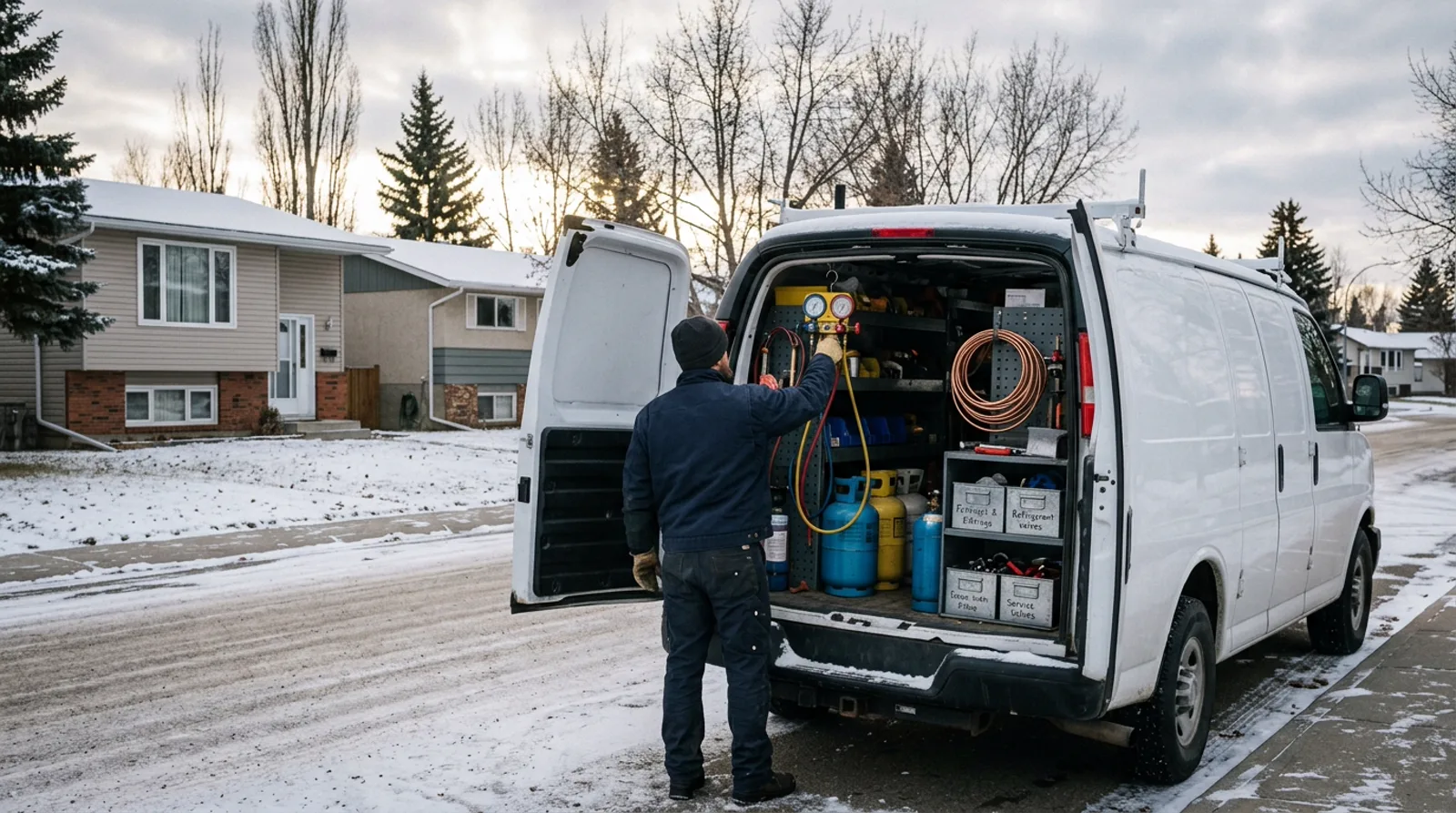
Air Conditioner Repair Spruce Grove Urgent Requests Prioritized
When your AC quits in July heat or cycles endlessly after a hailstorm, local pros diagnose and repair the actual fault without upselling you a new system you don't need.
AC Repair Services We Perform
From refrigerant leaks to control boards, local pros fix the components that fail most often in Alberta's temperature swings.
Refrigerant Leak Detection & Top-Up
UV dye tracing, nitrogen pressure test, and certified refrigerant charge. R-410A and R-22 systems. Local pros repair the leak source, not just add refrigerant temporarily. Post-hail inspections common after Parkland County storms.
Compressor Diagnosis & Replacement
Hard-start capacitor testing, thermal overload checks, and compressor swap when the unit hums but won't start or trips breakers. We evaluate repair-versus-replace economics honestly based on system age and refrigerant type.
Control Board & Thermostat Repair
Failed contactor relays, blown transformers, capacitor burnout, and wiring faults from power surges. The technician carries common Honeywell, White-Rodgers, and OEM boards on the truck for fast turnaround. Includes thermostat compatibility checks for smart models.
Condenser Fan Motor & Blade Replacement
Seized bearings, broken fan blades from hail impact, and failed run capacitors. Critical in Spruce Grove summers when outdoor units run continuously. Motor swaps typically done same visit, restoring airflow and preventing compressor damage.
Evaporator Coil Freeze-Up & Cleaning
Thaw frozen coils, diagnose low airflow from dirty filters or closed vents, clean coil fins clogged with cottonwood fluff common in Stony Plain. Includes blower wheel inspection and drain pan clearing to prevent overflow.
Emergency AC Diagnostics
Flat-rate on-site troubleshooting: electrical testing, airflow measurement, refrigerant pressure read, visual inspection of outdoor and indoor units. Diagnostic fee waived when you approve repair same visit. Essential for pinpointing intermittent faults or post-storm damage.
Why AC Units Fail Around Spruce Grove
🌡️ Extreme Temperature Swings
Chinook winds bring +15°C in January, then minus 30°C two days later. This cycling stresses compressor seals, contactor relays, and refrigerant joints. We see more cracked solder joints and failed capacitors here than in stable climates.
🧊 Heavy Hail & Storm Damage
Parkland County and west Spruce Grove see frequent hail May through August. Dented condenser fins reduce airflow by 30 percent, bent fan blades vibrate bearings to failure, and coil punctures leak refrigerant. The technician carries fin combs and stock replacement grilles.
🌲 Cottonwood & Poplar Debris
June cottonwood fluff clogs condenser coils like a blanket, causing high-head pressure and compressor overheating. Rural Acheson and Stony Plain properties near shelterbelts need coil cleaning twice per season to maintain efficiency and prevent shutdowns.
⚡ Power Quality & Lightning Strikes
Parkland County's overhead distribution sees voltage sags during storms and lightning-induced surges. Control boards, capacitors, and compressor windings fail without warning. We test for surge damage and recommend whole-home surge protection after board replacement.
What it costs here
Everything You Need to Know About AC Repair in Spruce Grove
From diagnosing no-cool calls to understanding when repair makes sense versus replacement, this guide covers Alberta-specific realities.
How Air Conditioner Repair Actually Works in Alberta Homes
Air conditioner repair in Spruce Grove addresses the mechanical, electrical, and refrigerant systems that deliver cool air throughout your home during prairie summers. A certified HVAC technician diagnoses the root cause of your cooling failure, whether it involves compressor issues, refrigerant leaks, frozen evaporator coils, failed capacitors, or blocked condensate drains. The repair process always begins with systematic testing: checking amperage draws on motors, measuring refrigerant pressures, testing electrical connections, inspecting ductwork for leaks, and verifying thermostat operation. Alberta summers can push daytime temperatures above 30 degrees Celsius for extended periods, so a malfunctioning AC unit creates genuine discomfort and sometimes safety concerns for vulnerable household members.
Professional repair differs fundamentally from replacement or simple maintenance. The technician isolates the specific failed component rather than servicing the whole system or installing new equipment. This involves using specialized diagnostic tools like manifold gauges for refrigerant pressure, multimeters for electrical continuity, thermometers for temperature differential measurements, and infrared cameras for detecting airflow problems. Many homeowners in Parkland County operate their systems only three to four months yearly, which means components sit idle through harsh winters where temperatures plunge below minus 30 degrees. This seasonal cycling creates unique wear patterns: seals dry out during dormancy, capacitors degrade from thermal stress, and electrical connections corrode from moisture intrusion during spring thaw cycles.
The actual repair work varies dramatically based on what failed and why. Simple fixes like replacing a burnt capacitor or cleaning a plugged condensate line take 30 to 90 minutes and cost $200 to $450 including parts and labour. Complex repairs involving compressor replacement, refrigerant leak detection and repair, or evaporator coil replacement require three to six hours and range from $800 to $2,800 depending on equipment access and refrigerant type. R-410A refrigerant, common in systems installed after 2010, costs more than older R-22 but provides better cooling efficiency in Alberta's dry climate. Technicians must hold valid refrigerant handling certification under federal regulations, and all work must comply with Alberta building and electrical codes even for repairs.
Alberta Climate Factors That Cause AC Failures in Spruce Grove and Stony Plain
The extreme temperature swings between Alberta winters and summers create relentless stress on air conditioning components. A unit that endures minus 35 degree nights in January must perform flawlessly when outdoor temperatures hit 32 degrees in July, a thermal range exceeding 65 degrees. This cycling causes rubber seals and gaskets to harden and crack, refrigerant lines to expand and contract (creating leak points at brazed joints), and electrical contactors to pit and fail. Chinook winds compound these problems by creating sudden 20 degree temperature jumps within hours, forcing systems to cycle on and off rapidly during shoulder seasons. Homeowners in Acheson and rural Parkland County face additional challenges because their outdoor units sit fully exposed to prairie weather without the windbreak protection found in denser subdivisions.
Spring conditions in this region trigger a cascade of AC problems that peak in late May and early June. Melting snow and spring rains saturate the ground around outdoor condenser units, and if the pad settled over winter or drainage worsened, standing water corrodes electrical components and promotes rust on cabinet panels. Poplar and cottonwood trees release enormous quantities of seed fluff in May that clogs condenser coils and restricts airflow, forcing compressors to work harder and overheat. The transition from heating to cooling mode exposes weaknesses that developed during winter dormancy: capacitors that weakened from cold fail on first startup, refrigerant that leaked slowly all winter finally drops below minimum charge levels, and ductwork that shifted during frost heave develops new leak points that waste cooled air into attic spaces.
Summer hailstorms present a distinct Alberta threat to outdoor AC equipment. A severe hail event with 2 to 4 centimetre stones can bend condenser fins, crack fan blades, dent copper refrigerant lines, and damage control boards inside the cabinet. Even minor fin damage reduces airflow efficiency by 15 to 30 percent, forcing the compressor to run longer cycles to achieve set temperatures. Insurance claims for hail damage to AC units are common across Spruce Grove and Stony Plain, but many homeowners discover the damage only when their system fails to cool properly weeks after the storm. Hail guards and protective screens can prevent this damage, but most builders install units without this protection to minimize upfront costs. The dry Alberta air also accelerates evaporation in condensate drain systems, allowing algae and mineral deposits to form hard blockages that cause water damage inside homes when drain pans overflow.
Clear Warning Signs Your Air Conditioner Needs Professional Repair
The most obvious signal is warm air blowing from your supply vents when the thermostat is set to cool and the system is running. Check your outdoor unit first: if the fan is spinning and you hear the compressor humming but indoor air stays warm, you likely have low refrigerant from a leak, a failing compressor that cannot build pressure, or blocked airflow through dirty coils. If the outdoor unit is completely silent while the indoor furnace blower runs, the problem involves electrical supply to the condenser, a failed capacitor, a tripped breaker, or a malfunctioning contactor. Refrigerant leaks are particularly common in Parkland County homes built between 2005 and 2012 because installation quality varied widely during the housing boom, and those brazed joints are now reaching failure age.
Ice formation on refrigerant lines or the indoor evaporator coil indicates serious airflow restriction or refrigerant imbalance. Homeowners often see frost on the large copper line running from the outdoor unit into the house, or notice ice building up inside the furnace cabinet around the evaporator coil. This happens when airflow drops below design levels due to extremely dirty filters, closed supply vents in too many rooms, crushed flex duct in attics, or undersized return air pathways. It can also result from low refrigerant charge, which drops evaporator temperatures below freezing and causes moisture in the air to freeze on coil surfaces. Running a system with frozen coils causes progressive damage: the compressor works against improper pressures, the blower motor strains to move air through blocked coils, and melting ice eventually floods the drain pan and leaks through ceilings.
Unusual sounds from either the indoor or outdoor unit demand immediate attention. A grinding or squealing noise from the outdoor unit typically indicates a failing fan motor bearing or a compressor on the verge of seizure. A clicking sound that repeats every few seconds without the unit starting points to a failed capacitor or contactor. Hissing or bubbling sounds near refrigerant lines suggest an active refrigerant leak where high pressure gas escapes through a crack or failed connection. Indoor sounds like banging when the system starts, constant rattling from ductwork, or whistling from supply vents indicate airflow problems that force the AC to work harder and wear faster. Stony Plain homes with older ductwork often develop these airflow issues as decades of thermal cycling cause joints to separate and flexible connections to tear.
Rising electricity bills without increased usage, short cycling where the unit runs for only five to ten minutes before shutting off, or foul odours from vents all indicate problems requiring diagnosis. Short cycling particularly stresses the compressor because startup current draw is four to six times normal running amperage, and repeated starts burn out contactors and capacitors rapidly. Musty smells usually mean biological growth in the drain pan or ductwork from condensate water that is not draining properly. Burning smells or electrical odours require immediate shutdown and professional inspection because they indicate overheating components, failing motors, or electrical shorts that present fire risk. Acheson homeowners with larger acreage properties sometimes ignore minor symptoms longer than urban residents, but delay typically converts a $300 repair into a $1,500 problem as secondary components fail from the stress of compensating for the original failure.
The Complete Air Conditioner Repair Process From Service Call to Cooling Comfort
Initial Diagnosis and System Testing
The repair process begins when a licensed technician arrives with diagnostic equipment and reviews your description of symptoms. They start by checking thermostat settings and verifying the system has power at the breaker panel, then move outdoors to assess the condenser unit for obvious damage like hail dents, bent fins, debris accumulation, or signs of animal intrusion. At the outdoor unit, they measure voltage supply, test the capacitor with a multimeter, check amperage draw on the compressor and fan motor, and listen for abnormal sounds that indicate mechanical wear. They attach manifold gauges to the refrigerant service ports to measure both high side and low side pressures, which immediately reveal whether the system is overcharged, undercharged, or has restriction in the refrigerant circuit.
Inside your home, the technician removes panels from the furnace cabinet to access the evaporator coil and inspects it for ice formation, dirt accumulation, biological growth, or physical damage. They measure temperature differential between return air and supply air, which should typically show 14 to 20 degrees Celsius difference when the system operates properly. They inspect the condensate drain system for blockages, check that the drain pan is not cracked or overflowing, and verify the safety float switch functions to shut down the system if water backs up. Ductwork inspection includes checking for disconnected joints, crushed flex duct, missing insulation, and improperly sized returns. Many Spruce Grove homes built in the 1990s have undersized return air ducts that restrict airflow and cause repeated AC failures that homeowners mistakenly attribute to equipment defects rather than installation design flaws.
Repair Execution and Parts Replacement
Once the technician identifies the failed component, they explain the problem in plain terms, provide a price quote that includes parts and labour, and outline how long the repair will take. For common failures like capacitors, contactors, or fan motors, the technician often carries replacement parts on their truck and completes the repair during the same visit. Capacitor replacement takes 15 to 30 minutes and involves discharging stored electricity safely, disconnecting wires, removing the old capacitor, installing the new one with correct microfarad rating, and testing system startup. Refrigerant leak repairs require more time because the technician must locate the leak using electronic detectors or nitrogen pressure testing, recover remaining refrigerant into tanks following environmental regulations, repair or replace the leaking component, pressure test the repair, evacuate moisture from the system with a vacuum pump, and recharge with the precise refrigerant quantity specified by the manufacturer.
Complex repairs involving compressor replacement, evaporator coil replacement, or extensive ductwork modification may require ordering parts and scheduling a return visit. Compressors are matched to each system by cooling capacity and refrigerant type, and installation involves safely recovering all refrigerant, disconnecting electrical and refrigerant lines, removing the old compressor, installing the new unit, brazing refrigerant connections with nitrogen purge to prevent oxidation, leak testing all joints, evacuating the system to remove air and moisture, and charging with fresh refrigerant. This work takes four to seven hours for a qualified technician and costs $1,200 to $2,800 depending on compressor size and accessibility. Parkland County homeowners with units installed on second floor balconies or tight side yards face higher labour costs because equipment access is difficult and safety precautions slow the work.
Testing, Verification and Prevention Advice
After completing repairs, the technician runs the system through multiple cooling cycles while monitoring performance. They verify proper refrigerant pressures under load, confirm the temperature differential meets specifications, check that all electrical connections are tight and amperage draws are within normal range, and ensure the condensate drains freely without backup. They measure airflow at multiple supply vents to confirm balanced distribution and listen for unusual sounds that might indicate secondary problems developing. The outdoor unit should run smoothly without excessive vibration, the fan should spin freely, and the compressor should cycle on and off in response to thermostat calls without short cycling.
Before leaving, experienced technicians provide specific advice for preventing future failures based on what they observed during diagnosis and repair. This might include recommendations for upgrading to high efficiency filters if ductwork allows it, installing a condensate pump if the drain line is prone to blockages, adding hail guards if your neighbourhood experiences frequent storms, or trimming vegetation that restricts airflow around the outdoor unit. They explain maintenance tasks you can perform yourself like monthly filter changes during cooling season, annual coil cleaning, and keeping the condensate drain flowing with a vinegar flush. Most importantly, they identify whether your system is approaching end of life where continued repairs make less economic sense than replacement, giving you honest guidance about whether this repair buys you two more seasons or ten more years of service. Stony Plain homeowners benefit from this candid assessment because it allows informed planning rather than facing emergency replacement during a July heat wave when prices are highest and availability is limited.
What Air Conditioner Repair Actually Costs in Spruce Grove, Stony Plain and Parkland County
Air conditioner repair pricing across the Tri-Region reflects both the diagnostic complexity and the real cost of doing business in Alberta. A straightforward service call with refrigerant top-up typically lands between $250 and $450, while more involved repairs such as compressor replacement, evaporator coil work, or control board failure can range from $800 to $2,800 depending on the component and unit accessibility. Emergency after-hours calls during a July heat wave command premium rates, often adding $150 to $300 to the base price. Mobile service trucks, liability insurance and the specialized tools required to work safely with refrigerants all factor into what you pay. The technician arriving at your Spruce Grove home carries diagnostic equipment, recovery tanks, manifold gauges, nitrogen for pressure testing, and an EPA-equivalent certification to handle R-410A or R-22 legally.
Labour rates in the Spruce Grove and Stony Plain market generally sit between $110 and $160 per hour, with most residential repairs taking one and a half to four hours once the diagnosis is complete. The trip charge or diagnostic fee, usually $95 to $150, covers the first hour and the initial assessment. This fee is often credited toward repair if you proceed with the work. Parts markup varies but expect wholesale cost plus twenty to forty percent, which covers warranty administration and the risk of housing inventory that may not move quickly. A capacitor might cost the contractor $35 and appear on your invoice at $65. A blower motor wholesale at $280 will be billed around $380 to $420. Contractors who stock common parts on their trucks can complete repairs the same day, while obscure components for older Carrier, Goodman or Lennox systems may require ordering, adding two to five business days.
Geographic factors influence cost more than many homeowners expect. A service call to a rural property west of Stony Plain or into Parkland County acreages often incurs a travel surcharge of $40 to $80 due to drive time and fuel. Homes with rooftop package units, common in newer Spruce Grove subdivisions near the Highway 16A corridor, may face higher labour quotes because working at height requires additional safety equipment and time. Split systems with the condenser tucked into a tight side yard or behind landscaping also add complexity. Warranty status matters significantly: if your unit is still under manufacturer coverage, you may only pay labour and the trip fee while parts ship free. Extended labour warranties from the original installer can reduce out-of-pocket expense to near zero. Always confirm what your coverage includes before authorizing work, because assumptions about warranty scope cause more billing disputes than any other single issue.
Comparing Repair Methods, Refrigerant Options and Equipment Choices
The approach to air conditioner repair diverges significantly based on whether your system uses R-22 refrigerant, common in units installed before 2010, or the newer R-410A standard in anything from roughly 2010 onward. R-22 has been phased out under international environmental agreements, making it progressively scarcer and more expensive. Topping up an R-22 system in Spruce Grove now costs $90 to $150 per pound, and a typical recharge requiring three to five pounds can hit $450 to $750 just for refrigerant plus labour. Technicians must recover old refrigerant before adding new, a legally mandated step that adds time. If your R-22 unit has a significant leak, many contractors will honestly recommend replacement rather than repeated expensive recharges. Retrofit solutions exist, converting R-22 systems to alternative refrigerants like MO99 or RS-44, but these carry mixed results and potential warranty voids, so tread carefully and get multiple opinions.
When the compressor fails, homeowners face the repair-versus-replace calculation that defines many service calls. Compressor replacement on a standard split system runs $1,400 to $2,800 including labour, refrigerant, nitrogen testing and startup. If your outdoor condenser unit is twelve years old or more, investing that sum into a aging system rarely makes financial sense because other components like the evaporator coil, reversing valve on heat pumps, or the blower motor in the furnace are likely approaching end of life as well. A new complete system installed typically costs $4,200 to $7,500 for a builder-grade setup in Spruce Grove, or $6,800 to $11,000 for a quality variable-speed unit with longer warranties. The decision hinges on total system age, remaining component health, your budget timeline, and whether you plan to stay in the home long enough to recoup the investment through reliability and efficiency gains.
Leak detection methods vary in precision and cost. The traditional soap-bubble method works for obvious leaks at accessible fittings but misses pinhole leaks in buried line sets or evaporator coils hidden in the plenum. Electronic leak detectors can sense refrigerant concentrations but give false positives near solvents or other chemicals. Ultraviolet dye injection, where fluorescent dye circulates through the system and glows under UV light, offers the most definitive proof but requires the system to run long enough for dye to reach the leak site, sometimes days. Expect to pay $120 to $220 for dye injection and follow-up inspection. Nitrogen pressure testing, where the system is evacuated and pressurized with inert gas, confirms whether a leak exists and how severe, but does not pinpoint location without additional steps. Quality contractors combine methods, starting with visual inspection of common failure points like the evaporator coil drain pan, condenser coil tubing bends, flare fittings at the service valves, and brazed joints near the compressor.
Mistakes Homeowners Make and Contractor Traps to Avoid
The single most expensive mistake Spruce Grove homeowners make is ignoring early warning signs until total failure occurs on the hottest weekend of summer. A compressor that cycles on and off every few minutes, ice forming on refrigerant lines, warm air from some vents but not others, or strange odours when the system runs all signal problems that cost far less to address early. A failing capacitor caught in May costs $180 to replace. The same capacitor ignored until it destroys the compressor in July becomes a $2,200 ordeal plus emergency service premiums. Delaying annual maintenance, especially the spring cleaning of the evaporator coil and condenser coil, accelerates wear because dirt acts as insulation that forces components to work harder and hotter. Dirty coils reduce efficiency by fifteen to thirty percent, increase operating cost, and shorten compressor lifespan by years.
Contractor traps begin with the bait-and-switch pricing model where the advertised service call or diagnostic fee suddenly does not include actually diagnosing anything beyond the most superficial glance. The technician arrives, declares the system needs refrigerant without testing pressures or checking for leaks, adds a few pounds at an inflated rate, and leaves. Two weeks later the unit stops cooling again because the underlying leak was never addressed. Reputable contractors perform a full refrigerant circuit test, measure subcooling and superheat, inspect electrical connections, check capacitor microfarad ratings with a meter, verify airflow across the evaporator, and test safety controls before proposing any repair. If the first thing out of the technician's mouth is a refrigerant price without diagnostic work, show them the door.
Another common trap involves pressuring homeowners into immediate compressor replacement or whole-system upgrades using scare tactics about refrigerant phase-outs, imminent failures, or inflated energy cost projections. A legitimate contractor explains options clearly, provides written estimates that break down parts and labour separately, and gives you time to consider or seek a second opinion on major repairs over $1,000. Be wary of same-visit financing offers with promotional interest rates that balloon after six or twelve months. Read every contract term, confirm the warranty coverage on both parts and labour, and verify the contractor holds current liability insurance and WCB clearance if they employ technicians. In Parkland County and rural areas, unlicensed handymen sometimes offer cheap air conditioner repairs but lack the certification to legally purchase or handle refrigerants, leaving you with improper work that fails inspection or voids manufacturer warranties.
Homeowners also err by attempting DIY refrigerant recharges using hardware store kits designed for automotive systems. Residential air conditioning requires precise refrigerant charge by weight, proper evacuation to remove moisture and air, and specialized gauges to measure system pressures under operating conditions. Overcharging damages the compressor. Undercharging reduces cooling capacity and causes the evaporator coil to freeze. Moisture introduced during amateur recharging creates acidic compounds that corrode components from inside. Alberta regulations and federal environmental law restrict refrigerant handling to certified technicians for good reason. The $60 you save on a DIY recharge often becomes a $1,800 compressor replacement within months, plus you have contributed to environmental harm through improper venting or recovery.
How to Hire the Right Air Conditioner Repair Contractor in the Tri-Region
Start by confirming the contractor holds a valid Alberta journeyman or master Gas Fitter 2 ticket, because although air conditioning is primarily electrical and mechanical, anyone working on your HVAC system should have proper trade credentials. Verify they carry a minimum two million dollar liability insurance policy and provide a current WCB clearance letter if they have employees. These documents protect you if someone is injured on your property or if work causes damage to your home. Many Spruce Grove homeowners skip this verification step, assuming any company with a truck and website is legitimate, but unlicensed operators and underinsured sole proprietors are more common than you would expect. Ask directly and request proof before signing a contract or allowing work to begin.
Evaluate how thoroughly the contractor diagnoses before quoting repair costs. A quality technician spends twenty to forty minutes on initial assessment, checking refrigerant pressures with manifold gauges, measuring voltage and amperage at the compressor and blower motor, inspecting the condensate drain for blockages, examining the condition of both coils, testing the thermostat calibration, and listening to system operation through a full cooling cycle. They should explain findings in plain language, show you the failed component if accessible, and outline why they recommend a specific repair path. Written estimates should itemize parts with model numbers, labour hours, refrigerant quantity and type, warranty terms on parts and labour separately, and a total price valid for at least seven days. Verbal quotes and vague line items like 'repairs as needed' are red flags.
Check references specific to air conditioner repair rather than general HVAC installation, because the diagnostic skill set differs considerably. Ask past customers whether the contractor solved the problem on the first visit, whether additional issues arose shortly after the repair suggesting incomplete diagnosis, how they handled warranty claims, and whether the final invoice matched the estimate. Online reviews offer some signal but treat them as a starting point rather than definitive proof, because small contractors often have thin review profiles and competitors sometimes post fake negative reviews. Local community Facebook groups for Spruce Grove, Stony Plain and Parkland County often yield candid recommendations from neighbours who have no financial stake in promoting any particular company.
Timing matters when hiring for air conditioner repair. Calling in May or early June when demand is moderate means more appointment flexibility, less pressure to make rushed decisions, and better negotiating position on pricing for non-emergency work. Once the summer heat arrives in earnest, expect longer wait times and higher rates. Emergency service exists for true failures during extreme weather, but if your system is limping along at reduced capacity, scheduling a standard appointment will save you significant money over declaring an emergency. Avoid contractors who push hard for immediate commitment, offer discounts that expire within hours, or cannot provide insurance and licensing documentation on request. These tactics signal a sales-driven approach rather than a service-quality focus.
How Tri-Region Services Helps
Tri-Region Services eliminates the guesswork and risk by routing you to one carefully vetted, fully insured local contractor who serves Spruce Grove, Stony Plain, Parkland County and Acheson. Contractors state that they carry liability insurance when they sign up, and we show that on their listing, along with their trade tickets, before they enter our network. You receive a free written quote with clear pricing, no obligation to proceed, and the confidence that comes from working with a professional who has demonstrated both technical competence and honest business practices. Our streamlined process saves you hours of research, phone calls and uncertainty, connecting you directly to qualified help when your air conditioner needs repair.
Why Homeowners Trust Us With AC Repairs
Licensing, insurance, and transparent pricing matter when someone enters your home and handles refrigerants.
Refrigerant Handling Certified
All techs hold valid Section 49 refrigerant tickets under Alberta's *Ozone-Depleting Substances and Halocarbon Alternatives Regulation*, required by law.
Insurance on file
Liability insurance is stated at signup for every technician, protecting you if anyone is injured on your property during the repair.
Honest Repair-or-Replace Guidance
If your compressor costs $2,400 to swap and the unit is 16 years old with R-22 refrigerant, we'll tell you replacement likely makes better economic sense.
Stocked Service Trucks
Capacitors, contactors, fan motors, transformers, and common control boards on every truck so most repairs finish same visit without parts runs.
Real Person Answers the Phone
No phone trees or offshore call centers; you speak directly to our Spruce Grove dispatch, and we text you tech arrival photos and ETAs.
Pros Who Stand Behind Their Work
Manufacturer warranty applies to parts (typically one to five years depending on component), and your technician honors callbacks without a second trip charge. Ask for the specific labour warranty term in writing.
This page is not tied to a contractor's brand. Leads route straight to your one local partner. Verified reviews can appear here once that partner has them (never fabricated).
Serving the whole Tri-Region
7 Questions Homeowners Actually Ask
How much does AC repair cost in Spruce Grove on average?+
Why is my air conditioner running but not cooling the house?+
Should I repair or replace a 15 year old AC unit in Alberta?+
How long does an air conditioner repair take?+
Can hail damage my air conditioner's outdoor unit?+
Do I need a permit to repair my air conditioner in Spruce Grove?+
Why does my AC freeze up in summer heat?+
What maintenance prevents most AC repairs?+
Get your free quote
Tell us what you need and a local pro will get right back to you.
- ✓ Sent straight to a local business
- ✓ You choose who you hire
- ✓ Free, with no obligation