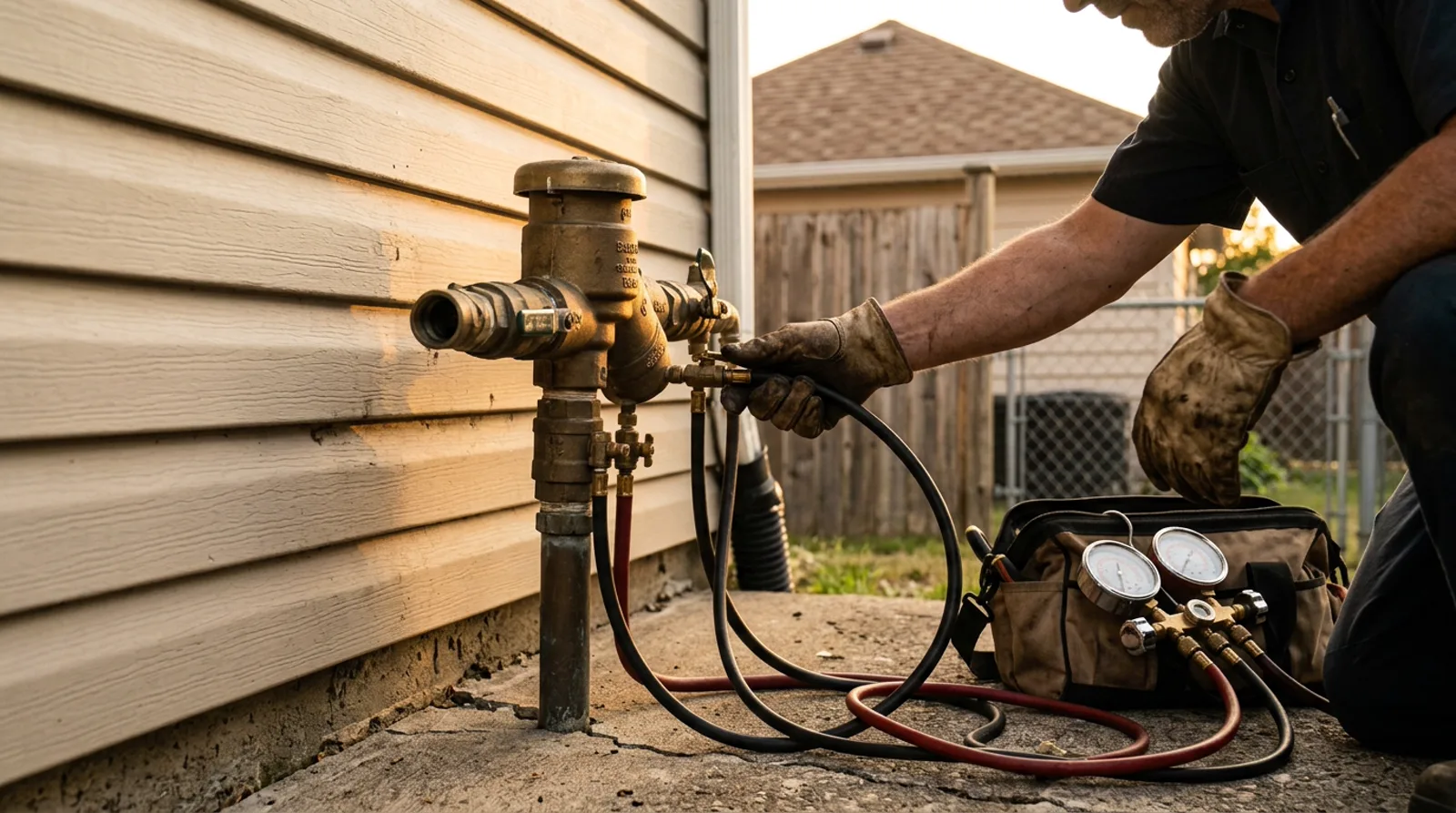
Backflow Testing Spruce Grove: Certified, Compliant, On Time
Get your annual backflow preventer test done by licensed technicians who file directly with EPCOR and municipalities. Same week reports, no failed inspections.
Complete Backflow Testing & Prevention Services
From annual compliance tests to full device replacement, local pros handle every step of backflow prevention in the Tri-Region.
Annual Backflow Preventer Testing
Certified test of your RP, DCVA, PVB or other backflow device. We test all components, fill out official forms, file with your municipality and mail you a compliance certificate within 3 business days. Price includes travel within Spruce Grove, Stony Plain and Parkland County.
Backflow Preventer Repair & Rebuild
When a device fails testing, we rebuild or replace internal components like check valves, springs, seats and seals. Most repairs completed same visit. Price depends on device type and parts availability. Common repairs include leaking relief valves and fouled check assemblies.
New Backflow Device Installation
Full installation of code-compliant backflow preventers for new construction, irrigation systems, fire suppression or commercial facilities. Includes permit coordination, device supply, proper placement per Alberta code, insulation for freeze protection and initial certification test.
Backflow Device Replacement
Complete removal of old or obsolete backflow preventer and installation of current code compliant unit. Local pros handle disposal, updated placement if needed, copper or PEX connections, insulation wrap and final testing. Common when devices are 15 plus years old or repeatedly fail.
Freeze Protection & Winterization
Insulation upgrades, heat trace installation or seasonal shutoff and drainage for outdoor backflow assemblies. Critical in Alberta where overnight lows hit minus 30 and freeze-thaw cycles crack housings. Includes inspection of existing insulation and valve function before winter.
Commercial Multi-Device Testing
Per-device rate for facilities with multiple backflow preventers such as strip malls, schools, food plants or multi-building sites. We schedule all devices in one visit, batch file reports and provide a master compliance summary. Minimum 3 devices for this rate to apply.
Why Backflow Testing Is Different in Spruce Grove, Stony Plain and Parkland County
💧 EPCOR, EQUS and Municipal Water Authority Filing
Spruce Grove connects to EPCOR water, Stony Plain uses their own utility, and rural Parkland County parcels often run on EQUS or private wells. Each authority has different filing portals, deadlines and form versions. We file directly with the correct agency so you never get a second notice or compliance letter.
❄️ Freeze-Thaw Cycle Damage to Outdoor Assemblies
Alberta winters swing from minus 30 to plus 5 in a weekend thanks to chinook winds. Backflow devices installed on exterior walls or in unheated pits crack, leak and fail at much higher rates than Ontario or BC. We inspect insulation, heat trace and drain valves every test visit because freeze damage is the number one local failure mode.
🏡 Irrigation System Backflow Requirements
Almost every Spruce Grove and Stony Plain home has an underground sprinkler system tied to municipal water. Code requires a PVB or RP device and annual testing, but many homeowners miss the notice or assume landscapers handle it. We test residential irrigation backflow preventers year-round and remind clients every spring before startup.
🏗️ New Subdivision and Acreage Permit Coordination
Parkland County acreages and new Spruce Grove subdivisions like Harvest Ridge and West Haven require backflow prevention at rough-in inspection. We coordinate with Spruce Grove, Stony Plain and Parkland County permit offices, supply code-compliant devices sized to your service line and schedule inspections so your build stays on track.
What it costs here
Everything You Need to Know About Backflow Testing in Alberta
Why annual testing is mandatory, how devices fail in Alberta winters, and what happens if you skip your test.
How Backflow Testing Actually Works in Spruce Grove and What's Required by Alberta Standards
Backflow testing is a mandatory safety inspection that verifies your backflow prevention device is functioning correctly and protecting the municipal water supply from contamination. In Spruce Grove, Stony Plain, Parkland County and Acheson, this testing must be performed annually by a certified backflow tester who holds valid Alberta qualifications. The test itself involves physically checking the internal components of your backflow preventer, measuring pressure differentials, simulating backflow conditions, and documenting that every valve, spring and check assembly operates within the tolerance ranges specified by the manufacturer and Alberta's plumbing codes. This is not a visual inspection or a quick look. It's a hands-on mechanical procedure using calibrated test gauges that takes between 30 minutes and two hours depending on device complexity, accessibility and whether any adjustments or minor repairs are needed during the testing process.
Your backflow preventer sits on the water line entering your property, typically in a basement mechanical room, crawl space, utility closet or sometimes in an insulated outdoor pit or heated enclosure. The certified tester arrives with a test kit containing specialized gauges, hoses, fittings and documentation forms. They'll shut off water to the device, drain the line, attach test equipment to designated test cocks (small valves built into the assembly specifically for testing), and systematically check each internal valve. For a typical reduced pressure zone device, which is the most common type in residential and commercial settings around Spruce Grove, the tester verifies that the first check valve holds against reverse flow, the second check valve provides redundant protection, and the relief valve opens at the correct pressure differential to dump contaminated water rather than letting it flow backward into the city supply. Every measurement gets recorded on an official test report that includes the device serial number, test gauge calibration date, and pass or fail status for each component.
Alberta regulations require that your test report be submitted to the local water utility within a specified timeframe, usually 30 days of the test date. In Spruce Grove, this means filing with the Town of Spruce Grove Utilities Department. Stony Plain and Parkland County have their own submission processes. The utility keeps these records to demonstrate compliance with provincial drinking water safety standards and to track which properties have active, tested backflow protection. If your device fails testing, the tester will note specific deficiencies like a check valve that doesn't seal completely, a relief valve that opens at the wrong pressure, or worn internal components. You then have a grace period, typically 30 to 90 days depending on the municipality, to repair or replace the device and have it retested. Operating with a failed backflow preventer or missing your annual test deadline can result in water service disconnection, fines ranging from $250 to $1,000, and potential liability if contamination occurs that traces back to your property.
Why Alberta's Climate and Water Systems Make Backflow Prevention Critical Year Round
Alberta's extreme temperature swings create unique backflow risks that don't exist in milder climates. During Parkland County's winter months, temperatures regularly drop to minus 25 or minus 35 Celsius, causing water lines to contract and creating pressure fluctuations throughout the distribution system. When a water main breaks due to frost heave or ground shifting, which happens dozens of times each winter across Spruce Grove and surrounding areas, pressure in the municipal system can drop suddenly. This pressure loss creates a vacuum effect that can suck contaminated water, chemicals, fertilizers or sewage backward through any unprotected connection into the clean water supply. A backflow preventer physically stops this reversal by closing check valves and opening relief ports the instant pressure drops below safe levels, but only if the device is functioning correctly and has been tested recently to confirm all components work as designed.
Chinook winds add another layer of complexity. These warm winter winds can raise temperatures by 20 degrees in a matter of hours, causing rapid snow melt and ground thaw that shifts soil around buried pipes and service connections. This ground movement can stress plumbing systems, crack fittings, or cause subtle misalignments that alter pressure dynamics in ways that increase backflow risk. Spring breakup in Acheson and rural Parkland County brings additional challenges as frost leaves the ground, sometimes reaching depths of two meters or more depending on winter severity. The freeze-thaw cycle we experience here, with multiple melt and refreeze events throughout late winter and early spring, is harder on plumbing infrastructure than a single deep freeze in colder climates or a mild winter elsewhere. These conditions mean backflow preventers in Alberta face mechanical stresses and pressure variations that wear components faster than in more stable environments.
Municipal water systems in this region also deal with agricultural and industrial connections that pose higher contamination risks. Around Stony Plain and rural areas west of Spruce Grove, properties with livestock operations, chemical storage, irrigation systems, fire suppression systems with antifreeze additives, and commercial operations with process water or chemical injection systems all represent potential contamination sources. Even residential properties can create backflow hazards through garden hose attachments left in pools, hot tubs filled with treatment chemicals, or boiler systems with chemical inhibitors. Alberta's growing season, though shorter than other provinces, is intense enough that fertilizer and pesticide use is concentrated into a few months, meaning contamination risks spike during spring and summer when these chemicals are actively being mixed, stored and applied. A functioning backflow preventer is the last line of defense that keeps these substances out of the drinking water that serves thousands of families across the region.
How to Know When You Need Backflow Testing and Who's Actually Required to Have It Done
Every property in Spruce Grove, Stony Plain, Parkland County and Acheson that has a backflow prevention device installed is legally required to have it tested annually, no exceptions. The confusion comes because not every property is required to have a backflow preventer in the first place. Residential homes with standard plumbing and no special hazards typically don't need one unless the property has an irrigation system, pool fill line, boiler system, water softener with chemical feed, or other cross-connection that creates contamination risk. Commercial properties, industrial sites, multi-family buildings, healthcare facilities, restaurants, hair salons with chemical processes, car washes, and any business that uses water for manufacturing or processing almost always require backflow prevention. If you're unsure whether your property needs a device or testing, check your municipal utility bill. Many jurisdictions in this area include a backflow device registration number or testing reminder notice on quarterly water bills for properties with registered devices.
The most obvious sign you need testing is receiving a notice from your municipality. Spruce Grove, Stony Plain and Parkland County utilities departments send annual reminders to properties with registered backflow preventers, usually in early spring before the testing season begins. These notices include your device registration details, the testing deadline, and consequences for non-compliance. If you've purchased a property within the last year and it has a backflow preventer, the testing responsibility transfers to you as the new owner, even if the device was tested shortly before closing. Real estate transactions don't reset the annual testing clock. Check the test tag attached to your device, which shows the last test date and the name of the certified tester who performed it. If that date is more than 12 months ago, you're overdue and need to schedule testing immediately to avoid penalties or service interruption.
Physical signs that something is wrong with your backflow preventer include water dripping or spraying from the relief port (the discharge opening on the side of the device), unusual noises like hammering or whistling when water is running, reduced water pressure throughout your property, or visible corrosion and deterioration on the device body or test cocks. These symptoms don't mean you can skip testing. They mean the device needs both testing and likely repair or replacement. Never attempt to disassemble, adjust or repair a backflow preventer yourself. These are precision devices with specific torque requirements, internal component alignments and testing procedures that require certification and specialized tools. Tampering with a backflow preventer can void warranties, create liability if contamination occurs, and violate plumbing codes. Even if you're a licensed plumber, backflow testing requires separate certification beyond standard plumbing credentials. The certification process involves formal training on device operation, testing protocols, gauge calibration and proper documentation, plus passing both written and practical exams administered by accredited backflow testing organizations.
- Annual testing notices mailed by municipal utilities in February through April for most jurisdictions
- Test tag on device showing last inspection date exceeding 12 months from current date
- Water discharging from relief valve during normal operation or when no water is running
- Noticeable pressure drop at fixtures after backflow device was installed or serviced
- Property purchase within last year requiring transfer of backflow testing responsibility
- Municipal warning letter or compliance order referencing overdue testing or failed inspection
The Complete Step by Step Process from Initial Contact Through Certified Documentation
The backflow testing process begins when you contact a certified backflow testing company serving Spruce Grove and surrounding areas. During this initial call or online inquiry, you'll provide your property address, describe where the backflow preventer is located (basement, mechanical room, outdoor vault), and mention any access challenges like tight spaces, low clearance, or locked areas that require coordination. The company will verify they service your area, confirm their testers hold current Alberta certification, and schedule a testing appointment. Most testing companies in this region operate on a route basis, grouping appointments by geographic area to minimize travel time and keep costs down. Expect to pay between $120 and $180 for a standard residential backflow test on a double check valve or reduced pressure zone device with normal accessibility. Commercial or industrial devices, devices requiring excavation or vault entry, or properties with multiple backflow preventers will cost more, typically $200 to $400 depending on complexity and time requirements.
On the scheduled test day, the certified tester arrives with calibrated test equipment, documentation forms, and sometimes a helper if the device location requires confined space entry or heavy vault covers need lifting. They'll need access to the backflow preventer and the shut-off valves immediately upstream and downstream of the device. You or someone with property access should be available during testing in case questions arise about the system, access to locked areas is needed, or immediate decisions are required if the device fails and needs repair. The tester starts by visually inspecting the device for obvious damage, corrosion, missing parts, or signs of leaking. They check that the device is the correct type for the hazard level, properly supported and installed according to code, and that test cocks open and close freely. They verify their test gauge calibration is current, which is required every 12 months and documented on a calibration certificate they can show you.
The actual testing procedure follows a specific sequence mandated by the device manufacturer and backflow testing standards. For a reduced pressure zone assembly, which is the gold standard for high hazard applications, the tester closes isolation valves, opens test cocks to drain the line and relieve pressure, attaches test hoses and gauges, and then systematically tests each component. They open and close valves in a precise order, take pressure readings at specific points, calculate the differential between readings, and compare results against acceptable ranges printed on the test form. A typical RP device test involves checking that check valve number two holds against at least 1 psi of pressure, the relief valve opens when differential pressure drops below 2 psi, and check valve number one prevents backflow up to supply pressure. Each test creates a scenario that simulates real backflow conditions. If any component fails to perform within spec, the tester notes the specific failure, explains what it means, and discusses repair or replacement options.
Once testing is complete, the tester removes gauges, closes test cocks, restores water service, and checks for leaks before leaving. They complete an official test report that includes property details, device information including make, model and serial number, test results for each component, overall pass or fail status, tester certification number, test gauge serial number and calibration date, and any recommendations for repairs or replacement. You receive a copy of this report immediately, usually both paper and email versions. The testing company files the original report with your municipal utility as required by local bylaws. This filing is crucial because it's your proof of compliance. If the device passed, you're done until the same time next year. If it failed, you typically have 30 to 90 days to complete repairs and schedule a retest, which usually costs $90 to $120 since it's faster than the initial inspection. Some testing companies offer repair services, while others only test and refer you to a licensed plumber for repairs, which then require retesting by a certified tester before you're back in compliance.
What Backflow Testing Really Costs in Spruce Grove, Stony Plain and Parkland County
A straightforward annual backflow test for a residential reduced pressure zone assembly or double check valve typically runs $120 to $200 in the Tri-Region when you have direct access to the device and no complications. That flat service call covers the tester's drive time, their certified equipment, the physical inspection and internal test of the assembly, the completion of Alberta regulatory paperwork, and the submission of your compliance certificate to the municipality or water utility. Most homeowners with single-family detached houses, townhomes or small commercial properties pay in this range every year to stay compliant with Spruce Grove, Stony Plain or Parkland County bylaws.
Costs climb when access is difficult, the assembly has frozen or corroded, or you need multiple devices tested in one visit. If your backflow preventer sits in a cramped crawlspace, behind a locked gate or inside a locked meter vault, expect $180 to $280 because the tester spends extra time rigging lights, crawling or coordinating access with the utility. When an assembly fails the initial test because springs have weakened, check valves stick or debris clogs the chamber, most licensed contractors quote $150 to $400 for parts and labour to rebuild or replace internal components on-site, then re-test immediately. Rural acreages with irrigation systems that draw from dugouts or stock ponds, fire protection loops with multiple assemblies, or small commercial buildings with process water often pay $250 to $500 per visit because the scope multiplies.
First-time installation of a backflow preventer where none exists, or replacement of an old gate valve with a compliant assembly, pushes costs much higher. A licensed plumber charges $400 to $900 for a standard residential reduced pressure zone device installation, including the brass assembly itself, inlet and outlet ball valves, test cocks, four drain fittings, copper or PEX piping, code-compliant supports and initial testing. Larger commercial or agricultural assemblies with higher flow rates, special certifications for fire suppression lines, or frost-protected enclosures in unheated spaces run $1,200 to $3,500 depending on pipe diameter, enclosure construction and permit complexity. Parkland County acreages installing backflow prevention on irrigation wells or livestock systems see the upper end of that range because distance from town, longer pipe runs and seasonal access all add labour hours and material freight.
What Drives the Price Higher or Lower
The single biggest price factor is whether your existing backflow assembly passes or fails the annual test. A passing test takes fifteen to twenty-five minutes of hands-on work: the tester closes the inlet and outlet isolation valves, attaches calibrated differential pressure gauges to the four test cocks, opens valves in a specific sequence mandated by the American Water Works Association, records pressure readings at each check valve and relief valve set point, verifies tight closure and proper cracking pressures, then completes the provincial compliance form with your assembly's serial number and test date. When everything meets spec, you pay the base service call and receive your certificate within forty-eight hours. A failing test adds parts, labour to disassemble the assembly, cleaning or replacement of rubber seals and springs, reassembly with new gaskets, a second full test cycle and additional paperwork if the serial number changes, all pushing total cost toward the $300 to $500 range.
Device type and location strongly influence both testing frequency and cost. Reduced pressure zone assemblies, the gold standard for high-hazard cross-connections like irrigation systems pulling from non-potable sources or commercial kitchens with direct chemical injectors, require annual testing under Alberta and federal plumbing codes. Double check valve assemblies, acceptable for lower-hazard scenarios like residential fire sprinkler systems fed by municipal water, also need yearly certification in most Tri-Region municipalities even though the test procedure is slightly simpler. Atmospheric vacuum breakers on outdoor hose bibs technically need annual inspection but many homeowners skip formal testing because enforcement is light and replacement cost is minimal, though that gamble can trigger insurance exclusions if a contamination event occurs. Pressure vacuum breaker assemblies on residential irrigation often cost less to test than RPZ devices because they lack the complex relief valve and spring mechanisms, but cold Alberta winters mean many sit drained and winterized for seven months, shortening their service life and increasing failure rates once spring arrives.
Geographic and logistical factors add real cost in our region. Testers serving Acheson industrial properties, rural Parkland County addresses or properties north of Highway 16A quote higher base rates to cover longer drive times, especially during breakup season when gravel roads turn to mud and spring thaw floods low-lying valve pits. Properties with backflow assemblies inside locked mechanical rooms, gated compounds requiring advance coordination, or buried vaults needing a shovel and prybar to access always pay more because clock time expands. Urgent or same-day service for last-minute compliance deadlines before water reconnection or permit final inspection typically doubles the standard rate, which is why smart homeowners book annual tests in early spring rather than waiting for the municipality's warning letter in July.
Comparing Backflow Prevention Methods and Assembly Types
Not all backflow preventers offer the same protection, and choosing the right type matters for compliance, cost and long-term reliability. Reduced pressure zone assemblies provide the highest level of safeguarding because they use two independent check valves separated by a pressure-monitored zone and a spring-loaded relief valve that dumps water to atmosphere if the zone pressure rises, signaling that one check has failed. This design physically prevents any reversal of flow under all failure modes, which is why municipal bylaws and the National Plumbing Code of Canada mandate RPZ devices for irrigation systems drawing from wells or dugouts, fire suppression lines with chemical additives, commercial kitchens with pot fillers over floor drains, and any connection where contaminated water could back-siphon into the municipal supply. The tradeoff is complexity: more moving parts mean higher testing costs, more frequent rebuilds and a three to five PSI pressure drop across the assembly that can affect flow to fixtures.
Double check valve assemblies use two spring-loaded check valves in series without a relief valve or monitored zone, relying on redundancy rather than active pressure monitoring. They cost twenty to thirty percent less to purchase and install than RPZ devices, lose only one to two PSI across the assembly, and tolerate freezing better because there is no relief valve to crack if water expands. Spruce Grove and Stony Plain typically allow double check assemblies for residential fire sprinkler systems fed by municipal water, multi-family building domestic supply lines and low-hazard commercial uses where contamination risk is minimal. The downside is lower protection: if both check valves fail simultaneously or debris lodges under both seats, backflow can occur undetected because there is no relief valve to signal the problem. Annual testing catches slow degradation, but a sudden pressure transient from a water main break or firefighting event might overcome both checks before the next test cycle.
Pressure vacuum breakers and atmospheric vacuum breakers represent simpler, cheaper alternatives for specific applications where back-siphonage is the only concern and no continuous pressure downstream is needed. A typical pressure vacuum breaker on a residential lawn irrigation system costs $180 to $350 installed and uses a single check valve plus an air inlet valve that opens to break the siphon if supply pressure drops, preventing contaminated water from being sucked backward. These work well for hose bibs, sprinkler systems that drain completely after each cycle and applications where the assembly sits higher than all downstream outlets. The catch is that PVBs cannot handle backpressure from pumps or elevation, must remain above ground year-round or be drained and blown out before freeze-up, and the air inlet valve can stick or corrode in Alberta's temperature swings. Atmospheric vacuum breakers are even simpler and cheaper, $40 to $80 for a brass hose bib model, but they cannot tolerate any downstream shutoff valve and must stay open to atmosphere continuously, making them suitable only for outdoor taps and basic garden hose connections.
- RPZ assemblies: mandatory for high-hazard connections, most reliable protection, higher cost and pressure loss, annual testing required, typical installed price $600 to $1,200 residential
- Double check valves: acceptable for lower-hazard uses like fire sprinklers, simpler design, less pressure drop, annual testing still required, typical installed price $450 to $900 residential
- Pressure vacuum breakers: irrigation and outdoor-only applications, no backpressure tolerance, must drain for winter, annual testing required, typical installed price $180 to $400
- Atmospheric vacuum breakers: hose bibs and seasonal connections, no downstream valves allowed, simplest and cheapest, often replaced rather than tested, typical installed price $40 to $120
Mistakes and Contractor Traps to Avoid in the Tri-Region
The biggest mistake homeowners make is ignoring the annual testing requirement until the municipality sends a warning letter threatening water shutoff. Spruce Grove, Stony Plain and Parkland County enforce backflow compliance through their water utilities, and while they rarely disconnect service on the first notice, repeated non-compliance can result in a $250 to $500 administrative penalty, mandatory immediate testing at premium rates, or actual disconnection requiring a plumber to reinstall a meter and pay reconnection fees before water flows again. Many homeowners assume their irrigation contractor or plumber automatically schedules annual tests, but unless you have a signed service agreement that explicitly includes testing reminders, it is your responsibility to track the calendar and book the appointment. Missing a test also voids coverage under most home insurance policies if contamination enters the municipal system and you face liability claims, a scenario that sounds remote until you hear about the Walkerton water crisis or smaller incidents where property owners paid thousands in fines and remediation costs.
Another frequent trap is hiring a handyman or unlicensed contractor to install or test a backflow preventer to save money. Alberta regulations require that anyone testing a backflow assembly hold a valid Alberta Certified Cross Connection Control Technician designation through an accredited program like the Alberta Safety Codes Authority or equivalent training body. That technician must use calibrated differential pressure test equipment verified within the past twelve months and submit results on approved provincial forms that include their certification number, the assembly make and serial number, and pass or fail status for each internal component. A cheap quote from someone without credentials might get a device bolted to your wall, but when the municipality audits compliance or your insurance investigates a claim, you will pay a licensed contractor to re-test or reinstall everything properly, often after the non-compliant assembly has already failed and contaminated your indoor plumbing or worse. In rural Parkland County where enforcement is lighter, some property owners gamble on unlicensed work, but that gamble becomes expensive the moment you apply for a building permit, sell the property or file any water-damage insurance claim.
Choosing the wrong type of backflow preventer for your application creates ongoing cost and headaches. Installing an RPZ assembly where a double check would suffice wastes money upfront and creates unnecessary pressure loss that affects shower flow and appliance performance. Conversely, installing a double check or pressure vacuum breaker where code mandates an RPZ leaves you out of compliance, and the municipality will force replacement before issuing an occupancy permit or restoring water service after a voluntary shutoff. Spruce Grove and Stony Plain publish clear cross-connection control bylaws specifying which device types apply to each hazard category, but many homeowners and contractors skip that research and default to whatever is cheapest or already in the truck. Always verify the requirement with your local water utility before installation, and insist your plumber pull a permit for any new backflow installation, which triggers a review by a building inspector or utility compliance officer who confirms the correct assembly type and location.
Red Flags When Hiring a Backflow Testing Contractor
Walk away from any contractor who cannot immediately provide their Alberta Cross Connection Control Technician certification number and proof of current calibration for their test equipment. Legitimate testers carry a wallet card or digital certificate from their training provider, and their differential pressure gauges have a calibration sticker showing the last verification date and the name of the accredited lab that performed it. Equipment must be recalibrated annually to maintain accuracy within the one percent tolerance required by provincial standards, and using out-of-date gauges invalidates the entire test. If a contractor hesitates or claims certification is optional for residential work, they are either ignorant of the law or deliberately cutting corners, and you will eventually pay for a proper test when the municipality rejects their paperwork.
Be cautious of contractors who quote a testing price far below the $120 to $180 range common in the Tri-Region, especially if they offer to test dozens of properties in one trip or bundle testing with unrelated services like furnace cleaning or duct work. While economies of scale exist for large commercial or multi-family buildings where one technician tests multiple assemblies in a single location, residential testing requires dedicated time per device to perform the procedure correctly, complete documentation and submit compliance certificates to the right authority. Lowball pricing often signals rushed work, skipped steps, or administrative shortcuts like submitting incomplete forms that get rejected, forcing you to pay for a second test. Similarly, contractors who refuse to provide a written quote, insist on cash payment or lack liability insurance and WCB clearance should not touch your plumbing. If they damage a valve, crack a pipe or flood your mechanical room during testing, you need proof of coverage or you will fund the repairs yourself.
How to Hire the Right Backflow Testing Professional
Start by confirming what your municipality actually requires and when the deadline falls. Contact the Spruce Grove Water Services Department, Stony Plain Utilities or the Parkland County Public Works office and ask for a copy of their cross-connection control bylaw, a list of properties flagged for mandatory testing, and the submission deadline for compliance certificates. Many utilities maintain an online registry where you can check your address, view past test records and download approved forms. Knowing your exact requirement prevents a contractor from upselling unnecessary services or installing the wrong device type. If you own an irrigation system, fire sprinkler loop, or commercial property with multiple water uses, request a written hazard assessment from the utility that specifies which assemblies you need and where they must be located, then share that assessment with every contractor you interview to ensure consistent quotes.
Collect at least three written quotes from Alberta-certified cross-connection control technicians who are also licensed plumbers or work for licensed plumbing companies. A complete quote should itemize the base testing fee, any access surcharges for difficult locations, parts pricing if the assembly fails and needs rebuild components, retesting fees, compliance certificate submission, and travel costs if you are outside the contractor's normal service area. Ask each contractor how long they have held certification, how many backflow assemblies they test annually, and whether they carry specific tools for your device make and model, because some older or specialty assemblies require proprietary adapters. Check their WCB clearance letter online through the Alberta government portal, verify they hold at least two million dollars in general liability insurance, and confirm they will pull a permit if installation work is involved. References from recent Tri-Region clients matter more than generic Google reviews because you want to hear about local permit experiences, municipal paperwork turnaround and follow-up service when questions arise months later.
Pay attention to how contractors explain the testing process and what happens if your assembly fails. A professional technician will describe the test sequence, explain the pressure readings they record at each check valve and relief valve, and outline the decision tree for rebuild versus replacement based on age, wear and parts availability. They should offer to show you the test in progress if you are curious, point out warning signs like corrosion or leaking relief valves, and provide clear written recommendations for maintenance or future replacement. Beware of contractors who pressure you to replace a failing assembly immediately without offering a rebuild option, especially if the device is less than ten years old and only failed due to a stuck spring or debris on a seat, issues that cost $80 to $180 in parts and labour versus $600 to $1,200 for a new assembly. Conversely, if your RPZ device is twenty years old, has been rebuilt twice already, and shows heavy corrosion or freeze damage, replacement is often smarter than another temporary repair that fails again next year.
How Tri-Region Services Helps
When you contact Tri-Region Services for backflow testing in Spruce Grove, Stony Plain, Parkland County or Acheson, we connect you directly with one pre-screened, Alberta-certified cross-connection control technician who holds active plumbing credentials and liability insurance they have told us about. You receive a single written quote within one business day that breaks down testing fees, potential parts costs if rebuild is needed, compliance certificate submission and any access or travel surcharges, all in clear language with no surprises. Our referred professional arrives on time with calibrated test equipment, completes the work to provincial standards, submits your compliance certificate to the correct municipal authority and provides you a copy for your records, handling the entire process so you stay compliant without the headaches of chasing paperwork or decoding regulations.
Why Tri-Region Homeowners and Businesses Trust Our Backflow Team
Certified testers, transparent pricing, same week filing and zero hidden fees.
Alberta Certified Backflow Testers
Every technician holds current ABPA (Alberta Backflow Prevention Association) or equivalent certification and renews annually with continuing education.
Direct Municipality Filing Included
The tester files your report with EPCOR, Stony Plain, Parkland County or EQUS directly, no extra fee, no forms for you to mail.
Insurance on file
Full commercial liability insurance is stated at signup for every technician who enters your property or handles your water system.
Upfront Flat Rate Pricing
You know the exact cost before local pros arrive, no trip charges inside our service area, no surprise diagnostics or hourly creep.
Same Visit Repairs When Possible
Local testers stock common rebuild kits, check valves and seals so most failed tests can be fixed and re-tested on the spot.
Real Local Dispatch, Not a Call Center
You submit one request and a local pro who knows Harvest Ridge from Highway 16A follows up to book your test.
This page is not tied to a contractor's brand. Leads route straight to your one local partner. Verified reviews can appear here once that partner has them (never fabricated).
Serving the whole Tri-Region
8 Questions Spruce Grove Homeowners Ask About Backflow Testing
Why do I need backflow testing every year in Spruce Grove?+
What happens if my backflow preventer fails the test?+
How much does backflow testing cost in Spruce Grove and Stony Plain?+
Do I need a backflow preventer if I have an irrigation system?+
Can I test my own backflow preventer to save money?+
Why do backflow devices freeze and break in Alberta winters?+
How long does a backflow test take?+
What is the difference between an RP and a DCVA backflow preventer?+
Get your free quote
Tell us what you need and a local pro will get right back to you.
- ✓ Sent straight to a local business
- ✓ You choose who you hire
- ✓ Free, with no obligation