Concrete · Spruce Grove
Concrete Driveway Cost in Spruce Grove (and Why Cracks Happen Here)
A standard two-car concrete driveway in Spruce Grove (roughly 400-500 square feet) typically costs between $3,200 and $7,000 installed. That works out to $8 to $14 per square foot depending on thickness, base preparation, and whether you're dealing with our clay-heavy soil conditions.
The wide price range isn't just contractor markup. Spruce Grove sits on glacial till and clay soils that expand when wet and contract when frozen. A driveway poured without proper base prep will crack within two winters, which is why the cheapest quote often becomes the most expensive mistake.
What Actually Drives Concrete Driveway Costs Here
The base price of $8-$10 per square foot assumes standard 4-inch thickness over compacted gravel. That's fine for passenger vehicles on stable soil. Most Spruce Grove properties need more than that.
Here's where costs increase:
- Base excavation and gravel: Clay soil removal and 6-8 inches of compacted Class II gravel adds $2-$3 per square foot, but it's non-negotiable if you want the driveway to last. The gravel provides drainage and a stable base that won't shift during freeze-thaw cycles.
- Thickness upgrades: Going from 4 inches to 6 inches of concrete adds roughly $1.50 per square foot. If you park a truck or trailer regularly, this isn't optional.
- Wire mesh or rebar: Adds $0.75-$1.25 per square foot but significantly reduces cracking from ground movement.
- Control joints: Properly placed control joints (saw cuts that guide where cracks form) should be included in any professional quote, but rushed jobs skip them.
- Finishing: Broom finish is standard. Exposed aggregate or stamped patterns add $3-$8 per square foot.
Excavating out old asphalt or a failed concrete driveway adds another $2-$4 per square foot depending on disposal fees at the Parkland County transfer station.
Why Spruce Grove Driveways Crack (And How to Prevent It)
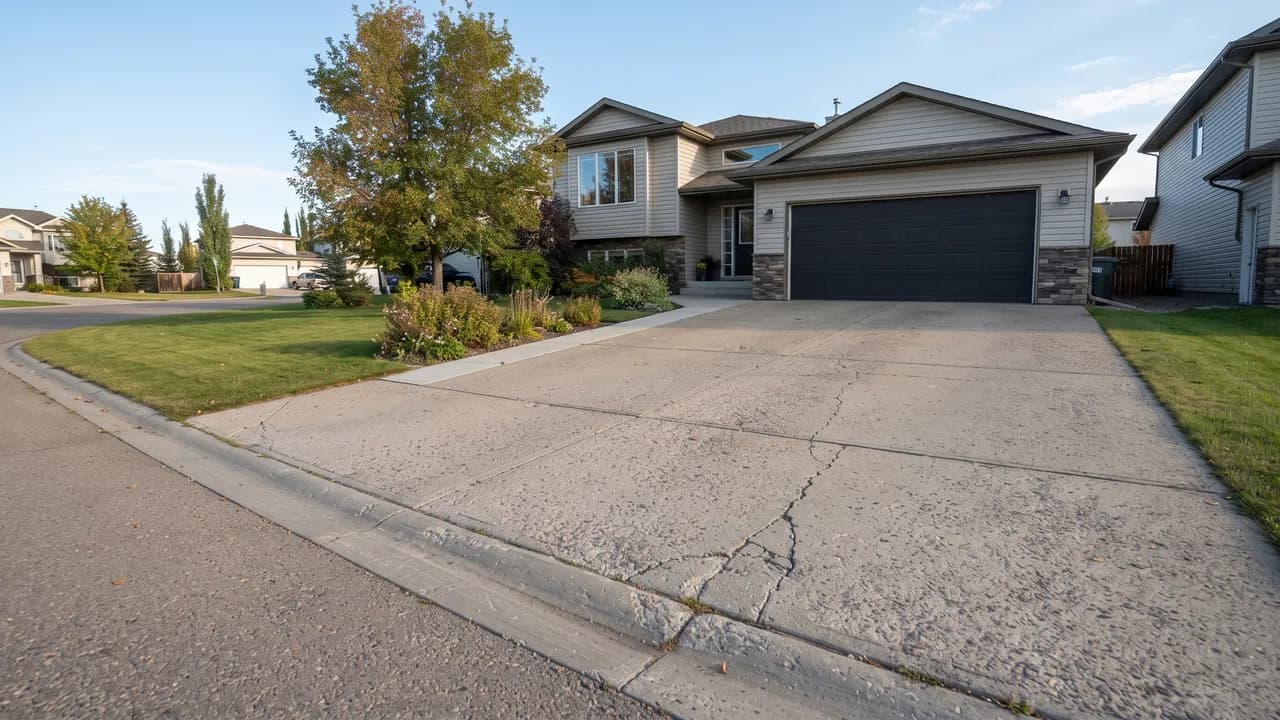
Drive down any established Spruce Grove neighbourhood like West Park or Grove Park and you'll see cracked driveways everywhere. It's not always bad concrete. Our climate is brutal on concrete.
We get 40-50 freeze-thaw cycles per winter. Water seeps into tiny concrete pores, freezes, expands, and creates pressure. Do that fifty times a year and even good concrete eventually fails. But premature cracking (within the first 5 years) almost always comes down to three issues:
Inadequate base preparation: Pouring concrete directly over clay or poorly compacted fill is asking for trouble. The ground shifts, the concrete follows, and cracks appear along stress points.
Wrong concrete mix: You want a minimum 32 MPa (4500 psi) mix with air entrainment for freeze-thaw resistance. Bargain contractors sometimes use 25 MPa mix to shave costs. It won't last.
Missing or improper control joints: Control joints should be cut to 1/4 the slab depth within 24 hours of pouring, spaced no more than 10 feet apart. They create intentional weak points so cracks form there (and can be sealed) rather than randomly across your driveway.
A qualified concrete contractor in Spruce Grove will discuss all three factors during the quote process. If they don't mention soil conditions or base prep, keep looking.
Concrete vs Asphalt: The Real Cost Comparison
Asphalt driveways in Spruce Grove run $4-$7 per square foot installed, which looks appealing compared to concrete's $8-$14. But asphalt needs resealing every 2-3 years (around $400-$600 each time) and typically requires replacement after 15-20 years. Concrete lasts 30-40 years with minimal maintenance beyond occasional crack sealing.
Asphalt also softens in summer heat. If you've ever noticed ruts where tires sit on hot July days, that's asphalt doing what asphalt does. Concrete stays stable regardless of temperature.
The break-even point is roughly 12-15 years. If you're planning to stay in your Spruce Grove home long-term, concrete wins on lifecycle cost.
Seasonal Timing and When to Pour
Concrete needs to cure at temperatures above 10°C for at least seven days. In Spruce Grove, that means the realistic pouring window runs from late April through mid-October. Contractors get slammed in June and July, so expect higher prices and longer wait times during peak season.
May and September offer the best combination of availability and curing conditions. Morning temperatures might dip close to 10°C, but daytime warmth and longer cure times actually produce stronger concrete than quick-curing summer pours.
Avoid November concrete work unless the contractor has heated blankets and a solid cold-weather protocol. Concrete that freezes before curing will fail catastrophically.
Getting Accurate Quotes
Any concrete professional should visit your property before quoting. They need to assess soil conditions, measure accurately, check drainage slope (driveways should slope at least 1/4 inch per foot away from your garage), and identify obstacles like utility lines.
A detailed quote should specify:
- Total square footage
- Concrete thickness and MPa rating
- Base material type and depth
- Reinforcement method (mesh, rebar, or fiber)
- Finish type
- Control joint spacing
- Curing method
- Timeline and payment schedule
Get at least three quotes. The lowest bid often cuts corners on base prep or concrete quality. The highest isn't necessarily better quality, just potentially inefficient. The middle quote with detailed specifications usually represents fair market value.
Permits and Property Lines
Spruce Grove requires development permits for new driveways or driveway expansions. The permit costs around $100 and ensures your driveway meets setback requirements (typically 0.6 meters from property lines) and doesn't create drainage issues for neighbours.
Most contractors handle permit applications as part of their service, but confirm this upfront. Pouring without a permit can result in removal orders and fines that make any money you saved irrelevant.
Maintenance That Actually Matters
Concrete is low maintenance, but not zero maintenance. Seal cracks as soon as they appear using polyurethane or silicone crack filler. A crack that's 1/8 inch wide today becomes 1/2 inch wide after one winter of water infiltration and freeze-thaw action.
Avoid de-icing salts during winter. Salt accelerates concrete deterioration and the freeze-thaw damage we're already fighting. Sand or kitty litter provides traction without the chemical damage.
Sealing the entire driveway surface is optional but extends life. A quality concrete sealer applied every 3-5 years costs around $200-$400 for a typical driveway and reduces water penetration significantly.
Frequently asked questions
How thick should a concrete driveway be in Spruce Grove?
Minimum 4 inches for cars, 6 inches if you regularly park trucks or heavy vehicles. The extra thickness helps resist cracking from both vehicle weight and our freeze-thaw cycles. Most contractors recommend 5 inches as the sweet spot for typical use.
Can I pour a concrete driveway in sections to save money?
Yes, but plan the sections carefully with proper control joints at each seam. Some homeowners pour the approach one year and the parking pad the next. Make sure each section has its own complete base preparation or you'll get differential settling where sections meet.
How long before I can drive on a new concrete driveway?
Wait at least 7 days for light vehicles, 14 days for heavy trucks. Concrete reaches about 70% strength in 7 days and 90% in 28 days. Driving too early creates permanent tire impressions and surface damage that can't be repaired.
Why is my neighbour's quote $3 per square foot cheaper than mine?
Either different square footage calculations, thinner concrete, minimal base prep, or they're skipping reinforcement. Ask specifically about base depth, concrete thickness, and MPa rating. A driveway that costs $3,000 less upfront but fails in 3 years isn't a bargain.
Do I need rebar or is wire mesh enough for Spruce Grove driveways?
Wire mesh (6x6 10-gauge) works fine for most residential driveways if properly positioned in the upper third of the slab. Rebar (typically #4 bar at 18-inch spacing) is better for heavy vehicles or problematic soil. Fiber-reinforced concrete is gaining popularity as an alternative that's easier to install.
Should I replace my cracked driveway or just patch it?
If cracks are less than 1/4 inch wide and the slab hasn't shifted vertically, patching and sealing can extend life by 5-10 years. If you have multiple wide cracks, chunks breaking off, or height differences between sections (tripping hazards), replacement makes more sense than ongoing patch work.
Need a local contractor in the Tri-Region?
Browse verified local pros for Spruce Grove, Stony Plain and Parkland County.
Browse the directory