Siding · Spruce Grove
Siding Repair vs Replacement After Alberta Storms
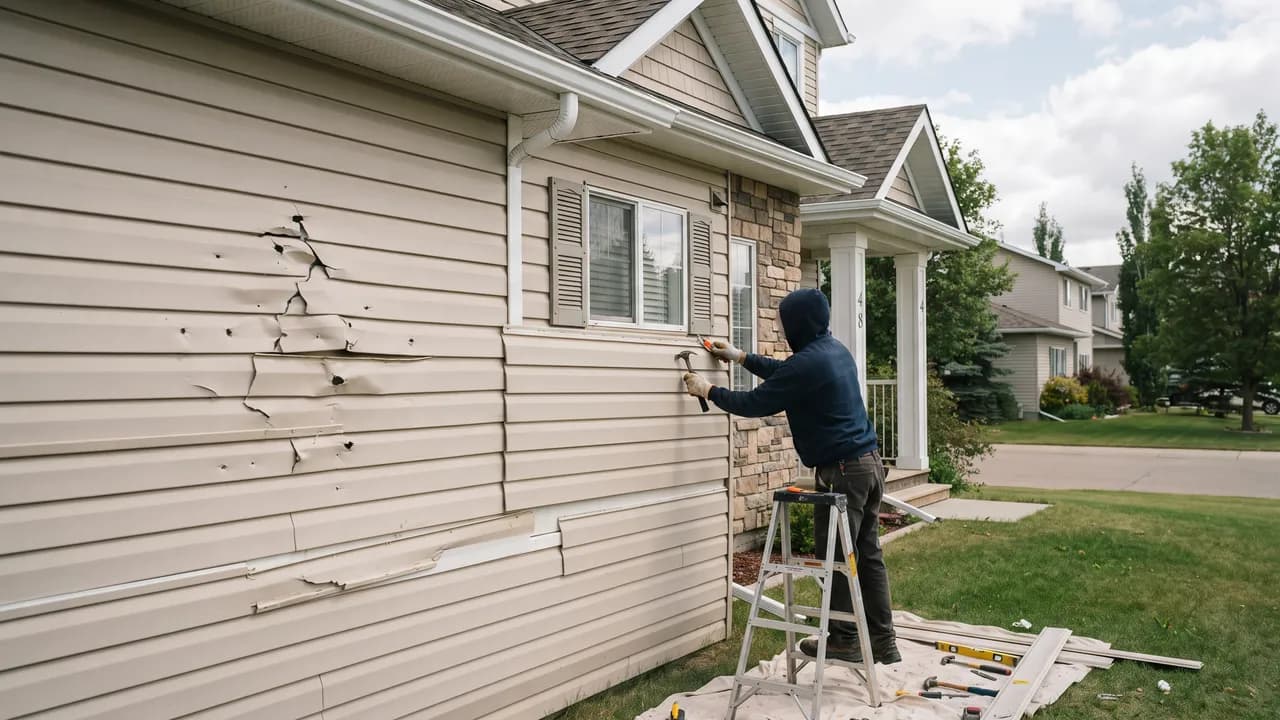
Last July a supercell rolled through Spruce Grove around 6 PM. Golf ball hail hammered the west end for twelve minutes. By morning half the homes on Jennifer Heil Way had dented vinyl and cracked fiber cement. The phones at local contractors rang for three weeks straight.
If you are reading this you probably have storm damage on your own house. The question every homeowner faces: patch it or replace it? The answer depends on the material, the extent, your insurance coverage, and whether you plan to sell in the next five years.
What Alberta Storms Actually Do to Siding
Hail is the main culprit. Wind tears pieces off but hail leaves the subtle damage that causes problems later. Vinyl gets brittle cracks that let water behind the panel. Fiber cement chips at the edges and those chips absorb moisture then freeze-expand in January. Engineered wood swells at the cut edges. Aluminum dents but rarely leaks unless the dent creases the metal.
Wind-driven rain exploits every gap. After a big blow you will see staining at window heads, at the J-channel around vents, at the bottom starter strip. That staining means water has been behind the siding for weeks.
Spruce Grove and Stony Plain sit in a hail corridor. Environment Canada data shows this region averages four severe hail days per year. The 2021 storm that hit Parkland County caused over $400 million in insured losses across central Alberta. Most of that was roof and siding.
When Repair Makes Sense
Repair works when the damage is localized and the siding is less than fifteen years old. A single elevation took a hit but the other three sides look fine. The color match is still close because UV fading has not progressed too far. The substrate (sheathing, house wrap, strapping) is dry and solid.
Vinyl is the easiest to repair. Individual panels unzip and snap back in. A pro can swap six damaged panels in two hours. Material cost runs $40 to $70 per panel depending on profile. Labor for a half-day call runs $300 to $500. Total repair often lands under $1,000.
Fiber cement repair is trickier. You cannot just pull one board. You have to remove the board above it because of the blind nailing pattern. That means more labor and more caulking and paint touch-up. Expect $800 to $1,500 for a localized fiber cement repair.
Engineered wood (LP SmartSide and similar) repairs well if the damage has not wicked into adjacent boards. The factory primer holds paint better than field cuts. A good carpenter feathers the new board into the old with minimal visual difference.
Matching Old Siding Is the Hidden Cost
Manufacturers change color palettes every three to five years. That "Wheat" vinyl from 2018 does not match the 2024 "Wheat." Fiber cement colors shift between production runs. If your siding is discontinued you face two choices: paint the repair to blend or side the whole elevation.
Painting vinyl works if you use 100 percent acrylic with a bonding primer. It lasts seven to ten years. Painting fiber cement is standard maintenance anyway. But painted repairs never match perfectly in direct sun. You will see the repair at certain angles.
Some insurers will pay to reside an entire elevation for "uniform appearance" if the color match fails. Others only cover the damaged panels. Read your policy endorsement. Ask your adjuster for the "matching endorsement" or "uniform appearance" clause.
When Full Replacement Wins
Replace the whole house when damage spans multiple elevations. Replace when the siding is past its service life regardless of storm damage. Replace when you find rot behind the damaged panels.
Vinyl lasts twenty to thirty years in Alberta if installed over proper strapping. Fiber cement lasts fifty plus. Engineered wood lasts thirty to forty. Aluminum lasts forty but dents cosmetically. If your siding is within five years of its expected life the storm just accelerated the inevitable.
Rot changes everything. Hail cracks let water in. Wind tears let water in. If the OSB or plywood sheathing is soft you have structural risk. Mold follows. Replacing siding over rotten sheathing voids most manufacturer warranties. The correct fix: strip to studs, replace sheathing, new house wrap, new siding. That is a full replacement job.
Energy codes have tightened. Alberta Building Code now requires R-4 continuous insulation exterior in many assemblies. If you are stripping to sheathing anyway, adding rigid exterior insulation pays back in heating savings and makes the wall assembly more durable. Many Spruce Grove builders now specify 1-inch GPS foam under new siding as standard practice.
Insurance Reality Check
Most policies cover "sudden and accidental" damage. Hail and wind qualify. Wear and tear does not. The adjuster will distinguish between storm damage and age-related cracking. They use ladder assists and drone photos. They know what ten-year-old vinyl looks like versus fresh hail impact.
Depreciation schedules apply. Actual cash value policies pay replacement cost minus depreciation. Replacement cost policies pay full replacement but often hold back the depreciation until you submit the final invoice. You front the money then get reimbursed.
Deductibles in Parkland County typically run $1,000 to $5,000. Some policies have percentage deductibles for hail (1% or 2% of dwelling coverage). On a $500,000 insured value a 2% deductible is $10,000. Know your number before you file.
File one claim for roof and siding together if both took damage. One deductible applies per occurrence. Most insurers treat the storm as one occurrence. Coordinate with a contractor who handles both trades. The roofing contractors in Spruce Grove who also manage siding claims can streamline the process.
Material Choices for Replacement
Vinyl remains the budget leader. Premium lines (CertainTeed Cedar Impressions, Royal Celect) run $8 to $12 installed per square foot. They resist impact better than builder-grade. Thicker panels (0.046 inch plus) handle hail better.
Fiber cement (James Hardie, Allura) runs $12 to $18 installed. It does not burn, does not rot, holds paint fifteen years. Heavy. Requires specialized cutting tools and silica dust controls. Installation labor costs more. But it is the gold standard for Alberta durability.
Engineered wood (LP SmartSide, TruWood) runs $10 to $15 installed. Lighter than fiber cement. Cuts with standard saws. Factory primer is excellent. Must be installed over rainscreen strapping in wet climates. Alberta is dry enough that direct-to-sheathing passes code but rainscreen is better practice.
Steel siding (EDCO, Rollex) runs $14 to $20 installed. Hail dents but does not crack. Color retention is excellent. Thermal movement requires proper expansion gaps. Noise in heavy rain bothers some homeowners.
Get three quotes. Ask each contractor for their installation warranty separate from the manufacturer warranty. Two years labor warranty is standard. Five years is better. Ten years labor warranty signals confidence.
Timing Your Project
Spring booked solid by March. Summer crews work long days but material lead times stretch to six weeks for specialty colors. Fall (September to October) is the sweet spot. Crews have capacity. Manufacturers have stock. Weather holds most years.
Winter installs happen but vinyl gets brittle below -10C. Fiber cement cuts fine but caulk cure slows. Most reputable contractors pause exterior work from mid-December to mid-February. Plan accordingly.
If insurance is paying, the clock starts at claim approval. Most policies require completion within 180 to 365 days. Extensions are possible but document the reason (material backorder, contractor schedule).
Choosing a Contractor
Local matters. A contractor based in Spruce Grove or Stony Plain knows the wind patterns, the common failure points on homes built in the 90s versus the 2010s, the inspectors at Parkland County. They have supplier accounts at the Spruce Grove Building Products and the Stony Plain Rona. They can pull permits same-day.
Check their Workers Compensation Board clearance. Ask for their Alberta Municipal Affairs contractor license number. Verify insurance: $2 million general liability minimum. Ask for three local references from the last twelve months. Call them.
The siding contractors serving Spruce Grove listed in our directory have told us about licensing, insurance, and local reputation. Start there.
Red Flags
- Door-to-door "storm chasers" with out-of-province plates
- Demands for full payment upfront
- No written contract with scope, materials, timeline, warranty
- Offers to "cover your deductible" (insurance fraud)
- Cannot produce WCB clearance letter on the spot
- Subcontracts to unnamed crews
A legitimate local contractor will give you a detailed written estimate breaking out material, labor, disposal, permit, and contingency. They will explain the house wrap they use (Tyvek CommercialWrap, Blueskin VP100, or equivalent). They will specify flashing details at windows, doors, deck ledgers, and penetrations.
Maintenance After Repair or Replacement
Wash siding annually with soft brush and mild detergent. Pressure washers void most warranties. Inspect caulk joints every spring. Re-caulk with polyurethane (NP1, Quad, or OSI Quad Max) not silicone. Silicone cannot be painted and fails on fiber cement.
Keep shrubs trimmed back twelve inches. Sprinkler heads aimed at siding cause premature failure. Adjust them. Clean gutters. Overflowing gutters splash water up behind the bottom starter strip. That is the number one cause of rot at the sill plate.
Touch up paint nicks within thirty days. Bare fiber cement or engineered wood absorbs water fast. A $15 bottle of touch-up paint saves a $1,500 board replacement.
Bottom Line
Repair when damage is isolated, siding is young, color matches, substrate is sound. Replace when damage is widespread, siding is aging, rot exists, or you want the energy code upgrade. Insurance covers sudden damage not maintenance. Know your deductible. Hire local. Get it in writing.
The storm last July taught a lot of Spruce Grove homeowners that "it looks fine from the street" is not a building strategy. Get a ladder. Look at the north elevation. Check the window heads. Probe the bottom edge with a screwdriver. If it gives, you already know the answer.
Frequently asked questions
How do I know if hail damaged my vinyl siding or if it's just age cracking?
Fresh hail impacts show clean circular cracks with sharp edges and often a small puncture at center. Age cracking follows the panel length, appears as hairline fissures, and feels brittle all over. Hail hits cluster on one elevation facing the storm direction. Age cracking distributes evenly. An experienced local contractor can distinguish them in five minutes.
Will my insurance cover residing the whole house if only two sides have hail damage?
Only if you have a "uniform appearance" or "matching" endorsement and the undamaged siding cannot be matched. Most standard policies pay only for damaged elevations. Some insurers offer a "cash out" for the undamaged sides at actual cash value. Negotiate with your adjuster using contractor letters documenting the color match impossibility.
What is the typical cost to replace siding on a 1,800 sq ft bungalow in Spruce Grove?
Vinyl: $18,000 to $25,000. Fiber cement: $28,000 to $38,000. Engineered wood: $22,000 to $30,000. Steel: $30,000 to $40,000. These include tear-off, disposal, house wrap, flashing, permit, and labor. Add $3,000 to $6,000 for 1-inch exterior rigid insulation if stripping to sheathing.
Can I install new siding over old siding in Alberta?
Code permits vinyl over wood or vinyl over vinyl if the substrate is flat and solid. Fiber cement and engineered wood require removal to sheathing. Overlay saves $2,000 to $4,000 in tear-off but hides rot, adds weight, and reduces window reveal depth. Most reputable Spruce Grove contractors recommend full removal for anything but vinyl-over-vinyl.
How long does a full siding replacement take on a typical two-storey home?
Crew of four: vinyl takes five to seven working days. Fiber cement takes seven to ten days due to cutting and painting. Engineered wood takes six to eight days. Weather delays add time. Spring and fall have the most reliable weather windows. Winter installs pause below -10C for vinyl.
What siding holds up best to Alberta hail?
Steel siding dents but does not crack or leak. Fiber cement resists impact better than vinyl but chips on edges. Thick premium vinyl (0.046 inch plus) survives golf ball hail better than builder-grade. No siding is hail-proof. The best system pairs impact-resistant siding with a ventilated rainscreen gap that lets the panel flex on impact.
Need a local contractor in the Tri-Region?
Browse verified local pros for Spruce Grove, Stony Plain and Parkland County.
Browse the directory