Eavestrough · Spruce Grove
5 Signs You Need Eavestrough Repair in Spruce Grove
Spring runoff in the Tri-Region does not mess around. One day the piles along Century Road are waist high and the next you are watching a sheet of water cascade off your roofline onto the patio stones you just pressure washed. Most homeowners in Spruce Grove do not think about eavestroughs until water is pooling beside the foundation or dripping through the kitchen light fixture. By then the repair bill has usually doubled.
The houses in Broxton Park, Westgrove, and Lakewood all face the same freeze-thaw cycles that punish gutters from November through March. Add the mature spruce and poplar trees lining streets like Jennifer Heil Way and you have a recipe for clogged corners and separated seams. Knowing the early warning signs can save you thousands in foundation repair and fascia replacement.
Water Spilling Over the Sides During Rain
This is the most obvious sign and the one most people ignore. A properly sized and sloped eavestrough system on a typical two-storey home in Spruce Grove should handle a 25-millimetre rainfall without overflowing. If you see water cascading over the front lip during a standard summer storm, something is wrong.
The culprit is usually one of three things. First, debris buildup from the cottonwood seeds that coat everything in June and the leaves that drop in October. Second, insufficient slope. Gutters should drop roughly one centimetre for every three metres of run toward the downspout. Third, undersized gutters. Many older homes in the City Centre area still have four-inch systems that cannot handle the roof area of a modern addition.
Overflow does more than make a mess. It saturates the soil around your foundation. In Parkland County where many lots have heavy clay, that water has nowhere to go but down along the basement wall. Hydrostatic pressure builds. Cracks form. Before you know it you are calling a waterproofing crew instead of a gutter guy.
Ice Dams Forming Along the Roof Edge
Drive through Spruce Grove in January and you will see icicles hanging like chandeliers off half the roofs on Grove Drive. Those icicles are pretty. They are also a red flag. Ice dams form when heat escaping from the attic melts snow on the roof. The water runs down until it hits the cold eavestrough and freezes. The dam grows. Water backs up under the shingles. Then it finds its way into your attic insulation and eventually your ceiling drywall.
Functioning eavestroughs with proper downspout drainage reduce ice dam severity by moving meltwater away before it can refreeze. But if your gutters are already clogged with fall debris or pulled away from the fascia by the weight of last winter's ice, they become part of the problem. The added weight of ice can rip the entire system off the house. We see it every year on homes in Heritage Grove and Prescott where the rooflines are complex and the gutters run long distances between downspouts.
If you notice icicles forming specifically at the gutter line rather than the roof edge, your eavestroughs are holding water. That means they are either clogged, improperly sloped, or damaged. Address it before the January deep freeze hits.
Water Pooling Near the Foundation
Walk around your house after a heavy rain. Look at the ground within one metre of the foundation walls. Are there depressions where water collects? Is the mulch washed away exposing landscape fabric? Is there a green algae stain creeping up the parging?
This is the sign that gets missed most often because it happens at ground level while you are looking up at the roof. But foundation water damage is the most expensive consequence of failed eavestroughs. In Spruce Grove where the water table can sit high in spring, saturated soil against a basement wall is a recipe for bowed walls and cracked floors.
Check your downspout extensions. The black corrugated pipe that runs out three feet and then stops? That is not enough. Code in Parkland County requires discharge at least 1.5 metres from the foundation. Many homes in Millgrove and Woodhaven have extensions that were crushed by a lawnmower years ago and never replaced. Others terminate right at the property line sending water straight into your neighbor's yard and eventually back under your own foundation.
A local eavestrough contractor can test your system with a garden hose and show you exactly where the water goes. It is a ten-minute check that prevents a fifty-thousand-dollar foundation job.
Fascia Boards Rotting or Pulling Away
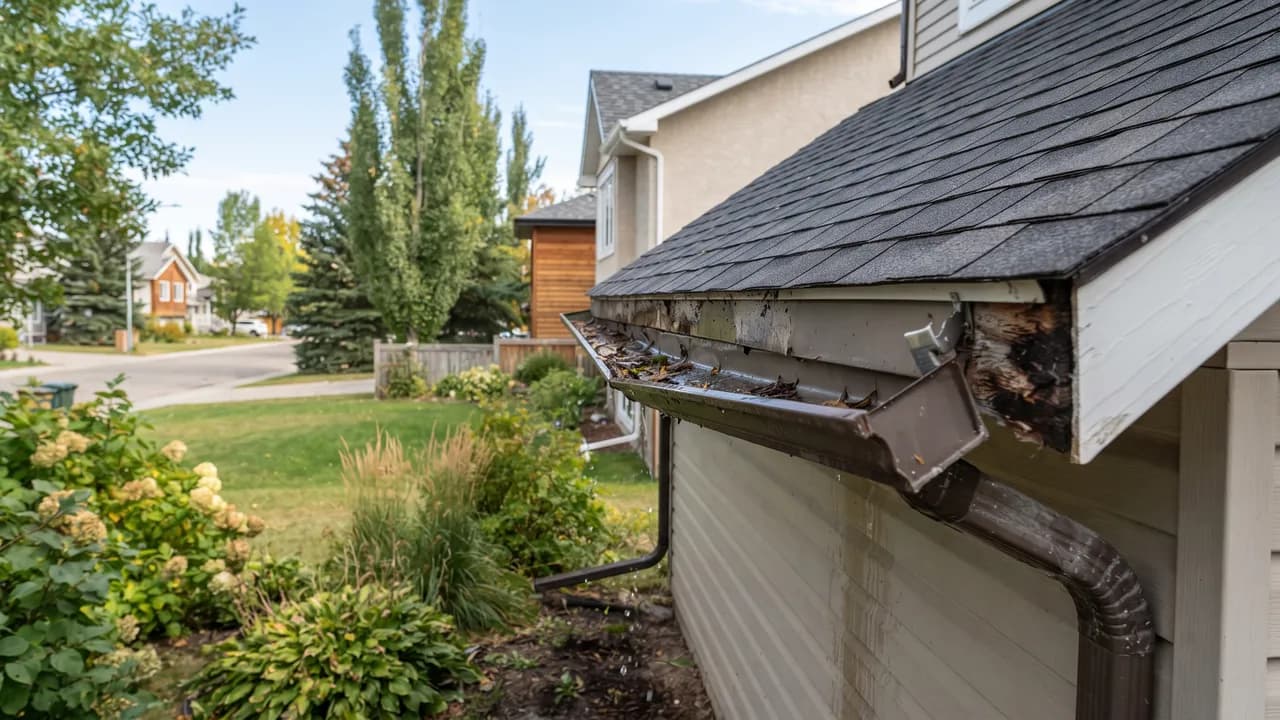
The fascia is the vertical board behind the eavestrough. It takes a beating. In the Tri-Region climate, fascia boards on the north and east exposures rarely dry out completely between snowmelt and spring rain. Add a leaking gutter joint that drips constantly onto the same six-inch section of fascia and you have rot developing in a single season.
Look up at the gutter line from the ground. Do you see dark staining on the fascia? Peeling paint? Gaps between the gutter and the board? In older neighborhoods like Broxton Park, many homes still have original pine fascia that has zero rot resistance. Once the paint fails, the wood absorbs water like a sponge.
The screws or spikes holding the gutter to the fascia are the first to go. As the wood softens, the fasteners pull out. The gutter sags. The slope reverses. Water pools in the low spot. The cycle accelerates. By the time the homeowner notices the gutter hanging at a drunken angle, the fascia often needs full replacement not just repair.
Aluminum fascia wrap is common on newer builds in Westgrove and Nakamun. It protects the wood but it also hides rot. If you see the aluminum buckling or popping off, the wood underneath is already gone. This is where a roofing contractor who also does eavestrough work saves you a separate call. They can assess the roof edge, fascia, and gutter system as one assembly.
Fall Cleaning Reveals Structural Issues
Late October. You are up the ladder clearing poplar leaves from the gutters on your Spruce Ridge home. You notice a few things. A corner joint that weeps when you run the hose. A downspout that is loose at the elbow. A section of gutter that flexes when you lean on it. These are not cosmetic issues. They are structural failures in progress.
The fall clean is your best diagnostic window. You are already up there. You have water running. You can see the seams, the slope, the fastener condition. Take notes. Take photos. Mark problem spots with a piece of tape.
Common findings in Parkland County homes include separated miters at inside corners where expansion and contraction have broken the sealant, downspout straps that have pulled out of rotting soffit, and gutter sections that have bowed from ice weight and no longer hold slope. Aluminum gutters in this climate typically last twenty to twenty-five years. If your home was built in the early 2000s boom, you are in the replacement window.
Do not just clean and walk away. A professional inspection after cleaning costs roughly one-fifth of a mid-winter emergency call. Most Spruce Grove eavestrough companies offer fall inspection packages that include slope testing, seam sealing, and fastener replacement.
What Repair Actually Costs Here
Prices in the Tri-Region run higher than Edmonton proper because travel time and disposal fees add up. Expect these ranges for common jobs:
- Reseal corner joints and end caps: $180 to $350
- Replace single downspout with extension: $220 to $400
- Rehang sagging section with new hangers: $300 to $600 depending on height
- Full fascia board replacement per linear metre: $85 to $140 installed
- Complete eavestrough replacement on average bungalow: $2,800 to $4,500 for five-inch aluminum with leaf guard
Leaf guard systems are worth the upgrade in treed areas like Lakewood and Heritage Grove. The micromesh styles handle spruce needles and cottonwood seeds better than the reverse-curve models. Budget an extra $8 to $12 per linear foot.
Get three quotes. Ask specifically about warranty on workmanship separate from material warranty. Ask if they use hidden hangers or spike-and-ferrule. Hidden hangers are standard now and hold better in freeze-thaw cycles. Ask about downspout sizing. Three-by-four-inch outlets on five-inch gutters move forty percent more water than two-by-three.
When to Call Versus When to DIY
Single-storey bungalow with accessible gutters? You can reseal a leaking corner joint with a tube of quality gutter sealant and a putty knife. Cost: fifteen dollars and an hour. Same job on a two-storey with a walkout basement in Woodhaven? Call a pro. The ladder work alone is not worth the risk.
Replacing a crushed downspout extension? DIY all day. Buying ten feet of corrugated pipe and a splash block at the Home Depot on Campsite Road costs thirty bucks.
Rehanging gutters? That requires checking and correcting slope across the full run. Miss by a few millimetres and you create a new low spot. Pros use laser levels. They also spot fascia rot you cannot see from the ground.
Full replacement? Always hire. The material markup you pay covers the contractor's ability to order exact lengths, match colours to your fascia and soffit, and warranty the install. Plus they deal with the old aluminum disposal at the Parkland County landfill where residential drop-off fees apply.
Seasonal Timeline for Spruce Grove Homeowners
Late April: Post-snowmelt inspection. Check for ice damage, pulled hangers, separated seams. Book repairs before the May long weekend rush.
Late June: Cottonwood seed purge. Flush gutters with a hose. Seeds turn to sludge that hardens like concrete.
Late October: Main clean after leaf drop. This is the big one. Book early. The best crews are booked solid by Thanksgiving.
Mid-November: Final check before freeze-up. Ensure downspouts are clear and extensions are connected. One frozen blockage in December means a service call at emergency rates.
Mid-winter thaw events: Walk the perimeter. Look for ice dams and overflow. Document with photos for spring repair planning.
Your eavestrough system is the first line of defense for your foundation, your fascia, and your basement. In Spruce Grove where the weather swings from minus thirty to plus thirty and the trees shed six months a year, neglect is expensive. The five signs above are your early warning system. Use them.
Frequently asked questions
How often should I clean my eavestroughs in Spruce Grove?
Twice minimum. Late June after cottonwood seeds and late October after leaf drop. Homes near mature trees in Broxton Park or Lakewood may need a third clean in August.
What size eavestroughs do I need for a typical Spruce Grove home?
Five-inch K-style is standard for bungalows up to 1,800 square feet. Two-storey homes or those with steep roof pitches in Heritage Grove often need six-inch with three-by-four downspouts.
Can I install leaf guards myself to save money?
You can but the micromesh systems that actually stop spruce needles require precise installation. Gaps at corners and end caps defeat the purpose. Most DIY installs fail within two seasons.
Why are my gutters loud during rain?
Water hitting the bottom of an empty downspout creates a drum effect. A downspout insert or rain chain at the outlet breaks the fall. Also check for loose hangers letting the gutter vibrate.
Does home insurance cover eavestrough damage from ice?
Typically only if the ice dam causes sudden water intrusion into the home. Gradual damage from neglected maintenance is excluded. Document your fall cleaning with dated photos for claims.
How long does a full eavestrough replacement take on a two-storey in Spruce Grove?
One day for a standard bungalow. Two days for a two-storey with complex rooflines. Crews usually start at 8 AM and finish by 4 PM. Schedule in May or September for best weather windows.
Need a local contractor in the Tri-Region?
Browse verified local pros for Spruce Grove, Stony Plain and Parkland County.
Browse the directory