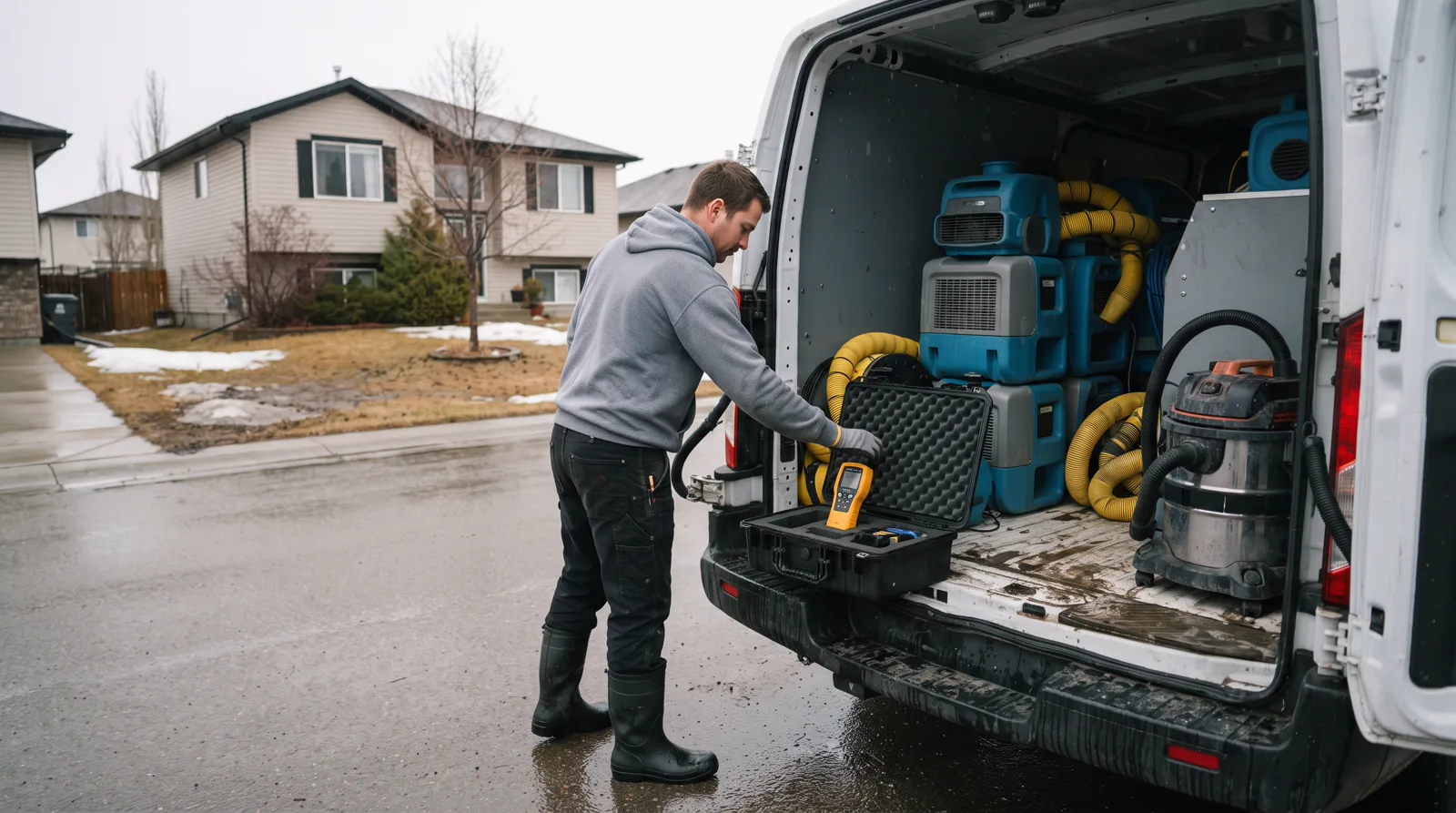
Burst Pipe Water Damage Restoration Emergency Requests Prioritized.
When a pipe bursts in your Spruce Grove home, every minute counts. Local pros extract water, dry structures, repair damage, and work directly with your insurance adjuster.
Complete Burst Pipe Damage Restoration
From the moment water stops flowing to final paint and flooring, local pros handle every phase of your recovery.
Emergency Water Extraction
Truck-mount extractors pull standing water from carpets, subfloors, and crawl spaces. Local pros remove soaked insulation and cut flood cuts in drywall to access wall cavities. Includes initial moisture mapping with thermal camera.
Structural Drying & Dehumidification
Industrial air movers and refrigerant dehumidifiers run continuously for 48 to 96 hours. Daily moisture readings confirm progress. We monitor hidden cavities in walls and under subfloors to prevent trapped moisture and future mold.
Drywall & Framing Repair
Replace water-damaged drywall, insulation, and baseboards. If studs or floor joists are soaked or warped, we sister new lumber or replace sections. All repairs meet Alberta Building Code for structural integrity and fire stops.
Flooring Restoration
Hardwood can sometimes be saved with slow drying and sanding. Laminate and carpet usually need replacement. The crew pulls, disposes, preps subfloor, and installs new flooring to match existing or upgrade. Vinyl plank and engineered hardwood are popular choices.
Mold Prevention & Remediation
Alberta homes can grow mold in 48 hours if moisture lingers. We apply antimicrobial treatment to all affected surfaces, HEPA vacuum debris, and seal contaminated materials in bags. If mold colonies are visible, full remediation with containment and air scrubbers.
Insurance Documentation & Liaison
We photograph damage, log moisture readings, itemize all equipment and labor, and submit estimates directly to your adjuster. Most Tri-Region policies cover sudden pipe bursts. We coordinate scope, handle change orders, and bill your insurer directly if you prefer.
Why Burst Pipes Hit Spruce Grove Hard
❄️ Deep Frost & Freeze-Thaw Cycles
Spruce Grove sees temperatures swing from minus 30°C to plus 5°C in a single week during chinook events. Pipes in exterior walls, unheated crawl spaces, and older garages freeze solid, then rupture when pressure builds. Homes built before 1990 often lack adequate insulation around supply lines.
🏚️ Older Housing Stock in Core Neighborhoods
Many homes near Highway 16A and downtown Spruce Grove were built in the 1970s and 1980s with copper or galvanized steel pipes. Corrosion weakens joints, and expansion from freezing can split seams. Crawl space construction (common in that era) makes pipes harder to insulate and inspect.
💧 Municipal Water Pressure & Shutoff Locations
Spruce Grove water mains run at 60 to 80 psi, enough to spray hundreds of liters per hour from a half-inch split. Your main shutoff is usually in the basement near the front wall or in a concrete valve box at the property line. Knowing its location before an emergency saves minutes and thousands in damage.
🏡 Insurance Deductibles & Coverage Limits
Most Tri-Region home policies have $1,000 to $2,500 deductibles and cover sudden pipe bursts but exclude gradual leaks or lack of maintenance. Sewer backup (often bundled) does not apply to supply line failures. We help you understand your policy and fight for full replacement cost, not depreciated value.
What it costs here
Everything You Need to Know About Burst Pipe Water Damage
From Alberta building science to insurance fine print, this guide covers what matters when your pipe fails.
Why Burst Pipes Are a Spruce Grove Winter Reality
Burst pipes in Spruce Grove, Stony Plain, and Parkland County are not random bad luck. They are the predictable result of Alberta's extreme freeze-thaw climate combined with the way homes are built and plumbed in this region. When temperatures drop to minus 30 Celsius or colder for sustained periods, any water line that lacks proper insulation or heat trace becomes vulnerable. Exterior walls with plumbing, crawl spaces, attics with supply lines, and older homes with minimal insulation see the highest failure rates. The water inside the pipe freezes, expands, and splits the copper, PEX, or galvanized steel. When the thaw arrives, whether from chinook winds or indoor heating, that split opens and water floods the structure.
Chinook winds create a second failure mode that catches many homeowners off guard. A chinook can raise temperatures from minus 20 to plus 5 in a matter of hours. Pipes that were frozen solid suddenly thaw, and any crack or weak joint that formed during the freeze now becomes a full breach. This is why restoration companies in the Tri-Region area see waves of calls after every chinook event in January and February. The damage is often discovered when a homeowner returns from work or wakes up to soaked ceilings, warped floors, and water pooling in the basement. By that point, hundreds or thousands of liters may have already escaped.
The depth of frost penetration in Parkland County adds another layer of risk. Alberta building code requires footings below the frost line, typically 1.2 to 1.5 meters, but water service lines entering older homes were sometimes installed shallower or without adequate bedding. When frost reaches these lines, they freeze despite being underground. Mobile homes, additions built without permits, and properties with compromised skirting or foundation gaps are especially prone to service line failures. Once a main water line bursts under a slab or in a crawl space, the restoration is far more invasive and costly than a simple fixture supply line.
Recognizing Burst Pipe Damage Before It Destroys Your Home
The clearest sign of a burst pipe is visible water where it should not be. Pooling on floors, dripping from ceiling fixtures, wet patches spreading across drywall, or water running from under baseboards all indicate active or recent failure. However, many burst pipe scenarios unfold hidden inside walls or above ceilings, and the water travels along joists, insulation, and wall cavities before appearing in a visible location. You might see staining or bulging drywall in a room far from the actual break. Always trace the water back to its highest or most upstream point. Gravity and building structure dictate the flow path, and the true breach could be in an attic, inside an exterior wall, or beneath a bathtub.
Other warning signs include sudden drops in water pressure, the sound of running water when no fixtures are open, unexplained spikes in water bills, or a water meter that spins continuously even when the house is idle. In winter, ice forming on exterior walls, frost inside attic spaces near plumbing, or frozen hose bibs can all signal that pipes are at risk or have already cracked but not yet released water. If you smell musty odors, see mold spots, or notice warping in hardwood or laminate floors without an obvious cause, a slow leak from a prior freeze event may be spreading moisture through your subfloor and wall cavities.
Timing matters enormously. The longer water sits in contact with building materials, the more damage it causes. Drywall begins to break down within 24 hours. Subfloors swell and delaminate. Insulation becomes a sponge that holds moisture against framing lumber, creating ideal mold conditions. In an Alberta winter, a burst pipe that goes unnoticed for even a few hours can release enough water to saturate entire rooms. Immediate action is not optional. Shut off the main water supply at the curb stop or just inside the foundation wall, move valuables and electronics away from wet areas, and call a restoration contractor who can respond the same day.
The Professional Burst Pipe Restoration Process
Emergency Water Extraction and Containment
The first step in any burst pipe restoration is stopping further water intrusion and removing standing water as quickly as possible. A qualified crew will confirm that the water supply is shut off, identify the breach location, and deploy truck-mounted or portable extraction units to pull water from carpets, floors, and any pooled areas. Industrial wet vacuums, submersible pumps, and weighted extraction wands are used depending on the volume and surface type. Speed is critical because every minute of contact time increases material damage and microbial risk. In larger floods, crews may extract hundreds of liters in the first hour alone.
Containment barriers and plastic sheeting are set up to isolate affected areas from clean zones, preventing cross-contamination and controlling airflow. This is especially important in forced-air heated homes where moisture can spread through ductwork. Technicians will document the extent of the damage with moisture meters, thermal imaging cameras, and photo logs for insurance purposes. They will mark wet areas on walls and floors with tape or chalk so that drying progress can be tracked over the following days. This initial assessment determines the scope of drying equipment needed and the estimated timeline for returning the structure to safe, dry conditions.
Structural Drying and Dehumidification
Once extraction is complete, the drying phase begins. High-velocity air movers are positioned to create airflow across wet surfaces, pulling moisture out of materials and into the air. Commercial dehumidifiers then capture that airborne moisture and drain it outside or into floor drains. The goal is to bring all materials back to their pre-loss moisture content, typically below 12 percent for wood framing and subfloors. Drywall, insulation, and carpet padding are porous and hold water stubbornly, so drying can take three to seven days depending on the extent of saturation and the building's ventilation.
Temperature control is part of the drying strategy. In winter, heat must be maintained inside the structure to support evaporation, but not so high that it promotes mold growth. Technicians monitor moisture levels daily with pin-type and non-invasive meters, adjusting equipment placement and airflow as materials dry. In cases where insulation is soaked or drywall has begun to crumble, those materials are removed before drying begins. Trying to dry destroyed materials wastes time and money. The faster you remove non-salvageable components, the faster the structure stabilizes and the less secondary damage occurs.
Mold Inspection and Antimicrobial Treatment
Alberta's cold winters do not prevent mold. They slow it down, but once water infiltrates a heated building envelope, mold spores activate within 24 to 48 hours if conditions remain damp. After drying is confirmed, a restoration contractor will inspect hidden cavities, under flooring, and behind baseboards for signs of microbial growth. If mold is present, affected materials are either removed or treated with antimicrobial agents registered for use in occupied structures. HEPA filtration and negative air machines may be deployed to prevent spore dispersal during removal work.
Prevention is always cheaper than remediation. If the burst pipe is caught early and drying begins within hours, mold is unlikely to establish. If the water sat for a day or more, or if the structure has a history of moisture problems, mold risk climbs steeply. Insurance adjusters and restoration contractors will often recommend preventive antimicrobial fogging or surface treatment even when no visible growth is present. This adds a modest cost to the project but protects against callbacks and health concerns weeks later when hidden mold emerges from wall cavities or subfloor spaces.
Repairing Walls, Floors, and Ceilings After the Flood
Once the structure is dry and confirmed safe from mold, reconstruction begins. Drywall that was saturated or cut open for access is replaced with new sheets, taped, mudded, and sanded to match existing finishes. Baseboards and trim are reinstalled, and the area is primed and painted. In homes with textured ceilings, matching the original texture requires skill and often a spray texture application. Flooring is one of the costest and most visible repairs. Hardwood that has cupped or buckled may need sanding and refinishing if the damage is mild, or full replacement if boards are warped beyond repair. Laminate and engineered flooring typically cannot be salvaged once swollen and must be torn out and replaced.
Subfloor damage is common in burst pipe events because water soaks through carpet or tile and saturates the plywood or OSB beneath. Swollen subfloor creates uneven surfaces, squeaks, and weak spots that telegraph through new flooring. A professional restoration includes subfloor inspection and replacement of any sections that exceed acceptable moisture levels or show structural compromise. This work is hidden but essential. Skipping subfloor repair to save money results in flooring failures within months. The cost to replace subfloor sections typically ranges from $30 to $60 per square meter depending on access and material type, and it must be factored into the total project budget.
Ceilings present unique challenges. Water from a burst pipe in an attic or second-floor bathroom often travels through ceiling joists and insulation, staining and weakening drywall over a wide area. Heavily damaged sections are cut out and replaced, but even stained sections that remain structurally sound may require sealing with stain-blocking primer before repainting. If the burst occurred in winter and the attic was not properly ventilated, ice damming or condensation may have compounded the water intrusion. In those cases, the restoration contractor should inspect attic insulation, vapor barriers, and ventilation to prevent recurrence. Fixing the visible damage without addressing the building science failure just sets up the next flood.
What Burst Pipe Water Damage Restoration Costs in Spruce Grove, Stony Plain and Parkland County
A straightforward burst pipe cleanup in a single room where you caught it quickly and water stayed on the surface typically runs $1,200 to $3,500 in the Tri-Region. That price includes emergency water extraction, drying equipment rental for three to five days, antimicrobial treatment, and minor drywall or baseboard repair. If the pipe broke overnight or while you were away and water soaked through subfloors, wicked up inside walls, or saturated insulation, you are looking at $5,000 to $15,000 or more depending on how many rooms are affected and whether structural elements need replacement. A full basement flood from a failed supply line can push past $25,000 when you account for demolition, mold remediation, new framing, insulation, drywall, flooring, and trim.
The biggest cost driver is how long the water ran and what building materials absorbed it. Drywall that stayed wet for more than 48 hours usually needs to be cut out and replaced because it loses structural integrity and becomes a mold risk. Hardwood flooring can sometimes be saved if it is solid wood and the water was clean, but engineered flooring with a plywood core almost always delaminates and cups beyond repair. Subfloors are the hidden expense. A soaked OSB or plywood subfloor under carpet or vinyl will swell, warp, and grow mold if you only dry the surface. Replacing subfloor means pulling up finished flooring, which turns a $3,000 job into an $8,000 job.
Alberta's deep frost and freeze-thaw cycles add a local wrinkle. Pipes that burst in exterior walls during a cold snap often damage insulation that has to be pulled and replaced, and any wall cavity that got wet needs to be opened for inspection because moisture trapped behind vapour barrier in winter will condense and mold before spring. Insurance companies in Alberta also require detailed moisture documentation and often mandate specific drying protocols before they will approve repairs, which means you cannot skip the thermal imaging and daily moisture meter logs even if it feels like overkill. If your contractor does not provide that documentation, your claim can be denied or reduced. Permit requirements vary by municipality. The City of Spruce Grove requires a development permit for structural repairs over a certain dollar threshold, and Parkland County has specific rules for work on septic fields or well systems if a pipe failure affected those areas.
Comparing Your Restoration Options: Repair vs. Replace and Material Choices
The repair versus replace decision comes down to material type, water exposure time, and whether you plan to sell in the next few years. Drywall that got surface wet but dried within 24 hours can often be patched and repainted without full replacement. You will see some texture mismatch and possibly a faint water stain even with primer, but it is structurally sound. Drywall that stayed saturated for two days or more loses its gypsum core integrity, crumbles when you press on it, and grows mold inside the paper facing. Trying to save it is false economy because it will sag, crack, or grow visible mold within six months. The same logic applies to baseboards and trim. Solid wood baseboards can be dried and reinstalled if they were not submerged long, but MDF baseboards swell and disintegrate and must be replaced.
Flooring decisions are more complicated. Solid hardwood flooring three-quarters of an inch thick can survive a clean water flood if you start drying within a few hours, pull up any rugs or underlayment that trap moisture, and run dehumidifiers for a full week. You will likely see some cupping or crowning where boards swell, but a professional can sand and refinish once everything is dry and the wood acclimates back to normal moisture content. Engineered hardwood with a thin veneer over plywood core cannot be saved. The plywood swells, the veneer delaminates, and the planks warp into waves. Luxury vinyl plank flooring is waterproof on the surface but water that gets underneath and soaks the subfloor will cause the planks to lift and buckle. You have to pull the flooring, dry and inspect the subfloor, and then reinstall new planks. Carpet and underpad are almost always a total loss in any flood because pad acts like a sponge and carpet holds moisture and odour even after extraction.
Subfloor and insulation are where contractors cut corners. A moisture meter reading on the surface of a subfloor does not tell you what is happening in the middle of a three-quarter inch OSB sheet. Thermal imaging can reveal trapped moisture, but the only sure method is to drill test holes or pull up a section and inspect. If the subfloor stayed above 18 percent moisture content for more than 48 hours, mold spores are already germinating and you need to replace it. Insulation in walls or floors that got wet must be removed, not dried in place. Wet fiberglass insulation loses its R-value permanently, and cellulose insulation holds water and molds quickly. Spray foam insulation can sometimes be dried if water only touched the surface, but if water soaked through seams or gaps it will trap moisture behind it and you have to cut it out.
Common Mistakes and Contractor Red Flags That Cost Homeowners Money
The most expensive mistake homeowners make is stopping the drying process too early because the floor feels dry or the contractor says everything looks fine. Surface dryness means nothing. Water wicks deep into drywall, subfloors, and framing lumber, and it takes five to seven days of continuous dehumidification and air movement to pull that moisture out. If you shut down equipment after three days because your power bill is climbing or the noise is annoying, you will have mold growth inside your walls within two weeks. Professional restorers use moisture meters to track progress and they will not sign off on a job until every reading is below 15 percent. If a contractor offers to pack up equipment early or does not measure moisture daily, walk away.
Failing to document the damage properly before repairs start is the second most common mistake. Insurance adjusters need photos of every affected area, moisture readings from multiple locations, and a written scope of loss that explains what materials are damaged and why they need to be replaced. If you let a contractor start tearing out drywall before the adjuster visits and takes their own photos, the insurance company can deny your claim for lack of evidence. The adjuster also needs to see the source of the water, the failed pipe or joint, so they can confirm it was a sudden failure and not a slow leak that you neglected. Some contractors push you to start work immediately and promise they will handle the insurance paperwork later. That is a red flag. The proper sequence is: stop the water, extract standing water, document everything, call your insurer, wait for the adjuster, get approval, then start demolition and drying.
Hiring a contractor without proper liability insurance and liability insurance is a gamble that can cost you tens of thousands of dollars. If a worker is injured on your property and the contractor has no liability insurance, you can be held personally liable for medical costs and lost wages. If the contractor damages your home further during repairs or causes a flood in a neighbouring unit in a townhouse, and they have no liability insurance, you are on the hook. Always ask for proof of both before signing a contract, and call the WCB directly to verify the account is active and in good standing. Parkland County and Spruce Grove both require contractors to show proof of insurance before issuing permits, but not all restoration work requires a permit so it is your job to verify. A contractor who hesitates or offers excuses when you ask for insurance documents is hiding something.
Accepting Incomplete Drying or Skipping Mold Prevention
Some contractors will dry the visible surfaces but skip opening walls or pulling baseboards to check for trapped moisture because it adds time and cost. If water ran under baseboards or behind drywall and you only dry the room air, moisture stays trapped in the wall cavity and molds. You will smell it within days and see staining or texture changes within weeks. A proper restoration includes removing baseboards, drilling weep holes in drywall near the floor to let moisture escape, and running focused drying equipment in wall cavities. If your contractor is not doing that and moisture readings were high near walls, insist on it or hire someone who will.
Skipping antimicrobial treatment after a flood is another shortcut that backfires. Even clean water from a supply line carries some bacteria, and once it sits in porous materials for hours it starts to grow biofilm and mildew. Spraying an EPA-registered antimicrobial on all affected surfaces after extraction and before drying kills existing growth and inhibits new growth during the drying period. It costs $150 to $400 depending on area size and it is worth every dollar. Contractors who skip it are either inexperienced or trying to lower their bid to win the job, and you will pay for it later in mold remediation costs.
How to Hire a Burst Pipe Water Damage Restoration Pro in the Tri-Region
Start by verifying credentials and insurance before you even discuss pricing. Ask for the contractor's WCB account number and call to confirm it is active and covers the work they will be doing. Request a copy of their commercial general liability insurance certificate with at least two million dollars in coverage, and call the insurance company listed to verify the policy is current. If they are registered with the IICRC, the Institute of Inspection Cleaning and Restoration Certification, that is a strong positive signal. IICRC certification is not legally required in Alberta but it means the contractor has completed training in water damage restoration, mold remediation, and structural drying. You can verify certification at iicrc.org. A contractor who is not certified can still do good work if they have years of experience and strong references, but certification gives you a baseline of competence.
When you request quotes, ask each contractor to visit your property and provide a written estimate that breaks down labour, equipment rental, materials, and disposal costs separately. Avoid any estimate that gives a single lump sum with no detail because it makes it impossible to compare bids or spot padding. Ask how long they expect drying equipment to run and whether that rental cost is per day or a flat fee. Ask what moisture content levels they consider acceptable before they will remove equipment. The answer should be below 15 percent for wood materials and below 12 percent for drywall. Ask whether they will provide daily moisture logs and whether they use thermal imaging to check for hidden moisture in walls and ceilings. If they say thermal imaging is not necessary or they only use it if they see visible damage, that is a red flag.
Ask what their process is for working with insurance companies. A good contractor will offer to meet with your adjuster, provide a detailed scope of loss, and submit documentation and invoices directly to your insurer if you authorize it. They should be familiar with Xactimate, the estimating software most adjusters use, and willing to negotiate line item costs if the adjuster pushes back. Be cautious of contractors who tell you not to involve insurance or offer to do the work for your deductible amount regardless of actual cost. That is insurance fraud and it can get your claim denied and put you on the hook for the full repair cost. Also be wary of contractors who offer to pay your deductible or give you a rebate after the insurance check arrives. That is also fraud.
Red Flags in Estimates and Timeline Expectations
A quote that is dramatically lower than others is almost always a sign of corner cutting or hidden costs that will be added later as change orders. If three contractors quote $6,000 to $8,000 and one quotes $3,200, the low bidder is either leaving out necessary work like subfloor replacement or antimicrobial treatment, or they plan to upsell you once the job is underway and you are committed. A legitimate low bid will come with a clear written explanation of what is excluded. Similarly, be suspicious of estimates that include vague line items like miscellaneous materials or unforeseen costs. Every material and task should be spelled out with quantities and unit prices.
Realistic timelines for burst pipe restoration depend on the extent of damage. Emergency water extraction and initial drying equipment setup should happen within hours of your call, ideally the same day. Drying takes five to seven days on average, longer if the weather is humid or the damage is extensive. Demolition of unsalvageable materials happens after drying is complete and insurance approval is received, usually one to three days of work. Reconstruction timelines vary widely based on scope but a typical single room restoration takes two to four weeks after drying is done. If a contractor promises to have you fully restored in a week unless the damage is very minor, they are either understaffed, cutting corners, or setting you up for disappointment.
How Tri-Region Services Helps
Tri-Region Services connects you to one carefully vetted, fully insured water damage restoration contractor in Spruce Grove, Stony Plain, or Parkland County who has been verified for commercial liability insurance, and a clean track record with past clients. You get a free written quote with transparent line-item pricing and no obligation to hire. We do not take a commission or referral fee, so the contractor's price is the same whether you find them yourself or we connect you. Our role is simply to save you the time and risk of vetting contractors yourself, and to make sure you are talking to a professional who follows proper drying protocols, documents everything for insurance, and stands behind their work.
How We Screen Burst Pipe Restoration Contractors
Every partner on Tri-Region Services is verified for credentials, insurance, and customer protection before we list them.
IICRC Water Damage Certification
All listed restorers hold current IICRC WRT (Water Damage Restoration Technician) certification, the industry standard for proper drying protocols.
Insurance on file
Contractors tell us about active liability insurance and Workers Compensation Board coverage so you are protected if someone is injured or property is damaged during the job.
Photo & Moisture Documentation
Every contractor we list uses thermal imaging and daily moisture logs, giving you hard evidence for insurance claims and peace of mind the job is done right.
Verified Local References
We call past customers in Spruce Grove, Stony Plain, and Parkland County to confirm quality, timeliness, and fair pricing before adding a restorer to our network.
Guaranteed 90 Minute Response Time
Flag your request as an emergency and it goes to available local restorers first, holidays and weekends included.
Transparent Pricing & No Hidden Fees
All quotes itemize extraction, drying, disposal, labor, and materials separately, so you see exactly what you are paying for and can share it with your adjuster.
This page is not tied to a contractor's brand. Leads route straight to your one local partner. Verified reviews can appear here once that partner has them (never fabricated).
Serving the whole Tri-Region
7 Questions Spruce Grove Homeowners Ask
How fast does water damage get worse after a pipe bursts?+
Will my home insurance cover a burst pipe in Spruce Grove?+
How do I find my main water shutoff valve in an emergency?+
Can hardwood floors be saved after a pipe bursts?+
How long does burst pipe restoration take in a Spruce Grove home?+
What causes pipes to burst in Alberta winters?+
Should I try to dry the damage myself or call a professional?+
How much does burst pipe water damage restoration cost in Spruce Grove?+
Get your free quote
Tell us what you need and a local pro will get right back to you.
- ✓ Sent straight to a local business
- ✓ You choose who you hire
- ✓ Free, with no obligation