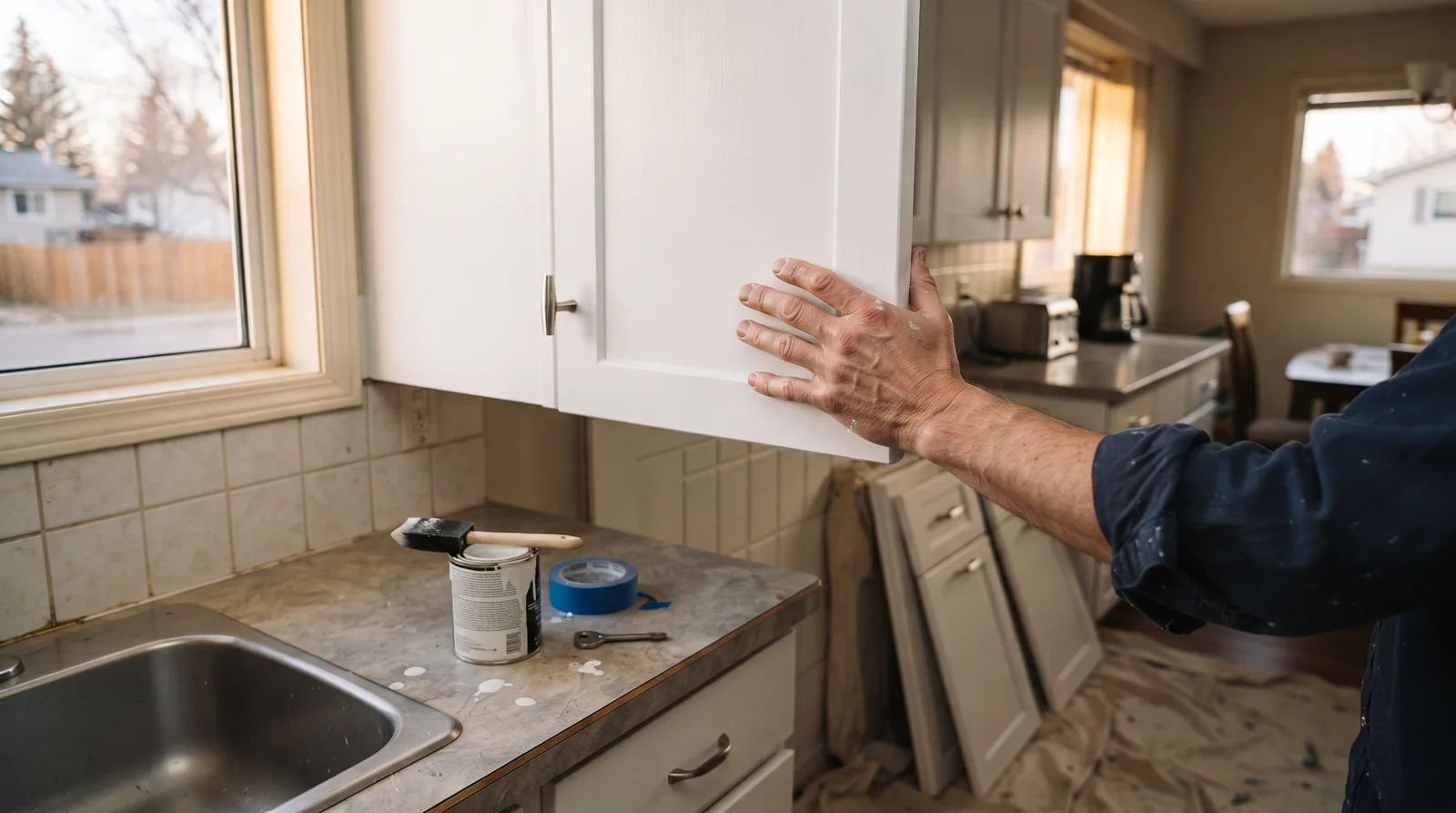
Cabinet Painting That Lasts in Alberta's Dry Climate.
Refinish kitchen and bathroom cabinets with durable, low-VOC coatings engineered for the Tri-Region's temperature swings and low humidity.
Cabinet Painting & Refinishing Services
From surface refresh to full strip and refinish, local pros handle every step in your home or shop.
Kitchen Cabinet Refinishing
Complete kitchen transformation: degrease, sand, prime, two finish coats. Doors and drawer fronts removed, sprayed off-site for a factory finish, frames hand-brushed. Hardware reinstalled or upgraded. Most kitchens done in 4 to 6 days with minimal disruption.
Bathroom Vanity Painting
Refinish bathroom vanities and linen cabinets with moisture-resistant coatings. Ideal for updating builder-grade oak or melamine. Doors removed and sprayed, carcass painted in place. Typical turnaround 2 to 3 days.
Cabinet Doors & Drawer Fronts Only
Refresh just the visible surfaces. Doors and drawer fronts removed, prepped and sprayed, frames left as-is or lightly touched up. Faster timeline and lower cost when cabinet boxes are in good shape. Common for rentals and flips.
Hardware Replacement & Upgrade
Swap dated handles and hinges for modern hardware. We drill new holes if needed, fill old ones, and colour-match wood filler. Includes soft-close hinge upgrades. Hardware sourced locally or supplied by you.
Cabinet Staining & Clear Coat
Strip old finish, sand to bare wood, apply new stain and protective top coat. Brings out grain on solid wood cabinets. More labour-intensive than paint, typically adds 2 to 3 days. Popular for rustic and craftsman kitchens in the Tri-Region.
Commercial Cabinet Painting
Refinish cabinets in offices, salons, dental clinics, retail shops and restaurants. High-durability coatings, fast turnaround, work scheduled evenings or weekends to avoid business interruption. Quote based on cabinet count and access.
Why Cabinet Painting Here Is Different
🌡️ Alberta's Dry Climate and Paint Curing
Low humidity speeds solvent evaporation but can cause surface skinning before deeper layers cure. We control spray booth humidity and use slower-evaporating reducers in winter. Cabinets cure harder and resist chipping better when the process is tuned to local conditions.
🏚️ Lead Paint in Older Tri-Region Homes
Homes built before 1990 in Spruce Grove, Stony Plain and Parkland County may have lead-based cabinet finishes. We test suspect surfaces, contain dust with HEPA filtration, and follow Alberta lead-safe work practices. You receive a lead-safe work certificate when applicable.
🔥 Winter Heating and Kitchen Humidity
Forced-air furnaces and low outdoor humidity dry out wood, causing joints to shrink and finishes to crack. We inspect for loose joints and wood movement before painting, repair as needed, and recommend a kitchen humidifier if the home is chronically under 30% RH.
📋 Ventilation and Indoor Air Quality
Alberta Building Code Section 6.2 requires mechanical ventilation during painting in occupied spaces. We use low-VOC waterborne finishes, run exhaust fans, and schedule spray work when you can leave for a few hours. Kitchens are safe to occupy the same evening.
What it costs here
Everything You Need to Know About Cabinet Painting in the Tri-Region
Process, prep, products, and what to expect when refinishing cabinets in Spruce Grove, Stony Plain and Parkland County.
What Cabinet Painting Actually Involves in Spruce Grove Homes
Cabinet painting is a complete refinishing process that transforms worn or outdated kitchen and bathroom cabinetry without the cost of replacement. The work involves removing all doors, drawer fronts and hardware, then cleaning, sanding, priming and applying multiple coats of durable paint or conversion varnish. Professional cabinet painters in Spruce Grove typically work on site for the boxes and frames, but take doors and drawer fronts to a shop or controlled space where temperature and dust can be managed. The goal is a factory quality finish that stands up to daily use, moisture exposure and the temperature swings common in Alberta homes.
Most cabinet painting projects in the Parkland County area take five to ten days depending on the size of the kitchen, the condition of the existing finish, and whether you are changing from a stained wood look to a painted solid color or simply refreshing a previously painted surface. The painter will mask off countertops, appliances and flooring, then work in stages so you can still use your kitchen for basic tasks. Bathrooms are faster, often completed in two to four days. The time investment is far shorter than a full cabinet replacement, which can leave your kitchen unusable for weeks and cost $15,000 to $40,000 or more.
The materials used matter as much as the technique. Spruce Grove painters who specialize in cabinets use waterborne or catalyzed conversion varnish finishes designed for high traffic surfaces, not standard wall paint. These coatings cure to a hard, chemical resistant surface that handles grease splatter, steam from cooking, and repeated cleaning. The primer layer is equally important: it blocks tannin bleed from oak or maple, seals any existing stains or odors, and creates a stable foundation for the topcoats. Cheap or mismatched primers lead to peeling, yellowing or uneven color within months, especially in Alberta's dry winter air and humid summer conditions.
Why Alberta's Climate and Lifestyle Drive Cabinet Refinishing Needs
Alberta homes face temperature extremes that accelerate cabinet wear. In winter, forced air heating systems drop indoor humidity below 20 percent, causing wood to shrink and finishes to crack or check. Spring and summer bring humidity spikes, especially during heavy rain events or when windows are open for ventilation. This seasonal expansion and contraction stresses cabinet joints and finish layers. Homes in Spruce Grove, Stony Plain and Acheson built between 1990 and 2010 often have builder grade melamine or thermofoil cabinets that delaminate or yellow under these conditions. Solid wood cabinets from the same era may show worn or faded stain, especially on doors facing south or west windows where UV exposure is strongest.
Cooking habits also play a role. Alberta families tend to cook at home more frequently than the national average, and local preferences for fried foods, slow cooked roasts and baking generate grease vapor and heat that settle on cabinet surfaces. Over years, this buildup dulls the finish, darkens light colored wood, and creates a sticky film that attracts dust. Kitchens near exterior doors see additional grime from mudroom traffic, especially during wet spring months or winter when snow and road salt are tracked indoors. Cabinets near the stove or above the dishwasher take the hardest hit, often showing heat damage, discoloration or peeling veneer.
Economic factors matter too. Replacing a full kitchen of cabinets in 2026 runs $18,000 to $50,000 depending on materials and layout, not including countertops, backsplash or labor for demolition and installation. Cabinet painting costs $3,500 to $9,000 for a typical Spruce Grove kitchen, delivering a modern look at one fifth the price. Many homeowners choose painting when preparing to sell, since updated cabinets return 70 to 80 percent of their cost in perceived home value. Others paint to match a new color scheme, accommodate aging in place modifications, or simply refresh a kitchen that functions well but looks tired.
How to Know Your Cabinets Need Professional Painting
Surface and Finish Damage You Can See and Feel
Run your hand over the cabinet doors near the handles and along the bottom edge of wall cabinets. If the surface feels rough, sticky or uneven, the finish has broken down. You may notice small cracks in the paint or varnish, especially along the raised panel edges or where the door frame meets the center panel. These cracks let moisture and grease penetrate, accelerating damage. Cabinets near the sink or stove often show water stains, heat discoloration or a yellowed tint that cannot be cleaned away. Thermofoil cabinets may have lifted or bubbled edges where the vinyl layer has separated from the substrate, a common failure in Alberta homes due to dry indoor air.
Check the cabinet boxes and face frames inside and around the hinges. If you see dark rings, watermarks or mold spots, moisture has been present long enough to compromise the finish and possibly the wood beneath. Painted cabinets that were originally a bright white or light color may have dulled to a cream or gray tone, especially if they are more than ten years old. Stained wood cabinets lose their luster and may look flat or blotchy, particularly if they were finished with a low quality polyurethane that has worn through in high touch areas.
Style and Functional Obsolescence
Honey oak, pickled oak and golden maple cabinets were standard in Spruce Grove homes built in the 1990s and early 2000s. These finishes are now considered dated and can make a home feel older than it is. If your cabinets are structurally sound but the color no longer suits your taste or the rest of your home's design, painting offers a cost effective update. White, gray, navy and sage green are popular choices in 2026, offering a clean modern look that appeals to buyers and aligns with current Parkland County design trends.
Functionality also signals the need for refinishing. If your cabinet layout works well but the doors no longer close properly due to warped wood or failing hinges, a painter can address these issues during the prep phase. Holes from old hardware can be filled and sanded smooth before priming. Cabinet painting projects often include hardware upgrades, since new handles and hinges dramatically improve the finished appearance and function. This combination of cosmetic and functional improvements extends the life of your cabinets by another ten to fifteen years or more.
The Step by Step Cabinet Painting Process
Assessment, Preparation and Removal
A professional cabinet painter in Spruce Grove begins with a detailed assessment of your existing cabinets. They identify the current finish type (paint, stain, lacquer, thermofoil), check for structural issues like loose joints or water damage, and discuss color and sheen options. The painter will take door measurements and photographs, then provide a written estimate that includes labor, materials and timeline. Once you approve the project, they schedule a start date and order any custom mixed paint to ensure accurate color matching. Most painters ask you to clear countertops and remove items from inside the cabinets, though they will handle all other prep work.
On day one, the crew removes all cabinet doors, drawer fronts and hardware. Each piece is labeled so it goes back in the correct location. Hinges are either cleaned and reused or replaced depending on their condition and your preference. The cabinet boxes and face frames are masked with plastic sheeting and tape to protect countertops, backsplash and appliances. In some cases, the crew will set up a temporary work station in a garage, basement or spare room where they can sand and spray doors in a controlled environment. This protects your living space from dust and overspray, and allows the painter to achieve a smoother finish than is possible when working on site.
Cleaning, Sanding and Priming
All surfaces are cleaned with a degreasing agent to remove cooking oils, grime and any residue that would prevent paint adhesion. This step is critical in Alberta kitchens where forced air heating can bake grease into the finish. The painter then sands every surface by hand or with a powered sander, removing the existing gloss and creating a rough texture for the primer to grip. Dings, holes and cracks are filled with wood filler or catalyzed putty, then sanded flush. If you are painting over stained wood, especially oak or maple, the painter applies a stain blocking primer to prevent tannins from bleeding through the topcoat. This primer also seals odors and provides a uniform base color.
Cabinet boxes and frames are typically primed with a brush and roller for speed and coverage. Doors and drawer fronts are primed with a high volume low pressure sprayer or a fine finish roller to eliminate brush marks. The primer must dry completely before sanding, a process that can take four to six hours in Spruce Grove's dry winter air or eight to twelve hours in summer when humidity slows cure times. Once dry, the primer is lightly sanded to remove any dust nibs or raised grain, then wiped clean with a tack cloth.
Topcoat Application and Curing
The topcoat is applied in two or three thin layers rather than one thick coat. This approach minimizes runs and sags, allows each layer to cure properly, and builds a durable finish that resists chipping. Most cabinet painters in the Parkland County area use a semi gloss or satin sheen for kitchen cabinets because these finishes are easier to clean and more resistant to moisture than flat paint. Bathroom cabinets often receive a semi gloss or gloss finish for maximum water resistance. Each coat must dry to the touch before the next is applied, with a minimum wait time of two to four hours depending on temperature and humidity.
After the final topcoat, doors and drawer fronts cure for 24 to 48 hours before they are handled or reinstalled. Full cure can take up to two weeks, during which time you should avoid placing heavy objects on shelves or slamming doors. The painter will rehang all doors, adjust hinges so everything closes evenly, and install new hardware if you have supplied it. They will also touch up any areas that were masked or inaccessible during spraying. The result is a factory quality finish that looks and performs like new cabinetry at a fraction of the replacement cost.
What Cabinet Painting Really Costs in Spruce Grove and the Tri-Region
Most kitchen cabinet painting jobs in Spruce Grove, Stony Plain, and Parkland County run between $3,200 and $7,500, depending on the number of doors, drawer fronts, and the condition of your existing cabinets. A small galley kitchen with 12 doors might cost $3,200 to $4,200, while a large open-concept kitchen with an island, 30 doors, and multiple drawer banks can push $6,500 to $7,500 or more. Bathroom vanity painting alone typically runs $600 to $1,400 per vanity. These are real numbers from insured, contractors working in the Tri-Region, not the lowball cash quotes you might see on classified sites. The difference reflects liability insurance, proper ventilation equipment, quality materials rated for Alberta's temperature swings, and the time required to do the job without shortcuts.
Several factors drive the price up or down in this market. Cabinet condition matters: if your doors are delaminating, have deep gouges, or the MDF core is swelling from water damage near the sink, a painter will need to repair or replace those pieces before any finish goes on, adding $400 to $1,200 in material and labor. Box configuration also affects cost. Cabinets with intricate trim, glass inserts, or two-tone finishes (island one color, perimeter another) require more masking, more coats, and more drying time between stages, which translates to higher labor. Door style plays a role too: flat slab doors are faster to prep and paint than raised-panel or cathedral-arch styles, where every profile and crevice needs sanding, priming, and careful brushwork to avoid buildup in the grooves.
Seasonal timing and insurance requirements affect pricing in Alberta. Many painters charge a premium for winter interior work in unheated garages or shops because spray booths need heat to cure paint properly when it is 25 below outside, and that costs fuel. liability insurance is mandatory for any contractor with employees, and liability insurance in the $2 million range is standard for reputable cabinet painters. If a quote seems unusually low, ask to see the WCB clearance letter and liability certificate. A contractor working without coverage might save you $800 upfront, but if someone gets hurt on your property or your cabinets are damaged during the job, you are exposed. The good operators factor insurance, proper equipment, and realistic timelines into their pricing, and those costs keep everyone protected when things go sideways.
Comparing Your Options: Paint, Stain, Reface, or Replace
Painting is the most cost-effective transformation when your cabinet boxes are structurally sound but the finish is outdated or worn. You can go from honey oak to crisp white, navy, or charcoal gray for a fraction of replacement cost, and a quality paint job using conversion varnish or catalyzed lacquer will hold up to daily use, grease splatter, and the humidity swings common in Alberta basements and lakefront homes. Paint works on wood, MDF, laminate, and even melamine if the surface is properly primed. The downside is that paint hides the wood grain entirely, so if you love the natural look of oak or maple, painting erases that character. Paint also shows every ding and chip more visibly than stain, although modern waterborne urethanes are much tougher than the latex paints used a decade ago.
Staining or refinishing is the right move when you have solid wood doors in good shape and you want to preserve or enhance the grain. This process involves stripping the old finish with chemical strippers or sanding it down to bare wood, then applying new stain and a protective topcoat. It is more labor-intensive than painting and typically costs 20 to 40 percent more because of the stripping stage and the multiple stain coats needed to achieve even color. Staining works beautifully on oak, maple, cherry, or alder, but it will not cover damage the way paint can. If your doors have water stains, sun fading, or blotchy areas where the original finish failed, those imperfections will telegraph through the new stain unless the wood is sanded aggressively, which adds time and cost. Staining also limits your color palette to wood tones, so if you are chasing a modern look with bold color, paint is the better route.
Refacing means keeping your existing cabinet boxes and replacing only the doors, drawer fronts, and visible end panels, then covering the box frames with matching veneer or laminate. It gives you a brand-new look without the demolition and plumbing work that full replacement requires, and it typically costs $8,000 to $16,000 for an average Tri-Region kitchen, about half the price of new cabinets. Refacing makes sense when your layout works but the style is dated, or when your boxes are high-quality plywood or solid wood and you do not want to throw them away. The catch is that you are still working with the same interior configuration, so if your shelves are the wrong height or you need more drawers, refacing will not solve that. You also need to find a supplier that stocks door styles and finishes you like, and lead times for custom doors can stretch to eight or ten weeks, especially if the supplier is based in Ontario or Quebec and shipping delays hit.
Full replacement is the most expensive option, typically $18,000 to $35,000 or more for a full kitchen, but it is the only one that lets you redesign the layout, add features like pull-out spice racks or soft-close hinges throughout, and get a factory warranty on every component. Replacement makes sense when your cabinets are falling apart, the boxes are particle board that is swelling and sagging, or you are doing a whole-home renovation and want to reconfigure the kitchen footprint. The downside is time and disruption: you are looking at two to four weeks without a functional kitchen, plus the cost of a temporary cooking setup, eating out, and the general chaos of a full demo. For most homeowners in Spruce Grove and Stony Plain who just want a fresh, modern look and whose cabinets are structurally solid, painting or refacing delivers 80 percent of the visual impact at a fraction of the cost and hassle.
Common Mistakes and Contractor Red Flags to Avoid
The biggest DIY mistake homeowners make is skipping the deglosser or TSP wash before priming. Kitchen cabinets accumulate a film of cooking grease, hand oils, and cleaning product residue that acts as a barrier between the wood and the primer. If you do not remove that layer, the primer will not bond, and within six months you will see peeling around the handles, along the edges, and anywhere the doors flex during normal use. Another common error is using regular latex wall paint instead of a product formulated for cabinets. Wall paint is designed to hide imperfections and provide coverage, not to withstand the abrasion, moisture, and grease exposure that cabinets endure. It will scuff, yellow, and show every fingerprint. Homeowners also underestimate drying time in Alberta's dry winter air and humid summer basements. Rushing the cure process by reinstalling hardware or stacking doors too soon leads to imprints, smudges, and finish failure that requires a complete do-over.
When hiring a contractor, the biggest red flag is someone who will not provide proof of WCB coverage and liability insurance. In Alberta is required for any business with employees, and reputable solo operators carry their own coverage even when not legally required because it protects them and you. If a painter falls off a ladder in your kitchen and has no coverage, you could be on the hook for medical costs and lost wages. Liability insurance protects you if the contractor damages your countertop, scratches your floor, or ruins a cabinet box beyond repair. Ask to see the certificates before any work starts, and verify the coverage is current by calling the insurer directly. A legitimate contractor will expect this request and have the documents ready. Anyone who deflects, offers a discount for cash to avoid the paper trail, or says insurance is not necessary is gambling with your financial safety.
Material shortcuts are another trap. Some contractors use cheap latex primer instead of a bonding primer designed for slick surfaces like melamine or laminate, then cover it with one coat of paint to save time. That approach might look fine for the first few months, but it will fail when the primer loses adhesion and the paint peels off in sheets. Another shortcut is skipping the final topcoat. Quality cabinet jobs use a self-leveling topcoat or a catalyzed clear coat that adds durability and a smooth, furniture-like finish. Stopping after the color coats leaves the paint vulnerable to chipping and staining. Watch out for contractors who promise a three-day turnaround for a full kitchen. Proper prep, priming, painting, and curing takes time. A realistic timeline for a medium-sized kitchen is five to seven working days if the doors are sprayed off-site, or eight to ten days if everything is done in your home. Anyone promising faster is either cutting corners on dry time or running multiple jobs simultaneously and splitting their attention, neither of which serves you well.
How to Hire the Right Cabinet Painter in Spruce Grove
Start by asking each potential contractor how they handle prep work. The right answer includes removing all doors and hardware, labeling each piece so it goes back in the right spot, filling any holes or dents with wood filler, sanding everything to create a uniform surface, and cleaning all grease and residue before any primer touches the wood. If the contractor says they will paint in place without removing the doors, or they plan to skip the deglossing step, move on. Ask what products they use and why. A good contractor will name specific primer and paint brands (BIN shellac primer, Benjamin Moore Advance, Sherwin-Williams ProClassic, or similar) and explain that these products are formulated for high-contact surfaces and offer better adhesion, durability, and stain resistance than standard wall paint. If they say they use whatever is on sale at the hardware store, that is a sign they are prioritizing cost over quality.
Get at least three written quotes and compare them line by line. A detailed quote should list the scope (number of doors, drawer fronts, whether the boxes and frames are included), the prep process, the primer and paint products by name, the number of coats, the estimated timeline, and the total price. If a quote is a single line that says 'paint kitchen cabinets, $4,500,' you have no way to know what is included or excluded, and that vagueness often leads to disputes when the job is done. Ask about the warranty. Reputable cabinet painters in Alberta stand behind their work with at least a one-year warranty on the finish, covering peeling, chipping, or adhesion failure under normal use. If a contractor will not warranty their work, they are signaling that they do not trust their own process or materials.
Check references and look at completed projects in person if possible. Photos on a website or social media can be staged or filtered, but seeing a kitchen that was painted two years ago and is still holding up tells you the work was done right. Ask the reference how the contractor handled problems, whether they showed up on time, how they managed dust and mess, and whether the final invoice matched the quote. Verify the contractor's business registration and check for complaints with the Better Business Bureau or consumer protection organizations. In small communities like Spruce Grove and Stony Plain, word of mouth is powerful, and contractors with a history of bad work or unfinished jobs do not last long, but it is still worth doing your homework before handing over a deposit.
How Tri-Region Services Helps
Tri-Region Services takes the guesswork out of finding a qualified cabinet painter in Spruce Grove and the surrounding area. When you submit a request through our platform, we route your project to one local professional who has told us they are insured, and who is known for quality work, fair pricing, and reliable communication. You get a free written quote with no obligation and no pressure, just a clear breakdown of what the job will cost and what is included. We do not sell your contact information to a dozen contractors or flood your phone with sales calls. You deal with one pro, evaluate their proposal on your timeline, and decide whether to move forward. It is the simplest, safest way to connect with a trusted local expert who knows Alberta cabinets, Alberta climate, and what it takes to deliver a finish that lasts.
Why Homeowners Choose Tri-Region Cabinet Painters
Licensed contractors who show up, finish on time, and stand behind their work.
Liability insurance
Every painter carries $2M liability insurance coverage stated at signup.
Lead-Safe Certified Practices
Trained in Alberta lead-safe work protocols, with HEPA containment and disposal documentation.
Written Quotes, Timelines & Warranties
Fixed-price quotes, start and finish dates in writing, and a 2-year warranty on adhesion and finish.
Low-VOC & Waterborne Coatings
We use Benjamin Moore Advance, Sherwin-Williams ProClassic, and other low-odour, durable waterborne finishes.
Work in Occupied Homes
Kitchens remain semi-functional during most of the project. Sink and microwave accessible, minimal dust.
Local References Available
Ask for recent cabinet projects in your neighbourhood. We connect you with past clients who agreed to share feedback.
This page is not tied to a contractor's brand. Leads route straight to your one local partner. Verified reviews can appear here once that partner has them (never fabricated).
Serving the whole Tri-Region
7 Cabinet Painting Questions Tri-Region Homeowners Ask
How long does cabinet paint last in Alberta's dry climate?+
Do I need to move out while you paint my cabinets?+
Can you paint over stained wood cabinets, or do they need stripping?+
What's the difference between painting cabinets and refinishing them?+
How long does a typical cabinet painting project take?+
Will my kitchen be usable during the work?+
Do older homes in Spruce Grove and Stony Plain have lead paint on cabinets?+
What kind of paint do you use, and can I choose the brand or colour?+
Get your free quote
Tell us what you need and a local pro will get right back to you.
- ✓ Sent straight to a local business
- ✓ You choose who you hire
- ✓ Free, with no obligation