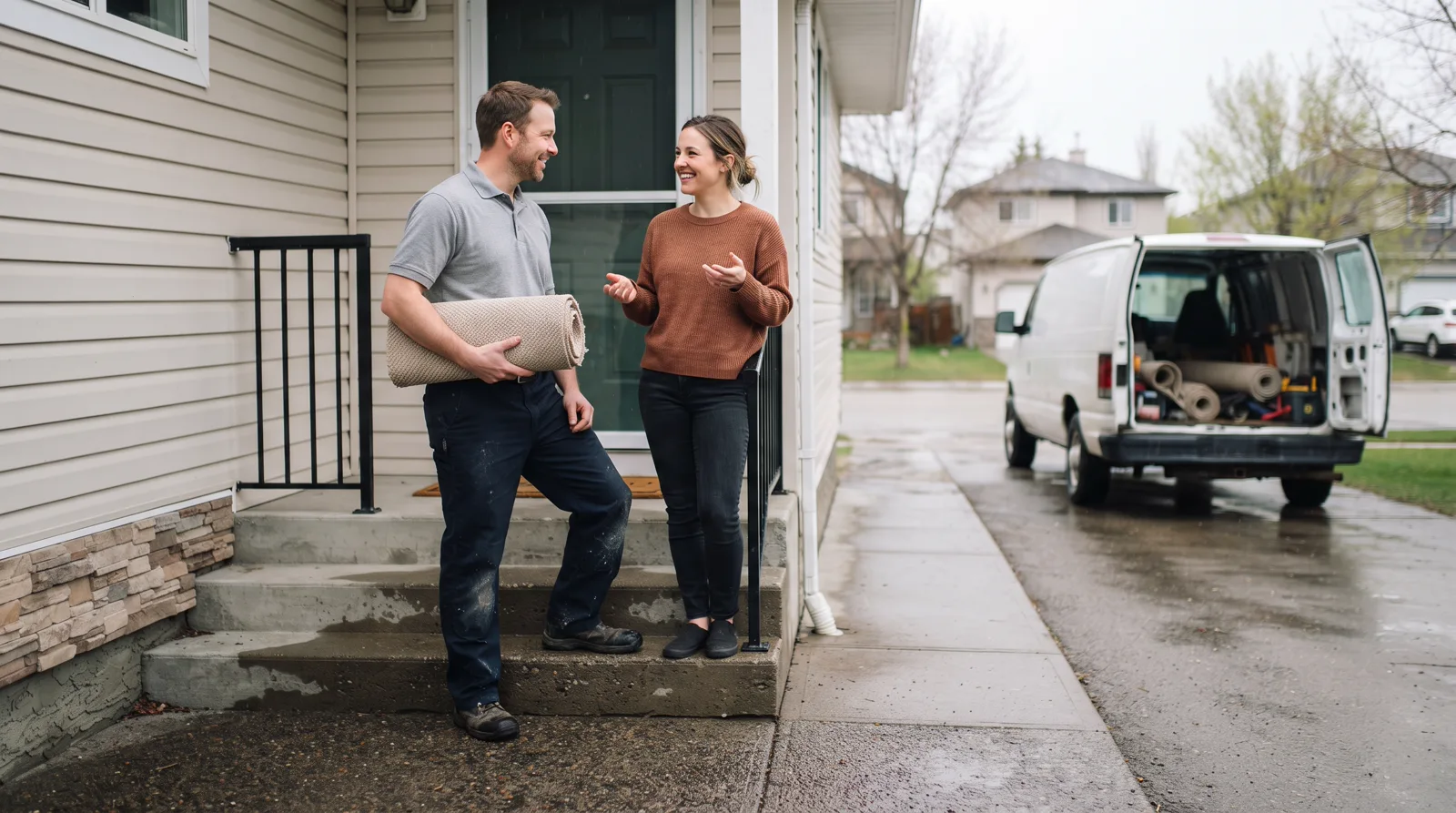
Carpet Installation Done Right, Warm Floors All Winter.
Professional carpet installation with proper pad, tight seams, and moisture barriers where you need them. Bedrooms, living rooms, basements across the tri-region.
Carpet Services Across the Tri-Region
From cozy bedrooms to finished basements, local pros handle every carpet project with precision and care.
Bedroom Carpet Installation
Soft, quiet carpet for bedrooms. Local pros handle furniture moving, pad installation, tight seams, and baseboard transitions. Perfect for master suites, kids' rooms, and guest bedrooms across Spruce Grove and Stony Plain.
Living Room & Main Floor Carpet
Durable, stain-resistant carpet for high-traffic areas. Expert seam placement to avoid walking paths. We match pile direction for even appearance and ensure smooth transitions to tile or hardwood.
Basement Carpet with Moisture Barrier
Alberta basements need vapor barriers and proper subfloor prep. Local pros install moisture-resistant pad, seal seams, and choose carpet that handles occasional dampness. Critical for Parkland County homes with high water tables.
Stair Carpet Installation
Safe, secure stair carpet with proper nosing and tight tack strips. We wrap or cap each step, ensure no loose edges, and match the carpet to your upper or lower level. Reduces noise and adds safety.
Carpet Repair & Stretching
Fix ripples, wrinkles, and loose edges without replacing the whole carpet. We re-stretch using a power stretcher, re-tack edges, and patch small damaged sections. Extends carpet life by years.
Carpet Removal & Disposal
Complete tear-out of old carpet, pad, and tack strips. We haul everything to the landfill, sweep the subfloor, and leave the space ready for new flooring. Includes staple and tack removal.
Carpet Installation for Alberta Homes
💧 Basement Moisture & Vapor Barriers
Alberta basements see moisture from snow melt, spring runoff, and high water tables. Local pros install 6-mil poly vapor barriers over concrete, use moisture-resistant pad, and choose carpet that won't mold if it gets damp. Critical for homes in Parkland County and along creeks.
🧊 Cold Subfloors & Pad R-Value
Concrete and old wood subfloors in Alberta homes stay cold all winter. We recommend 8 to 10 lb density pad with rubber or foam for insulation. Carpet over quality pad keeps floors 15 to 20 degrees warmer than tile or hardwood, saving on heating.
🐕 Pet-Friendly Carpet for Indoor Winters
Alberta pets spend more time indoors from October to April. Local pros install stain-resistant, low-pile carpet that resists claws, fur buildup, and accidents. Solution-dyed nylon is the best choice for durability and easy cleaning in high-pet households.
📐 Seam Placement for Tri-Region Homes
Spruce Grove and Stony Plain homes often have wide-open great rooms and long hallways. We plan seam placement to avoid walking paths, hide seams under furniture, and align pile direction so seams disappear. Poor seam work shows up in a year, good seam work lasts a decade.
What it costs here
Everything You Need to Know About Carpet Installation in Spruce Grove
From choosing the right pad for Alberta winters to avoiding basement moisture problems, this guide covers the decisions that matter.
What Carpet Installation Actually Involves in Spruce Grove Homes
Carpet installation is the complete process of preparing your floor, selecting and fitting underpad, cutting and securing carpet material, and finishing all edges and transitions. In Spruce Grove and Parkland County homes, this work typically starts with a site visit to measure rooms, assess subfloor conditions, and identify any moisture concerns common in Alberta basements and main floors. The installer checks for level concrete, examines wood subfloors for squeaks or movement, and measures doorways, closets, and irregular corners that need custom cuts. This upfront assessment determines whether your subfloor needs repair, moisture barrier installation, or leveling before any carpet goes down.
Most residential carpet installation in this area uses the stretch-in method, where carpet is stretched tight over tack strips nailed around the room perimeter. The installer first secures wooden tack strips with angled nails pointing toward the wall, leaving a small gap between strip and baseboard. High-density foam or rubber underpad is then rolled out and stapled or taped to the subfloor, cut to fit precisely within the tack strip border. The carpet itself is rolled out, rough-cut with excess material, then stretched using a power stretcher and knee kicker to eliminate wrinkles and ensure the backing catches firmly on the tack strip nails. Seams between carpet sections are heat-bonded with seaming tape and a hot iron, creating invisible joins when done correctly.
In Alberta homes built before 2000, you often encounter subfloor challenges that complicate installation. Many older Spruce Grove bungalows have concrete basement floors poured directly on grade with no vapor barrier, leading to moisture wicking up through the slab. Wood subfloors in main-level rooms may have settled unevenly or developed squeaks from decades of freeze-thaw movement in the foundation. Professional installers address these issues before laying carpet, sometimes installing a plastic moisture barrier over concrete, screwing down loose plywood, or using floor leveling compound to correct dips and humps. Skipping this prep work leads to premature carpet failure, mold growth in underpad, or visible lumps and valleys that never flatten out.
Why Alberta's Climate Demands Proper Carpet Installation
Freeze-Thaw Cycles and Foundation Movement
Spruce Grove experiences extreme temperature swings, with winter lows reaching negative 30 Celsius and chinook events bringing sudden thaws mid-winter. This freeze-thaw cycling causes foundations to shift incrementally, expanding when frozen ground pushes against basement walls and contracting when soil thaws. Over years, this movement creates uneven floors, cracks in concrete slabs, and gaps between subfloor sheets. Carpet installed without accounting for these irregularities will develop wrinkles, ripples, and loose spots as the floor beneath it continues to move. Professional installation addresses this by allowing slight expansion gaps at walls, using flexible tack strip placement, and ensuring the carpet is stretched tight enough to resist buckling but not so tight it tears when the floor shifts.
Basement floors in Parkland County homes are particularly vulnerable because frost penetrates deep into Alberta soil, sometimes reaching depths of two meters or more. This deep frost line means basement slabs sit in constant contact with frozen ground for four to five months each year. Moisture from soil freezing and thawing cycles can push up through concrete that lacks a proper vapor barrier, saturating carpet underpad and creating mold growth within weeks. Installers familiar with Alberta conditions always test concrete moisture levels before laying carpet in basements, using a plastic sheet test or calcium chloride kit to measure moisture vapor transmission. If moisture levels are high, they install a vapor barrier or recommend alternative flooring rather than installing carpet that will fail within a year.
Chinook Winds and Humidity Fluctuations
Chinook winds are a unique Alberta weather phenomenon where warm Pacific air spills over the Rockies, raising temperatures by 20 degrees or more in a matter of hours. These rapid warming events cause dramatic humidity swings inside homes, as outdoor air at negative 15 suddenly shifts to plus 5, bringing moisture-laden air into contact with cold interior surfaces. Carpet and underpad absorb and release moisture in response to these humidity changes, expanding when wet and contracting when dry. Poor installation that does not account for this movement leads to seams separating, edges pulling away from tack strips, and ripples forming down the center of rooms.
Homes heated with forced air systems experience even greater humidity variability, as furnaces running constantly in cold snaps dry indoor air to 15 percent relative humidity, while chinook periods bring levels back up to 40 percent or higher. Quality carpet installation includes selecting underpad with moisture-resistant backing and using seaming techniques that allow slight movement without separating. Installers working in Spruce Grove and Stony Plain understand that carpet must be acclimated to the home's temperature and humidity before installation, typically requiring the material to sit in the house for 24 to 48 hours before cutting and stretching. Rushing this acclimation step results in carpet that shrinks after installation, pulling away from walls and creating gaps.
Snow Melt and Entryway Moisture
Alberta homes deal with wet, snowy conditions from November through March, with residents tracking snow, slush, and road salt indoors multiple times daily. Entryways, mudrooms, and hallways near exterior doors take the brunt of this moisture exposure, with boots and shoes depositing water and de-icing chemicals directly onto carpet fibers. Carpet installed in these high-traffic moisture zones without proper planning fails quickly, as underpad compresses into a soggy mat, backing separates from fibers, and salt residue stiffens and discolors the pile. Professional installation in Alberta homes often includes transition strategies, such as running carpet only to the edge of the entryway and using tile or vinyl in the immediate entry zone, or specifying commercial-grade carpet with rubber backing and tighter weave that resists moisture penetration.
Basement family rooms and rec rooms face similar moisture challenges from a different source. Many Spruce Grove homes have basement walk-outs or ground-level windows where snow drifts pile against the foundation during winter. Spring melt sends this water downward along the foundation wall, finding any crack or gap to seep through into the basement. Even homes with exterior weeping tile and sump pumps can experience seasonal dampness along perimeter walls. Installers avoid running carpet tight to basement walls in these situations, leaving a small gap and using metal edge trim instead of tucking carpet into the wall-floor joint. This prevents carpet wicking moisture from damp concrete and allows air circulation that helps dry the perimeter.
Warning Signs Your Spruce Grove Home Needs New Carpet Installation
Visible wear patterns are the most obvious indicator, but understanding what you are seeing helps determine whether you need full replacement or targeted repair. High-traffic areas like hallways, room entries, and the path from the living room to the kitchen develop matted, flattened pile where carpet fibers have been crushed beyond recovery. This matting occurs because foot traffic bends fibers repeatedly in the same direction, breaking the fiber structure and preventing them from springing back upright. If the matted area is limited to a narrow path and the surrounding carpet still has good pile, you might consider strategic furniture rearrangement or area rugs rather than full replacement. However, if matting covers more than 30 percent of a room, or if the backing is visible through the pile, replacement is the only practical solution.
Ripples, wrinkles, and loose spots indicate installation failure rather than normal wear. Carpet should lie flat and tight from wall to wall, with no waves, bumps, or buckled areas. In Alberta homes, these problems often develop three to five years after installation when subfloor movement from freeze-thaw cycles or inadequate initial stretching allows the carpet to relax and buckle. Small wrinkles near doorways or in corners can sometimes be re-stretched by a professional using a power stretcher, avoiding full replacement. Widespread rippling across an entire room, or waves that return shortly after re-stretching, signals that the subfloor has moved significantly or the carpet backing has degraded. Re-stretching in these cases is a temporary fix, and you should plan for replacement within one to two years.
Odor and moisture issues are critical warning signs in Alberta basements and main-floor rooms over crawlspaces. Musty smells that persist even after deep cleaning indicate mold or mildew growing in the underpad or carpet backing, usually caused by moisture wicking up from the subfloor. This is especially common in Parkland County homes with unfinished basements or older concrete slabs that lack vapor barriers. If you notice the smell is stronger in corners, along walls, or in areas near exterior doors, moisture intrusion is the likely cause. Pulling back a corner of the carpet to inspect the underpad will often reveal dark staining, a sour smell, or crumbling foam, confirming that replacement is necessary. Attempting to clean or deodorize carpet with mold in the underpad is ineffective because the source of the problem is hidden beneath the surface.
- Carpet pile worn down to backing in traffic lanes, with fibers too matted to vacuum upright
- Wrinkles, ripples, or waves that create tripping hazards or visible lumps across the floor
- Persistent musty odors that do not improve with cleaning, especially in basements or near exterior walls
- Stains from pet urine, flooding, or spills that have soaked through to the underpad and subfloor
- Frayed or damaged edges at doorways and transitions where carpet has pulled away from tack strips
- Carpet installed before 1990 that may contain older backing materials prone to deterioration
The Complete Carpet Installation Process: What to Expect in Your Home
Initial Consultation, Measurement, and Subfloor Assessment
The process begins with an in-home visit where the installer measures each room, maps out doorways and closets, and assesses subfloor conditions. In Spruce Grove homes, this assessment is critical because many properties have unique challenges like uneven concrete slabs, squeaky wood subfloors, or basement moisture that must be addressed before installation. The installer measures room dimensions at multiple points because rooms are rarely perfectly square, and records the locations of heating vents, floor outlets, and built-in furniture that require carpet to be notched or cut around. They also check for adequate clearance under doors, as carpet and underpad add thickness that can prevent doors from opening smoothly after installation.
Subfloor evaluation includes testing concrete for moisture, examining wood floors for loose or damaged sections, and checking that the surface is level within acceptable tolerances. Installers use a straightedge or laser level to identify high and low spots, marking areas that need grinding down or building up with leveling compound. In homes with forced-air heating, they verify that floor vents are securely attached and flush with the subfloor, preventing carpet from sagging into loose vent openings. If the subfloor has significant issues such as extensive water damage, large cracks, or uneven settlement, the installer provides a written estimate for necessary repairs before proceeding with carpet installation. Addressing these problems upfront prevents callbacks and ensures the finished carpet looks and performs as expected.
Material Selection, Ordering, and Acclimation
After measurements are complete, you select carpet style, fiber type, and color, along with coordinating underpad. Residential carpet in Alberta typically uses nylon, polyester, or wool fibers in cut pile, loop pile, or cut-and-loop textures. Nylon is the most durable and resilient, making it ideal for high-traffic areas like hallways and family rooms, while polyester offers softer feel and stain resistance at a lower price point. Underpad choice is equally important, with high-density foam or rubber pads providing better support and longer carpet life than thin, low-quality foam. Installers familiar with Alberta conditions often recommend moisture-resistant underpad with a vapor barrier backing for basement installations, preventing moisture from wicking up through concrete and damaging the carpet.
Once you finalize selections, the installer orders materials and schedules delivery to your home 24 to 48 hours before installation. This acclimation period allows the carpet to adjust to your home's temperature and humidity, preventing shrinkage or expansion after installation. In winter months, when outdoor temperatures are well below freezing and indoor heating keeps humidity low, this step is especially important because carpet delivered from a warehouse may be damp or cold. Rolling the carpet out in the rooms where it will be installed and allowing it to relax ensures that measurements and cuts are accurate and that the finished installation lies flat without developing wrinkles.
Installation Day: Preparation, Stretching, and Finishing
On installation day, the crew begins by removing old carpet and underpad if present, then inspecting the subfloor and making any final repairs. They install tack strips around the perimeter of each room, positioning them about half an inch from the wall with the nails angled toward the baseboard. Underpad is rolled out, cut to fit inside the tack strip border, and secured with staples on wood subfloors or double-sided tape on concrete. The installer ensures the underpad lies flat with seams butted tightly together but not overlapping, as ridges or gaps in the underpad will telegraph through the carpet and create visible lines.
Carpet installation starts by rolling the material into the room with several inches of excess on all sides, then rough-cutting it to approximate size. The installer positions the carpet so any seams fall in low-traffic areas or where furniture will cover them, then uses a power stretcher to stretch the carpet tight from one wall toward the opposite wall. The power stretcher has a long pole that braces against one wall and a head that grips the carpet, applying force to pull it tight before securing it on the tack strips. Proper stretching is critical in Alberta homes because inadequate tension leads to ripples and buckling as the carpet relaxes or the subfloor moves. After stretching, the installer trims excess carpet with a wall trimmer, tucks edges down into the gap between tack strip and baseboard using a stair tool, and secures transitions at doorways with metal threshold strips.
Seaming is required when a room is wider than the carpet roll width, typically 12 feet, or when hallways and adjoining rooms need to be joined. The installer cuts both pieces of carpet precisely, aligns the pile direction so the seam is invisible, and places heat-activated seaming tape under the join. A seaming iron heats the tape to melt the adhesive, and the installer presses the two carpet edges together, using a seam roller to ensure a strong bond. Quality seams are nearly invisible and as strong as the surrounding carpet, but poor seaming technique results in visible lines, separated edges, or frayed fibers. After all carpet is installed, the crew vacuums thoroughly to remove loose fibers and installation debris, replaces floor vents and outlet covers, and inspects the work for any wrinkles, loose edges, or imperfections that need correction before leaving.
What Carpet Installation Actually Costs in the Tri-Region
Carpet installation in Spruce Grove, Stony Plain, and Parkland County typically runs $6 to $12 per square foot installed, including mid-range carpet and standard padding. A 200 square foot bedroom costs $1,200 to $2,400, while a 600 square foot basement runs $3,600 to $7,200. These ranges reflect real contractor pricing in 2026, not retail store markups. The wide spread comes down to carpet fiber quality, padding thickness, subfloor condition, and whether the installer needs to move furniture, pull old flooring, or address moisture issues common in Alberta basements.
Material costs dominate the bill. Budget polyester carpet starts around $2 to $3 per square foot for the roll alone, while premium nylon or wool can hit $8 to $15 per square foot before labor. Padding adds another $0.75 to $2 per square foot depending on density and thickness. Alberta's freeze-thaw cycles and dry winter air put stress on subfloors, especially in older Spruce Grove homes built on crawlspaces or poorly insulated slabs. If your installer finds uneven plywood, moisture damage, or concrete that needs leveling compound, add $1.50 to $4 per square foot for subfloor prep. Skipping this step guarantees premature wear and visible seams within two years.
Labor in the Tri-Region runs $3 to $5 per square foot for straightforward stretch-in installation on a clean, level subfloor. Complexities like stairs, closets, or basement moisture barriers push labor toward the higher end. Removing old carpet and hauling it to the Acheson transfer station adds $1 to $2 per square foot. Furniture moving can be another $100 to $300 flat depending on volume and stairs. Permits are not required for carpet replacement in Parkland County or Spruce Grove, but any subfloor structural work might trigger a building inspection if you are opening walls or sister joists.
Basement installs cost more because of moisture risk. Responsible installers test concrete slabs with a moisture meter or calcium chloride kit before laying pad and carpet. If the reading exceeds manufacturer thresholds, you need a vapor barrier or moisture mitigation coating, adding $1 to $3 per square foot. Stony Plain and rural Parkland County homes on well water or high water tables see this frequently. Refusing the test or ignoring high readings leads to mold, buckling, and odor within months, especially during spring melt when groundwater rises.
Comparing Carpet Types and Installation Methods for Alberta Homes
Broadloom carpet, sold in 12 or 15 foot wide rolls, is the standard for residential bedrooms and living areas. Installers seam pieces together and stretch the carpet over padding using tack strips around the perimeter. This stretch-in method works well on wood subfloors and allows easy future removal. Carpet tiles, typically 18 or 24 inch squares with built-in backing, install faster and let you replace damaged sections without redoing the whole room. Tiles suit basements prone to moisture or pet accidents because you can pull a few squares, dry the subfloor, and reinstall. However, tiles lack the plush, seamless look of broadloom and cost $4 to $9 per square foot installed, often more than budget broadloom.
Padding quality matters more than most homeowners realize, especially in Alberta's dry climate. Cheap 3 pound density foam compresses quickly under furniture and foot traffic, creating permanent divots within a year. Quality 8 pound density rebond or memory foam padding costs $1.50 to $2 per square foot but extends carpet life by 50 percent and improves underfoot comfort. Thicker padding also insulates against cold concrete slabs in Spruce Grove basements, reducing the chill homeowners feel in winter. Building code does not mandate specific padding, but manufacturers void wear warranties if you install their carpet over padding thinner than 7/16 inch or denser than 10 pounds. Check the fine print before your installer lays the pad.
Fiber type drives durability and maintenance. Nylon remains the most resilient choice for high-traffic areas like hallways and family rooms. It resists crushing, cleans well, and handles Alberta mud season without permanent staining. Polyester costs less and feels softer but mats down faster and holds oil-based stains. Polypropylene, often marketed as olefin, resists moisture and mold, making it a logical basement pick, but it lacks the luxury feel nylon provides upstairs. Wool offers natural stain resistance and a premium texture but starts around $10 per square foot for material alone and requires professional cleaning. For Tri-Region families with pets and kids tracking in snow and gravel, nylon in a mid-tone fleck or pattern hides dirt better than solid light colors.
Installation methods split between stretch-in and glue-down. Stretch-in, the dominant residential approach, uses wooden tack strips nailed to the subfloor perimeter and a knee kicker or power stretcher to pull the carpet taut. This method works on wood or concrete and makes future replacement straightforward. Glue-down, where adhesive bonds carpet directly to the subfloor, is rare in homes but common in commercial settings or moisture-prone basements using carpet tiles. Glue-down eliminates wrinkles and padding cost but traps moisture if the slab sweats, and removal is messy. Unless you have a specific moisture or commercial durability need, stick with stretch-in over quality padding.
Common Mistakes and Contractor Red Flags to Avoid
Skipping the basement moisture test is the number one avoidable disaster. Concrete slabs in Parkland County and Stony Plain absorb groundwater during spring runoff, even in homes with exterior weeping tile. An installer who refuses to test or waves off your concern about a damp smell is either ignorant or rushing the job. Moisture trapped under carpet and padding grows mold within weeks, creating health hazards and requiring full removal and remediation that costs more than the original install. A legitimate pro brings a moisture meter, tests multiple spots, and documents readings before laying a single tack strip. If the reading is high, they explain your options: a topical vapor barrier, a moisture-tolerant tile system, or delaying install until the slab dries.
Inadequate subfloor prep is the second most common shortcut. Carpet telegraphs every dip, hump, and loose plywood seam. Installers in a hurry skip sanding high spots, filling low areas with leveling compound, or screwing down squeaky subfloor panels. You will feel and hear these flaws the moment you walk on the finished carpet, and they accelerate wear along stress points. Older Spruce Grove homes often have 3/4 inch plywood subfloors that have cupped or separated at seams after decades of humidity swings. A proper installer spends an hour or more per room inspecting, screwing, filling, and sanding before rolling out padding. If your quote does not mention subfloor assessment or the installer shows up without a leveling compound and screw gun, find someone else.
No liability insurance is a lawsuit waiting to happen. Alberta law requires anyone employing workers to carry Workers Compensation Board insurance. If an uninsured installer or helper gets hurt in your Stony Plain home, you become liable for medical costs and lost wages. Always ask for a WCB clearance letter showing the account is in good standing. Sole proprietors working alone can apply for personal optional coverage, which costs around $800 to $1,500 per year depending on classification. An installer who brushes off the WCB question or says they are covered under someone else's account without proof is either operating illegally or misclassifying employees as subcontractors. Your homeowner's insurance will not cover you if an uninsured worker files a claim.
Lowball quotes that exclude critical steps are bait-and-switch traps. A quote of $4 per square foot installed sounds great until you realize it assumes a perfectly level subfloor, no furniture moving, no disposal, and the cheapest possible padding. The installer shows up, identifies issues you expected them to handle, and suddenly the price jumps 40 percent or they walk off the job. A legitimate quote itemizes carpet cost per square foot, padding type and cost, labor, subfloor prep allowance, removal and disposal if needed, and travel. It also states whether the installer provides a moisture test, moves furniture, or installs transition strips at doorways. If the quote is a single line with a total, ask for a detailed breakdown before signing anything.
Watch for Poor Seam Placement and Template Shortcuts
Seams are unavoidable in rooms wider than the carpet roll, but skilled installers hide them in low-traffic areas away from natural light. A seam running down the center of a Spruce Grove living room or perpendicular to a bright window will be visible forever, and it will separate if the installer did not use heat-activated seaming tape and a proper iron. Lazy installers place seams wherever the roll ends, ignoring sight lines and traffic flow. Ask during the estimate how seams will be positioned and whether they use hot-melt tape or the inferior cold-applied version that peels apart within a year.
Template shortcuts show up in rooms with complex layouts, angled walls, or built-ins. Professional installers create a paper or felt template of the room, transfer it to the carpet, and cut precisely before carrying the piece inside. This eliminates guesswork and wasted material. Installers who eyeball measurements and cut in place often leave gaps at walls, misalign patterns, or create excess seams because they mis-cut the first piece. If your Stony Plain home has bay windows, angled corners, or a basement with support posts, confirm the installer will template the room rather than cut and hope.
How to Hire a Carpet Installer in Spruce Grove and Surrounding Areas
Start by confirming the installer holds at least $2 million in commercial general liability insurance. Both protect you from financial risk if someone gets hurt or your home suffers accidental damage during the job. Ask for the WCB clearance letter and the insurance certificate, and verify the certificate names the insurer, policy number, and expiration date. Parkland County and Spruce Grove do not require contractor licensing for carpet work, but insurance and WCB are non-negotiable. An installer who hesitates or offers excuses is uninsurable for a reason, usually a history of claims or safety violations.
Request references from jobs completed in the past year, ideally in Stony Plain, Spruce Grove, or Parkland County so you can see similar home styles and subfloor conditions. Call at least two references and ask whether the installer showed up on time, completed the work in the promised window, left the site clean, and handled any issues professionally. Drive by the referenced address if possible and look at exterior maintenance quality. A homeowner who keeps a tidy yard and well-maintained home likely holds contractors to high standards. Online reviews help, but a motivated installer can seed fake positives or bury negatives, so prioritize direct reference calls.
Compare at least three written quotes that break down material, labor, prep work, and extras like removal and disposal. The lowest bid is rarely the best value. An installer quoting $5 per square foot installed with 8 pound padding and subfloor leveling will outlast a $3.50 quote using 3 pound foam and no prep, even though the initial bill is higher. Pay attention to warranty terms: reputable installers offer at least a one-year labor warranty covering seam separation, re-stretching, and installation defects. Carpet manufacturers provide separate material warranties, typically five to twenty years depending on fiber and construction. Make sure you receive both warranty documents after the job is complete.
Expect the timeline to include a site measure, material order lead time, and installation day. After you accept a quote, the installer measures your rooms precisely, orders carpet and padding from their supplier, and schedules install once materials arrive. Lead time runs one to three weeks depending on whether you chose in-stock or special-order carpet. Installation itself takes four to eight hours for a typical three-bedroom Spruce Grove home, longer if the crew is removing old flooring or addressing subfloor issues. Avoid installers who promise same-week turnaround unless they are using limited in-stock options, which may not include the color or style you want.
Payment Structure and Red Flags
Standard payment terms are a deposit at contract signing, usually 25 to 50 percent, and the balance due upon completion. The deposit covers material ordering and schedules your spot in the installer's calendar. Never pay the full amount upfront. An installer demanding 100 percent before starting work has cash flow problems or a history of abandoned jobs. Pay the balance only after you walk the finished job with the installer, check seam quality, verify the carpet is stretched tight with no wrinkles, and confirm transitions at doorways and stairs are secure. Reputable installers accept e-transfer, cheque, or credit card. Be cautious of cash-only demands, which often signal unreported income and no paper trail if something goes wrong.
Red flags include no physical business address, no company name on the truck or quote, pressure to decide immediately, or reluctance to provide proof of insurance and WCB. An installer who offers a steep discount for paying cash is evading taxes and likely cutting other corners. If the person quoting the job will not be the person installing, ask who will be on site, whether they are employees or subcontractors, and confirm all workers are covered under WCB. Fly-by-night operators use a different business name every season to escape bad reviews and liability. Check the Alberta Corporate Registry to verify the business exists and has not been dissolved or flagged.
How Tri-Region Services Helps
Tri-Region Services routes your carpet installation inquiry to one vetted, insured local professional who serves Spruce Grove, Stony Plain, Parkland County, and Acheson. Every contractor in our network tells us they carry commercial liability insurance, and they tell us about their credentials when they join. You receive one free written quote with no obligation, eliminating the need to cold-call multiple installers or gamble on search results. The matched pro evaluates your subfloor, tests for moisture if you are installing in a basement, and provides a detailed quote covering materials, labor, prep, and any extras. This process saves you research time and connects you with an installer who has demonstrated quality work and professional standards in the Tri-Region area.
Why Homeowners Trust Our Carpet Installers
Every installer in our network is licensed, insured, and rated by real tri-region customers.
Liability insurance
Every crew tells us they carry $2M liability insurance before they step into your home.
Written Quotes with Scope Breakdown
You see every line item: carpet, pad, removal, transitions, and any extras.
Post-Install Walkthrough
We inspect seams, check tack strips, and ensure every transition is smooth before we leave.
Workmanship Warranty
If seams lift, edges loosen, or ripples appear from install issues, local pros fix it at no charge.
Furniture Moving Included
We move standard furniture, protect your walls and doorways, and put everything back when done.
Job Site Cleanup
Old carpet, pad, tack strips, and scraps go straight to the installer's truck. You get a swept, vacuumed floor.
This page is not tied to a contractor's brand. Leads route straight to your one local partner. Verified reviews can appear here once that partner has them (never fabricated).
Serving the whole Tri-Region
7 Questions About Carpet Installation
Do I need a moisture barrier for basement carpet in Alberta?+
How long does carpet installation take?+
What is the best carpet pad for cold Alberta floors?+
Can you install carpet over existing flooring?+
How do I choose between nylon, polyester, and wool carpet?+
What does carpet removal and disposal cost?+
Will carpet make my home warmer in winter?+
How do I maintain new carpet to make it last?+
Get your free quote
Tell us what you need and a local pro will get right back to you.
- ✓ Sent straight to a local business
- ✓ You choose who you hire
- ✓ Free, with no obligation