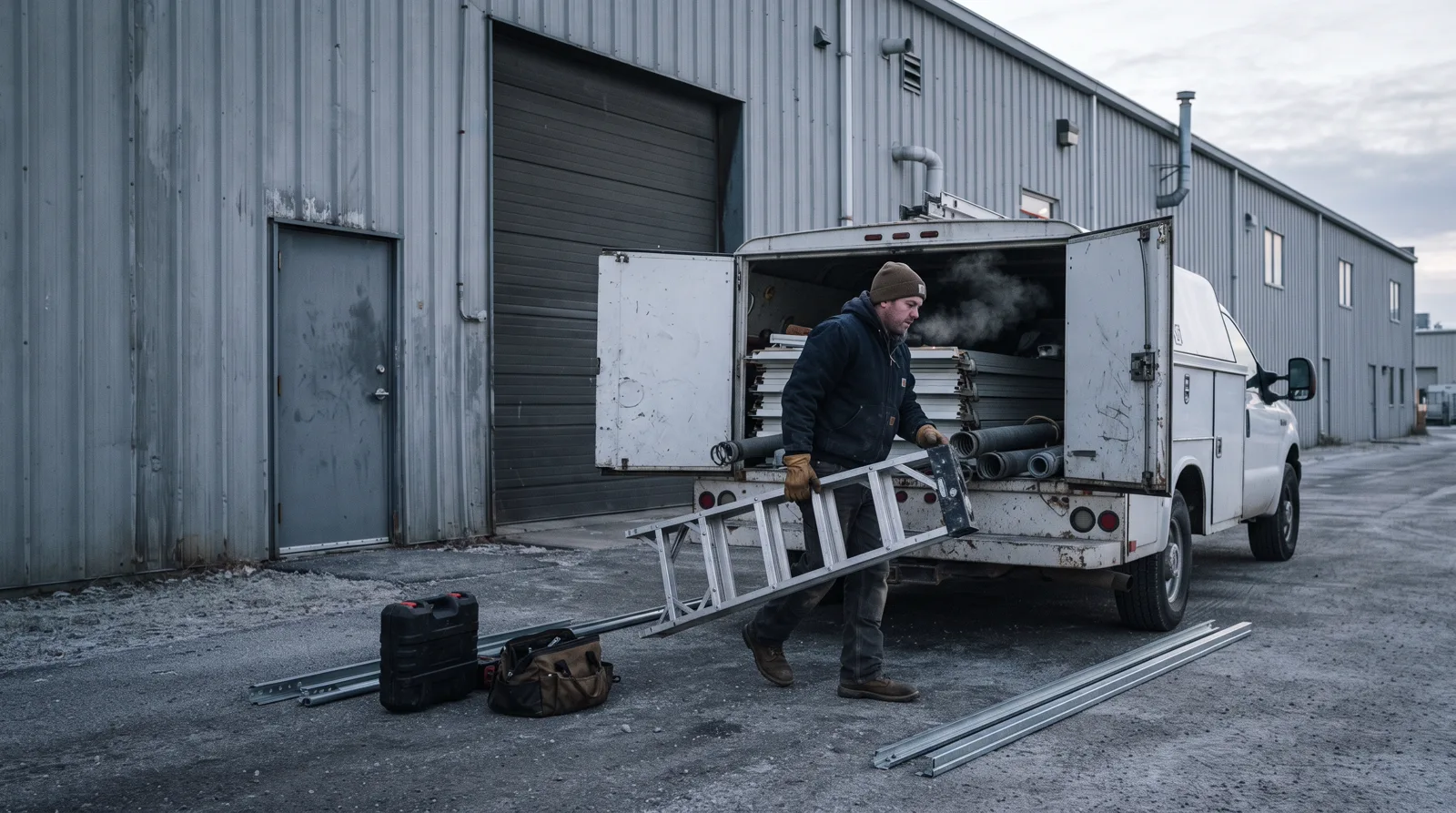
Industrial Overhead Doors Built for Alberta Business.
Fast installation, emergency repair, and preventive maintenance for warehouses, shops, and commercial facilities across Spruce Grove, Stony Plain, Parkland County, and Acheson.
Commercial Door Services for Every Industrial Need
From new construction to emergency breakdowns, we keep your operation moving.
Sectional Overhead Door Installation
Insulated steel sectional doors in sizes from 10x10 to 20x20 feet. Powder-coated finish, weather-sealed bottom, and torsion spring systems rated for 25,000 cycles. Built to handle Alberta freeze-thaw without warping.
High-Speed Door Systems
Rapid roll-up doors for warehouses and loading docks where time equals money. Open speeds of 40 to 80 inches per second, self-repairing breakaway design, and insulated curtain options. Reduces heating loss during high-traffic periods.
Commercial Door Repair & Parts
Broken springs, bent tracks, damaged panels, and failed openers. Local techs stock commercial-grade parts for most brands and can source specialty components quickly. Most repairs completed same visit.
Operator & Automation Upgrades
Heavy-duty jackshaft or trolley operators with remote access, smartphone control, and integration with building access systems. Safety edge sensors, photo eyes, and emergency manual release as standard. CSA certified for commercial use.
Safety Inspections & Code Compliance
Annual or quarterly inspections to meet Alberta Building Code and WCB safety requirements. We test spring tension, track alignment, photo eye function, and emergency stop systems. Written report with photos for your insurance and compliance records.
Weatherization & Energy Efficiency
Upgrade seals, add insulation panels, or replace single-skin doors with insulated models rated to R-16 or higher. Critical for heated warehouses and shops where a drafty door costs hundreds per month in natural gas during Spruce Grove winters.
Why Commercial Doors Here Need Alberta Engineering
🌡️ Cold-Weather Performance to Minus 40
Commercial door springs, seals, and operators must function reliably when it is minus 35°C at 6 a.m. and your loading dock needs to open. We spec cold-rated lubricants, heavy-duty torsion springs, and insulated panels that will not crack or delaminate during deep-freeze weeks in January and February.
💨 Wind Load Rating for Chinook Gusts
Acheson and Parkland County see sustained winds during chinook events and spring storms. Large commercial doors act as sails if not properly reinforced. Local pros install wind-rated doors with reinforced tracks, heavy-gauge steel, and engineered brackets that meet or exceed Alberta Building Code wind load tables for this region.
🏗️ Permitting and Inspection Coordination
New commercial door installations in Spruce Grove and Stony Plain require building permits and inspections for structural support and fire separation compliance. Local pros handle permit applications, coordinate with municipal inspectors, and provide stamped drawings when required by the authority having jurisdiction.
⚠️ WCB and Liability Insurance Coverage
Our installation crews carry commercial general liability insurance, which protects your business from claims if an injury occurs on site. You will receive proof of coverage before work starts, a requirement for most commercial property managers and insurance policies in Alberta.
What it costs here
Everything You Need to Know About Commercial Garage Doors in Spruce Grove
Door types, insulation, automation, maintenance, and how to choose the right system for your facility.
What Commercial Garage Doors Are and Why Spruce Grove Businesses Need Them
Commercial garage doors serve a fundamentally different purpose than the single-car doors on residential homes. These are engineered systems designed for daily heavy use in warehouses, manufacturing facilities, auto repair shops, fire stations, cold storage units, and distribution centers across Spruce Grove, Stony Plain, and the Acheson industrial corridor. A typical commercial door might cycle open and close 15 to 30 times per day, endure forklift traffic passing within inches of the panels, and maintain a thermal seal in conditions ranging from summer heat to -35°C winter cold. The door becomes a critical piece of infrastructure, not just an entrance. When it fails, entire operations can halt, employees sit idle, and revenue stops.
Alberta's climate creates unique demands that sort weak commercial doors from properly specified ones within a single winter. Chinook winds can swing temperatures 20 degrees in hours, causing metal panels to expand and contract rapidly. Deep frost penetrates uninsulated doors, creating ice buildup in tracks and freezing weather seals to concrete floors. Snow loads on horizontal track-mounted doors can reach significant weight during heavy storms. Hail events, common in the Parkland County area during spring and summer, can dent or puncture thin-gauge panels. A commercial door rated for mild climates will fail here, often catastrophically, within two to three years of installation.
Different commercial operations have different door requirements, and understanding the match matters. An auto body shop in Spruce Grove needs a well-insulated sectional door with high cycle springs and impact-resistant bottom panels to handle daily vehicle traffic and maintain comfortable working temperatures. A cold storage facility in Acheson requires a heavily insulated door, often with an R-value of 18 or higher, plus thermal breaks to prevent condensation and ice formation. A fire station needs a high-speed door that opens in under 10 seconds to meet emergency response times. A warehouse handling frequent loading dock activity might choose a rolling steel door with a commercial operator rated for 50,000 cycles or more per year.
When a commercial garage door fails during business hours, the costs accumulate quickly. A distribution center in Acheson with a jammed overhead door might have three trucks waiting, each representing $500 to $1,200 in delayed delivery penalties. An auto repair shop in Spruce Grove loses $200 to $400 per bay hour when a door malfunction blocks vehicle access. Heating costs spike when a poorly sealed door allows -20°C air to pour into a workspace, and WCB claims can follow if employees work in unsafe cold conditions. The real cost of a commercial door is not the purchase price, but the cost of failure. That is why businesses choose doors based on reliability, cycle rating, and proper climate specification, not lowest bid.
How Alberta's Climate and Building Codes Shape Commercial Door Requirements
Commercial garage doors in Spruce Grove face freeze-thaw cycles that most southern manufacturers never engineer for. When daytime temperatures climb to +5°C during a chinook, then plunge to -25°C overnight, the moisture that seeped into track assemblies, weather seals, and panel joints freezes solid. This expansion can crack powder coatings, split vinyl seals, and bind rollers in their tracks. Doors must use cold-rated lubricants, galvanized or stainless hardware, and weatherstripping compounds that remain flexible below -40°C. Bottom seals need to be replaceable and designed to compress against ice buildup on concrete floors. Cheaper doors use rubber compounds that turn brittle and crack within one Alberta winter, leading to air leaks and pest entry.
The Alberta Building Code requires commercial garage doors to meet specific wind and snow load ratings based on location and building height. In Parkland County, a standard commercial door installation must withstand wind loads of 0.5 kPa or higher, which translates to sustained winds around 90 km/h with gusts above that. Chinook wind events and prairie storms regularly hit those speeds. Snow load requirements depend on roof pitch and building design, but doors with horizontal tracks above the opening must support the additional weight of snow accumulation without sagging or binding. A door that meets code in Vancouver will not meet code in Spruce Grove. Engineers reviewing permit applications verify these ratings, and installers who skip the engineering stamp risk failed inspections and liability exposure.
Thermal performance separates a commercial door that works from one that creates problems. An uninsulated or poorly insulated door in a heated shop or warehouse becomes a thermal bridge, radiating cold inward and forming condensation or frost on interior surfaces. This leads to ice buildup, mold growth, and dramatically higher heating bills. Insulated commercial doors use polyurethane or polystyrene cores with R-values ranging from R-8 for basic models to R-18 or higher for climate-controlled or cold storage environments. The door's thermal breaks, where metal components pass through insulation layers, must be engineered to prevent heat loss. In Acheson's industrial corridor, where energy costs directly impact operating margins, a well-insulated door can pay for itself in energy savings within three to five years.
Commercial buildings in Alberta often require fire-rated doors depending on occupancy type and proximity to property lines or other structures. A fire-rated garage door must be tested and labeled to withstand fire exposure for a specific duration, typically 90 minutes or more, without allowing flame or smoke passage. These doors use specific core materials, steel gauges, and hardware that meet National Fire Code and Alberta Fire Code requirements. Installing a non-rated door where a rated one is required is a code violation that can void insurance, trigger stop-work orders, and create serious liability if a fire occurs. Contractors who do not understand these requirements should not be bidding commercial work.
Warning Signs Your Commercial Garage Door Needs Service or Replacement
Several mechanical symptoms indicate a commercial garage door has reached the end of its service life or needs immediate repair. Cables showing frayed strands or rust pitting are a critical safety risk, as a failed cable under spring tension can cause the door to drop suddenly, crushing anything beneath it. Springs that show gaps between coils, visible rust, or make popping sounds during operation are near failure. Panels with cracks, buckles, or separating seams lose structural integrity and thermal performance. Rollers that wobble, bind, or leave metal shavings in the tracks indicate worn bearings. These are not cosmetic issues. They are warnings that a catastrophic failure is approaching, and the financial and safety costs of ignoring them far exceed the cost of proactive replacement.
Operational symptoms often appear before mechanical failure becomes obvious. A door that takes longer to open or close than it did six months ago indicates motor wear, track misalignment, or spring fatigue. Loud grinding, scraping, or squealing during operation points to worn rollers, dry tracks, or damaged panels rubbing against the frame. A door that stops mid-cycle, reverses unexpectedly, or requires multiple button presses to operate fully has sensor, logic board, or power supply issues. Uneven movement, where one side of the door lags behind the other, signals broken cables, unbalanced springs, or bent tracks. In a commercial setting, these symptoms reduce productivity, frustrate employees, and signal that a breakdown during peak hours is imminent.
Alberta's climate leaves visible marks on failing commercial doors. Ice buildup along the bottom seal or inside the track channels during winter indicates the weatherstripping has failed or the door no longer seats properly. Frost patterns on the interior surface of the door panels reveal thermal bridging or insulation breakdown. Daylight visible around the door perimeter when closed, or wind whistling through gaps during storms, means seals have degraded. Rising heating bills without other operational changes often point to air leakage through the door assembly. Condensation or water pooling inside the building near the door after rain or snow indicates the top seal or panel joints are compromised. These are energy drains and comfort issues that also signal structural wear.
There is a financial tipping point where repairing an aging commercial door stops making sense. If a door has required three or more service calls in a single year, or if annual repair costs exceed 30 to 40 percent of a replacement door's price, replacement is the better investment. Parts availability also drives this decision. Older doors, especially those more than 15 years old, often use discontinued components. Technicians improvise fixes with generic parts that work temporarily but lack the original specifications. This creates a cycle of temporary repairs, increased downtime, and rising frustration. Businesses that wait until total failure to replace often face emergency premium pricing, limited door selection, and days of lost productivity waiting for installation.
The Commercial Garage Door Installation and Service Process in Spruce Grove
The commercial door process begins with an on-site assessment, not a phone quote. A qualified installer visits the business location in Spruce Grove, Stony Plain, or Acheson to measure the rough opening, assess headroom and side room clearances, inspect the structural support around the opening, and discuss operational requirements with the business owner or facility manager. This visit determines whether the existing opening can accommodate the desired door type, whether structural reinforcement is needed to support the door weight and wind load, and what electrical work is required for the operator. The installer also evaluates usage patterns, asking how many cycles per day the door will run, what kind of traffic passes through, and whether climate control or noise reduction is a priority. These details drive door specification.
Most commercial garage door installations in Spruce Grove and Parkland County require a building permit and engineered drawings. The installer or door supplier submits stamped engineering drawings showing the door assembly, structural load paths, wind and snow load calculations, and anchoring details. Depending on building occupancy and door size, the municipality may require fire rating certifications, safety sensor documentation, and electrical inspection sign-off. Permit approval timelines vary, but typically take two to four weeks in Spruce Grove. Skipping permits is common among low-cost installers, but it creates serious liability for the business owner. If an incident occurs, insurance can deny coverage based on unpermitted work, and the municipality can issue stop-use orders until the installation is brought into compliance.
Once site conditions and permit requirements are clear, the business chooses the door. Common commercial options include insulated sectional steel doors with windows for auto shops and retail-facing spaces, non-insulated rolling steel doors for unheated warehouses, high-speed fabric or aluminum doors for frequent-access applications, and heavily insulated thermal doors for cold storage or climate-controlled environments. Panel thickness ranges from 24-gauge steel for light-duty applications to 18-gauge or thicker for impact zones. Insulation options include polystyrene, which is cost-effective but lower R-value, and polyurethane foam, which offers better thermal performance and panel rigidity. Spring systems are rated by cycle count, typically 10,000 cycles for standard-duty, 25,000 for medium-duty, and 50,000 or more for high-cycle applications. Commercial operators come in chain-drive, belt-drive, or direct-drive configurations, with horsepower chosen based on door size and weight.
Professional commercial door installation typically takes one to two days depending on door size, structural work required, and whether removal of an old door is included. Installers coordinate timing to minimize business disruption, often scheduling work on weekends, after hours, or during planned shutdowns. The process involves removing the old door if present, reinforcing or modifying the structural opening if needed, installing the track system and mounting hardware, assembling and hanging the door panels, installing and tensioning the spring system, mounting and wiring the operator, installing safety sensors and controls, and testing the full operation cycle. Final inspection by the municipality follows, verifying code compliance, proper safety sensor function, and correct installation per the engineered drawings.
After installation, the door undergoes a full operational test. The installer verifies smooth operation through multiple open-close cycles, checks safety sensor response by placing an obstruction in the door path, tests manual release mechanisms, and confirms the door seals properly at the bottom and sides. The business receives documentation including warranty information, operator manuals, and a recommended maintenance schedule. Commercial doors require professional service every 12 months, including track cleaning, roller and hinge inspection, spring tension adjustment, cable examination, operator lubrication, and safety sensor testing. Many businesses purchase annual service contracts to ensure this happens consistently. Preventive maintenance extends door life, reduces emergency breakdowns, and keeps the system operating safely and efficiently over its expected 15 to 25 year service life.
Commercial Garage Door Costs in Spruce Grove and the Tri-Region
A single commercial overhead door in Spruce Grove typically runs from $2,200 to $8,500 installed, depending on size, insulation, operator type and wind load rating. A standard 10x10 insulated steel sectional with a basic chain drive operator starts around $2,800 to $3,400. A 16x14 insulated door rated for Alberta wind and snow loads, paired with a jackshaft operator and photo eyes, commonly lands between $5,200 and $6,800. High-cycle doors for busy shops, insulated to R-16 or R-18 and built to survive Parkland County winters, can reach $7,500 to $8,500 per opening. Size, insulation value, cycle rating and operator sophistication drive the bulk of the cost variation.
Material choice creates the next price tier. Non-insulated steel doors are the entry point at $1,800 to $2,600 for smaller openings, but they sweat, transmit noise and offer zero thermal protection in a climate that swings from minus 30 to plus 30. Single-layer insulated doors add $600 to $1,200 to the base price and deliver R-6 to R-8 performance, enough to keep frost off the interior and reduce heating costs in a climate-controlled warehouse. Double-layer polyurethane-injected doors rated R-16 or higher add another $1,400 to $2,200 but pay for themselves in fuel savings and comfort if you heat the space or run equipment sensitive to cold. Aluminum full-view doors with insulated glass panels start around $4,500 for a 10x10 and climb to $9,000 or more for 16-foot-wide openings, popular in Acheson showrooms and auto dealerships where visibility matters.
Operators and accessories pile on the next layer of cost. A basic chain drive trolley operator runs $800 to $1,200 installed and works fine for low-traffic bays that cycle a few times daily. Belt drive operators cost $1,100 to $1,600 and run quieter, a benefit if the door sits near an office or customer area. Jackshaft operators mount on the wall instead of the ceiling, freeing up overhead clearance for hoists or ductwork, and cost $1,400 to $2,000 installed. High-cycle operators built for 50 or 100 daily cycles cost $2,200 to $3,500 and are mandatory for busy service bays, loading docks and fire stations. Add $300 to $600 for photo eyes, wireless keypads, battery backup and remote monitoring, features that improve safety and uptime in a commercial setting.
Repair costs vary by failure mode and part availability. Spring replacement on a commercial door runs $280 to $650 depending on door weight and spring configuration; heavier doors and high-cycle springs cost more. Cable replacement costs $180 to $320 per side, roller replacement $40 to $80 per wheel, and panel replacement $350 to $900 per section depending on size and whether the panel matches an obsolete color or profile. Operator board replacement runs $220 to $480, motor replacement $380 to $750, and a full track realignment after an impact can hit $500 to $1,100 if the frame is bent. Winter service calls in Spruce Grove or Stony Plain often carry a $120 to $180 trip charge on top of labor, so bundling multiple repairs into one visit saves money.
Comparing Door Types, Materials and Operating Systems
Sectional steel doors dominate commercial installations in the Tri-Region because they balance cost, durability, insulation and parts availability. The door rides in vertical tracks, rolls overhead on a torsion spring counterbalance, and seals tightly when closed. Steel skins resist denting better than aluminum, hold paint longer in freeze-thaw cycles, and survive hail impacts that would crater softer materials. Insulated sectional doors use a steel outer skin, a polyurethane or polystyrene core, and a steel or vinyl inner skin, creating an R-value between 6 and 18 depending on thickness and core material. Polyurethane-injected doors offer the highest R-value per inch and bond the skins together, making the panel stiffer and more resistant to bowing in wind. Polystyrene boards slide between the skins and cost less but deliver lower R-values and can shift over time.
Rolling steel doors and coiling doors serve different use cases. A rolling steel door coils into a compact barrel above the opening, freeing interior space and eliminating side tracks. These doors work well in tight mechanical rooms, storage areas and exterior loading docks where overhead clearance is limited or side clearance is nonexistent. They cost $2,800 to $6,500 depending on size and slat gauge, and most models offer minimal insulation because the interlocking slats create air gaps. Wind-rated models use thicker slats and reinforced guides, necessary in exposed Acheson industrial parks where chinook winds can slam an unrated door off its tracks. Rolling doors cycle faster than sectional doors and handle high-traffic environments well, but they are louder, harder to insulate, and require more frequent lubrication in dusty or cold conditions.
Full-view aluminum doors with glass panels bring natural light into showrooms, fire stations and auto shops where visibility and curb appeal matter. The frame is extruded aluminum, and the panels are tempered safety glass or insulated glass units. A 12x12 full-view door costs $5,500 to $8,200 installed, and a 16x14 model can reach $9,500 to $12,000 with insulated glass and powder-coated frames. These doors look sharp and let in daylight, but the glass transmits cold, the frames conduct heat, and the seals require more maintenance than steel sectional doors. In a heated shop, condensation forms on the inside of single-pane glass when outdoor temperatures drop below minus 10, so insulated glass units are worth the $1,200 to $2,000 upcharge if the building stays above 15 degrees inside.
Operator Types and Cycle Ratings
Chain drive trolley operators are the entry-level commercial choice. A motor turns a sprocket that pulls a chain attached to the door's trolley carriage, lifting the door along the track. These operators cost $800 to $1,200 installed, handle doors up to 450 kilograms, and last 10 to 15 years in low-cycle applications. The chain rattles and clanks, especially in cold weather when metal contracts and the chain slackens, so they are a poor fit for offices or retail spaces where noise matters. Maintenance involves annual chain lubrication and periodic sprocket inspection, simple work that most facility staff can handle.
Belt drive trolley operators replace the metal chain with a reinforced rubber belt, cutting noise by 60 to 70 percent and delivering smoother starts and stops. They cost $1,100 to $1,600 installed and suit shops where the door opens into a customer area or sits near workstations. The belt lasts 8 to 12 years and requires no lubrication, but replacement belts cost $150 to $280 versus $60 to $90 for a chain. Jackshaft operators mount on the wall beside the door instead of overhead, using a shaft and gearbox to turn the torsion bar directly. This design frees up ceiling space for HVAC ducts, hoists or storage, and it works in buildings with low or obstructed ceilings. Jackshaft operators cost $1,400 to $2,000 installed and run quieter than chain drives, but they require more precise installation and the gearbox needs periodic oil changes.
Cycle rating determines how many open-close cycles the door and operator can handle before parts fail. Standard-duty commercial doors are rated for 10,000 cycles, roughly three to five years of daily use in a typical shop. Medium-duty doors are rated for 25,000 to 50,000 cycles and use heavier springs, thicker track, and commercial-grade operators, suitable for service bays that open 15 to 30 times daily. High-cycle doors rated for 100,000 cycles or more are built for fire stations, busy loading docks and municipal garages, with oil-tempered springs, sealed bearings, heavy-gauge track and direct-drive operators that cost $2,500 to $4,000 installed. Matching the cycle rating to actual use prevents expensive downtime and premature part replacement.
Common Mistakes and Contractor Red Flags
Buying the wrong door for the application is the most expensive mistake. A standard-duty insulated door works fine in a heated warehouse that cycles three times daily, but the same door fails within two years in a fire station that cycles 20 times daily. The springs fatigue, the rollers wear flat, the operator overheats, and the door ends up stuck open on a minus 25 morning. A contractor who does not ask how many daily cycles you expect, whether the building is heated, and what your wind exposure looks like is guessing, and guesses lead to callbacks. Insist on a door rated for at least twice your expected cycle count, and if you heat the space or store temperature-sensitive inventory, specify R-12 insulation or higher to prevent frost, condensation and heat loss.
Skipping wind load calculations in exposed locations causes catastrophic failures. A standard residential-rated door installed on an Acheson warehouse facing west into prevailing chinook winds can bow, buckle or rip off the tracks when a 90 kilometer per hour gust hits. Commercial doors in the Tri-Region should meet or exceed the wind load requirements in the Alberta Building Code, typically 0.8 to 1.2 kilopascals depending on exposure and building height. Wind-rated doors use thicker panels, reinforced struts, heavier track and additional anchors, adding $600 to $1,400 to the door cost but preventing catastrophic damage. A contractor who does not mention wind load or dismisses it as unnecessary is either inexperienced or cutting corners, and either scenario ends badly.
Ignoring safety devices is illegal and dangerous. Every commercial operator installed in Alberta after 2000 must include a photoelectric sensor that reverses the door if the beam is interrupted. Doors in fire stations and public-access buildings require additional safety edges that stop and reverse on contact. Skipping these devices to save $200 violates code, voids insurance, and creates liability if someone is injured. A contractor who suggests skipping sensors or disabling them to solve nuisance tripping is telling you they do not understand or care about code compliance. Sensors trip for a reason: dirt on the lens, misalignment, a damaged wire, or an actual obstruction. The correct fix is cleaning, realigning or repairing the sensor, never bypassing it.
Choosing price over reputation invites disaster. The lowest bid on a commercial door job is often low because the contractor is inexperienced, uninsured, using off-brand parts, or planning to cut corners on fasteners, insulation or safety devices. A reputable contractor provides a written quote that specifies door brand, insulation R-value, operator model, cycle rating, wind load rating, and warranty terms. They carry WCB coverage and commercial liability insurance, both of which you should verify before signing. They pull permits for new installs and provide a code-compliant installation with labeling, warning signs and manuals. A contractor who balks at written quotes, cannot provide insurance certificates, or dismisses permits as unnecessary is a lawsuit waiting to happen. Pay the extra 10 to 15 percent for a contractor who does it right the first time, because the cost of tearing out and redoing a failed installation far exceeds the savings from the cheap bid.
Hiring the Right Commercial Door Contractor
Start by verifying credentials and coverage. Every commercial door contractor in Alberta should carry commercial general liability insurance of at least $2 million. Ask for certificates and call the issuing company to confirm they are current. A contractor without liability insurance exposes you to liability if a worker is injured on your property, and a contractor without liability insurance leaves you holding the bag if the door damages your building, injures a customer, or fails during a windstorm. Check references from at least three recent commercial projects in the Tri-Region, and drive by those sites if possible to see how the doors look and function. A contractor with a solid reputation will happily provide references and proof of insurance; one who hesitates or makes excuses is hiding something.
Demand detailed written quotes that specify every component. A vague quote that says 'commercial door installed' tells you nothing about what you are buying. A proper quote lists door brand and model, dimensions, insulation R-value, panel gauge, color, window configuration if applicable, operator brand and horsepower, cycle rating, wind load rating, safety devices included, warranty terms for parts and labor, and whether permits and inspections are included. Compare at least three quotes side by side, and do not assume they are quoting equivalent products. A $4,200 quote might be for a non-insulated door with a residential operator and no wind rating, while a $6,400 quote might include R-16 insulation, a commercial jackshaft operator, wind-rated panels and a ten-year parts warranty. The difference is not price gouging; it is the cost of buying the right door for the application.
Ask about lead times, parts availability and service response. Some commercial door brands common in the United States take six to ten weeks to arrive in Spruce Grove, and parts for obscure brands can take even longer. A contractor who stocks common parts, has relationships with local distributors, and can service what they sell will get you back in operation faster when something breaks. Ask what their typical service response time is for emergency calls, whether they stock springs and operators for the door they are quoting, and whether they offer a service contract that includes preventive maintenance. A contractor who installs a door and disappears is useless when the door fails at 7 a.m. on a Monday and your crew cannot get into the shop. Choose a contractor who treats the installation as the start of a relationship, not the end of a transaction.
How Tri-Region Services helps
Tri-Region Services connects you with one vetted, fully insured local commercial door contractor who serves Spruce Grove, Stony Plain, Parkland County and Acheson. Every contractor in our network tells us they carry commercial liability insurance, stocks common parts, and has completed multiple commercial installations in the area. You receive one free written quote with detailed specifications, and you deal directly with the contractor from quote to completion. No bidding wars, no contractor roulette, just one qualified pro who shows up, assesses your needs, and provides a clear price for the right door and operator for your application.
Why Tri-Region Businesses Trust Us With Their Overhead Doors
Compliance, speed, and transparency built into every job.
Code compliant Installation Crews
Every technician carries active Workers Compensation Board coverage, protecting you from liability if an injury occurs during installation or repair.
Written Safety Inspection Reports
You receive a dated, photo-documented report of all safety tests and code compliance checks, ready for insurance audits or WCB reviews.
After-Hours Emergency Dispatch
When a door fails at 10 p.m. and your facility is losing heat or security, your request is flagged urgent and routed to an available local technician immediately.
Alberta Building Code Expertise
We stay current on Part 3 and Part 9 requirements for fire separation, structural support, and life safety as they apply to commercial overhead doors in this jurisdiction.
Downtime Minimization Guarantee
We pre-stage materials, coordinate delivery, and schedule installations during your off-hours or low-traffic periods to keep your operation running.
Multi-Location Fleet Service
If you operate facilities in multiple Tri-Region communities, we provide consistent service, centralized billing, and synchronized maintenance schedules across all your sites.
This page is not tied to a contractor's brand. Leads route straight to your one local partner. Verified reviews can appear here once that partner has them (never fabricated).
Serving the whole Tri-Region
7 Questions Business Owners Ask About Commercial Garage Doors
What R-value insulation do I need for a heated warehouse in Spruce Grove?+
When does a high-speed door make sense versus a standard overhead door?+
How often should a commercial overhead door be serviced?+
Do I need a building permit to replace a commercial garage door in Stony Plain?+
Should I repair or replace a 15-year-old commercial overhead door?+
What is typical emergency response time for a broken commercial door in Parkland County?+
How much does it cost to heat a warehouse with a poorly insulated overhead door?+
What wind rating should a commercial door have in Acheson?+
Get your free quote
Tell us what you need and a local pro will get right back to you.
- ✓ Sent straight to a local business
- ✓ You choose who you hire
- ✓ Free, with no obligation