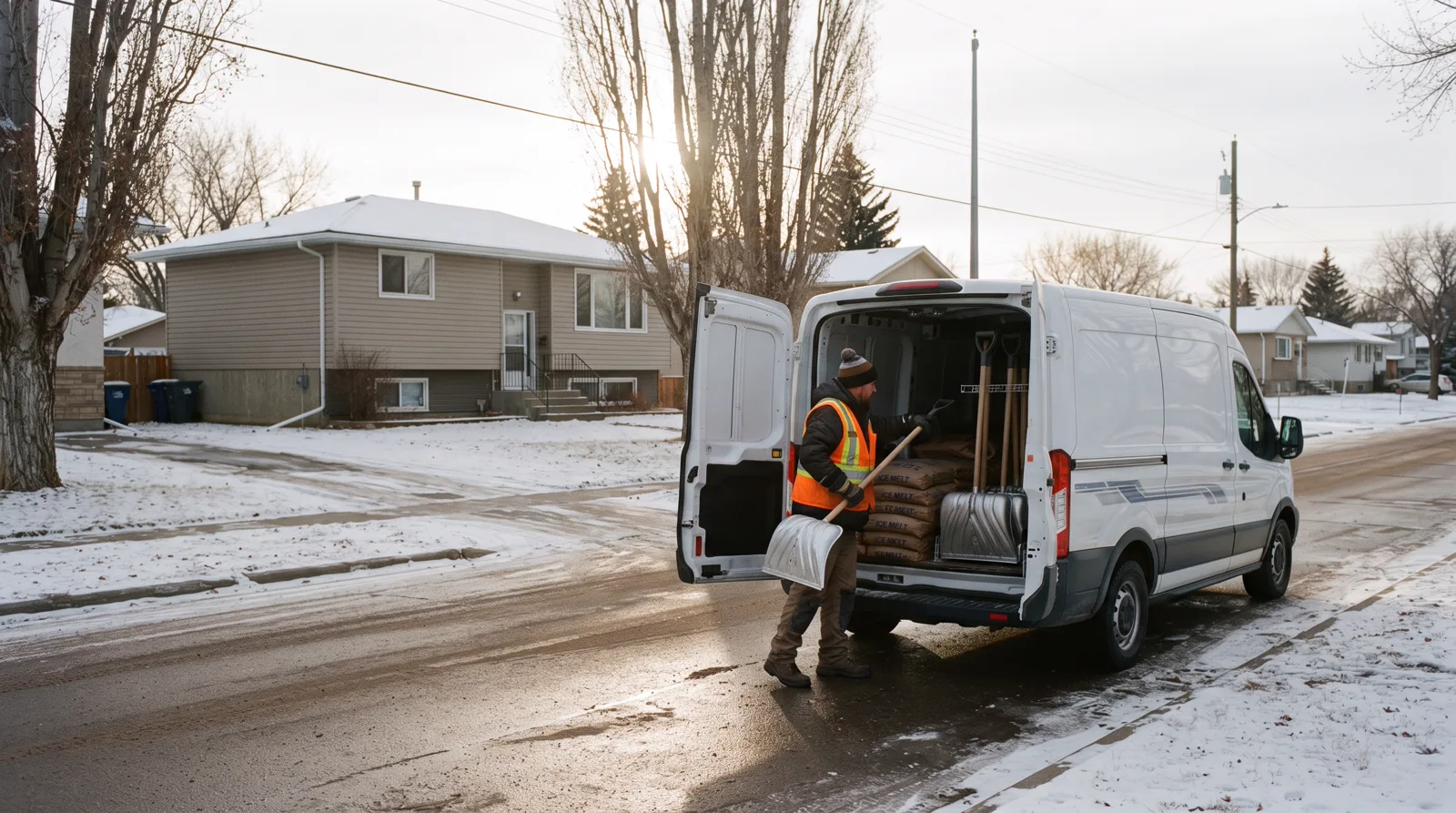
Commercial Snow Removal in Spruce Grove Cleared Before Your Customers Arrive.
Parking lots, loading areas and walkways cleared by local snow removal pros. Trigger-depth service, liability insurance stated at signup.
Commercial Snow Services We Connect You With
Every pro matched to your lot size, equipment needs and budget. Verified before dispatch.
Parking Lot Plowing
Small strip mall to big-box retail lots. The pro we match you with confirms trigger depth (typically 5cm to 8cm), arrival window and per-push or seasonal rate before the first snowfall. Equipment sized to your lot: skid-steer for tight spaces, loader for open acreage.
Loading Dock & Receiving Area Clearing
Dock ramps, truck turnarounds and receiving lanes cleared for morning deliveries. The snow removal pro confirms overnight or early-morning timing so your freight can roll in on schedule. Often bundled with parking lot service for one flat seasonal rate.
Walkways, Entries & Accessible Ramps
Sidewalks, building entrances and wheelchair ramps cleared to Alberta accessibility standards. The pro doing the work uses a small blower or shovel crew for tight corners, confirms slip-and-fall liability coverage, and schedules clearing before your doors open for the day.
De-Icing & Anti-Slip Treatment
Rock salt, calcium chloride or sand spread after plowing and during chinook freeze-thaw cycles. The pro we connect you with confirms material choice (salt works to minus 20C, calcium to minus 30C), application rate and whether it is included in your seasonal contract or billed separately.
Snow Hauling & Disposal
When snow piles block parking stalls or loading zones, the matched pro hauls it off-site to a legal dump area. Billed per truckload or by the hour. Common after back-to-back storms or on small lots with no room to push snow to the edges.
Emergency Requests Prioritized
Overnight snowfall or sudden storm during business hours. The pro on standby confirms arrival timing directly, clears your lot to safe operating condition, and invoices at the emergency rate (typically 1.5x to 2x standard per-push). Seasonal contract holders often get priority dispatch at no surcharge.
Why Alberta Weather Demands Local Know-How
🌬️ Chinook Freeze-Thaw Ice Layers
A January chinook melts 15cm of snow to slush, then overnight frost locks it into a skating rink. The pros we match you with plan for this: they apply calcium chloride or sand before the refreeze, not just after. One melt-and-freeze cycle causes more slip-and-falls than three straight snowstorms.
❄️ Compact Hard Pack from Deep Frost
When the thermometer sits at minus 25C for a week, every tire and boot compresses snow into a rock-hard base layer. Standard residential plows scrape over it. The commercial operators we connect you with use heavier equipment with down-pressure or a heated edge to break through, so your lot stays level all winter instead of rising 10cm by March.
🏢 WCB & Liability Rules for Commercial Properties
If a customer or employee slips on your lot, your insurer will ask who cleared it and whether they carried liability insurance and liability coverage. Every snow removal pro in our network confirms both before dispatch, and we verify the certificates are current, not expired from last season.
🚧 Parkland County & Spruce Grove Bylaw Snow Dump Limits
You cannot push snow onto the street or into drainage ditches without a ticket. The hauling contractors we match you with know the legal dump sites in Parkland County and Spruce Grove, and they price the round-trip mileage into the quote up front so there are no surprise fees when the pile gets too high.
What it costs here
Everything You Need to Know About Commercial Snow Removal in Spruce Grove
Contracts, equipment, timing, liability and what to ask before you sign. Read this before the first snowfall.
What Commercial Snow Removal Actually Involves
Commercial snow removal for a business in Spruce Grove or Stony Plain means more than a truck with a blade showing up after a storm. The service covers your entire parking lot, loading zones, drive lanes, sidewalks along your building, accessible parking stalls, and any area where customers or delivery drivers need to walk or drive safely. Most contracts include hauling snow off-site when windrows get too high to push, applying sand or ice melt to prevent slip hazards, and clearing catch basins so meltwater drains properly. The pro doing the work will confirm what equipment they plan to use based on your lot size and layout, and whether they can handle the job with a plow truck or need a loader and dump runs.
A small office parking lot with 20 stalls might get cleared with a three-quarter-ton truck and a rear blade in under an hour. A shopping plaza, warehouse yard, or industrial site with semi-truck access needs a loader or skid steer, possibly a dump truck for haul-away, and a multi-hour window to finish the job safely. Response time matters because your customers and staff arrive early, so most commercial contracts specify a trigger depth (often 5 cm or 7 cm of snow) and a completion deadline (for example, cleared by 7 a.m. on weekdays). The pro confirms their equipment list, backup plan if a machine breaks down, and how they handle overnight storms versus daytime accumulation before you sign anything.
Every business owner in Alberta worries about slip-and-fall liability, and snow removal is where that risk lives all winter. The contractor doing your clearing carries commercial general liability coverage (typically $2 million or more) for their crew, both stated at signup. After each clearing event, you receive a time-stamped record showing when the crew arrived, what areas were cleared, and what materials were applied. That documentation is critical if someone claims they slipped in your lot three days after a storm, because it proves you acted reasonably. Some contracts also include photo proof of completion, which insurance adjusters appreciate when a claim lands on your desk.
Why Spruce Grove and Parkland County Winter Conditions Demand Professional Snow Management
The Parkland County area, including Spruce Grove, Stony Plain, and Acheson, sits right in the chinook belt. That means a 20 cm dump on Monday can partly melt by Wednesday afternoon, then refreeze into a skating rink overnight when temperatures drop back to minus fifteen. A plow clears the snow, but the melt-and-freeze cycle leaves behind black ice, rutted ice ridges in drive lanes, and slick patches where customers step out of their cars. Professional snow clearing includes ice management: calcium chloride or sand applied to high-traffic zones, windrow edges cut back so meltwater doesn't pool and freeze, and repeat visits after a chinook to scrape off the new ice layer before it becomes a lawsuit.
Alberta Building Code requires commercial roofs to handle specific snow loads, but that doesn't mean you can ignore the giant piles accumulating next to your building. When a loader pushes snow into windrows along your lot perimeter, those piles can grow to two meters high by mid-February. If they're against your building, meltwater seeps into the foundation or floods your mechanical room during the next warm spell. If they block fire exits, sightlines, or accessible parking, you're out of compliance with municipal bylaws and could face fines. The snow removal pro will confirm where they plan to pile snow during the site assessment, and whether hauling off-site becomes necessary once storage room runs out.
The Town of Spruce Grove and Parkland County both have bylaws requiring business owners to keep parking lots, sidewalks, and accessible routes clear of snow and ice. If a customer in a wheelchair can't reach your front door, or if a delivery truck can't access your loading bay because the approach is buried, you're not just losing business, you're potentially liable. Some commercial leases include specific snow clearing standards, and landlords can back-charge tenants who don't maintain their assigned areas. A documented snow removal contract shows you're meeting your duty of care, which matters when the municipality inspects or when an insurance claim examines whether you took reasonable precautions.
Signs Your Business Needs a Commercial Snow Removal Contract
The clearest warning sign is someone slipping on ice in your parking lot or near your entrance. Even if no injury claim follows, that near-miss tells you the current approach isn't working. Alberta law expects business owners to take reasonable steps to prevent foreseeable harm, and a snow-covered or icy lot is a foreseeable hazard every winter. If your staff is salting the walkway but leaving the parking lot untouched, or if you're plowing once a week instead of after every storm, you're running risk that a professional contract eliminates. One slip-and-fall claim can cost tens of thousands in legal fees and settlement payments, far more than a seasonal snow contract.
When customers start commenting that your lot is hard to navigate, or when delivery drivers refuse to back into your loading bay because it's not cleared, you're losing money. A restaurant in Stony Plain that doesn't clear its parking lot by lunchtime loses the noon rush. A retail store in Spruce Grove with snow piles blocking half the stalls loses weekend shoppers who drive past to a competitor with clear access. Industrial sites face production delays when material deliveries can't get through, and office tenants complain when staff can't park safely. These aren't minor inconveniences; they're revenue hits that add up fast over a four-month winter season.
Many commercial insurance policies include a clause requiring regular snow and ice management as a condition of coverage. If you file a slip-and-fall claim and the insurer finds you didn't have a professional clearing contract or documented clearing schedule, they may deny the claim or refuse to renew your policy. Similarly, commercial lease agreements often specify that the tenant must keep their assigned areas clear to a certain standard, with photographic or timestamped proof available on request. If you're handling snow removal in-house with your own staff and a pickup truck, you likely don't have the documentation trail that satisfies an insurer or landlord when they audit compliance.
The Commercial Snow Removal Process from Site Assessment to Storm Response
The process starts with the snow removal pro visiting your property to measure the lot, identify obstacles (light poles, curbs, islands, fire hydrants), and discuss your business hours and access needs. They'll ask what time you need the lot cleared by, whether you have accessible parking that must be prioritized, and where snow can be piled without blocking sightlines or fire routes. Based on that walkthrough, they provide a quote. Pricing structures vary: some contracts charge per event (each time they plow), others offer a seasonal flat rate that covers unlimited visits, and some use a hybrid model with a base rate plus overage fees if snowfall exceeds a threshold like 150 cm total for the season. Typical per-event pricing for a small commercial lot in Spruce Grove runs $200 to $600 depending on size, while seasonal contracts for larger sites can range from $2,500 to $12,000 or more.
Once you agree on pricing, the contract spells out exactly when the crew will show up and what gets done. A common trigger is 5 cm of accumulation: when Environment Canada reports that much new snow, the contractor dispatches a crew without you having to call. The contract also defines a completion deadline, such as 'all areas cleared and sanded by 7 a.m. on business days' or 'within four hours of snowfall ending.' Some agreements include priority tiers, where your site gets cleared first if you pay a premium, or where multiple properties are serviced in a rotation. The pro will confirm their backup equipment plan in case a truck breaks down mid-storm, and whether they subcontract any portion of the work or handle everything with their own crew and machines.
When snow starts falling overnight or during business hours, the contractor monitors accumulation and dispatches a crew once the trigger depth is hit. The crew arrives with a plow truck or loader, clears the main drive lanes and parking stalls first so early arrivals can park, then works outward to perimeter areas and sidewalks. They push snow into designated windrow zones, apply ice melt or sand to walkways and accessible routes, and clear catch basins if meltwater is pooling. If the storm is ongoing, they may return for a second pass to keep the lot accessible throughout the day. After completing the work, the crew logs the time, takes photos if that's part of the contract, and submits a service record to your business. That record becomes your proof of due diligence if any incident occurs later in the week.
Throughout the winter, you receive a clearing log that shows every service date, what was done, and what materials were used. This documentation satisfies insurance audits, landlord inspections, and municipal bylaw checks. If conditions change during the season (for example, a chinook melts everything and then a January cold snap creates persistent ice), the contractor may recommend additional treatments or schedule changes. Some contracts allow for mid-season adjustments to the trigger depth or service frequency based on actual weather patterns. The goal is a lot that stays safe and accessible all winter without surprises, and a paper trail that proves you met your legal duty of care every single day.
What Commercial Snow Removal Costs in the Tri-Region
Commercial snow removal pricing in Spruce Grove, Stony Plain and Acheson typically runs on one of three models: per visit, seasonal contract, or hourly. Per visit pricing ranges from $150 to $800 for a standard business parking lot (20 to 50 stalls), depending on snowfall volume and whether you need just plowing or also salting and walkway clearing. Seasonal contracts for the same lot typically fall between $2,800 and $7,500 for November through March, with the price hinging on how many service visits are included and what triggers a callout. Hourly rates, less common but used for larger industrial sites or one-off events, run $120 to $200 per hour for truck and operator, with loader work climbing to $180 to $280 per hour.
Lot size is the single biggest cost driver, but layout complexity matters nearly as much. A 100-stall lot that is wide open and rectangular costs less to clear than a 60-stall lot carved into islands, curbs and tight turn radii. Equipment access influences price: if the operator has to hand-shovel loading dock approaches or use a small machine because a full-size loader cannot fit, labor time doubles. Frequency expectations also shift the number. A twice-weekly schedule through winter, regardless of snowfall, costs more than a trigger-based contract that only dispatches after 5 cm accumulation. In Parkland County and rural Acheson, longer travel distances from the contractor's yard add $50 to $150 per visit as a travel surcharge.
Material costs layer on top of equipment time. Bulk rock salt runs $90 to $140 per tonne delivered in the Tri-Region, and a typical commercial lot uses 200 to 600 kg per salting, translating to $18 to $84 in material per visit. Liquid brine pre-treatment, increasingly common on high-traffic lots, costs $0.08 to $0.15 per square meter applied. Sand is cheaper at $40 to $70 per tonne, but it does not melt ice and requires spring sweeping, which adds $200 to $600 to your April cleanup bill. Contractors who include materials in their seasonal rate build in a snowfall assumption (typically 120 to 150 cm total for a Spruce Grove winter), and if the season runs heavy, some contracts have an overage clause that bills extra visits at $100 to $250 each.
Comparing Your Snow Removal Methods and Equipment
Salt, sand and liquid brine each solve different problems, and the wrong choice leaves you with either a skating rink or a gritty mess tracked into your building. Sodium chloride (rock salt) melts ice down to around -10°C, which covers most Spruce Grove winter days, but it stops working during a deep cold snap and corrodes concrete and metal if overapplied. Sand provides traction without melting anything, so it works at any temperature, but it does not clear ice, it clogs storm drains, and it turns into a slurry that customers track inside. Liquid brine, applied before a storm, prevents snow from bonding to pavement and cuts salt use by 30 to 50 percent, but it requires specialized spray equipment and only works if you have advance notice of the snowfall.
Plow trucks, loaders and blowers each have ideal use cases. A pickup with a 2.4-meter blade is the workhorse for most business lots: fast, maneuverable, and capable of clearing 2,000 square meters in 20 to 30 minutes. Wheel loaders with pushers or buckets handle deeper snow and larger areas more efficiently, and they can stack snow higher, which matters on constrained lots where pile space runs out by February. Blowers throw snow farther and work well in tight spaces, but they are slower and cost more per hour. For a standard Spruce Grove retail plaza (40 to 80 stalls), a plow truck with a salter is the most cost-effective setup. For industrial yards in Acheson with wide-open space and heavy equipment traffic, a loader often makes more sense.
In-house snow clearing versus hiring a contractor is a cost and reliability trade-off. Buying a used plow truck and hiring a part-time operator gives you control and faster response, but a reliable truck with plow and salter costs $35,000 to $60,000, insurance and WCB add $4,000 to $8,000 annually, and you own the breakdown risk during a midnight snowfall. Contracted service shifts all of that to the vendor, and you pay only for snow events, but you lose scheduling control and you are one client among many when a 20 cm overnight storm hits every lot in Stony Plain at the same time. Most businesses under 10,000 square meters of pavement find contracting more predictable, while larger operations with on-site staff often justify owning equipment.
Mistakes and Contractor Traps to Avoid
The biggest mistake is signing a seasonal contract with no written service-level agreement. Vague promises like 'we'll keep your lot clear all winter' leave you with no recourse when the contractor does not show up until 10 a.m. and your opening-shift staff cannot park. A proper contract specifies exactly what triggers a visit (3 cm accumulation, 5 cm, or calendar-based), what time clearing must be complete (6 a.m. for retail, midnight for 24-hour operations), and what the penalty is for missed service. It also defines scope precisely: does the price include walkways, loading docks, and dumpster access, or just the main lot? In Spruce Grove, contractors who bid low often exclude walkways and then bill $60 to $120 per visit as an add-on once winter starts.
Lowball seasonal bids that disappear mid-winter are a recurring trap. A contractor offers $2,200 for the season when everyone else is quoting $4,500, you sign, and by January they stop responding because they underpriced the contract and cannot afford to service it. This happens most often with new operators who underbid to build a client list and then realize that 15 service visits at $150 effective cost do not cover truck payments, fuel, and labor. Always ask how many winters the contractor has operated commercially in Alberta, how many clients they currently serve, and whether they have backup equipment. A contractor running a single truck with no spare has no plan for a breakdown during a storm.
Insurance and WCB gaps create massive liability exposure that most business owners do not discover until something goes wrong. Alberta law requires anyone you hire for commercial work to carry liability insurance if they have employees, but sole operators can opt out, and if an uninsured operator gets hurt on your property, your business can be held liable for the injury. Minimum acceptable coverage for a commercial snow contractor is $2 million general liability and either liability insurance or a signed WCB personal coverage exemption. Some contractors let their liability lapse in summer and reactivate it in October, so ask for a current certificate of insurance (dated within 30 days) and verify the policy covers snow removal specifically, because some general landscaping policies exclude it.
Response Time Promises You Cannot Enforce
Contractors who promise 'two-hour response from first snowflake' rarely deliver unless they have crews pre-positioned overnight, which only the largest regional operators can afford. A more realistic and enforceable standard is 'lot cleared by 6 a.m. for any snowfall that ends before 3 a.m.' or 'within four hours of accumulation reaching trigger depth during business hours.' If a contractor will not put their response commitment in writing with a service credit for failure (typically 10 to 25 percent of the visit fee), the promise is decorative. Spruce Grove and Stony Plain see frequent overnight snow between November and March, and every commercial lot in town needs service at the same time, so a contractor with 40 clients cannot clear all 40 by 6 a.m. unless they run multiple crews.
How to Hire the Right Commercial Snow Removal Pro
Start by asking how the contractor will handle the three scenarios that expose weak operators: a 30 cm overnight dump, a freezing rain glaze on top of existing snow, and equipment breakdown during a storm. A competent answer to the first involves multiple trucks or a loader, pre-treatment or early-start plowing, and a realistic timeline (not 'we'll have you clear by 6 a.m.' unless they have serious equipment depth). For freezing rain, the answer should involve calcium chloride or a salt-sand blend, because straight salt does not work fast enough and sand alone does nothing for ice. For breakdowns, you want to hear about backup equipment or a mutual-aid agreement with another contractor, not 'it won't happen' or 'we'll get to you as soon as we can.'
Red flags include no local references, no proof of insurance, pricing that beats everyone else by 40 percent or more, and reluctance to provide a written contract. Any contractor who has successfully serviced commercial lots in the Tri-Region for more than one season will have business clients willing to confirm they showed up on time and handled heavy snow competently. If the operator cannot provide three commercial references within 20 km, they are either brand new or they burned their previous clients. Refusal to show a certificate of insurance before signing is disqualifying, because it means they either have none or it has exclusions they do not want you to see. Contracts do not need to be complex, but they must be written: scope, trigger, timeline, price, and term.
The contract must explicitly cover pile placement, because running out of space to stack snow by mid-February turns into an expensive problem. On a constrained lot, the contractor needs a plan to either haul snow offsite (which costs $150 to $400 per truck load) or stack it efficiently using a loader. If the contract is silent on hauling and the lot is full by January, you will get an unexpected mid-season bill. Also confirm who is responsible for spring cleanup: does the contractor sweep sand and debris, or does that fall to your janitorial service? If walkways are included, does the contract specify how quickly they are cleared relative to the parking lot, or will your staff be shoveling the entrance while the lot sits plowed?
How Tri-Region Services Helps
Tri-Region Services routes your commercial snow clearing request to one local professional with confirmed liability coverage stated at signup. You get a free written quote that breaks out lot clearing, walkways, salting, and any travel or hauling fees, so you know exactly what you are paying for before winter starts. The pro we connect you with operates in Spruce Grove, Stony Plain, Parkland County or Acheson year-round, which means they understand Alberta snow conditions, they have relationships with local salt and equipment suppliers, and they are not disappearing to another province in March. Request your quote today and get a snow removal plan locked in before the first accumulation.
How What Every Snow Removal Pro Tells Us At Signup
Liability, equipment and response time stated at signup. Ask to see the certificate before work begins.
Active Liability coverage Confirmed
We pull liability insurance account status and liability certificate before every winter season, not just at signup.
2-Hour Dispatch Commitment Verified
The pro doing your lot confirms their trigger depth and guaranteed arrival window in writing before the contract starts.
Equipment Capacity Matched to Your Lot Size
We ask for photos of their plow truck, loader or skid-steer and verify it matches the square footage and layout of your property.
Backup Plan for Equipment Breakdown
Every operator in the network confirms a secondary truck or a partner who can cover if their main rig goes down mid-storm.
Written Seasonal Contract or Per-Push Rate
No handshake deals. The matched pro sends you a one-page agreement spelling out trigger depth, timing, inclusions and price.
Track Record with Other Commercial Clients
We ask for references from at least two other businesses they have cleared for in the past two winters, and we call them.
This page is not tied to a contractor's brand. Leads route straight to your one local partner. Verified reviews can appear here once that partner has them (never fabricated).
Serving the whole Tri-Region
7 Questions Business Owners Ask About Commercial Snow Removal
What time does the plow come after a snowfall?+
Is a seasonal contract cheaper than paying per push?+
Who is liable if a customer slips on ice after the lot was plowed?+
How quickly after a snowfall does the plow arrive?+
What size of equipment do I need for a large parking lot?+
Is de-icing included in the plowing price or billed separately?+
Do snow removal companies work weekends and holidays?+
What happens if a chinook melts the snow and then it freezes into solid ice?+
Get your free quote
Tell us what you need and a local pro will get right back to you.
- ✓ Sent straight to a local business
- ✓ You choose who you hire
- ✓ Free, with no obligation