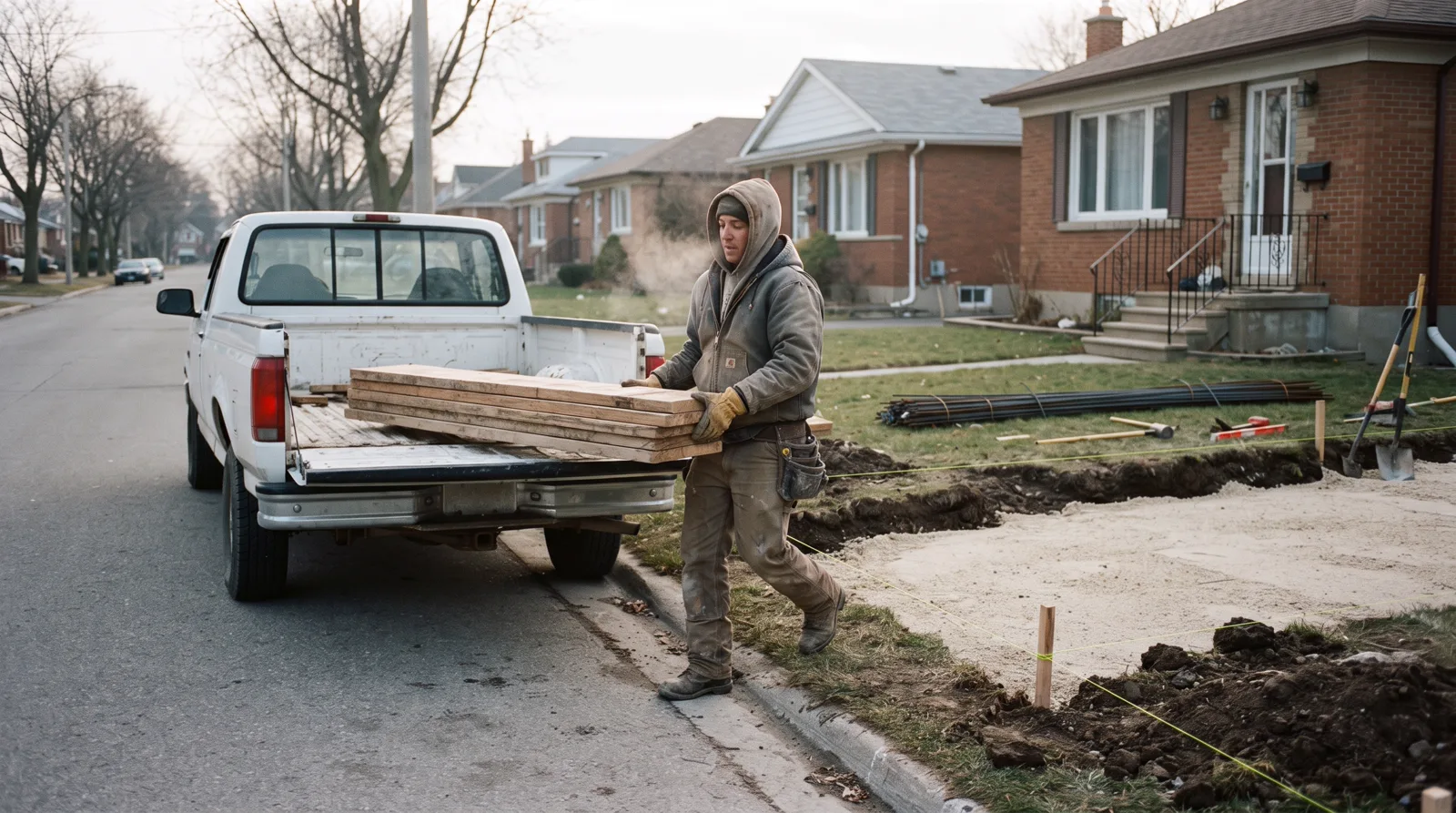
Concrete Driveways Engineered for Alberta Freeze-Thaw Cycles.
A properly installed concrete driveway in the Tri-Region lasts 30+ years if the base is right, the mix is winter-rated, and expansion joints are placed correctly.
Concrete Driveway Services in the Tri-Region
From tear-out to final cure, every step engineered for Alberta soil and climate.
New Driveway Installation
Complete build from excavation to finish. Includes engineered base, vapor barrier, rebar or fiber mesh, 4,000 PSI air-entrained concrete, control joints every 10 feet, and broom or exposed aggregate finish. Sized for two vehicles with turnaround space.
Driveway Replacement & Tear-Out
Remove old asphalt or failed concrete, haul debris, re-grade and compact base to current frost depth code (48 inches in Parkland County), install new concrete with proper drainage slope. Includes disposal fees and base correction if settlement occurred.
Decorative & Stamped Concrete
Ashlar slate, cobblestone, or wood plank patterns with integral color or acid stain. Requires sealed finish reapplied every 2 to 3 years to survive Alberta UV and de-icing salts. Popular for front approaches where curb appeal matters.
Heated Driveway Systems
Hydronic tubing or electric mat embedded in the slab. Melts snow on contact, eliminates shoveling and ice buildup. Adds $12 to $18 per square foot to base concrete cost. Requires dedicated 240V circuit or boiler tie-in. Most common in Spruce Grove executive builds.
Concrete Resurfacing & Overlays
Thin bonded overlay (1/4 to 1 inch) over structurally sound but surface-damaged concrete. Fixes scaling, spalling, or cosmetic cracks. Not suitable if base has heaved or settled. Extends life by 8 to 12 years when applied correctly.
Driveway Extensions & Aprons
Add RV pad, third parking spot, or widen existing approach. New pour tied to old with epoxy dowels or isolation joint depending on age and movement. Match existing finish where possible or create defined border with decorative edge.
Why Alberta Driveways Need Different Concrete
❄️ Freeze-Thaw Cycle Resistance
Tri-Region concrete experiences 40 to 60 freeze-thaw cycles per winter. Air-entrained mix (5% to 7% air content) creates microscopic bubbles that give expanding ice somewhere to go, preventing surface spalling and cracking. Non-air-entrained residential mix fails within 3 to 5 years here.
📏 Frost Depth & Base Requirements
Alberta Building Code mandates footings below frost line: 4 feet in Parkland County and Spruce Grove. Driveway base must be 6 inches minimum of compacted 3/4-inch clear crushed gravel over undisturbed or engineered fill. Skipping this causes slab heave and cracking within the first winter.
🌬️ Chinook Wind & Thermal Shock
Rapid temperature swings (minus 20°C to plus 10°C in 6 hours) stress concrete. Proper curing (7 days minimum, ideally 28) and control joints every 8 to 10 feet allow slabs to expand and contract without random cracking. Rushed jobs that strip forms early fail faster in chinook zones.
🧊 Snow Load & De-Icing Salt Exposure
Heavy snow years and calcium chloride use accelerate surface wear. Sealed concrete (penetrating silane or siloxane sealer) sheds water and resists salt intrusion. Reapply every 2 to 3 years. Unsealed driveways show scaling and pitting by year 5, especially along edges where salt pools.
What it costs here
Everything You Need to Know About Concrete Driveways in Spruce Grove
Base prep, mix specs, curing, joints, finishes, permits, and long-term care.
Why Concrete Driveways Make Sense in Spruce Grove's Climate
Spruce Grove sits in a climate zone that punishes weak driveways. Winter temperatures regularly drop to minus 30 Celsius or colder, then swing up during chinook events. Spring brings weeks of freeze-thaw cycling, sometimes multiple times in a single day. Summer heat can push pavement temperatures above 50 Celsius. These swings create expansion and contraction forces that crack asphalt, heave gravel, and destroy any driveway that lacks a proper base and structural strength. Concrete, when installed correctly with adequate thickness and reinforcement, handles this punishment better than any other common driveway material available in Alberta.
The frost line in Parkland County reaches approximately 1.8 to 2.1 meters deep. That means the ground beneath your driveway freezes solid every winter, expands, then thaws and settles every spring. A concrete driveway needs a compacted granular base that extends below the frost line in critical areas, plus control joints that allow the slab to move in predictable ways instead of cracking randomly. Asphalt driveways installed over inadequate bases will heave, crack, and develop potholes within five to seven years. Concrete driveways built to proper spec in this region commonly last 25 to 35 years, and some well-maintained examples in older Spruce Grove neighbourhoods are still functional after 40 years.
Hail is another local reality. Spruce Grove and Stony Plain see damaging hailstorms most summers, with stones sometimes reaching golf ball size or larger. Hail dents cars and damages roofs, but it does not harm a properly finished concrete surface. Asphalt softens in summer heat and can be pitted by large hail. Exposed aggregate or broom-finished concrete shrugs off hail strikes with no visible damage. This durability matters when you consider that a driveway replacement is a significant investment, typically ranging from $8,000 to $18,000 for a standard two-car driveway in this area, depending on size, thickness, and finish options.
Warning Signs Your Driveway Needs Replacement
Cracks wider than six millimeters that run across the full width of your driveway are a structural red flag. Hairline cracks are normal in concrete and can be sealed, but wide cracks that have separated and show vertical offset indicate that the base has failed or the slab was not thick enough for the loads it carries. If you can fit a screwdriver blade into a crack and wiggle it, water is getting underneath. That water freezes every winter, expands, and makes the crack worse. Once a crack has offset by more than 12 millimeters, meaning one side is noticeably higher than the other, you are looking at base failure. Grinding down the high side is a temporary cosmetic fix, but the underlying problem will continue to worsen until the slab is replaced.
Spalling is the term for surface concrete that has flaked away, exposing the aggregate underneath. You will see it most often near the edges of the driveway or in areas where water pools. Spalling happens when water penetrates the surface, freezes, and pops off the top layer of concrete. It is often caused by poor finishing practices, inadequate curing, or the use of de-icing salts during the first winter before the concrete has fully cured. If spalling is widespread and deep, covering more than 20 percent of the surface, patching will not solve it. The entire slab likely has low strength or was finished incorrectly, and replacement is the only permanent solution. Spalling also makes the surface rough and difficult to shovel in winter, and it accelerates further damage because the exposed aggregate absorbs more water.
Settling and pooling are the most visible signs of base problems. If large puddles form on your driveway after rain and take hours to drain, the slab has settled unevenly. This happens when the granular base was not compacted properly during installation, or when water has washed out material from underneath the slab. In Spruce Grove, spring runoff and heavy summer rains can erode a poorly prepared base in just a few years. Once settling has created low spots deeper than 25 millimeters, the problem will not fix itself. Water will continue to collect, freeze, and cause more cracking. Some homeowners attempt mudjacking or slab jacking to lift settled sections, and this can work if the base is otherwise sound. But if the settling is due to ongoing erosion or frost heave, lifting the slab is a temporary fix that will fail again within a few years. Replacement with proper drainage and a well-compacted base is the permanent answer.
How Concrete Driveway Installation Actually Works
A proper concrete driveway installation in this region starts with excavation to a depth that accounts for the total thickness of base material and concrete slab. For a standard residential driveway, that means removing 300 to 400 millimeters of existing material. The contractor will excavate the old driveway, any soft or organic soil, and enough depth to install a compacted granular base of at least 150 to 200 millimeters, plus a concrete slab of 125 to 150 millimeters thick. Thicker slabs, up to 175 or 200 millimeters, are specified when the driveway will carry heavy vehicles like RVs, trailers, or work trucks. Excavation must extend beyond the edges of the planned driveway to allow for formwork and proper compaction at the edges. In Spruce Grove clay soils, the excavation must reach stable subgrade that will not heave or settle.
The base material is critical. Contractors use clean crushed gravel, typically three-quarter inch clear stone or a granular base mix that meets Alberta Transportation specifications. This material is spread in layers, usually two lifts of 75 to 100 millimeters each, and compacted with a plate tamper or roller. Proper compaction prevents settling and provides a stable platform that will not shift under the weight of the concrete or vehicles. The base must be graded to direct water away from the house and toward the street or a drainage swale. A two percent slope is standard. If the existing grade does not allow this, the contractor may need to install weeping tile or a drainage channel along the house side of the driveway to prevent water from pooling against the foundation.
Formwork is built using straight lumber, usually two-by-sixes or two-by-eights, staked firmly into the ground. The forms define the edges of the driveway and hold the concrete in place while it sets. The contractor will set the forms to the correct elevation and slope, checking with a string line and level. Reinforcement comes next. Most residential driveways in this climate use welded wire mesh or rebar grid to control cracking. The reinforcement is placed on chairs or supports so it sits in the middle third of the slab, not on the base. This positioning gives the steel the best mechanical advantage to resist tensile stress. Fiber reinforcement mixed into the concrete itself is also common and helps reduce shrinkage cracking, but it does not replace steel in a driveway that will see freeze-thaw cycles and heavy loads.
Pouring and Finishing
Concrete arrives on site in a ready-mix truck, batched to a strength of at least 30 or 32 megapascals for driveways in this region. Higher strength mixes, 35 or 40 megapascals, are used when the driveway will carry heavy equipment or when the owner wants maximum durability. The concrete is placed into the forms, spread evenly, and struck off level with a screed board that rides on top of the forms. The crew works quickly because concrete begins to set within an hour in warm weather, and much faster in hot sun. Once the concrete is screeded level, the surface is floated with a bull float to smooth it and bring a thin layer of cement paste to the top.
Finishing creates the final surface texture. A broom finish is the most common choice in Spruce Grove because it provides traction in winter without being so rough that it is hard to shovel. The contractor drags a stiff bristle broom across the surface in straight lines, creating shallow grooves. Exposed aggregate is another option, where the top layer of cement paste is washed away before the concrete fully hardens, revealing the stones in the mix. This looks attractive and provides excellent traction, but it is harder to shovel and more expensive. Smooth troweled finishes are rare on driveways in Alberta because they become dangerously slippery when wet or icy.
Control joints are cut or tooled into the surface while the concrete is still workable. These joints are shallow grooves, usually one quarter of the slab depth, placed at regular intervals to control where cracks will form as the concrete shrinks during curing. A typical pattern places control joints every 3 to 3.5 meters along the length of the driveway, creating roughly square panels. Without control joints, the concrete will crack randomly, and those cracks will be wider and harder to seal. Properly placed control joints allow the slab to move slightly without visible damage.
The First Week: What to Expect During Installation
Installation of a typical residential driveway in Spruce Grove takes two to four days, depending on weather and site conditions. Day one is excavation and base preparation. The contractor will bring in an excavator or skid steer to remove the old driveway and dig to the required depth. The old concrete is usually hauled away, although some homeowners ask to have it broken up and used as fill elsewhere on the property. The base material is delivered and spread, then compacted. This phase is noisy and dusty, and your driveway will be completely unusable. You will need to park on the street or make alternate arrangements. If the contractor finds unexpected problems during excavation, such as soft clay, underground utilities, or poor drainage, the timeline and cost may change. Good contractors will stop and discuss options before proceeding.
Day two is formwork, reinforcement, and final base grading. The crew will build the forms, set them to the correct slope, and install the wire mesh or rebar. This is a quieter day with less disruption, but the driveway is still a construction zone and off limits. The contractor will inspect everything before calling for the concrete delivery. In summer, concrete pours are often scheduled for early morning to avoid the hottest part of the day, which can cause the concrete to set too fast and crack. In spring and fall, pours may happen later in the day when temperatures are warmest. Concrete cannot be placed if the temperature is forecast to drop below 5 Celsius within 24 hours, because freezing will damage the surface before it has gained enough strength.
Day three is pour day. The ready-mix truck will arrive, and the crew will place, screed, and finish the concrete. This takes three to six hours for a standard driveway. Once the finishing is done, the contractor will cover the surface with plastic sheeting or apply a curing compound to slow moisture loss. Proper curing is essential in Alberta's dry climate. If the surface dries too fast, the concrete will not reach full strength and will be prone to spalling and cracking. The driveway must be kept moist for at least three days, and longer is better. Most contractors will return the next day to spray the surface with water and check the curing cover.
You cannot drive on the new driveway for at least seven days, and 10 to 14 days is better. Concrete reaches about 70 percent of its full strength in seven days, but it continues to harden for weeks. Driving on it too soon can cause surface damage, rutting, or cracking. Walking on the driveway is usually safe after 24 to 48 hours, but check with your contractor. During the first month, avoid parking heavy vehicles in the same spot repeatedly, and do not use de-icing salts. Salt can damage the surface of new concrete that has not fully cured. Sand or kitty litter are safer options for traction during the first winter.
What a Concrete Driveway Costs in Spruce Grove and What Drives the Price
A typical residential concrete driveway in Spruce Grove, Stony Plain or Parkland County runs between $3,500 and $12,000, depending on size, complexity and finish. A single-car, straight drive with a standard broom finish sits at the low end; a double-wide or curved layout with stamped pattern or exposed aggregate at the high end. The regional average for a two-car driveway (18 by 20 feet, roughly 360 square feet) falls around $6,000 to $8,500. These are installed prices: tear-out of old pavement, base prep, concrete pour, finishing and clean-up. Prices reflect 2026 material and labour costs in the Edmonton metro market.
Base preparation accounts for a substantial share of the bill and varies widely by site. Spruce Grove and Stony Plain sit on dense clay subsoil that expands when wet and contracts when dry, so proper excavation and a compacted gravel base (typically 6 to 8 inches of crushed limestone) are non-negotiable. Frost depth in this zone reaches 4 feet, meaning the base must resist heave and drain well. Sites with poor drainage, high water tables or soft fill require extra excavation, geotextile fabric and deeper gravel, all of which add cost. A flat, well-drained lot costs less to prepare than a sloped yard with clay fill and runoff issues.
Concrete is sold by the cubic yard, and a 4-inch slab for a 360-square-foot driveway requires roughly 4.5 yards of ready-mix. Local batch plants in Spruce Grove and Acheson charge between $140 and $180 per yard delivered, depending on mix strength (3,000 to 4,000 PSI is standard) and additives (air entrainment for freeze-thaw resistance is essential in Alberta). Tight access or sites that require a concrete pump instead of a chute add $400 to $900 to the pour. Rebar or wire mesh, vapor barrier and forming materials are separate line items. Labour to place, screed, float and finish the slab is the largest variable: experienced crews charge $4 to $7 per square foot all-in.
A basic broom finish (textured for traction) is the cheapest option and most common in Parkland County. Upgrading to stamped concrete (mimics stone, slate or brick) adds $3 to $6 per square foot. Exposed aggregate (wash the surface to reveal decorative stone) adds $2 to $4 per square foot and requires sealing. Integral color or surface stain adds $1 to $3 per square foot. Extras like saw-cut control joints, expansion strips along the garage apron, decorative borders and sealer application all increase the final invoice. A driveway with multiple colors, curves and stamping can easily double the cost of a plain rectangle.
- Lot slope, soil type and drainage complexity
- Depth and quality of gravel base
- Concrete mix strength, additives and delivery distance
- Access constraints (pump surcharge, hand-finishing)
- Reinforcement type (rebar, mesh or fiber)
- Finish (broom, stamped, exposed, colored)
Comparing Your Options: Concrete, Asphalt and Decorative Finishes
Poured concrete is the default choice for driveways in Spruce Grove because it handles Alberta winters better than any alternative. A properly built 4-inch slab on a gravel base, reinforced with rebar or mesh and finished with air-entrained mix, will last 25 to 40 years with minimal maintenance. Freeze-thaw cycles, hail, snow plows and chinook winds do not crack or rut quality concrete the way they destroy asphalt. Maintenance is limited to occasional sealing (every 3 to 5 years) and filling hairline cracks if they appear. The upfront cost is higher than asphalt, but the longevity and low upkeep make concrete the better value over the life of the driveway.
Asphalt driveways cost roughly 40 to 50 percent less to install than concrete, making them attractive for budget-conscious projects. A typical asphalt job in Parkland County runs $2,500 to $5,000 for a two-car drive. The tradeoff is durability. Asphalt softens in summer heat, hardens and cracks in deep winter cold, and deteriorates rapidly under chinook temperature swings. Edges crumble, potholes form and the surface requires seal-coating every 2 to 3 years. Lifespan is 12 to 20 years under ideal conditions, often less in harsh climates. Asphalt makes sense for long rural driveways where total concrete cost would be prohibitive, but for a standard residential lot, concrete is the smarter long-term investment.
Stamped concrete offers the look of stone, slate or brick pavers at a fraction of the cost and without the maintenance headaches of individual units. Contractors pour the slab, then press pattern mats into the wet surface and apply integral or dry-shake color. The result is a high-end aesthetic (popular in Spruce Grove for front entries and curved drives) that pairs well with modern home design. Cost is $10 to $16 per square foot installed, compared to $6 to $9 for plain concrete. Stamped surfaces require sealing every 2 to 3 years to protect the color and prevent scaling. Exposed aggregate is another decorative option: the top layer of cement paste is washed away to reveal embedded decorative stone. It costs less than stamping ($8 to $12 per square foot), provides excellent traction and hides stains better than smooth finishes. Both options perform well in Alberta winters if the base work and mix quality are sound.
Common Mistakes and Contractor Traps to Avoid
The number one reason driveways fail in Spruce Grove and Stony Plain is inadequate base preparation. Contractors under pressure to keep bids low will cut the gravel base from 8 inches to 4, skip compaction or omit geotextile fabric on soft ground. The result is predictable: the slab settles unevenly, cracks form within a year and sections heave during spring thaw. Proper base work means excavating to stable subgrade, placing a minimum 6-inch layer of clean, crushed gravel, compacting it in lifts and ensuring positive drainage away from the house. Ask your contractor to specify base depth and material in the written quote. If they dismiss the question or suggest 3 inches is enough, walk away. Base work is invisible once the concrete goes down, so it is the easiest place for dishonest operators to cut corners.
A vapor barrier (6-mil polyethylene sheet) laid between the gravel base and the concrete prevents ground moisture from wicking up into the slab, which can cause efflorescence (white staining), scaling and premature deterioration. Many low-bid contractors skip it. Proper drainage is equally critical. The driveway surface should slope at least 1 percent (1 inch per 8 feet) away from the garage and toward the street or a swale. Water that pools on the slab or along the edges accelerates freeze-thaw damage and undermines the base. Contractors who pour flat driveways or ignore lot grading create chronic puddles and ice patches. Insist on a slope plan and vapor barrier as standard, not optional upgrades.
Rebar or welded wire mesh reinforcement does not prevent cracks, but it holds cracked sections together and prevents vertical displacement. The Edmonton region building code does not mandate reinforcement for residential driveways, so budget contractors often skip it to save $200 to $400. The result is cracks that open wide, edges that curl and slabs that become tripping hazards. Fiber-reinforced concrete (synthetic fibers mixed into the batch) is a cheaper alternative to mesh and helps control micro-cracking, but it is not a substitute for steel in heavily loaded areas like aprons or turnarounds. Specify rebar or mesh in the contract and confirm it is in place before the pour.
Concrete shrinks as it cures and expands and contracts with temperature swings. Without expansion joints (flexible strips installed where the driveway meets the garage floor, sidewalk or house foundation) and control joints (saw-cut grooves that guide where cracks form), the slab will crack randomly and often in visible, ugly patterns. Control joints should be cut within 24 hours of the pour, spaced no more than 10 feet apart and at least one-quarter the slab depth. Expansion joints are mandatory at fixed structures. Contractors who pour and walk away without cutting joints are either inexperienced or indifferent. The cracks will appear, and you will own them.
Concrete work does not require a provincial trade license in Alberta, so the market is full of unqualified crews offering cut-rate prices. The risks are real: no liability insurance means you are liable if a worker is injured on your property. No general liability insurance means you have no recourse if the crew damages your gas line, foundation or landscaping. Always verify WCB clearance (ask for the clearance letter), confirm liability insurance (minimum $2 million) and check references. A contractor who balks at providing these documents is not a professional.
How to Hire the Right Concrete Contractor in Spruce Grove
Start by verifying that any contractor you consider holds valid WCB clearance and general liability insurance. WCB clearance confirms that workers are covered under Alberta's workplace safety system; without it, you assume liability for on-site injuries. Request a current clearance letter and confirm the business name matches the quote. General liability insurance (minimum $2 million coverage) protects you if the crew damages your home, utilities or neighboring property. Ask for a certificate of insurance and call the insurer to confirm the policy is active. Concrete contractors who operate without these protections are either unlicensed fly-by-night operators or small outfits running under the table. Neither is worth the risk, no matter how low the bid.
A professional quote should itemize every phase of the job: demolition and removal of old pavement, excavation depth and disposal, type and depth of base material, concrete mix specification (PSI and additives), reinforcement type, slab thickness, finish type, control joint spacing, sealer application and cleanup. Vague quotes with a single lump sum and no detail leave the door open for shortcuts, substitutions and change orders. Compare at least three written quotes and ask questions about any line item you do not understand. Be wary of bids that come in 30 percent or more below the others: they almost always reflect cut corners (thin base, no rebar, low-grade mix, no permits) that you will pay to fix later.
Ask for recent references (projects completed within the past two years in Spruce Grove, Stony Plain or Parkland County) and follow up with at least two. Ask the homeowner if the contractor showed up on time, completed the work as quoted, left the site clean and addressed any issues promptly. A reputable contractor will offer a written warranty covering material and workmanship defects for at least one year. Read the warranty terms: some exclude cracks (which are inevitable in concrete), others cover only structural failure. Understand the cure schedule. Concrete reaches 70 percent strength in 7 days and full strength in 28 days. You should stay off the new driveway for at least 7 days and avoid heavy vehicles for a full month.
How Tri-Region Services Helps
Tri-Region Services connects you with one vetted, insured concrete contractor in your area who has been asked about liability insurance and recent local references. You receive a free written quote that breaks down scope, materials and timeline with no obligation to proceed. We do not operate a bidding platform or pass your contact information to multiple companies. Instead, we route you to a single trusted professional who will visit your property, assess your site and provide a detailed estimate. If you are ready to replace or install a concrete driveway in Spruce Grove, Stony Plain or Parkland County, request your free quote today and take the first step toward a durable, professionally built surface.
How Tri-Region Vets Concrete Contractors
Every crew in the network meets baseline insurance, code compliance, and quality standards.
Liability Coverage Stated at Signup
All contractors carry liability insurance accounts and minimum $2 million general liability. You receive proof before work starts.
Parkland County Permit Compliance
Contractor pulls required development or safety codes permit if your municipality requires it. Scope and inspector contact provided upfront.
Alberta Winter-Grade Concrete Mix
Minimum 4,000 PSI air-entrained mix from local batch plant. You get the delivery ticket showing mix design and air content test.
Engineered Base & Drainage Slope
6-inch compacted gravel base, plate compactor used, minimum 2% slope away from foundation. Photos of base before pour are standard.
Proper Curing & Control Joints
Minimum 7-day cure with curing compound or wet burlap. Control joints saw-cut within 24 hours at proper spacing to control crack location.
Written Scope & Material Specs
Contract states slab thickness, rebar or mesh, finish type, joint layout, and warranty terms. No verbal-only agreements in the network.
This page is not tied to a contractor's brand. Leads route straight to your one local partner. Verified reviews can appear here once that partner has them (never fabricated).
Serving the whole Tri-Region
7 Questions Homeowners Ask About Concrete Driveways
How thick should a concrete driveway be in Alberta?+
Concrete or asphalt for a Spruce Grove driveway?+
Do I need rebar or fiber mesh in my driveway?+
How long before I can drive on new concrete?+
Why do concrete driveways crack?+
Do I need a permit for a concrete driveway in Parkland County?+
What is the best finish for an Alberta driveway?+
How do I maintain a concrete driveway in winter?+
Get your free quote
Tell us what you need and a local pro will get right back to you.
- ✓ Sent straight to a local business
- ✓ You choose who you hire
- ✓ Free, with no obligation