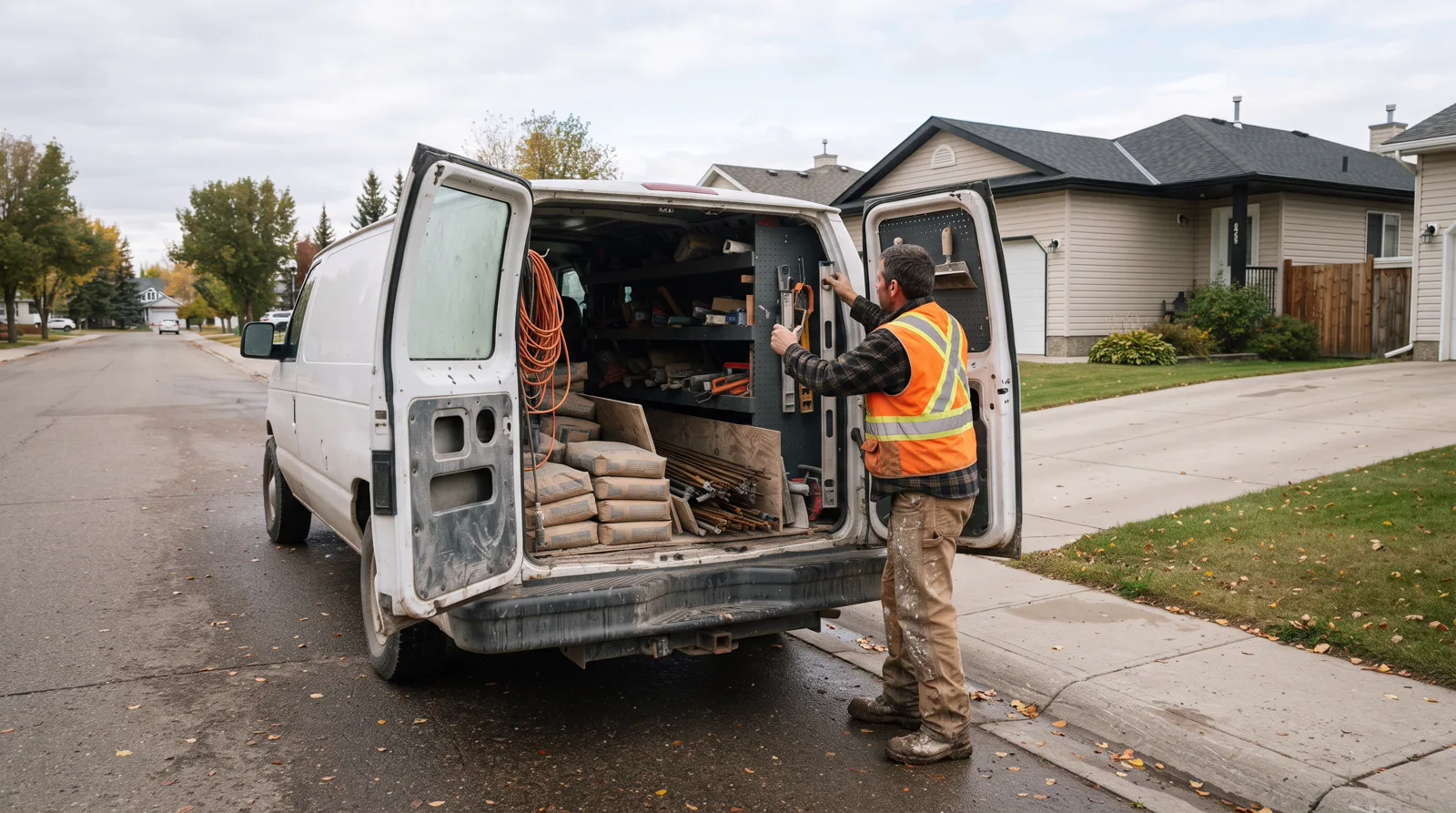
Concrete Patios Built to Last Through Alberta Winters.
Engineered for freeze-thaw cycles, chinooks, and decades of backyard entertaining. Local crews who know frost depths, drainage, and what actually works here.
Concrete Patio Options
From simple gathering spaces to custom outdoor rooms, every project engineered for Alberta's brutal freeze-thaw cycle.
Stamped Concrete Patios
Textures that mimic stone, slate, or wood. Sealed for winter salt and UV resistance. Popular patterns include ashlar slate, flagstone, and cobblestone. Color options mixed into the concrete or applied as hardener for fade resistance.
Broom Finish Patios
Classic textured surface with reliable traction when wet or icy. The most economical option and fastest to install. Clean lines, uniform appearance, easy to maintain. Ideal for covered patios or simple backyard layouts.
Exposed Aggregate Patios
River rock, pea gravel, or crushed stone embedded in the surface for natural texture and excellent grip. Hides minor wear and staining better than smooth finishes. Choose aggregate colors to match your landscaping or home exterior.
Colored & Stained Patios
Integral color mixed throughout the concrete or acid stains applied after curing. Earth tones, terracotta, charcoal, and custom blends available. UV-stable sealers protect color from Alberta sun and prevent salt damage from winter de-icing.
Multi-Level Patio Designs
Tiered patios with steps, seat walls, or raised planters. Define dining, fire pit, and lounge zones without fencing. Proper grading between levels ensures melt water flows away from your foundation. Includes railings if height requires it per code.
Patio Extensions & Additions
Expand an existing patio or tie new concrete into old slabs. We cut control joints to match, ensure proper bonding, and grade for drainage. Perfect for growing families or adding a hot tub pad, outdoor kitchen base, or fire feature surround.
Why Alberta Patios Need Local Expertise
❄️ Frost Heave & Deep Frost Lines
Spruce Grove frost penetrates 1.2 to 1.8 meters deep in a cold winter. Local pros excavate below frost line and compact 150mm of clear gravel base in lifts, then add road crush for stability. Skipping this step guarantees cracking within two freeze-thaw cycles.
🌀 Chinook Wind & Freeze-Thaw
Temperature swings from minus 25 to plus 5 in 48 hours are common in Parkland County. We use air-entrained concrete mixes rated for severe freeze-thaw exposure and space control joints every 2.4 to 3 meters to control where cracks occur. Proper curing and sealing are mandatory, not optional.
💧 Spring Melt & Drainage
A 20 square meter patio sheds hundreds of liters during April melt. We slope the surface 2% away from your house and install weeping tile or swales if your lot drains poorly. Poor drainage causes foundation moisture, ice dams at doorways, and ponding that accelerates concrete damage.
📋 Parkland County Permits & Inspections
Patios over 10 square meters or attached to your house foundation typically need a development permit in Spruce Grove and Stony Plain. Local pros handle permit applications, arrange inspections, and ensure setbacks meet bylaw. Unpermitted work can complicate insurance claims and home sales.
What it costs here
Everything You Need to Know About Concrete Patios in Spruce Grove
From planning and permits to pouring, finishing, and long-term care in Alberta's climate.
What a Concrete Patio Actually Involves in Spruce Grove
A concrete patio is not just a slab poured on dirt. It is a carefully engineered outdoor floor designed to handle Alberta's freeze-thaw cycles, snow loads, and drainage demands while providing a stable, long-lasting surface for furniture, grills, and foot traffic. In Spruce Grove, Stony Plain, and Parkland County, a properly built patio starts below grade with compacted granular fill that extends below the frost line (typically 4 feet deep in this region) to prevent heaving. The concrete itself is usually 4 to 6 inches thick, reinforced with steel mesh or rebar, and finished to your chosen texture. This is not a weekend DIY project: it requires excavation equipment, concrete delivery trucks, skilled finishing, and an understanding of local soil conditions and building codes.
The structural goal is simple: create a rigid, stable platform that sheds water away from your home and resists cracking under seasonal ground movement. Alberta clay soils expand when wet and contract when dry, which means the sub-base must be properly compacted and graded or the patio will settle unevenly within a year. Most contractors in the Tri-Region area use crushed limestone or pit run gravel as the base layer, compacted in lifts to 95 percent density or better. Steel reinforcement is placed mid-slab to control shrinkage cracking, and control joints are saw-cut or tooled into the surface to direct cracks to planned locations. The result is a monolithic pad that moves as one unit rather than breaking apart in sections.
Finish options range from basic broom texture (slip-resistant and economical) to stamped patterns that mimic flagstone, slate, or tile. Exposed aggregate is popular in the region because it hides surface wear and provides excellent traction in winter. Integral color or acid stain can be added for visual interest, though most homeowners choose neutral grays or earth tones that age gracefully. The key is that the finish must be applied while the concrete is still workable, so timing and crew skill matter. A poorly finished patio will show trowel marks, surface scaling, or premature wear. A well-finished patio will look clean and professional for 20 years or more with minimal maintenance beyond occasional resealing.
Why Alberta Weather Demands Purpose-Built Concrete Patios
Alberta's climate is uniquely harsh on outdoor concrete. Winter frost penetrates up to 4 feet deep in Parkland County, which means any footing or base layer shallower than that is vulnerable to frost heave. When groundwater freezes, it expands with thousands of pounds of force, lifting slabs and cracking them from below. Spring thaw reverses the process, leaving voids under the concrete that cause settlement and uneven surfaces. A patio built without proper excavation and granular base will crack, tilt, or break apart within one or two freeze-thaw cycles. This is why local contractors insist on deep granular fill and proper compaction: it isolates the concrete from freeze-thaw movement and provides a stable, non-frost-susceptible foundation.
Chinook winds add another layer of complexity. When temperatures swing from minus 20 Celsius to plus 10 Celsius in a single day, concrete experiences rapid thermal expansion and contraction. This cycle stresses the paste matrix and can cause surface scaling or internal microcracking, especially if the concrete was not properly air-entrained or cured. Air entrainment introduces microscopic bubbles into the mix, giving water a place to expand when it freezes rather than fracturing the concrete. In Spruce Grove and Stony Plain, reputable ready-mix suppliers will batch air-entrained concrete automatically for exterior flatwork, but you should confirm this with your contractor. Without it, the surface will spall and flake after a few winters.
Drainage is critical because standing water accelerates freeze-thaw damage. A patio must slope away from the house at a minimum of 1 percent grade (1 inch of drop per 8 feet of run) to prevent pooling. In areas with heavy clay soils like Acheson or rural Parkland County, surface water does not percolate quickly, so the patio must be graded aggressively or fitted with edge drains to channel runoff. Snow load is another consideration: a large patio can accumulate significant weight from winter snow, especially wet spring snow that compacts and refreezes. The slab must be thick enough and properly reinforced to carry this load without cracking. Hail is less of a structural concern but can pit and scar decorative finishes, so some homeowners choose textured or aggregate surfaces that hide surface damage better than smooth troweled concrete.
How to Know You Need a Concrete Patio (or Need to Replace the One You Have)
You are ready for a new concrete patio if you currently have no usable outdoor living space, if your existing patio is cracked or settled, or if you are planning a backyard upgrade and want a low-maintenance, permanent solution. Homeowners in Spruce Grove and Stony Plain often start with wood decks or paver patios, then switch to concrete after dealing with rot, insect damage, weed growth, or shifting pavers. Concrete eliminates these problems: there are no boards to replace, no gaps for weeds, and no annual re-leveling. If you entertain outdoors, host barbecues, or want a stable base for a fire pit or outdoor kitchen, concrete is the most reliable choice. It does not warp, splinter, or fade, and it handles Alberta winters without special winterizing or storage.
Existing concrete patios show several warning signs when they are nearing the end of their service life. Wide cracks (more than a quarter inch) that run across the slab indicate structural failure, usually from settlement or lack of reinforcement. Spalling or surface flaking means the concrete was not air-entrained or was poured in freezing conditions. Uneven surfaces or tilting sections point to base failure or frost heave. Pooling water is a red flag: it means the slab has settled or was not graded properly, and standing water will accelerate freeze-thaw damage every winter. If you see multiple cracks, surface scaling, and uneven areas, repair is usually not cost-effective. The base has failed, and patching the surface will not fix the underlying problem. A full tearout and rebuild is the only permanent solution.
Timing matters. Spring and summer are ideal for new patio construction in Alberta because the ground is workable, concrete cures at optimal temperatures, and you have time to enjoy the finished space before winter. Fall pours are risky: if temperatures drop below 5 Celsius during the cure period, the concrete will not gain full strength and may surface-scale the following spring. Most contractors in the Tri-Region area will not pour exterior slabs after late September unless they can tent and heat the work area. If you are planning a patio for next summer, start the conversation in late winter or early spring so you can secure a spot on the contractor's schedule before the busy season fills up. Lead times can stretch to 6 or 8 weeks during peak demand.
The Step-by-Step Process from Layout to Cure
Site Assessment, Design, and Permits
The process starts with a site visit. A qualified contractor will assess your yard's grade, soil type, drainage patterns, and proximity to the house foundation. They will measure the area, confirm there are no underground utilities (gas, power, telecom, water, sewer) in the dig zone, and discuss finish options, thickness, and reinforcement. In Spruce Grove and Parkland County, you are required to call Alberta One-Call at least two business days before excavation so utilities can be marked. Skipping this step can result in fines, service disruptions, or serious injury. Most residential patios do not require a building permit unless they are attached to the house or exceed a certain size, but rules vary by municipality. Your contractor should confirm local requirements before starting work.
Design decisions include patio size, shape, slope direction, and finish. A typical backyard patio ranges from 200 to 400 square feet, though larger outdoor kitchens or entertainment areas can exceed 600 square feet. The slab must slope away from the house at 1 to 2 percent grade, and the finish must be slip-resistant. If you want decorative stamping or coloring, discuss it now: these options add cost and require specialized tools and timing. The contractor will provide a written quote that includes excavation, base prep, concrete supply, reinforcement, finishing, and cleanup. Expect to pay between $8 and $18 per square foot for a basic broom-finish patio, or $15 to $30 per square foot for stamped or colored work, depending on complexity and site conditions.
Excavation and Granular Base Preparation
Excavation begins once the layout is staked and utilities are marked. The crew will dig out the patio area to a depth of 10 to 14 inches below final grade, removing topsoil, sod, and organic material. In areas with heavy clay (common around Stony Plain and Acheson), the excavation may go deeper to allow for thicker granular fill. The goal is to remove all frost-susceptible soil and replace it with clean, compactable aggregate. A skid steer or mini excavator is typically used for this work, and the spoil is either spread elsewhere on your property or hauled away. The excavated area is then graded to match the planned slope, and the subgrade is compacted with a plate tamper or roller.
Next, granular base material is delivered and placed in the excavation. This is usually crushed limestone, pit run gravel, or 3/4-inch clear stone, and it is spread in 4-inch lifts and compacted with a mechanical tamper to 95 percent density. The total base thickness is typically 6 to 8 inches, though deeper bases are used in poor soil conditions or where frost heave risk is high. Proper compaction is critical: loose base will settle under the weight of the concrete, causing cracks and uneven surfaces. Once the base is compacted and level, a final grade check is performed to confirm the slope is correct. Some contractors lay a vapor barrier (6-mil poly) on top of the base to prevent moisture migration into the concrete, though this is not always necessary in well-drained soils.
Forming, Reinforcement, and Concrete Placement
Wood or metal forms are set along the perimeter of the patio to contain the concrete and define the final shape. Forms are staked securely and leveled to match the design grade. Steel reinforcement is placed inside the forms, either as welded wire mesh or rebar grid, elevated on chairs or dobies so it sits mid-depth in the slab. Reinforcement does not prevent cracking, but it holds cracks tight and prevents sections of the slab from separating. Control joints are planned at this stage: they will be tooled or saw-cut into the concrete to create weak points where cracks can form in a controlled, straight line rather than randomly across the surface.
Concrete is delivered by ready-mix truck and placed directly into the forms or transferred by wheelbarrow if access is tight. The mix is typically 30 to 35 MPa strength, air-entrained for freeze-thaw resistance, with a slump of 100 to 125 mm for workability. The crew will spread and screed the concrete to the correct thickness, then use a bull float to level the surface and bring paste to the top. Timing is everything: if the concrete sets too fast, the finish will be rough and weak; if it is overworked, the surface will be soft and prone to scaling. In hot weather, the crew may add retarder to slow the set or use evaporation retarder spray to prevent premature drying.
Finishing, Control Joints, and Curing
Once the concrete has stiffened enough to support foot traffic on knee boards, finishing begins. For a broom finish, the surface is troweled smooth and then brushed with a stiff broom to create slip-resistant texture. For stamped patterns, texture mats are pressed into the surface while the concrete is still plastic, and release powder is used to prevent sticking. Edges are rounded with an edging tool to prevent chipping, and control joints are tooled in at 8 to 10 foot intervals to control cracking. If color is being added, it is either mixed into the concrete (integral color) or applied to the surface as a dry shake hardener before troweling.
Curing is the final and most important step. Concrete gains strength through a chemical reaction called hydration, which requires water and warmth. In Alberta's dry climate, moisture evaporates quickly, so the surface must be kept moist for at least 7 days after the pour. This is done by covering the slab with plastic sheeting, applying curing compound spray, or periodic water misting. The patio should not be walked on for at least 24 hours and should not bear heavy loads (furniture, grills) for 7 days. Full strength is reached at 28 days. Rushing this process will result in weak, dusty concrete that scales and cracks prematurely. A properly cured patio in Spruce Grove will last 25 to 30 years with minimal maintenance.
What a Concrete Patio Really Costs in Spruce Grove and Parkland County
A basic 12 by 14 foot brushed concrete patio in Spruce Grove typically runs between $1,800 and $2,800, while a 16 by 20 foot stamped or colored slab can push $4,500 to $7,500. The wide range reflects differences in site conditions, finish complexity, and contractor pricing. Alberta's short construction season and rising material costs mean prices climb every spring, so locking in a quote early in the year often saves money. Homeowners in Parkland County dealing with sloped yards or heavy clay soils should budget toward the high end, as site prep can double the foundation work required.
The biggest cost driver is what happens below the surface. Alberta clay expands when wet and shrinks when dry, creating relentless pressure on any slab poured directly on grade. A proper patio base starts with excavation to remove organic topsoil, then 4 to 6 inches of compacted Class II gravel to break the clay bond and allow drainage. In areas with poor drainage or high water tables, contractors may add a layer of clear stone or install weeping tile around the perimeter. Each of these steps adds $200 to $800 to the total, but skipping them guarantees cracking within two years. The concrete itself is the smallest line item: material cost is roughly $150 to $200 per cubic yard, and a typical 200 square foot patio needs about 2.5 yards.
Finishing choices separate budget patios from showcase spaces. A basic broom finish adds no extra cost and provides decent traction, but stamped concrete with integral color and a sealer runs an additional $3 to $6 per square foot. Exposed aggregate, where the top layer is washed to reveal decorative stone, falls in the middle at $2 to $4 per square foot and performs well in freeze-thaw cycles because the textured surface sheds water quickly. Borders, inlaid patterns, and multiple color zones each add complexity and labor, pushing costs higher. Control joints, which are saw-cut grooves that guide where cracks appear, should be included in every quote at no extra charge. Any contractor who calls them optional is cutting corners.
Permits in Spruce Grove and Stony Plain are not always required for ground-level patios under 108 square feet, but anything larger or elevated usually needs a development permit at $75 to $150. Parkland County has stricter setback rules, especially near property lines and septic fields, so call the county office before you dig. Some contractors include permit fees in their quotes, others make you handle it. Grading and drainage work can add another $500 to $1,500 if your yard slopes toward the house or if existing downspouts dump water onto the patio area. A proper patio slopes 1/4 inch per foot away from the foundation, and every quote should specify how they plan to achieve that grade.
Comparing Your Options: Plain, Stamped, Exposed Aggregate, and Overlays
Plain brushed concrete is the workhorse of Alberta patios. It costs the least, goes down fast, and holds up well if the base is solid and the mix includes air entrainment for freeze resistance. The broom finish provides traction when wet, which matters during spring melt and summer storms. Aesthetically, it is what it is: flat, gray, and functional. You can add a border or score pattern to break up the expanse, but most homeowners who choose plain concrete do so because they plan to cover it with furniture, planters, or an outdoor rug. The upside is durability and low maintenance. The downside is that it will never wow your guests.
Stamped concrete tries to mimic stone, slate, or brick at a fraction of the cost. Contractors press texture mats into the wet surface and apply color hardeners or stains to create convincing patterns. In the Tri-Region, popular stamps include ashlar slate, random stone, and wood plank. The look is impressive when done well, but stamped patios face two Alberta-specific challenges. First, freeze-thaw cycles can pop the surface layer if the contractor skimps on air-entrained concrete or applies the release powder too heavily. Second, stamped surfaces are smooth, and smooth concrete gets slippery when wet or icy. Applying a high-traction sealer helps, but you will need to reseal every two to three years to maintain both the color and the slip resistance. Expect to pay $6 to $10 per square foot installed, and ask to see photos of the contractor's stamped work after at least two winters.
Exposed aggregate is the middle ground. The installer pours a standard mix embedded with decorative stone, then washes or sandblasts the surface before it fully cures to reveal the stone. The result is a natural, textured finish that hides stains, provides excellent traction, and survives freeze-thaw better than stamped because there is no surface coating to delaminate. River rock, pea gravel, and crushed granite are common aggregate choices in Alberta. The texture makes snow shoveling slightly harder than a smooth slab, but the trade-off is a patio that still looks good after a decade with minimal upkeep. Installation cost is similar to basic stamping, around $5 to $8 per square foot, but you save on long-term resealing. If you want color, the installer can tint the concrete or use colored stone in the mix.
Overlays and Resurfacing When the Old Patio Is Salvageable
If you already have a concrete patio that is structurally sound but ugly or stained, a thin overlay can give it new life for $3 to $6 per square foot. Contractors apply a polymer-modified cement layer about 1/4 inch thick over the existing surface, then stamp, stain, or texture it. Overlays work only if the base slab is level, free of major cracks, and not actively heaving. In Alberta clay, that is a big if. Many old patios crack because the base was never right, and adding a pretty top coat does not fix the underlying movement. A good contractor will assess whether your slab is a candidate before quoting an overlay. If the existing concrete is badly cracked, settling, or tilting toward the house, tear it out and start over. Resurfacing a doomed slab just delays the inevitable and wastes your money.
Mistakes That Cost Homeowners Thousands and How to Avoid Them
The most expensive mistake is skipping proper base preparation. Alberta clay is not stable fill. It swells when it absorbs moisture and shrinks during dry spells, creating a seasonal push and pull that cracks concrete slabs like crackers. A contractor who excavates only 2 inches and dumps gravel directly on clay is setting you up for failure. The correct approach is to dig out 8 to 12 inches, remove all clay and organic material, then backfill with compacted Class II gravel in 2-inch lifts. Each lift gets tamped with a plate compactor until it no longer settles. This process takes time and adds cost, but it is the only foundation that will support a patio through ten or twenty freeze-thaw cycles. If a quote seems unusually low, ask how deep they plan to excavate and what base material they will use. Vague answers or pushback mean they are cutting this corner.
Poor drainage is the second killer. A patio that slopes toward the house or traps water in low spots will crack, heave, and stain within a year. The correct slope is 1/4 inch per foot away from the foundation, which means a 12-foot-deep patio should drop 3 inches from house to edge. Contractors achieve this by grading the base before pouring or by screeding the wet concrete to the right pitch. Either way, the final surface should shed water quickly after a rain. If your yard has natural drainage problems, such as a high water table or heavy runoff from neighboring properties, the contractor may need to install a catch basin, French drain, or extend downspouts well past the patio edge. These fixes add cost upfront but prevent catastrophic water damage later. Walk your yard after a heavy rain and note where water collects. Show those spots to your contractor and ask how they plan to address them.
Skipping control joints or placing them randomly is another common error. Control joints are deliberate weak points saw-cut into the slab to guide where cracks form. Without them, concrete cracks wherever it feels like it, often in jagged lines across the middle of your patio. Joints should be cut within 24 hours of pouring, spaced no more than 10 feet apart, and cut to a depth of one-quarter the slab thickness. For a 4-inch slab, that is 1 inch deep. Some contractors skip this step to save time or because they do not own a concrete saw. Others cut joints too shallow or wait too long, rendering them useless. If your quote does not mention control joints, ask. If the contractor says they are unnecessary or optional, find someone else.
Red Flags That Signal a Problem Contractor
A contractor who cannot provide proof of WCB coverage and liability insurance is a lawsuit waiting to happen. In Alberta, any contractor with employees must carry and anyone working on your property should have at least $2 million in general liability coverage. Ask to see the certificates before signing anything, and call the insurer to confirm the policy is active. If they dodge, delay, or offer excuses, walk away. Cash-only pricing, no written contract, or pressure to pay the full amount upfront are other bright red flags. Reputable contractors provide detailed written quotes, accept payment in stages tied to milestones, and never ask for more than 10 to 25 percent down. If someone shows up in an unmarked truck with no business name, no references, and a story about leftover materials from another job, you are dealing with a fly-by-night operator who will disappear the moment something goes wrong.
How to Hire a Concrete Contractor You Can Trust
Start by asking neighbors, friends, or local building supply yards for referrals. A contractor with a solid reputation in Spruce Grove or Parkland County will have no trouble providing three to five recent references. Call those homeowners and ask specific questions: Did the patio crack in the first winter? Did the contractor show up on time? Were there surprise costs? Would you hire them again? Drive by the finished projects if you can. Look for clean control joints, consistent color, and no obvious settling or cracking. If a contractor has been in business for five or ten years and has a trail of happy customers, that track record is worth more than a flashy website or a low quote.
When you meet with contractors, ask about their process in detail. How deep will they excavate? What type and depth of base material will they use? What mix design and air entrainment percentage will they specify? How will they ensure proper slope and drainage? What is their plan for control joints and curing? A knowledgeable contractor will answer these questions clearly and specifically. A mediocre one will give vague reassurances or say it depends on site conditions without explaining what that means. Ask if they handle permits or if you need to pull them yourself. Confirm whether cleanup, grading, and sealing are included or extra. Get everything in writing, including start date, finish date, payment schedule, and warranty terms. A typical warranty covers cracking due to workmanship or materials for one to three years but excludes damage from ground movement, tree roots, or improper use.
Get at least three written quotes and compare them line by line, not just the total price. The lowest bid is often low because the contractor is cutting base depth, skipping air-entrained concrete, using thinner rebar or mesh, or planning to rush the job. The highest bid might include extras like decorative borders, upgraded sealers, or extended drainage work that the others omitted. Break down what each quote includes and exclude, then decide which combination of price, quality, and scope makes sense for your property and budget. Do not be afraid to ask questions or push back on line items that seem unclear. A good contractor will explain their pricing and methods confidently. A bad one will get defensive or try to upsell you on things you do not need.
How Tri-Region Services Helps You Find the Right Pro
Tri-Region Services connects homeowners in Spruce Grove, Stony Plain, Parkland County, and Acheson with one vetted, insured local concrete contractor who will provide a free written quote with no obligation. We ask every pro in our network about liability coverage, verified references, and a track record of quality work in Alberta conditions. You fill out one request, we route it to the right contractor for your project, and they reach out within 24 hours to schedule a site visit. No bidding wars, no pressure, no runaround. Just a straightforward quote from a contractor who knows how to build patios that survive freeze-thaw and look great for years. Whether you want a simple brushed slab or a stamped showcase patio, we make the hiring process simple and transparent so you can focus on enjoying your new outdoor space.
How We Protect Your Investment
Every contractor in our network meets strict licensing, insurance, and quality standards.
Licensed
All concrete crews carry valid Alberta business licenses and liability insurance accounts to protect you from liability if someone is injured on site.
Liability Insurance Verified
Minimum two million in general liability coverage stated at signup. You receive a certificate of insurance naming you as additional insured.
Freeze-Thaw Rated Concrete
We specify air-entrained mixes with 5 to 8 percent air content, tested at the batch plant. This is the only mix that survives Alberta winters without spalling and surface flaking.
Engineered Base & Drainage
Every patio design includes a scaled site plan showing elevations, slopes, and drainage paths. No guesswork, no eyeballing grades with a two-by-four.
Written Quotes & Timelines
Clear scope, itemized costs, start and completion dates in writing. No verbal promises that disappear when the weather changes or the pour goes sideways.
Local References Available
We connect you with homeowners in Spruce Grove, Stony Plain, and Acheson who have lived with their patios through multiple winters. See the work firsthand before you commit.
This page is not tied to a contractor's brand. Leads route straight to your one local partner. Verified reviews can appear here once that partner has them (never fabricated).
Serving the whole Tri-Region
8 Questions Homeowners Ask
When is the best time to pour a concrete patio in Spruce Grove?+
How deep does the base need to be for Alberta frost?+
Do I need a permit for a concrete patio in Parkland County?+
How long does a concrete patio last in Alberta?+
What is the difference between stamped and plain concrete patios?+
How much does a typical backyard patio cost in Spruce Grove?+
Can I pour a patio against my house foundation?+
How do I maintain a concrete patio through Alberta winters?+
Get your free quote
Tell us what you need and a local pro will get right back to you.
- ✓ Sent straight to a local business
- ✓ You choose who you hire
- ✓ Free, with no obligation