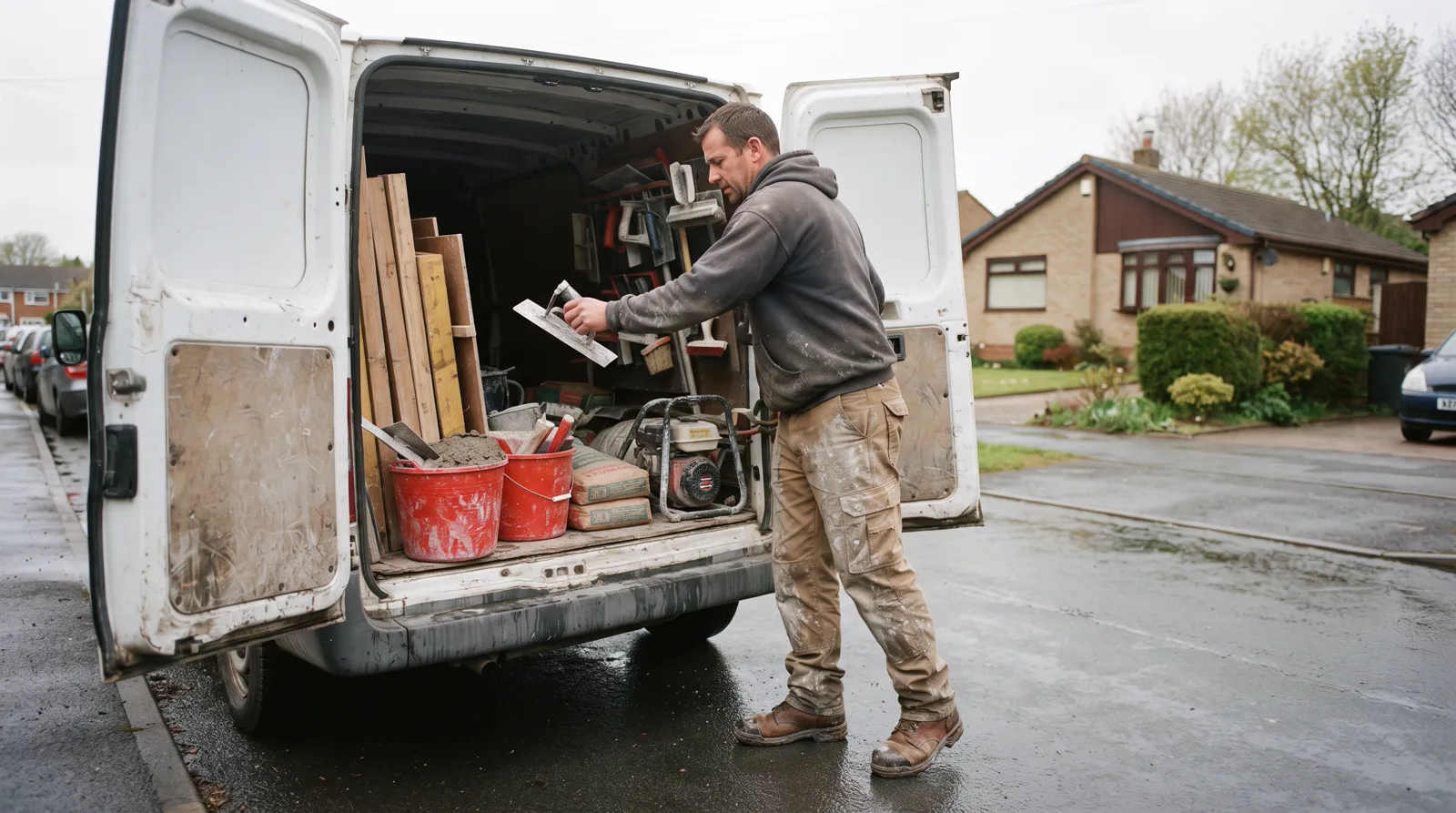
Concrete Sidewalk Spruce Grove: Built for Alberta Winters.
Professional concrete sidewalk and walkway installation designed to survive freeze-thaw cycles, frost heave, and decades of Parkland County weather.
Sidewalk & Walkway Services
From front entry walks to full perimeter paths, built to code and built to last.
Front Entry Sidewalks
Straight run from driveway or street to your front door. Typically 1.2m wide, 100mm thick, with control joints every 1.5m to manage cracking. Includes granular base, vapor barrier, and broom finish.
Perimeter Walkways
Full wrap-around paths connecting front, side, and back yard. Planned drainage slope to move melt water away from the foundation. Common in Parkland County acreages where distance from garage to backyard is substantial.
Garden & Landscape Paths
Curved or stepping-stone style walkways through flowerbeds, vegetable gardens, or tree groves. Often poured in sections with decorative exposed aggregate or stamped texture to blend with landscaping.
Accessible Ramps & Wide Walks
Code-compliant ramps with maximum 1:12 slope, handrails where required, and minimum 900mm clear width. Essential for aging-in-place renovations or multi-generational homes common in Spruce Grove.
Sidewalk Replacement & Repair
Remove and replace cracked, heaved, or settled sections. Local pros excavate failed slabs, re-compact base, and pour fresh concrete matched to existing thickness and finish. Includes disposal of broken material.
Decorative Finishes & Borders
Stamped patterns, exposed aggregate, colored concrete, or contrasting borders. Popular for front entries in newer Spruce Grove subdivisions where curb appeal matters. Sealed for stain and salt resistance.
Why Alberta Sidewalks Need More Than a Pour and Hope
❄️ Freeze-Thaw Cycle Engineering
Spruce Grove sees 80 to 120 freeze-thaw events per winter. We use air-entrained concrete (5 to 7 percent air content) and minimum 32 MPa strength to resist spalling and scaling when ice forms in the pores. Control joints every 1.5m allow slabs to expand and contract without random cracking.
🏔️ Frost Heave Prevention
Alberta frost can penetrate 1.8m deep in open ground. Local pros excavate to at least 150mm, lay compacted granular base, and ensure positive drainage so water does not pool under the slab and lift it during freeze-up. This is why proper site grading matters more here than in milder climates.
🧂 De-Icing Salt Damage Mitigation
Rock salt and calcium chloride are corrosive to fresh concrete. We specify minimum 28-day cure before first winter, apply penetrating silane sealer, and recommend sand or kitty litter for traction instead of salt during the first season. Stony Plain homeowners who skip this step often see surface pitting within two years.
📋 Spruce Grove Permit & Setback Rules
City of Spruce Grove requires building permits for sidewalks that connect to public right-of-way or alter drainage patterns. Setbacks from property lines, utility easements, and underground services must be verified before pouring. Most residential walks fall under the general permit process with 2 to 3 week approval.
What it costs here
Everything You Need to Know About Concrete Sidewalks in Spruce Grove
Design, materials, installation, and long-term care for Alberta conditions.
Why Concrete Sidewalks Face Unique Challenges in Spruce Grove and Parkland County
Concrete sidewalks in the Spruce Grove and Stony Plain area endure one of the harshest climate cycles in Canada. The freeze-thaw pattern here is relentless: temperatures can swing from minus 30°C in January to plus 5°C during a chinook event within 48 hours, then plunge back down. Every freeze cycle expands any moisture trapped in the concrete pores by roughly 9 percent, creating internal pressure that eventually cracks even properly installed walks. Over a typical winter, a sidewalk can go through 40 to 60 freeze-thaw cycles, compared to 10 to 20 in milder climates. This constant expansion and contraction is why you see so many cracked and heaved sections along residential streets in Parkland County, even on sidewalks that are only five or six years old.
The soil conditions under your sidewalk make the problem worse. Most of Spruce Grove sits on heavy clay subsoil that holds moisture like a sponge and expands dramatically when it freezes. In winter, frost can penetrate 1.5 to 2 meters deep in this region, well below the typical sidewalk base. When that clay freezes, it heaves upward, lifting sections of concrete and cracking them along control joints. When spring melt arrives, the clay contracts and the sidewalk settles unevenly, leaving lips and dips that become trip hazards. Chinook winds add another layer of chaos: a sudden thaw in February can saturate the base material, only to have it freeze solid again a week later. This cycle degrades the base faster than almost any other factor.
Snow removal practices accelerate the damage. Road salt and ice melt products are essential for safety, but they introduce chlorides that penetrate the concrete surface and corrode any embedded steel reinforcement. Even air-entrained concrete, which is designed to resist freeze-thaw damage, can suffer surface scaling when salt concentrations are high. Many homeowners in Acheson and rural Parkland County also use metal snow shovels or small plows that chip and gouge the surface, creating entry points for water. Once water gets into even a hairline crack, the next freeze will widen it. Within two or three seasons, a small surface crack can become a full-depth fracture that splits a panel in half.
What a Proper Concrete Sidewalk Installation Actually Includes
Site Preparation and Base Engineering
Professional sidewalk installation starts with excavation to a depth that gets below the organic topsoil and reaches stable subgrade. In Spruce Grove, that usually means digging down 200 to 250 millimeters, depending on soil type and drainage. The contractor will remove all sod, roots, and loose material, then compact the clay subgrade with a plate tamper or jumping jack to create a firm foundation. If the existing grade slopes toward the house or holds standing water, the crew will regrade to ensure positive drainage away from the foundation. Poor drainage is the single biggest cause of premature sidewalk failure in this area, because water that pools under the slab will freeze and heave.
The base layer is typically 100 to 150 millimeters of crushed gravel, screened to a specific size range and free of clay or fines that would trap water. In areas with heavy clay or known frost heave, contractors may use a thicker base or add a layer of coarse sand as a capillary break to prevent groundwater from wicking up into the gravel. The gravel is spread evenly and compacted in two lifts to achieve at least 95 percent standard Proctor density. Skipping this compaction step is a common shortcut that leads to settlement and cracking within the first year. A properly compacted base will shed water quickly and resist frost heave far better than native clay.
Concrete Mix and Reinforcement Specifications
Not all concrete is suitable for Alberta sidewalks. The mix needs to meet CSA A23.1 standards for freeze-thaw durability, which means a minimum 32 megapascal compressive strength, a low water-to-cement ratio (usually 0.40 to 0.45), and mandatory air entrainment. Air entrainment introduces millions of tiny air bubbles into the mix, giving the concrete internal space to accommodate the expansion of freezing water without cracking. A proper air content for exterior flatwork in this climate is 5 to 8 percent. You can test this on site with an air meter, and any reputable contractor will verify it before they start pouring. Mixes without air entrainment may look fine for the first winter, but they will start scaling and spalling by the second or third freeze season.
Reinforcement is another critical detail. Most residential sidewalks use welded wire mesh (10M or heavier) placed in the middle third of the slab thickness, or rebar laid on 600 millimeter centers in both directions. The steel does not prevent cracking, but it holds the crack faces together so the slab does not separate or heave unevenly. In long runs, contractors will also place control joints every 1.5 to 2 meters to manage where the concrete cracks as it shrinks during curing. These joints are either cut with a saw within 24 hours of finishing, or formed with a groover tool while the surface is still workable. Proper joint spacing and depth (at least one quarter of the slab thickness) ensure that cracks follow the joints instead of wandering across the middle of a panel.
Forming, Pouring, and Finishing
The crew sets up forms made from straight 2x4 or 2x6 lumber, or reusable steel or aluminum forms, staked securely so they will not shift when the concrete is placed. The forms define the finished edges and ensure a uniform thickness, typically 100 millimeters for residential sidewalks. Before pouring, the contractor will moisten the subgrade and base to prevent them from sucking water out of the fresh concrete, which would weaken the surface and cause shrinkage cracks. They will also install any isolation joints where the sidewalk meets existing structures like steps, garage floors, or driveways. These joints allow independent movement and prevent cracks from telegraphing through.
Concrete is placed in one continuous pour if possible, or in planned sections with proper cold joints if the run is very long. The crew will strike off the surface with a screed to level it, then float it smooth with a bull float to bring up a thin layer of cement paste. Once the bleed water has evaporated (this can take 30 minutes to two hours depending on weather), they will run an edger along the forms to create a rounded edge that resists chipping, and a groover to cut the control joints. Final finishing is done with a steel trowel for a smooth surface, or a broom for a slip-resistant texture. In Spruce Grove, a broom finish is almost always the better choice for safety, especially on sloped walks or areas that ice up in winter.
How to Know When Your Sidewalk Needs Replacement Instead of Repair
Settlement and heaving are the clearest warning signs that a sidewalk has reached the end of its useful life. If one or more panels have lifted or sunk more than 20 millimeters relative to adjacent sections, you have a trip hazard that creates real liability exposure. In Parkland County, homeowners can be held responsible for injuries that occur on their sidewalk, and insurance adjusters will ask whether you knew about the hazard and failed to fix it. Heaving is usually caused by frost action in the clay subgrade, and it rarely affects just one panel. If you grind down a lip this year, the same panel will likely heave again next winter because the underlying cause (poor drainage or inadequate base) has not been addressed. At that point, replacement with proper base preparation is the only permanent solution.
Extensive cracking is another indicator that repair is not viable. Hairline cracks that follow the control joints are normal and not a structural concern, but if you see multiple cracks running diagonally across panels, or if the cracks are wide enough to catch the edge of a coin, the slab has lost its integrity. Diagonal cracks usually mean the base has settled unevenly or the subgrade has shifted. You can fill these cracks with polyurethane or epoxy sealant to keep water out, but the slab will continue to move and crack elsewhere. Once more than 30 percent of the panels are cracked, most contractors will recommend full replacement because the cost of patching and grinding approaches the cost of a new pour, and the patched walk will still look terrible and fail again soon.
Surface deterioration such as scaling and spalling indicates that the concrete mix was inadequate or that years of salt exposure have finally broken down the surface. Scaling appears as flaking or peeling of the top layer, often in irregular patches that expose the aggregate underneath. Spalling is deeper: chunks of concrete pop out, leaving bowl-shaped craters. Both conditions worsen rapidly once they start, because the rough surface holds more water and salt. If more than half the surface area shows scaling or spalling, you are looking at replacement. You can patch individual spalls with concrete repair mortar, but the patches rarely bond well and they look mismatched. More importantly, if the surface is failing, it means the entire slab has been compromised by freeze-thaw cycles or poor mix design, and the rest will follow.
- Vertical displacement of 20 millimeters or more between panels
- Diagonal or random cracking affecting more than 30 percent of the walk
- Widespread surface scaling or spalling that exposes aggregate
- Pooling water that does not drain within a few hours after rain
- Visible gaps or voids under the slab edges when you look along the side
The Step-by-Step Process for Installing a New Concrete Sidewalk
Planning, Permits, and Pre-Work
Before any excavation starts, you need to confirm the location of underground utilities. In Spruce Grove and Stony Plain, you must call Alberta One Call at least three business days before you dig. They will arrange for utility companies to mark the locations of gas, power, water, sewer, and telecom lines. Hitting a gas line or fiber optic cable can result in fines, service disruption, and serious safety hazards. Even if you are replacing an existing sidewalk in the same footprint, underground services may have been added or relocated since the original walk was installed. This step is mandatory and free, and no professional contractor will skip it.
Most residential sidewalk projects in Parkland County do not require a building permit, but you should verify with your local municipal office. If the sidewalk connects to a public right-of-way or crosses a drainage easement, you may need approval or a temporary obstruction permit. If you are part of a homeowners association or live in a newer subdivision with design guidelines, check whether there are restrictions on sidewalk width, color, or finish. Some neighborhoods require all walks to match a specific profile or setback. Getting clarity on these details up front prevents costly rework later.
Demolition and Site Preparation
The crew will begin by removing the old sidewalk if one exists. They will cut control joints with a concrete saw to create manageable sections, then break up the slabs with a jackhammer or excavator-mounted breaker. Concrete debris is heavy: a 10 meter section of 100 millimeter thick sidewalk weighs roughly 2,400 kilograms, so disposal is a significant cost. Most contractors will haul it to a recycling facility where it is crushed and reused as road base, rather than sending it to a landfill. If the old walk had a gravel base, that material is usually removed as well, because it has likely become contaminated with fines and no longer drains properly.
Once the site is clear, the crew will excavate to the required depth and establish the correct grade. They will use a laser level or string lines to ensure the finished surface slopes away from the house at a minimum 2 percent grade (20 millimeters per meter). In areas with heavy runoff or clay soil, they may increase the slope to 3 percent. If the excavation reveals soft or organic soil, they will dig deeper and replace it with compacted gravel. Any tree roots that cross the path of the new sidewalk will be cut back cleanly to prevent future heaving. This is also the time to install any drainage features, such as a perforated pipe along the low side of the walk to intercept groundwater.
Base Installation, Forming, and Concrete Placement
The base material is delivered and spread in lifts, then compacted with a mechanical tamper. Each lift is usually 75 to 100 millimeters thick, and the contractor will make several passes with the tamper to achieve full density. You should see the surface become firm and stable, with no loose stones or soft spots. Once the base is complete, the crew sets the forms and checks them for level and alignment. They will drive stakes every meter or so and screw or nail the forms to the stakes, making sure the top edge of the form is at the exact finished height of the sidewalk. If the walk has curves or radius sections, they will use flexible plastic or metal forms that can bend smoothly.
Concrete is typically delivered by ready-mix truck, and the pour needs to happen quickly once the truck arrives because the mix starts to set within 90 minutes in warm weather. The crew will place the concrete in the forms, working from one end to the other, and use shovels or rakes to distribute it evenly. They will also vibrate the concrete along the edges with a screed or hand tamper to eliminate air pockets and ensure full contact with the forms. Once the slab is struck off and floated, they cut the control joints and apply the final finish. In hot or windy conditions, they may spray a curing compound on the surface to slow moisture loss, or cover it with plastic sheeting. In cooler weather, they may use insulated blankets to protect the concrete from frost overnight.
Curing, Backfill, and Cleanup
Concrete reaches about 70 percent of its design strength in seven days, but it continues to cure and harden for weeks. During the first three to seven days, the slab must be kept moist and protected from traffic. The contractor will usually leave the forms in place for at least 24 hours, then remove them and backfill the edges with soil or sod. You should not walk on the new concrete for at least 48 hours, and you should not drive or park anything on it for at least seven days. Loading the slab too early can cause surface cracking or permanent deformation, especially at the edges where the concrete is thinnest.
Once the forms are stripped, the crew will clean up the site, haul away debris, and restore any disturbed landscaping. They may apply a liquid curing compound or recommend that you keep the surface damp by misting it with a hose once or twice a day for the first week. In hot, dry weather, this step is critical to prevent shrinkage cracks. After seven days, the sidewalk is ready for light foot traffic, and after 28 days it has reached full strength. At that point, you can consider applying a penetrating sealer to protect the surface from salt and moisture, though this is optional. Most contractors recommend waiting at least 30 days before sealing to allow any residual moisture to escape.
What Concrete Sidewalk Installation Costs in the Tri-Region
A typical residential concrete sidewalk in Spruce Grove, Stony Plain, or Parkland County runs $12 to $18 per square foot installed, so a 30-foot walkway that is four feet wide (120 square feet) costs roughly $1,440 to $2,160. That baseline assumes standard 4-inch thickness, gravel base, wire mesh reinforcement, broom finish, and straightforward access. Jobs requiring demo of old concrete, steep grading, hand-mixed pours in tight side yards, or decorative finishes climb quickly. A front walkway with stamped borders, integrated steps, and removal of cracked slabs can reach $3,000 to $5,000 for the same square footage. Always ask for a written per-square-foot breakdown so you can see exactly what drives your number.
Several factors push prices higher in Alberta. First, frost depth here is 48 inches, so proper base prep and grading matter more than in milder climates. Crews compact six to eight inches of crushed gravel to prevent heave, and that labor and material cost shows up in your quote. Second and liability insurance are mandatory for legitimate contractors, adding overhead that cash-only operators skip (and leaving you exposed when someone gets hurt). Third, if your municipality requires a permit for a new sidewalk wider than existing or connecting to public right-of-way, expect $100 to $300 in fees and a few days of lead time. Parkland County and both towns enforce setback and drainage bylaws, so permit coordination is not optional.
Timing affects price as well. Concrete work in the Tri-Region happens April through October, with peak demand in June and July. Crews booked solid in summer may quote higher or push your job to shoulder season. Pouring in May or September saves 10 to 15 percent and often means faster scheduling, but watch overnight lows: concrete needs above-freezing temps for five to seven days to cure properly. A surprise frost can ruin a fresh pour. Finally, site access changes the math. A wide driveway that lets the truck park close keeps costs down. A narrow side yard requiring wheelbarrows, hand mixing, or a line pump adds $2 to $4 per square foot in labor. Walk your property with the contractor during the quote visit and point out gates, sprinkler lines, and tight corners so nothing becomes a surprise on pour day.
Comparing Your Options: Poured Concrete vs. Alternatives
Standard poured concrete remains the workhorse for residential sidewalks in Alberta because it handles freeze-thaw cycles, sheds water reliably, and lasts 25 to 40 years with minimal upkeep. A broom finish provides traction when wet or icy, and control joints every four to six feet let the slab expand and contract without random cracking. Maintenance is straightforward: seal every three to five years to block moisture and de-icing salt, fill hairline cracks as they appear, and keep soil graded away from edges so water does not pool. The main downside is aesthetic: plain gray concrete looks utilitarian. If curb appeal matters, stamped or colored concrete offers pattern and texture (slate, cobblestone, ashlar) for an extra $4 to $8 per square foot. The finish wears over time and requires resealing more often, but the visual upgrade can tie your walkway into landscaping or match an existing driveway.
Pavers are the premium alternative, running $18 to $30 per square foot installed. Interlocking concrete or clay pavers flex slightly with frost movement, so individual units can shift without the whole path cracking. You can lift and relay settled sections, replace stained pieces, and choose from dozens of colors and patterns. The trade-off is maintenance: Alberta winters push sand out of joints, weeds creep in, and edges need restraint to prevent creep. Plan to re-sand and edge every few years. Pavers work beautifully for curved garden paths and patios where their modular nature simplifies layout, but for a straight front walk, the cost and upkeep often outweigh the flexibility.
Asphalt is rare for residential sidewalks here but occasionally makes sense for long farm lanes or utility paths where cost trumps appearance. Expect $6 to $10 per square foot, faster installation than concrete, and a lifespan of 15 to 20 years before resurfacing. Asphalt softens in summer heat, ruts under heavy use, and needs seal-coating every three years. It also lacks the clean edge definition of concrete, so it looks industrial. Gravel is the budget option at $3 to $6 per square foot for compacted three-quarter-inch crusher. It drains instantly, never cracks, and you can DIY with a rented plate compactor. Downsides include constant top-up as stones migrate, poor traction in ice, and a casual look that does not suit formal front entries. For a backyard path to the shed or garden, gravel is practical. For your front door, poured concrete is the clear winner in durability, safety, and resale value.
Common Mistakes and Contractor Red Flags to Avoid
The number one installation mistake in the Tri-Region is skimping on base preparation. Concrete poured over poorly compacted soil or thin gravel settles unevenly within a year, creating trip hazards and cracks. Alberta frost heave is relentless: water trapped under the slab freezes, expands, and lifts sections in winter, then lets them drop in spring. A proper job removes sod and soft topsoil, lays six to eight inches of three-quarter-inch crushed gravel, and compacts it in two-inch lifts with a plate tamper. Cutting that step saves an hour of labor but guarantees problems. If a contractor quotes significantly less than competitors and mentions only four inches of base or hand-tamping, that is your warning. Ask explicitly how many inches of gravel, what size stone, and what compaction method. Legitimate crews will explain their process without hesitation.
Drainage and grading errors are almost as common. Sidewalks must slope away from your foundation at least one percent grade (one inch drop per eight feet) to prevent water from pooling against the house and seeping into your basement. Parkland County clay soil drains slowly, so standing water on a flat walkway turns into black ice all winter. Contractors in a hurry sometimes eyeball the grade instead of using a level and laser, leaving low spots that puddle. Insist on positive drainage in your contract and watch the crew set forms: stakes should reflect a clear slope, and you should see daylight under a straight edge when they check. Similarly, control joints (tooled grooves every four to six feet) guide cracking into straight lines you can seal rather than random zigzags. Skipping them or spacing them too far apart invites uncontrolled breaks. Rebar or welded wire mesh adds tensile strength and keeps cracks tight. A walkway without any reinforcement will crack; one with proper mesh and joints will crack neatly and stay serviceable for decades.
Contractor red flags often appear before the first shovel hits dirt. No liability insurance means an injured worker can sue you directly, and homeowner policies exclude workplace injuries. Ask for the contractor's WCB account number and verify it online at wcb.ab.ca. No liability insurance is equally dangerous: if their truck backs into your garage or a slab cracks your gas line, you pay. Request a certificate of insurance naming you as additional insured for the project duration. Cash-only pricing, no written contract, or pressure to pay the full amount up front all signal trouble. Legitimate contractors provide itemized quotes, accept payment milestones (deposit, post-demo, final after cure), and carry proper documentation. Lowball bids that undercut everyone by 30 percent or more usually mean missing steps: no permits, no base prep, no reinforcement, uninsured labor. You will pay twice when the work fails. Finally, beware crews that rush the cure time. Concrete needs five to seven days above 10 degrees Celsius to reach working strength. A contractor who wants to pour Friday and let you walk on it Sunday is trading your durability for their schedule.
How to Hire the Right Concrete Contractor in Spruce Grove and Stony Plain
Start by asking three to five local contractors for written quotes and checking their WCB and insurance status before you compare prices. A complete quote should specify square footage, concrete thickness (typically four inches for walkways), base material and depth (six to eight inches of three-quarter crushed gravel), reinforcement type (rebar or wire mesh), finish (broom, smooth, stamped), and whether the price includes demolition of old concrete, disposal, grading, and cleanup. Vague quotes that list a lump sum with no detail make it impossible to compare apples to apples and leave room for surprise charges. Ask how they handle permits: in Spruce Grove and Stony Plain, a walkway connecting to municipal sidewalk or altering drainage usually needs approval. A good contractor knows the local bylaw and either includes permit fees in the quote or walks you through the application.
Check references with recent clients in the Tri-Region and drive by finished jobs if possible. Look for clean control joints, consistent color (no blotchy curing), smooth edges, and no standing water. Ask past customers if the crew showed up on time, cleaned up daily, honored the timeline, and addressed any issues after the pour. Alberta weather can delay concrete work, so find out how the contractor communicated schedule changes. A pro who goes silent when rain pushes the job back a week will frustrate you all summer. Also ask about warranty: most reliable contractors offer one to two years on workmanship, covering settlement, cracking beyond hairline control joints, or spalling from improper finishing. Material defects (bad concrete mix) fall on the supplier, but installation errors are the contractor's responsibility. Get warranty terms in writing as part of your contract.
Red flags during hiring include reluctance to provide proof of WCB or insurance, refusal to pull permits, pressure to start immediately without a signed agreement, or requests for large up-front payments before any work begins. Standard practice is 10 to 25 percent deposit to schedule the job and buy materials, then progress payments at demo completion and final payment after the cure period when you have walked the finished path and confirmed quality. Never pay the full amount on pour day: concrete hides problems for weeks as it cures and settles. If edges spall, joints crack wide, or sections settle, you need leverage to bring the crew back. A contractor confident in their work has no issue with milestone payments.
Finally, trust your gut during the quote visit. A good contractor asks questions about your goals (decorative vs. utilitarian, timeline, budget), points out site challenges (slope, access, existing utilities), and explains their process without jargon or evasion. They measure carefully, take notes, and follow up with a detailed written estimate within a few days. Someone who walks the site for three minutes, quotes a price off the top of their head, and pushes for a handshake deal is not doing the homework required for quality work. Concrete is unforgiving: mistakes set in stone, literally. Choose the contractor who demonstrates thoroughness at every step, even if their quote is not the lowest.
How Tri-Region Services Helps
Tri-Region Services simplifies the search by connecting you with one vetted, insured local concrete contractor who serves Spruce Grove, Stony Plain, Parkland County, and Acheson. Every pro in our network tells us they carry liability insurance, pulls permits when required, and has completed residential sidewalk projects in your area with verified references. You submit one request describing your project, and we route it to the right contractor for a free written quote with no obligation. That saves you the time and risk of cold-calling names from search results or hoping a Facebook ad leads to a legitimate crew. Whether you need a simple front walkway, a curved garden path, or a full driveway apron and sidewalk package, our referral gets you a professional estimate from someone who knows Alberta frost, local bylaws, and the quality standards that matter. Request your quote today and take the guesswork out of hiring.
How We Screen Concrete Contractors
Every pro in our network meets baseline safety, insurance, and quality standards.
Insurance on file
Crews tell us they carry liability insurance. Ask to see the certificate before work begins.
Liability Insurance Confirmed
Minimum $2 million general liability so you are covered if a pour damages your foundation, driveway, or neighbor's fence.
Past Work Photos Required
We ask for photos of at least three completed sidewalks in the Tri-Region, not stock images from other provinces.
Written Quotes & Scope
Every contractor provides itemized quotes listing base depth, concrete strength, finish type, and disposal so you can compare apples to apples.
References from Local Jobs
We contact past customers in Spruce Grove, Stony Plain, or Parkland County to verify the work was completed on time and on budget.
No Deposit-Only Scams
Legitimate contractors ask for partial payment on completion of milestones, not full payment upfront before any concrete is poured.
This page is not tied to a contractor's brand. Leads route straight to your one local partner. Verified reviews can appear here once that partner has them (never fabricated).
Serving the whole Tri-Region
7 Questions Spruce Grove Homeowners Ask
Do I need a permit to pour a concrete sidewalk in Spruce Grove?+
How thick should a concrete sidewalk be in Alberta?+
What causes concrete sidewalks to crack in Spruce Grove?+
Can I pour a sidewalk myself or should I hire a contractor?+
How long does a concrete sidewalk last in Alberta?+
What is the best time of year to pour a concrete sidewalk in Spruce Grove?+
Should I seal a new concrete sidewalk?+
How much does it cost to replace a cracked concrete sidewalk in Spruce Grove?+
Get your free quote
Tell us what you need and a local pro will get right back to you.
- ✓ Sent straight to a local business
- ✓ You choose who you hire
- ✓ Free, with no obligation