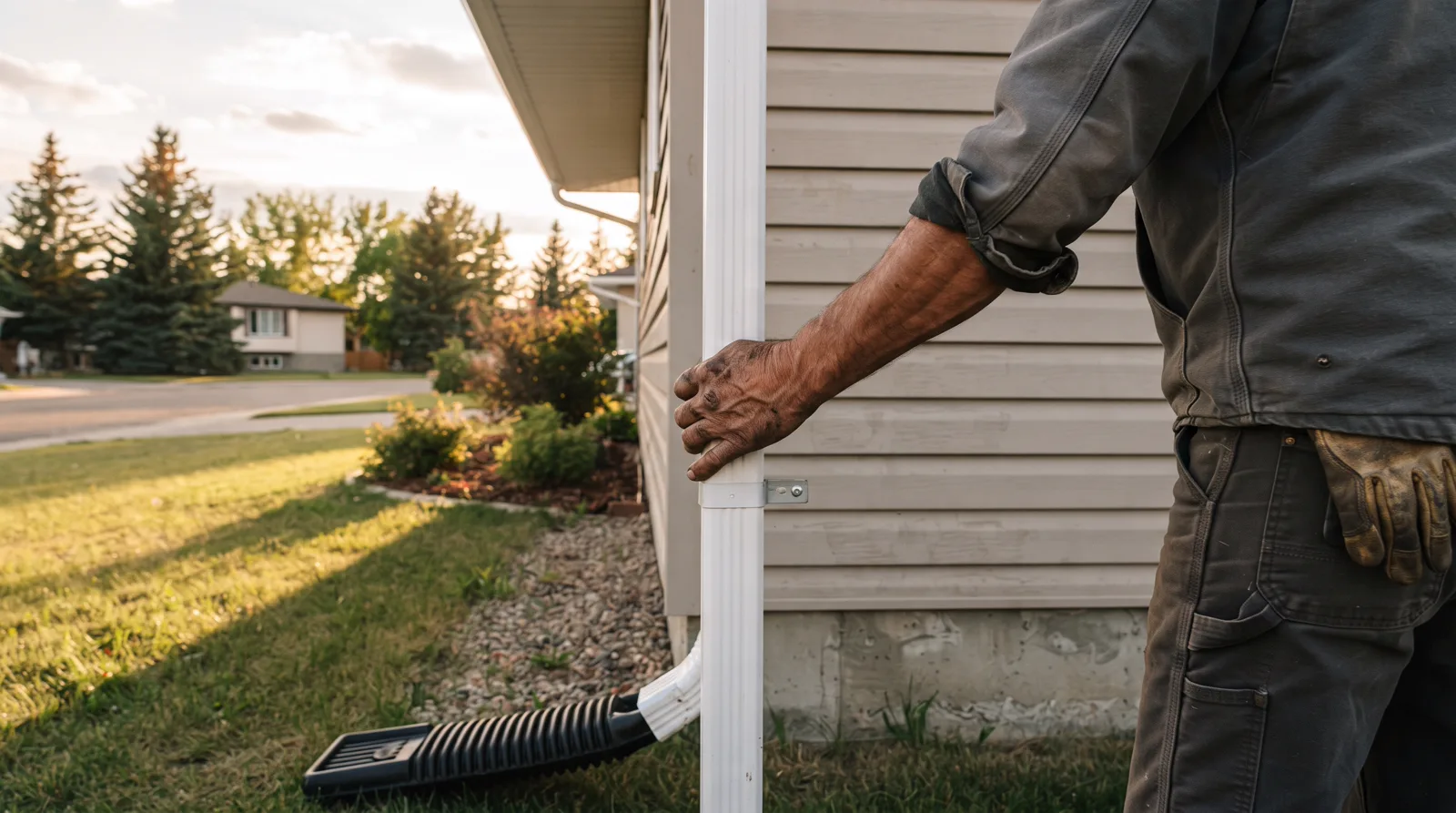
Downspout Installation That Actually Moves Water Away.
Properly positioned downspouts prevent basement flooding, foundation cracks, and ice dams. Local pros install, extend, and redirect for Alberta's freeze-thaw cycles and spring melt.
Downspout Solutions for Every Drainage Problem
From simple extensions to full underground systems, we solve water issues the right way.
New Downspout Installation
Add downspouts where water overflows or sections are missing. We match your existing eavestrough profile and secure to Alberta wind load standards. Includes brackets, elbows, and ground connection.
Downspout Extensions
Move water 2 to 6 meters from your foundation. Hinged or fixed options. Essential for preventing basement seepage and foundation cracks during spring melt and heavy rain.
Downspout Redirection
Redirect water away from driveways, sidewalks, or problem areas. Local pros reroute downspouts to better drainage points, add underground elbows, and prevent ice buildup at walk zones.
Underground Downspout Burial
Bury downspout lines to drainage wells, sump pits, or street. Excavation included. PVC pipe rated for Alberta frost depth (1.5m to 2.4m). Keeps yards clean and water completely away from foundation.
Splash Blocks & Drainage Solutions
Install concrete or plastic splash blocks, gravel drains, or pop-up emitters. Prevents soil erosion, protects landscaping, and guides water safely away during chinook melt events.
Downspout Repair & Replacement
Fix bent, rusted, or disconnected downspouts. Replace sections damaged by snow load, ice, or impact. Match aluminum, steel, or vinyl to existing system. Urgent requests prioritized.
Downspout Installation for Alberta Weather
❄️ Freeze-Thaw Cycle Durability
Alberta's 30 to 50 freeze-thaw cycles per winter crack weak downspout joints and pull brackets loose. We use freeze-rated brackets, sealed connections, and expansion-tolerant fittings that survive chinook swings from minus 20°C to plus 10°C in 24 hours.
💧 Spring Melt Volume Management
April and May snowmelt can dump 40 to 80 mm of water equivalent in days, overwhelming short downspouts. We size extensions and underground lines to handle peak melt flow, preventing basement window well flooding and foundation saturation common in Parkland County clay soil.
🏔️ Chinook Wind Protection
West winds hit Spruce Grove and Stony Plain at 60 to 90 km/h during chinooks, ripping loose poorly secured downspouts. We anchor every 1.2 meters with screw-mount brackets and use wind-rated elbows that stay locked even in sudden temperature drops after warm spells.
🧊 Ice Dam Prevention at Ground Level
Water pooling at foundation level refreezes overnight, creating ice dams that block future drainage and crack concrete. Extensions move water beyond freeze zones, and buried lines eliminate surface ice entirely, critical for north-facing walls in Acheson and rural Parkland properties.
What it costs here
Everything You Need to Know About Downspout Installation
Sizing, placement, materials, permits, and drainage solutions for Tri-Region homes.
What Downspout Installation Actually Involves in Spruce Grove
Downspout installation is the process of adding vertical pipes that carry rainwater and snowmelt from your eavestrough system down to ground level and away from your foundation. In Spruce Grove and Parkland County, this isn't just about connecting a pipe to your gutter. It requires careful planning around soil type, frost depth, drainage patterns, and the intense freeze-thaw cycles that define Alberta winters. A properly installed downspout directs thousands of litres of water per season away from your foundation, preventing basement flooding, foundation cracks, and the kind of soil erosion that turns front yards into muddy sinkholes every spring.
The physical components include the downspout pipe itself (usually aluminum or vinyl in 2x3 inch or 3x4 inch dimensions), elbows to navigate around soffits and architectural features, straps or brackets mounted to your siding or foundation, and some form of ground-level drainage solution. That last piece is critical in Alberta. You can't just dump water at grade and hope for the best. Our clay-heavy soils don't drain well, frost penetrates 1.8 to 2.4 meters deep in winter, and spring melt combined with rain can overwhelm any surface drainage in hours. Most professional installations in this region include buried drainage extensions, splash blocks, or connection to a perimeter drain system.
The installation process also has to account for building envelope details that matter in our climate. Downspouts penetrate the thermal and moisture barrier of your home's exterior, so flashing and sealing at every bracket point prevents ice damming and water intrusion. In Spruce Grove, where temperatures can swing 30 degrees in a single day during chinook events, expansion and contraction stress every connection. Installers use flexible sealants, avoid over-tightening fasteners, and space brackets to allow controlled movement. Skipping these details leads to split seams, pulled-off sections, and the rattling, banging downspouts you hear during windstorms. Quality installation means the system works silently and invisibly for 20 to 30 years.
Why Alberta's Climate Demands Reliable Downspout Drainage
Freeze-Thaw Cycles and Foundation Stress
Spruce Grove experiences 40 to 60 freeze-thaw cycles per winter, one of the highest rates in Canada. When water saturates the soil around your foundation and then freezes, it expands with enough force to crack concrete, shift footings, and push foundation walls inward. This isn't a gradual process. A single heavy rain followed by a hard freeze can create thousands of pounds of lateral pressure against your basement walls. Downspouts that dump water within two meters of your foundation guarantee this cycle repeats all winter, compounding damage season after season.
The clay soils common in Parkland County and Acheson make this worse. Clay absorbs water slowly but holds it for weeks, meaning the soil around your foundation stays saturated long after the rain stops. When that saturated clay freezes, it becomes a rigid, expanding mass pressing against your foundation from all sides. Properly extended downspouts move water at least 1.5 to 2 meters away from the foundation before release, giving it time to disperse into surrounding soil or flow toward natural drainage. This single change can eliminate 80 percent of freeze-thaw foundation stress.
Chinook Winds and Rapid Temperature Swings
Chinook winds are a western Alberta phenomenon where warm Pacific air pours over the Rockies and raises temperatures by 20 to 40 degrees in a matter of hours. Spruce Grove and Stony Plain sit right in the chinook belt, and these events create drainage chaos. A meter of snow can melt in 48 hours, overwhelming eavestroughs and downspouts designed for typical spring runoff. If your downspouts can't handle the volume or are clogged with ice, water backs up, overflows, and sheets down your walls. This is how you get interior water damage in February.
The rapid thaw also creates another problem: ice lenses in the soil. When the surface melts but the ground is still frozen two meters down, water has nowhere to go. It pools at grade, refreezes overnight, and creates ice dams at the base of downspouts. Homes without buried drainage extensions or splash blocks angled away from the foundation end up with permanent ice pads against their walls all winter. These ice masses grow every chinook cycle, eventually forcing water into basement window wells, foundation cracks, and weeping tile systems never designed to handle frozen ground.
Hail Damage and Heavy Precipitation Events
Spruce Grove and the surrounding region experience severe hailstorms multiple times per summer, with hailstones ranging from pea-sized to golf ball diameter. These storms don't just dent cars and siding. They split eavestrough seams, knock downspouts off their brackets, and punch holes through aluminum downspout elbows. A single July storm can disable your entire drainage system just before the heaviest summer rains. Homes with inadequate or damaged downspouts during these storms often see basement flooding within hours, because the ground is already saturated and has no capacity to absorb roof runoff dumping directly at the foundation.
Summer thunderstorms in Alberta can drop 25 to 50 millimeters of rain in an hour, far exceeding the capacity of undersized or poorly positioned downspouts. A typical 150 square meter roof sheds over 3,700 liters of water during a 25 millimeter rainfall. If that volume exits through one or two downspouts positioned poorly, the ground simply can't absorb it fast enough. Water pools, flows toward the foundation, and finds every crack and seam. Adding downspouts and extending their discharge points spreads the load, giving water time to soak in or flow away from the structure. This is why homes built in the 1980s and 1990s often need additional downspouts added during upgrades: roofs are larger, rainfall intensity has increased, and original systems were undersized from day one.
Warning Signs You Need Downspout Installation or Replacement
The clearest signal is visible water damage at your foundation or basement. If you see vertical staining on your foundation walls, that means water is overflowing or sheeting down from above rather than being carried away. Cracks in the foundation that widen over time, especially horizontal or stair-step cracks in block foundations, indicate ongoing freeze-thaw pressure from saturated soil. Basement window wells that fill with water during rain, damp spots on basement walls that appear after storms, or a musty smell that never quite goes away all point to water that's being dumped too close to your home. These aren't minor cosmetic issues. Foundation repairs in Alberta run $5,000 to $40,000 depending on severity, and most of that damage is preventable with proper downspout drainage.
Landscape and grading problems also tell the story. If you have deep channels eroded into the soil directly below where your eavestrough ends, or bare spots in your lawn where grass won't grow, that's concentrated water flow from missing or inadequate downspouts. Flower beds that turn into mud pits, mulch that washes away every spring, or pavers and walkways that sink and shift near the house all result from uncontrolled roof runoff. In Spruce Grove's clay soils, this kind of erosion doesn't heal itself. The soil structure breaks down, compaction increases, and drainage gets worse every year. Homeowners often assume they have a grading problem and spend thousands resloping their yards, when the real issue is simply that water is dumping out of the sky onto a three-square-meter patch of ground instead of being directed away.
Winter ice buildup is the third major warning sign. If you see ice columns forming at the bottom of your downspouts, ice pads spreading across your walkways, or icicles hanging from eavestrough seams, your downspouts aren't managing flow correctly. This could mean they're clogged, undersized, improperly sloped, or discharging into an area where water can't drain. Ice dams at ground level create slip hazards, but more importantly, they force water back up into the downspout and eavestrough system. That water refreezes overnight, expands, and splits seams or pulls sections off the house. By the time you notice these issues, you've often lost a full season of protection and allowed preventable damage to accumulate.
The Professional Downspout Installation Process in Alberta
Site Assessment and Planning
A proper installation starts with evaluating your roof size, eavestrough layout, soil type, grading, and existing drainage infrastructure. The contractor measures roof area to calculate peak water volume during heavy rain, then determines how many downspouts you need and where they should be placed. Alberta building practices suggest one downspout for every 10 to 12 meters of eavestrough, but this varies based on roof pitch, valley concentration, and local rainfall intensity. Homes in Spruce Grove with complex rooflines or multiple valleys often need additional downspouts to prevent eavestrough overflow.
The assessment also includes checking foundation type, frost depth, and soil drainage. In Parkland County, clay soils dominate, so contractors plan for buried extensions or drainage tiles rather than simple splash blocks. They identify where water can be directed: toward street drainage, swales, or dry wells. If your lot slopes toward the house or you're in a low spot, the plan might include sump discharge integration or grading corrections. This planning phase prevents the common mistake of installing a beautiful new downspout that dumps water into a spot where it immediately flows back toward the foundation.
Materials Selection and Preparation
Most residential downspouts in this region use aluminum or vinyl. Aluminum is more common because it handles freeze-thaw cycles better, doesn't crack in extreme cold, and can be color-matched to your siding or trim. Vinyl costs less upfront but becomes brittle below negative 30 Celsius, and UV exposure degrades it over time. Commercial or high-end residential installations sometimes use copper, which lasts 50-plus years and develops a protective patina, but costs three to five times more than aluminum. Sizing matters too: 2x3 inch downspouts are standard for most homes, but larger roofs or high-rainfall areas benefit from 3x4 inch sizing that moves 50 percent more water.
Contractors also select elbows, straps, screws, sealants, and end treatments. In Alberta, expansion and contraction is a given, so flexible polyurethane sealants replace rigid caulking. Straps are spaced every 1.2 to 1.5 meters and use screws long enough to hit solid framing, not just siding. The ground-level solution varies: buried PVC extensions running 1.5 to 3 meters from the foundation, pop-up emitters that release water at grade away from the house, or connection to an existing perimeter drain. Each option has trade-offs in cost, effectiveness, and maintenance requirements. Buried extensions work best but cost $150 to $400 per downspout depending on length and excavation difficulty.
Installation Steps and Testing
Installation begins by marking downspout locations on the eavestrough and house exterior, then cutting the eavestrough outlet hole and attaching the outlet fitting. The downspout is assembled in sections, connecting elbows to navigate around soffits and bring the run tight against the wall. Each joint is sealed and fastened, and straps are screwed into wall studs or blocking, not just siding. If the plan includes buried drainage, the contractor digs a trench 30 to 45 centimeters deep, slopes it away from the foundation at 2 percent grade, lays perforated or solid PVC pipe, and backfills with gravel and soil. For above-ground splash blocks, the installer ensures the block is angled and extends far enough to move water away effectively.
Once installed, the system is tested before the contractor leaves. This means running water from a hose into the eavestrough and watching how the downspout handles flow. The contractor checks for leaks at seams, proper flow rate, and confirms water exits at the intended location and drains away from the foundation. In winter installations, testing is limited, but contractors verify structural integrity, secure mounting, and proper slope. Final steps include cleaning up debris, checking that siding and trim weren't damaged during mounting, and walking the homeowner through maintenance basics like keeping outlets clear of leaves and checking straps annually. A professional installation in Spruce Grove typically takes three to six hours per downspout depending on complexity, and costs range from $250 to $800 per downspout installed including materials and labor.
What Downspout Installation Really Costs in the Tri-Region
A typical downspout installation for a single-family home in Spruce Grove or Stony Plain runs anywhere from $400 to $1,800, depending on how many downspouts you need, the height of your roofline, and what kind of drainage solution you want at ground level. If you are adding two downspouts with basic splash blocks on a single-story home, expect the lower end of that range. A two-story home with four new downspouts, underground drain connections, and grading work to slope the soil away from the foundation can easily hit $2,500 to $3,500. The math is straightforward: each downspout assembly (the vertical pipe, elbows, brackets, and outlet) costs $150 to $400 installed, and the real expense comes from how you manage the water once it reaches the ground.
Material choice has a noticeable impact on price. Aluminum downspouts are the local standard because they handle freeze-thaw cycles without cracking, resist rust in wet clay soil, and come pre-finished in a wide range of colours to match your eavestrough. Vinyl is cheaper up front, often $80 to $120 per downspout installed, but it becomes brittle in deep cold and can crack when snow slides off the roof or a chinook wind slams debris into it. Steel downspouts are the premium option at $200 to $500 each, offering superior strength and a clean modern look, but they require proper coating to avoid rust where brackets or fasteners break the finish. Most Tri-Region installers stock aluminum in standard profiles and can colour-match your existing gutters on the spot, which keeps lead times short and avoids special-order markups.
The biggest cost driver is what happens at the bottom of the downspout. A simple plastic splash block costs $15 to $30 and does an adequate job if your yard slopes naturally away from the house and your soil drains well. Rigid or flexible downspout extensions that carry water three to six metres from the foundation add $40 to $100 per downspout, and they work well in flat yards or areas where surface runoff is not a problem. Underground drainage, where the installer digs a trench, lays perforated pipe in gravel, and routes water to a dry well or storm sewer tie-in, is the most effective solution for heavy clay soil and poor surface drainage, but it adds $300 to $800 per downspout depending on trench length, depth (you need to go below frost line, which is 1.8 metres in this region), and whether the contractor hits rock, old utility lines, or tree roots during excavation.
Permit and inspection costs are real but modest. The Town of Spruce Grove and Parkland County do not typically require a permit for adding or relocating downspouts unless you are tying into a municipal storm sewer or doing major grading work that alters drainage patterns on neighbouring properties. Stony Plain has similar rules. If your project includes a sewer connection or a sump pump discharge line that runs to the street, expect a $75 to $150 permit fee and a required inspection to confirm proper backflow prevention and code compliance. Most residential downspout jobs do not trigger permit requirements, but asking your installer to verify local rules before starting work is a simple way to avoid a stop-work order or a retrofit demand from a bylaw officer after the fact.
Comparing Downspout Materials, Sizes and Drainage Methods
Aluminum downspouts dominate the Tri-Region market because they deliver the best balance of cost, durability, and climate performance. They resist corrosion in wet soil, handle temperature swings from minus 35 in January to plus 30 in July without warping or splitting, and they are lightweight enough that standard wall brackets hold securely on wood, vinyl, or stucco siding without special reinforcement. Aluminum comes in .027-inch and .032-inch thickness. The thinner gauge is fine for most homes, but if your roof sheds heavy ice or you have large evergreens that drop branches during storms, the thicker material adds impact resistance for an extra $20 to $40 per downspout. Colour selection is excellent: white, black, brown, bronze, pewter, and custom-match options are all stocked locally, so you can coordinate with your eavestrough, fascia, or siding without waiting weeks for a factory order.
Vinyl downspouts cost less, typically $80 to $120 installed, and they never rust or require painting. The tradeoff is brittleness in extreme cold. When temperatures drop below minus 20 and stay there for days, vinyl loses flexibility and can crack if struck by falling ice, a shovel during snow clearing, or even from the thermal shock of a sudden chinook. Vinyl also expands and contracts more than metal, which can cause joints to separate over time if the installer does not use enough brackets or leaves gaps at the seams. It works adequately on detached garages, sheds, or lower-priority areas where you want basic drainage without a big investment, but it is not the first choice for primary downspouts on a home where failure means water against the foundation or ice buildup near doorways.
Steel downspouts, usually 24-gauge galvanized or pre-painted steel, offer maximum strength and a sleek architectural look. They cost $200 to $500 per downspout installed, and they are the go-to option for commercial buildings, modern custom homes, or anywhere you need to handle high water volume or want the downspout to double as a design feature. Steel will not dent from hail or bend if someone leans a ladder against it, and it holds fasteners more securely than aluminum, which matters on tall buildings or in high-wind areas near Acheson or open farmland in Parkland County. The downside is rust potential at cut edges, bracket holes, or anywhere the coating is scratched. Quality installers seal all cut ends and use stainless fasteners to minimize corrosion, but steel still requires more attention than aluminum over a twenty-year lifespan.
Choosing the Right Downspout Size
Downspouts come in two common sizes: 2x3 inches and 3x4 inches. The 2x3 profile is standard on most homes and handles the drainage from 600 to 1,000 square feet of roof area without issue. It pairs with five-inch or six-inch eavestrough and works fine for typical single-family homes with moderate roof pitch and standard shingle surfaces. The 3x4 size is necessary when you have a large roof area draining to a single downspout, a steep pitch that concentrates water quickly, or a metal roof that sheds rain and snow faster than asphalt shingles. Undersizing the downspout is one of the most common mistakes in residential installations. If your eavestrough overflows during heavy rain even though it is clean and properly sloped, the problem is often inadequate downspout capacity, not gutter size. Upgrading from 2x3 to 3x4 adds $30 to $60 per downspout but eliminates overflow, ice dams at the outlet, and the fascia rot that comes from water spilling over the back of the gutter.
Surface Drainage vs Underground Systems
Splash blocks and surface extensions are the simplest and cheapest drainage options. A splash block is a plastic or concrete pad placed under the downspout outlet to spread water and prevent soil erosion. It works if your yard has natural slope away from the foundation and the soil drains reasonably well. Flexible or rigid extensions carry water three to six metres from the house, and they are effective in most situations as long as you position the outlet where water can flow away naturally and not pool or run back toward the foundation. Surface solutions are easy to install, require no excavation, and cost $15 to $100 per downspout depending on length and material. The drawback is visibility: extensions sit on top of the lawn and can be tripping hazards, obstacles for mowing, or eyesores if not positioned carefully.
Underground drainage is the permanent, invisible solution for problem areas. The installer digs a trench from the downspout outlet to a discharge point (a dry well, a swale, or a storm sewer connection), lays four-inch perforated or solid PVC pipe on a gravel bed, and buries it below frost line to prevent freeze damage. Water enters the pipe through a catch basin at the downspout base and flows by gravity to the outlet. This approach eliminates surface clutter, handles high water volume without erosion, and keeps water away from the foundation even during heavy spring melt or multi-day rainstorms. Cost runs $300 to $800 per downspout depending on trench length and site conditions, and it is worth every dollar in areas with heavy clay soil, poor surface drainage, or a history of basement seepage. Parkland County properties with flat lots and clay hardpan often need underground systems because surface water has nowhere to go and saturates the soil around the foundation unless you physically remove it through buried pipe.
Mistakes and Contractor Red Flags That Cost You Money
The most expensive mistake is spacing downspouts too far apart or using too few for the roof area. Building codes and manufacturer guidelines call for one downspout for every 600 to 1,000 square feet of roof, but plenty of older homes in Spruce Grove and Stony Plain were built with one downspout per side regardless of roof size. The result is eavestrough overflow during heavy rain, ice dams in winter, and fascia rot from water spilling over the back edge. Adding a second or third downspout is a small cost compared to replacing rotted fascia boards, re-painting siding, or fixing foundation cracks from years of water pooling against the house. A good installer will calculate the roof area, measure the existing eavestrough capacity, and tell you honestly whether you need more downspouts even if it increases the quote. A bad one will install exactly what you asked for and say nothing, then you discover the problem two years later when the damage is done.
Another common error is placing the downspout outlet too close to the foundation or aiming it toward a low spot where water cannot drain away. The bottom of the downspout should discharge at least 1.5 to 2 metres from the foundation wall, either through an extension or underground pipe, and the ground around the outlet must slope away at a minimum two percent grade so water flows naturally and does not pool. If the installer skips the extension or aims the outlet at a patio, walkway, or garden bed that traps water, you end up with saturated soil, frost heave against the foundation, or ice buildup that makes walkways dangerous all winter. This is especially problematic in flat yards common around Acheson and parts of Parkland County, where natural drainage is minimal and you need deliberate grading or underground pipe to move water off the property.
Hiring an uninsured or unlicensed contractor is a gamble that rarely pays off. Eavestrough and downspout work involves ladders, roofline access, and often digging near utilities or septic fields. If the installer is not covered by WCB (Workers' Compensation Board) and gets injured on your property, you can be held liable for medical costs, lost wages, and legal fees. If they are not insured for general liability and they damage your siding, break a window, or crack a water line during installation, you pay for the repair out of pocket. Legitimate contractors carry both WCB and liability coverage and provide proof when you ask. If someone offers a suspiciously low quote and cannot produce insurance documents, walk away. The few hundred dollars you save up front can turn into thousands in liability if something goes wrong, and there is no legal recourse because the contractor operates off the books.
Pressure tactics and vague quotes are red flags that signal a contractor more interested in closing the sale than doing quality work. A professional installer will visit the site, measure the roof and eavestrough, discuss drainage options, and provide a written quote that lists materials, labour, disposal fees, and any site-specific challenges like difficult access, underground obstacles, or permit requirements. The quote should specify downspout size, material, colour, bracket spacing, and the type of drainage solution at ground level. If the contractor gives you a verbal price over the phone without seeing the property, pushes you to sign the same day with a limited-time discount, or refuses to put the scope of work in writing, you are dealing with someone who will cut corners during installation and disappear if problems arise. Good contractors are busy and confident in their pricing, so they have no need for high-pressure sales tactics or fear of losing your business to a competitor who takes time to do the job properly.
How to Hire the Right Downspout Installer in the Tri-Region
Start by verifying credentials and insurance before you discuss pricing or schedule work. Ask for proof of WCB coverage, general liability insurance, and any relevant trade certifications or business licenses. In Alberta, eavestrough and exterior work does not require a specific trade ticket, but contractors who belong to industry associations or have completed manufacturer training programs tend to deliver better work because they follow updated installation standards and have access to warranty support if materials fail. Check online reviews on Google, Facebook, and the Better Business Bureau, and pay attention to how the contractor responds to complaints. Everyone gets a bad review eventually, but a company that addresses issues professionally and makes things right is far more trustworthy than one that ignores criticism or blames the customer.
Get at least three written quotes and compare them line by line, not just on total price. The lowest bid often reflects shortcuts: thinner material, fewer brackets, no extensions, or a plan to dump water right beside the foundation and move on. The highest bid is not always better either, especially if it includes unnecessary add-ons or premium materials that offer no real benefit for a standard residential job. Look for a quote that specifies downspout size, material thickness, colour, bracket type and spacing, and a clear drainage plan with extensions, splash blocks, or underground pipe as appropriate for your site. Ask what happens if the installer encounters rock, old foundations, or utility lines during excavation. A good contractor has contingency language in the quote and will call you before proceeding with extra work, while a bad one will present you with surprise charges after the fact and threaten to leave the job unfinished if you do not pay immediately.
Timeline and warranty expectations should be discussed up front. Most downspout installations take half a day to a full day depending on the number of downspouts, height of the building, and complexity of the drainage work. If the contractor says they can start tomorrow and finish in two hours, they are likely rushing and will not take time to do proper bracket spacing, seal joints, or verify that outlets are positioned correctly. A realistic timeline is one to three weeks from quote acceptance to installation, with the job completed in a single day unless weather or unforeseen site conditions cause delays. Material warranties are typically 20 to 30 years for aluminum and steel, but the installer's workmanship warranty is what protects you against poor installation. Look for a company that offers at least a two-year workmanship guarantee covering leaks, bracket failure, and drainage issues. Avoid contractors who provide no warranty or only cover defects for 90 days, because most installation problems do not show up until the first heavy rain or freeze-thaw cycle months after the work is done.
How Tri-Region Services Helps
We connect you with one carefully vetted, fully insured local contractor who specializes in eavestrough and downspout work in Spruce Grove, Stony Plain, Parkland County, and Acheson. No phone tag with multiple companies, no high-pressure sales calls, and no guessing whether the installer is legitimate. You get a free written quote that includes material specs, drainage options, and a clear timeline, and you decide whether to proceed with no obligation. Our contractor network carries full WCB and liability coverage, provides workmanship warranties, and has a track record of solving drainage problems correctly the first time. Reach out today and get your downspout installation handled by a pro who understands Alberta weather, local soil conditions, and what it takes to keep your foundation dry year-round.
Why Tri-Region Homeowners Choose Us
Licensed, insured, and built for Alberta weather.
Liability insurance
Every crew member is each crew tells us they carry $5 million liability, protecting your property during excavation and installation.
Alberta Building Code Compliant
Downspout placement, slope, and frost-depth burial meet Alberta code for foundation drainage and lot grading requirements.
Local Crews, Local Knowledge
Based in Spruce Grove, we know which neighborhoods have clay soil, high water tables, or drainage bylaw restrictions.
Urgent Requests Prioritized
Emergency downspout repairs and extensions often completed same day to prevent foundation damage during active rain or melt.
Weather-Tested Materials Only
Local pros install aluminum, steel, and PVC rated for Alberta UV, freeze-thaw, and hail impact, no flimsy vinyl that cracks at minus 25°C.
Free Drainage Assessment
We assess slope, soil type, and problem areas before quoting, so you get the right solution, not the most expensive one.
This page is not tied to a contractor's brand. Leads route straight to your one local partner. Verified reviews can appear here once that partner has them (never fabricated).
Serving the whole Tri-Region
8 Common Downspout Questions
How far should downspouts extend from my foundation in Alberta?+
Do I need a permit to bury downspouts in Spruce Grove or Stony Plain?+
What is the best material for downspouts in Alberta winters?+
Can I connect downspouts to underground sump or weeping tile?+
Why does water still pool near my foundation even with downspouts?+
How do I prevent ice buildup at the bottom of downspouts in winter?+
What size downspout do I need for my eavestrough?+
How much does it cost to bury downspouts in the Tri-Region?+
Get your free quote
Tell us what you need and a local pro will get right back to you.
- ✓ Sent straight to a local business
- ✓ You choose who you hire
- ✓ Free, with no obligation