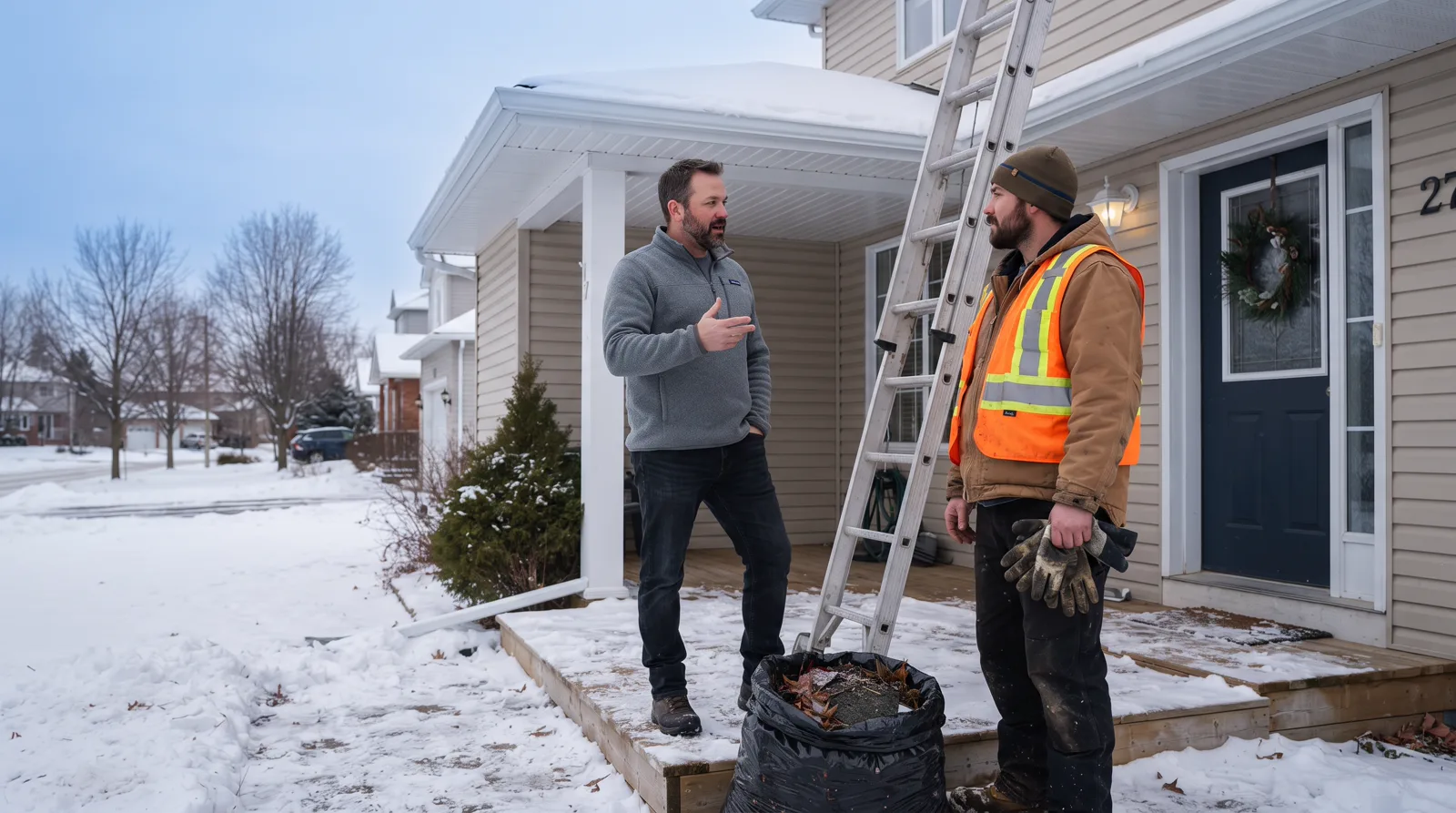
Eavestrough Cleaning Spruce Grove Before Ice Dams Form.
Hand cleaning, downspout flushing, and debris removal by local Alberta contractors. We bag it, haul it, and leave your eavestroughs flowing.
Complete Eavestrough Cleaning Services
From hand scooping to downspout augering, we clear every blockage and test every outlet.
Full Hand Cleaning & Bagging
We hand-scoop every linear foot, removing poplar seeds, aspen catkins, shingle grit, and moss. All debris is bagged on-site and hauled away. No blowing mess into your garden beds or driveway.
Downspout Flushing & Flow Testing
We flush every downspout with water to confirm drainage, and auger out packed clay, ice residue, or root intrusion if needed. You see the water hit the ground or splash block before we leave.
Debris Removal & Disposal
Everything pulled out goes into contractor bags and leaves with the crew. No piles left on the lawn, no expectation you'll deal with it later.
Gutter Inspection & Condition Report
While local pros clean, we document rust spots, separated seams, loose brackets, and any hail dimples or UV cracking. You get a written summary with photos, useful for insurance or repair planning.
Minor Seal & Bracket Tightening
If we spot a dripping corner or a sagging section held by one screw, we tighten brackets and apply butyl sealant on the spot. Keeps small problems from becoming leaks or detachment over winter.
Spring Ice Dam Prevention Flush
Early April service to clear any freeze-thaw debris and confirm downspouts are open before heavy melt. Prevents overflow staining on siding and foundation saturation during peak runoff weeks.
Why Spruce Grove Eavestroughs Clog Faster
🌳 Poplar, Aspen & Birch Debris Load
Mature boulevards drop catkins in May and leaves in October. A typical Heritage Park bungalow can fill gutters twice a year from tree canopy alone, even if your own yard is bare.
🌡️ Freeze-Thaw Overflow Risk
Clogged gutters turn into ice troughs during November freeze-up. Chinook melts release surges that overflow onto siding, stain stucco, and pool against foundations when the outlet is blocked by frozen debris.
💨 Chinook Wind Debris Drift
West winds push neighbour's leaves, grocery bags, and roofing grit into your eavestroughs even after you've cleaned your own yard. Post-chinook inspections often reveal fresh blockages within days of a cleaning.
🌊 Spring Melt Volume Management
April melt from a typical Parkland County roof sends 200 to 800 litres per hour through downspouts during peak thaw. A single clog redirects that onto walkways, creating ice patches and undermining patio slabs.
What it costs here
Everything You Need to Know About Eavestrough Cleaning in Spruce Grove
From seasonal timing to what contractors actually check, this is the local reference.
Why Eavestrough Cleaning Matters in Spruce Grove's Unique Climate
Spruce Grove and the surrounding Parkland County region experience weather patterns that are particularly hard on eavestrough systems. The spring thaw often arrives in sudden chinook waves, dumping massive volumes of snowmelt into gutters that may still be partially frozen or packed with winter debris. When eavestroughs cannot handle this rush of water, it spills over fascia boards, runs down exterior walls, and pools against foundations. This is not a cosmetic issue: prolonged saturation in freeze-thaw cycles causes wood rot, concrete spalling, and basement seepage that can cost thousands to remediate. Regular cleaning prevents this cascade of damage by ensuring meltwater and rain exit the roof system as designed.
The mix of deciduous and coniferous trees common to this area contributes a steady supply of organic material into gutters. Poplar and aspen shed catkins in spring, dense leaf fall arrives in autumn, and spruce or pine needles drop year round. Add in windblown shingle grit from aging roofs, and eavestroughs fill faster here than in many other regions. Once a layer of wet leaves compacts and begins to decompose, it forms a dense mat that blocks water flow and holds moisture against metal or vinyl trough materials. This trapped moisture accelerates corrosion in aluminum gutters and promotes algae or moss growth that further obstructs drainage. Professional cleaning removes this compacted organic layer before it becomes a structural problem.
Alberta hailstorms, particularly intense in late spring and summer, can knock leaves and small branches into gutters in a single afternoon. After a severe hail event, eavestroughs that were clear the previous week may be completely clogged with shredded foliage and hailstone residue. Winter snow load adds another dimension: deep snow sitting on roofs for months slowly compresses into dense layers that slide off in chunks during thaw periods, often carrying twigs and roof debris directly into the gutter channel. These seasonal pulses of debris mean that annual cleaning is rarely sufficient for most Spruce Grove properties. Twice-yearly service, typically in late spring after the final thaw and in late fall after leaf drop, aligns with the natural debris cycles and keeps systems functional through the harshest months.
Warning Signs Your Eavestroughs Need Professional Cleaning
Visible Overflow and Ice Dam Formation
The most obvious indicator is water spilling over the front edge of the gutter during or immediately after rain. This happens when debris blocks the trough channel or downspout outlet, forcing water to take the path of least resistance: over the side. In winter, this overflow freezes into thick ice ridges along the gutter lip, and those ridges grow with each thaw-freeze cycle until they become heavy enough to pull the gutter away from the fascia. Ice dams also form when snowmelt from the roof cannot drain through clogged gutters, backing up under shingles and into the attic space. If you see icicles hanging from gutter seams or water stains on soffits during winter, the system is already compromised and needs immediate attention once temperatures allow safe access.
Overflow staining on exterior siding, particularly the distinctive dark streaks that appear below gutter edges, is a secondary confirmation. These marks indicate that water has been running down the wall repeatedly, carrying tannins from decomposing leaves or algae from standing gutter water. On vinyl siding, these stains are often permanent without pressure washing. On wood or fiber cement, they signal prolonged moisture exposure that may already be degrading the material behind the surface. Regular cleaning prevents the debris buildup that causes overflow in the first place, protecting both the gutter system and the building envelope.
Sagging Sections and Fascia Separation
Gutters are designed to carry water, not soil. When organic debris decomposes inside the trough, it retains moisture and adds significant weight. A six-meter section of gutter filled with wet leaves and silt can weigh over 100 kilograms, far exceeding the load capacity of standard aluminum hangers. This weight causes the gutter to sag between supports, creating low spots where water pools instead of flowing toward downspouts. Once a sag develops, it traps more debris and water, worsening the problem in a self-reinforcing cycle. You will notice sagging as visible dips in the gutter line when viewed from ground level, or as sections that no longer sit flush against the fascia board.
Fascia boards that show rot, dark staining, or visible separation from the rafter tails are another clear sign. When gutters overflow or pull away from their mounting points, water runs directly onto the fascia, which is typically untreated wood or engineered wood product. Alberta's freeze-thaw cycles drive this water into cracks and joints, where it expands as ice and accelerates decay. If you can see daylight between the back of the gutter and the fascia, or if the fascia feels soft or spongy when pressed, the damage has already begun. Cleaning the gutters at this stage may require simultaneous fascia repair to restore a solid mounting surface, but further delay only increases the scope and cost of the repair work.
Plant Growth, Foundation Issues, and Interior Damage
Small plants, moss, or grass growing out of your eavestroughs indicate that debris has been present long enough to create a growing medium. Seeds blown into gutters by wind or deposited by birds germinate in the moist organic matter, and their root systems further block drainage while accelerating trough corrosion. This level of neglect usually corresponds with complete blockage of downspouts and severe overflow problems. If vegetation is visible from the ground, the gutters have not been cleaned in multiple seasons and likely require more than basic cleaning to restore function. Roots may have penetrated seams or caused separation at mitered corners, necessitating sealant repair or section replacement alongside debris removal.
Pooling water near the foundation, basement moisture, or even active seepage through foundation walls often trace back to failed eavestrough drainage. When downspouts are clogged or disconnected, roof runoff dumps directly beside the house instead of being carried away through proper drainage extensions. In Spruce Grove's heavy clay soils, this water does not percolate quickly and instead saturates the soil around the foundation, creating hydrostatic pressure that drives moisture through cracks and cold joints into basements. Homeowners sometimes assume they have a foundation problem when the real issue is gutter overflow concentrating runoff at the worst possible location. Cleaning the eavestroughs and ensuring downspouts discharge at least two meters from the foundation often resolves chronic basement dampness without expensive foundation work.
Interior ceiling stains, particularly in top-floor rooms or near exterior walls, can result from ice dam backup or overflow soaking into the building envelope. When water cannot exit through gutters, it finds alternate paths: under shingles, into soffit vents, along fascia boards, and eventually into wall cavities or attic insulation. By the time stains appear on interior surfaces, the hidden damage behind the drywall is usually far more extensive. Insurance claims for water damage related to ice dams or gutter failure are common in Alberta, but insurers often deny coverage if neglect or lack of maintenance contributed to the loss. Regular professional cleaning provides documentation of responsible maintenance, which can be critical if a claim is ever filed.
What Professional Eavestrough Cleaning Actually Involves
Professional eavestrough cleaning begins with a thorough inspection of the entire system from ground level and then from ladder or roof access. The technician examines gutter pitch and alignment, checks for loose or missing hangers, inspects seams and end caps for leaks, and notes any sections that sag or show corrosion. Downspout connections are tested to confirm they are secure and that extensions or underground drains are intact. This inspection identifies issues that cleaning alone will not solve, such as a gutter that has pulled away from the fascia or a downspout elbow that has separated and is dumping water into the soffit cavity. Reputable companies document these findings with photos and provide a written summary, giving homeowners a clear picture of the system's condition before any work begins.
Debris removal itself is done by hand using trowels or scoops, working methodically from downspout outlets back toward closed ends or mitered corners. Power blowers are rarely used because they scatter debris across roofs, into valleys, and onto landscaping, creating more cleanup work and potential drain blockages. Hand removal allows the technician to feel the condition of the gutter interior, detect rust perforation or cracks in vinyl, and remove compacted material that would resist blowing. All debris is bagged on site and removed from the property, not left in piles on the lawn or blown into garden beds. This is a physically demanding task: a typical single-family home in Spruce Grove with 30 to 40 meters of gutter can yield four to six large bags of wet leaves, shingle grit, and decomposed organic matter weighing 15 to 20 kilograms each.
Downspout clearing is a critical step that separates professional service from amateur efforts. Even if the trough channel is clear, a clog in the downspout or at the underground drain connection will cause the system to overflow. Technicians use plumber's augers, high-pressure hose attachments, or specialized downspout clearing tools to break up and flush out blockages. In cases where a downspout is completely packed with compacted leaves or ice, it may need to be temporarily disconnected at an elbow joint to access the clog. Once cleared, the entire system is flushed with water from a hose to verify that flow is restored and that water exits where intended. This final test also reveals any remaining minor clogs or leaks that were not visible during the dry inspection.
After cleaning and testing, the technician performs a final walk around the property to check for any damage to landscaping, ensure all debris has been removed, and confirm that ladders or equipment have not left marks on siding or soffits. Any minor issues found during the inspection, such as a loose hanger or a small leak at a seam, are pointed out to the homeowner with recommendations for repair. Some companies offer on-the-spot minor repairs such as resealing a corner miter or replacing a missing spike and ferrule hanger, while others provide a detailed estimate for more extensive work to be scheduled separately. The goal is to leave the property cleaner than it was found, with a fully functional eavestrough system and the homeowner informed of any maintenance needs.
The Step-by-Step Cleaning Process Explained in Detail
Safety Setup and Access Preparation
Before any ladder is placed, the technician surveys the site for hazards: overhead power lines, unstable ground, obstacles that could cause trips or falls, and areas where ladder placement might damage plants or decorative features. In Spruce Grove, spring and fall conditions often mean wet grass, muddy soil, or frost, all of which reduce ladder stability. Professional crews use ladder stabilizers or standoffs to span flower beds and prevent the ladder feet from sinking into soft ground. If the roof pitch is steep or the eaves are higher than two stories, fall protection equipment such as roof anchors and safety harnesses may be required under Alberta occupational health and safety regulations. This setup takes time but is non-negotiable: eavestrough cleaning involves working at height in awkward positions, and shortcuts in safety lead to serious injuries.
For homes with walkout basements or sloped lots, access can be complicated by uneven terrain and extended ladder reach requirements. Technicians may need to reposition ladders multiple times to cover all sections of gutter safely, and some areas may require roof access if the eaves are not reachable from ground-based ladder placement. Roof walking is done with caution to avoid damaging shingles, particularly in cold weather when asphalt shingles are brittle and prone to cracking. Proper footwear with soft soles and an understanding of roof structure, valley locations, and safe weight distribution are essential to prevent both personal injury and property damage.
Hand Removal of Debris and Trough Inspection
Starting at a downspout outlet or high point, the technician scoops out leaves, twigs, shingle grit, and any other accumulated material by hand or with a narrow plastic or metal scoop designed to fit inside standard five-inch gutters. Wet, compacted debris often forms a dense mat that adheres to the gutter bottom and sides, requiring scraping to dislodge. This hands-on approach allows immediate detection of rust holes, cracked seams, or areas where the gutter interior coating has worn away and corrosion has started. If the debris is dry and loose, it may be funneled directly into a bag or bucket hoisted up alongside the ladder. If it is heavy and wet, it is often dropped to the ground onto a tarp for later bagging to avoid the weight and awkwardness of carrying full bags up and down a ladder repeatedly.
As each section is cleared, the technician checks the gutter pitch by observing whether residual water or sludge naturally flows toward the downspout or pools in place. Proper pitch is typically one centimeter of drop per three meters of run, a subtle slope that is easy to lose if hangers have loosened or if the fascia has warped. Sections that hold standing water after debris removal indicate a pitch problem that will lead to stagnant water, mosquito breeding, and accelerated corrosion. Noting these areas allows the homeowner to prioritize re-sloping or hanger adjustments during future maintenance. The technician also inspects inside corners and end caps, which are common leak points, and checks that gutter spikes or hidden hangers are secure and not pulling through rotted fascia.
Downspout Clearing, Flushing, and System Testing
With the trough channels clear, attention shifts to the downspouts. Clogs most often occur at the top outlet where the downspout connects to the gutter, at elbow joints, or at the base where the downspout meets an underground drain or splash block. A plumber's snake or auger is fed into the downspout from the top, breaking up compacted leaves or ice that hand scooping cannot reach. If the clog is deep or stubborn, the downspout may be flushed from the top with a high-pressure hose nozzle, forcing the blockage out the bottom. In cases where this does not work, an elbow or section may be temporarily removed to access the clog directly. This requires care to avoid damaging the crimped connections or bending the lightweight aluminum or vinyl material.
Once all downspouts are clear, the entire system is flushed with water using a garden hose placed at the farthest point from each downspout. The technician watches to confirm that water flows smoothly through the trough and exits the downspout at a steady rate without backing up or leaking from seams. This test reveals clogs that were missed during hand cleaning, slow drainage caused by improper pitch, and leaks at joints or fastener penetrations. If water leaks from a seam, it indicates that the sealant has failed or that the joint has separated due to ice expansion or physical stress. These leaks are documented and can often be resealed on the spot with gutter sealant or silicone caulk if the homeowner requests immediate minor repairs. The water test is the final proof that the cleaning was thorough and that the system is ready to handle the next rain or snowmelt event.
Cleanup, Documentation, and Maintenance Recommendations
After the system is confirmed clean and functional, all debris bags are removed from the property and disposed of according to local waste management bylaws. Tarps are shaken out, stray leaves are picked up from walkways and garden beds, and any tools or equipment are accounted for and loaded. The work area is left clean, with no evidence of the service other than spotless gutters. Professional companies take pride in this final step because it reflects their overall attention to detail and respect for the homeowner's property. Leaving a mess or damaging plants undermines trust and invites complaints, even if the technical work was done well.
Before leaving, the technician reviews findings with the homeowner, often using photos taken during the inspection to illustrate problem areas. This might include a rusted section of gutter that should be replaced before it fails completely, a downspout extension that has disconnected and needs to be reattached, or fascia boards showing early signs of rot that warrant monitoring. Written documentation, either in the form of an invoice with notes or a separate inspection report, provides a record for the homeowner's files and can be useful for insurance purposes or future maintenance planning. Recommendations are prioritized into urgent repairs, items to watch, and optional upgrades such as gutter guards or leaf screens. This transparent communication helps homeowners make informed decisions and builds a relationship of trust that often leads to repeat business and referrals, which is how reputable local companies sustain their operations in a competitive market.
What Eavestrough Cleaning Really Costs in Spruce Grove and the Tri-Region
Most homeowners in Spruce Grove, Stony Plain, and Parkland County pay between $150 and $400 for a standard eavestrough cleaning on a single-story home with 100 to 150 linear feet of gutter. Two-story homes with 200 to 300 linear feet typically run $300 to $600, and larger properties with walkout basements, complex rooflines, or multiple downspouts can reach $700 to $900. These are real 2026 prices from local contractors, not national averages. The range exists because every home is different: a simple bungalow with accessible eaves costs far less than a two-story with steep pitches, tall spruce trees overhead, and eavestroughs packed with pine needles and ice dam residue from last winter.
Three factors drive the price more than anything else. First is linear footage: contractors charge by the foot ($1.50 to $3.50 per linear foot depending on height and access), so a home with 250 feet of gutter costs more than one with 120 feet. Second is the amount of debris: if your eavestroughs are half-full of decomposed leaves, shingle grit, and dirt, the crew spends twice as long scooping, bagging, and flushing. Third is access difficulty. Ground-level eaves on a bungalow need only a six-foot ladder. Second-story eaves over a concrete patio or flower bed require scaffold or extension ladders, and any section over a sloped walkout or near power lines adds time and risk, which contractors price accordingly.
Seasonal timing affects what you pay. Spring and fall are peak seasons in the Tri-Region because homeowners want gutters clear before May rains and after October leaf drop. Book during these windows and you may wait two weeks for a slot, and some contractors add a $50 to $100 surcharge for same-week service. Book in late winter (March) or mid-summer (July or August) and you often get faster scheduling and sometimes a 10 to 15 percent discount because crews have open calendars. Just avoid booking in deep winter: frozen debris turns cleaning into chipping, and ice in downspouts can crack elbows when flushed with water.
Most local contractors quote either a flat rate or a per-foot rate after a visual inspection. Flat rates are common for typical single or two-story homes and include cleaning, flushing, bagging debris, and a basic visual check of fasteners and slope. Per-foot pricing is more transparent and works better for larger or unusual properties. Either way, get the quote in writing and confirm what is included: some companies charge extra to bag and haul debris, others include it. Some flush downspouts as standard, others add $20 to $40 per downspout if clogs require augering or disassembly. Knowing exactly what you are paying for prevents surprise charges when the crew finishes.
Comparing Cleaning Methods: Hand Scoop, Blower, Pressure Wash, and Vacuum
The oldest and most thorough method is hand scooping with a small plastic scoop or gloved hands. The technician walks the ladder along every section, pulls out leaves, pine needles, shingle grit, and dirt, drops it into a bucket or tarp below, then flushes the gutter and downspouts with a hose to confirm flow. This method removes everything, including the sludge layer that builds up on the bottom of aluminum troughs after years of decomposition. It takes longer and costs more per foot, but it is the gold standard for heavily clogged systems or homes near large trees. In the Tri-Region, where cottonwood fluff, spruce needles, and aspen leaves create dense mats, hand scooping is often the only method that gets the gutter truly clean.
Leaf blowers are faster and work well for dry, loose debris like fall leaves that have not yet decomposed. The contractor uses a backpack or handheld blower to blast leaves out of the gutter onto the ground or a tarp, then flushes with water to clear the small stuff. This method is common in subdivision homes with minimal tree cover and short sections of gutter. The downside: it does not remove wet, compacted debris or the sludge layer on the bottom, and it can blow dirt and grit into downspouts, creating clogs lower in the system. It also requires a second crew member or homeowner to gather debris from the ground, and it is loud, which matters in neighborhoods where homes are close together.
Pressure washing sounds appealing but is rarely the right choice for routine eavestrough cleaning in Alberta. High-pressure water can dislodge debris quickly, but it also blasts shingle grit and dirt into downspouts, creating clogs that are harder to clear than the original blockage. Worse, pressure above 1,500 psi can bend aluminum troughs, separate seams, or blow out end caps, especially on older five-inch K-style systems installed in the 1990s and 2000s. Some contractors use a low-pressure garden hose with a gutter-flushing attachment after hand scooping, and that works fine. But if a contractor shows up with a 3,000 psi pressure washer and no scoop, that is a red flag: they are prioritizing speed over quality, and you may end up with damaged gutters or clogged downspouts that need a second visit to fix.
Vacuum systems, either truck-mounted or backpack units, are gaining traction with professional crews. These systems use a powerful wet-dry vacuum with a long wand to suck debris out of the gutter from the ground or ladder, capturing it in a bag or tank. The method is fast, quiet, and effective for dry leaves and light debris, and it keeps the mess contained so there is no cleanup on the lawn. The limitation is wet, compacted debris: vacuum systems struggle with heavy sludge or ice-dam residue, and they cannot remove debris stuck under gutter guards or behind fasteners. In practice, many Tri-Region contractors use a hybrid approach, vacuuming the bulk of dry debris and hand-scooping the stubborn sections, which gives you speed and thoroughness without compromise.
Common Mistakes and Contractor Red Flags to Avoid
The biggest DIY mistake is underestimating the danger of ladder work on uneven ground or near power lines. Every year, Alberta emergency rooms treat dozens of homeowners who fell from ladders while cleaning eavestroughs, and the injuries range from broken wrists to spinal fractures. The risk doubles on two-story homes where you need an extension ladder on soft soil, gravel, or a sloped driveway. If your home has eaves above 12 feet, sections over concrete or flower beds, or any proximity to overhead power lines, hire a professional with proper fall-arrest equipment and liability insurance. Saving $200 on a cleaning is not worth a hospital stay or permanent injury, and your home insurance does not cover medical costs if you hurt yourself doing maintenance the insurer considers high risk.
The second mistake is hiring based on the lowest quote without checking credentials. In Alberta, eavestrough cleaning does not require a license, so anyone with a ladder and a truck can advertise the service. That means the market includes experienced, insured professionals and also uninsured handymen working cash jobs with no liability insurance. If a worker is injured on your property and the contractor has no liability insurance, you as the homeowner can be held liable for medical costs and lost wages under Alberta law. Before you hire, ask for proof of WCB coverage (called a clearance letter) and commercial general liability insurance with at least two million dollars in coverage. Legitimate contractors provide these documents without hesitation because they know informed homeowners ask for them.
Watch for contractors who quote over the phone without seeing the property. Eavestrough cleaning costs depend on linear footage, debris load, height, and access, and none of those can be estimated accurately from a Google Maps screenshot. A contractor who says $150 for any bungalow or $300 for any two-story is either underpricing to win the job and will add charges on site, or is overpricing simple jobs to pad profit. Reputable contractors visit the property, measure or visually estimate linear footage, check downspout count, note tree coverage and debris type, and then provide a written quote. If they skip the site visit, you have no way to verify the price is fair, and you lose negotiating power if they arrive and claim the job is bigger than expected.
Be cautious of contractors who pressure you to add services on the spot. Some will arrive to clean eavestroughs, then claim your fascia is rotted, your gutter slope is wrong, or your downspouts need replacing, and offer to fix it all today for cash at a discount. Fascia rot and slope issues are real problems, but they should be diagnosed with photos, explained clearly, and quoted separately so you can get a second opinion. A contractor who creates urgency (we can fix this now or you will have water in your basement next week) is often upselling unnecessary work. Ask for photos of the problem area, request a separate written quote, and take a day to think it over. If the issue is genuinely urgent, it will still be urgent tomorrow, and you will make a better decision with time to compare options and prices.
How to Choose the Right Eavestrough Cleaning Service
Start by confirming the contractor is insured and has liability insurance. Ask for a copy of their commercial general liability certificate and their WCB clearance letter, and verify the WCB number online at alberta.ca/wcb-clearance-verification. This takes five minutes and protects you from liability if a worker is injured. Also ask how long they have been in business locally and whether they have references from homes in Spruce Grove, Stony Plain, or Parkland County. Contractors who have been cleaning gutters in the Tri-Region for five or more years understand Alberta weather, roof types, tree species, and the typical debris loads that come with chinook winds and early fall frosts. New companies can be excellent, but established ones have a track record you can verify.
When comparing quotes, look beyond the bottom-line number and compare what is included. Does the price cover debris removal and disposal, or will you be expected to bag and haul six garbage bags of wet leaves? Does it include flushing downspouts, or is that an add-on? Does the contractor inspect for loose spikes, separated seams, or damaged end caps, and if they find a problem, do they tell you or just clean and leave? The best contractors treat cleaning as a maintenance inspection: they clean thoroughly, flush to confirm flow, and report any issues with photos so you can decide whether to repair now or monitor. A slightly higher quote that includes debris haul, downspout flushing, and a basic condition report is worth more than a low quote that covers only scooping debris into your flower beds.
Timing matters more than most homeowners realize. Book your cleaning for late October or early November after the leaves have dropped but before the first hard freeze. This is peak season, so expect to book two to three weeks in advance. If your schedule is flexible, ask if the contractor offers a discount for mid-week or off-peak appointments (late winter or mid-summer). Avoid booking during freeze-thaw cycles in March or November when ice can reform overnight and crack elbows or miters that were flushed with water the day before. Also avoid same-day or emergency bookings unless you have a genuine overflow situation: contractors who can come today are often the ones with open calendars because their work quality or reliability keeps customers from rebooking.
How Tri-Region Services Helps
Tri-Region Services routes you to one vetted, insured local contractor who serves Spruce Grove, Stony Plain, Parkland County, and Acheson. Every pro in our network tells us they carry commercial liability insurance. You fill out one short form, we match you to a contractor based on your location and property type, and they contact you directly to schedule a free on-site visit and written quote. No bidding wars, no spam calls from five companies, no pressure: just one qualified local professional who knows Alberta weather and can clean your eavestroughs safely and thoroughly before the next storm.
How We Keep Eavestrough Cleaning Safe & Documented
Every contractor in our network is insured, and trained in roof-safe ladder placement.
Liability Insured
All height work works for a crew that contractors carry $2 million general liability in case of property damage.
Roof-Safe Practices, No Shingle Damage
Ladders are placed on firm ground or walkways, never leaned against vinyl or thin fascia that can crack or dent.
Before & After Photo Documentation
You get emailed proof of the debris load and the final clean state, useful for insurance or buyer disclosure if selling.
Debris Properly Bagged & Removed
Nothing left on your lawn or driveway, all organic and shingle waste goes into contractor bags and off-site disposal.
Written Condition Report Included
We note rust, separated seams, loose brackets, and hail dents so you can plan repairs or file claims with real evidence.
Local References Available on Request
We connect you with contractors who've cleaned gutters in your neighbourhood and can provide homeowner references within 5 km.
This page is not tied to a contractor's brand. Leads route straight to your one local partner. Verified reviews can appear here once that partner has them (never fabricated).
Serving the whole Tri-Region
7 Common Eavestrough Cleaning Questions
How often should I clean eavestroughs in Spruce Grove?+
What happens if I skip fall cleaning before winter?+
Can clogged gutters cause ice dams?+
How do I know if my downspouts are actually draining?+
Will cleaning damage my roof or shingles?+
What do you do with the debris you remove?+
Do I need to be home during the cleaning?+
Can you clean eavestroughs in winter?+
Get your free quote
Tell us what you need and a local pro will get right back to you.
- ✓ Sent straight to a local business
- ✓ You choose who you hire
- ✓ Free, with no obligation