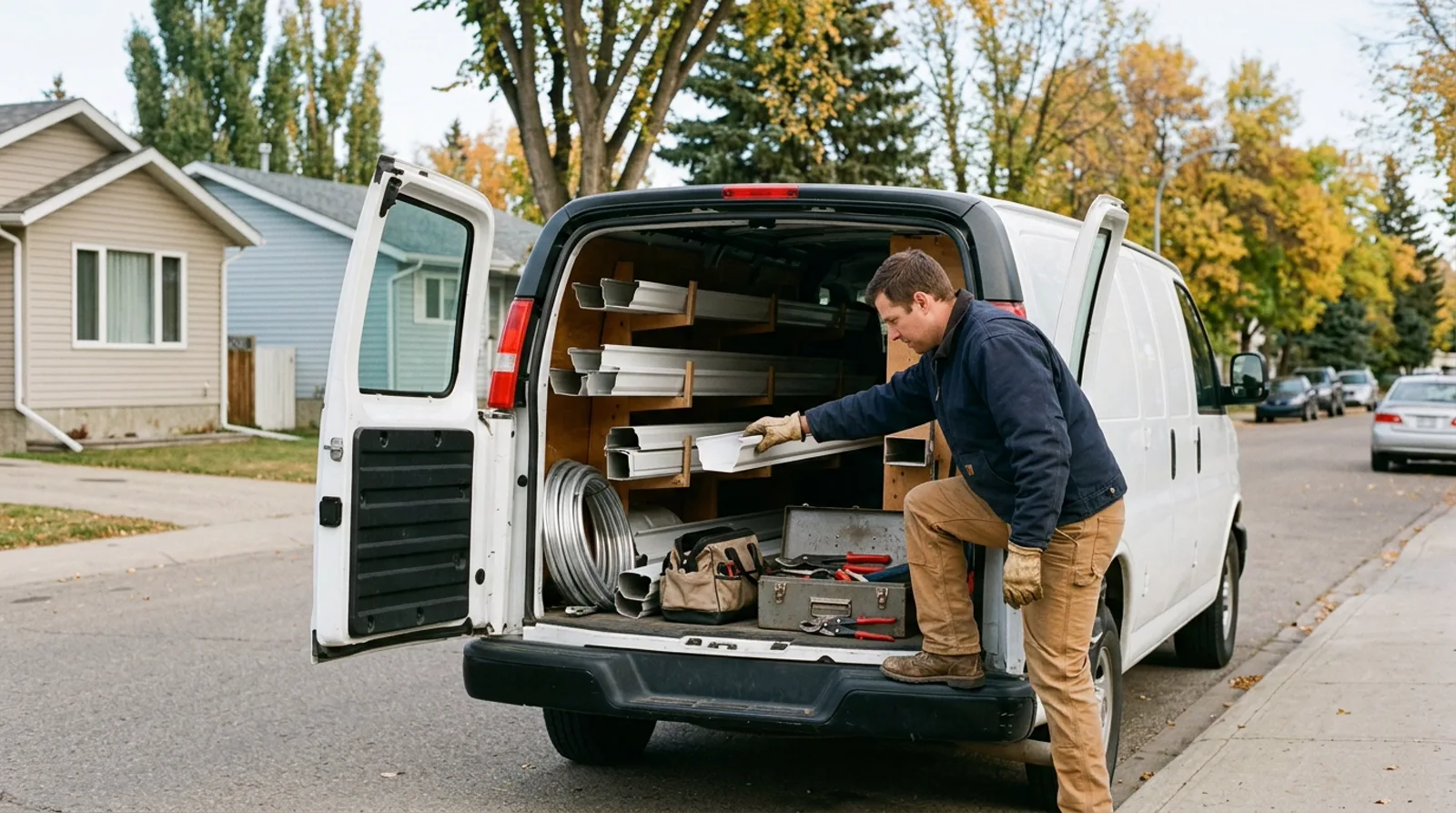
New Eavestrough Installation Built for Alberta Weather.
Seamless aluminum eavestroughs custom-fabricated on site, installed with proper slope and secure hidden hangers to handle hail, freeze-thaw cycles and heavy snow load.
Complete Eavestrough Systems for Residential and Commercial
Every installation includes fascia inspection, proper slope calculation, seamless fabrication and post-job cleanup.
Standard 5-Inch Aluminum Eavestrough
Most common residential size. Seamless .027 or .032 gauge aluminum, hidden hanger every 24 inches, choice of 20+ baked enamel colors. Handles typical Tri-Region rainfall and snow melt.
Oversized 6-Inch Eavestrough Systems
Recommended for steep roofs, large roof areas, or metal roofs that shed water fast. 30% more capacity than 5-inch. Prevents overflow during spring melt and summer storms.
Downspout Installation and Positioning
2x3 or 3x4 aluminum downspouts with secure strapping every 6 feet. We position outlets to drain away from foundation and avoid basement seepage. Extensions included to meet grading requirements.
Gutter Guard and Leaf Screen Systems
Micro-mesh or perforated aluminum guards that keep out poplar seeds, aspen leaves and pine needles common in Parkland County. Reduces cleaning frequency and ice dam risk.
Fascia Board Repair or Replacement
Rotten or damaged fascia won't hold eavestrough securely. Local pros replace sections with treated or PVC trim before installation so hangers anchor properly and your investment lasts.
Custom Metal Work for Complex Roof Lines
Hand-formed inside and outside miters, bay window wraps, dormer tie-ins, and valley connections. Ensures seamless water flow on multi-plane roofs without leaks or sags.
Why Alberta Weather Demands Better Installation
🧊 Freeze-Thaw Cycles and Ice Damming
Spring in Spruce Grove means daily freeze-thaw. Eavestroughs need precise 1/4 inch per 10 foot slope so meltwater drains before overnight refreeze. Poor slope turns gutters into ice troughs that tear off fascia.
🌨️ Snow Load and Fascia Anchoring
Heavy wet snow sliding off your roof hits eavestroughs hard. Hidden hangers screwed through fascia into rafter tails every 24 inches keep the system locked in place. Spike-and-ferrule installs common in other regions fail here.
⚡ Hail Damage Risk in Central Alberta
Parkland County and Spruce Grove see hail most summers. Thicker .032 gauge aluminum resists denting better than standard .027. We stock both and recommend the upgrade for south and west-facing roof lines.
🌬️ Chinook Winds and Secure Mounting
January chinooks bring 80+ km/h gusts. Eavestroughs installed with expansion gaps and secured to solid lumber survive. Poorly mounted gutters peel off fascia when wind gets underneath the back edge.
What it costs here
Everything You Need to Know About Eavestrough Installation in Spruce Grove
Sizing, materials, permits, timing, fascia prep and what separates a 10-year install from a 30-year system.
What Eavestrough Installation Actually Involves in Spruce Grove
Eavestrough installation is the process of attaching a continuous water collection and drainage system along the roof edges of your home. In Spruce Grove and Parkland County, this means installing gutters designed to handle Alberta's intense spring melt, summer thunderstorms, and the freeze-thaw punishment that happens from October through April. A proper installation creates a sealed channel that catches roof runoff and directs it through downspouts to discharge points at least six feet from your foundation. The goal is simple: keep water away from the structure where it causes tens of thousands of dollars in damage every year across the region.
Most residential installations in Spruce Grove use five-inch or six-inch seamless aluminum eavestroughs, fabricated on-site to eliminate joints where leaks typically start. The installer brings a roll-forming machine that creates continuous sections up to 100 feet long, custom-cut to match each roof edge. Aluminum is the standard here because it handles temperature swings from negative 35 Celsius in January to plus 30 in July without cracking, and it does not rust when exposed to snowmelt chemistry or the mineral content in Parkland County well water. Vinyl systems exist and cost less upfront, but they become brittle in deep cold and crack under snow load, which is why you see far fewer of them on homes built in the last 20 years.
The installation includes fascia inspection and repair, hanger spacing at 24-inch intervals to support ice and snow weight, sealed end caps, inside and outside corner fittings, and downspout outlets positioned to drain problem areas. Installers pitch the eavestrough at one-quarter inch per ten feet so water flows toward downspouts instead of pooling. Downspouts attach with hidden brackets and elbows that angle water away from the foundation or into underground drainage if your lot requires it. In subdivisions like Grove Pointe or Harvest Ridge, where lots are graded tight, you may need extensions or buried drain tile to prevent water from running back toward the house or flooding your neighbor's yard.
Why Alberta's Climate Makes Proper Eavestrough Installation Critical
Spruce Grove sits in a climate zone where eavestroughs face more stress in five years than they would in 15 years in coastal British Columbia. Winter temperatures regularly drop below negative 20 Celsius, then swing above zero during chinook events, creating freeze-thaw cycles that split poorly installed gutters and tear hangers out of fascia boards. Spring runoff from snow piled on your roof has to go somewhere, and if your eavestroughs cannot handle the volume or are pitched wrong, that water overflows directly onto the foundation or pools against basement windows. Summer hailstorms in this part of Alberta have damaged thousands of roofs and eavestrough systems in single events, with storms in 2020 and 2022 causing insurance claims across Spruce Grove and Stony Plain that ran into the hundreds of millions.
The deep frost line in Parkland County, often reaching four feet or more, means foundation movement is a constant reality. As the ground freezes and thaws, your foundation shifts slightly, and if water is allowed to saturate the soil around it, you get uneven settling, cracks in poured concrete, and frost heave that pushes basement walls inward. Eavestroughs are the first line of defense. A proper system keeps roof water away from that critical zone, reducing hydrostatic pressure and the risk of seepage during the melt. Homes without functioning eavestroughs or with systems that dump water right at the foundation often develop chronic basement moisture problems within three to five years, leading to mold, efflorescence on concrete, and expensive underpinning or weeping tile work.
Alberta wind is another factor. Chinook winds can gust over 80 kilometers per hour, and spring storms bring straight-line winds that rip loose anything not fastened correctly. Eavestroughs installed with inadequate hanger spacing or fastened into rotted fascia blow off, taking sections of soffit and fascia with them. The weight of snow and ice is equally demanding. A loaded eavestrough in February can carry 30 pounds per linear foot when packed with frozen slush, and if the hangers are spaced too far apart or the fascia is compromised, the whole system sags or tears away. Proper installation means using hidden hangers screwed into solid wood, not just nailed into fascia face, and inspecting the roof edge structure before any eavestrough goes up.
Warning Signs You Need New Eavestroughs
Visible Damage and Structural Failure
Walk around your house after a rainstorm and look at the eavestrough edges. If you see sagging sections, separations at the corners, or visible rust holes in older steel systems, the eavestrough is failing. Sagging happens when hangers pull out of the fascia or when the trough itself distorts under load. Once an eavestrough sags, water pools instead of draining, which accelerates corrosion and adds more weight, making the problem worse. Separations at mitered corners or end caps mean water is pouring out the side instead of flowing to the downspout, which defeats the entire purpose of having a gutter.
Hail damage shows up as dents, creases, or split seams. Even if the trough still appears to function, dents create low spots where water and debris collect, and creases weaken the aluminum so it splits during the next freeze. If a hailstorm damaged your roof enough to file an insurance claim, inspect the eavestroughs at the same time. Many homeowners replace the shingles and ignore the gutters, only to find leaks and failures six months later. Fascia boards that show rot, water staining, or soft spots indicate that water has been escaping the eavestrough system and soaking the wood for months or years. Replacing eavestroughs on rotted fascia is wasted money because the new system will fail just as quickly. The fascia must be repaired or replaced first.
Foundation and Basement Water Issues
If you see water stains on your foundation walls, soil erosion in mulch beds directly below the roof line, or pooling water near the foundation after a rain, your eavestroughs are not doing their job. Foundation stains appear as dark streaks or discoloration on concrete where water runs down repeatedly. Over time, this water finds its way into cracks and cold joints, especially around basement windows or where the foundation steps down. Erosion trenches in landscaping are another giveaway. A functional eavestrough system should leave your flowerbeds undisturbed. If you see deep channels washed into the soil or mulch scattered across the lawn, roof water is dumping straight down.
Basement moisture problems often start at the eavestrough. If you notice a musty smell, efflorescence (white mineral deposits) on basement walls, or water seeping in during heavy rain or spring melt, check the eavestrough discharge points first. Many homes in Spruce Grove and Stony Plain have downspouts that terminate too close to the foundation or discharge onto driveways that slope back toward the house. Water follows the path of least resistance, and if that path leads to your basement, you will have chronic problems no amount of interior sealant will fix. Proper eavestrough installation includes downspout extensions or buried drain lines that carry water at least six feet away, and in some cases, tie into storm sewer or drainage swales.
Overflow, Ice Dams, and Debris Buildup
Eavestroughs that overflow during moderate rain are either clogged, undersized, or pitched incorrectly. If you see water spilling over the front edge while the downspouts are running, the system cannot handle the volume. This is common on older homes with four-inch eavestroughs that were standard 30 years ago but are inadequate for the larger roof areas and steeper pitches on modern two-story homes. Upgrading to six-inch troughs increases capacity by nearly 50 percent and eliminates most overflow issues. Clogs from leaves, shingle grit, and seed pods are normal, but if you are cleaning the eavestroughs three or four times a year and still getting overflow, the pitch may be wrong or the outlets are too small.
Ice dams along the roof edge in winter indicate either poor attic ventilation or eavestrough problems that contribute to the issue. When eavestroughs fill with ice and block drainage, meltwater backs up under the shingles and leaks into the attic or down interior walls. You may see icicles hanging from the eavestrough, which looks picturesque but signals that water is freezing in place instead of draining. Large ice formations add hundreds of pounds of weight and often tear the eavestrough off the house when they let go. Homes in Spruce Grove with chronic ice dam problems benefit from heated cable systems or improved attic insulation and ventilation, but the eavestrough itself must be able to drain freely or the problem persists.
The Professional Eavestrough Installation Process in Spruce Grove
A professional installation starts with an on-site assessment where the contractor measures all roof edges, inspects fascia and soffit condition, and identifies drainage challenges specific to your property. The estimator notes roof pitch, the number of inside and outside corners, valley locations where runoff concentrates, and any obstacles like air conditioning units or electrical service masts. They check the distance from downspout discharge points to the foundation and look at lot grading to determine if extensions or underground drains are needed. In Spruce Grove, where many lots are tight and drainage bylaws apply, this step is critical. The contractor should provide a written quote that itemizes materials, labor, fascia repair if needed, and any required permits. Prices typically range from $8 to $15 per linear foot installed, depending on material choice, fascia condition, and access difficulty.
On installation day, the crew removes old eavestroughs and downspouts if present, taking care not to damage shingles, fascia, or siding. Removal exposes the fascia board, and this is when hidden rot or damage becomes visible. Any soft or rotted sections must be cut out and replaced with new pressure-treated or PVC trim board before the new eavestrough goes up. Fascia replacement adds cost, but installing new gutters over bad wood guarantees failure within a year or two. Once the fascia is sound, the installer marks a level line and then adjusts it to create the required pitch toward downspout outlets. Hidden hangers are screwed into the fascia at 24-inch intervals, positioned to hit solid wood behind the board, not just nailed into the face trim.
Seamless aluminum eavestrough is formed on-site using a portable roll-forming machine mounted on a trailer. The operator feeds a coil of pre-painted aluminum through the machine, which shapes it into a continuous trough section cut to exact length. This eliminates seams along straight runs, reducing leak points to just the corners and end caps. Sections are lifted into place, clipped onto the installed hangers, and secured. Corners are mitered and sealed with commercial-grade sealant, not silicone caulk, which fails in cold weather. End caps are crimped and sealed. Downspout outlets are cut into the trough bottom at low points, and elbows and downspout sections are assembled to direct water away from the foundation. The crew tests the system by running water through it with a hose, checking for proper flow, leaks, and drainage at discharge points. Any adjustments to pitch or hanger spacing are made before the job is called complete. Cleanup includes hauling away old materials, sweeping up fasteners and metal scraps, and ensuring landscaping is left undisturbed.
What Eavestrough Installation Really Costs in the Tri-Region
A standard single-story bungalow in Spruce Grove or Stony Plain typically runs $1,200 to $2,800 for a complete eavestrough installation, depending on the linear footage and material choice. Two-story homes with complex rooflines, dormers, or walkouts can climb to $3,500 to $6,500 because of the added height, scaffolding requirements, and extra corners that demand custom mitres. Acreages in Parkland County with large shop buildings or detached garages often see quotes in the $8,000 to $12,000 range when you're outfitting multiple structures at once. These are installed prices including removal of old gutters, new five-inch or six-inch seamless aluminum troughs, downspouts, elbows, and proper hanger spacing.
Material choice drives the biggest price swing. Vinyl eavestrough systems are the budget option at roughly $6 to $10 per linear foot installed, but they crack in our deep winter cold and rarely last more than a decade in the Tri-Region. Seamless aluminum in .027 or .032 gauge runs $10 to $16 per foot and handles Alberta freeze-thaw cycles far better. Heavy-duty steel eavestroughs, sometimes specified for commercial buildings or homes with severe ice damming, can reach $18 to $25 per foot because the material is harder to work with and requires specialized equipment to form and hang. Most Spruce Grove and Stony Plain installers work exclusively in aluminum because it balances cost, durability, and ease of fabrication.
Height and access add real cost. A single-story home with clear perimeter access is straightforward: the crew sets up ladders, runs the seamless machine on-site, and completes the job in a day. A two-story home or a steep-pitched roof requires scaffolding or pump jacks, adding $400 to $1,200 in rental and setup fees. Acreages with soft ground, landscaping restrictions, or homes backing onto ravines in Parkland County can push access costs higher when the crew has to hand-carry sections or rent a boom lift. Ice belt upgrades, gutter guards, or heat cable prep for problem valleys add another $300 to $800, but they're often worth it in areas prone to ice damming.
Fascia condition matters more than most homeowners expect. If your fascia boards are rotted, sagging, or wavy, no installer can hang a straight, properly pitched eavestrough without fixing the structure first. Fascia repair or replacement adds $8 to $18 per linear foot for materials and carpentry, and it's non-negotiable if you want a system that drains correctly and doesn't pull away in the first windstorm. Homes built in the 1970s and 1980s around Stony Plain often have original fascia that's reached end-of-life, so budget an extra $1,000 to $3,000 if your home falls in that era and you see paint peeling or soft spots when you press the boards.
Aluminum vs. Vinyl vs. Steel: Choosing the Right Material for Alberta Weather
Seamless aluminum is the dominant choice in the Tri-Region for good reason: it tolerates our temperature swings, resists rust, and comes in a wide range of baked enamel colors that won't fade for 15 to 20 years. Most contractors run .027 gauge aluminum for residential work, which is sturdy enough for typical snow loads and UV exposure. Upgrading to .032 gauge adds about $1 to $2 per foot but gives you thicker walls that resist denting from hail and ladder strikes, a real consideration in Parkland County where spring hailstorms are common. Aluminum won't crack in minus 35 cold snaps, and it's light enough that properly spaced hidden hangers can support the trough and a full load of ice without sagging.
Why Vinyl Fails in Alberta Cold
Vinyl eavestrough systems appeal to budget-conscious homeowners because the upfront cost is low, often half the price of aluminum. The problem is durability. Vinyl becomes brittle below minus 20 Celsius, and when chinook winds bring rapid temperature swings from minus 15 to plus 5 in a single day, the expansion and contraction cycles crack the joints and corners. You'll see split seams, broken brackets, and sections that pull apart within three to five years. Parkland County acreages with long runs of vinyl gutter often lose entire sections in heavy wet snow events because the material simply can't bear the load once it's aged and brittle.
Vinyl also fades badly under Alberta's high UV exposure. Dark brown or forest green gutters turn chalky grey within a few seasons, and the color mismatch against your fascia looks shabby. Replacement parts are hard to match because vinyl fades unevenly, so a repair on a six-year-old system means patching in bright new vinyl next to sun-bleached old material. Most experienced installers in Spruce Grove won't even offer vinyl anymore because the callback rate for failures is too high, and the labour to fix a failed vinyl system often costs more than installing aluminum correctly the first time.
Steel Eavestroughs: When the Extra Cost Makes Sense
Galvanized or Galvalume steel eavestroughs are the heavy-duty option, typically reserved for commercial buildings, shops, or homes with chronic ice damming problems that have destroyed lighter systems. Steel handles extreme snow loads and ice weight without sagging, and it's nearly impossible to dent with a ladder or hail. The trade-off is cost and complexity: steel is harder to cut, form, and hang, so expect to pay 50 to 80 percent more than aluminum for the same job. Rust is a concern if the galvanized coating gets scratched during installation or if you're in an area with heavy road salt spray, common along Highway 16A in Spruce Grove.
Steel makes sense if you have a steep roof with valley ice buildup that overloads standard five-inch aluminum troughs every winter, or if your home has exposed eaves in high-wind areas where debris impact is frequent. Some acreage owners in Parkland County choose steel for shop buildings and equipment sheds because the durability justifies the cost when you're protecting expensive machinery and the building will stand for 40 years. For a typical residential home, aluminum in the right gauge is almost always the better value unless you have documented recurring failure with lighter materials.
Common Mistakes and Contractor Red Flags to Avoid
Undersized gutters are the number one preventable mistake, and it's rampant in quick-flip renovations and low-bid installs. Standard five-inch K-style eavestrough is fine for small bungalows with simple rooflines, but if you have a two-story home, a large roof catchment area, or valleys that concentrate runoff, you need six-inch troughs and oversized three-inch by four-inch downspouts. Alberta gets intense summer thunderstorms and rapid spring melt that can overwhelm undersized systems, sending water sheeting over the front edge and straight down your foundation. A proper installer calculates square footage of roof area and pitch before recommending trough size. If a contractor quotes you without measuring your roof or asking about problem areas, that's a red flag.
Improper pitch is invisible until the first rainstorm, and then it's painfully obvious. Eavestroughs need a minimum slope of one quarter inch per ten feet toward the downspouts, but many installs in the Tri-Region are either dead flat or pitched backward because the installer eyeballed it instead of using a level and string line. Flat troughs hold standing water that freezes solid in fall and spring, creating ice dams that rip the gutter off the fascia when the weight builds up. Backward pitch is even worse: water pools at the high end, overflows, and rots the fascia behind the trough. Insist that your installer uses a laser level or taut string to verify pitch, and walk the perimeter yourself after installation to confirm water flows briskly toward every downspout.
Hanger Spacing and Hidden Costs
Hidden hangers should be spaced every 24 inches maximum in the Tri-Region, and closer to 18 inches in areas with heavy snow load or if you're using six-inch troughs. Contractors trying to shave costs will stretch that to 30 or 36 inches, which saves them time and a few dollars in hardware but leaves your gutters sagging under the first serious snowfall. Count the hangers yourself: a 40-foot run should have at least 20 hangers, not 12. If the installer argues that wider spacing is fine, find someone else. Cheap plastic spike-and-ferrule hangers are another shortcut that fails fast. Insist on hidden hangers screwed through the back of the trough into solid fascia, not flimsy spikes driven through the front lip.
WCB and Insurance: Non-Negotiables
Any contractor working at height on your property must carry commercial liability insurance, full stop. If a worker falls off your roof and the company has no WCB, you as the homeowner can be held liable for medical costs and lost wages, a financial disaster that has bankrupted Albertans. Ask for the WCB clearance letter and the certificate of insurance before signing anything, and verify the WCB number online at alberta.ca. Legitimate contractors provide these documents without hesitation. If you get excuses, delays, or promises to send it later, walk away. The same applies to liability insurance: a minimum of two million dollars coverage protects you if the crew damages your roof, siding, or landscaping during the install.
How to Hire the Right Eavestrough Installer
Start by asking neighbours, friends, and local building supply yards in Spruce Grove and Stony Plain for referrals. Word of mouth in the Tri-Region is powerful because bad installers get a reputation fast, and the good ones stay busy on repeat business and referrals. Look for contractors who have been operating locally for at least five years, because fly-by-night operators rarely stick around to honour warranties. Check online reviews on Google and Facebook, but read critically: one or two bad reviews among dozens of good ones is normal, but patterns of the same complaint mean the problem is real. Ask the contractor for three recent references with similar homes to yours, and actually call them to ask about communication, cleanup, and whether the system has performed well through a full winter.
Get at least three written quotes that break down material, labour, disposal, and any extras like fascia repair, gutter guards, or extended downspouts. A proper quote specifies the gauge of aluminum, the brand and style of trough, the number and type of downspouts, and the hanger system. Verbal quotes or one-line estimates on a scrap of paper are unacceptable. Compare the details, not just the bottom line: a quote that's $800 cheaper but uses thinner aluminum, fewer hangers, and no fascia inspection will cost you more in repairs within three years. Beware of quotes that are dramatically lower than the others, because that usually means the contractor is unlicensed, uninsured, cutting corners on materials, or planning to upsell you with surprise charges once the job starts.
Ask specific questions before you hire. How long will the install take? What happens if you find rotted fascia during removal? Do you provide a written warranty, and what does it cover? Will the crew haul away old gutters and debris, or is that my responsibility? What's your cleanup process, and do you protect landscaping and driveways from metal shavings? A professional installer answers these clearly and puts key terms in writing. If the contractor rushes you, dismisses your questions, or pressures you to sign the same day, that's a red flag. Good contractors are busy but not desperate, and they understand that homeowners need time to compare options and check references.
How Tri-Region Services Helps
Tri-Region Services takes the guesswork out of hiring by connecting you with one thoroughly vetted, fully insured local eavestrough professional who serves Spruce Grove, Stony Plain, Parkland County, and Acheson. Every contractor in our network tells us they carry commercial liability insurance, and a proven track record of quality installs that hold up in Alberta weather. You'll get a free written quote with clear material specs, labour breakdown, and a timeline, no pressure and no surprise charges. We've done the vetting work so you can move forward with confidence, knowing you're working with a trusted local pro who stands behind their work.
How We Screen Eavestrough Installers
Every contractor in our network meets insurance, safety and quality standards before they quote your job.
$2M liability insurance Coverage
Contractors tell us about current WorkSafe Alberta clearance letters and commercial liability certificates before any installer contacts you.
Proper Slope Calculation and Testing
Installers confirm 1/4 inch drop per 10 feet with a level during the job, not after problems start.
Hidden Hanger Systems, Not Spikes
All installs use hidden aluminum hangers screwed into rafter tails every 24 inches for secure anchoring that lasts decades.
On-Site Seamless Fabrication
Gutters are formed on your property from coil stock to exact measurements, eliminating mid-run seams that leak over time.
Complete Debris Removal and Cleanup
Old eavestrough, fascia scraps, metal cuttings and packaging leave with the crew, nothing is left behind.
Written Warranty on Labor and Materials
You receive a dated, signed warranty covering workmanship and material defects, not a verbal promise.
This page is not tied to a contractor's brand. Leads route straight to your one local partner. Verified reviews can appear here once that partner has them (never fabricated).
Serving the whole Tri-Region
7 Questions Homeowners Ask About Eavestrough Installation
Should I install 5-inch or 6-inch eavestroughs in Spruce Grove?+
Do I need a building permit to install eavestroughs in Spruce Grove or Parkland County?+
What gauge aluminum is best for Alberta hail?+
How far apart should downspouts be on my house?+
Can eavestroughs be installed in winter in Alberta?+
How long does it take to install eavestroughs on an average house?+
Should I install gutter guards when I get new eavestroughs?+
How long do aluminum eavestroughs last in Alberta?+
Get your free quote
Tell us what you need and a local pro will get right back to you.
- ✓ Sent straight to a local business
- ✓ You choose who you hire
- ✓ Free, with no obligation