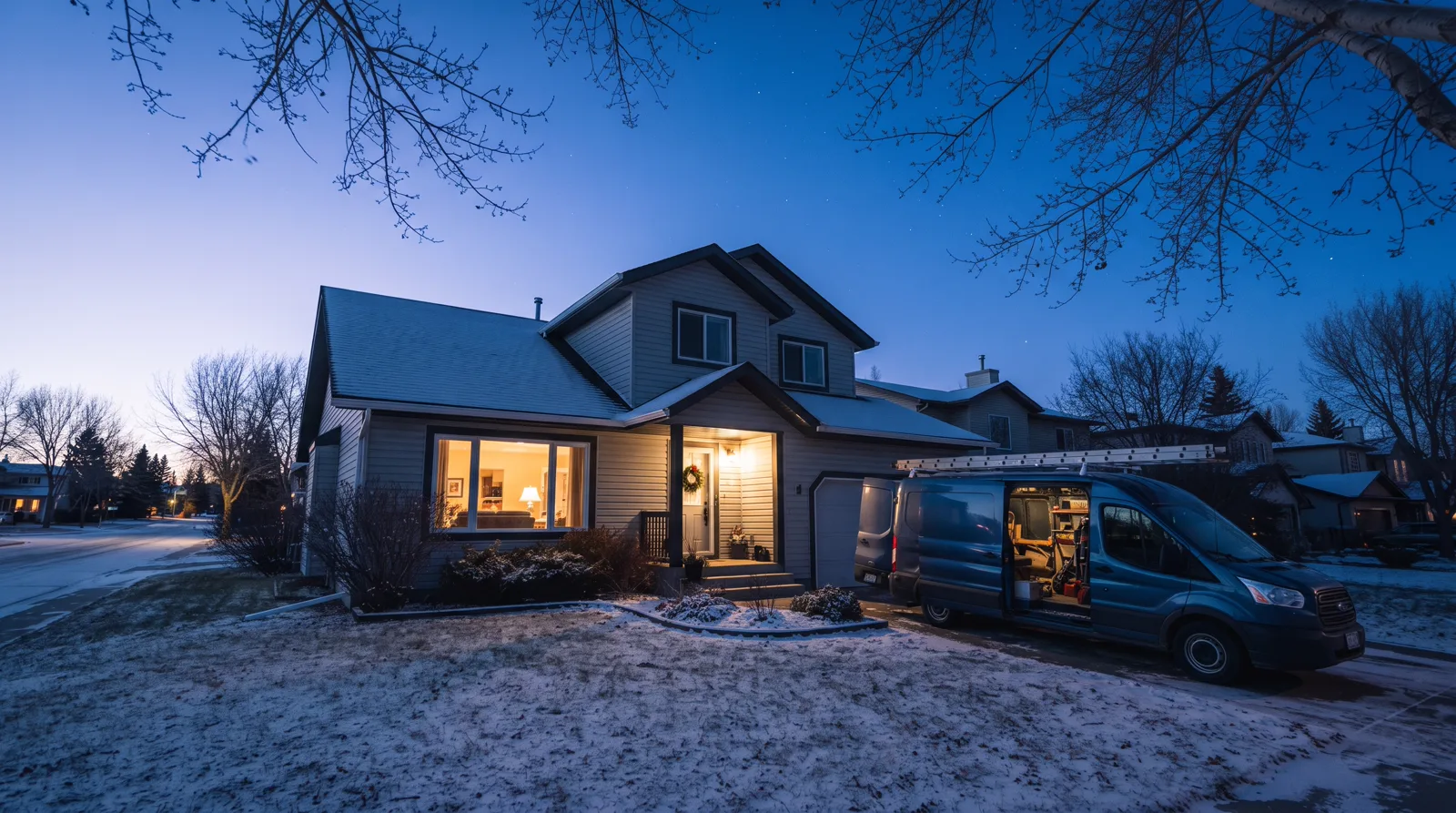
Eavestrough Repair in Stony Plain Before the Next Downpour
Leaking seams, sagging sections, or pulled-away fascia boards mean water is going where it shouldn't. We connect you with verified local eavestrough pros who repair it right the first time.
Common Eavestrough Repairs in Stony Plain
From minor leaks to full-side overhauls, matched to a pro who works in your neighbourhood.
Seam & Joint Sealing
Leaking miters, end caps, or outlet holes are sealed with polyurethane or butyl caulking rated for Alberta winters. Small repairs prevent big water damage down the line.
Sag & Pitch Correction
Sagging sections trap water and ice, leading to overflow and fascia rot. The pro re-spaces hangers to restore proper slope toward downspouts, usually 1 cm per 3 metres of run.
Downspout Repair & Extension
Detached elbows, crushed outlets, or downspouts dumping too close to the foundation are reattached or extended. Proper discharge keeps water away from basement walls and footings.
Spike & Ferrule to Hidden Hanger Conversion
Old spike-and-ferrule systems loosen over time, especially under snow load. Converting to concealed hangers spreads the load and eliminates the holes that let water into the fascia.
Fascia Board Assessment & Minor Repair
If the fascia is soft or pulling away, the eavestrough can't hold. Minor rot is patched or sistered before re-hanging the gutter. Severe rot may require a carpenter referral.
End Cap & Corner Replacement
Cracked or missing end caps and inside or outside miters are replaced with properly sealed components. Prevents leaks at the most stress-prone joints.
Why Eavestrough Repair in Stony Plain Is Different
❄️ Freeze-Thaw Cycles Separate Joints
Alberta sees dozens of freeze-thaw events each winter. Water expands in seams, cracks the caulking, and widens gaps. Repairs here use polyurethane sealants that stay flexible below freezing, not the brittle silicone used in milder climates.
🧊 Ice Dams Back Water Into Soffits
When heat loss melts snow on the roof, meltwater refreezes at the eaves and builds a dam. Gutters fill, overflow backwards under shingles, and rot the fascia and soffit. Proper pitch and downspout capacity are critical to drain melt before it refreezes.
🌪️ Chinook Winds Stress Fasteners
Sudden warm winds can gust over 100 km per hour in the Tri-Region, especially in Parkland County's open areas. Loose or undersized hangers let gutters flex and pull away. Repairs often include adding hangers at tighter intervals, typically every 60 cm instead of the old 90 cm standard.
🔨 Hail Dents Aluminum Eavestrough
Stony Plain and Spruce Grove see severe hail most summers. Dents don't always leak immediately, but they create low spots where water pools and debris catches. Minor dents can be lived with, but if they hold standing water, that section may need replacement to avoid rust-through on steel systems or algae staining on aluminum.
What it costs here
Everything You Need to Know About Eavestrough Repair in Stony Plain
From diagnosing leaks to choosing materials that survive Alberta winters, written for homeowners who want to understand the work before it starts.
How Eavestrough Repair Works in Stony Plain
Eavestrough repair targets specific damage points without replacing the entire system. A qualified contractor assesses whether leaking seams, sagging sections, rusted outlets, or loose brackets can be fixed in place or whether full replacement makes more sense. Most homeowners in Stony Plain face repair situations after hail storms, ice dam seasons, or when aging aluminum systems start separating at the joints. Repair costs typically range from $200 to $800 depending on how many sections need work, while full replacement runs $1,200 to $4,500 for an average bungalow.
Common repairs include resealing joints with commercial-grade caulk or pop-rivet patches, reinforcing sagging runs with hidden hangers or fascia brackets, patching small rust holes with aluminum flashing and sealant, realigning downspouts that pulled away from the wall, and replacing short sections where metal fatigued beyond salvage. The pro identifies whether the fascia board underneath is still sound or needs backing repair before any eavestrough work proceeds. Fascia rot is common in Parkland County homes built before 2005 because older construction details allowed water to wick behind the trough during freeze cycles.
Tri-Region Services connects you with local eavestrough specialists who carry liability coverage stated at signup. The matching process prioritizes contractors familiar with the roof styles common in Stony Plain, from older bungalow builds with narrow fascia to newer two-storey homes with complex valley intersections. You describe the issue through the intake form or chat assistant, the system routes your request to available pros in the area, and the matched contractor contacts you directly to schedule an on-site assessment and provide a written quote before any work begins.
Why Alberta's Climate Destroys Eavestroughs Faster
Stony Plain sits in a freeze-thaw belt that cycles above and below zero more than 40 times between October and April in a typical year. Each cycle expands trapped water inside seams, cracks sealant, and levers joints apart. Aluminum eavestroughs flex under this stress, and older systems installed with spikes instead of hidden hangers lose their grip on the fascia. Spring melt often reveals separation gaps that were invisible under snow, and by then water has been running behind the trough into the soffit cavity for weeks.
Hail is a recurring threat across Parkland County. A single severe cell in June or July can dent aluminum beyond cosmetic repair, creating low spots where water pools instead of draining. Those dents turn into rust holes within two seasons if the protective coating cracked on impact. Even light hail leaves micro-fractures in older painted steel troughs, which start flaking and rusting by the next spring. Insurance adjusters frequently approve eavestrough replacement after qualifying hail events, but smaller storms that only dent a few sections leave homeowners covering repair costs out of pocket.
Chinook winds add thermal shock to the damage cycle. A warm arch can push January temperatures from -20°C to +8°C in six hours, melting roof snow into rushing meltwater that refreezes the moment the wind dies. This rapid expansion and contraction fatigues metal at connection points, especially where downspouts meet horizontal runs. Ice dams form when attic heat escapes through poor insulation, melting the snowpack above the living space while eaves stay frozen. The meltwater backs up under shingles and overflows the trough, freezing into thick ridges that bend brackets and tear seams apart under sheer weight.
Warning Signs Your Eavestroughs Need Repair
Visible sagging between support points is the most obvious red flag. If a horizontal run dips noticeably or pulls away from the fascia, the hangers have failed or the fascia board underneath has rotted and can no longer hold fasteners. Water will overshoot a sagging section during heavy rain, pouring directly onto the foundation or splashing up the siding. You may also see separation gaps at corner miters or end caps, usually marked by rust staining or a thin black line where sealant has peeled away. These gaps leak even in light rain and widen every freeze cycle until the joint fails completely.
Water staining on fascia boards, soffits, or the wall below the roofline indicates overflow or leakage upstream. Brown or black streaks down white aluminum fascia mean water is escaping the system and running behind the trough face. Check the ground below your eavestroughs after a rainstorm. Pooling water, eroded soil, or splash marks on the foundation wall show that sections are clogged, sagging, or missing downspout extensions. Basement seepage often starts this way, especially in Stony Plain clay soils that hold water against the foundation when surface drainage fails.
Ice buildup patterns in winter tell you where trouble hides. Thick icicles hanging from a single section suggest a clog or a low spot where meltwater refreezes. If ice forms inside the trough and visibly weighs down the front edge, hangers are likely pulling loose or the slope has reversed. Rust holes become obvious in spring when you see light through the metal or find small streams dripping from the trough bottom instead of flowing to the outlet. Even pinhole leaks grow fast once Alberta's freeze-thaw cycle starts working the edges, so early repair saves money compared to waiting until entire sections need replacement.
The Eavestrough Repair Process: What to Expect
The process starts with a visual inspection from the ground and often a ladder check of each eavestrough run. The contractor looks for sag, separation, rust, clogs, and fascia condition. They measure slope with a level to confirm water still flows toward outlets, because reversed pitch is a common failure mode on older installs. If the fascia board is soft or shows rot, that gets flagged for repair before any eavestrough work proceeds. A rotted fascia cannot hold new fasteners, so patching the trough without fixing the backing only delays the next failure. Honest pros will scope the attic edge or pull a small section of soffit to verify the rafter tails and sheathing are sound if water intrusion is suspected.
Material selection depends on what is already installed and what caused the damage. Aluminum repairs use matching gauge material and either pop rivets with sealant or hidden splice plates for structural joins. Steel systems may get rust treatment and metal primer before patching. If the existing trough is a discontinued profile or custom color, the pro sources the closest match or explains the visible seam trade-off before proceeding. Sealants matter: cheap latex caulk fails in one winter, while polyurethane or butyl rubber formulations rated for metal-to-metal bonding and temperature swings last years. Bracket upgrades often accompany repairs, swapping old spikes for hidden hangers that distribute load and resist pullout.
The actual work involves securing ladders, removing debris and old sealant, cleaning metal with solvent to ensure adhesion, applying patches or reinforcements, resetting slope where needed, and testing flow with a hose before cleanup. The pro confirms that downspouts drain freely and extensions direct water at least six feet from the foundation. Post-repair maintenance advice typically covers cleaning frequency, winter precautions, and signs to watch that indicate the repair is holding. Workmanship warranty comes from the pro doing the work, confirmed in writing up front, and usually covers material failure or joint separation for one to three years depending on the scope.
What eavestrough repair really costs in Stony Plain and the Tri-Region
Eavestrough repair pricing in Stony Plain typically ranges from $150 to $800 for minor fixes like resealing joints, replacing short sections, or adjusting hangers. More extensive work, such as replacing 30 to 50 feet of trough or addressing ice dam damage that bent fascia brackets, runs $600 to $2,200. If the fascia board itself rotted from years of overflow and needs replacement before new eavestrough goes up, add another $400 to $1,200 depending on board footage and access. These numbers reflect local labour rates, which sit slightly below Edmonton metro but above rural Alberta, and they assume aluminum trough, the dominant material in Parkland County.
Several Alberta-specific factors push costs higher than you might expect from online averages. Winter freeze-thaw cycles crack sealant and pop rivets loose, so repairs often reveal hidden damage once a pro gets up the ladder. Chinook wind events can bend or dislodge poorly anchored sections, requiring more bracket work than a simple patch. Hail is a wildcard: after a major storm, contractor schedules fill for months and prices climb 20 to 40 percent. If your repair involves fascia that sat wet through multiple freeze-thaw seasons, rot often extends farther than the visible stain, turning a quick bracket swap into a half-day carpentry and eavestrough job.
Repair makes financial sense when damage is isolated to one or two problem spots and the rest of the system drains properly. If you are patching leaks in three places, resealing four corners, and replacing hangers along two walls, you are approaching the cost of full replacement and you will likely face new leaks within two years. A straight comparison: repairing 40 feet of sagging trough and two leaking miters might cost $650, while replacing that same 40 feet with seamless aluminum runs $850 to $1,100. The $200 to $450 premium buys you a decade or more of trouble-free performance, no joints to leak, and matching the newer sections on the rest of your house if you replaced those recently.
Comparing repair methods, materials, and the seamless advantage
Most Stony Plain homes have sectional aluminum eavestrough installed in ten-foot lengths joined by slip connectors and sealed with caulk. Repairing these systems means cutting out the damaged section, sliding in a new piece, and sealing the joints with a high-quality polyurethane or butyl caulk rated for exterior metal. The advantage is low material cost and straightforward access: any eavestrough supplier in Spruce Grove stocks standard sections and corners. The disadvantage is that every joint is a future leak point, especially after Alberta freeze-thaw works the caulk loose over five to seven years. If your repair involves adding more joints to an already sectional run, you are compounding that vulnerability.
Seamless eavestrough eliminates mid-run joints entirely. A pro brings a roll-forming machine on site, measures your roofline, and extrudes a single continuous piece from fascia to corner. Repairs to seamless systems usually involve end caps, corners, or downspout outlets, the only joints in the run, or they mean cutting out a dented or punctured section and splicing in a new seamless piece with concealed rivets and industrial sealant. Seamless repairs cost 25 to 40 percent more than sectional because the pro needs the machine and the precision to match factory bends, but the result is far more durable. If you are replacing more than 15 feet as part of a repair, the seamless upgrade often pays for itself by eliminating the next round of joint leaks.
Material choice comes down to aluminum, steel, and vinyl. Aluminum is light, resists rust, and flexes slightly without cracking, making it the best fit for Stony Plain's temperature swings. Most local repairs use .027 or .032 gauge aluminum, thick enough to hold shape but thin enough to cut and form easily. Steel eavestrough, usually found on older commercial buildings or rural shops, resists dents better but rusts if the finish scratches, a common outcome when ice slides off metal roofing. Vinyl is the budget option, popular on rental properties and quick flips, but it cracks in deep cold and sags under snow load. Repairing vinyl usually means replacing entire sections because patching rarely holds, and mixing old sun-bleached vinyl with new bright white looks worse than leaving the damage.
Mistakes homeowners make and contractor traps that cost you money
The most common homeowner mistake is patching leaks with roofing tar or generic silicone caulk bought at a hardware store. Tar goes on thick and black, stops the drip for a season, then hardens and cracks as temperatures swing from -30°C to +25°C across a Stony Plain winter and spring. Generic silicone does not bond well to aluminum or painted steel, especially if the surface still has old caulk residue or oxidation. The repair fails within months, often worse than before because water now runs behind the patch and rots the fascia. Proper eavestrough sealant is a polyurethane or butyl product designed for metal-to-metal joints and temperature extremes. It costs $12 to $18 a tube instead of $4, and it lasts years instead of weeks.
Another frequent error is ignoring the slope. Eavestrough must pitch toward downspouts at a minimum of one inch drop per 20 feet of run, and ideally closer to one inch per 16 feet in regions with heavy spring melt and summer thunderstorms. Homeowners often rehang sagging sections level because it looks straight, then wonder why water still pools and mosquitoes breed in the trough by July. A pro will pull a string line or use a laser level to verify slope before securing new brackets. If you or a handyman just eyeball it, you are gambling on drainage, and standing water accelerates rust on steel and algae growth on aluminum.
On the contractor side, the biggest trap is the roofer who offers to fix your eavestrough while they are up there doing shingle work. Roofing and eavestrough are related but distinct trades. A roofer who does not specialize in eavestrough may not carry the right sealant, may reuse old rusty hangers to save a trip to the supplier, or may install new trough without checking fascia condition. You will pay a discounted rate and get discounted results. Another red flag is a quote with no line items, just a total number and a promise to make it right. Eavestrough work is straightforward to itemize: linear feet of trough, number of corners, downspout outlets, end caps, fascia board replacement if needed, labour. If a contractor cannot or will not break it down, they are either hiding markup or they have not actually assessed the scope.
The WCB and liability question
Eavestrough repair means ladder work, often two storeys up on a windy Parkland County afternoon. If the person you hire is not covered by liability insurance and liability insurance, and they fall or drop a ladder through your window, you own the financial and legal consequences. Alberta law is clear: if you hire someone performing a service and they are injured on your property while uninsured, your homeowner's policy may deny the claim and you face personal liability. Asking for proof of WCB registration and a certificate of insurance is not rude or excessive, it is the baseline for any above-ground trade work. A legitimate contractor will email or text you both documents within minutes of your request. If they hesitate, make excuses, or offer a cash discount to skip the paperwork, you are looking at an uninsured operator and substantial risk.
How to hire the right eavestrough repair pro in Stony Plain
Start by verifying credentials and trade-specific experience. Ask how many eavestrough jobs the contractor completed in the past year and request references from Stony Plain or Spruce Grove customers, ideally with similar house styles and roof pitches. A pro who does mostly flat commercial buildings may not have the detail experience for residential two-storey peaks and complex valleys. Confirm they carry WCB coverage and liability insurance, and ask for current certificates. Check that the liability policy lists eavestrough or exterior trades work specifically, not just general contracting, because some policies exclude ladder work or metal fabrication.
Get at least two written quotes that break down materials, labour, and any fascia or soffit repair separately. A line-item quote lets you compare apples to apples and spot where one contractor is padding costs or cutting corners. Ask what gauge aluminum they will use, what sealant brand, and whether hangers will be spaced at code-compliant intervals, typically every 24 inches in Alberta to handle snow load. Inquire about warranty: a quality eavestrough repair should carry at least a one-year workmanship guarantee from the pro doing the work, covering leaks at joints and hanger failures but not damage from ice, hail, or ladder impacts after the fact.
Schedule the work for late spring or early fall if your repair is not urgent. Eavestrough crews are slammed after hailstorms and during the October rush before snow flies, and rushed work leads to missed details like improper slope or under-sealed corners. A repair done in May or September gets more attention, better weather for sealant to cure, and often a modest price break because contractors want to fill their calendars between peak seasons. If you are repairing in winter, understand that some sealants will not cure properly below 5°C, so a winter patch may need a spring follow-up to fully seal.
How Tri-Region Services helps
Tri-Region Services routes your eavestrough repair request to one vetted local professional who has confirmed liability coverage, and trade-specific experience in Stony Plain and the surrounding area. You receive a free written quote with clear line items, no obligation to proceed, and direct contact with the pro so you can ask about materials, timing, and workmanship warranty. We do not dispatch crews or send multiple contractors to bid against each other. We verify credentials on the back end, match you with a qualified pro, and step out of the way so you get transparent pricing and quality work without the runaround.
How Tri-Region Verifies Every Eavestrough Pro
You're trusting someone with ladders on your house and water management for your foundation. Here's what we confirm before the match.
Liability Coverage & liability insurance Confirmed
Insurance is stated at signup, so you're not exposed if someone falls or damages your property.
Local References From Tri-Region Work
The pro has completed jobs in Stony Plain, Spruce Grove, or Parkland County through the network, and past clients were willing to vouch for the quality.
Written Scope & Timeline Before Work Begins
No handshake estimates. The pro documents what will be fixed, what materials will be used, and when the work will happen, so there's no confusion mid-job.
Materials Spec'd for Alberta Winters
Sealants, hangers, and fasteners are rated for freeze-thaw cycling and temperature swings. No coastal-grade supplies that crack by December.
Photo Documentation of Before & After
Many pros take photos of the problem areas before repair and the finished work after, giving you a visual record if you ever need to reference what was done.
Workmanship Warranty Terms in Writing
The warranty on the repair comes from the pro doing the work, and the terms (usually one to two years on labour) are spelled out in writing before you pay.
This page is not tied to a contractor's brand. Leads route straight to your one local partner. Verified reviews can appear here once that partner has them (never fabricated).
Serving the whole Tri-Region
8 Questions About Eavestrough Repair in Stony Plain
How much does gutter cleaning cost in Parkland Village?+
Are gutter guards worth it in Stony Plain?+
When should I repair vs. replace eavestroughs in Parkland Village?+
What causes eavestrough leaks in Alberta winters?+
Can sagging gutters damage my foundation?+
How long do eavestrough repairs last?+
Do I need a permit for eavestrough repair in Stony Plain?+
Should I clean my eavestroughs before or after the repair?+
Get your free quote
Tell us what you need and a local pro will get right back to you.
- ✓ Sent straight to a local business
- ✓ You choose who you hire
- ✓ Free, with no obligation