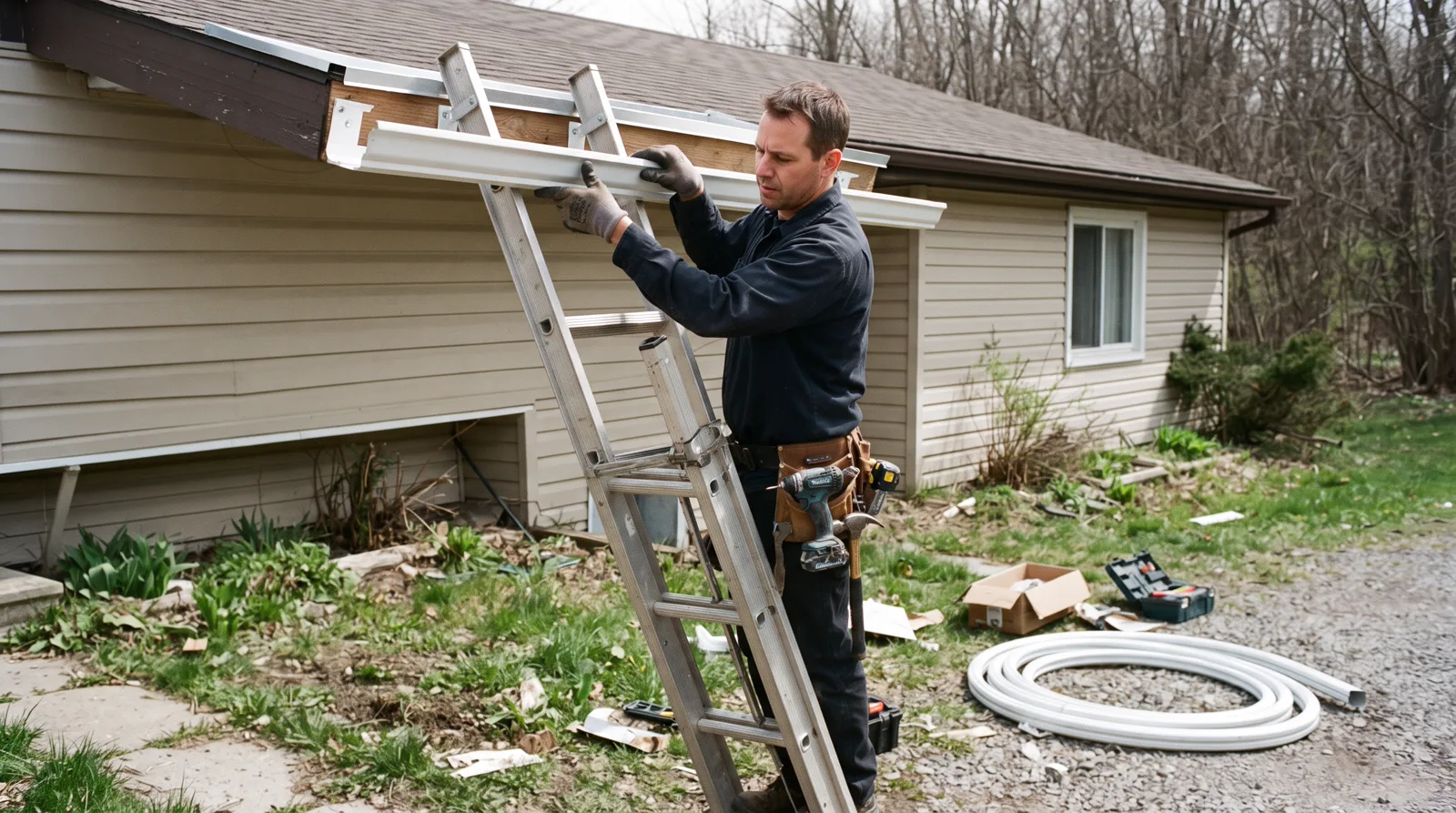
Replace Your Failing Eavestroughs with Systems Built for Alberta Weather.
From teardown to final inspection, local pros handle complete eavestrough replacement including fascia repair, hail damage documentation, and insurance claims support.
Complete Replacement, Not Patches
Every replacement includes teardown, fascia assessment, and a system sized for Alberta snow loads.
Complete Teardown & Disposal
Safe removal of old eavestroughs, hangers, and spikes. We haul everything away and inspect your fascia boards for rot, split ends, or water damage before the new system goes up. Price depends on linear footage and accessibility.
Fascia Board Repair or Wrap
Rotted or damaged fascia gets replaced with pressure-treated lumber or wrapped in aluminum coil stock. This step prevents future water infiltration and gives your new eavestroughs a solid anchor point that will last decades.
Seamless Aluminum Installation
Heavy-gauge seamless aluminum formed on-site to exact lengths. No joints, no leaks. Available in 20+ baked enamel colors. We size for Alberta snow loads, usually 5-inch or 6-inch K-style profiles with hidden hangers every 24 inches.
Pitch Correction & Resizing
If your old system pooled water or overflowed, we re-engineer the slope to ensure positive drainage. We also upsize downspouts from 2x3 to 3x4 inches where roof area demands it, preventing overflow during heavy Alberta downpours.
Downspout Extension & Rerouting
Extend downspouts away from your foundation with buried drain tile or above-ground extensions. Local pros reroute problem areas that dump water near basement windows or footings, critical in our freeze-thaw climate where foundation cracks can turn into basement floods.
Gutter Guard Integration
Micro-mesh or perforated aluminum guards installed during replacement, not retrofitted later. This keeps pine needles, aspen catkins, and roof grit out of your new system and extends maintenance intervals from twice a year to once every two or three.
Alberta Climate Demands Purpose-Built Systems
🧊 Freeze-Thaw Durability
Spruce Grove sees 80 to 100 freeze-thaw cycles per winter. We use hidden hangers with screw fasteners, not spikes, so expansion and contraction do not work the system loose. Proper pitch prevents standing water that freezes into ice dams.
⛈️ Hail Damage Documentation
Alberta hail seasons are June through August. We provide itemized reports with photos, measurements, and damage codes your insurer needs to approve replacement claims. Many policies cover full replacement if 8 or more dents per 10-foot section are documented.
❄️ Snow Load Capacity
Alberta Building Code specifies ground snow loads of 1.8 kPa for our region. We size eavestroughs and hangers to handle sliding roof snow without bending or pulling free. Most older 4-inch systems cannot handle modern architectural shingle snow slides.
🌬️ Chinook Wind Resistance
Chinook winds gust to 80 or 90 km/h, especially in Parkland County open areas. Hidden hangers every 24 inches, not 36, keep eavestroughs attached during wind events. We also check that fascia boards are screwed to rafter tails, not just nailed to sheathing.
What it costs here
Everything You Need to Know About Eavestrough Replacement in Alberta
From materials and sizing to insurance claims and seasonal timing, this guide covers the decisions every Tri-Region homeowner faces.
Why Eavestrough Replacement Becomes Necessary in Spruce Grove and Parkland County
Alberta's climate puts eavestrough systems through a punishing cycle that few other regions can match. Spruce Grove, Stony Plain, and the surrounding Parkland County area experience temperature swings from minus 30 Celsius in January to plus 30 in July, often with rapid chinook wind events that can shift temperatures by 20 degrees in a matter of hours. This freeze-thaw pattern causes ice to form inside eavestrough channels, expand, contract, and then melt repeatedly throughout late winter and early spring. Over time, the constant expansion stress cracks seams, loosens fasteners, and warps metal. Even high-quality aluminum eavestrough systems typically show serious wear after 15 to 20 years in this environment, and older steel systems often fail much sooner due to rust.
Hail is another local reality that accelerates the need for replacement. Parkland County and the Spruce Grove corridor sit in a hail-prone zone, and a single severe hailstorm can dent aluminum eavestrough badly enough to compromise drainage pitch or split seams outright. While minor cosmetic dents may not warrant immediate replacement, repeated hail events over several years weaken the material and create low spots where water pools instead of flowing toward downspouts. Pooled water in Alberta winters means ice buildup, which further distorts the channel and eventually leads to overflow, fascia rot, and foundation exposure. Homeowners who have lived in the same property for a decade or more have often seen two or three major hail events, and the cumulative damage adds up.
The design and age of homes in Spruce Grove also plays a role. Many properties built in the 1980s and 1990s were fitted with builder-grade steel eavestrough that was never intended to last more than 15 years. These systems are now 30 to 40 years old, and rust has often eaten through the bottom of channels or created holes around fastener points. Newer subdivisions in Acheson and the west end of Spruce Grove typically use thicker-gauge aluminum with baked enamel finishes, but even these systems are not immune to ice damage, especially if the original installation used insufficient hangers or incorrect slope. A poorly installed eavestrough system can fail in under ten years regardless of material quality, because improper pitch causes standing water, standing water causes rust or algae growth, and rust or debris clogs lead to overflow that rots the fascia board behind the eavestrough.
Warning Signs Your Eavestrough System Needs Replacement
Visible rust stains or holes in the eavestrough channel are the most obvious red flags. Walk around your property after a rainstorm and look for water dripping or spraying from spots other than the downspout outlets. Rust typically starts as small orange or brown spots on steel eavestrough, then spreads and eventually eats through the metal. Aluminum does not rust in the traditional sense, but it can corrode at seams or where dissimilar metals meet, such as steel screws in aluminum channels. If you see white powdery residue or greenish staining along seam lines, that is corrosion, and it means the joint integrity is compromised. Small pin holes can sometimes be patched with sealant, but if you are finding multiple holes or if rust has spread across more than a few feet of channel, replacement is the only reliable fix.
Sagging sections or eavestrough pulling away from the fascia board indicate that the fastening system has failed. In Spruce Grove's freeze-thaw climate, ice weight can be substantial. A full eavestrough channel holding snow melt and ice can weigh several hundred pounds along a 20-foot run, and if the hangers are spaced too far apart or have rusted through, the system will sag or pull loose. Once the eavestrough pulls away from the fascia, water runs behind it instead of into the channel, soaking the fascia board and potentially the roof edge. You may notice peeling paint on the fascia, soft or spongy wood when you press on it, or even visible mold or black staining. If the fascia is already damaged, the eavestrough replacement project will need to include fascia board repair or replacement as well, which adds to the scope but is essential for a proper installation.
Foundation and Basement Water Problems Linked to Failed Eavestrough
Many homeowners do not realize their wet basement or foundation cracks are caused by eavestrough failure. When eavestrough overflows or dumps water right at the foundation line instead of directing it away through downspouts and extensions, the soil around the foundation becomes saturated. Alberta clay soils do not drain well, and saturated clay expands, putting lateral pressure on foundation walls. Over several freeze-thaw cycles, this pressure can cause hairline cracks to widen, allowing groundwater to seep into the basement. If you have noticed increased basement moisture, efflorescence (white mineral deposits) on foundation walls, or standing water in window wells during spring melt, check your eavestrough system first before assuming you need foundation waterproofing.
Another telltale sign is erosion or settling of soil near the foundation. If you see trenches or grooves in the soil directly below the roofline, or if flowerbeds near the house are washing out after every rain, the eavestrough is not doing its job. Properly functioning eavestrough and downspouts should carry roof runoff at least four to six feet away from the foundation through extensions or splash blocks. In Spruce Grove and Stony Plain, where spring melt can dump large volumes of water in a short time, even a single failed eavestrough section can cause significant erosion and undermine basement or crawl space stability.
How Eavestrough Replacement Actually Works in Alberta Conditions
A proper eavestrough replacement begins with accurate measurement and assessment of the existing system. A qualified contractor will walk the entire perimeter of your home, measuring each roofline section and noting the number and placement of downspouts, the condition of the fascia and soffit, and any unusual roof features such as valleys, dormers, or multiple pitch changes. In Spruce Grove, many homes have complex rooflines with multiple sections at different heights, and the eavestrough system needs to tie together correctly to avoid water dumping onto lower roof sections or creating ice dam problems. The contractor should also evaluate the current drainage slope. Eavestrough must pitch at least one quarter inch per ten feet of run toward the downspout outlet, and on longer runs this pitch needs to be precise or water will pool.
Material selection matters more in Alberta than in milder climates. Aluminum eavestrough in .032 or .027 gauge thickness is the most common choice because it resists rust, is lightweight enough not to stress fascia, and can be formed seamlessly on site with a portable roll former. Seamless eavestrough eliminates the joint leaks that plagued older sectional steel systems, and the baked enamel finish holds up well against UV exposure and temperature extremes. Some homeowners opt for heavier .032 gauge material in areas prone to heavy snow load or ice, such as north-facing rooflines or sections under large spruce trees that shed snow in chunks. Copper eavestrough is occasionally used for heritage homes or high-end properties, but it is expensive and requires specialized installation. Steel eavestrough is still available and costs less than aluminum, but it will rust unless it is galvanized or painted, and even then it has a shorter lifespan in Alberta's wet-dry freeze-thaw cycle.
Removal of the old system is straightforward but requires care to avoid damaging the fascia or roof edge. Installers will typically remove the old eavestrough hangers and inspect the fascia board for rot, soft spots, or insect damage. If the fascia is solid, the new eavestrough can be mounted directly. If there is rot or damage, the affected sections of fascia must be replaced before the new eavestrough goes up. In older Spruce Grove homes, it is common to find that the fascia has been wet for years due to overflowing eavestrough, and several boards may need replacement. Fascia replacement is usually priced per linear foot and adds to the total project cost, but skipping this step and mounting new eavestrough over rotted wood is a recipe for failure within a year or two.
The Complete Replacement Process Step by Step
Most residential eavestrough replacement projects in Spruce Grove take one to two days, depending on the size of the home and the complexity of the roofline. Single-story bungalows with simple gable roofs can often be completed in a single day, while two-story homes with multiple roof sections, dormers, or walkout basements may require two days. The contractor will schedule the work during dry weather, as installing eavestrough in the rain or snow is difficult and risks improper sealing of end caps and outlets. Homeowners should expect the crew to arrive early in the morning, set up ladders and scaffolding if needed, and begin by removing the old eavestrough and downspouts. This generates some noise and debris, so if you have pets or small children, plan accordingly.
On installation day, the crew will measure and cut or form the new eavestrough sections, mount them to the fascia with hidden hangers spaced every 24 to 30 inches, and ensure the proper pitch toward each downspout outlet. Seamless eavestrough is formed on site using a roll-forming machine mounted on a trailer, which allows the installer to create continuous runs up to 50 feet or more without seams. Corners and end caps are sealed with high-quality gutter sealant rated for freeze-thaw cycles, and downspout outlets are installed at low points to ensure complete drainage. Downspouts are then attached and extended away from the foundation. In Parkland County and rural properties around Stony Plain, some homeowners choose to run downspout extensions underground to daylight drainage points 20 or 30 feet from the house, which requires trenching but provides superior foundation protection.
After installation is complete, the contractor should test the system by running water through it with a hose, checking for leaks at seams and outlets, and verifying that water flows smoothly to the downspouts without pooling. This is the quality checkpoint that separates a professional installation from a rushed job. The installer should also clean up all debris, old eavestrough sections, and fasteners, and leave the site in the same condition as before the work began. Homeowners should receive a written warranty covering both materials and labor. Typical warranties range from two years on labor to 20 years or more on the aluminum material itself, though the material warranty is often a manufacturer warranty rather than a contractor warranty. Ask for documentation and keep it with your home maintenance records in case issues arise down the road.
What eavestrough replacement costs in Spruce Grove and Parkland County
A full eavestrough replacement on a typical single-story bungalow in the Tri-Region (roughly 120 to 150 linear feet of gutter plus downspouts) runs between $1,400 and $3,200 installed, depending on material, access difficulty, and whether you add gutter guards. Two-story homes or walk-out designs with 200 to 250 linear feet cost $2,800 to $5,500. Acreage homes with complex rooflines, multiple valleys, and extended soffits can push $7,000 to $10,000 or more. These are 2026 Alberta prices that include removal of old gutters, hauling, new 5-inch or 6-inch K-style aluminum eavestrough, standard downspouts, elbows, and basic fascia inspection. They do not include fascia board replacement, soffit repair, or premium gutter guard systems, which add cost.
The biggest cost driver is linear footage, but material choice matters too. Seamless aluminum (.027 or .032 gauge) is the workhorse in this region and runs $8 to $14 per linear foot installed. Heavier .032 gauge steel eavestrough costs $12 to $18 per foot because it handles snow load better and resists denting from hail or ladder impact. Vinyl is the budget option at $5 to $9 per foot, but it cracks in deep cold and becomes brittle after a few Alberta freeze-thaw cycles, so most experienced installers steer homeowners away from it for permanent solutions. Copper is beautiful and lasts 50-plus years, but at $25 to $40 per foot it is rare outside heritage homes or high-end custom builds in Parkland County acreages.
Beyond material, your final invoice is shaped by access difficulty (steep pitch, second story, landscaping or deck blocking truck access), the condition of your fascia and soffit (rotten wood needs replacing before new gutters go on), and add-ons like gutter guards ($4 to $10 per foot), additional downspouts for better drainage ($80 to $150 each), or extended underground drains that daylight away from the foundation ($200 to $600). In Alberta, any contractor doing this work must carry liability insurance if they have employees, and liability insurance is standard. Reputable companies include that cost in their quote. Fly-by-night crews who quote rock-bottom prices often skip WCB and insurance, leaving you exposed if someone is hurt on your property or if the work fails inspection.
Comparing seamless aluminum, steel, vinyl, and gutter guard options
Seamless aluminum eavestrough is the gold standard in Spruce Grove and Stony Plain because it is light enough to install quickly, strong enough to handle Alberta snow loads when properly supported, and does not rust. The installer brings a roll-forming machine on a truck, measures your roofline, and extrudes continuous lengths with zero seams except at corners. Fewer seams mean fewer leak points. Standard .027 gauge works for most single-story homes, but .032 gauge is worth the small upcharge ($1 to $2 per foot) on two-story builds or if your roof sheds heavy snow or ice. Aluminum comes pre-painted in white, brown, black, or custom colors that match your fascia and trim. It expands and contracts with temperature swings, so installers use hidden hangers spaced every 24 inches (or tighter on steep pitches) to prevent sagging. Expect 20 to 30 years of service if installation and pitch are correct.
Steel eavestrough (galvanized or pre-painted) is less common but valuable in high-impact zones: acreages with tall trees that drop branches, homes near gravel roads where rocks kick up, or roofs that shed ice chunks during chinook thaws. Steel is heavier and costs more to install because cutting and forming take longer, but it resists dents and holds shape better than aluminum under mechanical stress. The trade-off is rust. Galvanized steel will eventually oxidize at cut edges or screw holes unless those spots are sealed with caulk or touch-up paint. Pre-painted steel (often called color-bond or enamel-coated) adds a protective layer, but any scratch or chip exposes bare metal to moisture. In Parkland County's wet spring and fall seasons, unchecked rust spreads fast. Steel is a smart choice if durability matters more than weight, but it demands vigilant maintenance.
Vinyl eavestrough is the budget pick, sold at big-box stores in 10-foot sections with snap-together fittings. It costs half what aluminum does, installs without special tools, and never rusts. The problem is Alberta winters. Vinyl becomes brittle below minus 20 Celsius, and when snow slides off your roof or a ladder leans against the gutter, brittle plastic cracks. UV exposure from our long summer days also degrades the plastic over time, causing it to warp, fade, or split at seams. Sectional vinyl systems have a joint every 10 feet, and each joint is a potential leak point once the rubber gaskets age. Most local contractors will not warranty vinyl work because failure rates are high. If cost is tight, sectional aluminum is a better compromise: it costs a bit more than vinyl but lasts three times as long and handles temperature swings without cracking.
Should you add gutter guards?
Gutter guards (also called leaf protection or gutter covers) are screens, meshes, or solid hoods installed over the trough opening to block leaves, pine needles, and shingle grit while letting water flow through. In the Tri-Region, where cottonwood fluff clogs gutters in June and aspen leaves pile up in October, guards reduce cleaning frequency from twice a year to once every two or three years. Micro-mesh stainless guards ($8 to $12 per foot installed) work best because the fine weave stops even small debris, but they cost as much as the eavestrough itself. Plastic snap-on screens ($3 to $5 per foot) are cheaper and keep out big leaves, but pine needles and grit slip through, and they can pop off in high wind or under heavy snow. Solid reverse-curve hoods shed debris entirely but sometimes overshoot during heavy rain, and ice can form along the leading edge in winter, blocking flow. If you have mature trees near the house or a steep roof that sheds debris, guards pay for themselves in saved ladder time and reduced overflow damage. If your lot is open and your roof is clean, skip them and clean gutters manually each spring and fall.
The biggest eavestrough replacement mistakes homeowners make in the Tri-Region
The number one mistake is choosing the cheapest quote without checking credentials. Eavestrough work does not require an Alberta trade ticket, so anyone with a truck and a ladder can claim to be an installer. Unlicensed crews quote low because they skip WCB registration (required by law if they have employees), carry no liability insurance, and often do not pull permits for fascia or soffit work that needs one. If a worker falls off your roof or a improperly secured ladder damages your siding, you are legally responsible. If the work fails inspection or causes water damage because the pitch was wrong, you have no recourse because the company has vanished. Always ask for a WCB clearance letter (it is a public record, searchable by company name on the WCB Alberta website) and a certificate of liability insurance naming your address. A legitimate contractor provides both without hesitation.
The second mistake is ignoring fascia and soffit condition before installation. Eavestrough hangers screw into the fascia board, which is the vertical trim behind the gutter. If that wood is rotten from years of overflow or ice damming, new gutters will sag or pull away within months because the fasteners have nothing solid to grip. Reputable installers inspect fascia during the quote and flag soft spots, peeling paint, or water stains. Replacing a 16-foot section of fascia board (1x6 or 1x8 pine or composite) adds $180 to $350 to the job depending on material and height, but it is mandatory for a lasting install. Skipping that repair to save money now means paying for the whole eavestrough job again in two or three years when the system fails. Soffits (the horizontal panels under the eaves) are less critical structurally, but if they are rotted or missing, you lose attic ventilation and invite wasps, birds, and squirrels into the eave space.
Another common error is attempting DIY eavestrough replacement without understanding pitch, fastener spacing, and downspout placement. Gutters must slope 1/4 inch per 10 feet toward downspouts, or water pools and overflows. Eyeballing that pitch is nearly impossible. Professionals use a string line and level, adjusting hanger height incrementally to create consistent fall. Homeowners who rent a box-store roll former and try it themselves often end up with reverse pitch (water flows away from the downspout), sagging sections, or gaps at corners where they miscalculated the miter angle. A failed DIY install wastes material cost (you cannot return custom-cut lengths) and still requires hiring a contractor to fix it. The total ends up higher than if you had hired a pro from the start. DIY makes sense for small repairs, a single downspout extension, or cleaning, but full replacement is a job for experienced hands with the right tools and liability coverage.
Finally, many homeowners skip the drainage plan beyond the downspout. Water exits the downspout at high volume during heavy rain or spring melt, and if it dumps next to the foundation, it undermines footings, floods window wells, or seeps into basements. Alberta clay soil does not drain well, so surface water sits and migrates toward the house. The fix is extending each downspout at least 6 feet from the foundation using rigid PVC pipe on the surface, or burying corrugated flex pipe that daylights into the yard or a swale. Some Parkland County lots have tight setbacks or grading that makes daylighting difficult. In those cases, a contractor may suggest a dry well (a gravel-filled pit that disperses water underground) or tying into a storm sewer lateral if the municipality allows it. Skipping this step means your new eavestrough works perfectly, but water still damages your foundation because it has nowhere to go.
How to hire an eavestrough contractor you can trust
Start by asking for three things upfront: a WCB clearance letter showing the company is registered and current (search their business name at wcb.ab.ca if they hesitate), a certificate of liability insurance with at least $2 million coverage (your address should be listed as the job site), and two or three local references from jobs completed in the past 12 months. Call those references and ask specific questions: Did the crew show up on time? Was the site left clean? Did the gutters work properly after the first heavy rain? Any callback issues? A contractor who has been in business more than five years and works repeat clients in Spruce Grove, Stony Plain, or Parkland County will have a list of happy customers ready to share. A contractor who balks at references or offers only out-of-area jobs is a red flag.
Get at least two written quotes that itemize material (gauge, color, seamless or sectional), linear footage, number of downspouts, fascia inspection or replacement, gutter guards if desired, and cleanup. Avoid quotes scribbled on scratch paper or given verbally. A professional estimate is typed or printed, includes company contact information and WCB number, and breaks down costs so you can compare apples to apples. Beware of quotes that are dramatically lower than others: the contractor is either cutting corners (thinner material, fewer hangers, no fascia check, no insurance) or planning to upsell you once the job starts. Beware of quotes that are unusually high without clear justification: you may be subsidizing inefficiency or paying for brand markup. The middle quote is often the best value, especially if the company has strong references and clear warranty terms.
Ask about workmanship warranty and material warranty separately. Aluminum and steel eavestrough typically carry a manufacturer warranty against defects (peeling paint, corrosion) for 20 to 30 years, but that does not cover installation errors like wrong pitch, loose hangers, or leaking corners. A good installer offers a workmanship warranty of at least two years, meaning they will come back and fix leaks, sagging, or overflow issues at no charge if the problem is due to installation rather than homeowner neglect or storm damage. Get that warranty in writing as part of the contract. Finally, never pay the full amount up front. Standard practice is a deposit of 25 to 50 percent to order material, with the balance due on completion and your satisfaction. If a contractor demands full payment before starting or only accepts cash, walk away. Legitimate businesses take checks, e-transfer, or credit cards and provide receipts for your records and potential insurance claims.
How Tri-Region Services helps
Tri-Region Services routes you to one vetted, insured local eavestrough professional who serves Spruce Grove, Stony Plain, Parkland County, and Acheson. Every contractor in our network has stated they carry liability insurance, and a track record of quality installations in the area. You get a free written quote with no obligation, and the process is faster than calling a dozen companies yourself. We do the screening so you do not have to guess who is legitimate. Reach out and we will connect you with the right pro for your project.
How We Screen Every Eavestrough Contractor
Every pro in our network meets baseline safety, insurance, and quality standards before they bid your job.
Insurance on file
Every crew carries active Workers Compensation Board coverage, so you are never liable if someone is injured on your property.
$2 Million Liability Insurance
General liability coverage protects your home if tools damage siding, a ladder breaks a window, or debris hits a neighbour's car.
Insurance Claim Documentation
We provide the itemized damage reports, photos, and code references your adjuster needs to approve hail or wind damage claims.
Fascia Inspection Before Install
The installer pulls a sample section of old eavestrough to check fascia condition before quoting, so you are never surprised by hidden rot mid-job.
5 Year Labor Warranty
Materials carry manufacturer warranties of 20 to 30 years, and we back our installation work for five years on pitch, hangers, and seams.
Local References Available
Every contractor provides recent Tri-Region job addresses and owner contact info, so you can see finished work and ask about service before you commit.
This page is not tied to a contractor's brand. Leads route straight to your one local partner. Verified reviews can appear here once that partner has them (never fabricated).
Serving the whole Tri-Region
7 Questions Homeowners Ask About Eavestrough Replacement
When should I replace my eavestroughs instead of repairing them?+
Will my home insurance cover eavestrough replacement after hail damage?+
What is the best eavestrough material for Alberta winters?+
How long does a full eavestrough replacement take?+
Do I need a permit to replace my eavestroughs in Spruce Grove or Stony Plain?+
What factors affect eavestrough replacement cost the most?+
How long will new eavestroughs last in Alberta's climate?+
Should I replace eavestroughs in spring, summer, or fall?+
Get your free quote
Tell us what you need and a local pro will get right back to you.
- ✓ Sent straight to a local business
- ✓ You choose who you hire
- ✓ Free, with no obligation