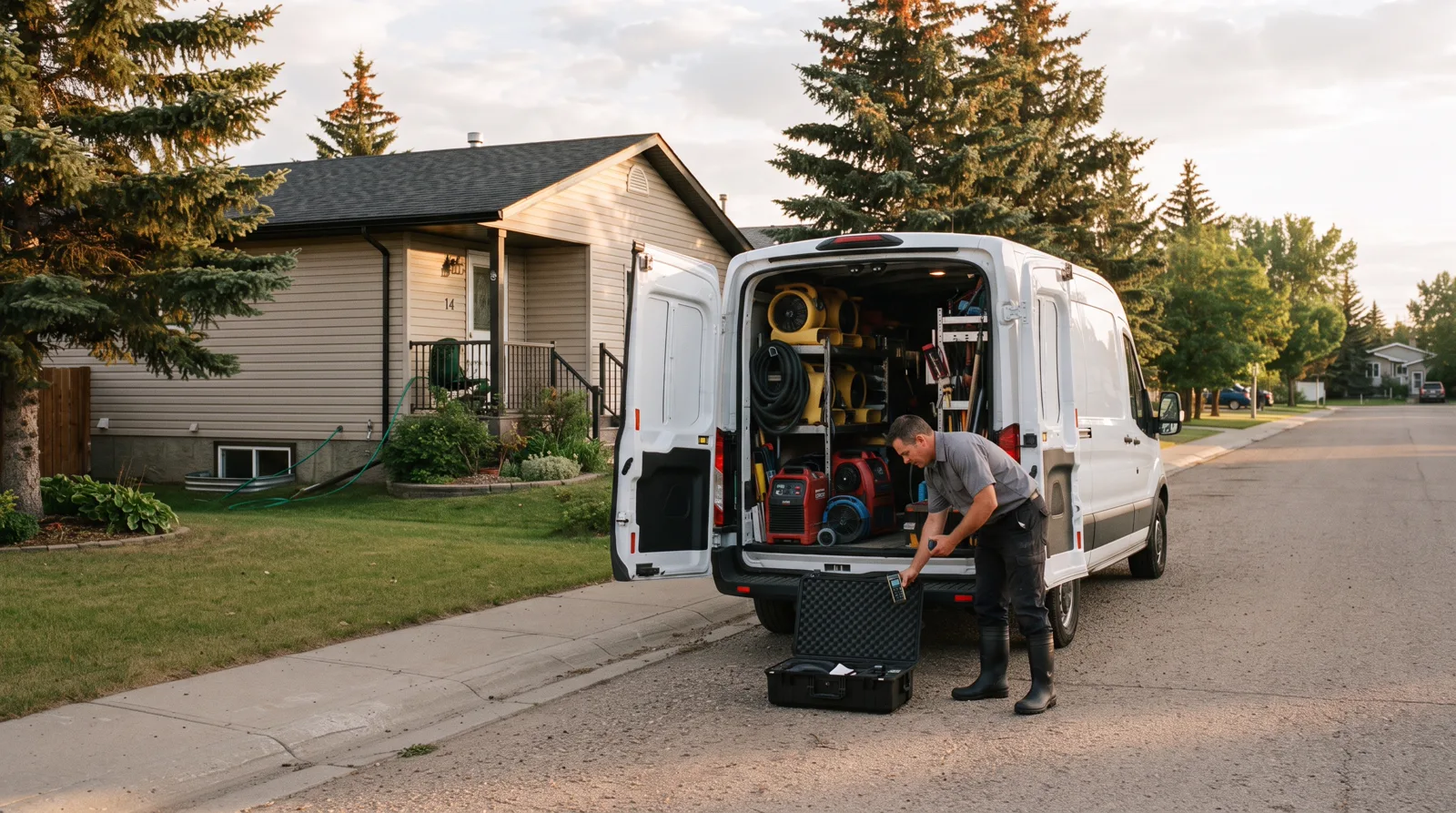
Emergency Water Extraction When Every Minute Counts.
Fast response to basement floods, burst pipes and sewage backup across the Tri-Region. Commercial equipment, insurance documentation, and mold prevention protocols from the first hour.
Emergency Water Removal Services
Truck-mounted extractors, thermal imaging, and structural drying equipment deployed to your property within hours.
Basement Flood Extraction
Complete removal of standing water from basements using truck-mounted vacuums and submersible pumps. Includes furniture lift, carpet pad removal, and initial moisture mapping. Common after spring melt, sump failure, or sewer backup in older Spruce Grove neighborhoods.
Burst Pipe Emergency Response
Rapid extraction after frozen pipe ruptures or water line failures. We coordinate with your plumber, extract all standing water, and document loss for insurance. Freeze-thaw cycles make this the most common winter call in Parkland County.
Sewage Backup Extraction
Category 3 contaminated water removal with full PPE and antimicrobial treatment. Includes safe disposal, affected material removal, and decontamination. Required when main line backs up or septic overflows. City of Spruce Grove requires licensed disposal.
Appliance Leak Extraction
Water removal after dishwasher, washing machine, or hot water tank failures. Local pros extract water from under cabinets, inside walls, and subfloors using specialty tools. Includes moisture detection in hidden cavities where rot starts.
Storm & Snow Melt Removal
Extraction after overland flooding, ice dam leaks, or rapid spring melt infiltration. Common in Acheson industrial properties and rural Parkland County. Includes perimeter trench water removal and foundation drying.
Crawlspace Water Removal
Confined space extraction using low-profile pumps and vapor barriers. Essential in older Stony Plain homes where groundwater infiltrates crawlspaces. Prevents rot, mold, and insulation damage. Includes vapor barrier assessment.
Why Alberta Water Damage Is Different
❄️ Freeze-Thaw Pipe Failures
Parkland County sees dramatic temperature swings from minus 30°C to plus 10°C within days during chinook events. Pipes in exterior walls, crawlspaces, and unheated garages rupture when thaw water refreezes. The crews carry heated extraction hoses and can work in sub-zero conditions.
🌊 Spring Melt Overload
Rapid April snowmelt overwhelms aging sump pumps and weeping tile systems across Spruce Grove. Basements that stayed dry all winter flood in 48 hours. The restoration crews in our network run March through May at peak capacity, often handling multiple calls per shift in the same neighborhood.
📋 Alberta Insurance Standards
Alberta insurers require moisture readings, thermal imaging, and timestamped photos within 24 hours of loss. We document everything to IICRC S500 standards, photograph all affected areas, and provide the moisture map your adjuster expects. Critical for sewer backup claims under your overland water endorsement.
🧊 Cold Weather Extraction Limits
Extracting water in January when your home is 5°C requires heated air movers and dehumidifiers, or extracted water refreezes in hoses and equipment. The crews carry winter extraction kits and can set up temporary heat in unheated spaces like Acheson warehouses.
What it costs here
How Emergency Water Extraction Actually Works in Alberta
What happens from the moment you call, how equipment works in our climate, and what your insurance needs documented.
What Emergency Water Extraction Actually Is (and Why Alberta Homes Need It Fast)
Emergency water extraction is the rapid removal of standing water and saturated materials from a building using industrial-grade pumps, vacuums and extraction tools within the first 24 to 48 hours after a flood or major leak. This is not mopping or shop-vaccing. Professional extraction crews deploy truck-mounted or trailer-mounted systems capable of removing hundreds of gallons per hour, paired with moisture detection equipment that finds hidden water inside wall cavities, under flooring and within insulation. The goal is to pull out bulk water fast enough to prevent secondary damage like mold growth, structural rot and material delamination.
In Spruce Grove, Stony Plain, Parkland County and Acheson, the need for speed is driven by our extreme temperature swings and construction realities. Most homes here sit on concrete basements or crawlspaces, and Alberta's clay-heavy soil shifts with freeze-thaw cycles, creating hairline foundation cracks that turn into entry points during spring melt or heavy rain. Chinook winds can dump 20 to 40 centimeters of snow, then spike temperatures above zero in 24 hours, overwhelming perimeter drains and sump pumps. When water gets into a finished basement with drywall, carpet and insulation, you have roughly 48 hours before mold spores colonize and insurance coverage gets complicated.
The typical emergency call in this region comes from a sump pump failure during spring runoff, a burst hot water tank in a mechanical room, a frozen and ruptured supply line after a cold snap, or roof ice dams that back water under shingles and into attics. Less common but catastrophic are sewer backups from municipal main blockages or overland flooding from rapid snowmelt in low-lying areas near Highway 16A or along the Pembina River corridor. Every scenario requires immediate water removal before you can even assess structural damage or start repairs. Waiting 72 hours turns a recoverable flood into a gut-and-rebuild.
The Real Warning Signs That You Need Emergency Extraction Right Now
Standing water of any depth greater than half an inch across more than a small area (say, larger than a typical bathroom) is an automatic call for professional extraction. If you can see water pooling, spreading or flowing, your building materials are already soaking it up like a sponge. Carpet padding holds water at six to eight times its dry weight. Drywall wicks moisture vertically up to a meter above the visible waterline. Engineered floor joists and OSB subfloor begin to swell and delaminate within hours. Even if you think you can bail it out with a wet-dry vac, you are not removing the water trapped in porous materials, and that hidden moisture is what causes the long-term damage.
Pay attention to less obvious signs, especially in Alberta homes with finished basements. A sudden musty or earthy smell, even without visible water, often means water has infiltrated insulation or pooled under vinyl plank or laminate flooring. Baseboards that feel spongy, drywall that sounds hollow when tapped, or ceiling tiles that sag are all evidence of concealed saturation. Condensation on cold water pipes or windows in a basement that is normally dry suggests elevated humidity from a hidden leak. If your sump pump is running constantly or you hear water trickling inside a wall, you likely have an active intrusion that standard household tools cannot address.
- Visible standing water deeper than 1 centimeter or covering more than 3 square meters
- Water stains spreading on walls, ceilings or floors, especially if the stain edge is still wet
- Soft, spongy or discolored drywall, especially at floor level or around windows and doors
- Persistent musty odor, even if no water is visible (indicates hidden saturation or early mold)
- Sump pump running nonstop or alarm sounding, signaling it cannot keep up with inflow
- Floors that feel cold, damp or buckled, particularly hardwood, laminate or engineered products
- Electrical outlets or switches near floor level that show corrosion or stop working (safety hazard)
How Professional Water Extraction Equipment Actually Works (and Why DIY Falls Short)
Professional extraction starts with truck-mounted or portable extractors rated at 200 to 400 CFM (cubic feet per minute) of airflow and capable of sustaining 10 to 15 inches of lift (vacuum pressure). These are not household wet-dry vacuums. A typical shop-vac pulls 50 to 80 CFM and loses suction as soon as the tank fills or the filter clogs. Truck mounts connect via hoses up to 100 meters long, so the operator can reach a basement or crawlspace without dragging a heavy machine down stairs. Portable extractors used in tighter spaces still deliver 3 to 5 times the suction of consumer units and include automatic pump-out systems that expel extracted water continuously into a floor drain or outside, eliminating the stop-and-empty cycle that wastes critical time.
Moisture detection is the hidden half of the job. Technicians use pin-type and pinless moisture meters to measure water content in wood, drywall and concrete, mapping the affected area room by room. Thermal imaging cameras reveal temperature differentials that show where water is pooling behind walls or under floors, even when the surface looks dry. In Alberta homes with poly vapor barriers and dense batt insulation, water can travel horizontally along the barrier before dripping into a stud bay three meters from the leak source. Without imaging, you are guessing. Professionals document moisture readings in multiple locations and depths to guide extraction placement and later verify that drying is complete.
After bulk water removal, extraction crews deploy air movers and commercial dehumidifiers. Air movers are not fans. They create focused, high-velocity airflow (1,200 to 3,000 CFM per unit) positioned at specific angles to accelerate evaporation from wet surfaces and materials. Dehumidifiers in restoration work are low-grain refrigerant (LGR) or desiccant models capable of pulling 70 to 150 liters per day from the air, far beyond the 12 to 20 liters of a residential basement dehumidifier. The combination creates a controlled drying environment where moisture is pulled from materials into the air, then stripped from the air by the dehumidifier, preventing it from condensing elsewhere. This is science, not just blowing air around.
The Step-by-Step Emergency Extraction Process (What Happens When the Crew Arrives)
Initial Safety Assessment and Source Control
The first action is a safety check, not water removal. The lead technician inspects for electrical hazards (submerged outlets, breaker panels in standing water), structural risks (sagging ceilings, compromised floor joists) and contamination level. Water is classified as clean (supply line), gray (appliance discharge, sump overflow) or black (sewage, river flooding). Black water requires protective equipment and biocide treatment. If the water source is still active (a running supply line, ongoing rain intrusion, a failed sump pump), the crew isolates or stops it before extraction begins. You cannot dry a space that is still flooding.
In Parkland County and Acheson, rural properties on wells or septic sometimes face pressure tank ruptures or septic backflow. Crews verify whether municipal services or private systems are involved and adjust their approach. If power is unsafe, they may run equipment off truck generators or wait for an electrician clearance. This phase takes 10 to 20 minutes but prevents injuries and equipment damage.
Bulk Water Removal and Material Extraction
Extraction begins with the deepest, most accessible water first. Truck-mounted extractors with weighted wands pull water from open floor areas, moving systematically to avoid spreading contamination. Submerged carpet is lifted and extracted from both the surface and the padding underneath. Padding almost always comes out entirely, as it cannot be dried effectively and becomes a microbial reservoir. In severe cases, baseboard is removed and small holes are drilled low on drywall to extract water trapped inside the wall cavity, a technique called flood cuts or weep holes.
Technicians work in a pattern, often starting at the farthest point from the exit and moving toward the door so hoses do not cross cleaned areas. Furniture is lifted onto blocks or moved entirely. Contents that are wet but salvageable are photographed, logged and relocated to a dry area. Items too damaged to save are documented for insurance and set aside. The goal in this phase is to remove all visible and accessible water within the first 2 to 4 hours on site.
Moisture Mapping, Documentation and Drying Setup
Once bulk water is out, the crew maps moisture levels throughout the affected space and into adjacent rooms. Floors, walls and ceilings are tested at multiple heights and locations. Readings are recorded on a floor plan sketch or digital app, creating a baseline for insurance adjusters and for verifying dryness later. High-moisture areas get focused air mover placement. Dehumidifiers are staged based on the volume of the space and the severity of saturation, typically one LGR unit per 100 to 150 square meters in a residential setting.
This documentation is critical. Alberta insurers, especially for sewer backup or overland flood claims, require proof of timely mitigation. Photos showing standing water depth, equipment in place and initial moisture readings protect your claim from denial based on delayed action. The extraction company provides a scope of work, equipment list and estimated drying time (usually 3 to 7 days depending on materials and weather). They also flag any materials that need removal (wet insulation, delaminated subfloor) and coordinate with your insurance adjuster before tearing anything out.
The crew leaves air movers and dehumidifiers running 24 hours a day, returning every 24 to 48 hours to take progress readings and adjust equipment. You are not expected to manage this yourself. Professional extraction is not a one-visit drop-off. It is a monitored process with clear start and end points, verified by moisture meters showing readings back to normal range (typically under 12 percent for wood, under 1 percent for concrete). Only then is the space considered dry and ready for repairs.
What Emergency Water Extraction Really Costs in the Tri-Region
Emergency water extraction in Spruce Grove, Stony Plain and Parkland County typically runs from $400 to $3,500 for a residential job, depending on how much water invaded your home and what category of contamination you are dealing with. A small clean water leak from a supply line affecting one room might land at the low end, while a sewer backup flooding a finished basement with category three water can push past $5,000 once extraction, disposal and initial antimicrobial treatment are complete. These are cash prices before insurance adjusters get involved. Most restoration companies in the Tri-Region bill by the hour for labour plus equipment rental and disposal fees, so a straightforward two hour pump out with minimal furniture moving will cost far less than an eight hour overnight job involving carpet removal and commercial dehumidifier placement.
Several factors push your bill higher in Alberta. After-hours and weekend calls often carry a 50 percent to 100 percent surcharge because crews are on standby and the urgency premium reflects the risk of secondary damage if you wait until Monday morning. Water category matters enormously: clean water from a broken pipe is category one and requires standard extraction, but water that touched a washing machine drain or dishwasher is category two (grey water) and demands antimicrobial rinses, while sewage or flood water is category three (black water) and requires full PPE, separate disposal protocols and often a complete tearout of porous materials. Accessibility and square footage also drive cost. A 1,200 square foot bungalow with an open floor plan is faster and cheaper to service than a sprawling walkout with multiple levels, tight crawlspaces and heavy furniture blocking access to the wet areas.
Insurance coverage in Alberta varies widely. Most homeowner policies cover sudden and accidental water damage, which includes burst pipes, appliance failures and roof leaks, but they explicitly exclude sewer backup unless you bought the optional rider and they exclude overland flooding unless you added that endorsement after the 2013 Calgary floods made it available. If your claim is covered, the restoration company will usually direct bill your insurer and you pay only the deductible, but if you are paying out of pocket you should get a written quote before work starts. Reputable contractors will walk the site, measure affected areas, explain what equipment they will deploy and give you a line item breakdown so you can compare bids. Companies that quote over the phone without seeing the damage or that refuse to put pricing in writing are gambling with your money and should be avoided.
Extraction Methods Compared: Truck Mount vs Portable vs Shop Vac Reality
Truck mounted extraction systems are the gold standard for serious flooding because they combine powerful vacuum suction with heated water injection and recovery in a single mobile unit mounted in a cargo van. A truck mount can pull hundreds of gallons per hour from carpet, pad and subfloor, and the heat accelerates drying by raising material temperature and lowering humidity. These rigs cost $30,000 to $60,000 new, so only established restoration companies own them, and they are overkill for small jobs. If a contractor shows up with a truck mount for a minor kitchen leak, you are likely paying for capability you do not need. Truck mounts shine when you have standing water across multiple rooms, saturated carpet pad that needs to be extracted in place before removal, or when subflooring is soaked and you need aggressive suction to pull water up through seams and edges.
Portable extractors are wheeled units about the size of a shop vacuum but purpose built for water recovery. They typically hold 10 to 20 gallons, have stronger suction than a household wet dry vac, and include wands and tools designed for carpet and upholstery. A good portable extractor costs $800 to $2,500 and is the workhorse tool for most residential water jobs in the Tri-Region. Contractors can carry two or three into a home, run them simultaneously in different rooms, and dump the recovery tanks outside or into a floor drain as they fill. Portables work well for category one and two water, handle stairs and tight spaces easily, and do not require the technician to run hoses from a truck parked in your driveway. For a typical basement flood affecting 500 to 800 square feet, a crew with portable extractors will finish the water removal phase in two to four hours.
Shop vacuums are not extraction tools, despite what some homeowners believe after a late night flood. A consumer grade wet dry vac has weak suction, a small tank that fills in minutes, and no heated air or injection capability, so it removes surface water but leaves the pad, subfloor and wall cavities wet. If you use a shop vac as a stopgap before the pros arrive, focus on pooling water and soaked belongings, then step aside when the real equipment shows up. Some unlicensed handymen show up to water jobs with only a shop vac and a couple of box fans, charge $200 to $400, and leave your home wet enough to grow mold within 48 hours. That is not extraction, it is expensive pretending. Real water damage restoration requires calibrated moisture meters, commercial dehumidifiers that pull 90 to 180 pints per day, air movers that create airflow across all wet surfaces, and technicians trained to monitor drying progress with daily readings until materials return to dry standard, which in Alberta winter can take four to seven days depending on indoor temperature and ventilation.
Five Contractor Traps Homeowners Fall Into After a Flood
The biggest mistake is calling a company that does not carry commercial general liability insurance, then discovering after the fact that you are liable if a worker is injured in your home or if the company damages your property further during the extraction process. Alberta law requires employers to carry WCB for workers, but sole proprietors can opt out, and unlicensed operators often skip both WCB and liability coverage to undercut legitimate companies on price. Always ask for proof of insurance before signing anything. A real contractor will email you a certificate of insurance from their broker within an hour. If they hesitate, make excuses or promise to send it later, walk away. If an uninsured worker falls through your wet floor or gets shocked by a submerged outlet, your homeowner policy may deny the claim and you could face a lawsuit.
The second trap is signing a contract that grants the restoration company authority to negotiate directly with your insurance adjuster without your oversight, then watching your claim get inflated with unnecessary work that maxes out your coverage and leaves you with a huge deductible bill. This happens when contractors include language like 'homeowner assigns all rights and benefits under insurance policy to contractor' or 'contractor authorized to act as homeowner's representative in all claim matters.' You should never sign away control of your claim. The contractor works for you, not the insurance company, and you have the right to review every line item, approve every scope change and communicate directly with your adjuster. Reputable companies will coordinate with your insurer and provide documentation, but they will not lock you out of your own claim.
Third, homeowners often fail to document the loss before extraction begins, then find themselves in a dispute with the insurer about what was damaged and how badly. Take photos and video of every affected area before the crew starts pulling water, including wide shots that show the extent of flooding and close-ups of water lines on walls, wet carpet, soaked belongings and visible damage to baseboards or drywall. Walk through every room on camera and narrate what you see: 'This is the basement family room, water is halfway up the baseboards, the carpet is soaked, you can see the water pooling near the furnace.' That video is your evidence if the adjuster later questions whether the damage was really as severe as the estimate claims. Also photograph your belongings before they are moved or discarded. If the contractor bags up wet contents and hauls them to a disposal bin, you lose the ability to prove what was ruined.
Fourth, many people accept a verbal assurance that the company will 'take care of everything' and start work immediately without a written scope of work or price estimate, then receive a bill that is double or triple what they expected because the verbal quote covered only extraction and the full job included drying, antimicrobial treatment, disposal and equipment rental that was never discussed. Get it in writing. A proper estimate breaks down labour hours, equipment rental by day, disposal fees, mileage if applicable, and materials like antimicrobial spray or containment plastic. If the scope changes because the contractor discovers hidden damage, they should stop work, explain what they found, give you a revised estimate and get your approval before continuing. Emergency does not mean blank cheque.
Fifth, homeowners sometimes ignore the drying phase and assume that once the standing water is gone, the job is done. Water wicks up into drywall, soaks insulation inside wall cavities, saturates subfloor and floor joists, and hides in places you cannot see. If you stop after extraction, those hidden wet materials will grow mold within 48 to 72 hours, especially in a heated Alberta home during winter when humidity is trapped indoors. The contractor should place moisture meters in walls, subfloor and baseboards, record the readings and return daily to monitor drying progress. When readings drop below 15 percent moisture content for wood and 12 percent for drywall, the material is dry and equipment can be removed. Skipping this monitoring phase is how people end up tearing out moldy walls six months later and spending more than the original flood would have cost to fix properly the first time.
How to Hire an Emergency Water Extraction Company in Spruce Grove
Start by confirming that the company holds IICRC certification, which is the industry standard for water damage restoration training. The Institute of Inspection, Cleaning and Restoration Certification offers courses in water damage restoration, applied structural drying and applied microbial remediation, and certified technicians have passed exams proving they understand moisture science, psychrometrics, drying equipment and contamination protocols. IICRC certification does not guarantee quality, but it does mean the technicians have formal training beyond YouTube videos and trial and error. Ask which certifications the crew leader holds and request proof. Legitimate companies list their IICRC credentials on their website and will happily show you a certification card.
Next, verify that the company responds 24/7 with actual employees, not an answering service that forwards your call to a contractor who may or may not pick up at 2:00 AM on a Sunday. Water damage is a true emergency because every hour of delay increases secondary damage, so you need a company that answers its phone, dispatches a crew within 60 to 90 minutes and starts extraction the same day you call. When you phone, ask how quickly they can be on site, whether the person you are speaking to is an employee or a call center operator, and what their average response time is for after hours calls. If they say 'we will try to get someone there today' or 'we will call you back to schedule,' keep calling other companies. The right answer is 'we will have a crew at your door within two hours.'
Ask about equipment inventory and whether the company owns its gear or rents it job by job. A serious restoration company owns multiple truck mounts or a fleet of portable extractors, 20 to 40 commercial air movers, a dozen dehumidifiers in different sizes, moisture meters for every crew, thermal cameras for finding hidden water, and enough containment and PPE supplies to handle a large loss without running to the rental shop mid job. If a contractor shows up with one portable extractor and two fans, you are dealing with a side hustle operator who will take three times as long and leave your home under dried. Ask how many air movers and dehumidifiers they will place in your home, and compare that number to the square footage of affected space. A good rule of thumb is one air mover per 100 to 150 square feet of wet area and one commercial dehumidifier per 500 to 800 square feet, adjusted for water category and material saturation.
Get a written estimate before work begins, even in an emergency. A reputable contractor will spend 15 to 30 minutes walking your property, measuring affected areas with a tape measure or laser, checking moisture levels with a meter, asking about your insurance coverage and explaining what needs to happen in what order. They will then write up a scope of work that lists tasks, equipment, estimated labour hours and total cost, and they will explain what is covered by insurance and what you might pay out of pocket. If the estimate says 'price TBD' or 'cost depends on extent of damage,' push back and ask for a range or a not-to-exceed number. You are entitled to know what you are authorizing before you sign.
Finally, trust your gut. If the contractor is pushy, dismisses your questions, pressures you to sign immediately because 'we have another call waiting,' or bad mouths other local companies, walk away. Water damage is stressful and the urgency is real, but you still have time to make a smart decision. A good contractor will be calm, professional, transparent about pricing and process, and willing to wait while you call your insurance company or get a second opinion. The best companies in Spruce Grove and Stony Plain earn their reputation by doing honest work, showing up when they say they will, and treating your home like it matters, because it does.
How Tri-Region Services helps
Tri-Region Services takes the guesswork out of hiring by connecting you to one fully vetted, IICRC certified, insured local water damage restoration company that serves Spruce Grove, Stony Plain, Parkland County and Acheson. They have told us about their credentials and checked references, so you do not have to call six companies at 3:00 AM while your basement fills with water. Submit your request through our platform and you will receive a free written quote, with no obligation to hire. If you choose to move forward, the work is backed by the contractor's commercial liability, and you communicate directly with the restoration crew from start to finish. We do not mark up the price, insert ourselves into your insurance claim or take a cut of the job. We simply connect you to the right pro and step aside so you can get your home dry and back to normal as quickly as possible.
Why Tri-Region Homeowners Call Us First
The credentials, equipment, and processes that matter when your basement is flooding at 2 a.m.
Under 2 Hour Response Guarantee
Emergency requests go straight to available local crews, holidays and weekends included.
Full Insurance Documentation
We photograph, measure moisture levels, and create the loss documentation your Alberta insurer requires before local pros extract a single liter.
IICRC Certified Technicians
Every crew member holds current Water Damage Restoration Technician certification and follows IICRC S500 standards for inspection, documentation, and extraction.
Commercial Truck-Mounted Equipment
We run truck-mounted extractors with 10x the suction of portable shop vacs, removing standing water in hours instead of days.
Mold Prevention Protocols
Antimicrobial treatment and structural drying plans start within the first 24 hours, inside the 48-hour window before mold colonies establish.
Structural Drying Expertise
We measure moisture in framing, subfloors, and drywall using pin and pinless meters, then place heated air movers and commercial dehumidifiers to dry structure to safe levels under 15% moisture content.
This page is not tied to a contractor's brand. Leads route straight to your one local partner. Verified reviews can appear here once that partner has them (never fabricated).
Serving the whole Tri-Region
8 Questions Tri-Region Homeowners Ask During a Water Emergency
How fast can you actually get to my house in Spruce Grove if I call right now?+
Will my home insurance actually cover emergency water extraction costs?+
How long does it actually take to extract all the water from a flooded basement?+
Can I stay in my home while you extract water and dry it out, or do I need to leave?+
How do you prevent mold from growing after you extract the water?+
Do you work directly with my insurance company, or do I have to pay upfront and get reimbursed?+
What is the difference between water extraction and structural drying? Are they the same thing?+
What actually causes most emergency basement floods in Spruce Grove and Stony Plain?+
Get your free quote
Tell us what you need and a local pro will get right back to you.
- ✓ Sent straight to a local business
- ✓ You choose who you hire
- ✓ Free, with no obligation