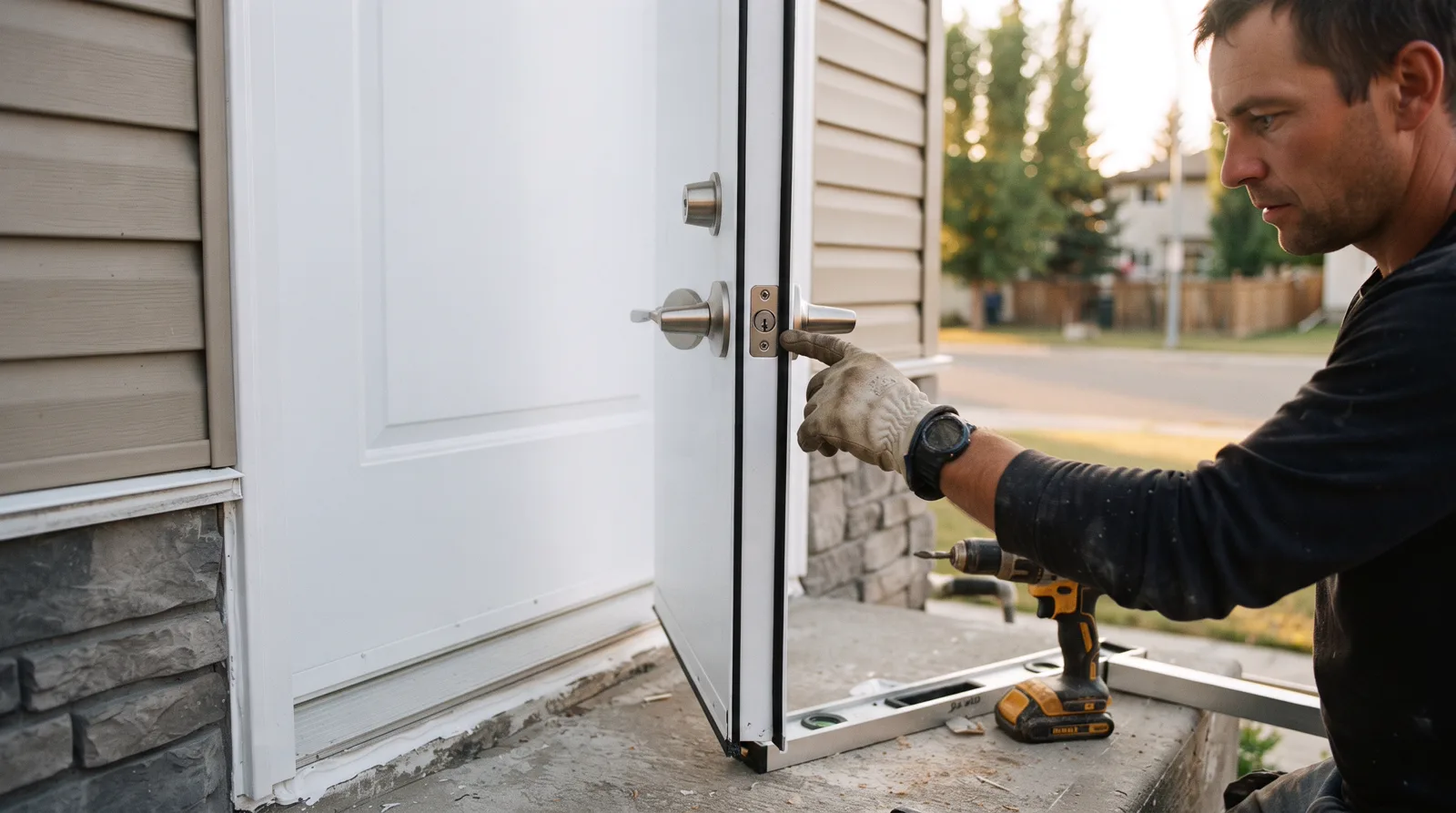
Entry Door Replacement Built for Alberta Winters.
New insulated entry doors that block frost, resist chinook wind, and cut your heating bill. Installed right the first time.
Entry Door Replacement Services
Steel, fiberglass and wood doors engineered for the Tri-Region climate
Steel Entry Door Replacement
Insulated steel doors with polyurethane cores, magnetic weather stripping, and triple-seal thresholds. Best for high-traffic homes and maximum security. Dent-resistant 24-gauge steel skins over R-16 foam cores handle freeze-thaw without warping.
Fiberglass Insulated Door Install
Fiberglass doors with wood-grain texture that won't crack, split or rot in Alberta's extreme temperature swings. Superior insulation values (R-18 to R-20) and zero maintenance. Ideal for exposed north or west-facing entries hit by chinook winds.
Solid Wood Door Installation
Custom solid wood or wood-core doors with factory-applied weatherproof finishes. Requires annual maintenance but delivers authentic character. We pre-hang, insulate the frame, and apply marine-grade sealant to prevent moisture intrusion at the threshold.
Frame & Threshold Rebuild
Replace rotted door frames, sills and thresholds caused by ice damming or capillary moisture. We sister new treated lumber to existing framing, install aluminum or composite sill pans, and seal with closed-cell spray foam. Often needed after 15 years in Alberta.
Weather Stripping & Insulation Upgrade
Magnetic or compression weather stripping, adjustable threshold sweeps, and door-bottom seals that maintain contact in freeze-thaw cycles. We also inject low-expansion foam around the rough opening to eliminate convective loops behind the jamb.
Security Door & Lock Upgrade
Reinforced strike plates with 3-inch screws into wall studs, Grade 1 deadbolts, and optional steel security screen doors. Insurance providers in Parkland County often reduce premiums when you install documented break-in resistant hardware.
Why Entry Doors Fail Faster in Spruce Grove & Stony Plain
🌡️ Deep Frost & Freeze-Thaw Cycles
Ground frost reaches 6 feet deep here, and daily winter temperature swings of 20°C stress door materials. Fiberglass and steel cores outperform wood because they expand and contract uniformly, preventing the frame-to-door gaps that cause ice buildup and air leakage.
💨 Chinook Wind Pressure
West-facing doors in Parkland County take direct hits from 80+ km/h chinook winds. Local pros install compression weather stripping rated for continuous deflection and use through-bolt hinges instead of screws to prevent the door from racking out of square over time.
🧊 Ice Damming at Thresholds
Snow melt refreezes at the threshold, lifting weather stripping and forcing water under the sill. Proper installation includes a sloped sill pan, weep holes, and a capillary break. Many big-box installs skip the pan, and you see rot within 5 years.
⚡ Energy Efficiency Rebates
Alberta utilities and Enbridge offer rebates for ENERGY STAR certified doors with U-factor below 0.30. We provide documentation for rebate applications, and clients typically recover $50 to $150 per door. Combine with a home energy audit for larger incentives.
What it costs here
Entry Door Replacement in Spruce Grove: What You Need to Know
Material selection, installation standards, permits and Alberta climate factors
What Entry Door Replacement Actually Involves in Spruce Grove
Entry door replacement means removing your existing front door, frame, threshold, and all associated trim, then installing a complete new door system that meets current Alberta building code and energy standards. This is not just swapping out the door slab. A proper replacement includes the door itself, a new insulated frame, an adjustable threshold designed for Alberta's freeze-thaw cycles, weatherstripping rated for extreme cold, and interior and exterior trim that seals against moisture and air infiltration. The goal is a door system that performs as one integrated unit, not a patchwork of old and new components that will leak air and water within a season.
In Spruce Grove and Parkland County, most entry door replacements involve steel or fibreglass doors with polyurethane foam cores, rated for energy performance in our climate zone. Wood doors are still installed, but they require more maintenance and are vulnerable to Alberta's moisture swings and UV exposure. The door frame, or jamb, is typically wood or composite material, factory-assembled with the door already hung and the weatherstripping installed. This pre-hung approach reduces installation time and ensures tighter tolerances than field-assembled systems. The threshold must be adjustable to accommodate settling and seasonal movement, and it must drain water away from the door, not trap it against the sill where it will freeze and cause rot or concrete spalling.
A typical replacement also includes replacing or upgrading the door's hardware: lockset, deadbolt, hinges, and sometimes a handleset or smart lock. Many homeowners use this opportunity to improve security with heavier-duty locks, longer hinge screws that anchor into the framing, and strike plates that resist kick-in attempts. The exterior trim, or brick mould, and the interior casing are replaced to match the new door dimensions and to create a clean seal against the wall. Flashing and sealant work is critical: the top of the door frame must be flashed to shed water, and all seams must be caulked with a product that remains flexible in cold weather. Installers working in this region understand that rigid caulk will crack and fail during the first winter, so they use polyurethane or hybrid polymer sealants rated to at least negative 40 degrees Celsius.
Why Alberta's Climate Demands Reliable Entry Doors
Spruce Grove experiences temperature swings that few other climates can match. A January morning can start at negative 35 degrees Celsius, and by afternoon a chinook wind can push the temperature above freezing. This cycle repeats throughout the winter, and every swing puts stress on your entry door. The door itself expands and contracts. The weatherstripping compresses and relaxes. Moisture that entered through gaps during a warm spell freezes solid when the temperature drops, forcing those gaps wider. Over several winters, a door that was snug when installed becomes loose, drafty, and inefficient. Replacing the door with a modern system designed for thermal cycling restores that tight seal and cuts the air leakage that drives up heating bills and makes your entryway uncomfortably cold.
Moisture is the other major factor. Snow piles against the door during winter storms. Spring meltwater runs down the face of the door and pools at the threshold. Summer thunderstorms drive rain horizontally into the door during high winds. If the door and frame are not properly sealed and drained, that water finds its way into the wall cavity, where it rots the wood framing, damages insulation, and eventually shows up as interior water stains or mould growth. Alberta's freeze-thaw cycle makes this worse: water that seeps into a crack or joint freezes, expands, and widens the opening. The next rain event brings more water, which freezes again, and the cycle accelerates the damage. A door system that was marginally adequate when new can become a major water intrusion point within five to seven years if it was not installed with proper flashing and drainage.
Wind is often underestimated. Spruce Grove and the surrounding area are exposed to westerly winds that gust to 70 or 80 kilometres per hour during winter storms. Those winds create pressure differentials that force air through any gap in the door seal. Even a small gap, a few millimetres wide, can let in enough cold air to drop the temperature in your entryway by several degrees and make the furnace work harder to compensate. Wind also drives snow and rain into gaps that would otherwise stay dry. A door that fits loosely or has worn weatherstripping will allow wind-driven moisture into the wall, where it does hidden damage long before you notice any interior signs.
Warning Signs Your Entry Door Needs Replacement
Physical damage is the most obvious sign. If the door surface is cracked, dented, or warped, or if the frame is rotted or split, replacement is usually the only practical solution. Wood doors in this climate often show rot at the bottom rail where water and snow sit against the door. Steel doors can rust through at the bottom edge or around the lockset if the factory finish was damaged and moisture got under the paint. Fibreglass doors are more resistant to rot and rust, but they can crack if struck hard, and once cracked they cannot be reliably repaired. If you see daylight around the edges of the closed door, or if you can see the weatherstripping is torn, compressed flat, or missing in sections, the door is no longer sealing properly. You can sometimes replace weatherstripping, but if the door has warped or the frame has shifted, new weatherstripping will not solve the underlying problem.
Performance issues show up as drafts, condensation, or difficult operation. If you feel cold air coming in around the door on a windy day, the seal has failed. If you see frost or condensation forming on the interior surface of the door or the frame during cold weather, the door is not insulated adequately or the seal is allowing warm interior air to contact the cold exterior surface. This condensation can run down and pool at the threshold, leading to rot or mould. If the door sticks, drags, or requires force to open or close, the door or frame has likely shifted due to settling, moisture damage, or thermal movement. Forcing a door that does not operate smoothly will damage the hinges and lockset, and it indicates that the frame is no longer square. A door that was easy to operate when new should stay that way. If it does not, something has changed, and that change usually means the door or frame needs replacement.
Energy and comfort problems are harder to quantify but just as important. If your entryway is noticeably colder than the rest of the house, or if you hear the furnace running more often during cold snaps, a failing entry door is a likely culprit. Homeowners in Spruce Grove report heating cost increases of 15 to 25 percent when an old door is leaking air. Replacing the door with a modern, well-sealed unit brings those costs back down and makes the entryway comfortable again. If you have replaced the weatherstripping and caulked all the seams and the drafts persist, the door itself is probably warped or the frame is no longer square. At that point, repair is not cost-effective. Replacement gives you a fresh start with a door system that is engineered to perform in Alberta's climate.
The Entry Door Replacement Process from Start to Finish
The process begins with an on-site assessment and measurement. An experienced installer will examine the existing door and frame, check for rot or structural damage in the surrounding wall, and take precise measurements of the rough opening. In older homes, the opening may not be perfectly square or plumb, and the installer needs to know that before ordering the door so they can plan the installation to compensate. The rough opening is the framed space in the wall, and it is typically a few centimetres larger than the door frame itself. That extra space allows the installer to shim the frame level and plumb, even if the opening is not. The installer will also discuss your preferences for door style, colour, glass options, and hardware. Many suppliers offer a range of decorative glass inserts, sidelights, and transom windows that can be incorporated into the door system. The installer will explain the energy ratings, material options, and expected lead time for the door to arrive.
Once the door is ordered and delivered, the installer schedules the installation. The work typically takes four to six hours for a standard single door, longer if there are sidelights or if structural repairs are needed. The installer begins by removing the interior trim and then the exterior trim. The old door is usually cut out or pried out in pieces, especially if it is stuck or if the frame is rotted. Once the old door and frame are out, the installer inspects the rough opening for rot, insect damage, or other issues. If the wall framing is sound, they clean the opening and apply new flashing to the sill and the head of the opening. The flashing is critical: it must direct water away from the frame, not trap it. A common mistake is to omit or improperly install the head flashing, which allows water to run down behind the door frame and rot the wall.
Installation and Weatherproofing
The new door frame is set into the opening and shimmed level and plumb on all sides. The installer checks the frame with a level and adjusts the shims until the frame is perfectly square. This step is vital: if the frame is out of square, the door will not close properly, the weatherstripping will not seal evenly, and the lockset may bind or fail. Once the frame is square, the installer fastens it to the wall framing with long screws driven through the shims. These screws must penetrate the wall framing by at least 50 millimetres to meet code and provide a secure anchor. The door is hung on its hinges, and the installer tests the swing and the fit. If the door binds or has gaps, they adjust the shims and recheck.
Weatherproofing comes next. The installer fills the gap between the door frame and the rough opening with low-expansion spray foam insulation. This foam seals air leaks and adds some insulation value, but it must be low-expansion foam: high-expansion foam can bow the frame and cause the door to bind. Once the foam has cured, the installer trims off the excess and applies a continuous bead of exterior-grade caulk around the outside of the frame where it meets the wall. They also caulk the threshold and any seams in the exterior trim. All caulk joints must be smooth and complete, with no gaps or voids. Inside, the installer installs the interior trim, caulks the joint between the trim and the wall, and fills any nail holes. The final step is to install the lockset, deadbolt, and any other hardware, and to adjust the threshold so that the door seals tightly when closed but still operates smoothly.
Final Inspection and Adjustment
After installation, the installer tests the door several times to ensure it opens and closes smoothly, latches securely, and seals tightly. They check that the weatherstripping contacts the door evenly on all sides and that there are no gaps or light leaks. They operate the lockset and deadbolt to confirm smooth function. If the door has a multi-point locking system, they verify that all locking points engage properly. The installer also explains the operation and maintenance of the door, including how to adjust the threshold if needed, how to lubricate the hinges and lockset, and when to inspect and replace weatherstripping.
A properly installed entry door should last 20 to 30 years in Alberta's climate, with only minor maintenance required. The key to that longevity is correct installation: a square frame, proper flashing and drainage, complete air sealing, and quality materials. Homeowners who invest in professional installation and a door system designed for extreme climates see immediate improvements in comfort and energy efficiency, and they avoid the recurring repair costs and early replacement that come with a poorly installed or inadequate door.
What Entry Door Replacement Really Costs in the Tri-Region
A basic steel entry door replacement in Spruce Grove, Stony Plain or Parkland County typically runs $1,200 to $2,500 installed, covering a standard pre-hung unit with weatherstripping, basic hardware and professional installation. Mid-range fiberglass doors with decorative glass and better insulation land in the $2,500 to $4,500 range, while premium wood or high-end fiberglass systems with sidelights, transoms or custom finishes can reach $5,000 to $8,000 or more. These numbers assume a straightforward swap on an existing opening with no structural work. If your rough opening needs adjustment, framing repair, brick mould replacement or siding patching, add $300 to $1,500 depending on scope. Alberta's freeze-thaw cycles and chinook winds make proper installation and weatherproofing critical, so cutting corners on labor to save a few hundred dollars often backfires within the first winter.
Material choice drives the biggest price swing. Steel doors are the most affordable and offer excellent security and low maintenance, but they dent and can show rust if the factory finish chips. Fiberglass resists dents, handles temperature swings without warping and can mimic wood grain convincingly, making it the most popular choice in the Tri-Region for homeowners who want durability and curb appeal. Solid wood doors deliver unmatched beauty and can be refinished repeatedly, but they require regular maintenance and move with humidity changes, which matters less in Alberta's dry climate but still demands quality weatherstripping. Entry-level models use hollow cores or minimal insulation; stepping up to foam-filled cores or triple-pane glass inserts adds $400 to $1,200 but pays back in heating savings and comfort when overnight lows hit minus 30.
Labor runs $400 to $900 for a standard install, covering removal of the old door, fitting and shimming the new unit, insulating the gap, installing trim and hardware, and testing the swing and lock. If the installer discovers rot in the subfloor, brick mould or framing, expect repair charges of $200 to $800 depending on severity. Permits in Spruce Grove and Stony Plain cost around $75 to $150 for door replacement and are required if you change the opening size or add sidelights, though simple swaps on the same footprint often fly under the radar. Disposal fees for the old door run $50 to $100. Many quotes bundle everything, but always confirm what's included so you're comparing apples to apples. Requesting itemized pricing helps you spot padding and understand where your money goes, and it gives you leverage if you want to supply your own hardware or handle trim painting yourself.
Comparing Your Door Options: Materials, Methods and Trade-offs
Steel doors dominate new construction and budget replacements because they're tough, fire-resistant and require almost no upkeep beyond an occasional wipe-down. A 20-gauge steel skin over a foam core delivers decent insulation and stands up to hail, heavy use and attempted break-ins far better than wood. The downsides are cosmetic: steel dents if you back a wheelbarrow into it, and surface scratches expose bare metal that rusts in Alberta's wet spring and fall months unless you touch them up promptly. Factory finishes have improved, and modern baked enamel resists fading, but you can't sand and restain steel the way you can wood. If your priority is security, low cost and minimal fuss, steel is hard to beat, especially for back or side entries where aesthetics matter less than function.
Fiberglass has become the go-to for front entries in the Tri-Region because it handles Alberta's temperature extremes without warping, splitting or swelling. High-definition embossing replicates oak, mahogany or fir grain so convincingly that most visitors assume it's real wood until they touch it. Fiberglass won't dent like steel, resists moisture better than wood, and holds paint or stain beautifully if you want a custom color. The foam core provides excellent insulation, and because fiberglass doesn't conduct heat or cold the way steel does, you avoid the frost buildup and condensation that can plague metal doors in deep winter. The main trade-off is cost: fiberglass runs 20 to 40 percent more than comparable steel, and lower-end models can feel hollow or flimsy. Stick with name brands like Masonite, Therma-Tru or Plastpro, and choose a six-panel or craftsman style that complements your home's architecture rather than a generic slab.
Solid wood doors are rare in new installs today but remain popular for heritage homes, custom builds and homeowners who value traditional craftsmanship. Wood offers unmatched beauty, the ability to refinish or change color every few years, and a substantial feel that fiberglass and steel can't quite replicate. Douglas fir, oak and mahogany are common choices, each with different grain patterns, hardness and price points. The downside is maintenance: wood expands and contracts with humidity, so it needs quality weatherstripping and a sheltered entry to prevent water intrusion. In Alberta's dry climate, movement is less of an issue than in coastal regions, but you still need to reseal or repaint every two to four years to prevent cracking and UV damage. Wood also dents and scratches more easily than fiberglass, though many owners consider that patina part of the charm. Expect to pay a 30 to 60 percent premium over fiberglass for comparable quality and insulation.
Pre-Hung vs Slab: Which Installation Method Makes Sense
Pre-hung units arrive with the door already mounted in a frame, complete with hinges, weatherstripping and often a sill. The installer removes your old door and frame as a single piece, slides the new unit into the rough opening, shims it level and plumb, insulates around the edges, and screws it in place. This method is faster, reduces the risk of alignment errors, and ensures a tight weatherproof seal because the door and frame were married at the factory under controlled conditions. Pre-hung is the standard for exterior replacements and almost always the right choice in the Tri-Region, where wind-driven rain and snow demand precision fitting.
Slab replacement involves hanging a new door on the existing frame using the old hinge locations. It's cheaper and less invasive because you're not tearing out trim or disturbing siding, but it only works if the existing frame is square, rot-free and worth keeping. Most exterior frames in homes over 15 years old show wear, and reusing a weathered frame with a new door is like putting new tires on bent rims. You might save $300 to $600 upfront, but you'll pay it back in drafts, difficult latching and premature hardware failure. Slab swaps make sense for interior doors or exterior doors in near-new homes where the frame is still perfect, but for most Tri-Region replacements, a pre-hung unit is the smarter long-term investment.
Mistakes and Contractor Traps to Avoid
The single biggest mistake homeowners make is choosing a door based solely on curb appeal without considering Alberta's climate demands. A beautiful six-panel wood door with a single-pane decorative glass insert might look stunning in the showroom, but if it lacks a thermal break, foam core or low-E glazing, you'll feel cold air pouring off it every time you walk past in January. Insulation values matter here: look for doors rated R-5 or higher, and if the door includes glass, confirm it's at least double-pane with argon fill. Spray foam insulation around the frame is non-negotiable in the Tri-Region; installers who skip it or use minimal expanding foam leave thermal bridges that bleed heat and cause frost buildup on the interior trim. Ask explicitly how the installer will insulate and air-seal the rough opening, and walk away from any answer that sounds vague or dismissive.
Skipping the permit is tempting because it saves the fee and the inspection wait, but it can backfire hard if you sell within a few years or file an insurance claim. Spruce Grove, Stony Plain and Parkland County all require permits for structural changes, which includes enlarging an opening to add sidelights or transoms. Even a straight swap can trigger permit requirements if the municipality decides the work affects fire separation or energy code compliance. The risk isn't just a stop-work order or a fine; unpermitted work can complicate your sale because the buyer's home inspector will flag it, and some lenders won't close until you retroactively permit and inspect the work. A reputable contractor will tell you upfront if a permit is needed and either handle the application for you or guide you through it. If someone offers to do the job off-book to save you the permit fee, that's a red flag that they're cutting other corners too.
Lowball bids often signal trouble. If one quote comes in 30 to 40 percent below the others, the contractor is either inexperienced, uninsured or planning to substitute inferior materials and hope you don't notice. Common shortcuts include using the cheapest door the supplier stocks regardless of what you discussed, skimping on weatherstripping, leaving the old brick mould in place when it should be replaced, or failing to insulate properly. You won't know until the first cold snap when drafts appear or the door won't latch because it wasn't shimmed correctly. On the flip side, don't assume the highest bid is the best; some contractors pad quotes when they're busy or don't really want the job. The sweet spot is usually the middle of your range, paired with a contractor who explains the work clearly, provides references you can call, and shows proof of WCB coverage and liability insurance. In Alberta, any contractor working on your home should carry WCB or demonstrate they're a certified owner-operator exempt from coverage, plus at least two million in liability insurance.
How to Hire the Right Entry Door Installer
Start by confirming the contractor is insured and bonded, which protects you if someone gets hurt on your property or the work damages your home. Ask for the WCB clearance letter and liability certificate, and call the insurer to verify coverage is active. Check references, but don't just ask if the contractor did a good job; ask how the door has held up through two or three winters, whether it still seals tight and operates smoothly, and if the installer returned promptly to address any issues. A door that looks great the day it's installed but leaks air or binds within six months tells you everything you need to know about the quality of the shimming, insulation and alignment. Look for contractors who specialize in exterior doors and windows rather than general handymen, because proper weatherproofing and code compliance require specific knowledge that comes from repetition.
Get at least three written quotes that break down material, labor, disposal, permit fees and any extras like new locksets or threshold replacements. Make sure each quote specifies the exact door model, core type, glass package and finish so you're comparing identical products. Ask what warranty the manufacturer provides and what the installer guarantees; most reputable door brands offer limited lifetime warranties on the door itself and one to five years on weatherstripping and finish, while good installers back their workmanship for at least one year. Red flags include contractors who only quote verbally, ask for large deposits upfront (more than 25 percent is risky), can't provide insurance proof, or pressure you to decide immediately with claims that material prices are jumping tomorrow. Quality contractors are busy but professional; they'll walk the job, take measurements, answer your questions clearly and give you time to compare options.
Timing matters less for entry doors than windows or roofing, but spring and fall are ideal because moderate temperatures make installation easier and give you a chance to test the weatherproofing before winter hits hard. Summer works fine too, though busy contractors may have longer lead times. Winter installs are possible but challenging because the crew will leave your home open to the elements for 30 minutes to an hour while they fit and shim the new unit, which can drop your interior temperature fast and make precise work difficult if it's snowing or blowing. If you're replacing a door in December or January, plan to be home so you can manage pets, cover nearby flooring and close off the entryway from the rest of the house with plastic sheeting. A good installer will bring tarps, work quickly and clean up thoroughly, but winter jobs always carry more risk of delays and discomfort.
How Tri-Region Services Helps
Tri-Region Services connects you with one pre-vetted, insured local entry door installer who serves Spruce Grove, Stony Plain, Parkland County and Acheson. Every pro in our network tells us they carry liability insurance, has proven experience with Alberta climate challenges, and commits to transparent pricing and workmanship guarantees. You'll receive a free written quote with no obligation, and because we've already asked about quality and reliability, you skip the hassle of sorting through dozens of online reviews and unverified contractors. Whether you need a simple steel door swap or a custom fiberglass entry with sidelights, we'll match you with the right specialist for the job.
Why Homeowners Choose Our Entry Door Installers
Licensed, insured and Alberta building code compliant
Building Permit Coordination
The installer pulls permits in Spruce Grove, Stony Plain and Parkland County when required and arranges inspections.
$2M Insurance on file
The installer's commercial liability insurance and liability insurance account protect your property during installation.
Alberta Building Code 9.7 Compliance
All installs meet current code for air barriers, thermal performance and structural fastening.
Free Pre-Install Inspection
We check frame condition, measure rough openings and identify hidden issues before quoting.
Local References Available
Speak to recent clients in your neighborhood before committing to the project.
Written 5-Year Warranty
Coverage on installation workmanship plus manufacturer warranties on doors and hardware.
This page is not tied to a contractor's brand. Leads route straight to your one local partner. Verified reviews can appear here once that partner has them (never fabricated).
Serving the whole Tri-Region
7 Questions About Entry Door Replacement in the Tri-Region
What R-value do I need for an entry door in Spruce Grove?+
Do I need a building permit to replace my front door in Parkland County?+
How long does entry door installation take?+
Why does my door threshold rot so quickly in Alberta?+
Steel vs fiberglass vs wood: which door is best for Spruce Grove winters?+
When should I replace my entry door instead of repairing it?+
How do I prevent frost buildup on the inside of my new entry door?+
Will a new entry door lower my home insurance premium in Parkland County?+
Get your free quote
Tell us what you need and a local pro will get right back to you.
- ✓ Sent straight to a local business
- ✓ You choose who you hire
- ✓ Free, with no obligation