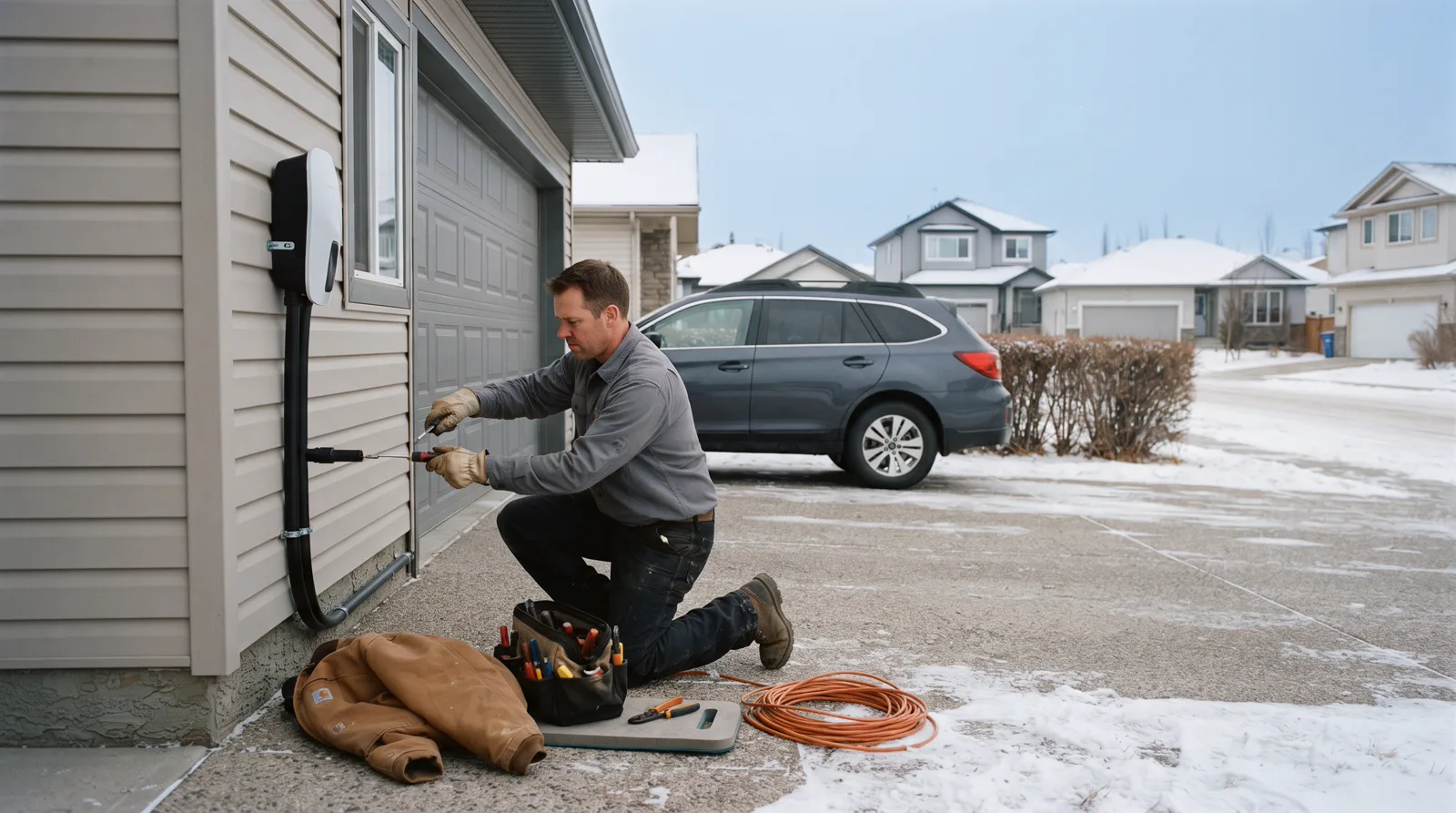
EV Charger Installation Spruce Grove & Tri-Region
Professional Level 2 charging station installation with proper permits, panel capacity assessment, and weatherproof connections built for Alberta winters.
Complete EV Charging Solutions
From garage wall mounts to heated driveway pedestals, local pros handle every part of your home charging setup.
Level 2 Wall Mount Installation
Hardwired or plug-in Level 2 charger in your garage or carport. Includes 240V circuit from panel, wall mounting, ESA permit and inspection. Cable management and tidy finish. Most popular option for attached garages with existing panel capacity.
Electrical Panel Upgrade
Upgrade from 100A to 200A service to safely add EV charging load. Common in older Spruce Grove homes built before 2000. Includes new panel, main breaker, grounding upgrades, ESA approval. Sometimes required by Epcor before charger install.
Detached Garage Charging Circuit
Run 240V circuit from house panel to detached garage for EV charging. Trenching or overhead depending on distance and frost depth. Very common in Parkland County acreages. Includes conduit, wire rated for burial depth, disconnect box, breaker.
Outdoor Driveway Pedestal
Weatherproof charging pedestal mounted in driveway or parking pad. Rated for cold to minus 40°C, concrete base below frost line, armoured cable underground. Popular for homes without garage access or multi-vehicle households needing exterior charging point.
Load Management & Smart Charging
Install load sharing devices or smart chargers that communicate with your panel to prevent overloads. Useful when panel is near capacity or you want scheduled off-peak charging. Works with most major charger brands, integrates with home automation.
Charger Relocation or Upgrade
Move existing charger to new location in same garage, or upgrade older 30A unit to modern 40A or 48A charger. Includes circuit verification, new mounting, breaker upgrade if needed. Common when changing vehicles or renovating garage space.
Why Alberta EV Charging Is Different
🌡️ Cold Weather Battery Drain
EVs lose 30 to 40 percent range below minus 20°C, so home Level 2 charging overnight is essential to start each day with full capacity. Trickle charging on 120V does not keep up with cold soak losses in January and February.
🏠 Older Spruce Grove Panel Capacity
Many homes built in the 1980s and 1990s have 100 amp service, which is tight when adding a 40 or 50 amp EV circuit alongside electric heat and dryer. We assess load calculations honestly and recommend upgrades only when actually required by code.
🧊 Frost Depth and Conduit Burial
Alberta Building Code requires electrical conduit buried 600 mm deep in most soils, or 450 mm under concrete to stay below frost heave zones. Detached garage and driveway pedestal installs account for this, plus expansion joints for freeze-thaw movement.
📋 Parkland County and City Permits
All EV charger installs require ESA electrical permit and inspection, but Parkland County acreages sometimes also need development permits if adding a new pedestal structure. We coordinate both, and Spruce Grove or Stony Plain building departments when work involves panel upgrades.
What it costs here
Everything You Need to Know About Home EV Charger Installation in Spruce Grove
Panel capacity, permit process, charger types, cold weather performance, and cost drivers explained in plain language.
How EV Charger Installation Actually Works in Your Spruce Grove Home
Installing a home EV charger is fundamentally an electrical service upgrade that connects a dedicated 240-volt circuit from your main panel to a wall-mounted charging unit in your garage or driveway. This is not a plug-and-play device you buy at a store and hang on the wall. The charger itself (technically called Electric Vehicle Supply Equipment or EVSE) requires professional installation because it draws substantial continuous power, typically between 7.2 kilowatts and 19.2 kilowatts depending on the unit. A licensed electrician must assess your existing electrical service capacity, install appropriate circuit breakers and wiring rated for the amperage, and ensure the installation meets the Canadian Electrical Code and Alberta's specific amendments. The entire process transforms your home's electrical system to safely deliver the same power draw as an electric stove or dryer, but for hours at a time while your vehicle charges overnight.
Your main electrical panel becomes the starting point for every installation. Most homes in Spruce Grove, Stony Plain and Parkland County built after 2000 have 200-amp service, which typically handles a Level 2 charger without a full panel upgrade. Older homes with 100-amp or even 60-amp service may need a complete service upgrade before the charger installation can proceed. The electrician calculates your home's existing electrical load by adding up all major appliances, heating systems, and circuits, then determines if there's enough capacity for the continuous 40-amp or 50-amp draw a typical EV charger requires. If your panel is already near capacity during peak usage (furnace running, oven on, dryer going), adding an EV charger could overload the system and trip the main breaker repeatedly, or worse, create a fire hazard from overheated wiring.
The physical installation involves running heavy gauge copper wire from the panel to the charging location, which might be 15 feet away in an attached garage or 80 feet away if you're installing a weatherproof unit on an exterior wall near a driveway parking spot. The wire must be protected in conduit according to code, and any outdoor portions must account for Alberta's temperature extremes, from minus 40 Celsius in January to plus 30 in July. The EVSE unit itself mounts at a height that keeps the connector cable off the ground but remains easy to reach, typically 48 to 60 inches from the floor. After the physical installation, the electrician tests voltage, confirms proper grounding, verifies the Ground Fault Circuit Interrupter (GFCI) protection functions correctly, and ensures the unit communicates properly with your vehicle. Only after passing these tests and a municipal inspection (required in most jurisdictions) can you legally and safely charge your vehicle at home.
Why Alberta's Climate and Infrastructure Make Home Charging Essential
Alberta's winter temperatures create unique challenges for electric vehicle ownership that make home charging not just convenient but practically necessary. When temperatures drop below minus 20 Celsius, lithium-ion battery chemistry slows dramatically, reducing both driving range and charging speed at public stations. Your EV might lose 30 to 50 percent of its rated range in deep cold, and a fast-charging session that takes 25 minutes in summer can stretch to 45 minutes or longer when the battery is cold-soaked. Starting each day with a fully charged, garage-kept vehicle means you're working with maximum available range and the battery has stayed warmer overnight. Public charging stations in Spruce Grove, Stony Plain and Acheson remain limited compared to urban Edmonton, with gaps of 20 to 40 kilometers between reliable charging locations once you head west or north into Parkland County's rural areas.
The electrical grid in this region handles cold weather demand differently than southern provinces, but extreme winter peaks still stress the system when every home runs furnaces, block heaters, and heated garages simultaneously. Home EV charging lets you choose off-peak hours (typically 11 PM to 7 AM) when electricity costs less and grid demand is lower, rather than competing for public chargers during the evening rush when everyone finishes work. Alberta's deregulated electricity market means time-of-use rates can save you $30 to $70 monthly compared to always charging at commercial rates. Your home charger becomes a predictable, controlled expense rather than the variable cost and inconvenience of hunting for available public stations, especially during January cold snaps when everyone's vehicle needs extra energy.
Property layouts in Spruce Grove and surrounding areas also favor home charging infrastructure. Most homes have attached or detached garages, concrete driveways, and sufficient space between the electrical panel and parking area to make installation straightforward. The alternative of relying on public infrastructure means planning every shopping trip or appointment around charging availability, adding 20 to 40 minutes to routine errands. Winter weather makes this particularly impractful, when standing outside in a minus 30 wind chill while your car charges at a commercial station turns a simple task into an endurance test. Home charging eliminates this friction entirely and lets you treat your EV like a phone: plug it in when you get home, unplug when you leave, and never think about fuel stops during your daily routine.
Clear Signs You Need Professional EV Charger Installation
The clearest indicator you need professional installation is when you're currently charging your electric vehicle with the portable Level 1 charger that came with the car, plugged into a standard 120-volt household outlet. This method delivers only 4 to 6 kilometers of range per hour of charging, meaning an overnight 10-hour session adds just 40 to 60 kilometers. If your daily commute between Spruce Grove and Edmonton exceeds 50 kilometers round trip, or you make regular trips to Stony Plain, Acheson and beyond, you're barely keeping pace with your usage. Colder months reduce charging efficiency further, and a single long weekend trip can leave you scrambling for public charging options or unable to use your vehicle for a full day while it slowly recharges. When you find yourself planning your life around charging time rather than simply driving where you need to go, the Level 1 solution has stopped working.
You'll know you've outgrown portable charging when you start carrying the cord back and forth between the house and car because someone else needs the garage outlet, or when you notice the outlet or plug face feels warm after hours of use. Standard household outlets are rated for intermittent loads like power tools or a vacuum cleaner, not the continuous 12-amp draw an EV charger demands for eight to twelve hours straight. Outlets installed 15 or 20 years ago may have loose connections behind the faceplate, slightly corroded terminals, or outdated wiring that doesn't meet current code standards for this type of sustained load. A warm outlet signals resistance in the connection, which generates heat and represents a genuine fire risk. If you've already tripped a breaker multiple times when the EV charger is running alongside other appliances, your existing circuit can't safely handle the combined load.
Vehicle-specific factors also trigger the need for professional installation. If you've upgraded from a plug-in hybrid with a small 12 to 16 kilowatt-hour battery to a full battery electric vehicle with 60 to 100 kilowatt-hours of capacity, your Level 1 charging becomes almost useless. Depleting the battery on a winter highway trip and trying to refill it from a standard outlet could take 30 to 40 hours of continuous charging. If you're considering or have recently purchased a truck like the F-150 Lightning with its massive battery pack, or a performance vehicle with higher charging capability, you're leaving significant capability unused without proper home infrastructure. Similarly, if you've added a second EV to your household, coordinating vehicle charging over multiple days becomes an impossible puzzle. Professional installation of one or two Level 2 chargers solves all these situations permanently, turning your garage into a reliable fueling station that actually meets your household's transportation needs.
The Complete Installation Process From Assessment to Charging
The installation process begins with a site assessment, either in person or through detailed photos and a phone conversation with the electrical contractor. The electrician needs to see your main electrical panel to check current service capacity, identify available breaker spaces, and assess the panel's age and condition. They'll measure the distance from the panel to the proposed charger location, note any obstacles like finished drywall that requires patching, concrete floors that need surface-mount conduit, or exterior walls that demand weatherproof routing. You'll discuss which EV charger model you've selected or get recommendations based on your vehicle's capabilities. A Tesla owner might choose a Tesla Wall Connector for seamless integration, while multi-vehicle households often prefer universal J1772 units that charge any North American EV. The contractor provides a written estimate covering the charger unit (if they're supplying it), materials, labor, permit fees, and any service upgrades required. Costs typically range from $800 to $2,500 for straightforward installations in homes with adequate existing service, or $3,000 to $6,500 when a panel upgrade is necessary.
Permit Application and Approval
Before any physical work starts, your electrician submits a permit application to Spruce Grove, Parkland County, or Stony Plain depending on your location. The permit process exists to ensure installations meet safety standards and can be inspected by qualified officials. Your contractor handles this paperwork, including electrical drawings showing circuit routing, breaker specifications, and wire gauges. Rural Parkland County permits sometimes process faster than municipal applications, but expect one to three weeks for approval regardless of jurisdiction. Some contractors begin material procurement during this waiting period to avoid delays once the permit arrives.
The permit fee itself runs $75 to $200 depending on the scope of work, with service upgrades requiring more expensive permits than simple circuit additions. This fee covers the inspection that happens after installation, which is not optional or negotiable. Working without a permit risks having your home insurance denied if a fire occurs, creates major complications if you sell the property, and violates provincial electrical regulations. Legitimate contractors always pull permits, and if someone offers to skip this step to save money, you're dealing with an unlicensed operator who's putting your home and family at serious risk.
Installation Day Work
Once the permit is approved and materials are staged, installation typically takes four to eight hours for standard garage installations in homes with existing capacity. The electrician starts by shutting off power to the main panel and installing the new double-pole breaker sized for your charger (usually 40 or 50 amps). They run the appropriate wire gauge (typically 6 AWG or 8 AWG copper) through walls, attic spaces, or along surfaces in protective conduit, securing it according to code requirements every few feet. In finished garages, they might fish wire through existing walls to minimize drywall damage, while unfinished spaces allow surface mounting along studs or ceiling joists. Any outdoor portions require weatherproof conduit rated for direct sunlight exposure and physical impact, with proper sealing where conduit enters the building envelope to prevent water infiltration and air leakage.
The EVSE unit mounts on a wall or pedestal base using lag bolts into studs or concrete anchors, positioned to allow the charging cable to reach your vehicle's charge port without stretching or lying across walkways. The electrician makes the final connections inside the charger's junction box, confirms all terminals are torqued to specification, and verifies proper grounding continuity back to the main panel. They restore power, test the unit's startup sequence, and confirm the display or indicator lights function correctly. Many modern chargers have WiFi capability, so they'll help connect the unit to your home network so you can monitor charging status and schedule sessions through a smartphone app.
Inspection and Final Steps
After installation is complete, the electrician requests a municipal inspection, which typically happens within three to seven business days. The inspector examines the panel connections, verifies wire sizing matches the permit application, checks that all conduit and mounting work meets code, and tests the GFCI protection to ensure it trips when simulated fault conditions occur. They confirm the charger is listed by CSA (Canadian Standards Association) or another approved testing agency, and that the installation matches Alberta's electrical code amendments. If everything passes, the inspector signs off on the permit and files the approval with the municipality. This documentation becomes part of your home's permanent record and must be disclosed to future buyers if you sell the property.
The contractor provides you with an instruction session covering how to connect your vehicle, what the different indicator lights mean, how to adjust charging schedules if your unit has that feature, and basic troubleshooting for common issues like error codes or charging interruptions. They'll give you copies of all permits, inspection certificates, warranty information for the charger, and receipts for insurance purposes. Some installations qualify for federal or provincial rebates or incentives, and your contractor can provide documentation required for those applications. At this point, your installation is complete, legal, safe, and ready for years of reliable service, typically charging your vehicle fully overnight while you sleep and starting each day with maximum range regardless of Alberta's weather.
What EV Charger Installation Really Costs in Spruce Grove and the Tri-Region
A complete home EV charger installation in Spruce Grove, Stony Plain, Parkland County or Acheson typically runs between $1,200 and $3,800, though projects can reach $5,500 or more depending on distance from your panel, charger model, and service upgrades. This total includes the charger unit itself (usually $600 to $1,800 for a quality Level 2 hardwired model), the electrical labour and materials ($800 to $2,500), permit fees in your municipality (around $75 to $150), and any required panel modifications. Many homeowners mistakenly budget only for the charger hardware they see online, then feel blindsided when the electrician explains that their 1980s panel needs a subpanel or that the garage is 45 metres from the house and requires trenching through frost-hardened clay.
Distance is the single biggest cost variable after the charger itself. If your garage shares a wall with your main panel or sits directly above it in a basement installation, you might land near the lower end of that range with a straightforward 10-metre wire run. When your detached garage sits 30 metres away across a driveway that freezes to bedrock depth every January, the electrician must trench below the frost line (roughly 1.8 to 2.4 metres in this region depending on soil type and drainage), install schedule 40 PVC conduit, pull heavy gauge wire, backfill properly, and coordinate any asphalt or concrete repairs. Trenching alone can add $1,200 to $2,800 to the project, and if you hit caliche hardpan common in Parkland County acreages, expect the higher end. Overhead wire runs on poles can sometimes reduce costs but create visual clutter and require proper height clearances that Alberta electrical code specifies for safety.
Panel capacity and service upgrades represent the other major cost driver. Most EV chargers draw 32 to 48 amps continuously, meaning your panel needs a dedicated 40 to 60 amp breaker and enough spare capacity to handle that load without tripping when your furnace, water heater, and dryer run simultaneously on a cold February evening. Older homes in established Spruce Grove neighbourhoods often have 100 amp services that are already near capacity. If your electrician calculates that your existing service cannot safely support the new load, you face either a panel upgrade to 200 amps ($1,800 to $3,200 including permit and utility coordination) or installation of a load management device that throttles the charger when other high-draw appliances cycle on. Load managers add $400 to $800 but avoid the bigger service upgrade, though they extend your charging time during peak household use. Every situation requires a proper load calculation, not guesswork, because undersized electrical systems create fire risk and void your insurance if an adjuster traces a problem back to an overloaded circuit.
Breaking Down the Real Expense Categories
The charger unit itself varies widely by brand, smart features, and amperage. A basic 32 amp Level 2 hardwired unit from a reputable manufacturer costs $600 to $900, while units with WiFi connectivity, load sharing capability, outdoor ratings for Alberta winter, and longer warranties run $1,200 to $1,800. Plug-in models using a NEMA 14-50 outlet cost slightly less upfront but require the outlet installation anyway, so the total labour difference is minimal. Avoid the temptation to buy the cheapest unit on a cross-border website, because many lack CSA approval required by Alberta code, will not pass inspection, and offer no local warranty support when a chinook temperature swing from minus 25 to plus 8 in twelve hours causes a component failure.
Labour and materials form the next major block, typically $800 to $2,000 for a standard installation where the garage is attached and the panel has capacity. This covers the dedicated circuit breaker, appropriately gauged copper wire (usually 6 AWG or larger for the current and distance), conduit, junction boxes, mounting hardware, proper grounding, and the two to five hours of skilled work to install everything safely. More complex jobs with longer runs, outdoor-rated conduit for exposed sections that face chinook wind and ice buildup, or tricky routing through finished basement ceilings push labour into the $1,500 to $2,500 range. Electricians in this region charge $90 to $140 per hour depending on their ticket level and business overhead, so a job requiring six hours of work plus a return trip for inspection easily crosses $1,000 in labour before materials.
Permit fees and inspection requirements add $75 to $150 depending on your municipality, and this cost is non-negotiable because unpermitted electrical work voids your home insurance and creates serious liability if you ever sell. Spruce Grove, Stony Plain, and Parkland County each have their own permitting processes, though all require the same Alberta Safety Codes standard of work. Your electrician should pull the permit, schedule the inspection, and provide you with the signed-off documentation for your records. Some contractors try to skip permits to appear cheaper, but when your insurance adjuster investigates a claim and discovers unpermitted high-voltage work, they will deny coverage and potentially cancel your policy. The permit fee is the cheapest insurance you will ever buy.
Comparing Installation Methods, Charger Types, and Configuration Choices
The fundamental choice is between hardwired chargers and plug-in models, and contrary to popular belief, hardwired installations are usually the better long-term option for Alberta homeowners. Hardwired units connect directly to a dedicated circuit breaker with no outlet or plug in between, eliminating a potential failure point and allowing slightly higher amperage in some configurations. They mount permanently to your garage wall, offer cleaner aesthetics, and reduce the risk of someone unplugging the unit or using the outlet for other purposes that could overload the circuit. The main downside is portability, if you move to a new home, the charger stays unless you pay an electrician to remove and reinstall it, though most people leaving an EV-ready home find that the installed charger increases resale value enough to justify leaving it behind.
Plug-in chargers use a NEMA 14-50 outlet (the same style as an RV plug or electric range) and offer flexibility to take the unit with you or swap between different chargers. The outlet installation costs nearly the same as hardwiring because the electrician still runs the same heavy gauge wire to the same location and installs the same size breaker, you are simply adding a $60 outlet and receptacle box instead of directly terminating the wire at the charger. The trade-off comes in long-term reliability, outlets and plugs rated for continuous 40 amp load can develop connection resistance over years of thermal cycling, especially in an unheated garage where temperatures swing from minus 30 to plus 30 across the seasons. That resistance creates heat, which accelerates wear, which increases resistance in a degrading cycle. Hardwired connections eliminate this variable entirely.
Amperage and charging speed represent the next decision point, and bigger is not always better despite what marketing materials suggest. Most EVs accept a maximum charge rate between 7.2 and 11.5 kilowatts, which corresponds to a 32 or 48 amp charger. A 32 amp Level 2 charger delivers roughly 30 to 35 kilometres of range per hour of charging, meaning an overnight eight-hour session adds 240 to 280 kilometres, more than sufficient for typical daily driving in the Tri-Region where round-trip commutes rarely exceed 100 kilometres. A 48 amp unit increases that to about 45 kilometres per hour but requires heavier wire, a larger breaker, and more panel capacity. Unless you routinely drive 300-plus kilometres daily or own a vehicle with an exceptionally large battery, the 32 amp option saves $300 to $600 in installation costs with no practical inconvenience. Calculate your actual needs based on your driving patterns, not theoretical maximum capability.
- Smart chargers with WiFi cost $200 to $400 more but let you schedule charging during off-peak hours if you are on a time-of-use rate plan, monitor energy consumption, and receive alerts if something goes wrong
- Outdoor-rated enclosures and cold-weather components add $150 to $300 but are essential if your charger mounts outside where chinook winds, blowing snow, and spring rain create harsh conditions
- Dual-port chargers for households with two EVs cost $1,400 to $2,200 for the unit plus additional installation labour, but often include load-sharing so both vehicles draw from one circuit without exceeding capacity
- Cable length matters in detached garages where you might park in different spots; most chargers come with 6-metre cables, but longer options exist if your garage layout requires extra reach
Load Management and Future-Proofing Strategies
Load management devices are becoming more common in the Tri-Region as households add EVs without wanting to pay for full panel upgrades. These systems monitor your home's real-time electrical demand and automatically reduce the charger's draw when your furnace, oven, and other heavy loads are running simultaneously, then ramp the charger back up when demand drops. Quality load managers cost $400 to $800 installed and can prevent a $2,500 service upgrade, though they extend charging times during peak household usage. If you typically charge overnight when the furnace cycles less frequently and other appliances are off, the impact is minimal. They make the most sense in older homes with 100 amp services where a full upgrade is cost-prohibitive but the existing panel is otherwise in good condition.
Future-proofing is worth considering if your household might add a second EV within five years or if you plan other high-draw additions like a hot tub or workshop equipment. Running slightly heavier wire than currently required (say, 4 AWG instead of 6 AWG) adds only $100 to $200 in material cost now but could save $800 or more later by avoiding a second expensive wire run. Similarly, if your panel is 20-plus years old and showing signs of corrosion or has aluminum wiring or Federal Pacific breakers, combining the EV installation with a panel upgrade makes financial sense because you are already paying for the permit, inspection, and electrician's time. Coordinating projects reduces the per-item cost and ensures your electrical system can handle modern demands safely for the next two decades.
Critical Mistakes and Contractor Traps to Avoid in EV Charger Projects
The most expensive mistake homeowners make is hiring someone without proper credentials to save a few hundred dollars upfront. Alberta law requires anyone doing electrical work for compensation to hold a valid Journeyman or Master Electrician certification, and the installation must be inspected and approved by an Alberta Safety Codes Officer. Unlicensed handymen, well-meaning neighbours, or electricians licensed in other provinces cannot legally do this work here, and when their installation fails inspection or worse, causes a fire or electrocution, your home insurance denies the claim and you face potential criminal liability if someone is injured. The contractor who offers to install your charger for $600 all-in is cutting corners somewhere, either skipping the permit, using substandard materials, doing shoddy work, or lacking proper liability insurance. The savings evaporate the moment something goes wrong.
Undersizing wire or breakers to cut material costs creates a dangerous situation that may not manifest immediately but degrades over time. Continuous high-amperage loads generate heat in the wire, and if that wire is too small for the sustained current, the insulation slowly breaks down, connections loosen from thermal expansion and contraction, and resistance increases. In Alberta's temperature extremes, where an unheated garage swings through 60-degree ranges seasonally, this degradation accelerates. A proper installation uses wire rated for 125 percent of the continuous load (so a 40 amp charger needs wire rated for 50 amps) and installs breakers that match the wire gauge and charger specifications exactly. When an electrician suggests using lighter wire than the charger manufacturer recommends or says the breaker size does not really matter, walk away immediately.
Ignoring the load calculation or assuming your panel has spare capacity without verification is another common trap. An electrician who agrees to install your charger without first examining your panel, checking the main breaker size, reviewing what other loads are on the system, and doing a proper calculation is guessing. In Spruce Grove and Stony Plain neighbourhoods built in the 1970s and 1980s, many homes have 100 amp services that were adequate for the era but are now pushed to limits by modern appliances, air conditioning, and multiple bathrooms. Adding a 40 amp continuous load without verifying capacity can trip your main breaker during cold snaps when the furnace runs constantly, or worse, create overheating in the panel that leads to arcing and fire. A load calculation takes 15 minutes and costs nothing, refusing to do one is a massive red flag that the contractor prioritizes speed over safety.
Recognizing Low-Quality Installation Shortcuts
Exposed wire runs without proper conduit are a clear sign of substandard work, especially in unfinished garages where someone might later install shelving, hang tools, or accidentally damage bare wire. Alberta code requires protection for wire runs, typically rigid conduit in exposed areas and properly secured Romex in walls. If your installer wants to run bare wire along studs or across open ceiling joists without protection, they are either ignorant of code requirements or deliberately cutting corners to save an hour of labour and $50 in conduit. Similarly, outdoor runs must use underground-rated wire in schedule 40 PVC below frost depth, not household Romex stuffed in flexible drainage pipe barely below the grass roots.
Improper grounding and bonding might not be visible to a homeowner but is critical for safety. The charger must be grounded to the panel ground bus, the conduit must be bonded if metallic, and the equipment grounding conductor must be sized appropriately for the circuit. An electrician who leaves grounding wires disconnected, uses the wrong gauge ground, or relies on conduit as the sole ground path when code requires a separate grounding conductor is creating a shock hazard. If the installation fails inspection for grounding issues, you pay twice, once for the shoddy work and again for the corrections. Insist on seeing the inspector's approval documentation before making final payment.
Choosing charger location without considering practical use leads to ongoing frustration. Mounting the charger at the front of the garage where you park in summer is useless if winter snowbanks force you to park 3 metres further back and the cable will not reach. Similarly, chargers placed where the cable drapes across walkways create trip hazards, and units mounted too high or too low make plugging in awkward and strain the cable. A good electrician walks through your typical parking scenarios, accounts for seasonal changes, and suggests a location that works year-round. If your installer shows up, picks a spot in 30 seconds without asking how you use the space, expect problems.
How to Hire the Right Electrician for Your EV Charger Installation
Start by verifying that any electrician you consider holds a current Alberta Journeyman or Master Electrician certification, which you can confirm through the Alberta Apprenticeship and Industry Training system. This is not optional or negotiable, it is the legal minimum to perform electrical work in this province, and anyone working without proper credentials is breaking the law and voiding your insurance. Ask to see their ticket number and check it yourself rather than taking their word. Also confirm they carry commercial liability insurance of at least two million dollars. If they are operating as a sole proprietor and claim they do not need WCB, verify that they have filed the proper exemption, because if they get injured on your property and are not covered, they can sue you personally for medical costs and lost income. Legitimate electricians provide this documentation without hesitation.
Get written quotes from at least two qualified electricians, and ensure each quote breaks down the charger unit cost, labour, materials, permit fees, and any additional charges separately so you can compare apples to apples. A quote that lists only a single total number makes it impossible to understand what you are paying for and leaves room for surprise charges later. The quote should specify the charger brand and model, the wire gauge and type, the breaker amperage, the installation method, and whether any panel modifications are included. It should also state clearly who pulls the permit, who schedules the inspection, and what warranty is provided on the labour. Vague quotes that promise to "install a charger for $X" without details are a warning sign that the contractor either does not understand the job fully or intends to cut corners once work begins.
Check references and verify past work, especially on EV charger installations specifically, because this is a relatively new specialty and not all experienced electricians have done many of them. Ask the contractor for the names and phone numbers of three recent customers who had Level 2 chargers installed in similar situations to yours (similar distance from panel, similar home age, similar service size). Call those references and ask specific questions about whether the project stayed on budget, whether it passed inspection on the first attempt, whether the electrician showed up on time and cleaned up afterwards, and whether they would hire that contractor again. If the electrician cannot provide recent local references or gets defensive when you ask, move on. Someone who does quality work is proud to share their track record.
- Confirm the electrician will pull the permit in their name and provide you with the inspection approval documentation before final payment
- Ask what happens if the installation fails inspection or if unexpected issues like panel capacity problems are discovered mid-project, the quote should address contingencies
- Verify the warranty period on labour, typically one year minimum, and get it in writing along with the charger manufacturer's warranty details
- Request a clear timeline including when work will start, how many days the installation will take, and when inspection is typically scheduled in your municipality
- Ensure the contract specifies that the site will be left clean, with any drywall holes patched, conduit painted if visible, and debris removed
Red Flags That Should End the Conversation Immediately
If an electrician suggests skipping the permit to save money or time, end the conversation immediately and find someone else. Permitted work is legally required, protects your insurance coverage, ensures the installation meets code, and provides documentation that increases your home's value. Contractors who casually suggest skipping permits either do not understand the liability they are creating for you or do understand and do not care, neither is someone you want working on a high-voltage permanent installation in your home. The permit fee is a tiny fraction of the total project cost, and the inspection process catches errors before they become dangerous or expensive problems.
Similarly, contractors who cannot provide proof of insurance or WCB coverage, who pressure you to pay the full amount upfront before work begins, who refuse to provide a written quote or contract, or who bad-mouth competitors rather than discussing their own qualifications are displaying behaviour patterns that lead to problems. Trust your instincts when something feels off, because EV charger installation is a significant investment that will be part of your home for years. Hiring the cheapest bidder who displays multiple red flags might save $400 now but will cost thousands later in repairs, corrections, or insurance headaches when the substandard work causes problems. The goal is not to find the cheapest option, it is to find a qualified professional who will do the job right the first time at a fair price.
How Tri-Region Services Helps
Tri-Region Services removes the guesswork and risk from hiring an electrician for your EV charger installation. Local pros maintain a curated network of fully licensed and insured electricians who specialize in residential EV installations throughout Spruce Grove, Stony Plain, Parkland County, and Acheson. When you contact us, we route your project to one pre-local professional who matches your specific needs, whether that is a straightforward attached garage installation or a complex detached building with panel upgrade requirements. You receive a free written quote that breaks down all costs transparently, and you work directly with that qualified contractor from quote through to inspection approval.
We have already done the verification work you would otherwise spend days on, confirming credentials, insurance, references, and track records so you do not have to wonder whether the electrician showing up at your door is qualified or cutting corners. The contractor we connect you with will pull the proper permit, schedule the inspection, and provide you with all documentation for your records. If you are comparing options and want an honest assessment of what your project should cost and what configuration makes sense for your situation, we provide that guidance with no pressure and no obligation. Our goal is to make your EV charger installation straightforward, safe, and priced fairly so you can focus on enjoying your electric vehicle rather than worrying about electrical hazards.
Why Homeowners Trust Us With EV Charging Work
Licensed, insured, and experienced with the specific electrical and permit realities of the Tri-Region.
Alberta Master Electrician on Every Job
Certified journeyman supervision and sign-off, ensuring code compliance and ESA inspection pass on first visit.
ESA Permit Included, We Manage Inspection
The electrician pulls the permit, books the inspector, and the work meets Alberta Safety Codes Act standards.
Insurance on file
Full liability coverage and up-to-date Workers Compensation Board clearance protect your home and the crew working on it.
Load Calculation Before Quoting
We measure existing panel load and appliance draw to give you an honest answer about whether an upgrade is truly necessary.
Local References in Your Neighbourhood
Electricians in our network have completed EV charger installs in Heritage Grove, Westwind, Campsite, and dozens of Parkland County acreages.
Same Electrician From Quote to Completion
The person who assesses your garage or panel is the one who returns to do the installation, ensuring continuity and accountability.
This page is not tied to a contractor's brand. Leads route straight to your one local partner. Verified reviews can appear here once that partner has them (never fabricated).
Serving the whole Tri-Region
8 Common Questions About EV Charger Installation
Do I need a 200 amp panel to install an EV charger in Spruce Grove?+
How long does a typical EV charger installation take in a Spruce Grove garage?+
Can I use my EV charger outside in Alberta winter temperatures?+
What is the difference between hardwired and plug-in EV chargers?+
Do I need a permit to install an EV charger in Parkland County or Spruce Grove?+
Will adding an EV charger increase my home insurance cost in Alberta?+
Can I charge two electric vehicles at the same time in my garage?+
What brands of EV chargers do you install in Spruce Grove?+
Get your free quote
Tell us what you need and a local pro will get right back to you.
- ✓ Sent straight to a local business
- ✓ You choose who you hire
- ✓ Free, with no obligation