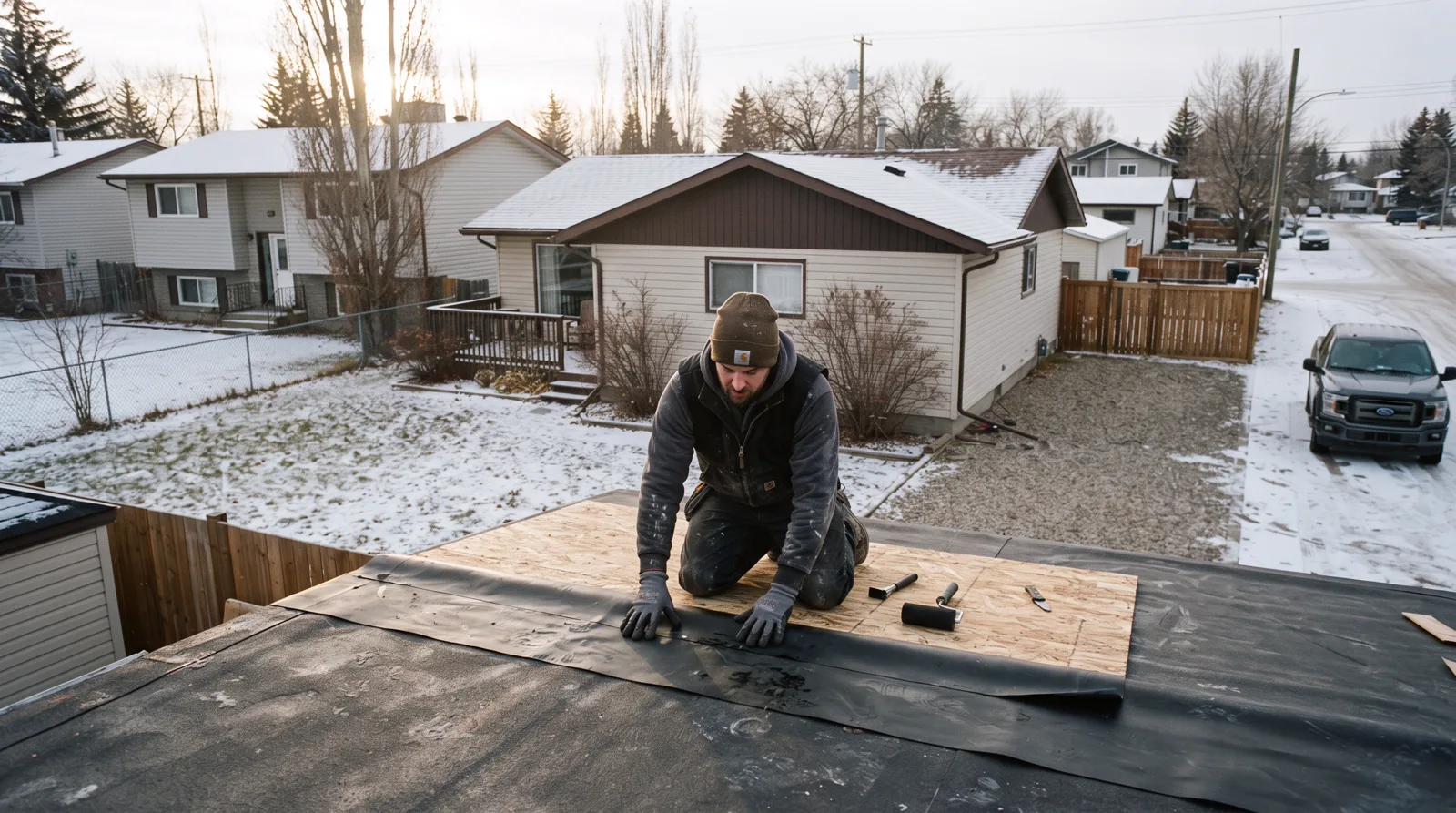
Flat and low-slope roofing built for Alberta snow, ponding and freeze-thaw.
TPO, EPDM, modified bitumen, and torch-on systems, plus leak repair, recoating and drainage correction from local roofers who understand Parkland County winters and the flat roofs that fail in them.
Flat roofing services in Spruce Grove & Stony Plain
Residential low-slope, garage and addition roofs, and commercial flat roofs across the Tri-Region. Every job handled by a local pro, quoted in writing, free.
TPO Single-Ply Roofing
Heat-welded thermoplastic membrane with a reflective white surface that cuts summer attic heat. Fully adhered or mechanically fastened over tapered insulation for positive drainage. A strong choice for Spruce Grove additions, garages and light commercial.
EPDM Rubber Roofing
Durable synthetic rubber membrane proven through decades of Alberta freeze-thaw. Excellent cold-weather flexibility, ballasted or fully adhered, with fewer seams on large spans. Ideal for shops, acreage outbuildings and flat residential sections.
Modified Bitumen & Torch-On
Two-ply SBS modified bitumen torch-applied for a rugged, walkable surface that stands up to foot traffic and mechanical units. A dependable system for older Stony Plain flat roofs and any deck that sees regular service access.
Flat Roof Leak Repair
Leak tracing, seam and flashing repair, membrane patching, and emergency tarping for active leaks. Most flat-roof leaks start at a penetration or seam, not the field, so we find the real source instead of chasing water stains.
Roof Coatings & Recoating
Silicone and acrylic restoration coatings that extend the life of a sound but weathered membrane, seal fine cracks and add reflectivity, often at a fraction of full replacement when the deck underneath is still dry and solid.
Drainage & Tapered Insulation
Ponding water is the number one killer of flat roofs. We rebuild slope with tapered insulation, add or relocate drains and scuppers, and correct dead-flat areas so water leaves the roof instead of sitting on it.
What flat roofs face in the Tri-Region
❄️ Heavy snow load
Flat roofs collect and hold snow instead of shedding it. Parkland County design loads are significant, and drifting against parapets and rooftop units adds concentrated weight that a failing membrane cannot protect.
🔄 Freeze-thaw cycling
Meltwater seeps into a seam or pinhole by day and freezes by night, prying the opening wider with every cycle. This is why small flat-roof defects turn into interior leaks so quickly in our climate.
🌊 Ponding water
Alberta code expects a flat roof to drain within 48 hours. Dead-flat areas and clogged drains leave standing water that degrades the membrane, grows algae and multiplies the load after a rain or melt.
☀️ UV and temperature swings
A dark membrane on a Spruce Grove summer day can swing over 60 degrees between afternoon and night. That constant expansion and contraction fatigues seams and fasteners faster than most owners expect.
What it costs here
Flat roofing in Spruce Grove: everything you need to decide
A plain-English guide to flat and low-slope roofing in the Tri-Region: the systems, why they fail here, repair versus replacement, what it costs, and how to hire a roofer you can trust.
Why flat roofs behave differently in the Tri-Region
A flat roof is never truly flat. Every sound low-slope roof is built with a slight pitch, usually a quarter-inch of fall for every foot, so that water moves toward a drain or scupper instead of sitting still. In Spruce Grove, Stony Plain and the surrounding Parkland County acreages, that small detail matters more than almost anything else, because our climate punishes standing water harder than a milder region ever would.
The reason is freeze-thaw. When water pools on a membrane in October, it works into any seam, fastener or pinhole during the warm part of the day, then freezes overnight and expands. Ice is roughly nine percent larger than the water it came from, so each cycle acts like a tiny wedge, prying the opening wider. A pinhole that would take years to matter in a mild climate can become an active interior leak in a single Alberta shoulder season.
Snow adds a second problem that pitched roofs mostly avoid. A steep asphalt roof sheds snow; a flat roof holds it. That standing snow load is heavy on its own, and it drifts unevenly against parapet walls, mechanical curbs and skylights, concentrating weight in exactly the spots where a membrane is already working hardest. A flat roof in our region is therefore both a waterproofing system and a structural surface, and it has to be detailed for both jobs.
Flat roofing systems compared: TPO vs EPDM vs modified bitumen
Most flat roofs in the Tri-Region use one of three membrane families. There is no single best option for every building. The right choice depends on the size of the roof, foot traffic, rooftop equipment, budget and how long you plan to own the property. Here is how the three systems actually behave in Alberta conditions.
TPO (thermoplastic polyolefin)
TPO is a single-ply membrane whose seams are fused with a hot-air welder, creating a bond as strong as the sheet itself. Its reflective white surface bounces summer sun, which lowers cooling load on air-conditioned buildings and reduces the daily heat swing that fatigues a roof. TPO is a popular, cost-effective pick for Spruce Grove additions, garages and light commercial buildings. Its main weakness is that quality varies by manufacturer and installer, so the warranty and the welder's skill matter as much as the brand.
EPDM (rubber membrane)
EPDM is a synthetic rubber that has protected Alberta flat roofs for decades. It stays flexible in deep cold, which is a genuine advantage here, and large spans can be covered with fewer seams than TPO. Standard EPDM is black, so it absorbs heat rather than reflecting it, though that can actually help melt snow. It is often the most economical durable membrane for shops, acreage outbuildings and larger flat sections where appearance is not the priority.
Modified bitumen and torch-on
Modified bitumen is the modern descendant of built-up tar-and-gravel roofing. Two or more plies of SBS-modified asphalt are torch-applied or self-adhered to create a thick, rugged, walkable surface. It tolerates foot traffic and rooftop service far better than a thin single-ply, which makes it a strong choice for roofs with mechanical units, or for older Stony Plain buildings where a proven multi-ply system is wanted. Torch-on work demands a careful, fire-aware crew, another reason to hire an established local roofer rather than the lowest bid.
Why flat roofs fail here, and how to prevent it
When a flat roof leaks, homeowners often assume the whole membrane is worn out. In reality, the large majority of flat-roof leaks in our area start at a small number of predictable points. Knowing where they are is the difference between a targeted repair and an unnecessary full replacement.
- Penetrations: vents, pipes, and mechanical curbs are where most leaks begin, because every penetration is a hole that was sealed and now has to stay sealed through years of movement.
- Seams and laps: on any membrane, the joints between sheets are the weak line. Cold-weld failures, lifted laps and aged adhesive let water track sideways under the surface.
- Flashing and parapets: where the roof meets a wall, skylight or edge, the transition detail takes the most abuse from freeze-thaw and is the second most common failure point.
- Ponding areas: dead-flat spots hold water that never fully drains, accelerating membrane breakdown and adding load. This is a slope problem, not just a membrane problem.
- Fasteners and blisters: wind uplift works fasteners loose over time, and trapped moisture under the membrane forms blisters that eventually split.
The role of drainage
Because ponding is so destructive in a freeze-thaw climate, drainage correction is often the highest-value work a Tri-Region flat roof can receive. Rebuilding slope with tapered insulation, adding or relocating drains and scuppers, and clearing the paths water actually takes will extend the life of almost any membrane. A roof that drains in a day is a roof that lasts; a roof that holds water is on a countdown.
Repair, recoat, or replace: how to decide
Not every tired flat roof needs to be torn off. One of the most useful things an experienced roofer does is tell you honestly which of three paths fits your roof, because the cost difference between them is large.
Repair makes sense when the membrane is generally sound and the problem is localized: a failed seam, a cracked pipe boot, a section of lifted flashing. A competent leak trace finds the true entry point, which is frequently several feet uphill from the interior stain, and fixes that source rather than smearing sealant over the symptom. Good repairs on a healthy roof buy years for a few hundred to a few thousand dollars.
Recoating fits a roof that is watertight and structurally solid but weathered, with fine surface cracks and fading. A silicone or acrylic restoration coating seals those micro-cracks, restores reflectivity and adds a renewable wear layer, often for a fraction of replacement cost. The catch is that coatings only work over a dry, adhered substrate. Coating over a wet or delaminating roof traps moisture and wastes money, so an honest moisture check comes first.
Replacement becomes the right call when the deck is wet, insulation is saturated, ponding is chronic, or the membrane has reached the end of its service life. At that point, patch-and-pray spending stacks up to more than a proper new system would have cost, and the interior damage risk keeps climbing. A full re-roof is also the moment to fix slope and drainage properly so the next roof does not repeat the same failure.
Snow load, ponding and the Alberta building code
Flat roofs in our region are engineered to carry real snow and rain loads, and the building code sets the rules. New and replacement low-slope roofs are expected to drain, with design that clears water within roughly 48 hours so that ponding does not become a permanent load or a freeze-thaw factory. Parapet walls, overflow scuppers and properly sized drains are not upgrades, they are how a flat roof is supposed to be built here.
Snow does not sit evenly. It drifts, and code accounts for that with higher loads near parapets, walls and rooftop units where snow piles deeper. When someone adds a heavy rooftop unit, a new curb, or even a rooftop patio to an existing flat roof, the added and redistributed load should be checked, not assumed. A roofer who understands local loading will flag when a structural review is warranted rather than simply laying membrane over a questionable deck.
For a full flat-roof replacement in Spruce Grove and most Tri-Region municipalities, a building permit is generally required, and the work should meet current insulation and drainage requirements. A reputable contractor handles the permit as part of the job. If a bidder suggests skipping the permit to save money, treat it as a serious warning sign, because unpermitted structural roof work can jeopardize both your insurance coverage and your eventual resale.
Commercial and acreage flat roofing across Parkland County
Flat and low-slope roofing is not only a residential concern. Shops, warehouses, strip retail and offices in Spruce Grove, Stony Plain and Acheson almost all sit under flat membranes, and acreage properties across Parkland County frequently have flat-roofed shops and outbuildings. These roofs carry the added complication of rooftop mechanical equipment, service traffic and larger uninterrupted spans.
Commercial re-roofing decisions weigh business disruption alongside cost. Phased replacement, work scheduled around operating hours, and restoration coatings that avoid a full tear-off are all tools a good commercial roofer brings to the table. The membrane choice also shifts: reflective TPO can reduce cooling costs on a conditioned building, while a rugged multi-ply system may suit a roof that sees constant foot traffic for equipment service.
For acreage shops and outbuildings, the priorities are usually durability, cold-weather performance and value over a large area, which is why EPDM and modified bitumen show up so often on rural Tri-Region buildings. Whatever the structure, the same fundamentals decide success: correct slope, sound flashing details, and a crew that installs the manufacturer's system the way the warranty requires.
What flat roofing costs in Spruce Grove and Stony Plain
Flat roofing is priced by the square foot of roof area, adjusted for the membrane system, the amount of insulation, the condition of the deck underneath and how hard the roof is to access. The ranges on this page are directional planning figures for the Tri-Region, not a quote. The only accurate number is a written estimate after someone has actually measured and inspected your roof.
A targeted leak repair typically runs from a few hundred dollars for a single boot or seam up to a few thousand for multiple failure points and interior remediation. A restoration coating on a sound membrane commonly lands in the mid-single-thousands, and because it avoids tear-off and disposal, it is often the best value when the roof qualifies. A full residential EPDM or TPO replacement, including tear-off, new insulation and proper drainage, generally falls in the range shown above, with size and complexity driving where you land.
Commercial flat re-roofs cover a much wider range because building size, membrane specification, insulation thickness and rooftop equipment vary so widely. The variables that move any flat-roof price the most are the same every time: total area, membrane type, how much insulation and slope correction is required, deck repairs discovered during tear-off, and access. Beware a bid that is dramatically lower than the others, because it usually means thinner insulation, a cheaper membrane, or skipped drainage work that you will pay for later.
How to choose a flat roofing contractor in the Tri-Region
Flat roofing is unforgiving of shortcuts, and the difference between a ten-year roof and a thirty-year roof is almost entirely installation quality. A few checks separate the professionals from the risky bids.
- Confirm active WCB coverage and at least two million dollars of liability insurance, and ask for the certificates before any work starts.
- Ask which specific membrane system they will install and whether they are trained or certified for it, because single-ply and torch-on warranties depend on approved installers.
- Insist on a written scope that names the membrane, the insulation and the drainage work, not a vague one-line price.
- Ask how they will correct slope and drainage, not just what membrane they will lay. A roofer who ignores ponding is setting up the next failure.
- Prefer an established local company with verifiable Parkland County reviews and a real address, over storm-chasing crews that appear after weather events and vanish before the warranty is ever tested.
How Tri-Region Services helps
Tri-Region Services is a local lead-referral service, not a call centre. When you request a quote on this page, your details go to one local roofer who works the Tri-Region, who has told us about their insurance and credentials. You get a fast, local response and a written quote, with no obligation and no pressure. If a flat roof is leaking or ponding right now, calling is the quickest way to get eyes on it.
Why Tri-Region homeowners call us first
Every pro is credential-checked before a single lead is sent their way.
Verified local pros
Credentials checked before any lead is routed, not a random call-centre dispatch.
Insurance on file
Pros tell us they carry liability insurance when they join. Ask to see their certificate before work begins.
Local Tri-Region dispatch
Based in the area, faster arrival than an Edmonton company, no travel surcharges.
Up-front pricing
Honest quotes in writing before work begins. No surprises.
Fast response
Urgent requests for active leaks are flagged and routed to available local pros first.
Workmanship guarantee
Work done to code and stood behind. Your satisfaction is the point.
This page is not tied to a contractor's brand. Leads route straight to your one local partner. Verified reviews can appear here once that partner has them (never fabricated).
Serving the whole Tri-Region
Flat roofing questions
How long does a flat roof last in Alberta?+
Why does my flat roof keep leaking after repairs?+
TPO or EPDM, which is better for a Spruce Grove roof?+
Can a flat roof be repaired in winter?+
What is ponding water and why does it matter so much?+
Do I need a permit to replace a flat roof in Spruce Grove?+
Is a roof coating a real fix or just a delay?+
How much does a flat roof cost in the Tri-Region?+
Get your free quote
Tell us what you need and a local pro will get right back to you.
- ✓ Sent straight to a local business
- ✓ You choose who you hire
- ✓ Free, with no obligation