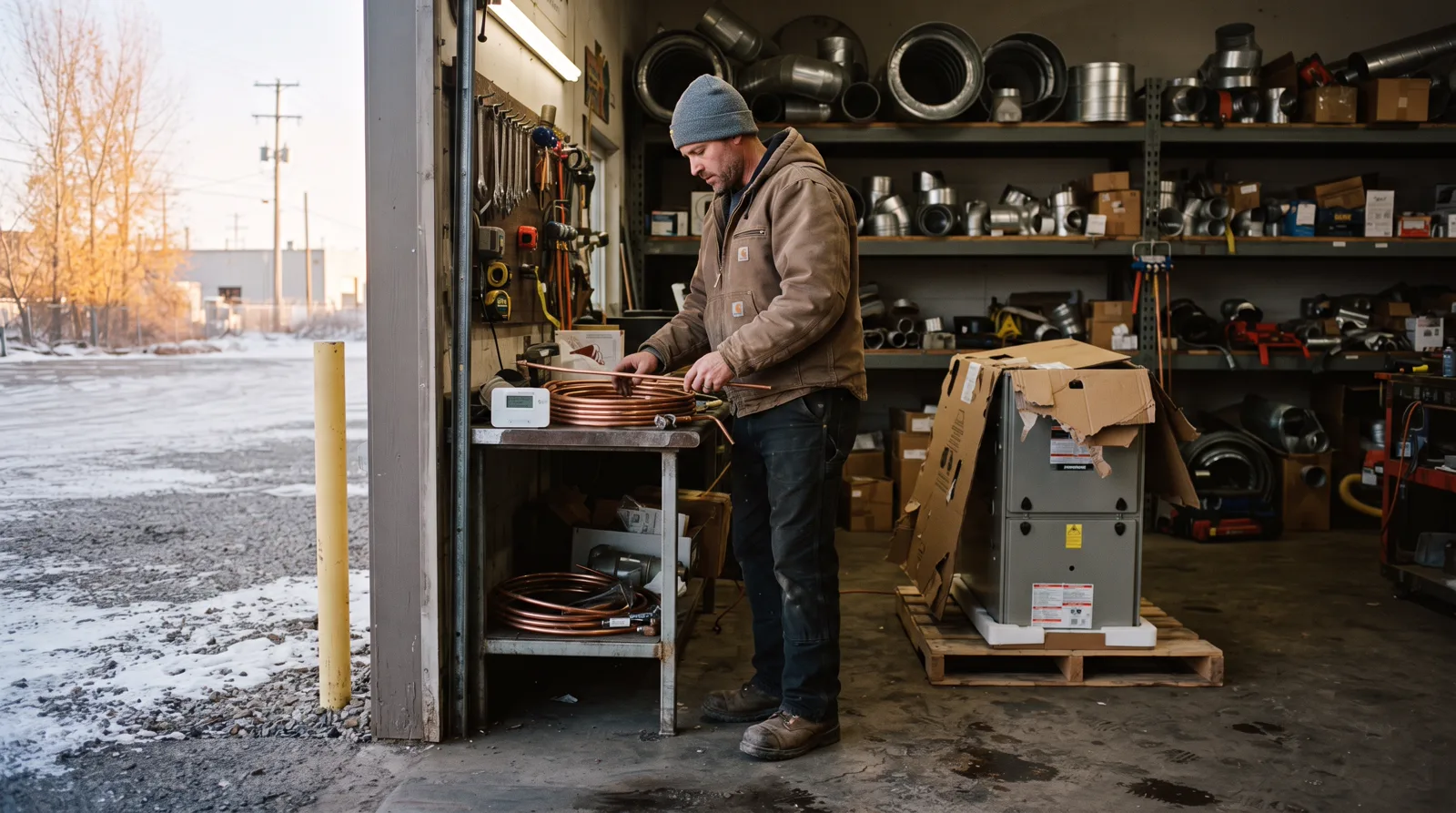
Furnace Installation Spruce Grove: Built for Alberta Winters.
Licensed HVAC techs install high-efficiency gas, electric and dual-fuel furnaces sized for Tri-Region homes. Permits pulled, old units removed, load calcs done right.
Furnace Installation Services We Deliver
From heat-loss calculations to final commissioning, local pros handle every step so your new system heats evenly and efficiently.
High-Efficiency Gas Furnace Install
Two-stage or modulating gas furnaces rated 95% to 98% AFUE. Your installer sizes to your Manual J load, pulls the Alberta gas permit, connects to existing ductwork, commissions and tests combustion. Includes old unit disposal and one-year labour warranty.
Electric Furnace Installation
Ideal for smaller homes, garages or rural properties without natural gas. We verify your panel capacity, install the electric furnace with proper breaker sizing, wire sequencers and limit switches. Clean, quiet operation with no combustion risk.
Dual-Fuel System Setup
Pair a gas furnace with an electric heat pump so you use the most economical fuel at any temperature. Our controls automatically switch between gas and electric based on outdoor temp and utility rates. Perfect for volatile Alberta weather and rising gas costs.
Manual J Load Calculation
Accurate room-by-room heating load using insulation values, window areas, infiltration rates and design temps. Prevents oversizing, which causes short-cycling, uneven temps and wasted energy. We provide a signed report for permit and warranty compliance.
Old Furnace Removal & Disposal
Safe disconnection of gas or electric supply, refrigerant recovery if applicable, and transport to an approved recycling depot. Local pros handle older units with asbestos tape or mercury switches according to Alberta environmental regs.
Ductwork Modification & Sealing
Resize plenums, add return-air pathways or seal leaky joints so your new furnace delivers rated airflow and efficiency. Common in older Spruce Grove homes where original duct was undersized or flex runs have collapsed in crawlspaces.
Why Furnace Installation Here Is Different
❄️ Minus 40°C Design Temperature
Alberta Building Code specifies a heating design temp of minus 38°C to minus 40°C for our region. We use this in every Manual J calculation so your furnace has enough capacity on the coldest January nights without oversizing for milder days. Undersized units run constantly and fail early.
🌬️ Chinook Wind & Freeze-Thaw Cycles
Rapid temperature swings stress heat exchangers and cause condensate freeze-ups in high-efficiency furnaces. Local pros install condensate traps with proper slope, heat tape on drain lines in unheated spaces, and recommend two-stage burners that modulate instead of cycling hard on and off.
📋 Alberta Gas Permit & Inspection
Every natural gas furnace install requires an Alberta gas permit under the Safety Codes Act and a follow-up inspection of combustion air, venting and gas-line pressure. Your installer pulls the permit, schedules the inspector and provides you with the signed green tag for insurance and resale records.
🏡 Acreage & Rural Service Realities
Parkland County acreages often use propane, require longer vent runs and lack easy access to recycling depots. We stock LP conversion kits, coordinate propane-tank regulators with your supplier and haul old furnaces to the Stony Plain transfer station so you do not need a truck.
What it costs here
Everything You Need to Know About Furnace Installation in Spruce Grove
From sizing and permits to efficiency ratings and warranty fine print, this guide walks you through the decisions that matter for Tri-Region homeowners.
How Furnace Installation Actually Works in Spruce Grove and Parkland County
A complete furnace installation means removing your old heating system and connecting a new unit that meets current Alberta building code requirements and manufacturer specifications. This involves electrical work, gas line connections, venting through your roof or exterior wall, condensate drainage if you choose a high efficiency model, and integration with your existing ductwork. The installer must size the furnace correctly for your home's square footage, insulation levels, window types, and the extreme temperature swings we experience between January cold snaps and mild chinook events. Undersized units run constantly and fail early, while oversized furnaces short cycle and waste energy.
The work requires permits from Spruce Grove, Stony Plain, or Parkland County depending on your location, and inspectors verify that gas connections meet CSA standards, electrical work follows the Canadian Electrical Code, and venting complies with manufacturer clearances and local amendments. Licensed gas fitters handle all natural gas connections because even small leaks create serious safety risks. High efficiency condensing furnaces produce acidic condensate that must drain properly to avoid damage to your foundation or basement floor, and these systems need special PVC or CPVC venting rather than the metal B-vent used on older atmospheric models.
Professional installation includes load calculations using Manual J methodology or similar approaches, which factor in ceiling height, wall construction, basement configuration, number of windows, and how exposed your property is to prevailing northwest winds. Installers in this region know that homes on the west side of Spruce Grove near Highway 16A face different wind loads than sheltered properties in Stony Plain's established neighborhoods. The crew will test combustion efficiency, check for gas leaks using electronic detectors and soap solutions, verify proper draft through the venting system, calibrate the thermostat, and confirm that your furnace communicates correctly with any zoning systems or smart home equipment you have installed.
Why Alberta's Climate Makes Professional Furnace Installation Critical
Spruce Grove and Parkland County experience temperature extremes that put massive stress on heating equipment, with winter lows reaching between negative 30°C and negative 40°C during polar vortex events and sudden chinook winds bringing temperature swings of 20 degrees or more in a single day. These rapid freeze thaw cycles create condensation issues in improperly vented systems, cause expansion and contraction in ductwork connections, and test every seal and gasket in your heating system. A furnace installed without accounting for these conditions may draft incorrectly when chinook winds create unusual pressure patterns around your home, leading to backdrafting that pulls combustion gases into your living space.
Deep ground frost in our region extends well below typical foundation depths, which affects how condensate lines must be routed and protected from freezing. High efficiency furnaces produce significant condensate year round, and any exterior drainage points need proper insulation and heat tracing in exposed areas. January cold snaps lasting two weeks or longer mean your furnace runs almost continuously, so oversized units that might work in milder climates will short cycle here even during our coldest periods, while undersized equipment simply cannot maintain comfortable temperatures when outdoor conditions hit negative 35°C overnight.
Snow loads on roofs in Parkland County regularly exceed what southern Alberta communities experience, and roof-penetrating vents must be positioned and sealed to prevent snow infiltration and ice damming around the vent cap. Installers familiar with local conditions know to avoid low slope roof areas where snow accumulates and to extend vent terminations high enough that blowing snow cannot block the intake or exhaust. Properties near Acheson's industrial areas face additional air quality considerations, with installers positioning fresh air intakes away from prevailing winds that might carry dust or other particulates toward your home.
Real Warning Signs That You Need Furnace Replacement
Age combined with repair frequency tells you more than either factor alone, because a 20 year old furnace that has needed three repairs in two years is approaching the point where continuing repairs make no financial sense. Furnaces in Alberta typically last between 15 and 25 years depending on maintenance quality, how hard they work during extreme cold events, and whether they were sized correctly when installed. If your current system dates to before 2005, it likely operates at 80% AFUE or lower, meaning you are losing significant money on energy costs compared to modern units rated at 95% to 98% AFUE.
Uneven heating throughout your home often indicates a furnace that can no longer move enough air to reach distant rooms, though this can also signal ductwork problems or a blower motor wearing out. If your master bedroom stays cold while the main floor overheats, or if you have closed vents in some rooms to balance temperatures, your furnace may lack the capacity to overcome resistance in your duct system. Strange noises like booming ignition, constant blower operation, rattling heat exchangers, or squealing belts all point toward components reaching end of life, and these sounds become more frequent as equipment ages.
Rising natural gas bills without corresponding increases in rates or changes in your household routines mean your furnace is losing efficiency. Check your billing history over the past three to five years, adjusting mentally for any extreme weather events, and look for a steady upward trend in consumption. Rust or corrosion visible around the cabinet, particularly near the base where condensate might collect, suggests the heat exchanger may be compromised. Soot accumulation around registers, persistent dust throughout your home despite regular filter changes, or increased allergy symptoms among family members can all indicate combustion problems or cracks in the heat exchanger allowing products of combustion to mix with your home's air supply.
Heat Exchanger Cracks and Carbon Monoxide Risk
The heat exchanger separates combustion gases from the air circulating through your home, and cracks in this component create immediate safety concerns because carbon monoxide and other combustion byproducts can enter your living space. Older furnaces with conventional steel heat exchangers are particularly vulnerable as metal fatigues through thousands of heating cycles. You cannot reliably inspect heat exchangers yourself because cracks often develop in areas not visible without disassembling the unit, and even small openings invisible to the naked eye can leak dangerous gases.
If your carbon monoxide detectors alarm, if family members experience frequent headaches or nausea that improve when you leave the house, or if your HVAC technician identifies heat exchanger damage during maintenance, replacement becomes urgent rather than optional. Repairing or replacing heat exchangers costs nearly as much as a new furnace while leaving you with an old blower, controls, and other components that will soon need attention. Licensed technicians in Alberta must red tag furnaces with cracked heat exchangers, meaning the gas supply gets shut off until the unit is replaced.
The Complete Furnace Installation Process From Quote to Startup
Initial assessment involves an installer visiting your property to examine your existing system, measure your home, evaluate your ductwork condition, check electrical service capacity, and inspect venting paths. They will ask about problem areas in your home, review your recent utility bills, and discuss your budget and efficiency priorities. This visit should include attic and crawl space inspection if accessible, because installers need to understand your insulation levels and air sealing quality to size the replacement correctly. Expect this assessment to take 60 to 90 minutes for a typical single family home, longer for properties with complex layouts or multiple heating zones.
The written quote should specify equipment models with exact efficiency ratings, labour costs, permit fees, disposal charges for your old furnace, and any ductwork modifications or thermostat upgrades recommended. Installers working in Spruce Grove and Parkland County should list separate line items for gas line modifications, electrical upgrades, fresh air intake installation, condensate pump requirements, and whether your chimney needs to be relined or capped after the new high efficiency furnace goes in. Verify that the proposal includes post installation inspection by the local authority, startup and commissioning, and some form of workmanship warranty separate from the manufacturer's equipment warranty.
Installation day typically requires one full day for straightforward replacements or two days when significant modifications are needed. The crew disconnects and removes your old furnace, caps any redundant gas lines, and may need to cut and modify ductwork if the new unit has different dimensions or plenum connections. High efficiency condensing furnaces require PVC venting run through your roof or exterior wall, condensate drainage to a floor drain or condensate pump, and fresh air intake from outdoors. The installer connects new gas lines using black iron pipe or approved CSST flexible gas line, wires the electrical connections including the 120 volt power supply and low voltage thermostat circuit, and seals all ductwork connections with mastic rather than relying on tape.
Startup and commissioning happens after installation is mechanically complete, with the technician checking gas pressure at the manifold, measuring temperature rise through the heat exchanger, testing safety controls including the high limit switch and rollout switches, and verifying proper draft through the venting system. They will run the furnace through multiple cycles while monitoring combustion efficiency, check that the condensate drains freely, program your thermostat if it is a new digital or smart model, and explain basic maintenance tasks you should perform. The final step involves scheduling the municipal inspection, which must occur before the installer can collect final payment on many jobs, and the inspector will verify code compliance including proper clearances to combustibles, correct venting termination heights, and adequate combustion air supply.
What Furnace Installation Really Costs in Spruce Grove, Stony Plain and Parkland County
A complete furnace installation in the Tri-Region typically runs between $3,800 and $9,500, and that wide range reflects real differences in equipment efficiency, home complexity, and the scope of work required. A basic 60,000 BTU single-stage furnace in a straightforward 1,200 square foot bungalow might land near the lower end, while a 100,000 BTU variable-speed modulating unit with upgraded venting, humidifier integration, and ductwork modifications in a two-storey Parkland County acreage can easily push past $8,000. The equipment itself accounts for roughly 40 to 55 percent of the total, with labour, permits, code compliance upgrades, and ancillary materials making up the balance. Understanding what drives these numbers helps you budget accurately and avoid sticker shock when quotes arrive.
Equipment tier makes the single biggest cost difference. A builder-grade 80% AFUE single-stage furnace from a value brand starts around $1,200 to $1,800 wholesale, while a premium 96% AFUE two-stage or modulating furnace with advanced diagnostics and longer warranties runs $3,200 to $5,500 at contractor cost. Mid-efficiency units in the 92 to 95% AFUE range with two-stage burners typically sit between $2,000 and $3,200. Capacity matters too: homes in rural Parkland County with open floor plans, cathedral ceilings, or poor insulation often need 80,000 to 120,000 BTU units, which cost more than the 40,000 to 60,000 BTU furnaces common in newer Spruce Grove subdivisions. Brand choice also plays a role, with Lennox, Carrier, and Trane commanding premiums over Goodman, Amana, or Comfort-Aire, though all can perform well when properly installed and maintained.
Labour and installation complexity add $1,800 to $4,000 depending on the particulars of your home. A direct swap in a garage or basement utility room with existing gas line, electrical, and high-efficiency venting takes four to six hours and stays toward the lower end. Homes requiring new PVC intake and exhaust pipes through the rim joist or sidewall, upgrades to 100-amp electrical panels, gas line resizing from half-inch to three-quarter inch black iron, or relocation of the furnace to meet current clearance codes add time and materials. Older homes in Stony Plain's established neighbourhoods sometimes need asbestos abatement around old ductwork, knob-and-tube electrical replacement near the furnace location, or structural modifications to accommodate taller high-efficiency units. Every home is different, which is why phone quotes are guesswork and on-site assessments matter.
Permits, inspections, and mandatory code upgrades contribute another $300 to $800 to the total. Spruce Grove, Stony Plain, and Parkland County all require HVAC permits for furnace replacement, currently running $150 to $250 depending on jurisdiction. A licensed gas fitter must pull the permit, complete the work to Alberta Building Code and CSA B149 standards, and arrange for a safety inspection before the utility will restore gas service. Inspectors routinely flag undersized return air ducts, missing combustion air provisions, inadequate clearances to combustibles, and outdated venting materials. Bringing these items into compliance is not optional, and while it adds cost upfront, it protects your family from carbon monoxide risks and ensures your home insurance remains valid. Budget for compliance work rather than hoping the inspector overlooks legacy issues.
Hidden Costs That Catch Homeowners Off Guard
Several expenses surprise homeowners who expected a simple swap. If your existing ductwork is undersized, leaky, or poorly balanced, you may need $800 to $2,500 in duct sealing, insulation, or new trunk lines to deliver the airflow a modern furnace requires. High-efficiency condensing furnaces produce acidic condensate that must drain to a floor drain, sump, or condensate pump, and homes without nearby drainage need pumps and plumbing added at $200 to $450. Thermostat upgrades are common too: older mercury or basic digital thermostats cannot communicate with variable-speed blowers or modulating gas valves, so a compatible programmable or smart thermostat adds $150 to $400 installed. Finally, disposal fees for the old furnace and associated materials run $75 to $200, and some contractors quietly bury this in their quote while others list it separately.
Financing and Rebate Realities
Many Alberta homeowners finance furnace installations through contractor payment plans, credit union loans, or home equity lines of credit, particularly when the old unit dies mid-winter and depletes emergency savings. Contractor financing typically carries interest rates between 7.9 and 19.9 percent depending on credit approval, with terms from 24 to 84 months. Read the fine print: some promotional zero-percent offers revert to punishing rates if not paid in full by a specific date. Federal and provincial rebate programs come and go, but as of recent years, the Canada Greener Homes Grant offered up to $5,000 for eligible energy retrofits including high-efficiency furnaces, though it requires pre- and post-retrofit energy evaluations by a certified advisor at additional cost. Some utility companies periodically offer modest rebates for ENERGY STAR certified equipment. Check current program availability before purchasing, and remember that rebates arrive months after installation, so you still need to cover the full cost upfront.
Comparing Your Furnace Options: Efficiency, Features and What Actually Matters
Efficiency ratings dominate furnace marketing, but AFUE numbers alone do not tell the whole story. A 96% AFUE furnace converts 96 cents of every gas dollar into usable heat, with only 4 cents lost up the flue, compared to 80 cents and 20 cents lost for an 80% AFUE mid-efficiency unit. Over a full heating season in Spruce Grove, where furnaces run October through April and sometimes into May, a high-efficiency unit saves roughly $250 to $450 per year in natural gas costs for a typical 1,500 square foot home compared to a standard-efficiency model. That payback takes six to twelve years depending on installation cost premiums, gas prices, and how long you plan to stay in the home. High-efficiency furnaces also vent through PVC pipes rather than metal chimneys, which allows installation flexibility but requires proper slope and drainage that older homes may not easily accommodate.
Burner staging and blower motor type affect comfort and operating cost as much as headline efficiency. Single-stage furnaces run full blast every time they fire, cycling on and off frequently and creating temperature swings of two to four degrees. Two-stage models run at a lower capacity most of the time, typically 60 to 70 percent, ramping to full output only during extreme cold snaps or recovery from setback. This delivers steadier temperatures, quieter operation, and better air filtration since the blower runs longer cycles. Modulating furnaces take this further, adjusting output in one-percent increments from around 40 percent to 100 percent, essentially matching heat delivery to real-time load. These pair with variable-speed ECM blowers that consume 60 to 80 percent less electricity than old PSC motors and allow for constant low-speed circulation that eliminates hot and cold spots. For open-concept homes or families sensitive to noise and temperature variation, the comfort difference justifies the $1,200 to $2,000 premium over single-stage equipment.
Brand and warranty considerations matter more for long-term satisfaction than many realize. All major furnace brands source components from a handful of suppliers, so a Goodman and a Carrier often share the same gas valve, ignitor, and blower motor. What differs is cabinet quality, engineering refinement, parts availability, and warranty support. Premium brands typically offer ten-year parts warranties and optional labour coverage, while value brands provide five to ten years on the heat exchanger and one to five years on components. Critically, warranty validity depends on professional installation by a licensed contractor and proof of annual maintenance. Parkland County acreages far from town should prioritize brands with strong local parts distribution, since waiting three days for an ignitor in January is miserable. Ask your contractor which brands they stock parts for and service regularly rather than chasing the absolute lowest price on an unfamiliar nameplate.
Right-Sizing: Why Bigger Is Not Better
Oversized furnaces are epidemic in Alberta, a legacy of installers who eyeball square footage, multiply by a rule-of-thumb factor, and add 20 percent for good measure. An oversized unit short-cycles constantly, firing for 90 seconds, shutting off, then firing again ten minutes later. This wastes gas, stresses components, fails to filter air adequately, and leaves some rooms cold while others overheat. Proper sizing requires a Manual J heat loss calculation that accounts for insulation levels, window types, air sealing, orientation, and local climate data. A well-insulated 1,800 square foot home in Spruce Grove might need only a 60,000 BTU furnace, while a poorly insulated 1,400 square foot bungalow in Parkland County could require 80,000 BTU. Contractors who skip this step are guessing with your money, and the result is a furnace that costs more, performs worse, and fails sooner.
Gas vs. Electric: The Alberta Reality
Natural gas remains the overwhelming choice for Tri-Region heating due to cost and availability. Electric furnaces or heat pumps eliminate combustion safety concerns and require no venting, but electricity rates make them expensive to operate except in extremely well-insulated new builds or as supplemental heat. A typical Alberta home uses 2,500 to 4,000 cubic meters of natural gas per heating season at current rates of roughly 10 to 15 cents per cubic meter, totaling $300 to $600. The same heat from electric resistance costs $1,200 to $2,200 annually at 13 to 16 cents per kilowatt-hour. Cold-climate air-source heat pumps improve this somewhat but lose efficiency below minus 15 Celsius and require backup heat for deep January cold snaps. Until electricity pricing changes dramatically, gas furnaces will dominate Alberta installations, and rural properties without gas service typically choose propane conversion over electric.
Mistakes to Avoid and Red Flags When Hiring a Furnace Installer
The biggest mistake homeowners make is accepting the first quote without understanding what it includes or excludes. A $4,200 price that seems attractive might omit permit fees, thermostat upgrade, code compliance work, ductwork modifications, and old furnace disposal, turning into $5,800 once the actual work begins. Demand itemized quotes that list equipment model and serial numbers, labour hours, permit costs, materials, and any foreseeable upgrades required to meet code. Compare apples to apples: one contractor quoting a 96% AFUE modulating Lennox with a ten-year parts and labour warranty is not comparable to another quoting a 92% AFUE single-stage Goodman with a five-year parts-only warranty, even if both are labeled as high-efficiency. Understand exactly what you are buying, what warranty coverage you receive, and what happens if inspections reveal additional work needed.
Hiring unlicensed or uninsured installers is the most dangerous mistake and surprisingly common in rural areas. Alberta requires gas fitters to hold a valid Gas Utilization Safety Code certification and carry liability insurance for their workers. An unlicensed installer cannot legally pull permits, which means no inspection, no insurance validity, and no recourse if the installation causes a house fire or carbon monoxide poisoning. Insurance adjusters routinely deny claims for damage caused by unpermitted work or unqualified contractors, leaving you financially responsible. Beyond licensing, verify the company carries two million dollars in general liability insurance and request a certificate of insurance naming you as an additional insured for the project duration. Stony Plain and Parkland County are not so remote that you need to risk your family's safety and financial security to save a few hundred dollars. Licensed professionals cost more because they carry the insurance, training, and accountability that fly-by-night operators skip.
Pressure tactics and too-good-to-be-true pricing signal trouble. Contractors who quote over the phone without visiting your home are guessing, and that guess often becomes a much higher number once they arrive and see the actual installation challenges. High-pressure sales reps who push same-day decisions, limited-time discounts, or scare tactics about your old furnace dying imminently should be shown the door. Legitimate contractors provide written quotes valid for 30 days, explain options without pressure, and answer technical questions confidently. Quotes significantly below market, particularly under $3,500 for a complete high-efficiency installation in a typical home, usually mean the contractor plans to cut corners on materials, skip permit processes, use refurbished equipment, or add surprise charges mid-job. Trust your instincts: if the deal feels off, it probably is.
- Skipping Manual J load calculations and oversizing the furnace by 30 to 50 percent
- Failing to inspect and seal ductwork before connecting a new high-efficiency furnace
- Reusing old single-wall B-vent with a condensing furnace that requires PVC intake and exhaust
- Not upgrading undersized gas lines, resulting in low pressure and incomplete combustion
- Ignoring return air deficiencies that starve the blower and reduce efficiency by 20 percent or more
- Accepting verbal quotes or handshake agreements with no written contract or warranty documentation
- Choosing the cheapest bid without verifying licensing, insurance, WCB compliance, or references
The Permit and Inspection Dodge
Some contractors offer lower prices by skipping permits and inspections, framing it as saving you money. This is fraud, and it exposes you to severe consequences. When you sell your home, real estate lawyers and home inspectors will identify unpermitted work, and you may be required to have it inspected retroactively, torn out and redone, or accept a steep price reduction. Worse, if your furnace causes a fire or carbon monoxide incident and investigators discover unpermitted installation, your insurance claim will be denied and you could face personal liability for injuries or damages. The permit process exists because furnaces are inherently dangerous: they burn fossil fuel indoors, produce carbon monoxide, operate under gas pressure, and generate extreme heat. Inspectors verify proper venting, adequate combustion air, correct gas pressure, safe clearances, and functional safety controls. Paying $200 for a permit and inspection is the least expensive and most valuable insurance you will ever buy.
How to Hire the Right Contractor in Spruce Grove, Stony Plain and Parkland County
Start by verifying credentials before you even request a quote. Visit the Alberta Safety Codes Council or Alberta Municipal Affairs website to confirm the contractor holds a valid Gas Utilization Safety Code certification and check for any disciplinary actions or suspensions. Ask for proof of WCB coverage by requesting their clearance letter, which shows they carry worker's compensation insurance and are in good standing. Request a certificate of general liability insurance showing at least two million dollars in coverage and ensure it has not expired. These steps take ten minutes and eliminate the majority of problem contractors before they waste your time or endanger your home. Legitimate companies provide this documentation immediately and without hesitation, while shady operators make excuses or change the subject.
Collect three detailed quotes from licensed contractors and meet them on-site. During the visit, watch how they assess your home. Do they measure supply and return ducts, inspect the existing venting, check gas line size, examine the electrical panel, and ask about comfort problems in specific rooms? Or do they glance at the old furnace, measure the space, and start pitching equipment? Strong contractors perform a room-by-room walkthrough, take notes, and ask questions about your priorities, budget, and timeline. They explain the work required to meet code, discuss equipment options without pushing the most expensive choice, and provide written quotes within a few days. Compare not just price but scope of work, equipment specifications, warranty terms, payment schedules, and project timelines. Be skeptical of quotes that are 30 percent below others unless you can identify exactly what is different: smaller equipment, shorter warranty, excluded permit costs, or no ductwork modifications.
Check references and online reviews, but do so intelligently. Ask each contractor for three recent customers in your area and actually call them. Ask specific questions: Did the crew show up on time? Did they protect floors and belongings? Did the furnace pass inspection on the first try? Were there surprise charges or change orders? How does the new furnace perform six months or a year later? Online reviews on Google, HomeStars, or the Better Business Bureau provide additional perspective, but remember that some negative reviews reflect unrealistic customer expectations rather than poor workmanship. Look for patterns: multiple complaints about the same issue, such as no-show appointments, sloppy work, or billing disputes, indicate real problems. Contractors with consistently positive reviews mentioning punctuality, cleanliness, and thorough explanations are worth prioritizing even if their quotes are not the absolute lowest.
Questions to Ask Before You Hire
Ask each contractor how they size furnaces and request a copy of the Manual J calculation for your home. This reveals whether they use engineering software or just estimate based on square footage. Ask about the specific furnace model they recommend: What is the AFUE rating? Single-stage, two-stage, or modulating? What warranty comes with it, and is labour included? Does the price include permits, inspections, thermostat, humidifier integration if you have one, ductwork sealing, old furnace disposal, and post-installation walkthrough? How long will the installation take, and will they complete it in one day or split it across multiple visits? What happens if the inspection reveals code deficiencies: are those repairs included or extra? Finally, ask what maintenance you should perform and whether they offer service plans or annual tune-up programs.
Red Flags That Should End the Conversation
Walk away immediately if the contractor cannot produce a valid gas fitter certification and WCB clearance letter. End discussions with anyone who suggests skipping permits or offers a cash discount to avoid inspections. Refuse to sign contracts with blank spaces for equipment model numbers, total price, or scope of work, and never pay the full amount upfront. Be wary of contractors who only offer one brand or model regardless of your home's needs, or who dismiss your questions as unimportant. Run from high-pressure tactics like claiming your old furnace is dangerous and must be replaced today, or limited-time pricing that expires if you do not sign immediately. Trust your gut: if the contractor makes you uncomfortable, seems evasive, or cannot explain their recommendations in plain language, they are not the right fit regardless of price.
How Tri-Region Services Helps
Tri-Region Services simplifies this entire process by connecting you with one carefully vetted, fully licensed and insured HVAC contractor in Spruce Grove, Stony Plain, Parkland County or Acheson. They have told us about their Gas Utilization Safety Code certification, liability insurance, and reputation so you do not have to spend hours researching. You receive one commitment-free written quote based on an actual on-site visit and professional assessment of your home's specific needs. No pressure, no runaround, no wading through pages of search results hoping to avoid the bad apples. Just one qualified local professional ready to provide honest pricing and expert installation backed by proper permits, inspections, and warranty support.
Why Homeowners Trust Us With Their Heating
Furnace replacement is a multi-thousand-dollar decision. Here is how we earn and keep your confidence.
Alberta-Certified Gas Fitters
Every installer in our network holds a valid Alberta gas-fitter certificate and stays current on continuing education, verified, not self-claimed.
Insurance on file
Contractors state that they carry liability insurance when they sign up, and we show that on their listing, so your homeowner policy and mortgage lender are protected.
Signed Manual J Load Calculation
Your installer provides the heat-loss report in writing so you know the furnace size is engineered, not guessed.
Permit Pulled & Green Tag Filed
Your installer handles the gas permit paperwork, schedules the inspector and gives you the signed approval document for your records.
Pros Who Stand Behind Their Work
If a connection leaks, a control fails or airflow is uneven, your installer returns to make it right under their workmanship warranty. Ask for the specific term in writing.
Responsible Disposal & Recycling
Old furnaces go to approved depots where metals, motors and refrigerants are recovered according to Alberta environmental rules.
This page is not tied to a contractor's brand. Leads route straight to your one local partner. Verified reviews can appear here once that partner has them (never fabricated).
Serving the whole Tri-Region
7 Questions Spruce Grove Homeowners Ask About Furnace Installation
How long does a furnace installation take in Spruce Grove?+
What size furnace do I need for a 1,500 square foot bungalow in Stony Plain?+
Do I need a permit to replace my furnace in Spruce Grove?+
Is a high-efficiency furnace worth the extra cost in Alberta?+
Can I install a furnace myself to save money?+
What is the difference between a single-stage, two-stage and modulating furnace?+
How do I know if my ductwork needs to be replaced or modified during a furnace install?+
Will my insurance cover a furnace failure, and does installation affect my policy?+
Get your free quote
Tell us what you need and a local pro will get right back to you.
- ✓ Sent straight to a local business
- ✓ You choose who you hire
- ✓ Free, with no obligation