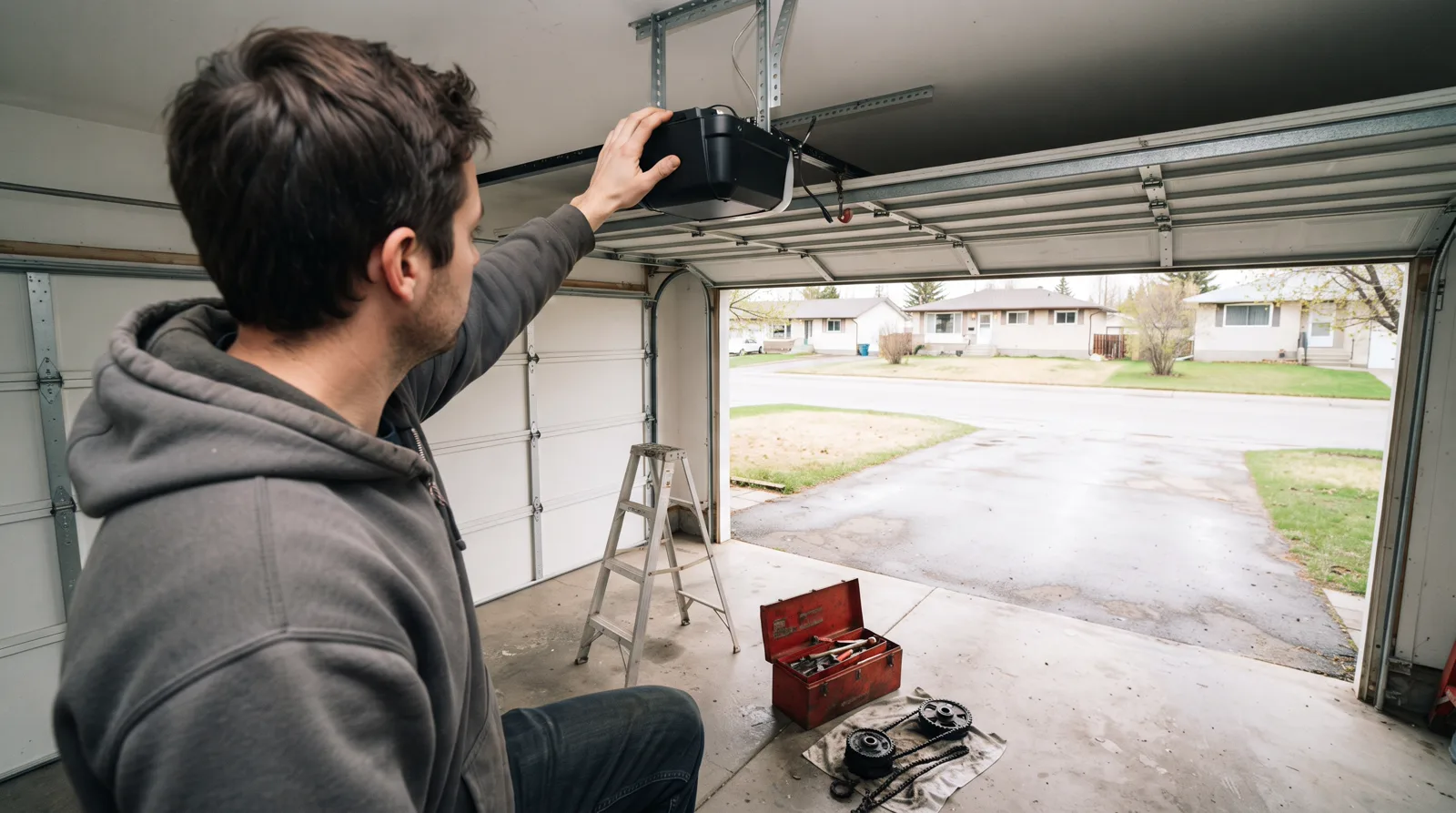
Garage Door Opener Repair Spruce Grove & Tri-Region
Motor quit? Remote not working? Sensor blinking? Local pros diagnose and fix or replace garage door openers fast, with parts stocked for Alberta winters.
Garage Door Opener Repair Services
Local pros service all major brands: LiftMaster, Chamberlain, Genie, Craftsman, and Overhead Door. Mobile service to Spruce Grove, Stony Plain, Parkland County and Acheson.
Motor Replacement
Opener motor burned out or making grinding noise? Local pros replace the motor unit or recommend a full opener swap if the chassis or gear assembly is worn. Cold-rated motors for Alberta winters. Includes labour, haul-away of old unit, and programming.
Remote & Keypad Programming
Lost remote, battery dead, or keypad not responding? Local pros program new remotes and keypads to your opener, clear old codes for security, and test range. Spares in the truck mean replacement is often done on the spot.
Safety Sensor Repair
Door reverses immediately or won't close? Safety sensors misaligned, dirty, or damaged by frost heave or a bump. We realign, clean lenses, replace wiring if chewed by rodents, or swap the sensor pair. Required by code in Alberta.
Chain, Belt & Screw Drive Repair
Chain sagging, belt slipping, or screw drive jammed? We adjust tension, replace worn chain or belt, lubricate screw drives, and verify the trolley carriage. Prevents premature motor failure and loud operation.
Smart Opener Install & Troubleshooting
Want MyQ, Chamberlain Wi-Fi, or LiftMaster smartphone control? Local pros install smart openers or retrofit adapters, connect to your home network, and walk you through the app. Troubleshoot connectivity issues or firmware updates.
Manual Release & Emergency Cord Repair
Emergency release cord snapped or handle broke off? Trolley stuck in manual mode and won't re-engage? Local pros replace the cord and handle, lubricate the trolley mechanism, and verify smooth engagement. Critical for power outages and safety.
Why Garage Door Openers Fail in Alberta
❄️ Extreme Cold Kills Motors & Remotes
Below -30°C, opener motors strain and remote batteries die fast. We stock cold-weather rated motors and lithium remotes that work to -40°C. Grease thickens in winter, so we use synthetic lube that stays fluid.
🌡️ Freeze-Thaw Shifts Sensor Alignment
Concrete garage floors heave with Alberta's freeze-thaw cycles, knocking safety sensors out of alignment. We mount sensors on adjustable brackets and verify clearance every visit. Dirt and salt spray also fog the lenses.
⚡ Power Surges from Grid & Chinooks
Spruce Grove and Stony Plain see power flickers from wind and grid switching. Surge damage fries circuit boards in openers. We recommend a $40 surge protector on the outlet, especially for smart openers with Wi-Fi boards.
🏗️ Code & Insurance Requirements
Alberta building code requires photo-eye safety sensors and UL listed openers for insurance. Older openers without sensors won't pass a home inspection. insured installers protect you if someone is hurt during service.
What it costs here
Everything You Need to Know About Garage Door Opener Repair in Spruce Grove
From diagnosing a dead motor to choosing a smart opener, this guide covers repair vs replace decisions, Alberta-specific challenges, and what to expect from a service call.
How Garage Door Opener Repair Works in Spruce Grove and Parkland County
Garage door opener repair is a diagnostic and mechanical service that restores function to the motorized system that lifts and lowers your garage door. The opener itself is a wall or ceiling mounted unit that uses a motor, drive mechanism (chain, belt, or screw), and control board to move the door along its tracks. When something fails, a qualified technician isolates the problem, sources the correct parts, and either repairs or replaces the faulty component. In Alberta, openers face unique stress from temperature swings, ice buildup on sensors, and the weight of insulated doors designed to handle our harsh winters. A proper repair addresses not just the symptom but the root cause, whether that is a worn gear, a failing capacitor, a misaligned safety sensor, or a logic board damaged by power surges.
Most residential openers in Spruce Grove and Stony Plain are chain drive, belt drive, or screw drive models rated for doors weighing 150 to 400 pounds. Chain drive units are the most common because they are affordable and durable, but they are also the noisiest and most vulnerable to cold weather stiffening of the chain and lubrication. Belt drive openers run quieter and handle temperature shifts better, making them a good choice for attached garages where noise travels into living spaces. Screw drive openers have fewer moving parts and require less maintenance, but they can struggle with extremely cold temperatures that cause the drive mechanism to contract. Technicians in this region keep parts inventory for all three types and understand how each system behaves when ambient garage temperatures drop below freezing for weeks at a time.
Repair work ranges from simple fixes like reprogramming a remote or adjusting force settings to complex jobs like replacing a burned out motor or installing a new logic board. Safety sensors, the photoelectric eyes mounted near the floor on either side of the door, are a frequent failure point in Alberta because moisture, dust, and frost can coat the lenses or knock them out of alignment. If the sensors do not see each other, the opener refuses to close the door, a safety feature required by code. Technicians also replace worn gears inside the opener housing, a common issue on older chain drive units where the plastic gear that meshes with the motor shaft strips under heavy use. Understanding what can be repaired versus what must be replaced saves you money and extends the life of the system when the rest of the components are still sound.
Why Alberta's Climate Puts Extra Demand on Garage Door Openers
The temperature extremes we experience in Parkland County and the Edmonton region place significant mechanical stress on garage door openers. Winter lows can hit negative 30 or negative 40 Celsius, while summer highs reach 30 degrees or more, creating a yearly swing of 70 degrees or greater. Metal components expand and contract with these cycles, plastic parts become brittle in the cold, and lubricants thicken or evaporate depending on the season. Openers installed in unheated garages are exposed to these conditions daily, and the motor, drive chain, and internal gears all work harder when cold. A motor that runs smoothly at 20 degrees may labor and overheat at negative 25, especially if the door itself has become heavy due to ice accumulation along the bottom seal or frozen lubricant in the hinges and rollers.
Freeze and thaw cycles create another layer of problems. Snow or rain can enter the garage through gaps around the door, and when temperatures drop overnight, that moisture freezes on the tracks, rollers, and safety sensors. Ice buildup on the bottom seal can effectively glue the door to the concrete floor, forcing the opener to strain against resistance it was not designed to handle. This can trip the internal overload protection, burn out the motor capacitor, or strip the drive gear. Chinook winds, those sudden warm spells in winter, can melt snow on the roof that then drips into the garage and refreezes when the chinook passes. Homeowners in Spruce Grove and Acheson are familiar with the cycle, but many do not realize how much it shortens the lifespan of opener components that were engineered for more stable climates.
Moisture is not just a winter issue. Spring runoff and summer thunderstorms bring humidity and the occasional leak through the roof or around door frames. Garage door openers have circuit boards, sensors, and electrical connections that can corrode or short out when exposed to condensation over time. Dust from gravel driveways, common in rural parts of Parkland County, coats moving parts and mixes with grease to form an abrasive paste that accelerates wear. Openers in farm or acreage settings often fail earlier than those in town because of the harsher environment, and repair techs in this area see more issues with rusted chains, pitted gears, and corroded terminals than their counterparts in milder regions. Keeping the opener and door properly maintained is not optional here, it is a practical necessity driven by our geography.
Clear Warning Signs Your Garage Door Opener Needs Repair
The most obvious sign of opener trouble is when the door refuses to move at all. You press the wall button or remote and hear nothing, or you hear the motor hum but the door stays put. A completely dead unit usually points to a tripped circuit breaker, a blown fuse in the opener itself, or a failed motor capacitor. If the opener hums or buzzes without moving the door, the motor is getting power but cannot generate enough torque, often because the capacitor has failed or the door is too heavy due to broken springs or frozen weather seal. Attempting to force the door open manually while the opener is engaged can strip gears or damage the trolley, so the first step is always to pull the red emergency release cord and see if the door moves freely by hand. If it does, the problem is in the opener. If it does not, the door itself has a mechanical issue that must be fixed before the opener will work reliably.
Intermittent operation is another red flag. The door works fine one time and then refuses to close or open the next, or it reverses direction unexpectedly before reaching the floor or the fully open position. This behavior often indicates misaligned or dirty safety sensors, worn limit switch settings, or a failing logic board. In Alberta, ice or frost on the sensor lenses is a common winter cause, and simply wiping them clean can restore function. However, if the sensors are physically knocked out of alignment by a shovel, hockey equipment, or a vehicle bumper, they need to be adjusted so the infrared beam connects properly. Limit switches tell the opener when the door has reached the fully open or fully closed position, and if those settings drift or the internal mechanism wears out, the door may stop short or overtravel and slam into the floor or header. These issues are repairable but require a technician with the right tools and knowledge of the specific opener model.
Excessive noise is a warning that should not be ignored. All garage door openers make some sound, but grinding, squealing, or rattling noises indicate worn or damaged parts. A grinding sound from the opener unit itself usually means the main drive gear is stripping or the chain is too tight and binding on the sprocket. A loud slapping or banging noise when the door moves can point to a loose chain, worn rollers, or a trolley that is jumping the rail. Squealing is often a dry or rusted chain or belt, but it can also be a motor bearing on its way out. These sounds are not just annoying, they are symptoms of accelerating wear that will lead to a breakdown if not addressed. Homeowners in Stony Plain and Spruce Grove who ignore noise often find themselves with a completely failed opener at the worst possible time, such as during a January cold snap when a service call costs more and parts take longer to arrive.
Finally, watch for doors that open or close too slowly, reverse for no reason, or respond only after multiple button presses. Sluggish movement can indicate a worn motor, incorrect force settings, or a door that has become unbalanced due to spring wear. If the door reverses immediately after starting to close, the force setting may be too sensitive or the track may have an obstruction. Multiple presses needed to get a response often point to a weak remote battery, but if the wall button also fails intermittently, the issue is in the opener's receiver or wiring. Any of these symptoms justify a service call, because small problems compound quickly in our climate and waiting until complete failure means you are stuck with a manual door during a blizzard or hailstorm, neither of which is pleasant.
The Garage Door Opener Repair Process from Start to Finish
A professional opener repair begins with a thorough diagnostic inspection. The technician arrives with a van stocked with common parts, tools, and diagnostic equipment specific to garage door systems. They start by observing the door in operation, listening for unusual sounds, watching the movement for jerks or hesitation, and checking whether the safety sensors and auto reverse function work correctly. They test the wall button and remote, verify that the emergency release operates smoothly, and measure the door's balance by disconnecting the opener and lifting the door manually to see if it stays open at waist height. An unbalanced door points to a spring problem, not an opener problem, and fixing that first is essential because openers are not designed to lift the door's full weight. In Spruce Grove and surrounding areas, techs also inspect for ice buildup, moisture damage, and rust that might not be obvious to the homeowner but can cause intermittent failures.
Once the problem is identified, the technician explains the issue in plain terms and provides a cost estimate for parts and labor. Common repairs include replacing the main drive gear, which typically costs $80 to $150 in parts and labor for a straightforward swap on a chain drive opener. Capacitor replacement runs $100 to $180 and takes about 30 minutes. Safety sensor realignment is often included in a service call fee of $90 to $130, but if the sensors themselves are damaged or corroded, new sensors cost $60 to $100 plus installation. Logic board replacement is more expensive, ranging from $150 to $300 depending on the opener brand and board availability. If the motor itself is burned out, the decision becomes whether to replace just the motor assembly, which can run $250 to $450, or replace the entire opener unit, which typically costs $400 to $900 installed depending on the horsepower and drive type. Technicians in this market usually recommend full replacement if the opener is more than 12 years old or if multiple components are failing, as labor costs for repeated repairs add up quickly.
The actual repair work is straightforward for experienced techs. Gear replacement involves opening the opener housing, removing the old gear from the motor shaft, installing the new gear with fresh lubrication, and reassembling the unit. Capacitor swaps are even faster, as the component is externally accessible on most models. Sensor realignment requires loosening the mounting brackets, adjusting the angle so the two sensors align perfectly, and then tightening everything down while confirming the indicator lights show a solid connection. Logic board replacement means disconnecting all the wires from the old board, noting their positions, installing the new board, reconnecting everything in the correct sequence, and then reprogramming the opener's settings including force limits, travel limits, and remote codes. Each repair includes cleaning and lubricating the chain or belt, checking the door's travel limits, and ensuring the auto reverse safety feature works by placing a block of wood on the floor in the door's path and confirming the door reverses on contact.
After the repair is complete, the technician runs the door through multiple full cycles, testing it with the wall button, remote, and keypad if present. They verify that the door opens and closes smoothly without excessive noise, that it stops precisely at the fully open and fully closed positions, and that the safety sensors immediately halt and reverse the door if the beam is broken. They also check that the manual release cord functions properly and that the emergency disconnect mechanism is not damaged or seized. Most reputable companies in Parkland County offer a 30 to 90 day warranty on labor and a one year warranty on parts, giving you some protection if the same component fails again due to defect or installation error. The technician should also provide maintenance tips specific to Alberta conditions, such as keeping sensors clean of snow and ice, lubricating the chain or belt every few months with a cold weather rated product, and ensuring the garage has adequate ventilation to prevent moisture buildup that accelerates rust and corrosion. A good repair leaves you with an opener that works as reliably as it did when new, or better if upgrades like a quieter belt drive or a battery backup system were part of the job.
What Garage Door Opener Repair Really Costs in the Tri-Region
Most opener repairs in Spruce Grove, Stony Plain, and Parkland County run between $150 and $400 for common fixes like sensor realignment, logic board replacement, or gear assembly swaps. A failed capacitor or worn drive gear typically costs $180 to $280 including labour and parts. Remote programming or wall switch replacement sits at the lower end, around $120 to $180. If your motor burned out or the rail assembly cracked, you are looking at $350 to $650 for the repair, though at that price point many contractors will recommend a full opener replacement instead because the labour cost to rebuild an old unit often exceeds the price of installing a new one.
Several factors push the price higher in our Alberta climate. Cold weather thickens grease and stresses motors, so winter service calls often reveal multiple worn components rather than a single failure. If your opener is older than 12 years, parts availability becomes an issue, and fabricating a custom bracket or sourcing a discontinued circuit board adds $80 to $150 to the job. Travel charges apply outside town limits in Parkland County and Acheson, typically $40 to $75 depending on distance. Insulated doors weigh more and require stronger openers with beefier components, so parts cost 15 to 25 percent more than standard residential models. After-hours or weekend emergency service doubles the base rate, turning a $200 weekday repair into a $400 Saturday call.
Replacement becomes the smarter choice when repair estimates exceed 60 percent of a new opener's installed cost. A quality belt drive opener with battery backup and smartphone control installs for $550 to $850 in the Tri-Region, so if your repair quote hits $400 or higher, compare that against a new unit's price and warranty. Old openers lack modern safety features mandated by current Alberta building code, including auto-reverse sensors and rolling code security, so upgrading during a major repair often makes more sense than pouring money into outdated technology. Ask for both a repair estimate and a replacement quote so you can decide which investment delivers better long-term value.
Comparing Opener Types and Repair vs. Replace Decisions
Chain Drive, Belt Drive, and Screw Drive Differences
Chain drive openers dominate older Tri-Region homes because they cost less upfront and handle heavy insulated doors reliably. The metal chain running along the rail makes noise, especially in winter when cold grease stiffens, but these units last 15 to 20 years with minimal maintenance. Repair parts remain widely available and inexpensive, so a worn sprocket or broken chain costs $120 to $220 to fix. The downside is vibration that travels through ceiling joists, making them a poor choice if your garage shares a wall with living space or a bedroom sits above the garage.
Belt drive openers run quieter because a reinforced rubber belt replaces the metal chain, making them ideal for attached garages near bedrooms or home offices. They cost $100 to $150 more than chain drives upfront and require the same horsepower to lift the same door weight. Belts wear out faster in extreme cold, and replacement belts run $60 to $90 plus labour, but the reduced noise and smoother operation justify the extra cost for most homeowners. These openers also vibrate less, putting less stress on mounting brackets and hardware over time, which can reduce long-term maintenance needs.
Screw drive openers use a threaded steel rod instead of a chain or belt, moving the trolley along a spiral track. They have fewer moving parts, so there is less to break, but Alberta's temperature swings cause the rod to expand and contract, throwing off the travel limits and sometimes causing the door to stop short or overrun. These openers work best in detached garages where temperature stays more stable. Repair costs sit between chain and belt drives, around $150 to $280 for common fixes, but finding a technician experienced with screw drives can be harder in rural Parkland County.
When to Repair and When to Replace
Repair makes sense when the opener is under 10 years old, the motor still runs strong, and the failure involves a single inexpensive component like a sensor, remote, or limit switch. If your opener's manufacturer still supports the model and parts ship within days, a $200 repair buys you another five to eight years of service. Check whether your opener has auto-reverse safety sensors and rolling code remotes, features required by current code. If it lacks these, factor in the cost and complexity of retrofitting them when deciding whether to repair or replace.
Replace instead of repair when the motor burns out, the main drive gear cracks, or the rail bends. These failures signal the unit reached end of life, and investing $300 to $500 in repairs on a 15-year-old opener just delays the inevitable next breakdown. New openers come with battery backup, smartphone control, and quieter operation, features that improve daily convenience and add resale value to your home. Warranties on new units run three to five years on parts and motors, versus zero warranty on repaired components. If you are selling your home within two years, a new opener photographs better and removes a potential inspection objection.
Consider replacement even for a working opener if you are upgrading to a heavier insulated door, adding windows, or switching from a single to a double door. An underpowered opener strains to lift the extra weight, shortening its lifespan and risking injury if it drops the door mid-cycle. Matching opener horsepower to actual door weight and cycle frequency prevents premature failure and safety hazards. Calculate total cost of ownership over five years, not just the immediate repair bill, to make the financially smarter decision.
DIY Troubleshooting vs. Professional Service
Homeowners can safely handle a few basic fixes without calling a pro. Cleaning the safety sensors, realigning them so the LED lights stay solid, and checking for obstructions in the door track solve about 30 percent of no-start complaints. Replacing the wall-mounted button or reprogramming a remote costs under $40 in parts and takes 15 minutes following the manual. Lubricating the chain or belt with white lithium grease twice a year prevents premature wear and reduces noise. These tasks require no special tools and carry minimal risk if you disconnect power at the breaker before starting.
Call a licensed technician for anything involving springs, cables, motor disassembly, or electrical diagnosis beyond swapping a battery. Garage door springs store enormous tension and cause serious injury or death when they snap during amateur repair attempts. Diagnosing a faulty logic board, burned motor winding, or intermittent limit switch requires a multimeter and experience reading wiring diagrams, skills most homeowners lack. Technicians carry replacement parts on their trucks and complete the repair in one visit, while DIY troubleshooting often turns into multiple hardware store trips and days of downtime. Liability also matters because insurance may deny a claim if an unlicensed repair caused property damage or injury.
Gray area tasks like replacing a worn gear or adjusting travel limits fall in between. Technically a homeowner can do them, but the risk of misadjustment causing the door to close too hard or not latch properly makes professional service worth the $150 to $250 cost. A technician will also inspect the entire system while they are there, catching a fraying cable or cracked roller before it fails. Weigh the $40 you save doing it yourself against the cost of a service call to fix what you broke or the injury risk if something goes wrong mid-job.
Mistakes and Contractor Traps to Avoid
The most common scam involves misdiagnosis that leads to unnecessary upsells. A contractor claims your motor is shot when really the capacitor failed, a $30 part, then quotes $600 for a full opener replacement. Some technicians deliberately damage a working component during inspection to create a billable repair. Protect yourself by getting a second opinion on any repair estimate over $300, especially if the contractor showed up for a simple remote programming and suddenly discovered major failures. Ask to see the failed part and take a photo of it. Legitimate pros welcome scrutiny because their diagnosis stands up to review, while scammers get defensive or refuse to show you the supposedly broken component.
Another trap is installing the wrong opener for your door type and weight. A contractor offers a deal on a chain drive unit he has in stock, even though your insulated double door needs a belt drive with higher horsepower. The underpowered opener struggles from day one, wearing out within three years instead of the expected 15. It also creates a safety hazard because it may not auto-reverse properly when it hits an obstruction, risking injury to children or pets. Insist the contractor calculate actual door weight, including windows and insulation, and match the opener horsepower to the manufacturer's load chart. A proper installation uses the right opener for the job, not whatever the truck is carrying that day.
Skipping required safety features to save a few dollars is another red flag. Some installers omit the photo-eye sensors or disable them to avoid troubleshooting alignment issues, leaving you with an opener that will not stop if a child or pet runs under the closing door. Others install openers without the required emergency release cord, trapping you inside during a power outage. Alberta building code requires both features on every residential opener, and your home insurance may deny a liability claim if an injury occurs and the inspection reveals missing safety equipment. Verify every required component is present and functional before you sign off on the work and pay the final bill.
Permit and inspection issues surface later when you sell the home or file an insurance claim. Many homeowners do not realize that replacing a garage door opener requires a permit in some Alberta municipalities, and an unlicensed DIY install or unpermitted contractor job shows up during a pre-sale inspection. The buyer demands you bring it to code, and you are suddenly paying for a second installation or a retrofit to add missing safety features. Confirm your contractor pulls the permit if local bylaws require it, and keep the permit paperwork with your home records. Spending an extra $75 on a permit now avoids a $1,200 problem at closing three years later.
How to Hire the Right Garage Door Opener Repair Contractor
Start by verifying the contractor holds commercial general liability insurance of at least $2 million. Ask for the WCB account number and call to confirm it is current, because some contractors let coverage lapse between jobs to save money, leaving you liable if a worker is injured on your property. Request a certificate of insurance naming you as an additional insured for the duration of the job. Legitimate contractors provide this documentation within 24 hours without pushback. Also confirm they are licensed to perform electrical work if the repair involves wiring, because connecting an opener to your electrical panel without a license violates the Alberta Safety Codes Act and voids your home insurance coverage for electrical fires.
Get at least three written quotes that break down parts, labour, travel, and disposal fees separately. A vague total price with no itemization hides markups and makes comparison shopping impossible. The quote should specify the exact opener model or part number being installed, not just a generic description like belt drive opener. Compare warranty terms across quotes, because a five-year parts and labour warranty signals a quality installation, while a 90-day warranty suggests the contractor expects problems. Ask how quickly they can source parts for your specific opener brand, and whether they stock common components on their truck or need to order everything. A contractor who carries inventory completes most repairs in one visit, while one who orders every part adds days of wait time.
Watch for red flags during the initial contact and estimate visit. A contractor who refuses to provide a written quote, insists on cash payment, or pressures you to decide immediately is either unlicensed or running a scam. Legitimate pros understand you need time to compare options and check references. A professional estimate includes a detailed scope of work, payment terms, start date, and completion timeline. The estimator should measure your door, test the current opener, and ask about your usage patterns before quoting, because a door cycled 10 times a day needs a more robust opener than one used twice a day. Beware of the lowest bid by a wide margin, because it often means the contractor will cut corners, use inferior parts, or add surprise charges once work starts.
How Tri-Region Services Helps
We route you to one vetted, insured local garage door professional who serves Spruce Grove, Stony Plain, Parkland County, and Acheson. Every contractor in our network tells us they carry commercial liability insurance, holds required licenses, and has proven experience with all opener types and brands. You receive a free written quote with itemized pricing, clear warranty terms, and a realistic timeline. No high-pressure sales, no bait-and-switch pricing, and no unlicensed installers. Request your free quote today and get your garage door opener repaired right the first time.
Why Tri-Region Homeowners Choose These Pros
Licensed, insured, and stocked so most repairs finish in one visit. No subcontractors, no surprise fees.
Parts Inventory On Every Truck
Sensors, remotes, gears, and motors in stock so 90% of repairs finish the same visit.
$5M Liability Insurance on file
The technician we send carries both, so you are protected if they are injured or your property is damaged during the repair.
Emergency Requests Prioritized
Stuck door blocking your vehicle? We prioritize lockouts and offer evening or weekend slots.
Code-Compliant Safety Sensor Installation
All repairs meet Alberta building code and UL safety standards required for home insurance.
1 Year Warranty on Parts & Labour
If a repaired component fails within a year, we return and fix it at no charge.
Locally Operated in Spruce Grove & Stony Plain
Not a national franchise. Techs live in the Tri-Region and know the climate and code.
This page is not tied to a contractor's brand. Leads route straight to your one local partner. Verified reviews can appear here once that partner has them (never fabricated).
Serving the whole Tri-Region
7 Common Garage Door Opener Questions
Why does my garage door opener stop working when it gets really cold in Spruce Grove?+
How long do garage door openers last in Alberta's climate?+
Should I repair my old garage door opener or just replace it?+
Are smart garage door openers worth it in Spruce Grove?+
Why do my safety sensors keep going out of alignment?+
How much does it cost to replace just the motor in a garage door opener?+
What do I do if my emergency release cord snaps or the door won't re-engage?+
Can I just replace the remote or do I need to reprogram the whole opener?+
Get your free quote
Tell us what you need and a local pro will get right back to you.
- ✓ Sent straight to a local business
- ✓ You choose who you hire
- ✓ Free, with no obligation