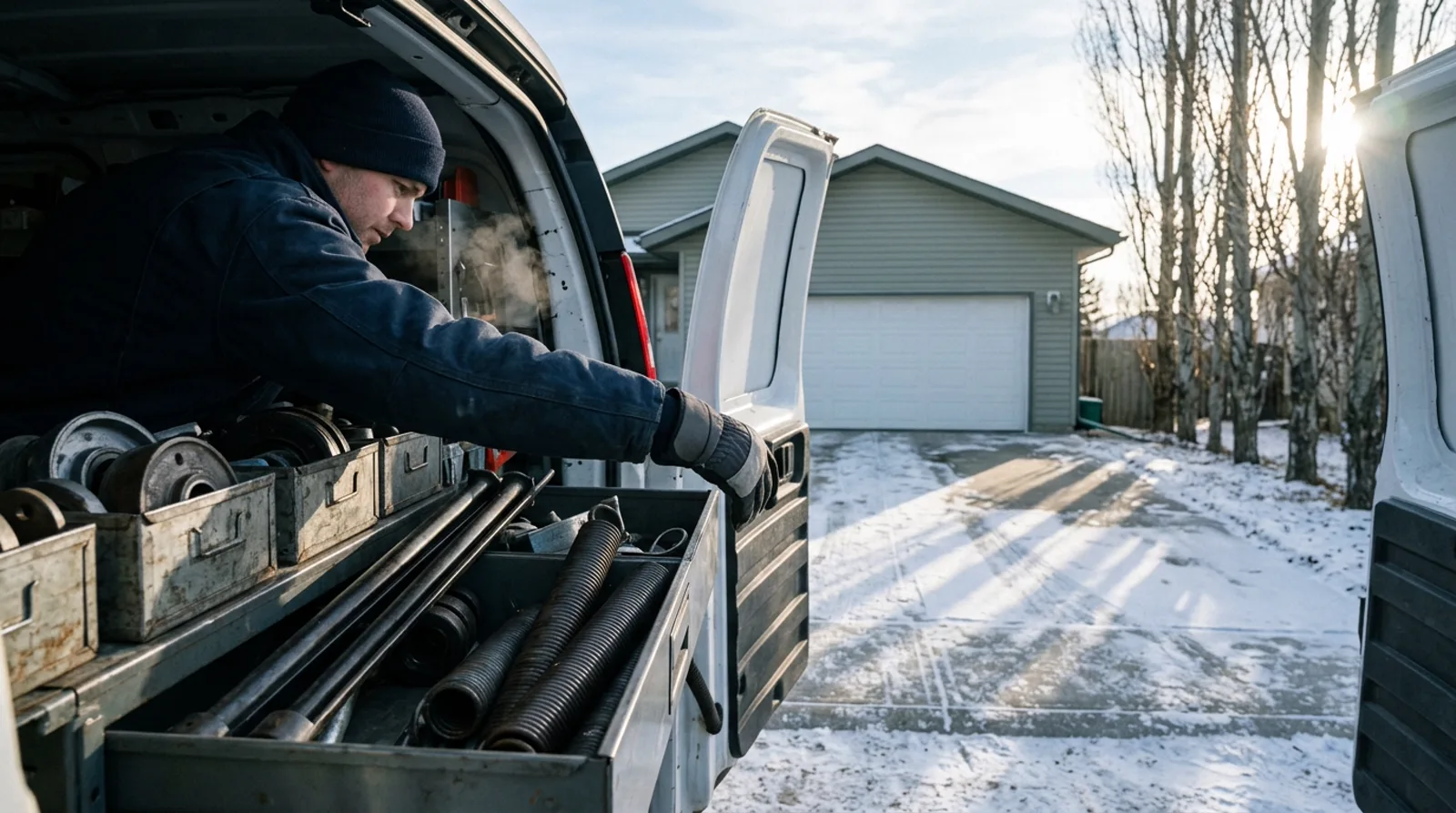
Garage Door Spring Replacement Urgent Requests Prioritized
Broken spring? Local pros replace torsion and extension springs fast, with quality parts and Alberta-tough installation.
Spring Replacement Services
Torsion, extension, and balance systems for residential and commercial doors.
Torsion Spring Replacement
Replace one or both torsion springs mounted above the door. Includes tension adjustment, safety cable inspection, and balance test. Standard springs rated for 10,000 cycles, high-cycle options available.
Extension Spring Replacement
Replace stretched or broken extension springs (side-mounted). Sold in pairs for even tension. Includes safety cable installation to prevent whipping if a spring breaks.
Spring Balance & Adjustment
Rebalance existing springs after seasonal temperature swings or door modifications. Ensures smooth, even travel and prevents motor strain. Includes full safety inspection.
Cable Replacement
Replace frayed or broken lift cables. Often needed when a spring fails and the cable slips off the drum. Includes drum inspection and alignment.
Roller & Hinge Service
Inspect and replace worn rollers and hinges during spring work. Cold Alberta winters crack plastic rollers. Local pros install steel or nylon rollers for quiet, long life.
Emergency Urgent Requests Prioritized
After-hours or weekend emergency calls. Stuck door blocking your car? Local pros are dispatched as fast as availability allows in Spruce Grove, Stony Plain, and Parkland County. Service fee applies, waived if you proceed with repair.
Why Springs Break Faster in Alberta
🌡️ Extreme Temperature Swings
Chinook winds can shift temperatures 20°C in hours. Steel springs expand and contract, fatiguing the metal. We use cold-rated springs and adjust tension for winter.
❄️ Winter Cycle Load
Parkland County winters mean you open and close your door 5 to 10 times daily (warming the car, letting it cool, errands). A 10,000-cycle spring lasts 3 to 5 years under heavy use.
🧊 Ice and Snow Buildup
Ice on the bottom seal or snow piled against the door adds weight. Springs must work harder, shortening lifespan. We inspect seals and adjust spring tension to match actual load.
🏗️ Alberta Building Code & Safety
Post-2010 installs require containment cables on extension springs. We bring all systems to current code during replacement. Insured, liability coverage on file.
What it costs here
Everything You Need to Know About Garage Door Springs
How they work, when to replace them, and what to expect during the repair.
What Garage Door Spring Replacement Actually Involves
Garage door springs do all the heavy lifting. A typical two-car residential door weighs between 130 and 200 pounds, and the springs counterbalance that entire load so you can lift the door with one hand or so your opener motor doesn't burn out in six months. When a spring breaks, the door becomes dead weight. Most people discover this when they press the wall button and the door barely budges, or the opener strains and stops, or they try to lift it manually and realize it weighs as much as a refrigerator.
There are two spring systems in use across Spruce Grove and Parkland County. Torsion springs mount on a shaft above the door opening, inside the garage. They wind tight when the door closes, storing energy, then unwind to lift the door when you open it. One or two torsion springs handle the entire door weight through a coordinated cable and pulley system. Extension springs run along the horizontal tracks on each side of the door. They stretch when the door closes and contract to help lift it. Each system has different failure modes, replacement procedures, and cost profiles.
Replacing a spring is not a swap-the-part-and-go job. The technician has to measure the door weight, calculate the correct spring wire diameter and length for the replacement, then install it under controlled tension. Torsion springs are wound to a precise number of turns based on door height. Too few turns and the door is heavy and will not open fully. Too many and the door slams up into the header or the opener fights the springs every cycle. Extension springs require the right pulleys, safety cables, and S-hook positioning. The replacement process involves working with components under hundreds of pounds of stored tension, which is why this is one of the most dangerous DIY garage tasks and why insurance and WCB rules treat it as high-risk work.
Why Alberta's Climate Destroys Garage Door Springs Faster Than Anywhere Else
Garage door springs are rated for a cycle count, typically 10,000 or 15,000 cycles for residential-grade springs and up to 25,000 or 50,000 for commercial or high-cycle versions. A cycle is one complete open and close. If you leave for work, come home for lunch, leave again, and come home at night, that is four cycles per day, or roughly 1,500 per year. In theory, a 10,000-cycle spring should last six or seven years. In Spruce Grove, Stony Plain, and Acheson, most springs fail in four to six years, and many fail sooner. The reason is not defective parts. It is Alberta weather.
Temperature swings are the primary spring killer. A torsion spring is a tightly wound coil of tempered steel wire. Steel expands when warm and contracts when cold. When the temperature inside your garage swings from -25°C overnight to +5°C by afternoon because a chinook wind rolls through, the spring goes through dozens of micro-expansions and contractions in a single day. This flexing accelerates metal fatigue at the molecular level. Extension springs experience the same thermal stress but also endure repeated stretching and compression, compounding the fatigue. Parkland County sees some of the most volatile temperature swings in the province. A winter week can bring -30°C, then a chinook that pushes it to +8°C, then a snap back to -20°C. Every swing shortens spring life.
Freeze-thaw cycles create another problem. Moisture condenses on cold springs, freezes, then thaws, then refreezes. This cycle introduces surface rust and micro-pitting on the spring coils. Even galvanized or powder-coated springs will eventually corrode under repeated freeze-thaw exposure, especially in attached garages where warm air from the house meets frigid air from outside. Once rust starts, it creates stress points where the spring will fracture. Deep frost also affects the lubricant on torsion spring shafts. When temperatures drop below -25°C, grease thickens or hardens, increasing friction during door operation. The opener or manual lift has to work harder, the spring winds and unwinds under higher resistance, and the cumulative stress shortens its life. Add snow load on the door itself, especially after a heavy February dump, and the springs are working overtime every cycle.
The Real Warning Signs You Need Spring Replacement Now
Sudden Failure Symptoms
A broken torsion spring makes a loud bang, like a gunshot or a firecracker going off in the garage. Homeowners often hear it in the middle of the night or early morning when the temperature is coldest and the metal is most brittle. If you hear that sound and then find your door will not open, or opens only six inches before the opener stops and reverses, the spring has snapped. You will usually see the break when you look up at the header. The spring will have a visible gap where the coil fractured, and the two ends may have separated or overlapped.
A broken extension spring is quieter but just as obvious. The door will sag on one side, or it will bind and refuse to open smoothly. If one extension spring breaks and the other is still intact, the door will lift unevenly, putting dangerous stress on the opener trolley and the remaining spring. Do not keep operating the door in this condition. You risk bending the tracks, damaging the opener, or having the door come off the tracks entirely and fall.
Pre-Failure Warning Signs Most People Miss
Springs give warning before they break, but most homeowners do not notice until it is too late. A door that feels heavier than usual when you lift it manually is a red flag. Torsion springs lose tension as they age and fatigue. If you disconnect the opener and try to lift the door by hand, it should rise smoothly and stay open at any point above waist height. If it drops or feels like you are lifting a boulder, the springs are losing their counterbalance force and are near the end of their life.
Listen for new noises. A scraping or rubbing sound during operation can mean the spring coils are binding because of rust or fatigue. A popping or creaking noise from the header area often indicates a spring developing a fracture point. Visible rust on the spring coils, especially near the center of a torsion spring where the most stress concentrates, is another sign. Rust does not just look bad. It creates weak points. If you see flaking rust or surface pitting, the spring is compromised and replacement should be scheduled before it fails at an inconvenient time, like when you are trying to leave for work on a -30°C January morning.
Why This Is Not a DIY Job and Why WCB and Insurers Care
Garage door spring replacement is one of the most dangerous tasks in residential maintenance. Torsion springs store hundreds of pounds of tension. If a winding bar slips during installation or removal, the bar can spin out and break bones, crack skulls, or cause fatal injuries. Extension springs under load can snap and whip across the garage, and the pulleys and cables can fail suddenly if not installed correctly. Emergency rooms across Alberta see DIY garage door injuries every year, and WCB considers this work high-risk even for trained technicians.
Insurance companies are increasingly scrutinizing garage door injuries. If a homeowner is injured attempting a DIY spring replacement, some insurers have denied claims on the grounds that the work required a licensed contractor. If a guest or family member is injured, liability becomes a serious issue. Spruce Grove and Parkland County bylaws do not explicitly require a permit for spring replacement, but they do require that work be done safely and to code. A professional service carries liability insurance for their workers, and the tools and training to do the job without turning your garage into a trauma scene.
The Professional Spring Replacement Process Step by Step
A qualified technician starts with a visual and functional assessment. They measure the door width, height, and weight, then inspect the existing springs to determine type, size, wire gauge, and inside diameter. Not all springs are the same, even on doors that look identical. A door with windows weighs more than a solid door. A steel door weighs more than an aluminum door. An insulated door adds another 20 to 40 pounds. The technician uses this information to select replacement springs with the correct load rating and cycle life. They also check the condition of the cables, pulleys, rollers, hinges, and tracks. If the cables are frayed or the rollers are worn, replacing only the springs sets the customer up for another service call in six months.
For torsion spring replacement, the technician begins by disconnecting the opener and securing the door in the closed position. They use winding bars to carefully release the tension from the broken spring, one quarter turn at a time. This is the most dangerous part of the job. Once the spring is fully unwound, they remove the set screws, slide the spring off the shaft, and install the new spring in the correct position. The new spring is then wound to the manufacturer-specified turn count, typically seven to eight full turns for a standard seven-foot-high door. After winding, the technician secures the spring with set screws, reconnects the cables, and tests the door balance. A properly balanced door should stay in place when lifted halfway and should require minimal effort to open by hand.
Extension spring replacement involves releasing the door tension by propping the door open and removing the spring tension from the pulleys. The technician disconnects the safety cable, removes the old spring, and installs the new spring with new pulleys and hardware. They then rethread the safety cable through the center of the spring. This cable is critical. If the spring breaks while the door is in motion, the safety cable prevents the spring from whipping across the garage. After installation, the technician tests the door multiple times, checking for smooth operation, even lift on both sides, and proper opener engagement. They lubricate the springs, hinges, and rollers, and they verify that the auto-reverse safety feature on the opener is functioning. A professional spring replacement in Spruce Grove or Stony Plain typically takes 45 minutes to 90 minutes depending on door configuration and whether any additional components need attention.
Cost for torsion spring replacement generally runs from $280 to $450 for a standard two-car door, including parts, labor, and warranty. Extension spring replacement is slightly less, typically $200 to $350, because the springs themselves are less expensive and the labor is simpler. High-cycle springs, oversized doors, or custom configurations can push the price to $500 to $650. If cables, rollers, or other components need replacement at the same time, expect to add $100 to $200. Most reputable companies in the Spruce Grove and Parkland County area offer a one-year to three-year warranty on parts and labor. Some offer same-day or emergency service for an additional fee, which can be worth it if your door is stuck closed and you cannot get your vehicle out.
What Garage Door Spring Replacement Costs in Spruce Grove and What Drives the Price
In Spruce Grove, Stony Plain, and Parkland County, replacing a broken garage door spring typically runs between $200 and $450 for a standard residential single or double car garage with torsion springs. Extension spring replacements on older or lighter doors usually cost $150 to $280. These are daytime service rates from local contractors who carry proper liability insurance and liability insurance. Emergency calls after hours, weekends, or holidays often add $75 to $150 to the base price. The final number depends on spring type, door weight, shaft configuration, and whether your opener needs recalibration after the new springs go in.
Spring type and door size are the two biggest cost drivers. A standard 16 foot wide, insulated steel double door with one or two torsion springs falls into the lower cost range. Heavier wood doors, oversized three car garage doors, or doors with windows and thick insulation need larger diameter, longer springs rated for higher cycle counts, which cost more. If your door uses two torsion springs and both are near the end of their life, most pros replace both at once to avoid a second service call in six months. Replacing one spring costs $200 to $280, replacing both runs $320 to $450 depending on spring size and labor time.
Labor accounts for roughly half the bill. A qualified technician spends 45 minutes to 90 minutes on a typical torsion spring job, including safe removal of the broken spring, measuring and installing the new spring, adjusting cable tension, lubricating all moving parts, and testing the door balance and opener force settings. The work is dangerous if done incorrectly, so you are paying for skill, tools, and insurance, not just parts. Materials cost $80 to $180 for quality springs rated for 10,000 to 25,000 cycles. Cheaper 5,000 cycle springs save $30 upfront but wear out faster in Alberta's freeze thaw cycle and heavy snow load season, so most reputable contractors will not install them.
Watch for hidden costs. Some companies quote a low base price but add charges for trip fees, disposal of the old spring, recalibrating the opener, or mandatory safety inspections. A legitimate quote includes all labor, parts, adjustment, and cleanup. If the technician finds additional problems like worn rollers, frayed cables, or a bent track, those are separate line items you can approve or decline. Permits are not required in most Alberta municipalities for spring replacement since it is a like for like repair, but if the contractor suggests upgrading to a heavier spring system or modifying the header bracket, verify whether a permit applies and who pays for it.
Comparing Torsion Springs vs Extension Springs: Which System Makes Sense for Your Garage
Torsion springs sit on a shaft above the door opening and twist to lift the door. They are the standard on most double car garages built in the last 20 years. A torsion spring system uses one or two springs mounted horizontally, with lift cables running down each side of the door. The springs wind tight when the door closes and unwind to assist the door as it opens. Torsion springs last longer than extension springs, typically 10,000 to 25,000 cycles depending on the wire gauge and coating. In Spruce Grove and Stony Plain, where temperature swings from minus 30 in January to plus 30 in July stress metal components, galvanized or powder coated torsion springs resist rust and brittleness better than bare steel. Replacement cost for torsion springs is higher, but the longer lifespan and smoother operation make them the better investment for most homeowners.
Extension springs run along the horizontal track on each side of the door and stretch to counterbalance the door weight. They are common on older single car garages and lighter, uninsulated doors. Extension springs are cheaper to buy and simpler to install, so replacement costs run $150 to $280 for a pair. The downside is shorter lifespan, usually 5,000 to 10,000 cycles, and a rougher, noisier door operation. Extension springs also wear out faster when exposed to temperature extremes and road salt spray tracked into the garage during winter. If one extension spring breaks, you replace both sides to keep the door balanced. Safety cables running through the center of each extension spring are mandatory in Alberta to prevent a broken spring from whipping across the garage, so make sure your contractor includes them if they are missing.
Choosing between the two depends on your door type, budget, and how long you plan to stay in the home. If you have a heavy insulated door or a double car garage, torsion springs are worth the extra cost. They handle more weight, last longer, and operate more quietly. If you have a lightweight single door and plan to replace the entire door and opener in the next few years, a less expensive extension spring replacement buys you time without over investing. Upgrading from extension to torsion is possible but requires adding a torsion shaft, new brackets, and reconfiguring the lift system, which costs $500 to $800. Most contractors recommend sticking with the existing system unless you are already replacing the door or opener.
Common Mistakes and Red Flags When Hiring for Garage Door Spring Replacement
The biggest mistake is attempting DIY spring replacement. Torsion springs store hundreds of pounds of torque, and a spring under tension can cause serious injury or death if the winding cone slips during removal or installation. Extension springs are less dangerous but still risky without proper clamps and tools. YouTube videos make it look simple, but garage door injuries send dozens of Albertans to emergency rooms every year. The tools required, including winding bars, a proper ladder, and a torque wrench, cost more than hiring a professional for a one time repair. Save DIY energy for tasks that will not put you in the hospital. Spring replacement is not one of them.
Contractor red flags start with no proof of WCB coverage. Any legitimate contractor working in Alberta must carry WCB if they have employees, and even sole proprietors should carry liability insurance to cover property damage or injury. If a contractor cannot produce a WCB clearance letter or insurance certificate on request, walk away. A broken spring or slipped winding bar that damages your vehicle, dents the door, or injures someone becomes your financial problem if the contractor has no coverage. Parkland County and Spruce Grove have seen fly by night operators offer cheap rates, do unsafe work, and disappear when something goes wrong. Verify credentials before anyone touches your door.
Lowball quotes that sound too good to be true usually are. If one estimate is $120 and three others are $250 to $300, the low bidder is either using junk parts, skipping safety steps, or planning to upsell you once they arrive. Some contractors quote a base price for the service call, then add parts, labor, and adjustment fees once they have your door torn apart and you feel pressured to proceed. A professional quote itemizes parts, labor, travel if applicable, and any optional add ons like roller replacement or track alignment. The total should be clear before work begins, with no surprise charges when the job is done.
Material quality traps are common. Not all springs are created equal. A 5,000 cycle spring costs $40, a 10,000 cycle spring costs $70, and a 25,000 cycle spring costs $120. Some contractors install the cheapest spring available and charge you mid tier pricing, pocketing the difference. Ask what cycle rating the replacement spring carries, whether it is galvanized or powder coated for rust resistance, and what warranty backs it. A quality spring should come with at least a one year warranty on parts and labor. If the contractor will not specify the spring rating or says all springs are the same, find someone else. In Alberta's climate, a cheap spring will fail in three to five years, while a quality spring lasts a decade or more.
How to Hire the Right Garage Door Pro in Spruce Grove and the Tri-Region
Start by asking for proof of WCB coverage and liability insurance. Any contractor working in Alberta should provide a WCB clearance letter showing their account is in good standing and their premiums are paid. Liability insurance protects you if the technician damages your vehicle, siding, or roof during the repair, or if someone is injured. These are non negotiable. A contractor who hesitates, says coverage is optional, or offers a cash discount to skip paperwork is not worth the risk. Reputable local companies provide proof upfront without being asked because they know informed homeowners expect it.
Get at least three written quotes and compare line items, not just totals. A proper quote specifies spring type, cycle rating, coating, labor hours, and any additional services like lubrication or safety cable installation. One contractor might quote $250 using a 10,000 cycle spring, another $280 using a 15,000 cycle galvanized spring. The higher quote may be the better value if the spring lasts twice as long. Ask whether the price includes adjusting the opener force settings and testing the door balance, or whether those are extra. Some companies include a full safety inspection and minor adjustments as part of the service, others charge separately. Knowing what is included helps you compare apples to apples.
Check reviews and ask for references from jobs in Spruce Grove, Stony Plain, or Parkland County. A contractor with a strong local reputation has repeat customers and referrals to protect. Online reviews on Google or Facebook show patterns. One bad review might be a fluke, but multiple complaints about no call no shows, hidden fees, or poor quality work are red flags. If possible, ask neighbors or coworkers for recommendations. Local word of mouth is gold in tight communities like ours. A contractor who has been serving the area for five or ten years has a track record you can verify.
Understand the timeline. Most local contractors can schedule a spring replacement within 24 to 72 hours for non emergency calls. If your car is trapped in the garage or the door will not close, many offer same day or next day emergency service for an additional fee. Once on site, the job takes 45 minutes to 90 minutes for a straightforward torsion spring replacement. If the technician discovers additional issues like a damaged cable or worn rollers, they should explain the problem, provide a price for the extra work, and get your approval before proceeding. Avoid contractors who pressure you to approve extra repairs on the spot without explanation or who start work without confirming the price.
How Tri-Region Services Helps
Tri-Region Services routes you directly to one vetted, insured local garage door professional who serves Spruce Grove, Stony Plain, Parkland County, and Acheson. Contractors state that they carry liability insurance when they sign up, and we show that on their listing. When you request a quote through our platform, you get one written estimate with clear line items, no hidden fees, and a straightforward timeline. You avoid the hassle of calling five companies, waiting for three to call back, and comparing confusing quotes with different inclusions. Our contractor will assess your door, explain what needs replacing, provide a fair price using quality parts, and schedule the work at your convenience. No pressure, no upselling, just honest service from a local pro who wants your repeat business and referrals.
Why Tri-Region Pros Are Different
Every technician is licensed, insured, and accountable to local homeowners.
Licensed
All technicians carry liability insurance. You see credentials before work starts.
Lifetime Warranty on Springs
Spring breaks within its rated cycle life? Local pros replace it free. Labor warranty included for 1 year.
Urgent Requests Prioritized
Door stuck blocking your car? Flagged urgent and routed to the first available local tech.
Upfront Pricing, No Surprises
You see the total cost before we start. No hidden fees, no upsells you didn't ask for.
Trained on Alberta Conditions
Our techs know cold-weather installations, chinook stress, and snow load. Not a national franchise reading a manual.
Free Safety Inspection Included
Every spring job includes a 12-point safety check: cables, rollers, hinges, sensors, and opener force settings.
This page is not tied to a contractor's brand. Leads route straight to your one local partner. Verified reviews can appear here once that partner has them (never fabricated).
Serving the whole Tri-Region
7 Questions Spruce Grove Homeowners Ask
How do I know if my garage door spring is broken?+
Can I replace a garage door spring myself?+
How long do garage door springs last in Alberta?+
What is the difference between torsion and extension springs?+
Why do both springs need to be replaced at the same time?+
How much does garage door spring replacement cost in Spruce Grove?+
Do you offer same-day emergency spring replacement?+
What maintenance can I do to make my springs last longer?+
Get your free quote
Tell us what you need and a local pro will get right back to you.
- ✓ Sent straight to a local business
- ✓ You choose who you hire
- ✓ Free, with no obligation