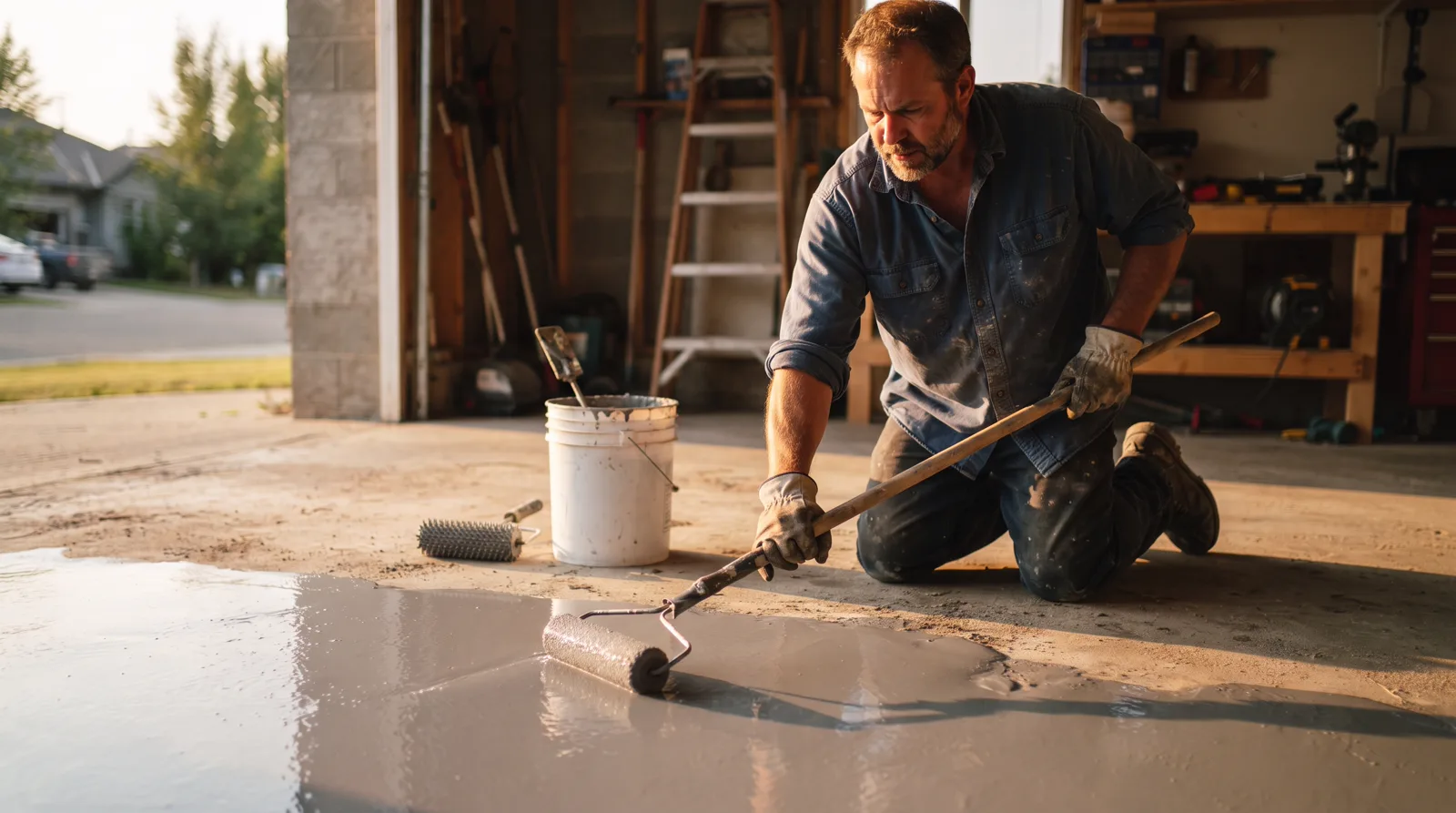
Epoxy Garage Floors Built for Alberta Winters.
Chemical-resistant, freeze-thaw rated coatings that handle road salt, snow melt and temperature swings from -35°C to +30°C.
Garage Floor Coating Systems
Every system designed for Alberta freeze-thaw cycles, road salt exposure and heavy vehicle traffic.
Solid Color Epoxy Coating
100% solids epoxy base with slip-resistant topcoat. Standard grey, tan or custom color. Two-coat system with 24 hour recoat window. Best for daily driver garages and light commercial bays.
Decorative Flake Broadcast
Full broadcast vinyl chip system over epoxy base. Hides concrete imperfections, adds texture for winter traction. Clear polyurethane topcoat resists UV yellowing and tire marking. Popular in show car garages and workshop spaces.
Metallic Epoxy Finish
Swirled metallic pigment creates unique marble or carbon fiber effect. Self-leveling application. High-gloss polyaspartic seal rated for Alberta temperature swings. Premium option for luxury vehicles and modern homes.
Concrete Prep & Crack Repair
Diamond grinding to open pores, routing and filling active cracks with flexible epoxy compound. Oil stain treatment with enzymatic cleaner. Moisture testing to prevent delamination. Required prep before any coating system.
Chemical-Resistant Polyurethane
Aliphatic polyurethane topcoat over epoxy primer. Resists gasoline, brake fluid, battery acid and de-icing salt. Won't yellow under UV from garage door windows. Specified for mechanic shops and fleet maintenance bays.
Custom Color Matching
Match existing home trim, vehicle color or corporate branding. RAL, Pantone or sample-based tinting. Minimum 400 sq ft for custom batches. Lead time 10 to 14 days for pigment sourcing.
Why Alberta Garage Floors Need Different Systems
❄️ Winter Application Windows
Concrete must be above 10°C and rising for proper epoxy cure. We heat garages with propane or electric during cold snaps, extending the season into late fall and early spring. Moisture levels spike during chinook melts, so we test slabs with calcium chloride kits before any prep work starts.
🧊 Freeze-Thaw Cycle Durability
Spruce Grove sees 80 to 100 freeze-thaw events per winter. Coatings must flex with concrete expansion without cracking or delaminating. We specify elastomeric crack fillers in control joints and use 100% solids epoxy (no water-based products) to prevent winter failure.
🚗 Road Salt and Mag Chloride Resistance
Highway 16A and Township roads use magnesium chloride brine in winter. Standard garage floor paint fails within one season. Polyurethane topcoats resist chemical attack and prevent the white calcium deposits that bloom on untreated concrete when salt tracks in.
🏗️ Parkland County and Spruce Grove Permits
Garage floor coating is typically non-structural and does not require a permit. If you are pouring new concrete or adding radiant heat, building permits apply. Coatings must meet VOC limits under Alberta's Environmental Protection Act for enclosed spaces.
What it costs here
Everything You Need to Know About Garage Floor Coating in Spruce Grove
Surface prep, product selection, application timing and long-term care for Alberta climates.
What Garage Floor Epoxy Actually Is and How It Works
Garage floor epoxy is a two-part thermoset resin system that chemically bonds to concrete through a process called mechanical adhesion. The system consists of a resin component and a hardener component that, when mixed together, trigger an irreversible chemical reaction. This reaction creates cross-linked polymer chains that cure into a rigid, dense surface far harder than the concrete underneath. Unlike paint, which simply sits on top of concrete and can peel away, epoxy penetrates into the pores of properly prepared concrete and forms a molecular bond. The cured coating typically measures between 10 and 20 mils thick, which is roughly the thickness of five to ten sheets of paper, but the resulting surface is hard enough to resist impacts, chemical spills, and the constant abrasion from vehicle tires.
The preparation process is what determines whether the coating lasts two years or twenty years. Professional installers in Spruce Grove and Stony Plain use diamond grinding equipment to open up the concrete pores and remove any surface contamination, laitance, or previous coatings. This mechanical profiling creates a surface texture similar to 80 grit sandpaper, which gives the epoxy something to grip. Many homeowner failures happen because they skip this step and try to apply epoxy over smooth, sealed, or contaminated concrete. The concrete must also be dry, with moisture levels below four pounds per thousand square feet as measured by a calcium chloride test. Alberta's clay soils and high water tables mean moisture testing is not optional, it is a requirement for any coating that will last.
Epoxy differs from polyurethane and polyaspartic coatings in chemistry, cure time, and performance characteristics. Epoxy is the base layer in most professional systems because it bonds exceptionally well to concrete and provides a thick, impact-resistant foundation. However, epoxy yellows under UV exposure and can be softer than polyurethane top coats, which is why many installers use a hybrid system with an epoxy base coat and a polyurethane or polyaspartic top coat. Polyaspartic coatings cure much faster, sometimes in hours rather than days, but they require more skill to apply because the working time is very short. For a Spruce Grove garage that sees heavy use from trucks carrying equipment, salt, and gravel, a properly applied epoxy system with a UV-stable top coat provides the best combination of durability, chemical resistance, and long-term appearance.
Why Alberta Garages Destroy Unprotected Concrete Floors
Freeze-thaw cycling is the primary enemy of bare concrete in Alberta. When snow and ice melt on your garage floor and the water seeps into the concrete pores, it expands by roughly nine percent when it freezes again overnight. This expansion creates internal pressure that fractures the concrete from the inside out. A single winter in Parkland County can involve dozens of freeze-thaw cycles, especially during chinook events when temperatures swing from minus fifteen Celsius to plus five Celsius in a matter of hours. Over time, this constant expansion and contraction causes the surface to flake, crack, and crumble in a process called spalling. Once spalling starts, it accelerates because the damaged surface allows even more water penetration. Epoxy coating stops this cycle by sealing the concrete and preventing water from entering the pore structure.
Road salt and de-icing chemicals are the second major threat. Magnesium chloride, calcium chloride, and sodium chloride are all hygroscopic, meaning they pull moisture out of the air and keep concrete wet longer. This extended wetness accelerates freeze-thaw damage and also triggers a chemical reaction with the calcium hydroxide in concrete, forming expansive salts that physically push the surface apart. If you notice white, powdery deposits on your garage floor after winter, that is efflorescence, a sign that salts are reacting with the concrete. Vehicles tracking in these chemicals from Highway 16A or Range Road 10 deposit them directly onto your floor every time you park. An epoxy coating creates a chemical barrier that prevents de-icing salts from contacting the concrete, and the smooth, sealed surface makes it easy to sweep or mop away salt residue before it causes damage.
Moisture from below the slab is a year-round issue in Spruce Grove, Stony Plain, and Acheson due to the clay-heavy soils and seasonal high water tables. Many garages built in the 1980s and 1990s were constructed without a proper vapor barrier under the slab, which allows ground moisture to wick up through the concrete continuously. This moisture carries dissolved salts and alkalis to the surface, creating efflorescence and weakening the concrete matrix. In spring, when the frost comes out of the ground and the water table rises, uncoated garage floors can actually feel damp to the touch. Epoxy coatings are not vapor barriers themselves, so moisture testing is mandatory before installation. If moisture levels are too high, a moisture-mitigating primer or a breathable coating system must be used instead of standard epoxy, or the coating will delaminate within months.
How to Know Your Garage Floor Needs Coating
Surface Dusting and Deterioration
If you notice a fine layer of dust on your garage floor no matter how often you sweep, the concrete surface is breaking down. This dusting happens when the top layer of cement paste deteriorates due to age, carbonation, or chemical attack. Every time you walk on the floor or drive over it, small particles detach and become airborne. This dust is not just a nuisance, it indicates that the structural integrity of the surface is compromised. Once dusting starts, it will not stop on its own, it will only accelerate. Applying an epoxy coating at this stage locks down the remaining surface and prevents further deterioration. If the dusting is severe and the surface feels soft or chalky, the concrete may need to be ground down to sound material before coating, which is why early intervention saves money.
Concrete that has been exposed to repeated freeze-thaw cycles often develops a rough, pitted texture even if there are no large cracks. This surface scaling makes the floor difficult to clean because dirt and oil settle into the low spots. It also means the concrete is losing its surface strength. If you run your hand over the floor and feel significant roughness or if small chunks of concrete come loose easily, the surface has passed the point where a simple sealer will help. Epoxy coating not only protects what remains but also fills in minor surface imperfections to create a smooth, level finish. The thicker the epoxy system, the better it will hide existing surface damage, which is why many professionals recommend a base coat plus a top coat rather than a single thin layer.
Cracks, Spalling, and Structural Damage
Hairline cracks are common in concrete and usually not a structural concern, but wider cracks or cracks that are growing indicate ongoing movement or freeze-thaw damage. In Alberta, cracks tend to worsen over winter because water infiltrates, freezes, and widens the crack with each cycle. If you can fit a coin into the crack or if the edges are crumbling, the crack needs to be routed out and filled with a flexible epoxy filler before coating. Epoxy itself is rigid and will not bridge moving cracks, so any active movement must be addressed first. Many coating failures happen because installers apply epoxy over cracks without proper preparation, and the crack telegraphs through the coating within the first year.
Spalling, where the surface of the concrete flakes or chips away in layers, is a clear sign of advanced freeze-thaw damage or salt contamination. This typically appears near the garage door where the most snow and ice accumulate, or along the edges of the slab where drainage is poor. Once spalling starts, it exposes fresh concrete to further attack, and the damaged area grows outward like a slow infection. Epoxy coating can stop spalling from progressing, but the damaged material must be removed first and the area patched with a polymer-modified concrete repair compound. The patch must cure fully and be ground smooth before epoxy is applied, or the repair will be visible and may fail under load.
Staining and Chemical Damage
Oil, antifreeze, and brake fluid stains are nearly impossible to remove from bare concrete because the liquids penetrate deep into the pores. If your garage floor has dark patches where vehicles have been parked or where spills have occurred, those stains are permanent unless you grind the surface down. More concerning than appearance is the fact that these chemicals weaken the concrete over time. Petroleum products and glycol-based antifreeze act as solvents that break down the cement paste, making the surface softer and more prone to dusting and spalling. Epoxy coating prevents new stains from forming and makes spills easy to clean up with a mop or paper towel. Existing stains do not affect epoxy adhesion as long as the surface is properly cleaned and degreased before coating, but heavily contaminated areas may require solvent washing or grinding to ensure a good bond.
Battery acid, which is sulfuric acid, creates a different kind of damage. If you have ever had a battery leak or overflow in your garage, you may notice a white or yellowish stain surrounded by a roughened, pitted area. This is acid etching, where the acid has literally dissolved part of the concrete. Acid damage weakens the surface and makes it more porous, which accelerates freeze-thaw damage in winter. Epoxy coating protects against future acid spills, but the damaged area should be neutralized with a baking soda solution and rinsed thoroughly before coating. If the acid damage is deep, that section may need to be patched or ground down to solid concrete. Chemical resistance is one of the key reasons commercial shops and dealerships use epoxy floors, and the same protection is available for residential garages in Spruce Grove and Stony Plain.
The Professional Epoxy Application Process Step by Step
Surface preparation begins with diamond grinding the entire floor to remove the top layer of concrete, open the pores, and create the rough texture needed for adhesion. Professional contractors use walk-behind grinders with industrial dust collection systems to avoid filling the garage with silica dust. This step removes any existing sealers, oil contamination, and weak surface material. After grinding, the floor is vacuumed and damp mopped to remove all dust, and any cracks or damaged areas are routed out and filled with flexible epoxy filler. The filler must cure for at least 24 hours before the next step. If moisture is a concern, a calcium chloride test is performed by taping a small dish of calcium chloride to the floor for 72 hours and measuring the weight gain. If the floor fails the moisture test, a moisture-mitigating primer is applied first, or the project is delayed until the slab dries out.
Once the floor is clean, dry, and profiled, the epoxy base coat is mixed and applied. Most professional systems use a 100 percent solids epoxy, which means there are no solvents that evaporate during curing, so the coating cures to its full applied thickness. The epoxy is poured onto the floor in ribbons and spread with a notched squeegee or roller to ensure even coverage. The installer works in sections, maintaining a wet edge to avoid visible lines. If decorative color flakes are part of the system, they are broadcast onto the wet epoxy immediately after application. The flakes provide texture for slip resistance and hide minor imperfections in the concrete. Flake coverage can range from a light scatter to full broadcast, where the flakes completely cover the base color. The base coat typically cures for 24 to 48 hours depending on temperature and humidity, and then any excess flakes are scraped off and the floor is lightly sanded to knock down sharp edges.
The final step is applying a clear polyurethane or polyaspartic top coat. This layer provides UV resistance to prevent yellowing, adds gloss and depth to the finish, and increases chemical and abrasion resistance. The top coat is self-leveling, so it flows out to a smooth, glossy surface without brush or roller marks. Some installers add an anti-slip additive to the top coat for garage floors, especially near the door where water and snow can make the surface slippery. After the top coat is applied, the floor must cure for at least 24 hours before foot traffic and 72 hours to seven days before vehicle traffic, depending on the product used and the ambient temperature. Alberta's cold winters mean cure times can be longer if the garage is not heated. A properly installed epoxy system in a heated garage in Spruce Grove should last 15 to 20 years or more with routine cleaning and minimal maintenance, while a poorly prepared DIY coating may fail in less than two years.
What Garage Floor Coating Really Costs in Spruce Grove and Parkland County
A professional epoxy or polyurethane garage floor coating in Spruce Grove, Stony Plain, or Parkland County typically runs $6 to $10 per square foot installed, meaning a standard two-car garage (400 to 500 square feet) costs $2,400 to $5,000 depending on the system you choose and the condition of your concrete. Single-car garages (200 to 250 square feet) usually fall in the $1,200 to $2,500 range, while oversized three-car or shop spaces (600 to 800 square feet) can reach $4,800 to $8,000. These prices assume a solid concrete slab in decent shape. If your floor has cracking, spalling, or oil contamination that requires grinding, patching, or moisture mitigation, add $1 to $3 per square foot for prep work. Contractors in Acheson and rural Parkland County sometimes charge a travel fee of $75 to $150 if you are outside their usual service radius, so confirm that upfront.
The biggest cost driver is surface preparation, not the coating itself. Epoxy and polyurethane resins are relatively inexpensive in bulk; labour and equipment make up 60 to 70 percent of your invoice. Proper prep means diamond grinding the concrete to open the pores, vacuuming all dust, repairing cracks with flexible polyurea or epoxy crack filler, and sometimes acid etching or shot blasting if the slab has a hard trowel finish or old sealer. Grinding alone takes two to four hours for a typical garage and requires a commercial dust-extraction system to keep silica out of the air. Contractors who skip this step and rely on acid etching or a quick floor buffer are selling you a coating that will peel within a year, especially under the freeze-thaw punishment Alberta concrete endures. Always ask what grits they use (50 to 80 grit is standard for epoxy), whether they grind the perimeter by hand, and how they handle cracks wider than a credit card.
Material choice also moves the price. A basic two-coat 100 percent solids epoxy system with color flakes costs $6 to $7 per square foot and delivers a durable, chemically resistant surface that handles road salt, oil, antifreeze, and light impact. Upgrading to a polyaspartic or aliphatic polyurethane topcoat adds $1.50 to $2.50 per square foot but gives you better UV resistance (so the floor will not yellow in a garage with windows), faster cure times (you can park on it in 12 to 24 hours instead of three to five days), and superior abrasion resistance under studded winter tires. Metallic epoxy systems, which use mica or aluminum pigments to create a marbled or 3D effect, run $9 to $12 per square foot because the installer has to manipulate the wet epoxy with trowels and torches to develop the pattern, doubling labour time. Quartz broadcast systems, where you spread silica sand or colored quartz into the wet epoxy for extreme slip resistance and impact protection, cost $8 to $11 per square foot and are popular in shops with heavy toolboxes or vehicle lifts.
Comparing Epoxy, Polyurethane, and Polyaspartic Coatings for Alberta Garages
Pure epoxy coatings dominate the residential garage market because they bond aggressively to concrete, resist most chemicals, and tolerate the moisture vapor that wicks up through Alberta slabs during spring thaw. A typical epoxy system uses a primer coat (often 100 percent solids epoxy thinned 10 to 20 percent with a reactive diluent to penetrate the concrete), a pigmented base coat with decorative flakes broadcast into the wet surface, and sometimes a clear epoxy or polyurethane topcoat for added gloss and protection. Epoxy cures through a chemical reaction between resin and hardener, so temperature matters. Installers need the concrete and air above 10 degrees Celsius for proper cure, and humidity below 85 percent to avoid blushing (a milky haze caused by moisture trapped in the film). In Spruce Grove and Stony Plain, that means most epoxy work happens May through September unless the contractor heats the garage and controls humidity with dehumidifiers.
Polyurethane and polyaspartic coatings are often used as topcoats over an epoxy base rather than standalone systems, though some contractors now offer 100 percent polyaspartic floors in high-end applications. Polyurethanes cure harder and more flexible than epoxy, so they resist scratching from gravel, salt crystals, and tire chains better, and they stay glossy under UV exposure instead of yellowing. Polyaspartics are a subset of polyureas with a slightly slower cure, giving installers more working time while still allowing same-day or next-day traffic. A polyaspartic topcoat cures in four to six hours at 15 degrees Celsius, so you can apply it in the morning and park your truck that evening. The tradeoff is cost (polyaspartic resins run two to three times the price of epoxy per gallon) and application difficulty (the material sets fast, so only experienced crews can achieve a smooth, streak-free finish). If your garage sees heavy use, oil changes, welding sparks, or you park a diesel truck that drips fuel, a polyaspartic topcoat is worth the extra dollar per square foot.
Avoid single-coat epoxy kits sold at big-box stores unless you treat them as a temporary cosmetic fix. These water-based or low-solids epoxies (often 40 to 60 percent solids, with the rest being water or solvent that evaporates) do not penetrate or bond like professional-grade 100 percent solids systems, and they wear through in high-traffic lanes within 18 to 36 months under Alberta conditions. The floor may look fine for the first winter, but once road salt and freeze-thaw cycles start working on the thin film, you will see peeling at the edges, hot-tire pickup (where the coating softens and sticks to your tires on a hot day), and bare concrete in the wheel paths. A proper two or three-coat system applied by a contractor costs three to four times as much upfront but lasts 10 to 15 years with minimal maintenance, making it the better investment if you plan to stay in the house or want to add value before selling. DIY kits have their place in workshops or sheds where appearance and longevity are secondary, but not in a heated garage attached to your home.
Mistakes Homeowners Make and Contractor Red Flags to Watch For
The most expensive mistake is hiring a contractor who skips or rushes surface preparation. If the crew shows up without a grinder, or they tell you acid etching and a quick scrub are enough, walk away. Acid etching alone does not remove laitance (the weak, dusty layer on the surface of troweled concrete), old sealers, or cure-and-seal products left by the builder, and it cannot open the pores in dense, hard-troweled slabs common in newer Spruce Grove subdivisions. Without proper mechanical abrasion, the epoxy sits on top of the concrete instead of soaking in, and the bond fails as soon as the slab expands and contracts through a freeze-thaw cycle. A reputable installer will grind the entire floor with a walk-behind planetary grinder or edge grinder, vacuum with HEPA filtration, and perform a water-drop test or plastic-sheet test to confirm the surface is clean and the concrete is dry enough to coat. If they cannot explain their moisture-testing protocol, assume they do not have one.
Another red flag is a contractor who refuses to provide proof of WCB coverage and commercial liability insurance. Floor coating work involves chemical resins, flammable solvents, dust extraction equipment, and heavy grinders. If a worker is injured in your garage and the company has no liability insurance, you as the homeowner can be held liable for medical costs and lost wages under Alberta law. Liability insurance (minimum $2 million is standard) protects you if the crew damages your furnace, water heater, or vehicle during the job, or if fumes from the epoxy migrate into your home and cause damage. Ask for certificates before signing anything, and verify them directly with the insurer or WCB if the amounts or dates look suspicious. Legitimate contractors carry this coverage and will email you the certificates within a day. Fly-by-night operators will make excuses, offer a discount to skip the paperwork, or disappear when you press the issue.
Price-based decision-making without comparing scope is a third common trap. A quote for $2,000 sounds better than a quote for $4,500 until you realize the cheaper bid includes one coat of epoxy with no topcoat, no crack repair, and no flake broadcast, while the higher bid includes full grinding, crack filling, a pigmented base coat, a full flake broadcast, and a polyurethane topcoat. Always ask what the price includes: number of coats, type of resin (100 percent solids or water-based), surface prep method (grind, etch, or buff), crack and spall repair, flake or quartz broadcast, topcoat, and warranty length. Some contractors lowball the estimate to win the job, then upsell you on prep work and materials once they arrive, turning a $2,500 quote into a $4,000 invoice. Get everything in writing, including start and completion dates, cleanup, and what happens if weather delays the cure or if the concrete fails a moisture test.
How to Hire the Right Garage Floor Coating Contractor in the Tri-Region
Start by confirming the contractor specializes in garage floor coatings and has completed at least 50 residential projects in the past two years. Floor coating is a narrow trade that sits between painting and concrete work; a general handyman or a painter who does epoxy as a side job will not have the grinders, dust extractors, or resin-application experience to deliver a professional result. Ask to see photos of recent work in Spruce Grove, Stony Plain, or Parkland County (not stock images from the resin supplier), and request two or three references you can call. When you contact references, ask specific questions: Did the crew show up on time? Was the workspace left clean? Did the coating cure without bubbles, streaks, or soft spots? Has the floor held up through Alberta winters? A contractor who has been in business for three to five years and has a trail of happy customers on Google or Facebook is a safer bet than a brand-new company with no reviews or a decades-old painting business that just added epoxy to the menu.
Get at least two written quotes that break down labour, materials, and prep work separately, and compare them line by line. A detailed quote will specify the resin brand and product line (for example, Dur-A-Flex 8200, Sherwin-Williams Pro Industrial, or Rust-Oleum RockSolid Professional), the number of coats, the mil thickness per coat (a base coat should be 10 to 20 mils, a topcoat 3 to 5 mils), the type and amount of flake or quartz, and the expected cure and recoat times. If a quote just says epoxy floor coating, $3,500, with no breakdown, you have no way to verify you are getting what you paid for. Ask about the warranty as well. Reputable contractors offer a one to five-year warranty covering peeling, delamination, and bubbling (but not stains, scratches, or damage from improper use). The warranty should be in writing and should specify what voids it, such as coating the floor before the concrete has cured for 28 days, failing to maintain expansion joints, or using the garage as a workshop with acetone, paint thinner, or battery acid spills.
Schedule the work during a stretch of stable weather (May to September is ideal) and make sure you can keep vehicles out of the garage for three to five days if the system uses epoxy, or 24 to 48 hours if it uses a fast-cure polyaspartic topcoat. The contractor will need access to power, water, and ventilation (open the overhead door and any windows, and set up a box fan to exhaust fumes). Move everything out of the garage or consolidate it in one corner that the crew can work around. If you have built-in cabinets or a workbench along the walls, the installer should grind and coat up to the base or leave a small gap and caulk it with color-matched epoxy caulk. Expect some dust and odour even with good extraction and ventilation; the smell from epoxy and polyurethane resins is strong but not toxic at the levels used in residential work, and it dissipates within 24 to 48 hours once the coating cures. Plan to stay elsewhere if you have asthma, chemical sensitivities, or young children, and ask the contractor to close and tape off any interior door between the garage and the house.
How Tri-Region Services Helps
Tri-Region Services takes the guesswork out of hiring by connecting you with one pre-vetted, fully insured local contractor who specializes in garage floor coatings in Spruce Grove, Stony Plain, Parkland County, and Acheson. Every pro in our network tells us they carry commercial liability insurance, has completed background and reference checks, and has proven experience with 100 percent solids epoxy and polyurethane systems in Alberta climates. You will receive a free, written quote that breaks down prep work, materials, labour, and warranty terms in plain language, with no pressure and no obligation. If you decide to move forward, we monitor the project to ensure the work meets our quality standards and your expectations. Whether you need a basic two-coat epoxy system for a single-car garage or a high-performance polyaspartic floor for a heated shop, we will match you with the right contractor for the job and make sure you get a fair price and a floor that lasts.
Why Homeowners Trust Our Coating Crews
Licensed, insured and trained for residential and light commercial epoxy systems.
Liability insurance
Every applicator carries liability insurance and $5 million commercial liability covering property damage and workmanship defects.
Manufacturer-Certified Installers
Trained and certified by epoxy and polyurethane manufacturers on mixing ratios, cure times and substrate preparation.
Moisture and Adhesion Testing
We test every slab for moisture vapor transmission and surface porosity before coating to prevent future delamination.
Diamond Grinding Equipment
Professional diamond grinders open concrete pores for mechanical bond. No acid etching that leaves residue and weakens adhesion.
Written Cure Time and Use Schedule
You receive a printed timeline showing when you can walk on the floor, park light vehicles and return to full garage use.
Local References in Spruce Grove and Parkland
We provide phone numbers and addresses (with owner permission) of completed jobs in your neighborhood for in-person inspection.
This page is not tied to a contractor's brand. Leads route straight to your one local partner. Verified reviews can appear here once that partner has them (never fabricated).
Serving the whole Tri-Region
8 Common Questions About Garage Floor Epoxy
How long does garage floor epoxy last in Alberta winters?+
Can you apply epoxy coating in winter?+
What is the difference between epoxy and polyurethane garage coatings?+
How much does it cost to epoxy coat a two-car garage in Spruce Grove?+
Do I need to repair cracks before applying epoxy coating?+
Will epoxy coating stop my garage floor from dusting?+
Can I drive on the garage floor right after epoxy coating?+
How do I maintain an epoxy-coated garage floor?+
Get your free quote
Tell us what you need and a local pro will get right back to you.
- ✓ Sent straight to a local business
- ✓ You choose who you hire
- ✓ Free, with no obligation