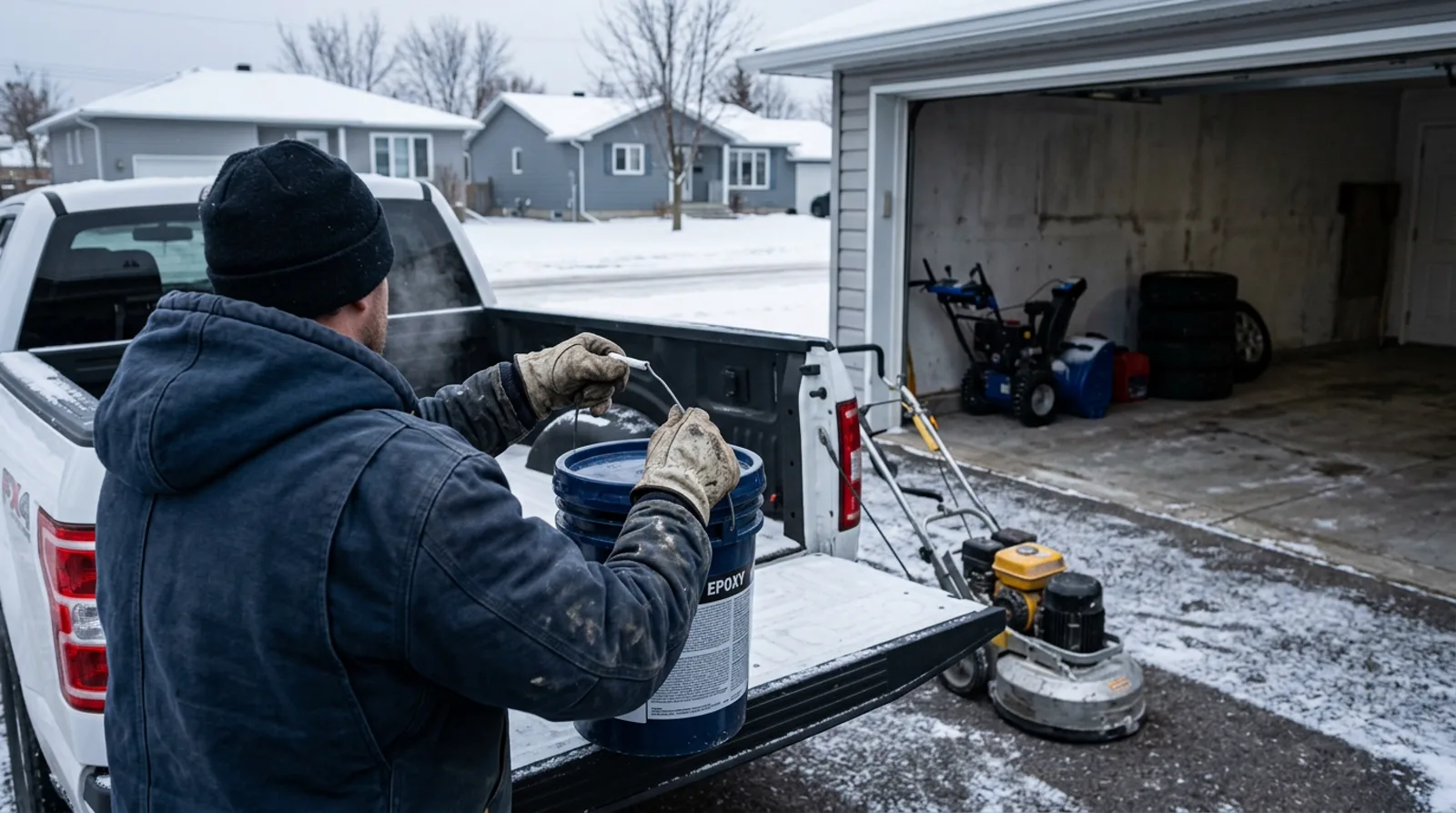
Garage Floor Concrete Built for Alberta Winters.
Durable concrete garage floors and epoxy coatings that handle freeze-thaw, road salt, and heavy loads. Local crews, proper vapor barriers, and finishes that last.
Complete Garage Floor Solutions
From bare gravel to showroom finish, local pros handle every step of garage floor concrete work.
New Garage Slab Pour
Full excavation, gravel base, 6 mil poly vapor barrier, rebar or mesh reinforcement, and 4 to 6 inch slab pour with proper slope for drainage. Meets Alberta Building Code for frost protection and load bearing.
Epoxy Floor Coating
Diamond-ground prep, crack fill, two-part epoxy with broadcast flake or quartz, and clear topcoat. Chemical resistant, easy to clean, and hides old stains. Ready to drive on in 72 hours.
Crack Repair & Patching
Rout and seal cracks with flexible polyurethane or epoxy injection to stop water infiltration. Grind high spots, fill low areas, and feather edges. Prevents further damage from freeze-thaw expansion.
Floor Leveling & Resurfacing
Self-leveling overlay or micro-topping to fix settled slabs, eliminate trip hazards, and restore proper drainage slope. Bonds to existing concrete and cures hard enough for vehicle traffic.
Polished Concrete Finish
Multi-stage diamond grinding to expose aggregate, densify the surface, and create a high-gloss or satin finish. Extremely durable, low maintenance, and no coatings to reapply. Ideal for heated floors.
In-Floor Heating Integration
Hydronic or electric radiant tubing embedded in slab pour or overlay. Keeps your garage ice-free in winter, accelerates snow melt on vehicles, and makes the space usable year-round. Thermostat and zone control included.
Why Alberta Garage Floors Are Different
❄️ Freeze-Thaw Cycling
Spruce Grove sees 80+ freeze-thaw cycles per winter. We use air-entrained concrete, proper joint spacing, and flexible crack sealants to let the slab move without breaking. Standard southern mixes fail here within 3 years.
🧊 Deep Frost Line
Alberta frost penetrates 6 feet deep. Garage slabs need undisturbed subgrade, minimum 6 inches of compacted gravel, and a continuous vapor barrier to prevent frost heave and moisture wicking that causes efflorescence and spalling.
🧂 Road Salt Exposure
Vehicles track magnesium chloride and calcium chloride into garages all winter. We seal the surface with epoxy or densifier to block salt penetration, which otherwise pulls moisture into the concrete and causes surface scaling and rust stains.
📋 Parkland County Permits
Detached garage slabs over 108 square feet require a development and building permit in Parkland County, and inspections for footing depth and rebar placement. We coordinate permit submission, engineer letters if needed, and schedule inspections so you stay compliant.
What it costs here
Everything You Need to Know About Garage Floor Concrete
From prep to finish, here's how garage floors are built to last in Alberta's harsh climate.
Why Garage Floor Concrete Matters in Spruce Grove and Parkland County
Garage floors in the Tri-Region take a beating that homeowners in milder climates never experience. Every winter, your vehicle drags in road salt, sand, and magnesium chloride from Highway 16A and the Yellowhead. That corrosive slurry sits on your concrete all season, eating into the surface while freeze-thaw cycles crack the slab from below. A poorly installed or deteriorating garage floor does not just look bad. It creates trip hazards, damages stored items when water pools, and lowers your home's resale value when buyers see a floor that screams deferred maintenance.
Alberta's climate makes garage floors one of the hardest-working surfaces in your home. Winter temperatures in Spruce Grove and Stony Plain regularly hit minus 25 Celsius or colder, then swing up during chinook events. Your concrete slab expands and contracts with every temperature shift. If the original pour was done without proper gravel base or control joints, those movements turn into cracks. Water seeps into those cracks, freezes, expands, and makes the damage worse every winter. By year ten or fifteen, what started as a hairline crack becomes a network of fissures with edges that crumble when you run a snow blower over them.
The second issue is the garage floor's job description. This is not a basement slab that sits undisturbed. You park a truck or SUV on it that weighs two tonnes or more, often while the concrete is still cold and brittle from overnight temperatures. You drag in snow and ice melt that puddles and refreezes overnight. You store lawn equipment, freezers, and boxes directly on the surface. A residential garage floor in Parkland County needs to be spec'd and poured like a light commercial slab, not a patio. Many builders do not do that, which is why so many ten-year-old garage floors already need serious repairs or replacement.
Warning Signs Your Garage Floor Needs Professional Attention
Dusting is the first sign most homeowners notice. You sweep the garage and the next day there is a fine layer of concrete powder near the overhead door or along the walls. That powder is the surface of your slab breaking down because the concrete was either mixed wrong, poured in cold weather, or never properly sealed. Dusting means the top layer has no structural integrity left. It will continue to erode, and anything you store on that floor will end up coated in grit. If you see persistent dust even after sweeping, the concrete has failed and needs either a professional sealer, a bonded overlay, or full replacement depending on how deep the damage goes.
Cracks wider than a toonie are a second red flag. Hairline cracks are normal in any concrete slab, especially in Alberta where seasonal movement is significant. But when a crack is wide enough to catch the wheel of a dolly or trip someone walking in socks, that crack has become a structural issue. Check whether the crack has vertical displacement, meaning one side is higher than the other. If it does, the slab has settled unevenly or the subgrade was not compacted correctly during the original build. Epoxy injection can stabilize small cracks, but displaced slabs usually need mudjacking or full replacement to avoid ongoing problems.
Spalling and surface pitting show up after years of salt exposure. The concrete surface flakes off in thin layers, leaving rough pockmarks that collect water and oil. Spalling happens when water penetrates the surface, freezes, and pops off chunks of concrete. Once it starts, it accelerates because each new pit gives water more places to infiltrate. This is especially common near the garage door where slush piles up. Light spalling can be ground down and resurfaced with a polymer overlay. Deep spalling, where you can see aggregate or rebar, means the slab has lost enough cover that resurfacing will not last and you need a new pour.
When to Resurface vs Replace
Resurfacing makes sense when the underlying slab is still structurally sound but the surface is ugly or lightly damaged. If your floor has dusting, minor spalling, or surface stains but no major cracks or settlement, a bonded concrete overlay or epoxy coating can give you another fifteen to twenty years. Resurfacing costs between $400 and $1,200 for a typical two-car garage in Spruce Grove, depending on the system used. It is a two or three day job including prep, application, and cure time. The catch is that resurfacing only works if the existing slab is stable. If the concrete moves, the overlay will crack and delaminate within a year or two.
Full replacement is necessary when the slab has structural problems that resurfacing cannot fix. This includes large cracks with vertical displacement, widespread spalling deeper than half an inch, or floors that puddle because the slab has settled unevenly. Replacement means breaking out the old concrete, verifying or rebuilding the gravel base, and pouring a new slab to current Alberta Building Code specs. For a standard 20 by 20 foot garage, replacement typically costs between $2,800 and $4,500 depending on gravel work, thickness, and whether you add rebar or wire mesh. The job takes about a week once you account for demolition, base prep, forming, pouring, and the minimum seven day cure before you can park on it.
What a Professional Garage Floor Installation Actually Involves
Demolition and removal is the dirty first step. A crew breaks up the old slab with jackhammers or a skid steer mounted breaker, then hauls the rubble away in a bin or dump truck. A typical two-car garage slab weighs about eight to ten tonnes, so removal is not a DIY job unless you have access to heavy equipment and a way to dispose of broken concrete legally. In Parkland County, broken concrete usually goes to a recycling facility or approved fill site. The demolition stage also exposes the gravel base underneath. A good contractor inspects that base for soft spots, organic material, or areas where the gravel has shifted. If the base is compromised, it gets excavated and rebuilt with fresh three-quarter inch clear crush, compacted in lifts.
Base preparation determines whether your new floor will last five years or fifty. The Building Code requires a minimum four inches of compacted granular fill under garage slabs, but experienced contractors in freeze-thaw climates often go six inches or more. The gravel provides drainage so water does not pool under the slab and freeze. It also gives the concrete a stable platform that will not shift when the ground freezes in winter. Each lift of gravel is compacted with a plate tamper or jumping jack. If the base is not dense, the slab will settle unevenly and crack within the first few freeze-thaw cycles. Some contractors also install a vapor barrier (six mil poly) under the slab to prevent ground moisture from wicking up into the concrete, which is especially important if you plan to install epoxy coating later.
Forming and reinforcement happens next. The crew sets up wood or metal forms around the perimeter to define the slab edges and hold the concrete in place while it cures. The top of the forms is set to create a slight slope toward the garage door, usually one-quarter inch per foot, so water drains out instead of pooling. Reinforcement is either welded wire mesh (six inch by six inch grid, ten gauge wire) or rebar placed on chairs to hold it in the middle third of the slab. Rebar is more expensive but provides better crack control in high-stress areas like where heavy vehicles park. Control joints are also planned at this stage. These are intentional weak points cut or formed into the slab so that when the concrete does crack, it cracks along the joint line where it is less visible.
The Pour and Finish Process
Concrete arrives in a ready-mix truck and gets placed quickly because it starts to set within ninety minutes in warm weather, faster in Spruce Grove's summer heat. The crew uses rakes and shovels to spread the mix evenly, then screeds it level using a straight edge that rides on the forms. Proper mix design matters in Alberta. The concrete should be a minimum 32 MPa compressive strength with air entrainment between five and eight percent. Air entrainment creates microscopic bubbles in the concrete that give freeze-thaw cycles room to expand without cracking the slab. Contractors who skip air-entrained mix to save a few dollars are setting you up for spalling and surface failure within five years.
Finishing determines the surface texture and durability. After screeding, the crew uses a bull float to smooth the surface and bring a thin layer of cement paste to the top. This paste layer is what gets troweled to the final finish. For garage floors, a medium broom finish is standard because it provides traction when the floor is wet but is still smooth enough to sweep easily. Some homeowners request a trowel-smooth finish if they plan to epoxy coat the floor later, but smooth concrete can be slippery when damp. The crew also edges the perimeter and cuts control joints while the concrete is still workable. Once finishing is done, the slab needs to cure undisturbed for at least seven days before you park a vehicle on it. Longer cure times in cold weather are common.
Epoxy and Coating Systems: Beyond Basic Concrete
Epoxy coatings bond a resin layer to the concrete surface, creating a hard, chemical-resistant finish that looks sharp and cleans easily. The process starts with aggressive surface prep, usually diamond grinding or shot blasting to open the concrete pores and remove any sealers, oils, or laitance that would prevent bonding. Without proper prep, epoxy will peel off in sheets within a year. After grinding, the floor is vacuumed and wiped down, then a primer coat is rolled on. The epoxy topcoat goes on next, often with decorative color flakes broadcast into the wet epoxy for texture and visual interest. A clear polyurethane or polyaspartic topcoat is applied last to protect the epoxy from UV yellowing and add abrasion resistance.
Polyaspartic coatings are increasingly popular in Alberta because they cure hard even in cold temperatures and can be applied in a single day. Traditional epoxy takes twenty-four to seventy-two hours to cure between coats, which means your garage is out of commission for most of a week. Polyaspartic systems cure in a few hours, so a pro crew can grind, prime, coat, and topcoat your floor in one long day. You can park on it the next morning. The downside is cost. Polyaspartic materials run about fifty percent more than standard epoxy, so a full garage coating that might cost $1,100 with epoxy could run $1,600 or more with polyaspartic. For homeowners who cannot lose garage access for a week, the premium is worth it.
Coating durability depends on the prep work and the system quality. Box-store epoxy kits that you roll on over a lightly etched floor rarely last more than two or three winters in Alberta. The freeze-thaw action and salt exposure cause them to delaminate and peel. Professional coatings applied over diamond-ground concrete with a proper primer and UV-stable topcoat can last fifteen to twenty years if maintained correctly. Maintenance means sweeping regularly to remove grit, wiping up oil and chemical spills promptly, and avoiding metal shovels or sharp tools that can gouge the coating. If the coating does chip or scratch, small repairs are possible, but large damaged areas usually require grinding off the old coating and reapplying the system.
When Coating Makes Sense vs New Concrete
Coating an existing slab is the right move when the concrete underneath is structurally sound but visually tired or lightly stained. If your floor has no major cracks, no spalling, and drains properly, a coating system will transform it for a fraction of the cost of replacement. This is ideal for newer homes where the builder poured decent concrete but left it unfinished, or for older homes where the slab is solid but discolored from years of use. The prep work will reveal any hidden problems. If the grinder exposes soft, crumbling concrete or the surface delaminates during prep, the slab is not a good coating candidate and you should consider replacement or an overlay instead.
New concrete with an immediate coating is the gold standard for long-term performance and appearance. When you pour a fresh slab, you control the mix design, finish, and cure process to optimize it for coating. The concrete can be troweled smooth, cured properly, and coated as soon as it reaches the minimum twenty-eight day strength threshold. This approach costs more upfront because you are paying for both the new slab and the coating, but it delivers a garage floor that will look showroom-sharp and perform flawlessly for decades. For homeowners building new or doing a complete garage renovation, this is the approach that maximizes value and eliminates future headaches.
What Garage Floor Concrete Actually Costs in the Tri-Region
A basic new concrete garage floor in Spruce Grove, Stony Plain, or Parkland County typically runs $6 to $9 per square foot for a standard 4-inch slab, meaning a typical double garage (around 400 to 500 square feet) lands between $2,400 and $4,500 installed. That baseline includes excavation to code depth, a proper gravel base, vapour barrier, wire mesh reinforcement, the pour itself, and a basic broom finish. If you need thicker concrete for heavy equipment, go to 6 inches, and your cost jumps to $9 to $12 per square foot because you are paying for significantly more material and labour to place and finish a deeper slab. Prices also climb in winter; many contractors add 10 to 20 percent between November and March because cold-weather pours require heated enclosures, blankets, and longer cure times to prevent freeze damage.
Epoxy or polyaspartic coatings over existing concrete add another $3 to $8 per square foot depending on the system. A single-coat garage-grade epoxy applied by a homeowner might cost $400 to $800 in materials for a double garage, but professional two-part polyaspartic systems with flake broadcast and topcoat run $1,500 to $3,500 for the same space because the prep is far more intensive. Contractors grind the slab to open the pores, fill cracks, apply primer, broadcast colour flakes, and seal with a UV-stable topcoat, and that labour is where the money goes. If your existing slab has serious issues like heaving, wide cracks, or a failing surface, no coating will fix structural problems, so you may need a full demo and re-pour, which pushes total cost to $3,000 to $6,000 for a typical garage.
Several factors push prices higher in the Tri-Region. Access matters: if the pour truck cannot reach your garage and concrete must be pumped or wheelbarrowed, expect $500 to $1,200 extra for pump rental and added labour. Soil conditions also play a role; expansive clay common around Stony Plain and Acheson requires deeper excavation, better compaction, and sometimes geotextile fabric to prevent settling, adding $400 to $1,000. If you want a heated slab with in-floor hydronic tubing, budget another $6 to $10 per square foot for the tubing, manifold, and installation before the pour. Decorative finishes like stamped concrete, integral colour, or exposed aggregate add $2 to $6 per square foot. Always get three written quotes that itemize base, reinforcement, finish, and any site-specific costs so you can compare apples to apples and avoid surprise charges after the pour.
Comparing Your Options: New Pour vs. Overlay vs. Epoxy Coating
A full-depth new pour is the gold standard when you are starting from dirt or replacing a badly failed slab. You excavate to the required depth (typically 10 to 12 inches below finished grade in Alberta to get below frost line for the base), place 4 to 6 inches of clean gravel for drainage and stability, lay a 6-mil polyethylene vapour barrier to block ground moisture, add wire mesh or rebar for tensile strength, and pour 3,000 to 4,000 psi concrete. The result is a monolithic slab that will handle vehicle loads, resist freeze-thaw cycling, and last 30 to 50 years if properly maintained. New pours also let you correct slope for drainage, add floor drains or trench drains, and install in-floor heat if you plan to use the garage as a workspace. The downsides are cost, time (you cannot drive on the slab for at least seven days, and full cure takes 28 days), and disruption, but you get a brand-new foundation that solves underlying problems rather than masking them.
Concrete overlays, sometimes called micro-toppings or resurfacing systems, are a middle option when your existing slab is sound but ugly or lightly damaged. Contractors grind or shot-blast the surface, repair cracks and spalls with epoxy or polymer cement, then apply a 1/4-inch to 1-inch bonded topping made of high-strength polymer-modified concrete. These systems can be troweled smooth, stamped, or stained, and they cost $4 to $8 per square foot depending on thickness and finish. Overlays work well for cosmetic upgrades and minor leveling, but they do not fix structural issues like heaving, voids under the slab, or serious cracking from foundation movement. In Alberta's climate, any overlay must be freeze-thaw stable and properly bonded; a cheap mix or poor surface prep will cause delamination within a year or two. Overlays also reduce your floor height by up to an inch, which can affect door clearances and transitions to other rooms, so measure carefully before committing.
Epoxy and polyaspartic coatings are thin film systems (typically 10 to 30 mils total) that protect and beautify existing concrete without adding structural strength. Epoxy is the older technology: two-part resin and hardener that cures hard and glossy, available in solid colours or with decorative flakes. It works well in garages but yellows under UV light, takes 24 to 72 hours to cure, and can be tricky to apply in cold weather because the chemical reaction slows below 10 degrees Celsius. Polyaspartic coatings cure in hours, resist UV yellowing, and tolerate lower temperatures, making them the preferred choice for Alberta garages, though they cost 20 to 40 percent more. Both systems require meticulous surface prep: the concrete must be clean, dry, and profiled (ground or acid-etched) or the coating will peel. Coatings hide minor stains and surface wear but will telegraph cracks and will not stop water intrusion if your slab has vapour barrier failures or drainage problems. Think of them as a protective skin, not a structural fix.
Common Mistakes and Contractor Red Flags to Avoid
The biggest mistake homeowners make is skipping the vapour barrier or using one that is too thin or poorly lapped. Alberta soil holds moisture, and without a continuous 6-mil poly barrier under your slab, ground water will wick up through the concrete, causing efflorescence (white salt deposits), coating failures, and freeze damage when that moisture freezes and expands. Some contractors cut corners by omitting the barrier entirely or using torn scraps with gaps at the seams. Insist on a full barrier with 6-inch overlaps at all seams, taped or sealed, and extending up the edges of the formwork. Another common error is inadequate base compaction. If the gravel base is not compacted in layers with a plate tamper or roller, the slab will settle unevenly over time, creating cracks and low spots. A proper base should be at least 4 inches of 3/4-inch clear crush, compacted to 95 percent density, and you should see the contractor using mechanical compaction equipment, not just spreading gravel with a rake and calling it done.
Watch for contractors who pour in freezing weather without proper protection. Concrete must cure above 5 degrees Celsius for at least the first 72 hours, or the hydration reaction stops and you get weak, crumbly concrete that will spall and crack within months. Responsible contractors in the Tri-Region either avoid pours from late November through March or use heated enclosures, insulated blankets, and cold-weather admixtures that accelerate set time and generate extra heat. If a contractor offers a suspiciously low winter quote and does not mention any cold-weather measures, that is a red flag. Similarly, be wary of anyone who promises you can drive on the slab the next day; concrete reaches only about 70 percent of its strength in seven days and full design strength at 28 days. Driving heavy vehicles on fresh concrete compresses the surface, creates micro-cracks, and shortens the slab's life. A legitimate contractor will tell you to stay off for at least a week and avoid heavy loads for two weeks.
Ask every contractor for proof of WCB coverage and liability insurance before they start work. In Alberta, any contractor with employees must carry and if they are injured on your property without coverage, you as the homeowner can be held liable for their medical costs and lost wages. Request a WCB clearance letter dated within the last 30 days, and call the number on the letter to verify it is legitimate. Liability insurance (minimum $2 million) protects you if the contractor damages your property or a third party is injured. Some contractors operate without either, offer a cash discount, and disappear if something goes wrong. Also red-flag contractors who ask for large deposits up front; a reasonable deposit is 10 to 25 percent to cover materials, with the balance due on completion. If someone wants 50 percent or more before breaking ground, they may be using your money to finish someone else's job or are financially unstable. Finally, insist on a written contract that specifies concrete strength (PSI), slab thickness, base depth and material, reinforcement type, finish, cure time, and warranty terms. Handshake deals and vague quotes lead to disputes and poor outcomes.
How to Hire the Right Concrete Contractor
Start by asking for recent references from jobs in Spruce Grove, Stony Plain, or Parkland County, and actually call them. Ask the previous customers whether the contractor showed up on time, completed the work as quoted, cleaned up the site, and how the slab has held up after at least one winter. Drive by a few finished jobs if possible and look for clean edges, uniform colour, proper slope away from the building, and no obvious cracking or spalling. A contractor who is proud of their work will happily share addresses of recent projects. If they hesitate or only offer references from years ago, that is a warning sign. Also check online reviews on Google and HomeStars, but take them with context; one bad review among dozens of good ones may just be an unreasonable customer, but a pattern of complaints about incomplete work, poor communication, or warranty issues is a serious concern.
Get at least three written quotes that break down every cost: excavation, base material and compaction, vapour barrier, concrete volume and strength, reinforcement, labour, finishing, and cleanup. This transparency lets you compare fairly and spot lowball bids that omit critical steps. Be cautious of quotes that are 30 percent or more below the others; the contractor may be planning to cut corners, use substandard materials, or add change orders once the job is underway. Ask each contractor how they handle Alberta's freeze-thaw cycles (air-entrained concrete with 5 to 8 percent air content is essential), what their cold-weather procedures are, and how long they recommend staying off the slab. The answers will reveal their experience level and commitment to quality. A good contractor will also visit your site, check soil conditions, measure carefully, and ask about your intended use (storage only, workshop, vehicle parking) because that affects slab thickness and reinforcement.
Verify credentials and ask about warranties. Any contractor pouring structural concrete should have experience with Alberta building codes, know local frost-depth requirements (typically 4 feet in the Edmonton area, but Parkland County can vary depending on soil type), and be able to pull permits if required. While many residential garage floors do not require a permit, some municipalities require one if you are adding square footage or changing grade, so confirm with your local building department. Ask what warranty the contractor offers; a reputable one will guarantee their work for at least one year against defects in workmanship and materials, though they cannot warrant against damage from ground movement, impacts, or neglect. Get the warranty terms in writing as part of your contract. Finally, trust your gut: if a contractor is evasive, pushy, or dismissive of your questions, move on. The best contractors communicate clearly, show up when they say they will, and take pride in doing the job right the first time.
How Tri-Region Services Helps
Tri-Region Services connects you with one carefully vetted, fully insured local concrete contractor who has proven experience with garage floors in Spruce Grove, Stony Plain, and Parkland County. Contractors tell us about liability insurance, liability insurance, and references before we ever add a contractor to our network, so you skip the research and risk. When you reach out through our directory, your request goes directly to a qualified pro who will visit your property, assess your soil and existing conditions, and provide a detailed written quote at no charge or obligation. You get one honest, local expert rather than a flood of random bids, and because our contractors know we only refer quality-conscious homeowners, they bring their best work and fair pricing. We do not take a cut or markup; we simply connect you to the right person for the job and let the work speak for itself.
Why Homeowners Trust These Crews
Every concrete contractor in our network meets strict standards for licensing, insurance, and local reputation.
Insurance on file
All crews carry active Workers Compensation Board coverage so you're protected if someone is injured on your property.
Liability Insurance Current
Minimum $2 million general liability stated at signup crew is listed, covering property damage and third-party claims.
Parkland County Permit Experience
These contractors know the permit process, engineering letter requirements, and inspection schedules for Spruce Grove, Stony Plain, and unincorporated areas.
Local References Available
Every listed contractor has completed garage floors in the Tri-Region within the past 18 months and can provide verifiable local references.
Written Quotes & Warranties
You receive a detailed written estimate before work starts, and a warranty on materials and workmanship, typically 1 to 5 years depending on scope.
Alberta Building Code Compliance
Proper frost footing depth, vapor barriers, reinforcement spacing, and concrete mix design that meets or exceeds provincial code for garage floor applications.
This page is not tied to a contractor's brand. Leads route straight to your one local partner. Verified reviews can appear here once that partner has them (never fabricated).
Serving the whole Tri-Region
8 Questions Homeowners Ask
How thick should a garage floor be in Alberta?+
Do I need a permit to pour a garage floor in Parkland County?+
How long before I can drive on new concrete?+
What's better for a garage floor: epoxy coating or polished concrete?+
Can you pour a garage floor in winter in Alberta?+
How do I prevent cracks from freeze-thaw cycles?+
How much does it cost to epoxy coat a 2-car garage floor?+
Do I need a vapor barrier under my garage concrete slab?+
Get your free quote
Tell us what you need and a local pro will get right back to you.
- ✓ Sent straight to a local business
- ✓ You choose who you hire
- ✓ Free, with no obligation