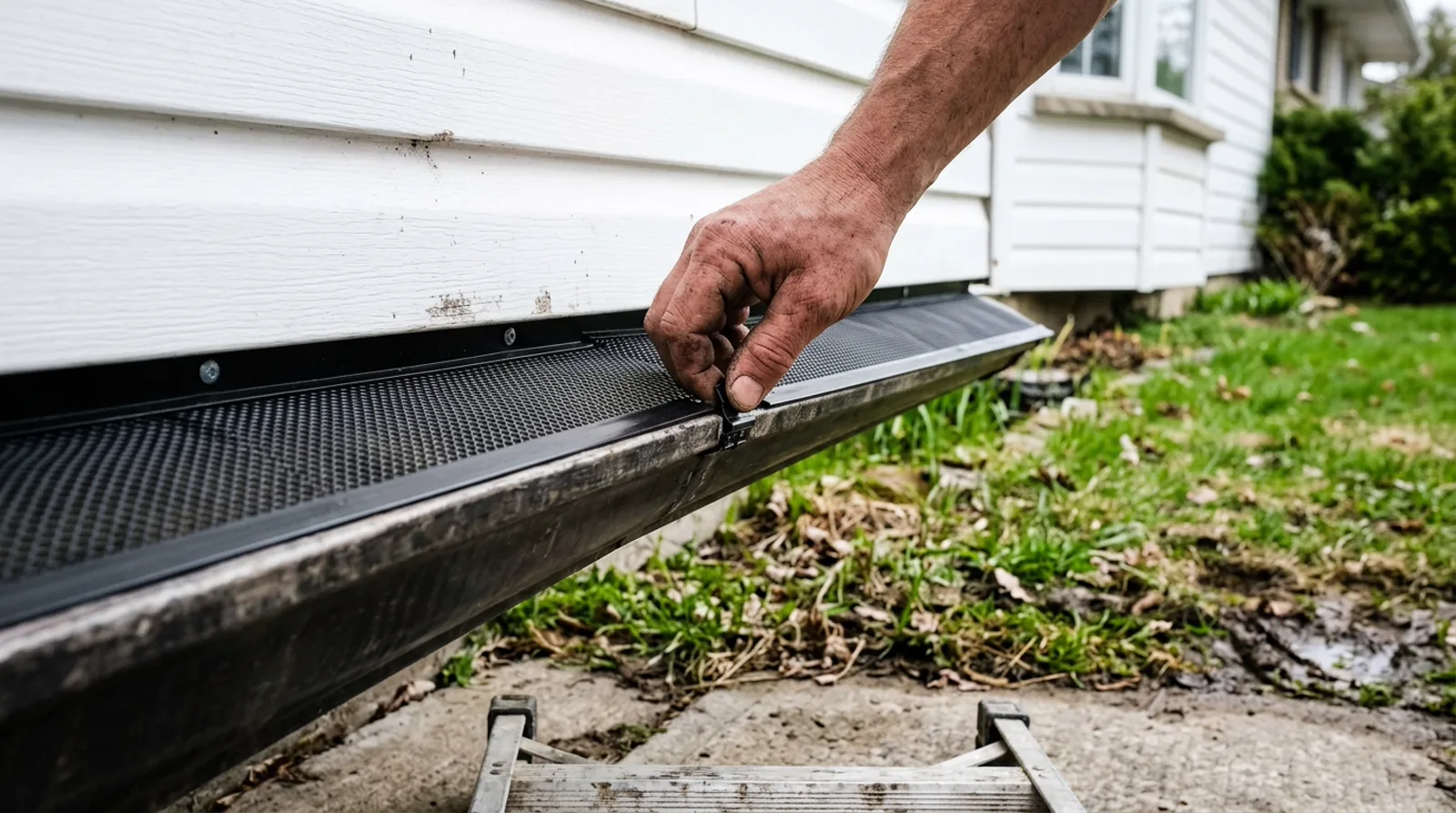
Gutter Guard Installation Built for Alberta Weather
Stop cleaning gutters twice a year. Professional gutter guard installation protects your home from clogs, ice dams and water damage.
Gutter Guard Systems for Every Budget
From basic mesh to premium micro-mesh, local pros install guards that match your home and budget.
Micro-Mesh Gutter Guards
Surgical-grade stainless steel mesh blocks pine needles, shingle grit and even poplar seeds. Best choice for homes near conifers. Handles snow load and ice without warping. 20 to 25 year lifespan.
Aluminum Perforated Guards
Powder-coated aluminum with small perforations blocks most leaves and debris while allowing water flow. Holds up to hail and chinook winds. Popular mid-range option. 15 to 20 year lifespan with minimal maintenance.
Reverse Curve (Surface Tension) Guards
Water flows over the curve into the gutter while debris slides off. Works well for heavy rain and Alberta snow melt. Visible from ground. Professional installation required for proper pitch and fastening.
Foam Insert Guards
Porous foam inserts sit inside the gutter and block debris while allowing water through. Budget-friendly DIY option or professional install. Needs replacement every 3 to 5 years as foam compresses and breaks down.
Screen and Snap-In Mesh Guards
Plastic or metal mesh screens snap onto gutter edges. Blocks leaves and large debris but pine needles and seeds can slip through. Easy to remove for cleaning. Good starter option for low-debris areas.
Guard Removal and Upgrade
Remove old, damaged or ineffective gutter guards and install new system. Includes debris cleaning, gutter inspection and guard disposal. We upgrade foam and screen guards to micro-mesh or aluminum for long-term performance.
Why Alberta Homes Need Gutter Guards
🍂 Pine Needles and Poplar Seeds
Spruce Grove, Stony Plain and Parkland County are full of mature conifers and poplars. Pine and spruce needles slide through standard screens. Micro-mesh guards are the only system that blocks them completely.
❄️ Snow Load and Ice Dam Prevention
Alberta roofs carry heavy snow from November through March. Clogged gutters cause ice dams that lift shingles and leak into walls. Properly installed guards keep water flowing and prevent freeze damage at the roofline.
🌬️ Chinook Wind Debris
Warm chinook winds melt snow fast and blow twigs, leaves and shingle grit into gutters. Guards stop the sudden debris surges that come with every chinook cycle. Less maintenance, more consistent drainage all winter.
🧊 Freeze-Thaw Cycle Durability
Temperatures swing from -30°C to +10°C in the same week. Cheap plastic guards crack. Aluminum and stainless steel guards flex without breaking. Local pros install materials rated for extreme temperature swings and guaranteed not to warp.
What it costs here
Everything You Need to Know About Gutter Guard Installation
How guards work, what types last longest in Alberta weather, and what to expect from installation day.
What Gutter Guards Actually Do and Why Spruce Grove Homes Need Them
Gutter guards are protective covers or screens installed over your existing eavestrough system to block leaves, pine needles, seeds, and other debris from entering the channel while allowing rainwater and snowmelt to flow through freely. In Spruce Grove, Stony Plain, and Parkland County, where mature poplars drop cotton-like seeds in June, spruce and pine trees shed needles year-round, and fall brings waves of aspen and birch leaves, unprotected gutters can clog multiple times per season. A quality gutter guard system eliminates the need to climb ladders every few weeks during peak debris months and prevents the overflow, foundation damage, and ice dam formation that result from blocked troughs.
The core function is simple: create a barrier that debris cannot penetrate while ensuring water reaches the downspouts. Different guard types use varying approaches. Micro-mesh systems use stainless steel or aluminum mesh with openings as small as 50 microns, fine enough to block even shingle grit and poplar fluff. Reverse-curve or surface-tension guards rely on water adhesion, directing rain around a curved hood and into a small slot while debris slides off the front edge. Screen guards use larger perforations that handle heavy rainfall but may require occasional brushing to remove accumulated pine needles. Foam inserts sit inside the gutter channel, blocking debris while wicking water through the porous material. Each type performs differently under Alberta's intense spring runoff, summer thunderstorms, and freeze-thaw cycles, so matching the guard style to your roof pitch, tree coverage, and local weather patterns determines whether the system works or creates new problems.
For homes in this region, gutter protection is not a luxury upgrade but a practical response to specific environmental stressors. A typical property with mature landscaping in Stony Plain or on an acreage near Acheson can accumulate 30 to 50 pounds of wet debris in gutters over a single autumn, enough to bend hangers, pull troughs away from fascia boards, and create standing water that freezes solid in October. When temperatures drop to minus 25 Celsius or colder through December and January, that ice expands, cracks seams, and forces water under shingles. Gutter guards prevent the initial debris accumulation, stopping this destructive chain before it starts. Homeowners report going from cleaning gutters four to six times per year to once every two or three years after installation, with no loss of drainage performance and significantly less risk of winter damage.
How Alberta's Climate Makes Gutter Protection Critical
Freeze-Thaw Cycles and Ice Formation
Spruce Grove experiences an average of 60 to 80 freeze-thaw cycles per winter, a relentless pattern where daytime temperatures climb above zero and nighttime lows plunge back to minus 10 or colder. When gutters contain even a small amount of debris mixed with water, each freeze locks moisture in place, and each thaw adds another layer. Over weeks, this builds into solid ice dams that block downspouts and force meltwater sideways under shingles or over the trough edge. Homes with unprotected gutters often develop icicles three to five feet long by mid-January, a visible sign that water is trapped and refreezing rather than draining. Gutter guards eliminate the debris that provides anchor points for ice formation, allowing meltwater to flow even during partial thaws and preventing the thick ice buildup that damages roofing and fascia.
Chinook winds complicate the picture further. These warm Pacific air masses can raise temperatures by 15 to 20 degrees in a matter of hours, melting snow on south- and west-facing roof slopes while north slopes remain frozen. The resulting meltwater rushes into gutters that may still contain ice from the previous cold snap. If debris clogs the channel or downspout, the water has nowhere to go and either overflows onto foundation plantings and walkways or refreezes into a thicker dam. Gutter guards maintain open channels, so even during rapid chinook melts, water exits the system before it can pool and refreeze. This is especially important for two-story homes where overflow can cascade onto lower roof sections, creating dangerous ice sheets and accelerating shingle wear.
Spring Runoff and Heavy Rainfall Events
Alberta's spring melt is not gradual. Late April and early May often bring sustained temperatures above 10 Celsius combined with rain, generating runoff volumes that exceed what gutters were designed to handle if flow is restricted in any way. A clogged downspout turns a five-inch-per-hour trough system into a waterfall that dumps hundreds of litres directly against the foundation, saturating clay soils and creating hydrostatic pressure on basement walls. Parkland County and rural properties on heavier clay experience this acutely, as the soil drains slowly and any additional water remains near the foundation for days. Gutter guards ensure maximum flow capacity during peak runoff by keeping the channel and downspout outlets clear, directing water through underground drains or splash blocks away from the structure.
Summer thunderstorms add another stress layer. Convective cells that develop over the foothills can dump 25 to 40 millimetres of rain in under an hour, often accompanied by pea- to quarter-sized hail. Unprotected gutters filled with spring debris cannot handle this sudden volume, and water sheets over the edge, eroding soil, flooding window wells, and undermining poured concrete steps. Hail impact can also compact wet leaves and organic matter into a dense mat that acts like a dam. Micro-mesh and solid-surface guards shed hailstones and allow water to enter the trough without carrying debris, maintaining full drainage capacity even during extreme weather. Homeowners in Spruce Grove who installed guards before the July 2023 hailstorm reported no overflow issues, while neighbors with clogged gutters experienced significant water intrusion.
Snow Load and Structural Stress
Winter snow accumulation on roofs adds weight that gutters must support, especially when wet, heavy snow falls in October or March. A five-inch trough filled with decomposing leaves and saturated organic debris can weigh 15 to 20 pounds per linear foot once snow and ice are added. Multiply that by 40 or 50 feet of gutter, and the total load exceeds 800 pounds, enough to bend aluminum hangers, crack vinyl brackets, or pull screws out of fascia boards. Gutter guards prevent debris accumulation, so the only weight is from snow and ice resting on the guard surface itself. Quality systems are engineered to support snow loads exceeding 200 pounds per square foot, far more than the trough would otherwise carry, and the even weight distribution across the guard prevents sagging and structural failure.
When snow slides off steep roofs, it can strike gutters with significant force. Homes with metal roofing or steep 8:12 to 12:12 pitches common in modern Spruce Grove builds experience this regularly. Unprotected gutters filled with frozen debris have no give and often tear away from the house during a slide. Gutter guards, particularly those installed under the shingle edge with hidden hangers, create a smooth surface that allows snow to glide over the system rather than catching and ripping. The debris-free channel below remains intact, ready to handle melt as soon as temperatures rise. This dual benefit of structural protection and maintained drainage makes gutter guards essential for any home in this region with roof slopes above 6:12 or metal roofing.
Warning Signs Your Spruce Grove Home Needs Gutter Guards
The most obvious indicator is repetitive clogging. If you are cleaning gutters three or more times per year, or if you notice overflow during rainstorms despite recent cleaning, debris is accumulating faster than you can manage it. Homes surrounded by poplars, aspens, or spruce trees often see this pattern, with cottonwood seeds in June, needles in August, and leaves in October creating a never-ending maintenance cycle. Each overflow event risks foundation damage, so repetitive clogging is not just inconvenient but a structural threat. Gutter guards break this cycle by preventing debris entry in the first place, reducing cleaning frequency to once every two or three years for a simple surface brushing rather than deep channel excavation.
Visible plant growth in gutters signals that organic matter has been sitting long enough to decompose into soil. Grass, weeds, or even small shrubs sprouting from eavestrough channels indicate months of neglect or such heavy debris loads that cleaning cannot keep pace. This is common on acreages near Acheson or rural Parkland County properties where mature tree canopies drop continuous material and homeowners may not notice the buildup until it becomes extreme. Plants mean roots, and roots break seams, crack end caps, and hold moisture against fascia boards, leading to wood rot. If you see green growth, the gutters are already compromised. Installing guards after a thorough cleaning and any necessary repairs prevents recurrence and protects the investment in new or restored troughs.
Water stains on siding below the roofline or soil erosion directly beneath gutter runs show that water is not reaching the downspouts. During rainfall, walk the perimeter of your home and watch for streams pouring over the gutter edge rather than exiting through downspouts. This happens when debris clogs the channel or, more often, when organic matter blocks the downspout outlet or the transition from trough to drop. Even a small blockage causes upstream backup, and in Alberta's heavy spring rains or summer cloudbursts, that backup becomes a torrent. Foundation plantings suffer, topsoil washes away, and water infiltrates basement walls through cracks or window wells. Gutter guards keep debris out of the entire system, including downspout entrances, so water follows its intended path and erosion stops.
- Ice dams forming along the roofline every winter, visible as thick ridges of ice at the eaves
- Icicles longer than 18 inches hanging from gutters, indicating trapped and refreezing meltwater
- Sagging gutter sections or visible separation from fascia boards due to weight from wet debris and ice
- Basement or crawlspace moisture, musty odors, or efflorescence on foundation walls after rainfall
- Gutters overflowing during chinook melts or spring runoff despite no visible blockage from the ground
The Gutter Guard Installation Process: What to Expect
Initial Assessment and System Measurement
Professional installation begins with a detailed inspection of the existing gutter system. The installer examines trough condition, checking for rust, cracks, loose hangers, and proper slope toward downspouts. Gutters must drain correctly before guards are installed, as a guard will not fix underlying pitch or structural problems. In Spruce Grove, many homes built in the 1980s and 1990s have aluminum troughs that have pulled away from fascia boards due to ice load or were installed with insufficient slope, sometimes as little as one-eighth inch per ten feet instead of the recommended one-quarter inch. If slope is inadequate, the installer will rehang sections, add hangers, or recommend replacement before proceeding with guards. This ensures the system functions as designed once protection is in place.
Measurement includes total linear footage of gutters, number and location of downspouts, roof pitch, and tree coverage assessment. Steep roofs above 8:12 pitch require guards that can handle high-velocity water, while low slopes benefit from larger surface area guards that capture slower runoff. Homes with dense poplar or spruce canopies overhead need micro-mesh systems that block fine seeds and needles, whereas properties with minimal tree cover can use screen-style guards with larger openings. The installer also notes whether the roof has architectural shingles, metal panels, or cedar shakes, as installation methods differ. Detailed measurements produce an accurate material quote and ensure no surprises on installation day. Expect this assessment to take 30 to 45 minutes for an average single-story home, longer for complex rooflines or multi-story structures.
Material Selection and System Design
Once the assessment is complete, the installer recommends a specific guard type based on your roof, tree exposure, and budget. Micro-mesh systems in aluminum or stainless steel cost $15 to $30 per linear foot installed and offer the highest level of debris exclusion, ideal for homes with heavy poplar seed or pine needle loads. These systems feature a fine mesh, often 275 to 400 microns, bonded to an aluminum frame that slides under the shingle edge and clips to the gutter lip. Reverse-curve guards made from aluminum or vinyl run $12 to $22 per foot and work well on moderate-slope roofs with mixed debris, though they may allow fine seeds to enter during high winds. Screen-style guards, either aluminum or plastic, cost $8 to $15 per foot and suit properties with light debris or homeowners willing to brush the surface once or twice per season.
For Alberta's climate, durability and ice resistance matter as much as debris blockage. Installers in this region prefer all-metal systems over vinyl, as vinyl becomes brittle at minus 30 Celsius and can crack under snow load or hail impact. Stainless steel mesh resists corrosion from road salt spray in urban areas like Spruce Grove, while powder-coated aluminum frames match gutter colors and provide decades of service without rust. The installer will show samples, explain performance differences, and provide a written estimate with material specifications, labor costs, and warranty terms. Quality installations include a workmanship warranty of two to five years and a manufacturer's product warranty of 20 to 30 years or more, depending on the brand.
Installation Steps and Quality Checkpoints
On installation day, the crew begins by thoroughly cleaning the existing gutters and downspouts, removing all debris, flushing channels with water, and checking that flow reaches the ground without obstruction. This baseline cleaning is critical, as installing guards over clogged troughs locks in debris and defeats the purpose. Next, the team measures and cuts guard sections to fit each gutter run, accounting for inside and outside corners, end caps, and downspout outlets. Micro-mesh systems typically slide under the first course of shingles and clip or screw to the outer gutter lip, creating a smooth surface angled to shed debris. The installer lifts shingle tabs carefully to avoid damage, especially in cold weather when asphalt shingles are less flexible, and uses hidden hangers or screws to secure the frame without penetrating the roof deck.
Each section is checked for proper alignment and water flow before moving to the next. The guard should sit flush with the gutter opening, with no gaps that allow debris entry, and the slope should match or enhance the existing gutter pitch. Downspout outlets receive strainer inserts or fine mesh filters to block any debris that might enter through seams or corner transitions. Once all sections are installed, the crew tests the system by running water from a hose along the roofline and observing flow into gutters and out through downspouts. They look for overflow at seams, pooling on the guard surface, or water sheeting over the edge, adjusting brackets or trimming guard sections as needed to optimize performance.
Final inspection includes checking that shingles were replaced correctly, no fasteners are exposed or over-tightened, and all corners and end caps are sealed. The installer provides care instructions, explaining that most systems require only an annual brush-off of surface debris like pine cones or large leaves. For micro-mesh guards, even this is often unnecessary, as rain and wind naturally clear the surface. The entire installation for a typical 1,500-square-foot bungalow with 120 linear feet of gutter takes four to six hours, weather permitting. Installers prefer dry conditions and temperatures above 5 Celsius to ensure sealants cure properly and shingles remain pliable, so spring and fall are the busiest seasons for gutter guard work in Spruce Grove and surrounding areas.
What Gutter Guard Installation Really Costs in the Tri-Region
A typical gutter guard installation for a single-story home in Spruce Grove or Stony Plain runs between $800 and $2,200, while two-story homes with standard rooflines usually fall in the $1,400 to $3,500 range. These prices reflect complete professional installation including materials, labour, debris removal, and minor gutter adjustments. The wide range exists because your final cost depends on several Alberta-specific factors: total linear footage, guard type chosen, roof pitch and height, existing gutter condition, and whether your home has multiple valleys, dormers, or complex rooflines common in Parkland County acreages. Mobile home installations can run lower at $600 to $1,400 depending on accessibility and perimeter length.
Material choice drives the biggest price variation. Basic aluminum screen guards installed over existing 5-inch gutters cost roughly $4 to $7 per linear foot installed, making them the entry point for most homeowners. Mid-range micro-mesh systems with stainless steel mesh and an aluminum frame run $8 to $12 per foot, while premium surgical-grade stainless micro-mesh or copper systems can reach $15 to $25 per foot installed. These per-foot rates include the guard itself, fasteners rated for Alberta freeze-thaw cycles, and professional installation with proper pitch verification. A contractor quoting significantly below $4 per foot is likely cutting corners on fastener quality, skipping pitch correction, or using thin-gauge materials that will buckle under snow load.
Labour represents 40 to 60 percent of your total project cost in this region, and it should. Safe two-story installation in Spruce Grove during shoulder seasons requires proper scaffolding or stabilized extension ladders, two-person crews for safety compliance, that protects you from liability if someone falls. Roof pitch matters more than most homeowners realize: a 6/12 pitch or steeper adds $1 to $3 per foot because installers need roof jacks, harnesses, and extra time to work safely. Homes with metal roofs or torch-on membrane also cost more because fastening methods differ and installers must avoid puncturing the roof membrane, which can void your roof warranty if done incorrectly.
Timing affects price in this market. Late April through June and September through early October are peak installation months when contractors are busy with eavestrough and exterior projects. Expect to pay full rate and book two to four weeks ahead. November through March sees slower demand, and some installers offer 10 to 15 percent discounts to keep crews working, but only if temperatures stay above minus 10 Celsius for sealant curing and safe working conditions. Avoid July and August premium pricing unless you are solving an active wasp nesting problem inside clogged gutters. Many Parkland County homeowners schedule installation in late September right after the main leaf drop, which is smart timing but also the busiest two weeks of the year.
Comparing Gutter Guard Types: Which Works Best in Alberta
Micro-mesh guards with stainless steel mesh and aluminum or vinyl frames dominate the Tri-Region market because they handle our specific debris mix well: poplar seeds in May and June, massive leaf volume in September and October, spruce and pine needles year-round, and the cottonwood fluff that clogs everything in late June. The mesh openings measure between 50 and 275 microns, small enough to block even shingle grit and pine needles while letting water through during heavy spring runoff or summer cloudbursts. Quality micro-mesh systems sit slightly elevated above the gutter lip on a angled frame, which lets debris blow off or slide down rather than matting on top. Expect to pay $8 to $15 per linear foot installed for these systems, and look for mesh that is welded stainless rather than woven, because woven mesh can separate under snow load.
Aluminum or vinyl screen guards cost less at $4 to $7 per foot installed, but they work best for homes with minimal tree cover or owners willing to brush debris off the screens twice per year. The perforations are larger than micro-mesh, typically 3mm to 6mm, which means poplar seeds, spruce needles, and small maple keys can slip through and still create some buildup in the gutter bottom. In Acheson or rural Parkland County where homes sit under large poplars, screens reduce your cleaning frequency from four times per year to maybe twice, which is still a useful improvement. These guards snap into place under the first row of shingles or clip onto the gutter lip, making them the easiest type for handy homeowners to install themselves and the least likely to void a roof warranty because no fasteners penetrate the roof deck.
Reverse curve or surface tension guards use a curved hood to direct water into a narrow slot while debris theoretically slides off the edge. These systems look clean and nearly invisible from the ground, and they do handle large leaves well. However, Alberta's spring runoff and heavy summer storms can overwhelm the surface tension effect, causing water to overshoot the slot and pour over the gutter entirely during peak flow. Spruce needles, poplar seeds, and cottonwood fluff also stick to wet aluminum, creating a mat that blocks the slot. Installation costs run $10 to $18 per foot because the system must be precisely angled and often requires removing the front gutter lip or replacing the gutter entirely. Some brands void your warranty if you do not pay for annual professional cleaning, which defeats the purpose for many homeowners.
Foam and brush insert guards are the budget option at $2 to $4 per foot for materials alone, and many homeowners install them as a DIY project. Foam inserts sit inside the gutter and let water percolate through while blocking large debris. Brush guards look like giant pipe cleaners that fill the gutter trough. Both types work reasonably well for the first season, but they become debris traps by year two. Poplar seeds, dirt, and shingle grit embed in the foam pores or tangle in the brush bristles, eventually choking off water flow and creating a soggy mess that grows mold and sprouts seedlings. Removing old foam or brush inserts to clean the gutter underneath is more work than cleaning an unprotected gutter. These products make sense only for homeowners who plan to replace them every 18 to 24 months as a consumable item, not a permanent solution.
Contractor Traps and Installation Mistakes That Cost You Later
The most expensive mistake is hiring an installer who does not verify or correct gutter pitch before installing guards. Gutters must slope at least 1/4 inch per 10 feet toward the downspout for proper drainage, and many older Spruce Grove homes have settled or had eavestroughs installed dead level. Adding gutter guards to a zero-pitch or backward-sloped gutter just locks in standing water and mosquito breeding pools. A legitimate contractor measures pitch with a laser level before starting, adjusts hangers as needed, and confirms water flow to the downspout. Installers who skip this step are either inexperienced or rushing the job, and you will end up paying a second contractor to remove the guards, re-hang the gutters properly, and reinstall guards, which doubles your total cost.
Fastening method matters more in Alberta than in milder climates because freeze-thaw cycles and snow load create forces that pull cheap installations apart. Gutter guards must be secured with stainless steel screws into fascia board or rafter tails, not just clips or adhesive. Some low-bid contractors use pop rivets or sheet metal screws that rust out within two winters, leaving the guard loose and allowing debris underneath. Other installers rely on the guard sliding under the first shingle course with no mechanical fastener at all, which works fine until a snow load or ice dam shifts the guard out of position. Ask specifically how the guard will be fastened and whether fasteners penetrate the roof deck or fascia only. Fascia-mounted systems are safer for your roof warranty, but they require fascia in good condition, which is not a given on older Stony Plain homes with rotted trim.
Mixing gutter guard brands or installing guards over mismatched gutter sizes creates gaps that defeat the entire system. Most subdivision homes in this region have 5-inch gutters, but some acreages or older properties have 6-inch or even 4-inch troughs. Gutter guards are engineered for specific gutter profiles and widths, and forcing a 5-inch guard onto a 6-inch gutter leaves a gap where debris enters. Similarly, installing premium micro-mesh on the front of the house and cheap screens on the back to save money just moves your clogging problem to the rear downspouts, which overflow onto walkways and basement window wells. A proper installation uses one guard type throughout, sized correctly for your actual gutter dimensions, with special adapter pieces at inside and outside corners where two sections meet.
Unlicensed or uninsured installers are common in the spring rush, often advertising on community Facebook pages with prices 30 to 40 percent below established companies. These operators skip liability insurance, liability insurance, and proper business licensing, which means you are legally responsible if they fall off your roof or damage your property. Alberta law makes the property owner liable for workplace injuries to uninsured contractors, and a fall from a two-story roofline can generate six-figure medical and legal costs. Additionally, many product warranties require professional installation by a licensed contractor and become void if installed by an unlicensed handyman or as a DIY project. Saving $600 on installation is not worth the risk of a $200,000 injury claim or losing a 20-year product warranty.
How to Hire the Right Gutter Guard Installer
Start by verifying that any contractor you consider holds commercial liability insurance of at least $2 million, which is the standard minimum in Alberta for this type of work. Ask for the WCB account number and call WCB directly at their employer services line to confirm the account is active and in good standing, because some contractors let coverage lapse between jobs to save money. Request a certificate of insurance and check the expiry date, because policies can be cancelled for non-payment even if the certificate looks current. A contractor who hesitates or makes excuses about providing this documentation is either uninsured or underinsured, and you should end the conversation immediately.
Get written quotes from at least three contractors, and make sure each quote specifies the guard brand and model, material gauge, linear footage, fastening method, and whether the price includes pitch correction and minor gutter repairs. Vague quotes that just say "gutter guard installation" with a lump sum price are a red flag, because they leave room for change orders and disputes later. Ask whether the quote includes removing old screens or failed foam inserts, hauling away debris, and sealing end caps, because these extras can add $150 to $400 if not included upfront. Request references from jobs completed in the past 12 months in Spruce Grove, Stony Plain, or Parkland County specifically, and follow up with at least two references to ask about communication, cleanup, and whether the system is performing as promised.
Watch out for high-pressure sales tactics common with franchise or national gutter guard companies that send commissioned salespeople to your door. These operations often quote $18 to $30 per foot for proprietary systems sold as the only solution that works, with same-day discounts if you sign immediately. The products are usually good quality, but the pricing includes a 40 to 60 percent sales commission and corporate overhead. Local independent installers offer equivalent micro-mesh systems at $8 to $15 per foot because they have lower overhead and no commission structure. Similarly, avoid contractors who push you toward the most expensive option without explaining why mid-range alternatives would not meet your needs. A trustworthy installer asks about your tree coverage, roof type, and budget before recommending a solution, rather than leading with the highest-margin product.
Confirm the installation timeline and ask what happens if weather delays the job. Spring and fall in this region bring unpredictable cold snaps and rain that can push installation back by days or weeks. A professional contractor will give you a realistic window rather than promising a specific date months in advance, and they will communicate proactively if delays occur. Ask whether the installer will protect landscaping and flowerbeds below the work area with tarps, because even careful crews drop fasteners, cut-offs, and old debris. Finally, get the warranty terms in writing, including what is covered, for how long, and whether the warranty is backed by the manufacturer, the installer, or both. Product warranties of 20 to 25 years are common for quality micro-mesh systems, but workmanship warranties usually run 1 to 5 years and cover only installation defects, not damage from ice, hail, or improper gutter pitch that existed before the guards were installed.
How Tri-Region Services Helps
We connect you with one carefully vetted, fully insured local gutter guard installer who serves Spruce Grove, Stony Plain, and Parkland County. Every pro in our network tells us they carry liability insurance, has completed at least 50 guard installations in the past two years, and uses quality micro-mesh or screen products proven to handle Alberta winters. You get a free written quote with itemized pricing, material specifications, and a realistic timeline with no pressure to commit on the spot. We do not take a commission or referral fee from the contractor, so the price you are quoted is the same price you would pay by contacting them directly. Our role is simply to save you the time and risk of vetting contractors yourself, and to make sure you are talking to someone who has demonstrated reliability and quality work in this specific region.
Why Homeowners Choose Our Gutter Guard Installers
Every pro is insured, experienced with Alberta weather and backed by real local references.
Liability insurance
All installers carry liability insurance and $2 million liability coverage for roof and ladder work.
Local Crews, No Subcontractors
Your installer lives in Spruce Grove, Stony Plain or Parkland County and takes pride in the work.
Manufacturer Warranty Honored
Local pros install guards correctly so manufacturer warranties stay valid. No voided coverage from DIY mistakes.
Free Pre-Installation Inspection
We check your gutters, fascia and roof edge before quoting. No surprise costs or hidden damage fees.
Urgent Requests Prioritized
Request a quote in the morning, get a detailed written estimate by end of day or next morning.
Debris Cleanup Included
Local pros clean out gutters, test downspouts and haul away debris before installing guards. Job site left clean.
This page is not tied to a contractor's brand. Leads route straight to your one local partner. Verified reviews can appear here once that partner has them (never fabricated).
Serving the whole Tri-Region
7 Questions About Gutter Guards in Alberta
Do gutter guards actually work in Alberta winters?+
What type of gutter guard is best for pine needles?+
Can gutter guards handle Alberta snow load?+
Do gutter guards prevent ice dams?+
How long do gutter guards last?+
Can I install gutter guards myself or should I hire a pro?+
Do gutter guards need maintenance?+
What happens if hail damages my gutter guards?+
Get your free quote
Tell us what you need and a local pro will get right back to you.
- ✓ Sent straight to a local business
- ✓ You choose who you hire
- ✓ Free, with no obligation