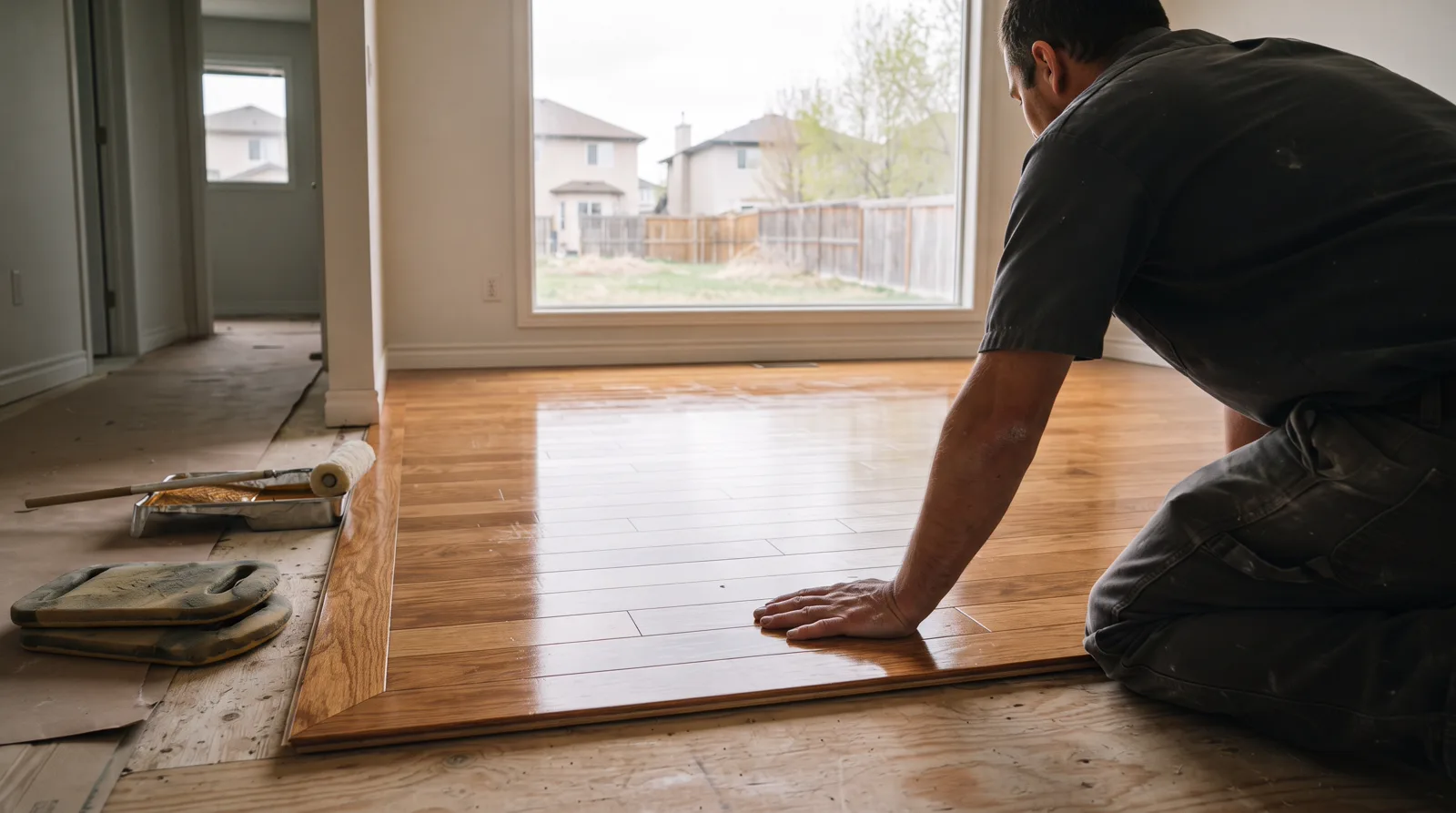
Hardwood Floor Refinishing That Lasts Alberta Winters.
Restore worn hardwood to showroom condition with dustless sanding, custom stain matching, and finishes engineered for freeze-thaw cycles and dry Prairie air.
Hardwood Refinishing Services
From light refreshes to full restoration, sized for Tri-Region homes and Alberta's seasonal stress on wood.
Standard Sand & Refinish
Three-grit drum sanding sequence, stain if desired, two coats of water-based polyurethane. Removes surface scratches, evens wear patterns, restores factory smoothness. Most common service for 10 to 20 year old floors showing traffic lanes.
Custom Stain Color Change
Full sand to bare wood, apply new oil or water-based stain, seal with compatible topcoat. Popular for updating honey oak to grey tones or walnut. Requires extra dry time between coats and proper humidity control during Alberta's dry winter months.
Deep Scratch & Gouge Repair
Hand-scrape damaged boards, fill with color-matched wood putty or epoxy, feather edges, spot-sand and blend finish. Common near entry doors where gravel and ice melt cause concentrated damage. Priced per severity, not square footage.
Water Damage Restoration
Remove and replace cupped or black-stained boards, dry subfloor to below 12% moisture, sand entire area to level, refinish to match. Alberta basements flood from sump failures and spring melt. Includes moisture meter verification before any finish is applied.
High-Traffic Commercial Refinishing
Heavy-grit initial pass, commercial-grade aluminum oxide finish rated for 500+ daily foot traffic, cure schedule that allows phased reopening. Sized for restaurant dining rooms, retail showrooms, office lobbies. Requires after-hours access and ventilation planning.
Low-VOC Eco Finish
Water-based zero-VOC polyurethane or natural hardwax oil, no solvent odor, safe for occupied homes with kids or pets during application. Longer cure time than oil-based but no respirator needed. Popular for bedrooms and nurseries where ventilation is limited.
Why Alberta Hardwood Needs Local Expertise
🌬️ Chinook Wind & Humidity Swings
January can hit 8% indoor humidity, July spikes to 60%. Finishes must flex with seasonal wood movement or they crack and peel within two years. Water-based poly with plasticizer handles Prairie swings better than rigid oil finishes from coastal climates.
❄️ Freeze-Thaw Gapping
Boards shrink in winter heating, expand in summer. Gaps up to 2 mm are normal and close on their own. Refinishing during shoulder seasons (April or October) when humidity is near annual average gives the most stable baseline for finish adhesion and color consistency.
🚪 Mudroom & Entry Abuse
Gravel, road salt, and ice melt concentrate wear at thresholds. Spruce Grove and Stony Plain homes show 3x more entry damage than southern markets. We reinforce high-impact zones with extra topcoat passes and recommend walk-off mats sized to capture four full strides.
📋 Parkland County Permit Reality
Residential refinishing rarely needs permits, but commercial spaces over 500 sq ft may trigger occupancy and ventilation reviews under Alberta Building Code 2019. We verify requirements with local inspectors before start and coordinate final walkthrough if your lease or insurance requires signoff.
What it costs here
Everything You Need to Know About Hardwood Floor Refinishing in Spruce Grove
How the process works, what to expect during the job, and how to maintain your newly refinished floors through Alberta's seasonal extremes.
What Hardwood Floor Refinishing Actually Is and Why It Works
Hardwood floor refinishing is the process of mechanically removing the worn surface layer of a solid wood floor, then applying fresh protective finish coats. Unlike surface cleaning or recoating, refinishing takes the floor back to bare wood using progressively finer grits of abrasive paper, erasing scratches, stains, discoloration, and finish failure accumulated over years of use. The process works because most hardwood flooring installed in Spruce Grove homes is three-quarter inch solid wood, which can be sanded down multiple times over its lifetime without compromising structural integrity. Each refinishing cycle removes roughly one sixteenth of an inch of wood, meaning a typical floor can be refinished five to seven times before the tongue and groove joinery or wear layer becomes too thin.
The reason refinishing delivers such dramatic results is that the damage you see on worn hardwood is almost always confined to the finish layer and the top fraction of the wood itself. Water marks from planters, scratches from furniture moves, traffic wear in doorways, and UV fading near windows all live in that top surface. Once that damaged layer is removed through controlled sanding, you expose fresh wood that still holds the grain pattern, color variation, and character of the original floor. The new finish you apply after sanding (polyurethane, oil-modified poly, or hardwax oil) then seals and protects that clean surface, giving you a floor that looks and performs like new installation at a fraction of the cost.
Refinishing differs fundamentally from screen and recoat, which many homeowners confuse with full refinishing. Screening uses a fine abrasive mesh to scuff an existing finish so a new topcoat can bond, but it does not remove the old finish or touch the wood itself. Screening works only when the existing finish is intact but dull, with no deep scratches, stains, or wear through to bare wood. In Spruce Grove's climate, where winter dryness causes finish checking and spring moisture drives cupping, most floors that look worn enough to need attention are past the point where screening helps. Full refinishing becomes the only option that restores both appearance and protection.
How Alberta's Climate Accelerates Hardwood Wear and Finish Breakdown
Spruce Grove sits in a climate zone that punishes hardwood floors in ways homeowners in milder regions never experience. Winter indoor humidity regularly drops below twenty percent when furnaces run continuously for weeks, pulling moisture out of wood flooring and causing individual boards to shrink. This seasonal contraction opens gaps between boards, stresses the finish at board edges, and creates the fine checking and cracking you see in finish coats on older floors. When spring arrives and outdoor humidity climbs, those same boards absorb moisture and expand, sometimes cupping at the edges if the subfloor beneath holds more moisture than the room air above. This annual cycle of expansion and contraction fatigues the finish layer, causing it to lose adhesion, crack along grain lines, and eventually peel or flake in high traffic areas.
Chinook winds add another layer of stress that few other regions deal with. A chinook event can swing indoor conditions from dry winter cold to warm dry air in less than a day, forcing rapid moisture changes in wood flooring that would normally take weeks. Floors installed without proper acclimation or finished during unstable weather are particularly vulnerable, developing finish adhesion problems or stress cracks within the first heating season. Even well-installed floors show accelerated aging after a decade of chinook cycles, especially in homes with south or west facing windows where UV exposure combines with temperature swings to break down finish chemistry faster than the manufacturer's expected lifespan.
The Parkland County area also experiences significant temperature differentials between main floors and basements, particularly in walk-out configurations common in acreage builds. A main floor hardwood installation might see summer temperatures near twenty-five Celsius and winter temperatures near twenty-two, while the basement slab stays closer to fifteen year round. If hardwood extends into a basement or lower level without proper climate separation, you often see finish failure and board movement concentrated in transition zones where temperature and humidity gradients are steepest. Refinishing these floors without addressing the underlying climate control issues will only buy you a few years before the same problems return.
The Real Warning Signs That Your Floor Needs Refinishing
The most definitive sign that refinishing is overdue is visible bare wood in traffic lanes. When you can see raw wood grain in doorways, in front of the kitchen sink, or along the path from the garage entry to the main living area, the finish has worn completely through and the wood itself is absorbing dirt, moisture, and staining agents. Once wood is exposed, surface cleaning does nothing but grind contaminants deeper into the grain. You may also notice these bare areas feel rough or fuzzy underfoot compared to areas where finish remains, because unprotected wood fibers raise when exposed to moisture from mopping or humidity swings. Any floor showing bare wood in even small areas needs full refinishing immediately, because continued exposure will cause permanent staining and grain raising that requires deeper sanding to remove.
Finish that has turned milky, cloudy, or yellowed beyond the original amber tone indicates chemical breakdown of the polyurethane or varnish layer. In Spruce Grove homes, this often appears first on south-facing floors where UV exposure is highest, or in kitchens where cooking oils and cleaning agents slowly degrade the finish from above while moisture from spills attacks from below. You might also see finish that has developed a spiderweb pattern of fine cracks called checking, particularly along board edges where seasonal movement stresses the film. Checking usually starts small and spreads over time, allowing moisture and dirt to penetrate under the finish and cause dark lines along cracks. Once checking covers more than scattered boards, recoating will not solve the problem because new finish cannot bond to a contaminated or failing base layer.
Deep scratches that catch your fingernail, water stains that have darkened the wood itself, and cupping or crowning of individual boards are all indicators that the floor has moved past cosmetic wear into structural or moisture-related damage. Cupping, where board edges sit higher than centers, usually means the underside of the floor has absorbed moisture, either from a subfloor issue or from seasonal humidity imbalance. Crowning, where board centers sit higher than edges, often follows cupping after a floor dries out, leaving a permanent deformation. Both conditions require not only refinishing but also diagnosis and correction of the moisture source. Pet urine stains that have penetrated deep into the wood, dark water rings from planters left too long, or black staining around old rug pads all indicate tannin or chemical reactions within the wood that will reappear through a new finish unless removed by sanding deep enough to eliminate the stained wood.
The Hardwood Floor Refinishing Process Step by Step
Preparation and Room Clearing
Refinishing starts with complete room clearing and preparation, which takes longer and matters more than most homeowners expect. Every piece of furniture, every area rug, and every wall hanging must come out, because sanding generates fine dust that penetrates everywhere despite containment efforts. Baseboards usually stay in place, but shoe molding and quarter round often get removed to allow sanding right to the wall edge and to prevent damage during the aggressive first sanding pass. HVAC registers get covered or sealed with tape, interior doors get removed or sealed with plastic, and any gaps around door frames or penetrations get sealed to prevent dust migration into the rest of the house. In Spruce Grove's dry climate, dust control becomes even more critical because the static charge on fine wood dust causes it to cling to walls, ceilings, and ductwork.
The floor itself gets inspected for protruding nails, staples from old carpet, or loose boards that will chatter or catch the sander. Any fasteners get set below the surface using a nail punch, because a single forgotten staple will tear the abrasive belt on a drum sander and cost time and material. Loose boards get refastened with finish nails or screws if accessible from above, or addressed from below if the subfloor is accessible. Gaps between boards get evaluated to determine if they are seasonal (normal) or structural (indicating subfloor movement or improper installation). Seasonal gaps from winter shrinkage usually close up after refinishing when indoor humidity stabilizes, so filling them is often skipped unless gaps exceed a quarter inch.
Sanding Sequence and Dust Extraction
The actual sanding happens in three or four passes using progressively finer abrasive grits, starting with a coarse grit that removes the old finish and surface damage, and ending with a fine grit that creates a smooth surface ready for finish. The first pass typically uses 36 or 40 grit on a drum sander for the main field, working diagonally or with the grain depending on floor condition and the severity of cupping or finish buildup. This coarse pass is aggressive and loud, removing finish, surface staining, and the top layer of wood in a single go. Edges and corners that the drum sander cannot reach get addressed with an edge sander using the same grit, requiring careful blending to avoid visible lines where the two machines meet.
After the coarse pass, the floor gets vacuumed thoroughly and inspected for remaining stains, deep scratches, or areas where old finish remains in grain pores or board edges. A second pass at 60 or 80 grit removes the scratches left by the coarse grit and begins to smooth the surface, while also giving a final chance to address problem areas before moving to finer grits. The third pass, usually at 100 or 120 grit, creates the final surface texture. Some refinishers add a fourth pass at 150 grit for ultra-smooth results, particularly under water-based finishes that highlight any remaining sanding marks. Each pass must be vacuumed completely before the next, because coarse grit particles left on the floor will be driven into the wood by the next finer grit, creating permanent scratches that telegraph through the finish.
Modern sanding equipment includes dust extraction systems that capture ninety to ninety-five percent of dust at the source, but no system is perfect. Fine dust still escapes into the air and settles on horizontal surfaces throughout the work area and adjacent rooms. After final sanding, the floor gets vacuumed with a fine-filter shop vacuum, then tacked with a microfiber cloth barely dampened with water or mineral spirits to pick up the last clinging dust. Any moisture introduced at this stage must be minimal and must be allowed to dry completely before finish application, because water raised grain will telegraph through the finish as roughness, and mineral spirits contamination will cause adhesion failure.
Staining and Finish Application
Staining is optional and depends entirely on whether you want to change the wood color or enhance its natural tone. Most oak, maple, and birch floors in Spruce Grove homes were originally finished natural or with a light amber tone, and many homeowners choose to go darker during refinishing for a more modern look or to hide minor remaining imperfections. Stain gets applied after final sanding and tacking, usually by wiping on with a rag or lambswool applicator, allowing it to penetrate for the time specified by the manufacturer (typically five to fifteen minutes), then wiping off the excess. Stain that sits too long or is not wiped evenly will dry blotchy, particularly on maple or birch, which absorb stain unevenly due to their tight grain. Oil-based stains are standard in this climate because they give more working time in dry conditions and produce more predictable color, though water-based stains are gaining use for their lower odor and faster recoat times.
Finish application is the final and most critical step, because it determines durability, appearance, and how the floor will age over the next decade. Oil-based polyurethane remains the most common choice for residential refinishing in Alberta, delivering hard, amber-toned protection that stands up to traffic, moisture, and temperature swings. It requires two to three coats, with light sanding between coats using 220 grit or a fine abrasive pad to ensure mechanical bonding. Each coat needs eight to twelve hours to dry enough for recoating, and the final coat needs seventy-two hours before furniture returns and a full week before area rugs go down. Water-based polyurethane dries faster and stays clear instead of ambering, but costs more, requires more coats for equivalent protection, and shows every surface imperfection that oil-based finish would hide.
Application method matters as much as product choice. Professional refinishers typically use lambswool applicators or specialized finish mops for oil-based poly, working in straight lines with the grain and maintaining a wet edge to avoid lap marks. Water-based finishes often go on with synthetic applicators or roller systems designed to minimize bubbles and streaking. The room must be kept as dust-free as possible during application and drying, with no air movement from fans or open windows that would stir dust or cause uneven drying. Temperature and humidity both affect cure time and finish leveling. In Spruce Grove's dry winter air, finishes can dry too fast and show brush marks or bubbles, while high summer humidity can extend dry times and cause finishes to remain tacky longer than expected.
Real Cost Breakdown for Tri-Region Hardwood Floor Refinishing
Hardwood floor refinishing in Spruce Grove, Stony Plain, and Parkland County typically runs $3 to $5 per square foot for a full sand and refinish job. A standard 1,000 square foot main floor will cost $3,000 to $5,000, while larger open-concept homes pushing 1,500 to 2,000 square feet can reach $6,000 to $10,000. These prices assume oak or maple in decent condition with two coats of polyurethane. If your floors need significant repair work, deep sanding to remove cupping from water damage, or specialty stains that require extra coats, expect the upper end of the range or higher. The square footage rate drops slightly on larger jobs because setup and equipment costs spread over more area.
Several factors push Tri-Region refinishing costs up or down. Floor species matters: softer pine or fir sand faster and cost less, while exotic hardwoods like Brazilian cherry or hickory require carbide-grit paper and more passes, adding $1 to $2 per square foot. Existing finish type affects labor: old polyurethane sands predictably, but wax finishes or unknown coatings from the 1960s and 1970s require test spots and sometimes chemical stripping before sanding can start. Room layout and furniture removal drive costs too. An empty room with no base trim removal runs cheaper than a furnished space where the contractor moves heavy furniture, pulls floor registers, and carefully detaches baseboards. Some Tri-Region contractors charge $200 to $400 flat for furniture moving and base trim work, others build it into the per-square-foot rate.
Stain and finish choices create the widest price swings. Clear polyurethane over natural wood is the baseline. Custom stain colors add $0.50 to $1 per square foot because they require careful even application, adequate dry time, and an extra day on site. Water-based polyurethane costs $1 to $1.50 more per square foot than oil-based but dries faster, smells less, and stays clear longer under Alberta sun exposure through south-facing windows. Hard wax oil finishes popular in acreage homes run $1.50 to $2 more per square foot and need annual maintenance, but they allow spot repairs without full refinishing. Multi-coat systems with sealers and two topcoats add another $0.75 to $1.25 per square foot. Always ask for a written quote that breaks out square footage, finish type, number of coats, and any repair or prep work so you can compare contractors on equal terms.
Comparing Refinishing Methods: Which Works Best in Alberta Conditions
Drum sanding is the traditional method and still the most common for heavily worn floors in older Spruce Grove and Stony Plain homes. A drum sander uses a rotating cylinder with coarse-grit paper to remove the old finish and level the wood in long passes along the grain. It cuts fast and handles deep scratches, pet stains that penetrated the wood, and uneven boards from decades of settling. Drum sanders remove about one sixteenth of an inch of wood per full refinish, so floors can typically be refinished four to six times before the tongue-and-groove joints weaken or you hit nail heads. The downside is operator skill: an inexperienced contractor can gouge waves into your floor or sand through to the subfloor on a corner. Drum sanding also creates significant dust even with vacuum attachments, so expect fine powder on window sills and upper shelving despite plastic barriers.
Orbital or random-orbit sanding has become popular for newer floors or those in good condition that just need a cosmetic refresh. These machines use round sanding disks that spin and oscillate, removing finish more gently than drum sanders. Orbital sanders rarely gouge or create waves, making them safer for DIY-minded homeowners, but they take longer and struggle with deep damage or uneven boards. Many Tri-Region contractors use a hybrid approach: drum sanding for the main field to flatten and remove heavy wear, then orbital sanding for the final passes to eliminate drum sander chatter marks and create a glass-smooth surface. This combination delivers professional results in two to three days for a typical main floor. Orbital-only jobs work well for five to ten year old floors that need a light scuff and recoat but do not justify full refinishing cost.
Dustless or low-dust systems are worth asking about if you live in the home during refinishing or have respiratory concerns. True dustless sanding uses industrial vacuums rated at 300 to 600 cubic feet per minute connected directly to the sander, capturing 95 to 98 percent of dust at the source. You will still see some fine dust settlement, but nothing like traditional methods that coat entire rooms. Most Tri-Region contractors offer dustless as standard now because it reduces cleanup time and client complaints. The equipment costs more to buy and maintain, so some smaller operators charge $0.25 to $0.50 extra per square foot for dustless service. If a contractor offers significantly lower pricing but uses old equipment with no dust control, factor in your own time to clean or hire a cleaning service afterward. Drywall dust and hardwood sanding dust are different animals: hardwood dust is finer, travels farther, and settles into HVAC systems and behind appliances if not controlled.
Common Mistakes and Contractor Red Flags to Avoid
The biggest homeowner mistake is refinishing floors that cannot handle another sand. Engineered hardwood with a thin veneer layer, often just 2 to 3 millimeters, can only be refinished once or not at all depending on veneer thickness. Some homeowners discover this mid-project when the contractor sands through to plywood backing. Before committing to refinishing, verify you have solid hardwood at least three quarters of an inch thick. Check in a floor register opening, under a base trim piece, or drill a small test hole in a closet if uncertain. Engineered floors that fail mid-refinish turn into expensive replacement projects. Solid hardwood installed in the 1950s through 1980s in older Spruce Grove homes typically has plenty of wood left for multiple refinishes, but newer builds after 2000 often used engineered products to save cost.
Choosing finish based on appearance alone without considering household use patterns leads to regret within months. Oil-based polyurethane is extremely durable and resists scratches from dog claws, grit tracked in from rural driveways, and dropped tools in workshop areas, but it ambers over time and takes 24 hours between coats. Water-based polyurethane stays crystal clear and dries in two to four hours, allowing faster project completion, but it scratches more easily and shows wear patterns sooner in high-traffic entries and hallways. Hard wax oil finishes look beautiful and feel natural underfoot, perfect for acreage homes aiming for a European aesthetic, but they require reapplication every 12 to 18 months and offer little protection against water spills or pet accidents. Match your finish to your actual life: busy families with kids and dogs need oil-based polyurethane or commercial-grade water-based products, while empty nesters in low-traffic homes can enjoy the beauty of wax oil or single-component finishes.
Skipping proper acclimatization before refinishing causes finish failures in Alberta's extreme seasonal humidity swings. Hardwood expands in summer humidity and contracts in winter when forced-air furnaces dry indoor air below 25 percent relative humidity. Refinishing floors in August when wood is fully expanded, then watching them shrink in January, opens gaps between boards that trap dirt and look unfinished. Professional contractors check moisture content with a pin or pinless meter and delay work if readings exceed 12 percent or fall below 6 percent. Ideally, refinish in shoulder seasons like May or September when indoor and outdoor humidity stabilize near 40 to 50 percent. If you must refinish in winter, run a humidifier for a week before and during the project to prevent excessive wood shrinkage. Chinook winds that spike winter temperatures in the Tri-Region can cause rapid humidity drops, so monitor conditions and communicate with your contractor about timing.
Contractor Red Flags That Signal Problems Ahead
A contractor who quotes over the phone without seeing your floors is guessing and will almost certainly hit you with change orders once work starts. Legitimate refinishing estimates require an in-person inspection to check wood species, existing finish type, subfloor condition, and damage extent. The contractor should pull a floor register or lift a corner of base trim to verify solid versus engineered construction and measure moisture content. Quotes that come back within an hour of a ten-minute walk-through rarely account for hidden issues like previous bad repairs, water stains that penetrated deep into the wood, or subfloor squeaks that need fixing before refinishing. Expect a thorough contractor to spend 20 to 30 minutes measuring, testing, and asking about your finish preferences before providing a written quote days later.
Be cautious of contractors who push you toward the most expensive finish options without explaining trade-offs or who dismiss your questions about durability and maintenance. A good refinishing pro will ask how you use the space, whether you have pets, and what look you want, then recommend two or three finish systems that fit your needs and budget. High-pressure sales tactics, vague descriptions like premium finish or European system without naming actual products, and resistance to providing manufacturer data sheets all signal a contractor more interested in margin than results. Ask specifically what products they will use by brand and product line, then verify those products exist and match the described characteristics. Some contractors buy contractor-grade finishes in five-gallon pails with no consumer labeling and claim they are commercial or professional grade to justify markups.
How to Hire the Right Hardwood Floor Refinishing Pro in the Tri-Region
Start by verifying the contractor holds liability insurance in Alberta and at least $2 million in commercial general liability insurance. Hardwood refinishing involves heavy equipment, flammable finishes, and the potential for serious property damage if a sander gouges your floor or finish fumes ignite. Ask for proof of both before signing any contract, and call the WCB number on the clearance letter to confirm it is current, not expired. Uninsured contractors offer tempting low prices but leave you fully liable if a worker gets injured on your property or if faulty work damages your home. Some Tri-Region homeowners have faced $30,000 to $50,000 bills to replace entire floors after uninsured contractors botched refinishing and disappeared. Legitimate professionals carry insurance as a cost of doing business and provide proof without hesitation.
Check references specific to flooring work completed in the past 12 months, and drive by those addresses if possible to see the results firsthand. Phone references can be friends or family, and online reviews are easily faked or gamed, but actual homes in Spruce Grove and Stony Plain that you can verify give real insight. Ask the contractor for three to five recent projects similar in scope to yours, then contact those homeowners and ask how the project went, whether the timeline held, if the quote matched the final bill, and how the floors look a year later. Pay attention to complaints about dust control, finish durability, and communication during the job. A contractor with strong recent references who welcomes your calls to past clients is confident in their work. One who hesitates, offers only glowing five-star reviews from anonymous sources, or provides references from five years ago may be hiding recent problems.
Insist on a detailed written contract that specifies square footage, wood species, finish products by brand and product line, number of coats, prep work included, furniture moving responsibilities, cleanup expectations, and a day-by-day timeline. Vague contracts with language like sand and refinish floors or apply quality finish leave room for disputes over what was promised versus what was delivered. The contract should state whether you or the contractor removes furniture, who handles base trim removal and reinstallation, and what happens if hidden damage like subfloor rot appears mid-project. Payment terms matter too: never pay the full amount upfront. Standard practice is 10 to 25 percent deposit to secure the schedule, 50 percent after sanding and staining are complete, and the final 25 to 40 percent once you inspect and approve the finished floors. Contractors who demand 50 percent or more upfront before starting work are either cash-strapped or running payment schemes where your deposit funds someone else's incomplete project.
How Tri-Region Services Helps
Tri-Region Services connects you with one vetted, insured local hardwood floor refinishing contractor who serves Spruce Grove, Stony Plain, Parkland County, and Acheson. Contractors state that they carry liability insurance when they sign up, and we show that on their listing, so you skip the guesswork and risk of hiring strangers off the internet. Request a quote through our site and a qualified professional will contact you within one business day to schedule an in-person assessment and provide a free written estimate with no obligation. You get the confidence of working with a proven local pro without spending hours vetting contractors yourself.
How We Screen Hardwood Refinishing Contractors
Every pro in our network clears these checks before we connect you. No exceptions.
liability insurance
COR-certified where available, current clearance letter on file, no outstanding claims that would delay your project or expose your property to liability.
Commercial General Liability Insurance
Minimum $2 million occurrence coverage verified within 90 days, includes completed operations so you're protected long after the crew leaves.
Dustless Sanding Systems
HEPA-rated vacuum attachment on drum and edger sanders captures 95%+ airborne particles, protects HVAC and reduces cleanup from days to hours.
Written Finish Warranty
Minimum two-year coverage against peeling, bubbling, or adhesion failure when you follow basic care instructions, with clear remedy process if issues appear.
Local Spruce Grove & Stony Plain References
Recent projects within 20 km, same climate and building stock, contactable homeowners who will confirm timeline, cleanliness, and finish durability after at least one full winter.
Humidity & Ventilation Planning
Provides target indoor humidity range during cure (40% to 55%), recommends dehumidifier or fan placement, explains odor timeline so you can plan occupancy and pet boarding if needed.
This page is not tied to a contractor's brand. Leads route straight to your one local partner. Verified reviews can appear here once that partner has them (never fabricated).
Serving the whole Tri-Region
7 Questions Homeowners Ask Before Refinishing
How long does hardwood floor refinishing take from start to finish?+
Do I need to leave my home during hardwood floor refinishing?+
What's the best time of year to refinish hardwood floors in Alberta?+
How do I prevent gaps and cupping after refinishing in dry Alberta winters?+
Can you match the stain color on my existing hardwood floors?+
How long before I can put furniture and area rugs back on refinished floors?+
What's the odor and ventilation situation with modern hardwood finishes?+
Is refinishing cheaper than replacing hardwood floors?+
Get your free quote
Tell us what you need and a local pro will get right back to you.
- ✓ Sent straight to a local business
- ✓ You choose who you hire
- ✓ Free, with no obligation