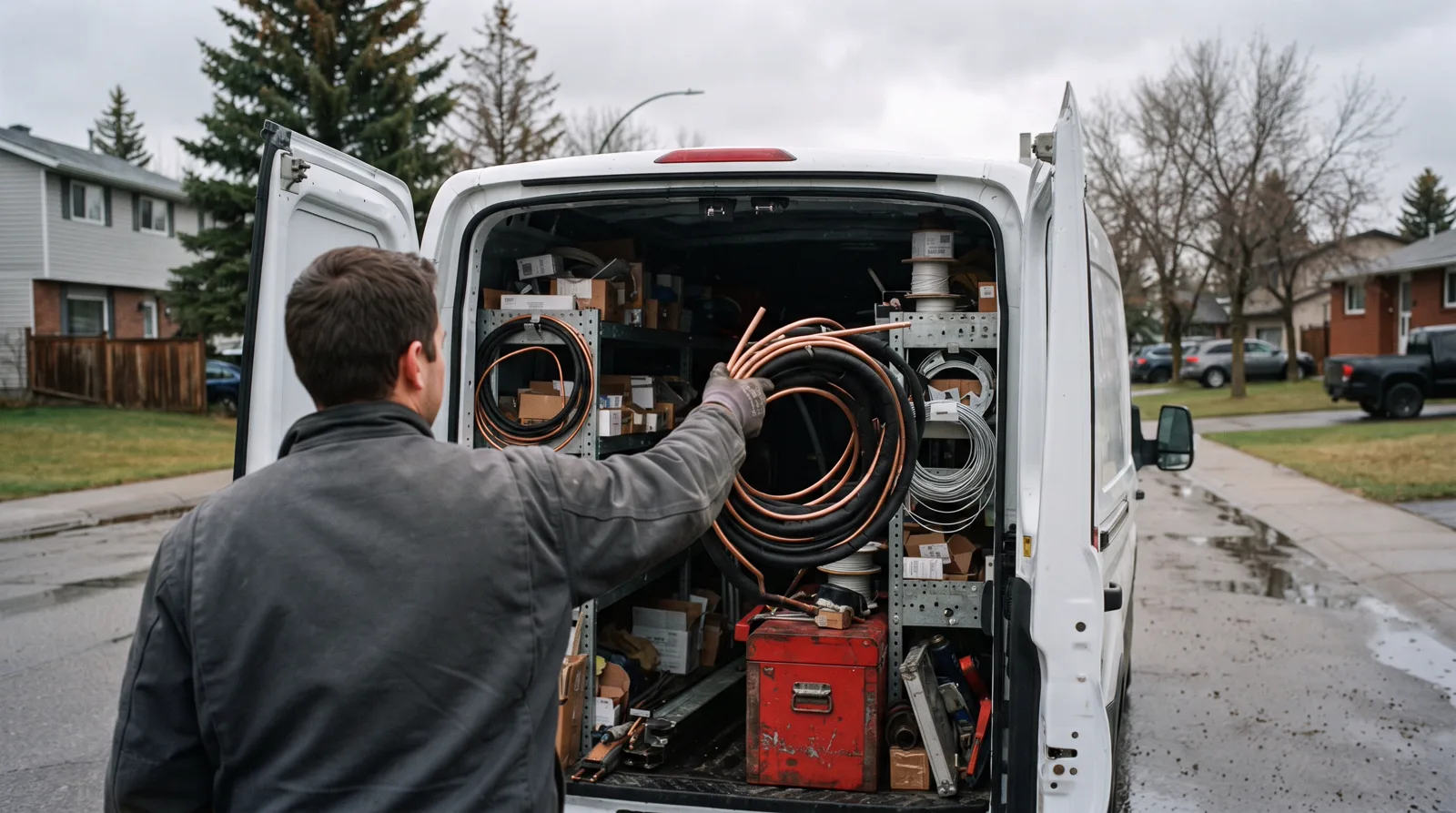
Heat Pump Installation for Alberta's Real Climate
Local pros install and commission cold climate heat pumps engineered to deliver reliable heating when Spruce Grove hits -35°C, with load calculations, permit coordination, and backup heat integration.
Complete Heat Pump Installations
From load calculation through commissioning, local pros handle the full scope so your system works flawlessly in January and July.
Manual J Load Calculation & System Sizing
We measure your home's actual heat loss using wall assembly R-values, window specs, and infiltration data to prevent undersizing. This calculation drives equipment selection and ensures you have capacity at -35°C without over-buying tonnage. The report satisfies permit requirements and qualifies you for rebates.
Cold Climate Air Source Heat Pump Install
Installation of ducted cold climate heat pumps rated to -30°C or colder, with vapor-injected scroll compressors and low-ambient controls. Includes outdoor pad or wall bracket, refrigerant line set, condensate drain with heat trace, electrical service upgrade coordination, and integration with existing forced-air ductwork. Local pros install brands like Mitsubishi Zuba, Carrier Greenspeed, and Lennox cold climate models that maintain full heating capacity in Alberta winters.
Dual Fuel Hybrid System Setup
We configure your heat pump to work alongside your natural gas furnace, automatically switching based on outdoor temperature and energy cost. The thermostat calculates the breakeven point, typically around -15°C to -20°C, so you burn gas only on the coldest nights. This setup maximizes efficiency while guaranteeing you never lose heat, even during polar vortex events.
Ductless Mini-Split Installation
Installation of single-zone or multi-zone mini-split systems for additions, garages, shops, or homes without ductwork. We core through walls, mount indoor heads with proper drainage slope, run refrigerant and electrical lines inside protective conduit, and pressure-test before charging. Each zone gets its own remote and can operate independently, ideal for zoning a walkout basement or heated workshop.
Electrical Service & Panel Upgrades
Heat pumps draw 30 to 60 amps, often requiring a panel upgrade from 100A to 200A service. Our licensed electricians coordinate with EPCOR or FortisAlberta, pull permits through Spruce Grove or Parkland County, install the new breaker and disconnect, and ensure code-compliant wiring. We schedule inspections and provide you with the signed-off permit for rebate claims.
Heat Pump Commissioning & Calibration
After installation, we verify refrigerant charge with superheat and subcooling measurements, confirm airflow across the coil meets manufacturer specs, calibrate the thermostat, program defrost cycles, and test backup heat staging. We leave you with a commissioning report and walk you through the thermostat settings so you understand economy mode, aux heat lockout, and scheduling.
Why Alberta Heat Pumps Are Different
🌡️ Cold Climate Performance Below -25°C
Standard heat pumps lose 50% capacity by -20°C. Local pros install only cold climate models with vapor injection and variable-speed inverters that maintain rated BTU output to -30°C, critical for January cold snaps in Spruce Grove and Stony Plain. Below that temperature, your backup heat stages automatically.
💨 Chinook Wind and Defrost Cycling
Alberta's chinook winds create rapid temperature swings, triggering frequent defrost cycles that can ice up poorly tuned systems. We adjust defrost initiation settings and verify drain line heat trace so meltwater doesn't freeze into a block on your pad, a common failure mode west of Edmonton.
🏗️ Spruce Grove and Parkland County Permits
Spruce Grove requires HVAC and electrical permits for heat pump installs; Parkland County requires a development permit for any outdoor equipment within setback zones. We submit drawings, coordinate inspections, and ensure your installation is legal and insurable, avoiding the liens that come with unpermitted work.
⚡ EPCOR and ATCO Rebate Coordination
EPCOR offers up to $4,500 for cold climate heat pumps in their service area, while ATCO and other utilities have separate programs. We provide the invoices, equipment specs, and commissioning data required for applications, and advise on federal Greener Homes grants that stack with provincial incentives.
What it costs here
Everything You Need to Know About Heat Pump Installation in Spruce Grove
Cold climate engineering, backup strategies, ROI timelines, and what to expect from consultation through first winter.
How Heat Pump Installation Actually Works in Spruce Grove and Parkland County
Heat pump installation is not simply hanging a unit on your wall and plugging it in. A professional installation starts with a detailed heat loss and heat gain calculation specific to your home's square footage, insulation levels, window count, ceiling height, and orientation. In Spruce Grove and Stony Plain, installers must account for Alberta's extreme temperature swings, from minus 35°C winter lows to plus 30°C summer peaks. The system must be sized correctly, because an undersized unit will struggle during January cold snaps and an oversized unit will short cycle, wasting electricity and failing to dehumidify properly in summer. This calculation process takes one to two hours onsite and determines whether you need a single zone ducted system, a multi-zone ductless setup, or a hybrid approach that keeps your existing furnace as backup.
The physical installation involves mounting an outdoor condenser unit on a concrete pad or wall bracket, installing one or more indoor air handlers (either wall-mounted heads, ceiling cassettes, or ducted units), and running refrigerant lines, electrical wiring, and condensate drainage between them. In Parkland County and Acheson, frost heaving is a real concern, so outdoor pads must be poured at least 150 millimetres thick and placed below the frost line or on compacted gravel with proper drainage. The refrigerant lines are insulated copper tubing that must be brazed (not compression fitted) and vacuum tested to ensure no leaks. Poor brazing is the number one cause of heat pump failures within the first three years, because even tiny leaks allow moisture into the refrigerant circuit, which then freezes and damages the compressor.
Electrical work includes running a dedicated 240-volt circuit from your panel to the outdoor unit and low-voltage control wiring between indoor and outdoor components. In Alberta, this work must be done by a licensed electrician or a qualified HVAC technician under an electrical permit. Many Spruce Grove homes built before 1990 have 100-amp service panels that are already near capacity, so upgrading to a 200-amp panel may be required before adding a heat pump load. The indoor air handler also needs a condensate drain line that either connects to your home's plumbing stack or drains to the exterior through a dedicated pipe that must be sloped and insulated to prevent winter freeze-ups. Installations typically take one to three days depending on system complexity, with ductless mini-splits on the shorter end and whole-home ducted systems requiring more time.
Why Alberta's Climate Makes Heat Pumps Both Challenging and Necessary
Alberta's temperature extremes push heat pump technology to its limits, but recent advances in cold-climate heat pumps have made them viable even in Spruce Grove's harsh winters. Standard air-source heat pumps lose efficiency rapidly below minus 10°C, but cold-climate models now maintain heating capacity down to minus 25°C or colder. The challenge is that heat pumps work by extracting heat from outdoor air and concentrating it indoors, so the colder it gets outside, the harder the system must work and the less heat is available to extract. During a deep freeze in January or February, your heat pump may need supplemental heat from electric resistance coils or your existing furnace, which is why many local installations are hybrid systems that automatically switch to natural gas heat when outdoor temperatures drop below a set threshold, usually around minus 20°C.
Chinook winds create another layer of complexity. A sudden temperature swing from minus 20°C to plus 5°C in 24 hours causes rapid freeze-thaw cycles that stress outdoor units. Ice buildup on the condenser coil is normal during winter operation, and quality heat pumps have automatic defrost cycles that briefly reverse the refrigeration process to melt accumulated frost. However, chinook conditions can overwhelm this system, leading to ice dams around the base of the outdoor unit or icicle buildup that blocks airflow. Proper installation includes elevated mounting (at least 300 millimetres above expected snow depth) and strategic placement away from roof drip lines and areas where meltwater accumulates. Homes in Parkland County near agricultural fields also face wind-blown dust and chaff that can clog outdoor coils, requiring more frequent cleaning than urban installations.
Summer humidity in Spruce Grove is relatively low compared to eastern provinces, which actually works in favor of heat pumps. Air conditioning mode is the most efficient operation for any heat pump because it's easier to move heat out of your home than to extract it from frigid outdoor air. A properly sized system will keep your home comfortable even during July heat waves while using 50 to 70 percent less electricity than traditional air conditioning because the heat pump moves heat rather than generating cooling through raw electrical resistance. The dry Alberta climate also means condensate drainage is lighter, reducing the risk of drain pan overflow or blocked lines. However, spring and fall shoulder seasons bring the best efficiency, when outdoor temperatures are moderate and the system can heat or cool your home using minimal energy.
Clear Signs You Need Heat Pump Installation (Not Just a Furnace Replacement)
Your natural gas bills are climbing year over year, even though your usage habits have not changed. Spruce Grove homeowners with older furnaces (15 years or more) are often running units with 80 percent AFUE ratings or lower, meaning 20 cents of every heating dollar goes straight up the chimney as waste heat. Heat pumps deliver 200 to 400 percent efficiency because they move existing heat rather than burning fuel to create it. If your winter gas bills consistently exceed $250 per month in a home under 2,000 square feet, a heat pump could cut your heating costs by $100 to $150 monthly during moderate winter weather (October through December and March through April). The payback calculation changes with natural gas prices, but with current rates around $4 to $6 per gigajoule and electricity at 10 to 16 cents per kilowatt-hour, heat pumps typically break even within seven to 12 years when you factor in federal and provincial rebates.
You have no air conditioning, and you are tired of suffering through summer heat waves or running expensive window units. Installing central air conditioning alongside your furnace costs $4,000 to $7,000 in Stony Plain, while a cold-climate heat pump that provides both heating and cooling runs $8,000 to $16,000 depending on system type. For the incremental cost difference, you gain year-round climate control and heating efficiency that pays dividends every winter. Many Parkland County homeowners who install heat pumps report that the summer cooling benefit alone justifies the investment, with winter heating savings as a bonus. Window units are noisy, inefficient (often drawing 1,500 watts to cool a single room), and require installation and removal every season. A permanent heat pump solution adds tangible value when you sell your home.
Your home has rooms that are always too hot or too cold, or you want to add climate control to a garage, shop, or new addition without extending ductwork. Ductless mini-split heat pumps excel in this scenario because each indoor head operates independently with its own thermostat. A common Spruce Grove installation involves adding a mini-split to a master bedroom that overheats in summer because it faces south, or conditioning a finished basement suite that never gets adequate airflow from the main furnace. These targeted installations cost $3,500 to $6,500 for a single-zone system and solve comfort problems that would otherwise require expensive ductwork modifications. Garage and workshop heating is another ideal application, because you can set the space to a lower temperature when not in use and quickly warm it up without heating the entire house.
Furnace Failure Timing and Strategic Planning
Your furnace is approaching 18 to 25 years old, or it has required multiple repairs in the past three years. At this stage, you face a decision point: invest $1,200 to $2,500 in another repair, replace the furnace with an identical model for $4,000 to $6,500, or step up to a heat pump system. If the furnace fails in December or January when outdoor temperatures are consistently below minus 20°C, you will likely default to a quick furnace replacement because heat pump installation takes longer and you need heat immediately. Strategic homeowners in Acheson and Stony Plain schedule heat pump consultations in spring or fall when there is no emergency pressure, allowing time to compare quotes, apply for rebates, and book installation during contractor shoulder seasons when pricing is more competitive.
Combining a new high-efficiency furnace with a heat pump in a hybrid configuration offers the best of both worlds for Alberta's climate. The heat pump handles heating duty from plus 15°C down to minus 15°C or minus 20°C, operating at two to three times the efficiency of the furnace. When temperatures drop further, the system automatically switches to natural gas, avoiding the low-efficiency range where the heat pump struggles. This approach costs $12,000 to $20,000 but virtually eliminates the risk of being without heat during extreme cold, which is a legitimate concern with heat pump only installations in our climate. Insurance companies and mortgage lenders prefer homes with backup heating sources, particularly in rural Parkland County where power outages during winter storms can last hours or occasionally days.
The Complete Heat Pump Installation Process from Consultation to Commissioning
Step one is an in-home assessment where a qualified HVAC contractor examines your existing heating system, electrical panel capacity, indoor space for air handler placement, and outdoor locations for the condenser unit. The technician measures rooms, notes insulation levels (check your attic, it should be R-50 or better in Alberta), counts and measures windows, and identifies thermal weak points like uninsulated basement walls or poorly sealed doors. This visit should include a blower door test or at least a visual inspection for air leakage, because heat pumps work best in reasonably tight homes. If your home is drafty, the contractor should recommend air sealing as a prerequisite or concurrent project. You will receive a written proposal detailing equipment specifications (brand, model, SEER rating, HSPF rating, BTU capacity), installation scope, permit costs, warranty terms, and a timeline. Expect to pay $200 to $500 for a detailed assessment if you do not proceed with installation, though most contractors waive this fee if you hire them.
- Manual J heat load calculation documenting your home's exact heating and cooling requirements
- Equipment specification sheet showing efficiency ratings and operating temperature range
- Site plan indicating outdoor unit placement, refrigerant line routing, and electrical pathway
- Itemized quote separating equipment, labor, permits, electrical work, and any duct modifications
- Rebate eligibility confirmation for federal Greener Homes grants and any active provincial programs
Permitting, Inspections, and Code Compliance in Spruce Grove
Before installation begins, your contractor must pull a building permit from the City of Spruce Grove, Town of Stony Plain, or Parkland County, depending on your location. The permit costs $150 to $300 and requires submitting equipment specifications, electrical load calculations, and a site plan. Alberta's Safety Codes Act requires that gas, electrical, and plumbing work meet provincial standards and be inspected by accredited agencies. For heat pump installations, you typically need an electrical inspection to verify the new 240-volt circuit and panel modifications, and a gas inspection if you are installing a hybrid system that connects to your existing furnace. Inspections happen after rough-in (wiring and line sets installed but not yet connected) and after final commissioning.
Reputable contractors include all permit and inspection costs in their quotes and schedule inspections as part of the installation process. You should never hear that permits are optional or that the work is too small to require inspection. If an unlicensed installer does the work and you later file an insurance claim for fire damage or refrigerant leak, your insurer may deny the claim based on non-compliant installation. Alberta New Home Warranty programs and some insurance policies explicitly require that HVAC work be done by licensed technicians under permit. liability insurance is equally important: ensure your contractor carries active Workers Compensation Board insurance, because if an installer is injured on your property and the company lacks liability insurance, you could be personally liable for medical costs and lost wages.
Installation Day: What Happens in Your Home
The crew arrives with the equipment and begins by protecting your floors and work areas with drop sheets and floor runners. They mark the outdoor unit location and indoor air handler positions, then cut any necessary holes for refrigerant line penetrations through exterior walls. These penetrations must be sealed with spray foam and exterior caulking rated for Alberta freeze-thaw cycles. For ductless systems, installers mount the indoor heads on interior walls, typically 15 to 20 centimetres below the ceiling for optimal air distribution. For ducted systems, they position the air handler in your furnace room, attic, or basement and connect it to your existing duct network or install new supply and return ducts as needed.
Outside, the team pours or levels the concrete pad (if not already done on a previous day), sets the condenser unit, and connects refrigerant lines that run through the wall penetration to the indoor components. Refrigerant lines are hard copper that must be cut to exact length, deburred to remove metal shavings, and brazed with silver solder while flowing nitrogen through the lines to prevent internal oxidation. This is skilled work that takes time to do correctly. The electrical crew runs the 240-volt power line from your panel to a disconnect box beside the outdoor unit, then connects low-voltage control wires between indoor and outdoor equipment. After all connections are complete, they vacuum the refrigerant lines to remove air and moisture, then charge the system with the correct type and amount of refrigerant (R-410A for older systems, R-32 or R-454B for newer models).
Commissioning involves starting the system and verifying that it heats and cools properly, refrigerant pressures are within specification, airflow is balanced, and all safety controls function correctly. The technician programs the thermostat, explains operation and maintenance procedures, and walks you through the warranty registration process. You should receive a commissioning report documenting refrigerant charge, electrical voltage and amperage readings, and airflow measurements. This document becomes important if you ever have warranty claims or need to prove proper installation to an insurance adjuster. The entire process for a straightforward ductless mini-split takes one full day, while a complex ducted or hybrid system may require two to three days plus a return visit after inspections to complete final connections.
What Heat Pump Installation Actually Costs in Spruce Grove, Stony Plain and Parkland County
A complete heat pump installation in the Tri-Region typically ranges from $8,500 to $22,000, with most homeowners paying between $11,000 and $16,500 for a quality cold-climate system. This price includes the outdoor condenser unit, indoor air handler, refrigerant lines, electrical work, condensate drainage, permits, startup and warranty registration. Single-zone mini-splits land at the lower end, around $4,200 to $7,800 per indoor head, while whole-home ducted systems for a 1,500 to 2,200 square foot house push toward the middle and upper range. Properties in rural Parkland County sometimes face higher costs due to longer travel distances, specialized mounting requirements for older farmhouses, or upgraded electrical panels required to handle the load.
The biggest price driver is system capacity measured in tons or BTUs, directly tied to your home's heating and cooling needs. A 2.5 ton heat pump suits a well-insulated 1,400 square foot bungalow, costing around $10,500 to $13,000 installed. A 3.5 or 4 ton system for a two-story 2,400 square foot home with moderate insulation runs $13,500 to $17,500. Cold-climate performance matters enormously here. Standard heat pumps lose substantial capacity below minus 10 Celsius and become inefficient backup heaters by minus 20. True cold-climate models from manufacturers like Mitsubishi, Fujitsu, or Bosch maintain heating capacity down to minus 25 or minus 30 Celsius, critical during January cold snaps in Spruce Grove. These units cost $1,800 to $3,500 more than standard models but deliver actual heat when you need it, not just expensive resistance heating.
Labour represents 35 to 45 percent of your total project cost and varies based on installation complexity. A straightforward replacement where ductwork, electrical and refrigerant lines already exist might add only $2,800 to $4,200 in labour. New installations requiring ductwork modifications, wall penetrations for line sets, electrical panel upgrades from 100 to 200 amps, or structural reinforcement for rooftop condenser mounting push labour to $5,500 to $8,500. Homes in Acheson's industrial area or acreages outside Stony Plain sometimes need trenching for ground-mounted condensers to keep units away from snow drifts or agricultural equipment, adding $600 to $1,400. Permit fees in Spruce Grove and Stony Plain run $150 to $280 for HVAC and electrical combined, and your contractor should always pull these permits rather than attempting unpermitted work that voids manufacturer warranties and creates insurance headaches.
What Drives Your Final Price Up or Down
Existing infrastructure has the single largest impact on installation cost. Homes built after 2005 often have adequate ductwork sizing, insulation and electrical capacity, making heat pump installation relatively straightforward. Older homes in established Spruce Grove neighbourhoods like Grove Park or Hilldowns frequently need duct sizing corrections because original forced-air systems moved less air at higher temperatures than heat pumps require. Undersized ducts create velocity noise, frozen coils in winter, and efficiency losses that negate your energy savings. Proper duct modifications add $1,200 to $3,800 depending on how many runs need resizing and whether your basement or crawlspace allows easy access.
Your electrical service and panel capacity determines whether you need costly upgrades. Heat pumps draw 20 to 50 amps depending on size, and cold-climate models with auxiliary heat strips can pull 60 to 80 amps during defrost cycles or extreme cold. Many homes in Parkland County still operate on 100 amp services barely managing existing loads. Panel upgrades to 200 amps cost $2,200 to $3,800 including utility coordination, trenching if your meter base needs relocation, and inspection fees. Acreages on well water pumps, shop heaters or EV chargers almost always need this upgrade. Some contractors quote the heat pump installation separately and spring the electrical costs on you later, so ask explicitly whether your service can handle the new load during the estimate visit.
Refrigerant line length and placement complexity also affect pricing. Standard quotes assume 25 to 35 feet of line set between indoor and outdoor units. Every additional 10 feet adds $180 to $320 in materials and labour because longer runs require larger diameter tubing, more refrigerant charge, and pressure testing. Multi-story homes where the air handler sits in a second-floor closet and the condenser mounts on grade 40 feet away fall into this category. Aesthetic routing where homeowners want lines concealed in walls rather than surface-mounted adds another $400 to $900 in drywall cutting, patching and painting. Contractors who provide one-line pricing without measuring your actual layout often underbid and either eat the cost, leading to rushed work, or surprise you with change orders mid-project.
Comparing Heat Pump Types, Brands and Configuration Options for Alberta Climate
Ducted air-source heat pumps represent the most common whole-home solution, functioning as a direct replacement for your gas furnace and central air conditioner. These systems move conditioned air through your existing ductwork, maintaining consistent temperatures across all rooms. Quality ducted heat pumps cost $9,500 to $18,000 installed for typical Tri-Region homes, depending on capacity and cold-climate performance. The advantage is familiarity: your home heats and cools exactly as it did before, just with lower energy bills and reduced carbon footprint. The disadvantage is that any existing duct leakage, poor insulation or sizing problems get carried forward unless addressed during installation. Homes with basement ductwork running through uninsulated crawlspaces or against cold foundation walls can lose 20 to 30 percent of heated air before it reaches living spaces, making even the most efficient heat pump work harder and cost more to operate.
Ductless mini-split heat pumps offer targeted heating and cooling without ductwork, ideal for additions, garage conversions, finished basements or older homes where installing ducts is impractical. Each indoor wall-mounted unit connects to the outdoor condenser via refrigerant lines and electrical wiring running through a three-inch diameter hole. Single-zone systems serving one area cost $4,200 to $7,800 installed, while multi-zone systems serving three to five spaces run $11,500 to $19,500. Mini-splits deliver exceptional efficiency because they avoid all duct losses and allow room-by-room temperature control. Homeowners heat only occupied spaces rather than maintaining 21 degrees throughout a 2,000 square foot house when everyone's gathered in the living room and kitchen. The trade-off is aesthetic: wall units measure roughly 10 inches tall by 30 inches wide, and not everyone appreciates their appearance. Installation is generally faster and less invasive than ducted systems, often completed in one day without drywall repairs.
Hybrid or dual-fuel systems pair a cold-climate heat pump with your existing natural gas furnace, automatically switching between the two based on outdoor temperature and energy costs. The heat pump handles temperatures down to a programmed setpoint, typically minus 15 to minus 20 Celsius, then the furnace takes over during deeper cold. This approach costs $7,500 to $14,500 depending on whether your furnace needs replacement or just integration controls. Dual-fuel makes economic sense in areas with expensive electricity relative to natural gas, though Alberta's electricity rates have been volatile. You maintain the reliability of gas heat during January cold snaps while capturing efficiency gains during the 85 percent of the heating season when temperatures stay above minus 15. The system requires smart controls that calculate the break-even point where gas becomes cheaper than electricity per BTU delivered, automatically switching fuels without homeowner intervention. Poor control programming or incorrect setpoints result in higher bills rather than savings.
Cold-Climate Performance Ratings That Actually Matter
HSPF2 ratings measure heating efficiency across an entire season, but this number alone does not tell you whether a heat pump will heat your Spruce Grove home in January. A unit with a stellar HSPF2 of 10 might achieve that rating in mild climates and collapse to expensive resistance heating at minus 15 Celsius. Look for the COP, or coefficient of performance, at minus 15 and minus 25 Celsius specifically. Quality cold-climate heat pumps maintain a COP above 2.0 at minus 15, meaning they deliver two dollars of heat for every dollar of electricity consumed. At minus 25, decent units should still achieve COP of 1.5 or better. Anything below 1.0 means you are running an electric resistance heater, the most expensive heating method available.
Maximum heating capacity retention at low temperatures matters more than peak efficiency. A 36,000 BTU heat pump that retains 85 percent capacity at minus 25 Celsius delivers 30,600 BTUs when you genuinely need it. A cheaper 42,000 BTU unit retaining only 50 percent capacity delivers just 21,000 BTUs in the same conditions, forcing auxiliary heat to make up the difference. Manufacturers publish extended performance data sheets showing capacity and efficiency at five-degree increments. Reputable contractors provide these sheets during the quote process rather than citing only the headline SEER2 or HSPF2 numbers. If your contractor cannot explain capacity retention at Alberta winter temperatures, they either sell equipment inappropriate for this climate or lack the technical knowledge to design the system properly.
Backup Heat and Auxiliary Systems You Might Need
Most cold-climate heat pumps include electric resistance heat strips as backup when outdoor temperatures drop below the unit's effective operating range or during defrost cycles. These strips consume 5 to 15 kilowatts, expensive to run but necessary for maintaining comfort during extreme cold. Homes relying entirely on heat pump heating should size strips to cover at least 60 percent of design heat load so the house stays warm during multi-day cold snaps. Undersized backup heat means bedrooms drop to 16 or 17 degrees on minus 30 mornings, a common complaint in poorly designed systems. Resistance heat costs roughly 11 to 14 cents per kilowatt-hour at current Alberta rates, compared to 3 to 5 cents per kilowatt-hour equivalent when the heat pump runs efficiently.
Keeping your existing furnace as backup rather than installing electric strips offers greater comfort and lower operating costs during extreme weather, though it requires maintaining two systems. The furnace needs annual servicing, the gas line stays connected, and you pay a monthly service charge even if the furnace only runs 10 days per year. This setup costs an extra $600 to $1,100 upfront for integration controls and typically adds $180 to $240 annually in maintenance and service fees. For many rural Parkland County homeowners accustomed to reliable furnace heat and wary of full electrification, this hybrid approach provides a confidence buffer while still capturing heat pump efficiency for most of the heating season. Urban homeowners focused on eliminating natural gas entirely accept the resistance heat cost as the price of decarbonization.
Critical Mistakes and Contractor Traps to Avoid During Heat Pump Installation
Undersized heat pumps represent the most common and expensive mistake in cold-climate installations. Contractors sometimes size equipment using cooling load calculations designed for air conditioners, then select a heat pump matching that tonnage. This approach fails in Alberta because heating requirements far exceed cooling needs, especially in homes with marginal insulation. A house needing 2.5 tons of cooling might require a 4 ton heat pump to maintain comfort at design heating conditions of minus 30 Celsius. Undersized systems run constantly during cold weather, never quite reaching setpoint temperatures, racking up high electricity bills and wearing components prematurely. Indoor coils ice over from continuous operation, forcing frequent defrost cycles that blast cold air and make occupants uncomfortable. Proper sizing requires Manual J load calculations using local design temperatures and actual insulation values, not rules of thumb or quick estimates based on square footage.
Refrigerant charge errors during installation destroy efficiency and shorten equipment life, yet many installers skip proper charging procedures to save 30 minutes. Heat pumps arrive from the factory with a refrigerant charge calculated for a standard 15 to 25 foot line set. Longer runs require additional charge, and every installation requires verification using superheat and subcooling measurements at specific outdoor temperatures. Undercharged systems reduce capacity by 10 to 20 percent and cause compressor overheating. Overcharged systems waste energy, create high head pressures, and can damage the compressor or reversing valve. Proper charging requires manifold gauges, accurate outdoor temperature readings, and manufacturer-specific target values. Contractors who quote flat-rate pricing and rush through multiple installs per day rarely take time to dial in the charge correctly. You will pay for this shortcut through higher bills and earlier equipment replacement, often without realizing the system never performed to its rated capacity.
Ignoring condensate drainage and freeze protection causes winter shutdowns and water damage. Heat pumps produce condensation year-round, and in heating mode this moisture must drain from both indoor and outdoor units. Indoor drain lines that worked fine for summer air conditioning can freeze in unheated spaces during winter when the heat pump runs most. Outdoor units produce significant condensation during defrost cycles, and this water must drain away from the unit foundation. Contractors who simply tie into your existing AC drain line without verifying winter performance create problems. Best practice includes heat trace cable on drain lines running through cold spaces, proper drain pan slope, secondary overflow protection, and outdoor drainage that directs water at least six feet from the foundation. In Parkland County acreages with septic systems, condensate cannot discharge onto drain fields. Failures here mean emergency service calls when your heat pump locks out on a Saturday night in January.
- Ductwork rebalancing after installation: heat pumps move more air at lower temperatures than furnaces, requiring damper adjustments and sometimes additional return air capacity to prevent frozen coils and short cycling
- Thermostat location and programming: heat pump thermostats need different settings than furnace thermostats, especially regarding auxiliary heat lockout temperatures and defrost cycle management
- Vibration isolation and noise control: improperly mounted outdoor units transmit vibration into home structures, and refrigerant lines without isolation bushings create rattling in wall cavities
- Snow and ice management: outdoor units need at least 18 inches clearance on all sides, protection from roof snow slides, and elevated mounting where drifting occurs along north building walls
Electrical and Permit Shortcuts That Create Liability
Heat pump circuits require dedicated breakers, proper wire sizing for the amperage and distance, and disconnect boxes within sight of both indoor and outdoor units. Some contractors install substandard wiring, omit the outdoor disconnect to save $85, or tap into existing circuits already near capacity. This violates electrical code, fails inspection if you ever pull permits for other work, and creates fire risk. Insurance companies can deny claims for damage originating from unpermitted or non-compliant electrical work. The few hundred dollars saved by skipping proper electrical installation exposes you to unlimited liability. Always verify your contractor pulls electrical permits and that a certified electrician, not an HVAC apprentice, completes the power wiring. Your municipality can confirm online whether permits were issued for your address.
Unpermitted installations also void manufacturer warranties and create resale complications. Major heat pump manufacturers require proof of permitted installation by licensed contractors to honour warranty claims. Equipment failures in year two or three get denied, leaving you paying thousands for repairs that should have been covered. Real estate lawyers increasingly flag unpermitted mechanical systems during home sales, requiring retroactive permits, inspections and sometimes equipment replacement before transactions close. The $250 permit fee your contractor skipped to win the bid with a lower price costs you $4,500 later when the city requires a full permit, inspection of inaccessible work, and correction of deficiencies before issuing approval.
How to Hire the Right Heat Pump Contractor in Spruce Grove and the Tri-Region
Start by verifying three non-negotiable credentials that separate legitimate professionals from handymen with a truck. First, confirm active Alberta gas fitter certification if the contractor will work on any gas connections for hybrid systems or furnace integration, and an Alberta electrical license for power connections. Second, demand proof of WCB coverage showing current premium payments and worker classification. WCB fraud is common, with contractors claiming coverage then letting policies lapse. Call WCB directly at their clearance line with the company name and verify active coverage. Third, require liability insurance of at least two million dollars and ask for a certificate of insurance naming your property address. These credentials protect you from catastrophic financial exposure if a worker is injured on your property or if installation errors cause equipment failure or property damage. Contractors who hesitate, claim credentials are coming, or provide expired documents should be removed from consideration immediately regardless of price.
Request detailed written quotes that break down equipment model numbers with specifications, labour, materials, permits, electrical work, duct modifications, startup and warranty registration as separate line items. Single-number quotes like total installed $12,500 hide what you actually receive and make comparison between contractors impossible. Equipment specifications should include exact model and serial number ranges, HSPF2, SEER2, heating capacity at minus 15 and minus 25 Celsius, and warranty terms. Vague descriptions like high-efficiency heat pump system or builder-grade unit mean you will receive whatever equipment the contractor gets the best price on that week, often discontinued models or base-tier units inappropriate for Alberta winters. Detailed quotes also establish scope boundaries so contractors cannot claim duct modifications or electrical upgrades are extra after you have signed contracts and work has started.
Check references specifically from cold-climate heat pump installations completed within the past two years, not general HVAC work. Ask previous customers whether their home stayed warm during January cold snaps, whether the system sounds quieter or louder than their old furnace, how much their electricity bills increased, and whether the contractor responded to warranty issues or disappeared after installation. Drive by reference addresses in winter and observe whether outdoor units are covered in ice buildup, a sign of drainage problems or poor installation. Contractors who refuse to provide recent references or only offer new-construction projects rather than retrofit installations lack the experience needed for the complications that arise in existing homes. Online reviews help but can be manipulated. Conversations with actual homeowners who lived through a full heating season reveal how systems truly perform and whether the contractor stands behind their work when problems emerge.
Questions to Ask During the Onsite Estimate
Competent contractors spend 60 to 90 minutes on the initial site visit, examining ductwork, electrical service, insulation access, outdoor unit placement options, and measuring supply and return grilles. Ask how they will size the equipment and request to see the Manual J calculation results. If the contractor quotes tonnage on the spot without calculations, based only on square footage or a quick walk around, their sizing method is inadequate. Ask what outdoor temperature they use for design heating load. Spruce Grove design temperature is approximately minus 31 Celsius, and calculations using warmer temperatures result in undersized equipment. Ask about refrigerant line routing, where penetrations will occur, and how lines will be concealed or protected. Contractors who wave off these details or say they will figure it out during installation lack planning discipline.
Discuss backup heating explicitly. Ask what happens when outdoor temperature drops below minus 25 for three consecutive days, how much auxiliary heat will run, and what that costs per day to operate. If the contractor cannot provide a clear answer with approximate operating cost, they either do not understand the equipment or do not want you thinking about worst-case scenarios. Ask about warranty coverage: what parts are covered for how many years, what labour warranty the contractor provides, and whether you need to maintain annual service contracts to preserve coverage. Ask how the contractor handles after-hours emergency service and what their typical response time is for heat calls in January. Companies that install all week then disappear on evenings and weekends leave you stranded when systems fail during peak demand.
Red Flags That Should End the Conversation
Pressure tactics like this price is only good today or we have a cancellation next week but cannot guarantee when we will be back signal a sales-focused contractor, not a service professional. Quality contractors stay busy through referrals and reputation, not manufactured urgency. Offers to skip permits to save money or to avoid inspection delays reveal a contractor comfortable breaking regulations, likely cutting other corners you will not discover until equipment fails. Requests for large deposits before ordering equipment, especially more than 25 percent of contract value, indicate cash flow problems or worse. Legitimate companies order equipment on their accounts and absorb the float between purchase and customer payment.
Unwillingness to provide written quotes, insistence on verbal agreements, or contracts with vague scope descriptions like as per discussion create unenforceable terms and leave you no recourse when work quality suffers. Quotes significantly lower than others, 25 percent or more under competitors, mean the contractor priced inadequate equipment, will not pull permits, hires uninsured workers, or plans to add change orders once work starts and you feel committed. The rare exception is a contractor trying to fill schedule gaps in genuinely slow periods, but this is uncommon in a market with months-long backlogs. Trust your instincts: contractors who show up late without calling, return quotes days after promised deadlines, or cannot answer technical questions coherently will not suddenly become reliable once they have your deposit.
How Tri-Region Services Helps
Tri-Region Services connects homeowners in Spruce Grove, Stony Plain, Parkland County and Acheson with one carefully vetted, fully licensed and insured local heat pump installation professional. Contractors state that they carry liability insurance when they sign up, and we show that on their listing, along with the Alberta gas fitter and electrical credentials their trade requires, before any contractor joins our network. When you contact us, we route your project details to a qualified professional who will visit your property, perform proper load calculations, and provide a detailed written quote at no cost and with no obligation. This eliminates the time-consuming process of vetting multiple contractors yourself while ensuring you work with someone who meets our credentialing standards and understands Alberta's challenging climate requirements. Our goal is to make hiring the right professional straightforward and reduce the risk that you end up with an undersized system, unpermitted work, or a contractor who disappears when warranty issues arise.
Why Homeowners Trust Our Heat Pump Work
Credentials, safety standards, and transparency that protect your investment and your family.
Interprovincial Red Seal Gas Fitters
Lead technicians in our network hold Red Seal certification and Alberta journeyman tickets for gas fitting and refrigeration, legally qualified to integrate heat pumps with gas furnaces.
Licensed Electricians for Panel and Service Work
All electrical upgrades are performed by Alberta-licensed electricians, with permits pulled through the municipality and inspections scheduled for code compliance.
Insurance on file
Every crew member is covered under Workers Compensation Board insurance, and comprehensive general liability protects your home during installation.
Itemized Quotes with Equipment Model Numbers
You receive a line-item quote listing exact equipment models, AHRI ratings, labor hours, permit fees, and rebate eligibility before we start.
Commissioning Report and Warranty Registration
Your installer hands you a commissioning sheet with refrigerant pressures, airflow CFM, and electrical readings, then registers your equipment warranty with the manufacturer on your behalf.
Emergency Requests Prioritized
If your system stops heating in winter, the request is flagged urgent and routed first in Spruce Grove, Stony Plain, and Parkland County, and trucks are stocked with common cold climate parts.
This page is not tied to a contractor's brand. Leads route straight to your one local partner. Verified reviews can appear here once that partner has them (never fabricated).
Serving the whole Tri-Region
8 Questions About Heat Pump Installation
Will a heat pump work in Spruce Grove when it hits -30°C?+
How much will a heat pump save on my Spruce Grove gas bill?+
Do I need a building permit for heat pump installation in Spruce Grove?+
Can I add a heat pump to my existing forced-air furnace?+
What size heat pump do I need for a 1,800 square foot house?+
How long does heat pump installation take?+
What rebates are available for heat pumps in Spruce Grove?+
What maintenance does a heat pump need in Alberta winters?+
Get your free quote
Tell us what you need and a local pro will get right back to you.
- ✓ Sent straight to a local business
- ✓ You choose who you hire
- ✓ Free, with no obligation