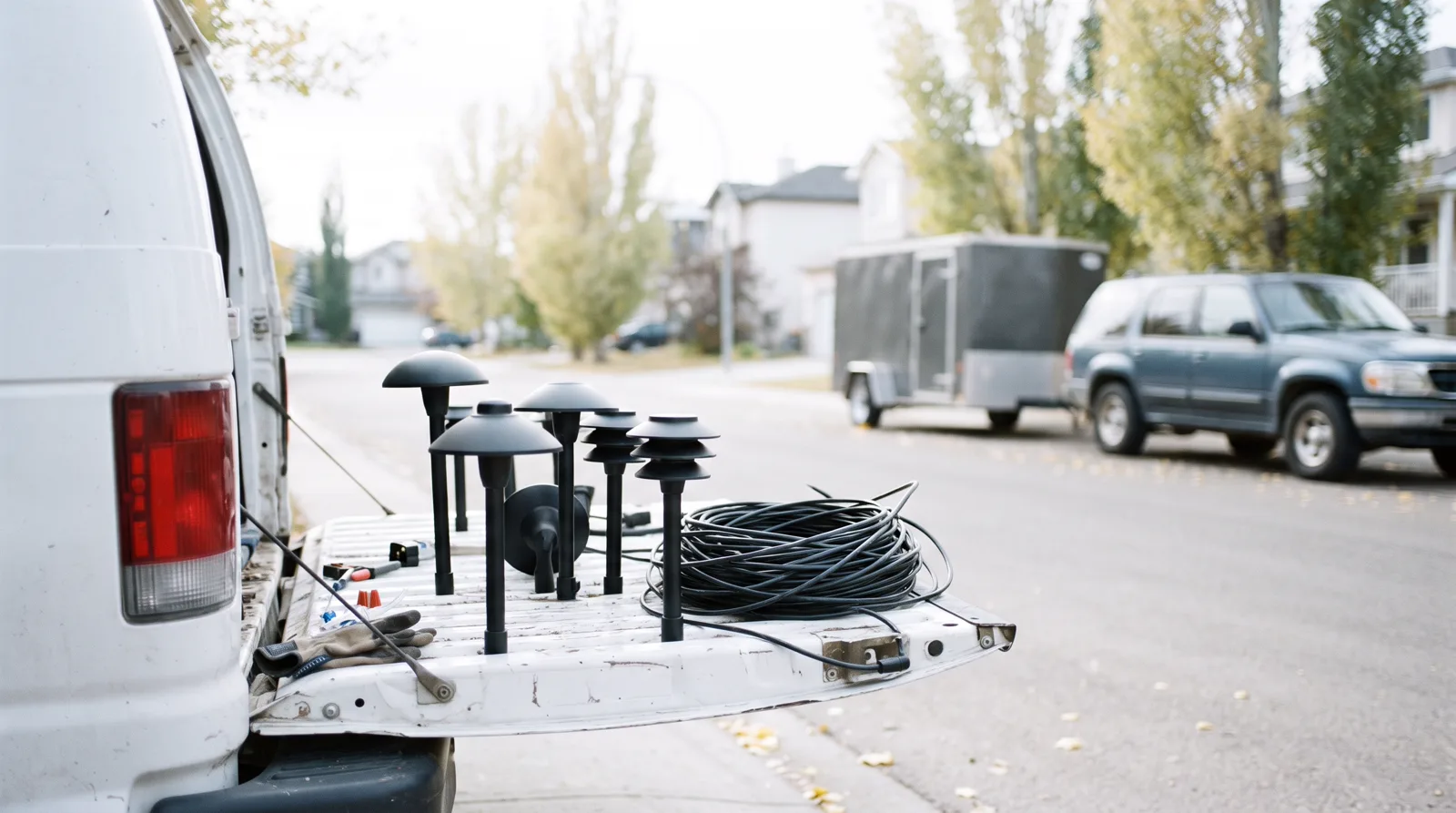
Outdoor Lighting Installation Built for Alberta Winters
From frost-rated landscape lighting to motion security floods, local pros install exterior electrical systems that stand up to chinook swings, deep frost and snow load.
Outdoor Lighting Services for Tri-Region Properties
Every install meets Alberta Electrical Code Section 12, uses frost-rated boxes and includes permit filing where required.
Landscape & Garden Lighting
Path lights, uplights for trees and features, low voltage transformer systems. We bury wire below frost line (minimum 1.2 metres in Parkland County clay), use sealed splice boxes and select LED fixtures rated for minus 40. Typical install covers 6 to 12 fixture zones with photocell or smart timer control.
Motion Security Lighting
Dusk-to-dawn floods, motion-activated wall packs and driveway pole lights. We run weatherproof conduit, install GFCI protection and angle fixtures to minimize light trespass onto neighbouring acreages. Motion sensors are calibrated to avoid false trips from wind-blown branches or passing deer common in Acheson and rural Stony Plain.
Soffit & Eave Potlights
Recessed cans in exterior soffits for clean porch and entry lighting. We use IC-rated (insulation contact) housings with vapour barriers intact, seal penetrations against ice dam melt and match trim colour to your fascia. Wiring routes through attic space or exterior conduit depending on construction type.
Garage & Workshop Lighting
Detached garage feeds, LED shop fixtures, outdoor receptacles for block heaters and EV charging prep. We trench 120V or 240V service from main panel, install weather-rated disconnect and provision circuits for future hot tub or welder loads. All underground runs are direct-bury rated cable in sand-bedded trench.
Permanent Holiday Lighting Tracks
Year-round RGB track systems mounted to fascia or roofline. Programmable colour and sequence control via smartphone app. Local pros install aluminum channel with individual LED nodes, hide transformers in soffits and provide weatherproof junction boxes. Popular in newer Spruce Grove subdivisions where bylaw restricts temporary staple-up installations.
Outdoor Receptacles & Circuits
GFCI-protected outlets for power tools, pressure washers, pool pumps and seasonal decorations. Weather-rated bubble covers, in-use covers for devices that stay plugged in and dedicated 20A circuits for high-draw equipment. We mount boxes above typical snowpack height (45 cm minimum) and route conduit to avoid deck post footings.
Why Outdoor Electrical Work Is Different Here
❄️ Minus 40 Frost Depth and Freeze-Thaw Cycles
Parkland County frost penetrates 1.8 metres in open ground, deeper than many municipalities. We bury all low-voltage landscape wire below 1.2 metres and use sand bedding to prevent frost heave from cracking conduit. Spring chinook cycles cause rapid thaw and soil movement, so junction boxes are mounted to grade beams or frost-wall footings, never floating in backfill.
🌬️ Chinook Wind and Ice Loading
Sudden temperature swings from minus 25 to plus 10 in 24 hours create ice buildup on fixtures, then rapid melt. We specify fixtures with sealed gaskets (IP65 minimum), angle them to shed water and avoid installing directly under roof valleys where ice chunks fall. Soffit potlights get extra vapour barrier attention to prevent warm attic air from condensing inside the housing during cold snaps.
🏗️ Spruce Grove and Stony Plain Permit Reality
New lighting circuits, detached garage feeds and any work increasing panel load require electrical permits and inspection. We file with Safety Codes Council, coordinate inspection timing and provide homeowner with compliance documentation for insurance and resale. Permit fees run $85 to $180 depending on scope, but avoiding them risks insurance denial after a claim.
🦌 Rural Acreage Voltage Drop and Wildlife
Properties in Acheson and rural Parkland County often sit 100 metres or more from the nearest transformer, increasing voltage drop risk on long landscape lighting runs. We calculate wire gauge to keep drop under three percent and use junction boxes with steel covers in areas where deer, coyotes or farm equipment might damage plastic enclosures. Motion sensors are tuned to ignore animal movement below knee height.
What it costs here
Everything You Need to Know About Outdoor Lighting Installation in Spruce Grove
From choosing frost-rated fixtures to understanding permit requirements, here's how exterior electrical work gets done right in Alberta's climate.
What Outdoor Lighting Installation Actually Involves in Spruce Grove
Professional outdoor lighting installation in Spruce Grove means designing, wiring, and mounting exterior fixtures that withstand Alberta winters while delivering consistent performance year-round. This is not simply screwing bulbs into brackets and hoping for the best. Licensed electricians assess your property's electrical capacity, determine whether your main panel can support additional circuits, and install weather-rated junction boxes, conduit runs, and proper grounding that meet the Canadian Electrical Code and Alberta Safety Codes. They calculate load requirements, select transformer sizing for low-voltage systems, and ensure every connection is waterproof and protected against freeze-thaw cycles that can crack inferior housings or corrode poorly sealed terminals.
The work begins with a site evaluation where the electrician walks your property to understand sight lines, security concerns, architectural features worth highlighting, and functional needs like pathway safety or garage access. They note existing power sources, measure distances for voltage drop calculations on long runs, and discuss control options ranging from simple photocells and timers to smart switches and motion sensors integrated with home automation systems. This planning phase determines whether you need a dedicated 15-amp or 20-amp circuit, whether trenching for underground wiring is required, or if surface-mounted conduit along eaves and fences will suffice. In Spruce Grove's established neighborhoods where frost lines reach 1.8 metres deep, trenching decisions directly affect project timelines and costs.
Installation itself involves mounting hardware securely to wood, vinyl, stucco, or concrete surfaces using appropriate anchors and weatherproof backplates, running NMWU or T90 rated wire through conduit or direct burial cable through trenches, making connections inside weatherproof boxes with properly rated wire nuts and corrosion inhibitors, and testing every fixture under load before backfilling or closing walls. Low-voltage landscape lighting systems require transformer installation near a GFCI-protected outlet, typically mounted on exterior walls or inside garages where temperatures stay moderate. High-voltage systems like security floods and wall-mounted sconces connect directly to dedicated circuits with proper breaker protection. Every installation concludes with labeling circuits in your panel, testing GFCI function, and demonstrating controls to homeowners so they understand timers, dimmers, and override switches.
Why Spruce Grove Properties Need Purpose-Built Exterior Lighting Systems
Spruce Grove's location west of Edmonton means exposure to chinook winds, rapid temperature swings, and extended winter darkness that makes outdoor lighting essential for safety and security. From November through February, sunset arrives before 5:00 PM, leaving homeowners navigating driveways, walkways, and entry steps in complete darkness during the workday commute home. Ice accumulation on unlit stairs becomes a serious liability risk, and packages left on dark porches become easy targets when homes appear unoccupied. Properly installed motion-activated floods and pathway lighting eliminate these hazards while adding negligible cost to monthly power bills when controlled with timers or photocells that operate lights only when needed.
Alberta Weather Demands Commercial-Grade Components
The freeze-thaw cycles that define Spruce Grove winters destroy consumer-grade outdoor fixtures within two or three seasons. Temperatures routinely swing from minus 25°C overnight to plus 5°C during chinook events, creating condensation inside poorly sealed housings that freezes, expands, and cracks plastic lenses or corrodes sockets and wiring connections. Professional installations use fixtures rated for Canadian climates with gasket-sealed lenses, corrosion-resistant aluminum or copper housings, and silicone-sealed wire entries that prevent moisture intrusion. Electricians also account for snow load on post lights and wall sconces, ensuring mounting brackets can handle wet heavy snow that accumulates during March storms.
Wind is another critical factor often overlooked by DIY installations. Chinook gusts regularly exceed 70 kilometres per hour in exposed areas of Spruce Grove and Parkland County, tearing inadequately anchored fixtures from walls or snapping poorly braced lamp posts. Licensed installers use lag bolts into solid framing members, not just siding or stucco, and specify posts with concrete footings below frost line. They also select fixtures with lower wind resistance profiles for exposed locations and avoid top-heavy designs that act like sails during storms.
Security and Property Value Considerations
Well-designed outdoor lighting demonstrably reduces property crime by eliminating dark corners where intruders can approach undetected. Motion-activated floods covering side gates, rear yards, and detached garages create the perception of occupancy and surveillance even when homeowners are away. Insurance providers recognize this value, and some companies offer modest premium reductions for properties with comprehensive security lighting, though homeowners should verify specifics with their brokers. The key is strategic placement that covers vulnerable access points without creating light pollution that annoys neighbors or violates municipal dark-sky guidelines.
From a resale perspective, professionally installed landscape lighting that highlights mature trees, architectural details, and well-maintained gardens significantly enhances curb appeal during evening showings. Real estate agents in Spruce Grove consistently note that homes with thoughtful exterior lighting sell faster and command higher prices than comparable properties with bare bulbs over garage doors. Buyers perceive these installations as evidence of overall property care and avoid the hassle of coordinating their own electrical work after closing.
Clear Warning Signs You Need Professional Outdoor Lighting Installation
If you are currently navigating your driveway, walkways, or entry steps in darkness during evening hours, relying on a single porch light that barely illuminates the immediate doorway, you need additional lighting. This situation is both dangerous and unnecessary given the relatively modest investment required for pathway and step lighting. Trips and falls on icy surfaces during winter months result in serious injuries that could be prevented with properly positioned fixtures that reveal ice patches, uneven pavement, and obstacles. Similarly, if you hesitate to take out garbage after dark or avoid using your backyard in the evening because of inadequate lighting, you are not fully utilizing your property.
Existing outdoor lighting that flickers, fails frequently, or trips breakers indicates underlying electrical problems that require professional attention before they worsen. Moisture intrusion into fixtures or junction boxes causes intermittent connections that create arcing and heat buildup, eventually leading to complete failure or fire hazard. Corrosion on sockets and terminals from failed weatherproofing prevents reliable bulb contact and shortens lamp life dramatically. If you find yourself replacing bulbs every few months or resetting breakers to restore outdoor lights, the fixtures themselves or the wiring supplying them have failed and need replacement, not just new bulbs.
Security concerns like dark side yards, unlit rear entrances, or shadowed areas near sheds and detached garages also signal the need for professional lighting installation. If you have experienced property theft, vandalism, or unwanted visitors, or if you simply feel uneasy arriving home after dark, motion-activated security lighting provides both deterrent value and peace of mind. Properties backing onto green spaces, ravines, or undeveloped land in Parkland County face additional wildlife encounters, and lighting helps identify whether that movement near your garage is a person, a deer, or just wind-blown branches before you step outside.
The Complete Outdoor Lighting Installation Process From Consultation to Final Inspection
The process begins with an on-site consultation where a licensed electrician walks your property with you to understand your goals, identify existing electrical infrastructure, and assess practical constraints. This is not a sales pitch but a technical evaluation where the electrician measures distances, notes obstructions like existing landscaping or underground utilities, examines your electrical panel for available breaker spaces and capacity, and discusses realistic timelines. Expect this consultation to last 45 minutes to 90 minutes depending on property size and complexity. The electrician will ask about specific concerns like dark areas, desired ambiance, control preferences, and budget constraints before proposing solutions tailored to your property rather than offering a one-size-fits-all package.
Following consultation, the electrician prepares a detailed quote that itemizes fixtures, materials, labor, permit costs, and estimated timeline. This document should specify fixture models with manufacturer names and wattages, indicate circuit requirements and whether panel upgrades are necessary, identify trenching or conduit runs with measured distances, and outline payment terms. Review this quote carefully and ask questions about fixture warranties, which typically range from two to ten years depending on manufacturer, and about workmanship guarantees. Reputable Spruce Grove electricians stand behind their installations and will return to address any issues that arise from improper installation, though they are not responsible for damage from homeowner modifications or accidents.
Once you approve the quote, the electrician applies for the required electrical permit through Alberta Safety Codes, which takes one to two weeks for approval depending on current workload at the permit office. Never skip this step or hire contractors who suggest avoiding permits to save time or money. Unpermitted electrical work voids your home insurance, creates liability if someone is injured, and must be disclosed during home sales, often requiring expensive retroactive permitting and inspection. Permitted work also triggers a final inspection where a provincial inspector verifies code compliance, providing assurance that the installation meets safety standards.
Installation day begins with the electrician marking fixture locations with spray paint or flags based on your approved plan, then proceeding with the physical work in a logical sequence. For systems requiring trenching, this happens first using a walk-behind trencher or hand digging in areas near existing utilities, creating channels 30 to 45 centimetres deep for direct burial cable in areas without frost heave concerns, or deeper near building foundations. The electrician pulls cable through conduit for above-ground runs or lays direct burial cable in trenches with sand bedding for protection. Next comes mounting fixtures using appropriate hardware for each surface type, making weatherproof wire connections inside junction boxes with proper strain relief and corrosion inhibitors, and installing transformers or control devices in protected locations.
After all fixtures are mounted and wired, the electrician makes final connections at your electrical panel, installing a new dedicated breaker if required and properly labeling the new circuit. They test each fixture individually to verify proper operation, check voltage at distant fixtures to ensure acceptable voltage drop, test GFCI protection if applicable, and demonstrate all controls including timers, photocells, dimmers, and manual overrides. For trenched installations, they backfill carefully to avoid damaging cables and restore landscaping to near-original condition, though final grading and seeding are typically homeowner responsibilities. The electrician then requests final inspection from Alberta Safety Codes, and once the inspector approves the work and issues a compliance certificate, your installation is complete and fully documented for insurance and resale purposes.
What Outdoor Lighting Installation Actually Costs in Spruce Grove and Surrounding Areas
Outdoor lighting installation costs in Spruce Grove, Stony Plain, Parkland County and Acheson vary dramatically based on system complexity, fixture quality, wiring distances and site conditions. A basic package with four to six pot lights under soffits and two coach lights beside garage doors typically runs $1,200 to $2,400 including labour, wire, boxes and mid-grade fixtures. A comprehensive landscape lighting system with 12 to 20 low-voltage path lights, uplights for trees, spot fixtures on architectural features and transformer costs $3,500 to $7,500 depending on spread and fixture choices. High-end projects incorporating smart controls, colour-changing LED strips, custom bronze fixtures and extensive trenching across large acreages can reach $12,000 to $20,000. These are real working ranges from electricians serving the Tri-Region, not theoretical numbers pulled from national averages that ignore Alberta's specific installation challenges.
The biggest cost driver is underground wire routing. Running buried conduit from your main panel or garage sub-panel out to garden beds, fence lines or detached shop buildings means trenching through frost-heaved clay soil, navigating existing irrigation lines and crossing driveways or walkways. Electricians charge $18 to $35 per linear foot for trenched circuits depending on soil conditions, depth requirements and whether they need to bore under concrete. A 60-foot run to light your back patio and pergola adds $1,100 to $2,100 just for the buried wire and conduit before any fixtures go in. Properties in Parkland County with longer setbacks and rural driveways face higher costs simply because the wire has to travel farther. Acheson commercial properties installing perimeter security lighting around shop yards routinely see trenching costs exceed the fixture budget because distances are measured in hundreds of feet, not dozens.
Fixture quality creates the second major cost split. Basic builder-grade LED pot lights and wall packs from big-box stores cost $25 to $60 each and work fine for utilitarian coverage. Mid-tier landscape fixtures with cast aluminum housings, integrated LEDs and five-year warranties run $80 to $180 per fixture and deliver better beam control and weather resistance through Alberta winters. Premium brands with solid brass or copper construction, replaceable LED modules, lifetime finishes and 10-year electronics warranties cost $200 to $450 per fixture but survive decades of freeze-thaw cycles, hail storms and UV exposure without the lens cracks and housing corrosion that cheaper fixtures develop within three to five years. For a 12-fixture landscape system, the difference between budget and premium components is $1,800 to $4,500 in material cost alone, and that gap either shows up in your electrician's quote or in how often you're replacing failed fixtures down the road.
Smart Controls and Automation Add-Ons
Adding smart controls to outdoor lighting introduces $350 to $1,200 in extra costs but delivers scheduling, dimming and integration with home automation systems. A basic photocell and timer combination costs $80 to $150 installed and turns lights on at dusk, off at a set hour, meeting the minimum function most homeowners need. Mid-range smart switches compatible with Alexa or Google Home run $180 to $320 per circuit installed and let you control zones from your phone or voice commands. Full landscape lighting controllers with app-based scheduling, brightness adjustment for individual fixture zones and astronomical clock functions that adjust for seasonal daylight changes cost $500 to $900 for the controller plus $200 to $450 in additional installation labour because the electrician needs to wire multiple control circuits back to a central hub rather than simple switch legs.
For properties in Spruce Grove with extensive front and back yard lighting, zoned control makes practical sense because you can run entry lights all night for security while shutting down decorative garden lights at 11 PM to avoid light pollution and save energy. The upfront cost pays back in flexibility and reduced runtime. Some electricians push expensive proprietary systems with monthly cloud fees, but standard residential-grade smart switches from established brands work reliably without subscriptions and integrate with whatever home automation platform you already use or might adopt later. Make sure any smart components the electrician quotes are standard protocols, not locked ecosystems that trap you with one manufacturer forever.
Low Voltage Versus Line Voltage Systems
Most landscape lighting operates on 12-volt low-voltage systems stepped down from household 120-volt power through a transformer, while building-mounted security and soffit lights typically run on direct line voltage. Low-voltage systems cost less to install per fixture because the wire requirements are simpler (no conduit mandate for burial, though pros still use it), and you can add or relocate fixtures without an electrician if you keep within transformer capacity. A 300-watt low-voltage transformer with weather-rated enclosure costs $180 to $420 installed and powers 12 to 18 typical LED landscape fixtures. The trade-off is voltage drop over distance: runs longer than 80 to 100 feet see brightness falloff on fixtures farthest from the transformer unless the electrician designs multiple home runs or uses heavier gauge wire. On larger Parkland County properties, you may need two or three transformers positioned strategically rather than one central unit.
Line-voltage systems eliminate voltage drop concerns and deliver consistent brightness across any distance, but every fixture must be electrician-installed on code-compliant wiring, changes require permit and inspection, and there's more shock risk if something gets damaged. Security floods and wall packs around Acheson shop buildings typically run line voltage because they need full brightness in large coverage areas and the fixtures are mounted high on permanent structures. For residential landscape lighting, low voltage wins on cost, flexibility and safety unless you're lighting very long driveway runs or need extremely bright output that exceeds what 12-volt LEDs deliver. Most professional installations use low voltage for gardens and paths, line voltage for building-mounted security fixtures, giving you the best of both approaches in one cohesive system.
Comparing Fixture Types and Installation Methods for Alberta Conditions
Path lights are the most common landscape fixture, designed to line walkways, driveways and garden borders with pools of downward light every six to ten feet. Stake-mount path lights cost $45 to $140 each and install quickly by driving a stake into soil and connecting to buried low-voltage wire. Better quality units use cast aluminum or composite housings with integrated LED boards delivering 150 to 300 lumens per fixture, enough to define edges without overpowering plantings. Cheaper plastic path lights crack during Alberta freeze-thaw cycles and tip over when frost heaves the ground, requiring constant re-staking and replacement. For properties in Stony Plain with long curved driveways, electricians often recommend spacing fixtures at eight-foot intervals on alternating sides rather than every side lining, creating rhythm without excessive fixture counts that drive cost up. The buried cable between fixtures needs enough slack to accommodate frost movement without pulling connections apart, a detail inexperienced installers miss and pay for with service calls every spring.
Uplights and spotlights create architectural drama by washing light up tree trunks, accentuing stone features or highlighting building facades. These directional fixtures range from compact bullet-style units at $65 to $95 each up to larger flood-style uplights at $150 to $380 that cover wider areas. Installation requires careful aiming and burial or staking at the base of the feature being lit. Spruce and pine trees common in Parkland County landscapes look spectacular with warm LED uplights positioned two to four feet from the trunk, casting branch shadows on walls or sky. Stone or stucco architectural details on home exteriors gain depth and texture when grazed with low-angle light from fixtures positioned eight to 12 feet away. The electrician's skill in aiming and positioning matters as much as the fixture itself because poorly placed uplights create harsh shadows, glare into windows or wash out rather than enhance the feature. Expect the installation time per uplight to be 20 to 40 minutes including aiming and burial, compared to 10 minutes for a simple path light stake.
Security and motion-sensing floods serve functional purposes around garages, back doors, side yards and Acheson commercial entries where you need instant bright light when approaching. Basic motion-flood combos with dual LED heads cost $60 to $140 installed on existing junction boxes. Better units with adjustable sensitivity, time delay settings and photocells that prevent daytime triggering run $120 to $280. These line-voltage fixtures mount on weatherproof boxes with sealed connections because Alberta wind-driven rain finds every gap. Cheap fixtures with exposed wire nuts and flimsy gaskets fail within two winters when moisture penetrates and corrodes connections. For rural properties in Parkland County, motion floods at all four building corners plus detached garage doors create a security perimeter that lights up when anyone approaches, deterring prowlers while avoiding the light pollution and energy waste of all-night floods. Solar-powered motion floods sound appealing but don't deliver enough brightness or reliability through Alberta winters to be worth considering for serious security applications.
- Path lights: $45 to $140 each, best for walkways and garden borders, stake or surface mount installation
- Uplights and spots: $65 to $380 each depending on output, used for trees and architectural features, require careful aiming
- Motion security floods: $60 to $280 installed, line-voltage, essential for entry points and dark building sides
- Soffit pot lights: $70 to $160 each installed, recessed into existing soffits for even downlighting of entries and patios
- Step and deck rail lights: $35 to $95 per fixture, low-voltage or line, required by code on stairs over three risers
- String and festoon lighting: $12 to $35 per foot installed, requires proper support structure and weatherproof connections
Mistakes Homeowners Make and Contractor Traps to Avoid
The single biggest mistake is buying a kit from a big-box store and expecting a handyman or landscaper to install it correctly. These kits include undersized transformers, thin wire that causes voltage drop, cheap plastic fixtures and misleading layout diagrams that ignore electrical code. Non-electricians wire the transformer incorrectly, bury cable without proper depth or protection, overload circuits and create systems that either don't work reliably or pose actual fire and shock hazards. One Spruce Grove homeowner spent $800 on a DIY landscape lighting kit, paid a landscaper $400 to install it, and called a licensed electrician six months later when half the lights stopped working and the transformer smelled like burning plastic. The electrician found reversed polarity, corroded connections and overloaded circuits. Tearing out the botched work and reinstalling properly cost $1,900, more than double what a professional installation would have cost from the start. Licensed electricians are the only trade legally permitted to connect permanent outdoor lighting circuits in Alberta, and there's no insurance coverage when unlicensed work causes damage or injury.
Another common trap is accepting bids that seem too good to be true because they are. A legitimate electrician installing a 12-fixture landscape lighting system with quality components, proper trenching and code-compliant wiring cannot do it for $1,200 when material cost alone is $900 and labour takes 10 to 14 hours. Lowball quotes come from contractors planning to use the cheapest possible fixtures, skip proper burial depth, eliminate essential components like junction boxes or drip loops, or simply walk away mid-job when they realize the price doesn't cover actual work required. Stony Plain homeowners have been burned by contractors who quote low to win the job, show up and trench halfway, then demand more money or abandon the project leaving open holes and exposed wire. A proper outdoor lighting installation quote itemizes fixture counts and types, linear feet of trenching, transformer capacity, switch or control method and number of circuits. If the quote is a single line item with no detail, you have no way to verify what you're actually getting or hold the contractor accountable to complete it as described.
Failing to discuss long-term maintenance and bulb replacement strategy is a third critical mistake. Older outdoor lighting used halogen or incandescent bulbs requiring replacement every year or two, creating ongoing cost and hassle. Modern LED fixtures with integrated boards eliminate bulb changes but make the entire fixture the replacement unit if the LED fails. Quality fixtures use modular LED boards that an electrician can swap for $80 to $150 in parts and labour. Cheap integrated LED fixtures become disposable: when the LED dies in five to seven years, you replace the whole $50 fixture and discover the manufacturer discontinued it and the new one doesn't match your existing style. Parkland County homeowners with 20-fixture systems face replacing the entire installation when the first wave of failures starts if they chose mismatched cheap components. Professional installations use fixtures from manufacturers with long-term parts availability and modular components, and the electrician documents make, model and circuit layout so future service is straightforward rather than archaeological detective work.
Permit and Inspection Requirements
Outdoor lighting installation in Spruce Grove, Stony Plain and Parkland County requires electrical permits when work involves new circuits from the panel, line-voltage wiring or modification of existing building-mounted fixtures beyond simple bulb replacement. Low-voltage landscape lighting systems often fall into a grey area: technically, connecting the transformer to a household circuit requires permit, but enforcement varies. Licensed electricians pull permits as standard practice because it protects both them and you, ensures inspection confirms code-compliant work, and provides documentation for insurance and resale. Homeowners who skip permits to save the $80 to $150 fee discover the problem when selling: home inspectors flag unpermitted electrical work, buyers demand corrections or price reductions, and bringing everything up to code after the fact costs more than doing it right initially. Some buyers walk away entirely from homes with unpermitted electrical modifications because their insurance companies won't cover properties with known code violations.
The inspection process for outdoor lighting is straightforward when the work is done correctly. The electrician schedules a rough-in inspection after trenching and wiring but before backfilling and final fixture installation. The inspector verifies proper burial depth (18 inches minimum for direct-burial cable, 12 inches when in conduit), correct wire type and gauge, adequate transformer sizing and proper weatherproof boxes and connectors. After passing rough-in, the electrician completes installation and calls for final inspection where the inspector verifies all fixtures operate correctly, controls function as intended and everything matches the permit drawings. The entire process adds three to seven days to project timeline depending on inspector availability but costs nothing beyond the permit fee. Contractors who resist permits or claim they're unnecessary are either not properly licensed or planning shortcuts that won't pass inspection. Either way, they're contractors you should avoid completely.
How to Hire the Right Outdoor Lighting Electrician in the Tri-Region
Start by verifying the electrician holds a valid Alberta journeyman or master electrician ticket . The electrical trade in Alberta is regulated, and only licensed electricians can legally perform permanent wiring work. Ask for the ticket number and verify it through the Alberta Apprenticeship and Industry Training system. liability insurance protects you from liability if the electrician or their helper is injured on your property. Some electricians operate as sole proprietors without employees and claim they don't need WCB, which is technically true, but you want written confirmation of their exemption status and evidence of liability insurance covering at least two million dollars. Acheson commercial clients routinely require these verifications, and residential homeowners deserve the same protection. An electrician who hesitates or gets defensive about providing license and insurance documentation is hiding something.
Get at least two detailed written quotes that break down fixture counts, types and installed locations, linear feet of trenching by area, transformer capacity and location, control method (timer, photocell, smart switch), total circuit count and whether work includes permit and inspection. The quotes should specify fixture brands and model numbers or at minimum performance specifications like lumen output, colour temperature, housing material and warranty length. This detail lets you compare apples to apples rather than choosing based solely on bottom-line price. A quote that simply says 'install landscape lighting, $3,200' tells you nothing about what you're getting and makes it impossible to hold the contractor accountable. Quality electricians provide this detail as standard practice because they're proud of the systems they design and want you to understand the value. During the quote process, pay attention to how thoroughly the electrician walks your property, asks about your goals and lighting priorities, and offers design suggestions based on your home's architecture and landscaping. An electrician who spends 15 minutes, barely looks around and gives a verbal price is not someone you want installing a system you'll use for 15 years.
Check references specific to outdoor lighting work, not just general electrical service. Ask previous clients whether the system operates reliably through winter, how well fixtures have held up to Alberta weather, whether the electrician completed work on schedule and budget, and if they've needed service calls for failures or issues. Drive by completed projects if possible to see the actual quality and design aesthetic. Some electricians are excellent at panel upgrades and home rewiring but have no eye for landscape lighting design and produce utilitarian systems that work but lack visual appeal. For projects over $4,000, consider asking to see fixture samples or discussing mock-ups for key areas before committing to an entire system. Professional outdoor lighting electricians in Spruce Grove and Stony Plain often bring fixture samples to consultations and can set up temporary demonstration lighting in your yard at dusk so you see exactly what the effect will look like before installation begins. This level of service costs nothing extra but reveals which contractors treat lighting as design work versus those who see it as just another wiring job.
- Confirm active Alberta electrical license (journeyman or master ticket) through provincial registry verification
- Require proof of WCB coverage and liability insurance of at least two million dollars before work starts
- Get detailed written quotes specifying fixture counts, types, brands, trenching distances and control methods
- Ask for references specific to outdoor lighting projects and verify system performance after one year minimum
- Confirm quote includes permit fees and inspection scheduling as part of service, not optional add-ons
- Discuss warranty coverage for both fixtures and installation labour, typically one year minimum on workmanship
How Tri-Region Services Helps
Tri-Region Services takes the guesswork out of finding a qualified outdoor lighting electrician in Spruce Grove, Stony Plain, Parkland County and Acheson. When you contact us with your lighting project details, we connect you directly to one pre-vetted, fully licensed and insured local electrician who specializes in exterior lighting systems. This is not a lead-generation service that sells your information to multiple contractors who then hound you with sales calls. We route you to a single professional who will visit your property, assess your needs and goals, and provide a detailed written quote with no obligation. The electrician we connect you with carries full liability insurance, pulls permits as required, and has a proven track record of quality outdoor lighting installations across the Tri-Region.
You get one straightforward quote from a contractor we trust, and you decide whether to proceed. No pressure, no runaround, no wading through pages of online reviews wondering which are real. Our role is simply to make the right introduction between homeowners who need expert outdoor lighting installation and the local electricians who do this work at the highest standard. That is the entire service: one connection, one quote, your decision. If you are ready to add security, beauty and function to your property with professionally installed outdoor lighting, contact Tri-Region Services and we will get you connected to the right pro for a free written quote.
Why Homeowners Choose Us for Outdoor Lighting
Licensed, insured and committed to code-compliant work that protects your property and investment.
Licensed Master Electrician on Every Job
Alberta-certified tradesperson supervises all installations, signs permit applications and stands behind the workmanship with personal accountability.
Insurance on file
Full commercial insurance protects your property during installation, means you're never liable if someone is injured on your site.
Permit Filing and Inspection Coordination Included
Local pros handle Safety Codes Council paperwork, schedule inspection appointments and provide you with signed-off compliance certificates for insurance records.
Three-Year Workmanship Warranty on All Installs
If a connection fails, a fixture leaks or a breaker trips due to our installation, we return at no charge to diagnose and repair within three years of completion.
Cold-Weather Installation Expertise
Electricians in our network have installed outdoor lighting through every kind of Alberta weather and know how to trench frozen ground, protect wire in chinook thaw and seal boxes against ice dam runoff.
Transparent Quotes with Line-Item Material Costs
Every estimate breaks down labour hours, fixture models, wire gauge and permit fees so you understand exactly what you're paying for before work starts.
This page is not tied to a contractor's brand. Leads route straight to your one local partner. Verified reviews can appear here once that partner has them (never fabricated).
Serving the whole Tri-Region
8 Common Outdoor Lighting Questions
Do I need an electrical permit to install landscape lighting in Spruce Grove?+
What's the difference between line voltage and low voltage outdoor lighting?+
How deep do you bury landscape lighting wire in Parkland County?+
Can outdoor lights be installed in winter or do I need to wait until spring?+
What IP rating do outdoor fixtures need to survive Spruce Grove weather?+
How much does it cost to run power to a detached garage in Stony Plain?+
Will motion sensor lights false-trigger from wind or animals at night?+
Can I add smart control to outdoor lights for voice or phone app operation?+
Get your free quote
Tell us what you need and a local pro will get right back to you.
- ✓ Sent straight to a local business
- ✓ You choose who you hire
- ✓ Free, with no obligation