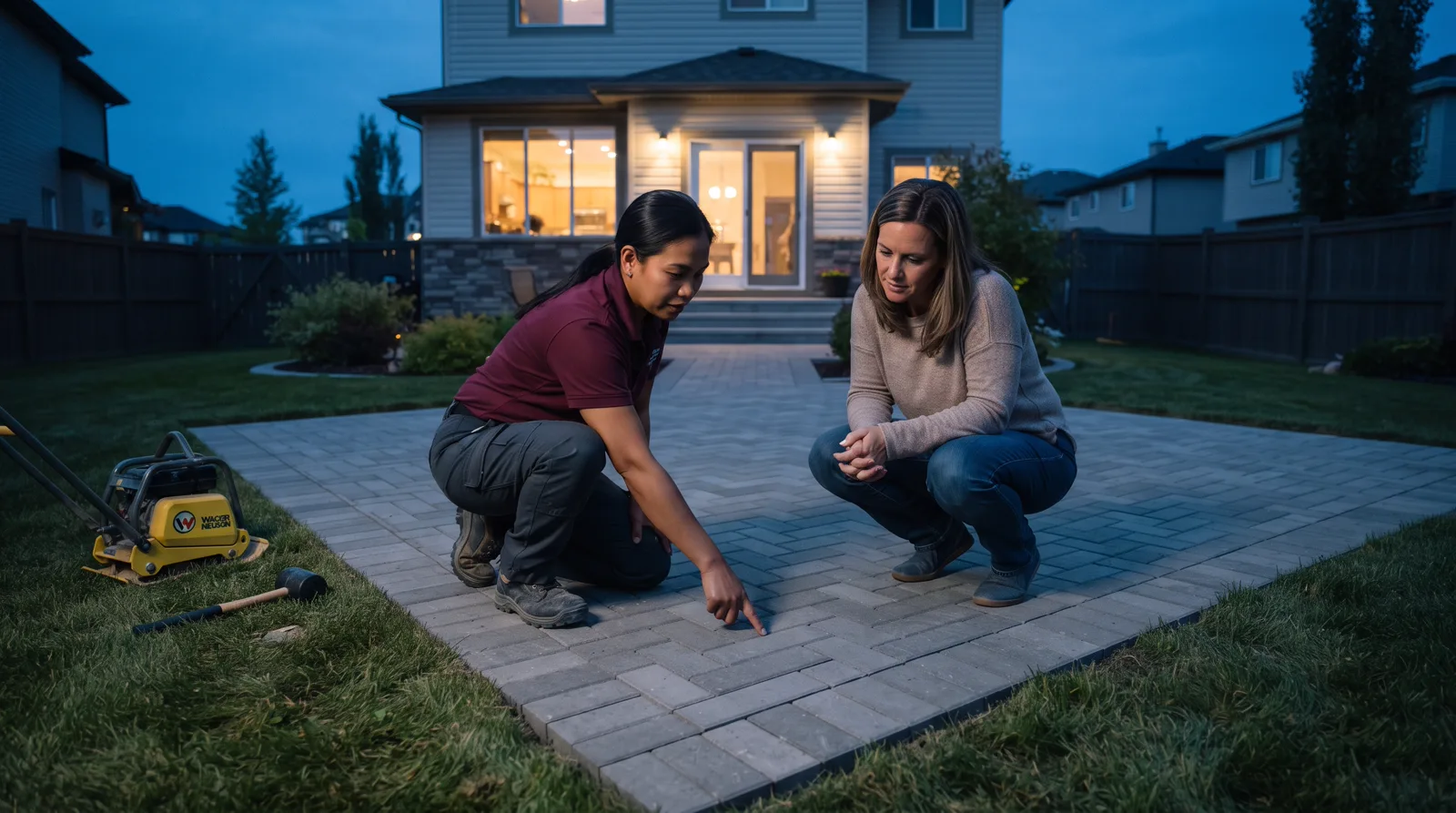
Patio Installation Built for Alberta Weather.
Custom outdoor living spaces engineered to survive freeze-thaw cycles, clay soil movement, and chinook wind swings.
Patio & Hardscaping Services
From stamped concrete to interlocking stone, built to last in Alberta conditions.
Interlocking Paver Patios
Concrete or clay pavers on engineered aggregate base with polymeric sand joints. Permeable options available for drainage. Popular for their flexibility during freeze-thaw movement and easy repair if settling occurs.
Natural Stone Flagstone Patios
Alberta quarried flagstone or imported slate set in sand or mortar. Each piece is unique. Requires proper jointing to prevent frost heave cracking. Best for low-traffic entertainment areas with strong visual impact.
Stamped Concrete Patios
Monolithic concrete surface stamped with pattern and colour. Requires control joints every 8 to 10 feet to manage cracking from temperature swings. Sealed annually to resist salt and moisture intrusion during winter.
Permeable Paver Systems
Open-joint or grid pavers that allow water infiltration, reducing runoff and preventing ice buildup. Ideal for properties with poor drainage or clay soil. Meets low-impact development standards and reduces pooling after chinook melt events.
Fire Pit & Seating Walls
Integrated fire features with retaining seat walls using modular blocks or natural stone. Gas or wood-burning options. Includes aggregate base, capstones, and optional lighting. Built to Alberta fire safety setback requirements.
Walkways & Front Entry Pavers
Durable interlocking or flagstone paths from driveway to front door orgate to backyard. Designed with slope for drainage and anti-slip texture. Withstands de-icing salts and heavy snow clearing without surface degradation.
Why Alberta Patios Need Special Engineering
❄️ Freeze-Thaw Cycle Survival
Spruce Grove sees 80+ freeze-thaw cycles per year. Proper 6 to 8 inch aggregate base with geotextile fabric prevents frost heave that cracks concrete and lifts pavers. We compact in lifts and verify drainage slope before laying surface material.
🌊 Clay Soil & Drainage Management
Parkland County clay holds water and expands when frozen, pushing hardscaping out of level. Local pros excavate to stable subgrade, install drainage tile where needed, and use open-graded base that sheds water fast. Prevents spring settling and ice dams.
🌬️ Chinook Wind & Temperature Swings
A chinook can swing temperatures 20°C in hours, expanding and contracting materials rapidly. Interlocking pavers handle this flex better than monolithic concrete. For stamped concrete, we cut expansion joints and use fibre reinforcement to resist cracking.
📋 Parkland County & Spruce Grove Permits
Most residential patios under 10 square metres do not require a permit, but retaining walls over 1 metre or structures near property lines do. We verify setback rules and coordinate inspections if your project includes gas lines for fire features or electrical for lighting.
What it costs here
How to Plan a Patio That Lasts in Alberta
Material choice, base engineering, drainage, and seasonal timing all matter in freeze-thaw climates.
Why Pavers Survive Alberta Weather When Concrete Fails
Concrete patios in Spruce Grove and Parkland County face a brutal opponent: the freeze-thaw cycle. Water seeps into microscopic cracks during summer rain or snowmelt, then expands by nine percent when temperatures drop overnight. That expansion creates pressure that concrete cannot flex to accommodate. Over three to five years, you will see spalling (surface flaking), widening cracks, and sections that heave or sink as the subgrade shifts. A poured slab is a single rigid plane, so when one section fails, the damage radiates. Replacement means jackhammering the entire pad and starting over, often costing $3,000 to $8,000 for a typical 12 by 16 foot space.
Pavers survive because they move independently. Each unit can shift a fraction of an inch without cracking, absorbing the ground movement caused by frost heave and clay soil expansion. Alberta clay swells when wet and shrinks when dry, a cycle that repeats every spring and fall. A properly built paver base includes 12 to 18 inches of compacted class two gravel that extends below the four-foot frost line, preventing the pavers themselves from riding the freeze-thaw wave. When one paver does crack (usually from a direct hail strike or a dropped tool), you lift it out and drop in a replacement in ten minutes. No mixer truck, no curing time, no patching compound that never quite matches.
Chinook winds add another layer of stress. When a winter chinook swings the temperature from minus fifteen Celsius to plus eight in six hours, the surface of a concrete slab expands while the bottom stays frozen. That differential stress creates internal fractures you will not see until spring, when the first warm week turns hairline cracks into spiderweb patterns. Pavers do not care about rapid temperature swings because the joints between them provide expansion room. The polymeric sand or stone dust in those joints compresses and releases, acting as a buffer that concrete simply cannot replicate.
Signs Your Backyard Is Ready for a Patio Upgrade
You are currently using a temporary solution that you have outgrown. Gravel patios grow weeds through landscape fabric, shed stones into the lawn, and turn into mud pits during spring runoff. A portable deck on blocks wobbles, traps moisture against your siding, and costs more in annual re-leveling than you want to admit. If you host family dinners outdoors, set up a firepit more than twice a year, or drag furniture across the yard every time you want to sit outside, you have already decided you need a permanent solution. The question is whether you want to spend another season working around the problem or fix it before summer arrives.
Your current concrete pad is failing in ways you have stopped trying to ignore. The surface has divots where water pools after rain, forcing you to sweep standing water toward the lawn before anyone can sit down. Corners have heaved or settled, creating a visible slope that makes chair legs uneven. Cracks wider than a pencil run across the middle, and you have patched them twice only to watch them reopen every spring. Efflorescence (white mineral staining) blooms along edges where salt and moisture wick through the concrete. These are not cosmetic issues. They are structural failures that will only accelerate, and resurfacing products will buy you one or two seasons at best before the underlying slab movement defeats them.
You are planning a project that requires excavation anyway, and combining work saves money. If you are installing a deck, privacy fence, or pergola, the contractor will already have equipment on site and disturbed soil in the build zone. Adding paver installation to that scope eliminates a second mobilization fee (typically $400 to $800) and allows the crew to tie the patio grade and drainage into the other hardscape. Many homeowners in Stony Plain install pavers and a firepit surround in the same phase, using the excavated soil to build up low areas elsewhere in the yard. Coordinating trades also means the patio base compaction happens before fence posts go in, preventing vibration damage to fresh concrete footings.
How Professional Paver Installation Actually Works in Alberta
The process starts with a site assessment that most homeowners underestimate. A qualified installer will mark underground utilities through Alberta One Call (mandatory and free), then evaluate soil type, existing grade, and drainage patterns. Clay soil dominates Parkland County and Spruce Grove, meaning the patio must be built as a drainage bridge, not just a surface. The crew identifies where water currently flows during spring melt and heavy rain, then designs the patio slope and edge drains to intercept runoff before it reaches your foundation. If your yard has a high water table (common near wetlands or in subdivisions built on old slough land), the installer may recommend a perforated drain tile loop around the patio perimeter, tied into a daylighting point or sump. Skipping this step is how patios turn into ice rinks every November.
Excavation depth surprises people. To prevent frost heave, the bottom of the gravel base must sit below the frost line, which runs four feet deep in this region. That means removing 14 to 20 inches of topsoil and clay, depending on the paver thickness and sand bedding layer you choose. The excavated area extends six to twelve inches beyond the finished patio edge to allow room for edge restraint and proper base compaction. Topsoil goes into a pile for redistribution (never buried under the base, as organic matter compresses unevenly), while clay is usually hauled away unless you are building up a berm elsewhere. A 200 square foot patio generates three to four cubic yards of excavated material, enough to fill a tandem axle dump trailer.
Base installation is the part that determines whether your patio lasts ten years or forty. The crew spreads class two gravel (a mix of three-quarter inch crushed rock and fines) in four-inch lifts, compacting each layer with a plate tamper or ride-on roller until it reaches ninety-five percent compaction. You will hear the machine make multiple passes in a grid pattern, and the operator will test density with a hand probe or dynamic cone penetrometer on commercial jobs. Edges get extra attention because that is where base failure starts when traffic or freeze-thaw cycles push outward. A one-inch bedding layer of concrete sand (not play sand, which is too round to lock) goes on top of the compacted gravel, screeded to a smooth plane with a laser level or string line. This layer must be no more than one and a half inches thick, any deeper and the sand will compress unevenly under foot traffic, creating low spots.
Paver laying follows a pattern you chose during planning, whether herringbone (the strongest for vehicle traffic), running bond, or a circular feature layout. The crew starts from a fixed edge (usually the house foundation or a string line representing the longest straight run) and works outward, keeping joints tight and checking alignment every few rows. Cuts happen at borders and around obstacles like deck posts or gas line risers, using a masonry saw with a diamond blade. Once the field is complete, edge restraint (plastic spikes and aluminum or composite trim) locks the perimeter to prevent creep. Polymeric sand gets swept into joints and activated with a fine water mist, binding pavers together while still allowing individual movement. A final compaction pass with a rubber-padded plate tamper seats everything, and the installer sweeps excess sand off the surface. You can walk on the patio immediately, though heavy furniture should wait forty-eight hours for the joint sand to cure.
Base Preparation: The Hidden Work That Determines Longevity
Why Gravel Depth Matters More Than Paver Quality
Homeowners shopping for patios obsess over paver color and texture, then balk at base cost. That priority is backwards. A premium paver sitting on six inches of poorly compacted gravel will fail within three years, while a basic concrete paver on eighteen inches of properly installed class two base will outlast your mortgage. The gravel layer does three jobs: it distributes weight to prevent point loading that causes settling, it provides a capillary break so groundwater cannot wick up and freeze under the pavers, and it gives frost heave somewhere to dissipate instead of pushing the surface up. Skimping here saves you $400 to $800 in material and labor, then costs you $3,500 to $6,000 in tear-out and rebuild within five years.
Class two gravel works because the mix of stone sizes locks together under compaction. The three-quarter inch angular rock creates a skeleton, while the fines (dust and small chips) fill voids and prevent the stone from shifting. Rounded river rock or pea gravel, sometimes used by budget installers, cannot achieve the same compaction density because smooth stones roll past each other instead of interlocking. You will see this failure as wavy surfaces, pavers that rock when stepped on, or entire sections that sink after the first winter. Proper base installation requires a vibratory plate compactor (not hand tamping), moisture control during compaction (the gravel should be damp, not soaked), and testing with a probe to verify density before the bedding sand goes down.
Drainage Integration That Prevents Spring Flooding
A patio without drainage planning becomes a dam. Water that used to soak into the lawn or run along the surface now hits 200 square feet of impermeable pavers and has to go somewhere. If the patio slopes toward your house (even one percent grade, which is nearly invisible to the eye), spring melt and summer storms will push water against your foundation, eventually finding its way into the basement or crawlspace. Alberta building code does not require permits for patios under a certain size, but it does require that new hardscape not worsen drainage onto neighboring properties. That means your installer must grade the patio to direct water away from structures and toward a safe discharge point: the lawn, a swale, a gravel drip edge, or a buried drain line.
The standard slope is two percent (one quarter inch drop per foot), enough to move water without creating a noticeable slant. On large patios or where the yard is nearly flat, installers add a catch basin or trench drain at the low edge, connecting it to solid four-inch PVC that daylights into the yard or ties into the storm sewer if your municipality allows it (Spruce Grove and Parkland County have specific bylaws). Clay soil makes surface drainage critical because water does not percolate down, it sits until it evaporates or runs off. A properly built patio acts as a controlled water management surface, not a flood generator. If your installer does not discuss drainage in the estimate meeting, you are talking to someone who fixes their mistakes on callbacks.
What Patio Installation Actually Costs in Spruce Grove and Parkland County
A typical interlocking paver patio in Spruce Grove runs between $18 and $35 per square foot installed, meaning a modest 200 square foot sitting area costs $3,600 to $7,000 while a generous 400 square foot entertaining space lands between $7,200 and $14,000. Natural stone patios push higher, from $28 to $50 per square foot, because the material itself costs more and installation demands more skill to achieve level surfaces and tight joints. Stamped concrete sits in the middle at $12 to $22 per square foot, offering pattern variety at a lower price point but with trade-offs in long term flexibility and repair.
The base preparation drives a significant portion of your cost and determines whether your patio stays flat or heaves and settles after Alberta's brutal freeze thaw cycles. Contractors in Parkland County know they need to excavate deep enough to get below the frost line, typically 48 inches in this region, then build up with compacted road crush and bedding sand. A proper six to eight inch base of three quarter inch clear rock, mechanically compacted in two inch lifts, costs more in labor and material than a thin sand bed, but it is the only method that survives our winters. Skipping this step to save a few hundred dollars today guarantees a wavy, sunken patio within two seasons.
Site conditions add cost quickly. If your yard slopes toward the house, the contractor needs to build in drainage solutions like a catch basin or channel drain, adding $400 to $1,500 depending on complexity. Clay soil common around Stony Plain requires extra excavation and better rock base because it holds water and expands when frozen. Tight side yard access where equipment cannot reach means hand digging and wheelbarrowing tons of rock, doubling labor hours. Removing an old concrete patio or deck before starting the new patio adds $2 to $5 per square foot for demolition, hauling, and disposal fees.
Extras that improve function and longevity also add to the total. Polymeric sand between paver joints costs $100 to $200 more than regular sand but locks pavers together and resists ant tunneling and weed growth. A proper edge restraint, either aluminum or heavy duty plastic spikes, prevents paver creep over time and adds $3 to $6 per linear foot. Sealing the finished patio protects against oil stains and color fade, costing $2 to $4 per square foot, and should be reapplied every two to three years. Outdoor lighting, gas line hookups for fire pits, and built in seating walls increase both the budget and the usability of the finished space.
Comparing Your Material and Design Options
Interlocking concrete pavers remain the most popular choice in Spruce Grove because they combine durability, repairability, and a wide range of colors and shapes. These machine made units deliver consistent dimensions and can be lifted and reset if you need to access utilities or fix a settled spot, something impossible with poured concrete. They handle freeze thaw movement well because the joints between pavers allow slight individual movement without cracking. Expect to pay $4 to $10 per square foot for the pavers themselves, with mid range options around $6, then add installation. Tumbled or antiqued finishes cost a dollar or two more per square foot but deliver a softer, aged look that suits traditional home styles common in Parkland County.
Natural stone pavers like Chilton flagstone, Indian slate, or Ontario granite offer organic color variation and a premium aesthetic but demand higher skill during installation because thickness varies from piece to piece. Installers must sort and shim individual stones to create a flat walking surface, which takes more time than laying uniform concrete pavers. Stone also costs significantly more at the supply yard, from $8 to $20 per square foot before installation, but the result is a one of a kind surface that will not fade. In areas with heavy shade or consistent moisture, natural stone can develop moss or algae, requiring occasional pressure washing and application of a stone safe cleaner.
Stamped or colored concrete provides pattern and texture at a lower installed cost, usually $12 to $22 per square foot including finishing and sealing. The contractor pours a four to six inch slab over compacted base, then stamps patterns like ashlar slate, cobblestone, or wood plank into the wet surface before it cures. The entire patio is one monolithic piece, which means no weed growth between joints but also means any crack from ground movement is visible and difficult to repair invisibly. Alberta's temperature swings make control joints essential every eight to ten feet to manage cracking, and even with joints, some surface cracks are almost inevitable over time. Resealing every two years protects the color and surface but adds ongoing maintenance cost.
For base and bedding, the industry standard in the Tri-Region is six to eight inches of three quarter inch clear crushed rock, compacted in layers, topped with one inch of bedding sand or stone dust screenings. Some contractors offer a thinner four inch base to cut cost, which might survive under a low traffic walkway but will fail under a patio that sees furniture weight, foot traffic, and snow load through winter. The edge restraint, either spiked plastic or aluminum L-track, is critical to prevent the perimeter pavers from creeping outward over years of freeze thaw cycles. Polymeric sand swept into the joints binds when activated with water, locking pavers together and blocking weed seeds and insect tunneling far better than regular masonry sand.
Mistakes and Contractor Traps That Cost Homeowners Thousands
The biggest mistake homeowners make is accepting a lowball quote without questioning how the contractor plans to achieve that price. A bid that comes in 30 or 40 percent below others is not a deal, it is a warning sign that corners will be cut on base depth, compaction, or material quality. Some contractors skip the fabric barrier between subgrade and rock base, allowing clay soil to migrate up into the rock over time and reducing drainage effectiveness. Others use recycled asphalt grindings instead of clean three quarter inch rock because grindings are cheaper, but they compact inconsistently and can soften in summer heat, leading to settlement and waviness.
Ignoring drainage planning is the second most common failure. If your patio sits level or even slightly pitched toward the house, every rainstorm and snowmelt event pushes water against your foundation, which can lead to basement seepage, foundation movement, and expensive remediation. The patio surface must slope at least one percent, ideally two percent, away from the house, meaning a ten foot deep patio should drop two to three inches from back to front. In areas where the yard naturally drains poorly or clay soil dominates, adding a perimeter drain or catch basin is not optional. Skipping this work to save a few hundred dollars now routinely costs homeowners several thousand in foundation or drainage repairs within five years.
Hiring a contractor who lacks liability insurance and liability insurance exposes you to serious financial risk. If a worker is injured on your property and the contractor has no WCB account, the injured worker can pursue a claim against you as the property owner. Liability insurance protects you if the contractor damages your gas line, irrigation system, or underground utilities during excavation. Asking to see a WCB clearance letter and a current certificate of insurance before work starts is not rude, it is basic due diligence. Contractors who hesitate or claim they are too small to need coverage should be crossed off your list immediately, no matter how attractive the price.
Rushing the project timeline creates problems. Base rock must be compacted and allowed to settle, ideally with a day or two between rock placement and paver installation, especially if rain is forecasted. Wet base material does not compact properly, and laying pavers over a spongy base guarantees future settlement. Similarly, if polymeric sand is applied and activated with water too soon after installation, or if rain is predicted within 24 hours of activation, the sand can wash out or haze the paver surface. Quality contractors build weather windows into their schedule and will delay a phase rather than push through poor conditions.
How to Hire the Right Patio Contractor in the Tri-Region
Start by asking each contractor how deep they excavate and what base material they use. The correct answer for Parkland County and Spruce Grove is six to eight inches of three quarter inch clear rock, compacted mechanically in two inch lifts, with a fabric barrier between the native soil and the rock. If a contractor says four inches is plenty, or offers crusher dust or recycled asphalt instead of clean rock, move on. Ask whether they pull a development permit if your municipality requires one, which Spruce Grove and Stony Plain do for patios over a certain size or within setback zones. A contractor who brushes off permit questions is willing to leave you holding the liability if a bylaw officer notices unpermitted work.
Request proof of WCB coverage and liability insurance, and take the time to verify the WCB account number online through the Alberta government database. Check that the contractor's liability policy is current and covers at least two million dollars, which is the industry standard for residential renovation work. Ask for three recent references, ideally projects completed within the past 18 months, and actually call them. Specific questions to ask references include whether the base settled or moved after the first winter, whether the contractor showed up on schedule, how they handled unexpected issues like buried debris or utility conflicts, and whether the final invoice matched the quote.
Watch for red flags during the quoting process. If the contractor provides a verbal estimate without walking the site and measuring, they are guessing and will almost certainly hit you with change orders once work begins. A detailed written quote should break out square footage, material specs including paver brand and color, base depth and type, edge restraint method, and whether polymeric sand and sealing are included. Vague line items like 'patio installation' or 'materials' leave room for substitution and dispute. Similarly, avoid contractors who demand large up front deposits before ordering materials. A reasonable deposit is 10 to 25 percent to secure your spot on the schedule, with the majority paid on completion.
Ask how the contractor handles conflicts with buried utilities, irrigation lines, or unexpected soil conditions. Professional crews call Alberta One Call before digging to locate public utilities, but private lines like sprinkler systems and low voltage lighting are your responsibility to mark or disclose. A good contractor will hand dig test holes in areas where conflicts are likely and discuss options before proceeding. If they hit a gas line or electrical conduit and their response is to patch it with tape and keep going, you have both a safety issue and a future service call expense.
How Tri-Region Services Helps
Tri-Region Services simplifies the hiring process by connecting you with one vetted, insured local patio contractor who has told us they carry liability insurance and has a track record of quality work in Spruce Grove, Stony Plain, and Parkland County. You will receive a free written quote that breaks down materials, labor, base preparation, and drainage work with no obligation and no pressure. Instead of contacting five contractors, waiting for three to respond, and trying to compare vague estimates, you get one thorough proposal from a pro who knows Alberta soil, climate, and building code requirements and has successfully navigated hundreds of local patio projects.
Why Homeowners Choose Tri-Region Contractors
Local crews who understand the soil, the code, and the climate.
Insurance on file
Every crew tells us they carry liability insurance, protecting you from on-site injury claims.
Engineered Base, Not Guesswork
We follow Alberta building code for frost depth and use compaction testing on larger projects.
Photo Documentation of Base Layers
You receive timestamped photos of excavation, geotextile, aggregate, and compaction before surface install.
5-Year Workmanship Warranty
We stand behind settling, joint failure, and base movement for five full seasons after install.
Local References in Your Neighbourhood
We provide addresses of past projects in Spruce Grove and Stony Plain so you can see real aging performance.
Responsible Excavation Disposal
Clay and sod are hauled to licensed facilities or reused on-site for grading, never dumped illegally.
This page is not tied to a contractor's brand. Leads route straight to your one local partner. Verified reviews can appear here once that partner has them (never fabricated).
Serving the whole Tri-Region
8 Questions About Patio Installation in Spruce Grove
What is the best patio material for Alberta freeze-thaw cycles?+
Do I need a permit to build a patio in Spruce Grove or Parkland County?+
How deep does the base need to be to prevent frost heave?+
When is the best time of year to install a patio in Alberta?+
How much does a typical backyard patio cost in Spruce Grove?+
Will my patio crack or settle after the first winter?+
Can I install a patio myself to save money?+
What maintenance does a paver patio need in Alberta?+
Get your free quote
Tell us what you need and a local pro will get right back to you.
- ✓ Sent straight to a local business
- ✓ You choose who you hire
- ✓ Free, with no obligation