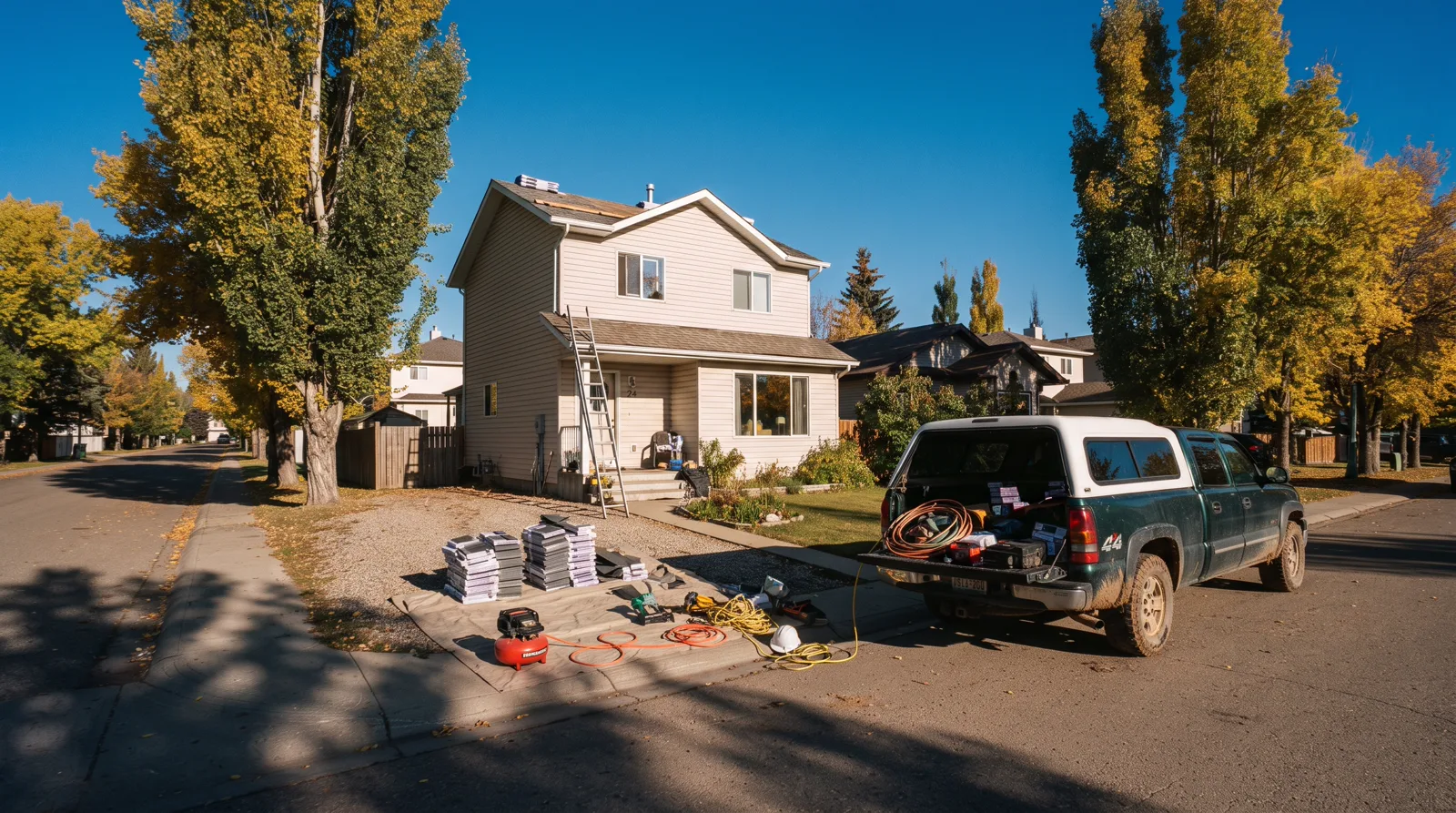
Roof repair done right the first time, before a small leak becomes a big one.
Leak tracing, shingle and flashing repair, valley and chimney work, and emergency tarping from local roofers. Most repairs are booked the same week, with emergency response for active leaks.
Roof repair services in Spruce Grove & Stony Plain
From a single blown-off shingle to a stubborn leak nobody else could find. Every job handled by a local pro, quoted in writing, free.
Leak Detection & Repair
We trace a leak to its true source, which is usually a penetration or flashing detail well uphill of the ceiling stain, then fix that source instead of chasing the symptom. Interior stain assessment included.
Shingle Replacement
Replace blown-off, cracked, curling or missing shingles after Alberta wind and hail. We colour-match as closely as possible and seal properly so the repair sheds water and blends in.
Flashing & Vent Boot Repair
Chimney, wall, skylight and valley flashing plus cracked plumbing vent boots are the most common leak points on a Tri-Region roof. We re-seal or replace the detail so water stays out for good.
Valley & Chimney Repair
Valleys carry the most water on any roof and chimneys are a classic leak zone. We rebuild valley flashing and re-flash chimney bases to stop the leaks these areas are famous for.
Emergency Tarping
When a roof is actively leaking after a storm, local pros secure a temporary tarp to stop interior and insulation damage, then return to complete the permanent repair once the roof is safe to work on.
Storm & Insurance Repairs
Wind and hail damage documented for your insurer, with coordination on the adjuster's scope. We help you understand what your policy covers before you commit to filing a claim.
What damages Tri-Region roofs
🌩️ Hail and wind
Spruce Grove sits in an active hail corridor and chinook winds lift and crack shingles. A single summer storm can turn a sound roof into a repair job or an insurance claim overnight.
❄️ Ice damming
Warm attic air melts snow that refreezes at the cold eaves, backing water up under the shingles. This is a leading cause of winter leaks in the Tri-Region and it damages more than just the roof.
🔄 Freeze-thaw on flashings
Repeated freezing and thawing works sealant loose around chimneys, vents and valleys. These small failures are behind most of the leaks we trace on local roofs.
🌲 Debris and overhang
Acreage and mature-neighbourhood roofs collect needles and branches that trap moisture and clog valleys, accelerating shingle wear and creating leak points that a quick repair can head off.
What it costs here
Roof repair in Spruce Grove: how to fix it right
A plain-English guide to roof repair in the Tri-Region: where leaks really start, repair versus replacement, emergency steps, insurance, and how to hire a roofer who fixes the cause, not the symptom.
Why most roof leaks are not where you think
When water shows up on a Spruce Grove ceiling, the natural assumption is that the hole in the roof is directly above the stain. It almost never is. Water enters at a failed detail, then runs along the underside of the deck, down a rafter, or across the top of the ceiling until it finds a low spot to drip through. By the time you see it inside, the real entry point can be several feet uphill and off to one side.
That single fact explains why so many roof repairs fail. A crew that patches the spot above the stain is treating the symptom, and the leak comes back with the next rain. A proper repair starts with a leak trace: inspecting the penetrations, flashings and seams uphill of the interior evidence, checking the attic where possible, and identifying the true source before any sealant comes out. Finding the cause is the entire job. Fixing it is the easy part.
In the Tri-Region, the usual suspects are consistent. Cracked plumbing vent boots, lifted or corroded chimney and wall flashing, worn valley metal, blown-off or cracked shingles from wind and hail, and ice-dam backup at the eaves account for the large majority of the leaks we see. A roofer who knows these patterns can often find in twenty minutes what a general handyman will chase for a season.
The most common roof repairs in the Tri-Region
Roof repair is not one job, it is a family of related fixes. Knowing which one your roof needs helps you judge a quote and spot a contractor who is guessing.
Shingle repair and replacement
Alberta wind and hail crack, curl and tear shingles off. Replacing a small number of shingles is a straightforward repair when the surrounding roof is sound, though an exact colour match on a weathered roof is rarely perfect because sunlight fades shingles over time. Widespread cracking or granule loss across the whole roof, on the other hand, is a sign the roof is near the end of its life and repeated spot repairs stop being economical.
Flashing and vent boot repair
Flashing is the metal that waterproofs the transitions where the roof meets a chimney, wall, skylight or valley, and it is the number one source of leaks on a pitched roof. Rubber plumbing vent boots are a close second: they dry out and crack in Alberta sun and cold, and a cracked boot drips straight into the attic. Both are common, fixable repairs, and catching them early prevents the far more expensive interior and structural damage a slow leak causes.
Valley and chimney work
Valleys funnel water from two roof planes into one channel, so they carry the heaviest flow and wear out first. Chimneys sit in that flow and rely on step flashing and counter-flashing that loosens over years of freeze-thaw. Rebuilding valley metal and re-flashing a chimney base solves leaks that homeowners often assume mean a whole new roof, when a targeted repair will do.
Repair or replace: making the honest call
The most valuable thing a trustworthy roofer tells you is when NOT to spend money. Repair is the right answer when the roof is generally sound and the problem is localized: a handful of damaged shingles, a single failed flashing, one leaking penetration. On a healthy roof, repairs buy years of service for a few hundred to a few thousand dollars.
Replacement becomes the smarter spend when the signs point to whole-roof failure: widespread granule loss and bald spots, shingles cracking across the entire surface, multiple leaks in different areas, or a roof that is simply at the end of its rated life. At that point, money poured into spot repairs is money you will spend again soon, on top of the replacement you still need, plus the mounting risk of interior damage.
A good roofer inspects the whole roof before quoting a repair and tells you honestly which camp yours is in. Be wary of anyone who pushes a full replacement for a single leak without showing you why, and equally wary of anyone who keeps selling small patches on a roof that is clearly finished. The right call protects your money in both directions.
What to do when your roof is leaking right now
An active leak is a race against water damage. A few steps limit the harm before a roofer arrives.
- Move belongings and furniture away from the drip and put down a bucket or bin to catch water.
- If the ceiling is bulging with trapped water, carefully relieve it with a small hole over a container, because a controlled release does far less damage than a collapsing ceiling.
- Do not climb onto a wet, icy or steep roof yourself. Most serious roofing injuries happen to homeowners attempting exactly this.
- Photograph the interior and any visible exterior damage. This documentation helps both the repair and any insurance claim.
- Call for emergency service. A temporary tarp stops the bleeding and protects your insulation and drywall until a permanent repair can be scheduled safely.
Emergency response in the Tri-Region
Because active leaks cannot wait, the roofers we connect you with offer emergency tarping across Spruce Grove, Stony Plain and Parkland County. The tarp is not the repair, it is protection: it buys the days needed to inspect properly, order any materials, and complete the permanent fix in safe conditions. Stopping water intrusion quickly is almost always cheaper than repairing the interior damage a delayed response causes.
Roof repairs and insurance in Alberta
Many roof repairs in the Tri-Region stem from sudden events that insurance may cover: hail, windstorm, or a tree limb. Most Alberta home policies cover sudden storm damage, but the settlement depends on whether you have replacement-cost or actual-cash-value coverage, and many insurers now apply a separate hail deductible that can be a percentage of your home's insured value.
For genuine storm damage, documentation matters. Dated photos, an itemized assessment from a qualified roofer, and prompt filing all strengthen a claim, because insurers are more skeptical of damage reported long after the storm that supposedly caused it. A reputable local roofer can document the damage and help you understand your policy before you decide to file, so you go in with realistic expectations.
Be cautious of any contractor who offers to waive your deductible or guarantees your claim will be approved. Both are red flags in Alberta. An honest roofer helps you navigate the process, not game it, and is still here to honour the warranty long after the out-of-province storm chasers have moved on.
How to hire a roof repair company you can trust
Roof repair attracts more than its share of cut corners, because the work is out of sight and the results are hard to judge from the ground. A few checks protect you.
- Confirm active WCB coverage and liability insurance before anyone climbs up, and ask for the certificates.
- Ask how they will find the leak, not just what they will charge. A roofer who talks about tracing the source rather than patching the stain is the one you want.
- Get the scope in writing: what will be repaired, what materials, and whether it is a repair or the start of a replacement.
- Ask about a workmanship warranty on the repair. A company that stands behind its work in writing has skin in the game.
- Choose an established local company with verifiable Parkland County reviews over storm-chasing crews that appear after weather events and vanish before any warranty is tested.
How Tri-Region Services helps
Tri-Region Services is a local lead-referral service, not a call centre. Request a quote on this page and your details go to one local roofer who works the Tri-Region and who has told us about their insurance and credentials. You get a fast local response and a written quote, with no obligation. If a roof is leaking right now, calling is the quickest way to get help on the way.
Why Tri-Region homeowners call us first
Every pro is credential-checked before a single lead is sent their way.
Verified local pros
Credentials checked before any lead is routed, not a random call-centre dispatch.
Insurance on file
Pros tell us they carry liability insurance when they join. Ask to see their certificate before work begins.
Local Tri-Region dispatch
Based in the area, faster arrival than an Edmonton company, no travel surcharges.
Up-front pricing
Honest quotes in writing before work begins. No surprises.
Fast response
Same-week repairs where possible, with emergency tarping for active leaks.
Workmanship guarantee
Repairs done to code and stood behind. Your satisfaction is the point.
This page is not tied to a contractor's brand. Leads route straight to your one local partner. Verified reviews can appear here once that partner has them (never fabricated).
Serving the whole Tri-Region
Roof repair questions
How much does a roof repair cost in Spruce Grove?+
How do I know if I need a repair or a new roof?+
Can you fix a roof leak in winter?+
Why does my roof keep leaking after it was repaired?+
Does insurance cover roof repairs in Alberta?+
How long does a roof repair take?+
Should I repair my roof myself?+
What are the signs my roof needs repair soon?+
Get your free quote
Tell us what you need and a local pro will get right back to you.
- ✓ Sent straight to a local business
- ✓ You choose who you hire
- ✓ Free, with no obligation