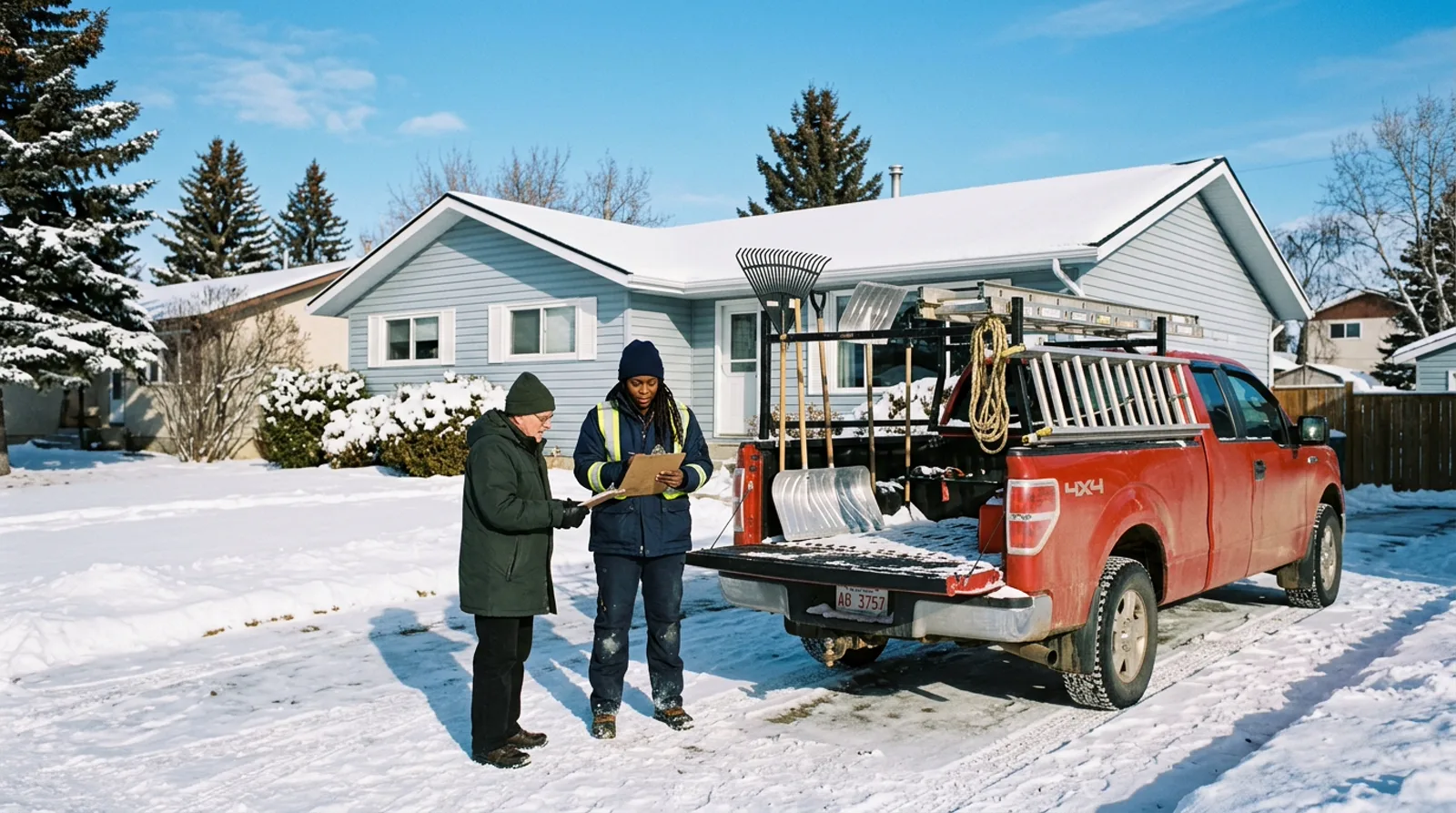
Roof Snow Removal Before the Damage Starts.
Heavy snow, ice dams and freeze-thaw cycles can collapse structures and flood interiors. Connect with verified pros who clear roofs safely, assess loads, and prevent winter damage across the Tri-Region.
Complete Roof Snow Services
From emergency clearing to preventive ice dam work, the pros in our network handle every winter roof scenario.
Emergency Snow Clearing
Urgent removal when you see sagging, hear cracking, or measure dangerous snow depth. Pros arrive with fall protection gear, assess structural load, clear snow by hand or with roof-safe tools, and document the before and after state for your insurer. Most emergency calls in Parkland County happen after 40 cm of wet snow or a chinook melt-refreeze event.
Ice Dam Removal
Low-pressure steam removal of ice dams that form when heat loss melts snow, water refreezes at the eaves, and backs up under shingles. Chemical melting or chipping damages roofs. Steam dissolves dams without shingle or membrane harm, and the pro inspects attic ventilation and insulation gaps that caused the dam in the first place.
Commercial Flat Roof Clearing
Scheduled or emergency clearing for low-slope and flat commercial roofs where snow accumulates and drains poorly. Pros calculate load per square meter against building code limits, clear using non-penetrating tools, check drains and scuppers for ice blockages, and coordinate with property managers to minimize business interruption. Larger roofs and multi-level buildings cost more.
Residential Pitched Roof Clearing
Preventive or post-storm clearing for single and two-story homes. The pro sets up fall arrest anchors, removes snow in controlled layers to avoid sudden load shifts, clears valleys and eaves where ice dams start, and leaves a thin protective snow layer to avoid shingle scour. Steep pitches, multiple roof levels, and heights above two stories increase time and cost.
Eaves and Valley Deep Clearing
Targeted removal from the roof zones where ice dams and leaks begin. Valleys funnel meltwater and trap heavy snow. Eaves collect refrozen runoff. The pro hand-clears these critical zones, inspects for existing ice penetration under shingles, flushes downspouts if accessible, and explains what attic improvements prevent repeat problems. Often bundled with full clearing.
Post-Storm Inspection and Assessment
Visual roof inspection after heavy snow or freezing rain to measure snow depth, estimate load, check for structural deflection, and recommend whether clearing is needed now or can wait. The pro provides a written report with photos, load calculations, and timeline. Useful for property managers, strata councils, and cautious homeowners who want expert judgment without committing to full removal yet.
Why Alberta Roofs Need Different Thinking
🌡️ Chinook Freeze-Thaw Torture
Warm chinook winds melt snow into water, temperatures plunge overnight, and that water becomes dense ice. A roof that handled 50 cm of powder now bears the equivalent of 80 cm because ice weighs three times more than snow. Pros in our network recognize chinook-affected roofs and clear before the refreeze, not after the damage.
❄️ Parkland County Snow Loads
Alberta Building Code sets ground snow load at 1.9 kPa for Spruce Grove and Stony Plain, but drifting, roof geometry, and multi-day storms create localized loads well above that. Flat roofs, valleys, and areas downwind of roof features collect disproportionate weight. The pros we connect you with measure depth, test density, and calculate actual load before deciding what to remove.
🏗️ Older Roof Structures and Additions
Many Tri-Region homes have additions, attached garages, or renovations built under earlier code editions with lower snow load ratings. A 1980s sunroom addition may not carry the same load as the main house. Pros inspect truss spacing, look for sag, and prioritize clearing on the weakest structures first, especially after heavy or wet snow events.
🧯 Insurance and Liability Reality
Most Alberta home policies cover roof collapse from snow load but exclude damage from lack of maintenance. If your insurer can argue you ignored obvious danger, the claim fails. Documented professional clearing, load assessments, and photos create a defendable maintenance record. The pros in our network provide written reports and timestamped photos specifically for this purpose.
What it costs here
Everything You Need to Know About Roof Snow Removal in Alberta
When to clear, how pros do it safely, what it costs, and how to prevent the expensive damage that snow and ice cause in Parkland County winters.
What Roof Snow Removal Actually Involves
Roof snow removal is the controlled clearing of accumulated snow and ice from residential and commercial rooftops to prevent structural damage, ice dam formation, and interior water intrusion. In Spruce Grove and Parkland County, this service becomes critical when heavy snowfall combines with Alberta's freeze-thaw cycles to create dense, wet snow that weighs far more per cubic foot than the light powder that falls in January. A roof snow removal professional uses specialized tools like roof rakes with extended poles, snow shovels designed not to damage shingles, and in some cases, steam equipment to address ice dams without tearing up the roofing membrane or flashing.
The work is not simply shoveling snow off the edge. A qualified technician assesses load distribution, identifies weak points or existing damage, and removes snow in a pattern that avoids unbalancing the roof structure. On a typical Spruce Grove bungalow, that means clearing the lower sections first to reduce the chance of a snow slide that could damage eavestroughs, siding, or anyone standing below. On commercial buildings with low-slope roofs common in Acheson industrial parks, removal requires walking on the roof surface itself, so professionals use fall protection harnesses and check that the decking can support both the worker and the remaining snow load before starting.
Alberta's building code specifies a ground snow load of roughly 1.4 to 1.8 kPa for the Parkland County area, but that's a design minimum for new construction. Older roofs, structures with complex valleys, or buildings with inadequate attic ventilation can experience trouble well before reaching code limits. Wet snow after a chinook can weigh three times as much as dry snow, and ice layers add even more. Roof snow removal professionals carry moisture meters and sometimes infrared cameras to spot hidden ice dams or areas where meltwater has refrozen inside the roof assembly, turning what looked like a moderate snow load into a serious structural concern.
Why Alberta's Climate Makes Roof Snow Management Essential
Chinook Wind Cycles and Wet Snow Accumulation
Spruce Grove sits in the chinook zone, which means winter temperatures can swing from minus 25°C to plus 5°C in a single day. When a chinook arrives mid-winter, the top layer of snow on your roof melts, then refreezes as temperatures drop again overnight. This creates a dense ice layer that acts as a dam, trapping meltwater from the next warm spell. That water has nowhere to go, so it backs up under shingles, through nail holes, and into the attic. Insurance claims for ice dam damage in Alberta spike every February and March for exactly this reason.
The wet snow that falls after a chinook is the heaviest type. A cubic foot of fresh powder weighs around five to seven pounds, but chinook-affected wet snow can weigh fifteen to twenty pounds per cubic foot. A modest four inches of wet snow across a 1,500 square foot roof translates to more than three tons of weight. Add an underlying ice layer, and you're looking at loads that exceed what many older Spruce Grove homes were designed to carry, especially those built in the 1970s and 1980s before updated snow load tables came into effect.
Ice Dam Formation and Attic Heat Loss
Ice dams form when heat escapes from your attic and warms the roof decking enough to melt the bottom layer of snow. That meltwater runs down to the eaves, where the roof surface is cold because there's no heated space below. The water refreezes, building up a ridge of ice along the edge. More meltwater hits that ridge and backs up, pooling behind it. Asphalt shingles are designed to shed water that flows downward, not to resist standing water, so the backup seeps through gaps and causes interior leaks, stained ceilings, damaged insulation, and in severe cases, rot in the roof decking and framing.
Parkland County homes with cathedral ceilings or bonus rooms over the garage are especially vulnerable. These areas often have less insulation depth than a standard attic, and the framing configuration makes it harder to ventilate properly. A roof snow removal visit addresses the symptom by clearing the snow, but the long-term fix is improving attic insulation and ventilation to keep the roof deck cold. The professionals Tri-Region connects you with will point out signs of heat loss, like bare spots in the snow pattern or heavy icicle formation, so you know whether you're dealing with a one-time snow event or a recurring problem that needs insulation upgrades.
Structural Load Limits and Building Age
Alberta's building code has been updated multiple times over the past fifty years, and each update has generally increased the required snow load design strength. A home built in Stony Plain in 1965 may have been engineered for a snow load well below what today's code requires. That doesn't mean the house is unsafe under normal conditions, but it does mean the margin for extreme snowfall is smaller. When snow depth on the roof exceeds twelve inches of wet, compacted snow, older structures start to show stress signs like nail pops in drywall, cracks at door frames, or sagging ridgelines.
Commercial and agricultural buildings face even higher risk. Older pole barns, storage sheds, and warehouse roofs in Acheson were often built to minimum standards with long spans and minimal intermediate support. A heavy snow load combined with wind can create uneven loading, where snow drifts pile up on the leeward side and overload a single truss or beam. Removing snow from these structures requires understanding the load path and working in a sequence that doesn't destabilize the building. The contractors Tri-Region verifies for commercial work carry liability coverage appropriate to that risk level and know how to assess whether a roof is safe to walk on before starting removal.
Warning Signs Your Roof Needs Clearing Now
The most obvious warning sign is visible sagging in the roofline or ceiling. Stand back from your house and look at the ridge and the eaves. If you see a dip or curve that wasn't there before, the roof structure is bending under load. Inside, check for cracks in drywall at the corners of door frames or along the ceiling-to-wall joint. These cracks often appear suddenly after a heavy snowfall and indicate the framing is moving. If you hear creaking or popping sounds from the attic, especially at night when temperatures drop, that's the framing adjusting to load and temperature stress. Any of these signs means you should have the snow cleared immediately, not next week.
Ice dams show up as thick ridges of ice along the eaves, often with large icicles hanging below. Some icicles are normal after a melt day, but if you see continuous ice buildup that's several inches thick and runs the full length of the eaves, that's a dam. Interior signs include water stains on ceilings near exterior walls, wet insulation in the attic, or dripping from pot lights and ceiling fixtures. By the time water is visible inside, the ice dam has been there for days and has already caused damage. Clearing the snow stops further melting, but you may still need repairs to the roof deck, insulation, and ceiling finishes.
Snow depth itself is a guide, but it depends on snow type. Twelve inches of dry powder is much lighter than six inches of wet, compacted snow. A rough rule of thumb for Spruce Grove and area is to consider removal when total snow depth exceeds eighteen inches, or when you have more than eight inches of wet snow after a chinook. If you can't safely reach the roof edge to check, look at snow depth on your deck railing or fence posts as a proxy. If snow is piled above the top of a standard four-foot fence, your roof is carrying a serious load. For flat or low-slope roofs common on garage additions and commercial buildings, consider removal at lower thresholds because these roofs have less inherent strength to resist bending.
- Visible sagging in the roofline or ridge when viewed from the street or yard
- New cracks in interior drywall, especially near door frames or ceiling joints
- Creaking or popping sounds from the attic during temperature changes
- Ice dams with thick ridges along eaves and large icicle formations below
- Water stains on ceilings near exterior walls or dripping from light fixtures
- Total snow depth over eighteen inches, or more than eight inches of wet, heavy snow
- Bare patches in the snow on your roof, indicating heat loss and potential ice dam formation
The Roof Snow Removal Process From Start to Finish
Initial Assessment and Safety Setup
The process begins with a visual assessment from the ground. The technician checks snow depth, looks for existing damage like broken shingles or separated flashing, and identifies hazards like overhead power lines or obstacles below the eaves where snow will be dropped. On residential jobs in Spruce Grove, that includes moving vehicles, patio furniture, and propane tanks away from the drop zone. For commercial sites in Acheson, it may mean coordinating with site operations to shut down loading areas or restrict access to certain zones while work is in progress.
Safety equipment is set up before anyone touches the roof. Ladders are positioned on solid ground, not on snow or ice, and secured at the top. If the roof pitch is steep or icy, the worker uses a fall protection harness anchored to a secure point on the opposite side of the roof. For jobs where the technician will walk on the roof surface, they confirm the decking is sound and that the structure can support the combined weight of the worker, tools, and remaining snow. On older homes, that may mean removing some snow from the ground with a roof rake first to reduce load before climbing up.
Snow Removal Methods and Sequencing
Most residential roof snow removal in Parkland County is done with a combination of roof rakes and hand shovels. A roof rake is a long-handled tool with a wide blade or roller system that allows the operator to pull snow off the lower few feet of the roof while standing safely on the ground. This method works well for single-story homes and bungalows, and it avoids the risk of damaging shingles or compressing insulation by walking on the roof. The technician works in vertical strips from eave to ridge, pulling snow down in controlled amounts so it doesn't all slide off at once and damage the eavestroughs.
For steeper roofs, two-story homes, or situations where ice dams have already formed, the technician may need to work from the roof surface itself. They start at the lowest point and work upward, removing snow in layers rather than trying to clear down to the shingles in one pass. This reduces the chance of damaging the roofing material with a shovel edge or scraper. Special care is taken around roof penetrations like vents, chimneys, and skylights, where ice often builds up and snow tends to drift. Steam equipment is sometimes used to melt channels through ice dams, allowing trapped water to drain without having to chip the ice away mechanically.
Post-Removal Inspection and Recommendations
Once the snow is cleared, the professional inspects the roof for damage that may have been hidden under the snow. That includes checking for lifted or missing shingles, separated flashing around chimneys and vents, cracks in rubber boots around plumbing stacks, and any areas where water has clearly been pooling. On flat or low-slope roofs, they check for standing water or ice that indicates a drainage problem. These findings are documented, often with photos, so the property owner has a clear record of existing conditions and knows what repairs to prioritize once weather allows.
The technician also looks for signs of underlying issues that contributed to the problem. Bare spots in the snow pattern suggest heat loss from poor attic insulation. Heavy ice buildup at the eaves with little ice higher up confirms inadequate ventilation. If the same areas of the roof had significantly more snow than others, that points to wind patterns or roof geometry that creates drifting. The contractors Tri-Region connects you with will explain these findings in plain terms and, if asked, can provide referrals to insulation specialists or roofing contractors who can address the root causes so you're not dealing with the same emergency every winter.
What Roof Snow Removal Costs in Spruce Grove and What Drives the Price
A typical single-story residential roof removal in Spruce Grove runs $400 to $900, while a two-story home with a steeper pitch and limited access can push $1,200 to $2,500. Commercial flat roofs are usually quoted per square foot, often $0.75 to $2.50 depending on depth, ice layer complexity, and whether a lift is required to reach the parapet. These ranges reflect what homeowners in Parkland County and Acheson actually pay during an average winter, but a heavy February snowfall after weeks of freeze-thaw can double the price when every crew is booked solid and ice dams have already formed. Timing matters: calling in late January after three chinooks and re-freezes costs more than booking a preventive clear in early December when snow is still light and dry.
The biggest cost drivers are roof pitch, height, and accessibility. A shallow-pitch garage is fast and low-risk, often cleared in an hour. A 9/12 pitch two-story home requires fall-arrest anchors, harnesses, and two workers moving carefully, tripling labor time. If your roof edge sits above power lines, mature spruce trees, or a narrow side yard with no truck access, expect an access surcharge because the crew cannot stage ladders safely or use a lift. Ice dams add another layer: a thick ridge along the eaves requires steam equipment or careful chipping, not just shoveling, and that specialized work commands $150 to $400 extra depending on linear footage. Snow depth beyond about 60 centimeters also slows removal because each shovel load is heavier and the risk of underlying shingle damage rises, forcing a more deliberate pace.
Hidden costs include disposal if the crew cannot safely push snow off the edges, emergency or after-hours premiums during a storm, and repair charges if removal reveals damaged flashing, torn shingles, or a cracked skylight that was invisible under the snow. Some contractors build a return-visit discount into the quote if you book seasonal service, clearing three or four times through winter at a reduced per-visit rate. Others charge a flat mobilization fee if your property is outside their usual Spruce Grove or Stony Plain service area. Always confirm whether the quote includes ice dam treatment, gutter clearing, and minor shingle inspection, or if those are separate line items added at the end.
Comparing Your Options: Manual Removal, Steam Methods, and Preventive Systems
Manual removal from the ground using a long-handled roof rake works for single-story homes with accessible eaves and light, fluffy snow. A homeowner can clear the lower four feet of roof in an afternoon, reducing load and stopping melt-water from pooling at the eaves. The limitation is reach: you cannot clear the ridge or any area more than about three meters from the edge, and packed or icy snow resists the rake blade. Pulling too hard risks tearing shingles or dislodging flashing. On-roof manual removal by a professional crew with proper fall protection is the most common method in the Tri-Region. Workers shovel or push snow toward the edge, leaving a thin protective layer to avoid scraping the granules off asphalt shingles. This approach handles any depth and any roof geometry, but it is labor-intensive and weather-dependent: high wind, freezing rain, or extremely cold temperatures make the work unsafe and most crews will reschedule.
Steam or hot-water systems use a wand that melts channels through ice dams and cuts slots in deep snowpack, letting melt-water drain and reducing load without mechanical impact on the roof surface. This method is ideal for older heritage homes with fragile clay tile or slate, and for commercial roofs where membrane punctures are a constant risk. The downside is speed and cost: steaming takes longer than shoveling, requires a truck-mounted boiler and generator, and typically costs $200 to $600 more than manual removal for a comparable area. It is the go-to solution when an ice dam is already leaking into the attic and you need immediate relief without risking further shingle damage. Some contractors combine the two methods, using steam to open a drainage path through the ice ridge and then shoveling the bulk snow behind it.
Preventive systems reduce or eliminate the need for emergency removal. Electric heat cable installed in a zigzag pattern along the eaves and through downspouts keeps a melt channel open, preventing ice dams before they form. Installation runs $8 to $15 per linear meter, and the cable draws about 7 to 12 watts per foot, adding $40 to $90 to your winter power bill if left on continuously. A more permanent fix is improving attic insulation and ventilation so the roof deck stays cold and snow melts evenly rather than pooling at the eaves. A local insulation contractor can assess your attic for about $150 to $300 and propose upgrades, often in the $1,500 to $4,500 range depending on attic size and existing R-value. That investment pays back over five to ten winters by eliminating most removal costs and avoiding ice dam damage altogether.
Common Mistakes and Contractor Red Flags to Avoid
The most dangerous mistake is attempting steep-roof removal yourself without fall-arrest equipment. Alberta sees multiple winter hospitalizations every year from homeowners who climbed a snow-covered roof in running shoes, lost footing on ice beneath the snow, and slid off the edge. Even if you own a harness, residential roofs rarely have code-compliant anchor points, and a fall-arrest system requires training to rig correctly. Insurance may deny a claim if the adjuster determines you were performing commercial-risk work without proper safety measures. The second common error is using metal tools aggressively: a sharp shovel or ice chopper can slice through asphalt shingles, puncture EPDM membrane on a flat roof, or crack clay tile, turning a $600 removal job into a $3,000 repair. Professionals use plastic or wooden-edged tools and leave a sacrificial snow layer to protect the surface.
Contractor red flags start with no proof of WCB coverage and liability insurance. If a worker falls off your roof and the company has no liability insurance account, you as the property owner can be held liable for medical costs and lost wages under Alberta law. Always verify the WCB account number online before signing, and request a certificate of insurance naming general liability of at least $2 million. Seasonal fly-by-night operators appear every November with a truck and a ladder, offer a too-good price, damage your roof or gutters, and vanish by March when you notice the leaks. Legitimate local contractors have a registered business name, a municipal business license, references you can call, and ideally membership in a trade association. Avoid anyone who demands full payment up front: standard practice is a deposit of 25 to 50 percent, with the balance due on completion and your satisfaction.
Timing mistakes cost money and risk damage. Waiting until an ice dam is already leaking into your living room means emergency rates, limited contractor availability, and potential interior damage to drywall and insulation that insurance may not fully cover if you delayed action unreasonably. On the other hand, clearing snow after every small fall wastes money: a 10-centimeter dusting does not threaten structural load, and early-season removal can actually increase ice dam risk by exposing shingles to repeated freeze-thaw cycles. A practical rule is to monitor total depth and call for removal when accumulation exceeds about 40 centimeters, or immediately if you see icicles longer than 30 centimeters forming along the eaves, which signal poor attic ventilation and ice dam development. If you book a contractor and then chinook winds melt half the snow the day before the scheduled visit, most reputable companies will let you reschedule without a cancellation fee rather than charging you for unnecessary work.
How to Find and Hire the Right Roof Snow Removal Professional
Start by verifying credentials before discussing price. Ask for the contractor's WCB account number and confirm it is active and in good standing through the Alberta WCB online registry. Request proof of commercial general liability insurance with coverage of at least $2 million, and check that the policy is current and names snow removal as a covered activity. Some insurers exclude roof work or impose seasonal restrictions, so a certificate dated and specific to winter operations gives you confidence. Check references: ask for two or three recent customers in Spruce Grove or Stony Plain, call them, and ask whether the crew showed up on time, left the property clean, and whether any damage occurred. A contractor who hesitates or cannot provide verifiable local references is not worth the risk.
When comparing quotes, look beyond the bottom-line number. A detailed estimate specifies the scope: will they clear the entire roof or just the lower section, do they include ice dam removal or is that extra, will they inspect and photograph any pre-existing damage before starting, and is there a separate charge for gutter clearing? Confirm the timeline: can they come within 48 hours of your call during peak season, or is there a week-long wait? Ask about their safety protocols, what equipment they use to protect themselves and your roof, and whether they carry replacement shingles in case of accidental damage. A professional contractor will answer these questions clearly and provide a written quote that you can compare line by line with others. Avoid vague verbal estimates or quotes scribbled on scrap paper with no company letterhead or contact details.
The best time to hire is before you need emergency service. If your roof is prone to ice dams or your home is two stories with a steep pitch, contact a few contractors in November and get on their callback list for the season. Some offer priority scheduling or discounted rates if you pre-book three removals through winter. When the first major snowfall hits in late December or January, you call your pre-arranged contact and get a slot within days instead of joining the two-week queue. This approach also gives you leverage to negotiate: off-peak or advance-booked jobs are worth more to a contractor than one-off emergency calls, and you can often secure a 10 to 20 percent discount compared to peak-storm pricing.
How Tri-Region Services Helps
Tri-Region Services routes your roof snow removal request to one local contractor whose insurance, and customer references have all been stated at signup. You describe your roof type, height, and any visible ice dam or access concerns through a short online form or phone call, and within a few hours a local professional contacts you directly to arrange a free on-site quote. No bidding war, no multiple sales calls, just one qualified match. The pro you are connected with carries their own liability coverage and workmanship warranty, and those details are confirmed in writing before any work starts, so you know exactly what protection you have if something goes wrong.
How We Screen the Pros You Meet
Tri-Region verifies credentials, confirms coverage, and ensures the operator who shows up is trained, insured, and equipped for safe roof work.
Liability insurance Confirmed
Every pro in our network carries current Workers Compensation Board coverage, stated at signup, so you are never liable if someone is injured on your property.
Liability Insurance Verified
Commercial general liability cover is confirmed active before any job, protecting you from property damage claims during clearing work.
Fall Protection Certified
Operators are required to use CSA-approved harnesses, anchors, and fall arrest systems on any roof above single-story height, meeting Alberta OHS standards.
Written Reports and Photo Documentation
The pro provides a clearing report with timestamped photos, snow depth measurements, and load notes, creating the maintenance record your insurer expects.
Emergency Response Capacity
Pros in our network commit to defined response windows during storm events, with priority dispatch for structural emergencies like sagging or cracking.
Local Service Radius
Every operator knows Spruce Grove, Stony Plain, and Parkland County roads, weather patterns, and building stock, so response times stay realistic even in winter conditions.
This page is not tied to a contractor's brand. Leads route straight to your one local partner. Verified reviews can appear here once that partner has them (never fabricated).
Serving the whole Tri-Region
8 Questions About Roof Snow Removal
When does roof snow actually need professional removal in Alberta?+
How much snow is too much for roofs built to Alberta code?+
What causes ice dams in Spruce Grove and Stony Plain winters?+
Is roof snow removal covered by Alberta home insurance?+
How do professionals remove snow from roofs safely without damage?+
Can I remove roof snow myself or should I always hire a professional?+
What is the typical emergency response time for roof snow removal?+
How often should commercial flat roofs be cleared in Parkland County winters?+
Get your free quote
Tell us what you need and a local pro will get right back to you.
- ✓ Sent straight to a local business
- ✓ You choose who you hire
- ✓ Free, with no obligation