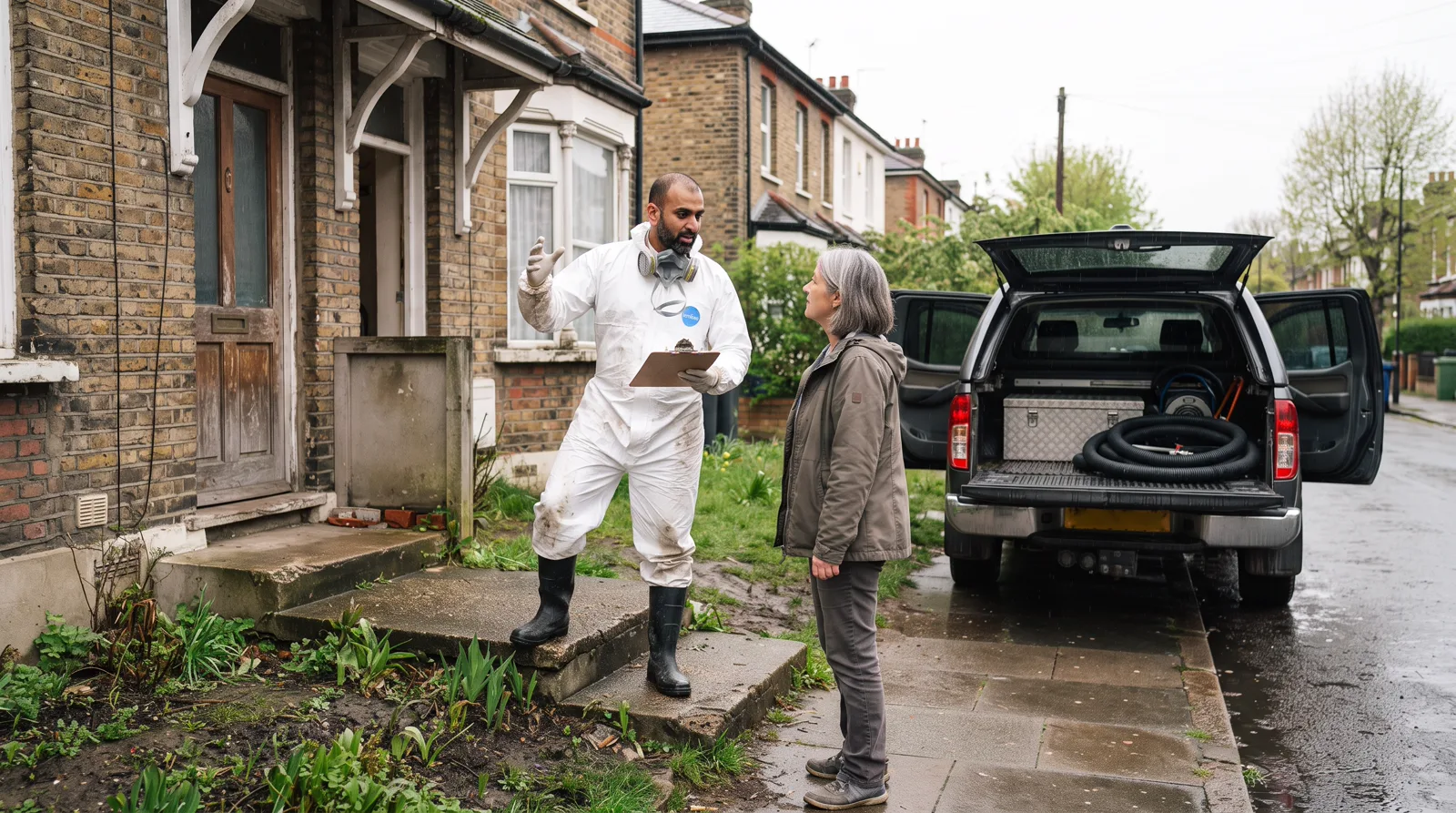
Sewage Backup Cleanup Spruce Grove
Safe removal, sanitization, and disposal after blackwater contamination. IICRC certified crews with hazmat training respond 24/7.
Complete Sewage Remediation Process
From containment to sanitization, following Alberta Health Services protocols.
Emergency Extraction & Containment
Immediate blackwater removal with truck-mount extractors. Seal contaminated zones to stop spread. Full PPE and negative air pressure where needed. Typical basement extraction takes 3 to 6 hours depending on volume and access.
Structural Sanitization & Disinfection
Hospital-grade antimicrobial application to all hard surfaces. Remove and dispose of porous materials (drywall, insulation, carpet pad). Treat framing lumber with EPA-registered disinfectants. Document every step for insurance and health inspectors.
Air Scrubbing & Odor Removal
HEPA air scrubbers capture airborne pathogens and particles. Hydroxyl generators break down organic odor molecules without ozone. Run continuously for 48 to 72 hours post-cleanup. Essential for indoor air quality and resale value.
Personal Property Disposal
Safe removal of contaminated belongings that cannot be salvaged. Upholstered furniture, mattresses, carpet, and porous items go to licensed waste facilities. Provide itemized disposal list and photos for insurance claims. Hard goods may be sanitized if structurally sound.
Pipe Inspection & Repair Coordination
Camera inspection to identify root cause: tree roots, collapsed line, municipal main backup. Coordinate with licensed plumbers for line repair or replacement. Check backwater valve function. Required to prevent repeat incidents and satisfy insurance.
Rebuild Preparation & Documentation
Final moisture mapping and clearance testing. Detailed photo log and scope of loss for contractors. Certificate of sanitization for insurance adjuster and future buyers. Leave space clean, dry, and ready for framing and drywall.
Why Sewage Backups Happen Here
🏔️ Clay Soil & Slow Drainage
Parkland County clay expands when wet and drains poorly. Spring melt and heavy rain overwhelm undersized sewer laterals, especially in older subdivisions built before 1990. Backwater valves are now code but many homes lack them.
❄️ Freeze-Thaw Sewer Line Damage
Deep frost (down to 2 meters) and chinook cycles crack aging clay and concrete sewer pipes. Groundwater infiltration and root intrusion follow. February and March see the highest backup call volume as lines shift and separate.
🌳 Tree Root Intrusion in Mature Areas
Older Spruce Grove and Stony Plain neighborhoods have mature poplars and willows with aggressive root systems. Roots seek moisture in sewer lines through tiny cracks, then expand and block flow. Camera inspection reveals this in 60% of recurring backup cases.
🌊 Spring Melt System Overload
Rapid April snowmelt combines with frozen ground that cannot absorb runoff. Municipal systems in Acheson and parts of Spruce Grove see peak flows 3x to 5x normal capacity. If the main backs up, your lateral does too, even if your line is perfect.
What it costs here
Everything You Need to Know About Sewage Backup Cleanup
Health risks, insurance coverage, cleanup process, and how to protect your home from future contamination.
What Sewage Backup Cleanup Actually Involves
Sewage backup cleanup is not water damage restoration with stronger chemicals. It is the safe removal, disposal, and sanitization of Category 3 contaminated materials after raw sewage, toilet overflow, or storm drain backflow enters your home. The sewage carries bacteria like E. coli and Salmonella, viruses including hepatitis A, parasites such as Giardia, and chemical contaminants from household and industrial waste. Every porous surface the sewage touches, drywall to carpet to insulation, becomes a biohazard that must be handled under strict containment protocols. Restoration technicians wear respirators, gloves, and full protective suits because airborne pathogens and skin contact both pose serious infection risk.
In Spruce Grove and Stony Plain, most sewage backups originate from municipal sewer line blockages during spring melt or from your own lateral line collapsing under frost heave pressure. The sewage does not politely pool in your basement drain. It erupts through floor drains, toilet bases, and washing machine standpipes, flooding finished basements with contaminated water that soaks into everything it reaches. Within 48 hours, mold begins colonizing the damp materials, and within 72 hours bacterial counts can make the space unsafe to occupy without protection. A professional sewage cleanup crew does not just extract the standing water and spray disinfectant. They remove and dispose of contaminated materials, treat all hard surfaces with hospital-grade antimicrobials, and verify the space is safe before reconstruction begins.
The difference between a Category 1 clean water leak and Category 3 sewage is liability and health code. Your homeowner's insurance will cover sewage cleanup under most policies, but only if you act fast and document the damage properly. Parkland County Environmental Health and Alberta Health Services both have guidelines for sewage exposure, and a licensed restoration company must follow those rules or risk shutting down your claim. DIY sewage cleanup exposes you to infection, spreads contamination to unaffected areas, and leaves behind pathogens that testing will later find. The cost to hire a professional crew for a 400 square foot basement sewage backup typically runs $3,500 to $8,000 depending on how much material must be removed and how deep the contamination traveled into walls and subfloors.
Why Sewage Backups Happen in Spruce Grove and Parkland County
The sewer systems serving Spruce Grove, Stony Plain, and the older parts of Parkland County were built in the 1970s and 1980s using clay tile and early PVC pipe that is now aging past its design life. Clay pipe joints shift and separate under Alberta's extreme freeze-thaw cycle, which drops soil temperatures to minus 30 Celsius in January and then swings back above freezing during chinook events. That movement cracks the pipe, lets tree roots infiltrate the line, and creates low spots where grease, wet wipes, and solid waste collect until the pipe is fully blocked. When the blockage is downstream of your home, every toilet flush and washing machine cycle has nowhere to go but back up through your basement drains.
Spring melt is the worst time for sewage backups in this region. Parkland County gets 400 to 500 millimeters of precipitation per year, much of it falling as snow that sits frozen all winter and then melts rapidly in March and April. The ground is still frozen solid a meter down, so that meltwater cannot percolate into the soil. Instead it runs into storm drains, which in older neighborhoods are combined with sanitary sewer lines in a single pipe. The sudden inflow overwhelms the pipe capacity, and the municipality's lift stations and treatment plant cannot keep pace. The result is a reverse flow event where diluted sewage surcharges back through basement floor drains in low-lying areas. Spruce Grove's older Heritage Park and Westgrove neighborhoods see this almost every spring because they sit in the original drainage basin before the city expanded its trunk sewer capacity.
Tree roots cause chronic backups in mature neighborhoods. Cottonwoods, willows, and poplars common in Spruce Grove yards send roots 10 to 15 meters searching for water, and a clay sewer pipe joint with even a hairline crack will attract root penetration. The roots grow into a dense mat inside the pipe, catching toilet paper and waste until the line is blocked. You will notice slow drains, gurgling when you flush, and sometimes a sewage smell near your basement floor drain days before the actual backup happens. A plumber can camera the line and show you the root mass, but cutting the roots only buys you six months to a year before they grow back. The permanent fix is replacing the clay lateral with seamless PVC, a job that costs $4,000 to $12,000 depending on distance to the street and how much landscaping must be disturbed.
Warning Signs You Need Professional Sewage Cleanup
The smell is the first clue. Sewage odor is unmistakable: a sharp, fecal, rotten-egg stench from hydrogen sulfide gas that gets stronger the closer you get to the source. If you walk into your basement and smell that, do not ignore it and hope it goes away. Sewage gas is not just unpleasant, it is toxic in concentration and indicates contamination is already present. Look for standing water or damp spots on the floor near drains, toilets, or the washing machine. Even if the water has drained away, a dark stain on concrete or wet carpet is enough evidence that sewage was present. Touch nothing with bare hands, do not walk through the affected area in regular shoes, and keep children and pets out of the basement entirely until a restoration crew assesses the situation.
Visible sewage solids, toilet paper, or a greasy film on the floor means you are dealing with Category 3 contamination. At that point, calling a plumber to clear the drain is only half the solution. The plumber will restore flow and stop new sewage from entering, but everything the sewage touched is now contaminated and must be cleaned or removed by a restoration company following biohazard protocols. Some homeowners think they can mop up the mess with bleach and a bucket, but sewage is not surface dirt. It penetrates carpet pad, soaks into drywall, and wicks up studs through capillary action. You cannot see the bacteria and you cannot smell them once the surface dries, but they remain viable and will cause illness or trigger mold growth when humidity returns.
Health symptoms in your household after a suspected backup are a red flag. Stomach cramps, diarrhea, vomiting, skin rashes, or respiratory irritation within a few days of basement water exposure suggest sewage pathogen contact. Alberta Health Services treats sewage exposure as a reportable concern when multiple household members fall ill, and your family doctor will ask whether there was recent flooding or plumbing failure. Even if no one is symptomatic yet, the safe assumption is that any backup from a toilet, floor drain, or sump pit connected to the sanitary sewer is contaminated until testing proves otherwise. Professional crews use ATP meters and microbial swabs to verify surfaces are clean after treatment, a step you cannot replicate with household cleaners and guesswork.
The Complete Sewage Backup Cleanup Process
The first step is containment and safety. A licensed restoration crew will set up physical barriers using plastic sheeting and zipper doors to isolate the contaminated area from the rest of your home, preventing airborne pathogens and cross-contamination. They establish negative air pressure using air scrubbers with HEPA filters, so any airflow moves into the contaminated zone rather than out into clean areas. All technicians wear respirators rated for biohazard work, disposable coveralls, gloves, and boot covers. They document the extent of the damage with photos and moisture readings for your insurance claim before any material is removed. If the sewage is still standing, they extract it using truck-mounted pumps and dispose of the waste at a licensed treatment facility, not down your own drains or onto your yard.
Material removal comes next. Carpet and underpad are always discarded after sewage contact, no exceptions. Drywall that wicked sewage more than a few centimeters up from the floor must be cut out and removed because you cannot fully sanitize the gypsum core. Baseboards, trim, and any wood in contact with the sewage are evaluated: solid wood can sometimes be saved if treated immediately, but engineered wood and MDF disintegrate and must go. Insulation in rim joists or under basement slabs that got wet is pulled out and thrown away. Everything goes into heavy-duty biohazard bags, sealed, and hauled to a landfill that accepts contaminated waste. Some restoration companies in Spruce Grove will try to save materials to reduce your costs, but if the material is porous and was submerged, it is safer and faster to replace it than to gamble on incomplete disinfection.
Hard surface treatment and antimicrobial application follow removal. Concrete floors are pressure-washed with a hospital-grade disinfectant containing quaternary ammonium compounds or sodium hypochlorite at concentrations strong enough to kill bacteria, viruses, and fungi on contact. The crew scrubs all remaining framing, joists, and foundation walls, then applies a residual antimicrobial coating that continues to kill pathogens for days after application. They use thermal foggers to treat areas that are hard to reach by hand, such as the gap between floor joists or behind mechanicals. Air scrubbers run continuously during this phase, pulling contaminated particles out of the air and trapping them in HEPA filters that are disposed of as biohazard waste.
Drying and verification are the final steps. Industrial dehumidifiers and air movers run for three to five days until moisture readings in framing and concrete return to normal, typically below 12 percent wood moisture content and under 4 percent on a concrete moisture meter. The crew takes post-treatment microbial samples and sends them to a lab for culture, confirming that bacterial counts are within safe limits before you reoccupy the space. Some insurance companies require an independent hygienist to clear the space, especially if children or immune-compromised people live in the home. Once clearance is issued, reconstruction can begin: new drywall, fresh insulation, new flooring, paint, and trim. Total timeline from backup to move-back-in is usually 10 to 14 days if the crew and contractors are lined up and the insurance adjuster moves quickly.
What Sewage Cleanup Really Costs in the Tri-Region
Sewage backup cleanup pricing in Spruce Grove, Stony Plain and Parkland County typically falls into three tiers based on contamination severity and affected area. A small Category 2 greywater backup contained to a single bathroom might run $1,200 to $2,500 if caught early, covering extraction, antimicrobial treatment and drying. A moderate Category 3 blackwater event affecting a basement rec room and hallway typically costs $3,500 to $8,000, including removal of porous materials like drywall and carpet, thorough disinfection and full structural drying. Large scale sewage floods that saturate finished basements with multiple rooms, or events involving crawl spaces and floor joist contamination, can reach $10,000 to $25,000 or more once you account for demolition, disposal, sanitization, odor control and post-remediation testing. These are cash-out-of-pocket ranges if you are paying directly. Insurance claims often cover the work minus your deductible, but your adjuster will apply policy limits and exclusions that can shift what you actually receive.
Several local factors drive the final bill in ways that catch homeowners off guard. The age and construction type of your home matters significantly. Older Spruce Grove bungalows with poured concrete foundation walls and wood subfloors absorb sewage differently than newer Stony Plain walk-outs with sealed concrete and engineered floor systems. If sewage soaks into original 1970s particle board subfloor, the entire floor deck often requires replacement rather than restoration, adding $4,000 to $9,000 in framing lumber, OSB sheathing and labor. Homes with in-floor radiant heat complicate matters further because contaminated water can infiltrate the tubing chase, requiring slab penetration or full system abandonment. Winter timing inflates costs because frozen ground prevents outdoor disposal, forcing contractors to haul contaminated materials to Edmonton transfer stations at premium rates. Parkland County acreages face higher mobilization fees since equipment and crew travel from Spruce Grove or Stony Plain service hubs, sometimes adding $300 to $600 to the base quote.
Material category and square footage affected are the two largest cost levers. Sewage that stays on tile or vinyl flooring in an unfinished utility room is far cheaper to remediate than sewage that floods a carpeted rec room with drywall, baseboards and insulation. Porous materials like carpet pad, drywall below the four foot flood line, and any wood that stayed wet longer than 48 hours must be removed and discarded under IICRC S500 standards. A 600 square foot finished basement with sewage exposure across carpet, drywall and framing will generate three to five tons of contaminated waste, and disposal fees at local landfills run $120 to $180 per ton plus transportation. Structural drying time also drives labor costs. A concrete slab with surface water can dry in three to five days with commercial air movers and dehumidifiers, but a wood-framed floor system with joist bay contamination may need seven to ten days of continuous drying and daily moisture readings. Equipment rental is billed per day, so extended drying periods add $150 to $400 in daily charges. Always ask for a line-item breakdown showing extraction, antimicrobial application, demolition, disposal, drying and testing as separate costs so you can see exactly where your money goes.
Comparing Cleanup Methods and Sanitization Options
Sewage extraction methods vary based on water depth and surface type. For standing water deeper than half an inch, truck-mounted extraction units are the industry standard. These rigs park outside your home and run high-capacity vacuum hoses into the affected area, pulling hundreds of gallons per hour into a sealed holding tank. The advantage is speed and volume. A flooded 800 square foot basement can be extracted in 30 to 60 minutes, minimizing further absorption into walls and subfloors. Portable extractors are used for smaller backups or areas where truck access is limited, such as crawlspaces or acreages with long driveways. These units are slower but still effective for jobs under 200 gallons. After bulk extraction, technicians use weighted wands and detail tools to pull residual sewage from carpet fibers, grout lines and floor seams. Some companies follow extraction with a hot water flush to dilute remaining solids, though this adds water volume and drying time. In all cases, extracted sewage must be transported to an approved sewage treatment facility or pumped into your municipal sewer cleanout if local bylaws allow. Never let a contractor dump sewage onto your yard or into a storm drain, as this violates Alberta environmental regulations and can result in fines.
Antimicrobial Treatment and Disinfection Protocols
Once sewage is extracted, the real sanitization work begins. Professional remediation crews apply EPA-registered antimicrobial agents designed to kill bacteria, viruses and pathogens present in Category 3 blackwater. Hospital-grade quaternary ammonium compounds are common for hard surfaces like concrete, tile and sealed wood. These are sprayed or mopped at manufacturer-specified dilution rates and left to dwell for ten minutes before being extracted or wiped down. Porous materials that cannot be effectively disinfected, including drywall, insulation and carpet pad, are removed and discarded rather than treated. Some contractors use foggers to disperse disinfectant into wall cavities, floor joist bays and other hidden spaces, though fogging alone is never sufficient without physical cleaning of visible surfaces. After antimicrobial treatment, an enzyme-based odor counteractant is often applied to break down organic matter causing persistent sewer smells. This is especially important in crawl spaces and rim joist areas where airflow is limited and odors linger for months if untreated.
Oxidizing agents like chlorine dioxide or hydrogen peroxide vapor are sometimes used for severe contamination or when mold growth is already visible. These treatments penetrate deeper than surface disinfectants and can reach inside wall cavities and subfloor spaces. However, they require full home evacuation for 24 to 48 hours and demand careful ventilation afterward. Not all Tri-Region contractors are trained or equipped for oxidizing treatments, so verify credentials if this method is proposed. After disinfection, independent testing labs can collect surface swabs or air samples to confirm bacterial counts meet safe thresholds. This post-remediation verification costs $300 to $600 but provides documentation for insurance claims and peace of mind that your home is truly safe. Always insist on third-party testing rather than accepting the contractor's word that the job is complete.
Structural Drying and Moisture Monitoring
Professional drying is what separates a proper sewage cleanup from a cosmetic cover-up. After extraction and disinfection, affected materials still hold moisture deep in their structure. Concrete slabs can stay damp for weeks, and wood framing can retain 30 to 40 percent moisture content even when surface water is gone. Restoration crews deploy industrial air movers to create rapid air circulation across wet surfaces, accelerating evaporation. These fans are positioned at precise angles to direct airflow under cabinets, along baseboards and into wall cavities where moisture hides. Commercial dehumidifiers running 24 hours a day pull moisture out of the air and drain it into floor drains or sump pits. In an Alberta winter, indoor humidity must be carefully managed because over-drying can crack drywall and hardwood, while under-drying leaves conditions ripe for mold. Daily moisture readings using pin-type and pinless meters track progress and determine when materials have returned to safe levels, typically below 15 percent moisture content for wood and under 1.5 percent for concrete.
Drying times vary widely based on construction type and ambient conditions. A concrete basement with minimal furnishings might reach dry standards in four to six days. A finished basement with multiple rooms, insulated walls and wood subfloors can take ten to fourteen days. Drying cannot be rushed without risking hidden moisture pockets that breed mold within weeks. Some contractors use thermal imaging cameras to scan walls and floors for temperature differentials that indicate trapped moisture. This technology adds cost but prevents expensive callbacks when mold appears two months later. Always ask how moisture levels will be documented and request copies of daily log sheets showing readings from each affected area. If a contractor quotes a flat three day drying period regardless of your home's specifics, that is a red flag they are guessing rather than monitoring.
Contractor Traps and Mistakes Homeowners Make
The biggest mistake homeowners make after a sewage backup is waiting to call for help. Every hour sewage sits in your basement increases contamination spread, odor penetration and structural damage. Sewage contains bacteria counts in the millions per milliliter, and porous materials begin absorbing pathogens within minutes. Some homeowners try to extract the water themselves using a shop vacuum, believing they will save money by doing the heavy lifting before a contractor arrives. This is dangerous and ineffective. Standard shop vacuums are not designed for biohazard liquids, and aerosolized sewage particles during DIY extraction expose you to E. coli, hepatitis A and other serious pathogens. Contaminated wastewater also ruins the vacuum, creating a secondary disposal problem. Even if you successfully remove standing water, you lack the antimicrobial agents, personal protective equipment and drying capacity to safely remediate the space. Insurance companies recognize this, and many policies require professional restoration within 48 hours to maintain full coverage. Attempting DIY cleanup can void your claim and leave you paying out of pocket for a problem that grows worse by the day.
Another common trap is hiring the first company that answers the phone without verifying credentials and insurance. Sewage cleanup is physically unpleasant work, and fly-by-night operators with a truck and a pump will gladly take your money while doing substandard work. In Alberta, legitimate restoration contractors carry comprehensive general liability insurance in amounts of at least two million dollars, plus liability insurance for every worker on site. Always ask for proof of both before signing a contract. If a crew member is injured in your home and the company lacks WCB, you can be held personally liable for medical costs and lost wages. Similarly, if a contractor causes additional damage during demolition or flooding and has no liability coverage, you are left with no recourse. Check for IICRC certification as well. The Institute of Inspection, Cleaning and Restoration Certification offers specialized training in water damage restoration and applied microbial remediation. A company with IICRC-certified technicians demonstrates a baseline of professional knowledge that weekend warriors lack.
Watch for pricing red flags that signal trouble. Any contractor who quotes a firm price over the phone without inspecting your home is guessing, and that guess will always be low to get their foot in the door. Once work begins, add-ons and change orders pile up until the final bill is double or triple the verbal estimate. Insist on a written scope of work and line-item quote after an in-person assessment. Be wary of contractors who push for immediate demolition before moisture readings are documented. Unscrupulous operators remove more material than necessary because they bill by volume, and homeowners have no way to verify what was truly unsalvageable. Similarly, avoid companies that discourage insurance involvement or offer a cash discount to skip the claim. This often means the contractor wants to avoid the scrutiny and documentation requirements that adjusters demand. Legitimate restoration firms work seamlessly with insurance companies because their processes meet industry standards and withstand third-party review. If a contractor seems evasive about providing references, proof of insurance, or detailed invoices, walk away and find someone who operates transparently.
How to Hire the Right Sewage Cleanup Professional
Start by verifying emergency response capability. Sewage backups do not wait for business hours, and a company that only operates nine to five on weekdays is useless when your basement floods at 11 PM on a Saturday. The best restoration firms offer true 24/7 dispatch with crews ready to roll within 60 to 90 minutes of your call. Ask how quickly they can arrive and what their response time guarantee covers. A company with local technicians in Spruce Grove or Stony Plain will always beat a provider dispatching from Edmonton, especially during winter road conditions or busy storm seasons. Confirm they own their extraction and drying equipment rather than renting it on demand. Companies that own truck-mounted units, commercial dehumidifiers and air scrubbers have the capacity to handle your job immediately and can scale resources if the damage is worse than initially thought. Contractors who rely on rental equipment often face delays when supply runs short during peak flood periods.
Request references from recent sewage jobs in the Tri-Region, not just general water damage projects. Sewage remediation requires specific training and equipment that differs from clean water extraction. Ask past clients whether the contractor communicated clearly throughout the process, provided daily updates and moisture logs, and left the home genuinely clean and odor-free. Check online reviews on Google and Facebook, paying attention to how the company responds to complaints. A contractor who argues with negative reviews or blames the homeowner is a liability. Look for detailed responses that acknowledge concerns and explain corrective actions. Call the Better Business Bureau and verify the company has no unresolved complaints or patterns of poor workmanship. In Alberta, you can also check the Corporate Registry to confirm the business is legitimately registered and how long it has operated. Fly-by-night operators often register under new names every few years to escape bad reputations.
During the initial consultation, evaluate how thoroughly the contractor assesses your situation. A professional will document the extent of contamination with photos and moisture readings, explain the restoration process in plain language, and provide a written scope of work before touching anything. They will ask about your home's mechanical systems, including HVAC and plumbing layouts, because sewage can infiltrate ductwork and floor drains in ways that require specialized cleaning. They should also discuss your insurance coverage and offer to work directly with your adjuster, providing detailed estimates and documentation that support your claim. Red flags include vague timelines, refusal to provide written estimates, or pressure to sign a contract immediately before you can compare quotes. Trustworthy contractors understand that sewage cleanup is a significant expense and homeowners need time to make informed decisions. They will walk you through each phase of the work, explain why certain materials must be removed, and answer questions without impatience or jargon.
How Tri-Region Services Helps
Tri-Region Services simplifies the search by connecting you to one vetted, fully insured local sewage cleanup professional who serves Spruce Grove, Stony Plain, Parkland County and Acheson. Every contractor in our network tells us they carry comprehensive liability insurance and IICRC certifications in water damage restoration and applied microbial remediation. We verify credentials before a company joins our directory, so you skip the risky work of checking references and insurance policies yourself. When you submit a request, we route your information to a qualified pro who will contact you within two hours to schedule an on-site assessment. You receive a free written quote that breaks down extraction, disinfection, drying and restoration costs with no obligation to proceed. Our service is completely free for homeowners, and contractors in our network are selected based on response time, customer satisfaction scores and proven expertise in handling Category 3 blackwater events. Whether your basement flooded at 3 AM or you are dealing with insurance paperwork after a backup, Tri-Region Services connects you to local help you can trust.
Why Trust Matters in Sewage Work
This is category 3 water contamination. Certification, licensing, and documented protocols are not optional.
IICRC Water Damage Restoration Certified
Crews trained in category 1, 2, and 3 water classification and remediation protocols.
Full Hazmat PPE & Protocols
Tyvek suits, respirators, gloves, and eye protection on every sewage job, no exceptions.
Licensed for Biomedical Waste Disposal
Alberta Environment permit for transporting and disposing of contaminated materials legally.
Insurance Claims Documentation
Photo logs, moisture readings, itemized scope, and disposal receipts formatted for adjusters.
Insured crews
Workers Compensation Board coverage protects you from liability if a worker is injured on your property.
Emergency Requests Prioritized
Emergency requests are routed straight to available local crews across Spruce Grove, Stony Plain, and Parkland County.
This page is not tied to a contractor's brand. Leads route straight to your one local partner. Verified reviews can appear here once that partner has them (never fabricated).
Serving the whole Tri-Region
8 Questions Homeowners Ask
Is sewage backup covered by home insurance in Alberta?+
How long does sewage cleanup take in a typical basement?+
What is the difference between category 1, 2, and 3 water?+
Can I clean up sewage backup myself to save money?+
What has to be thrown out after a sewage backup?+
How do you prevent future sewage backups in Spruce Grove?+
Do you work directly with insurance adjusters?+
What causes sewage backups in Spruce Grove specifically?+
Get your free quote
Tell us what you need and a local pro will get right back to you.
- ✓ Sent straight to a local business
- ✓ You choose who you hire
- ✓ Free, with no obligation