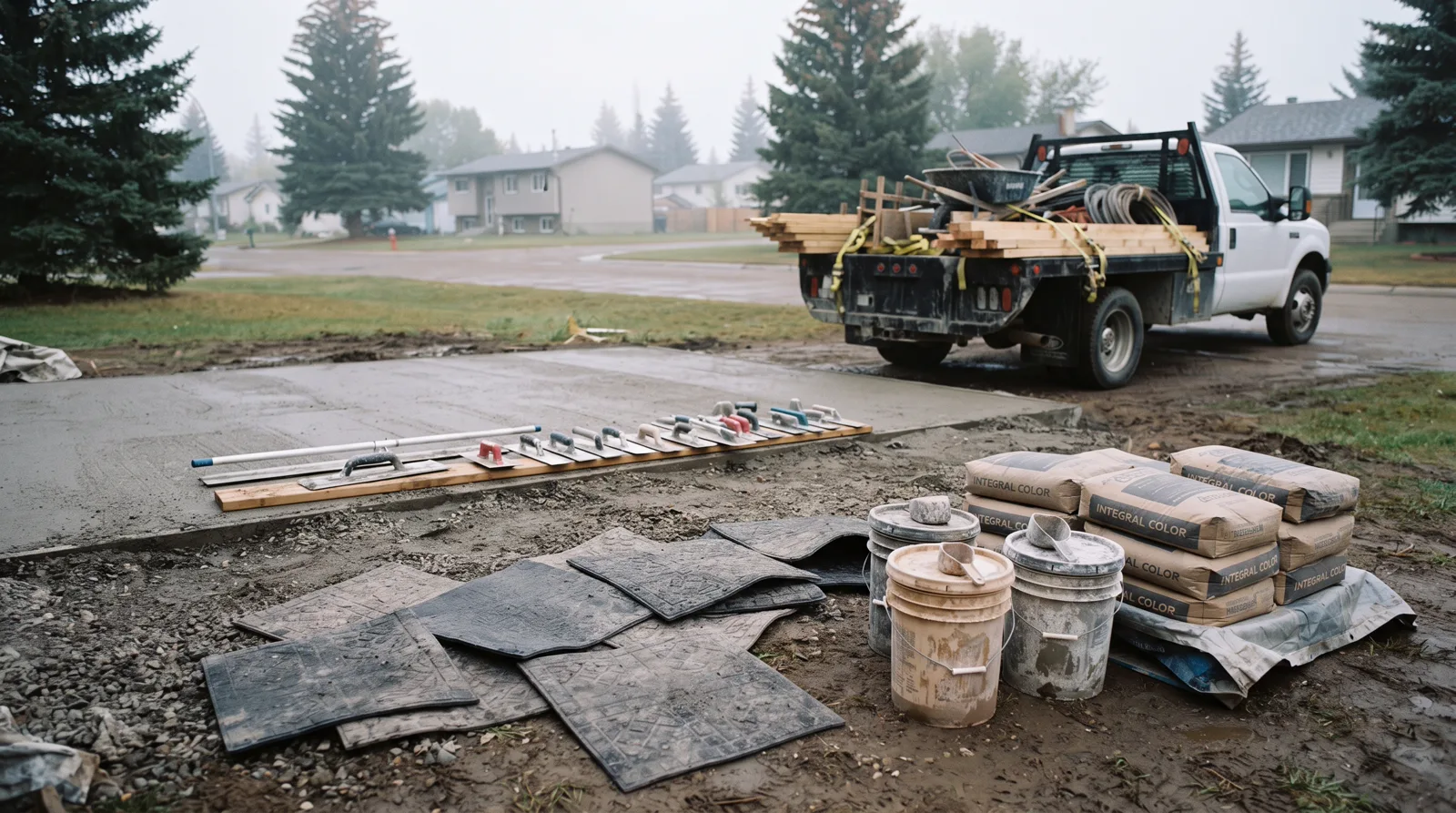
Stamped Concrete That Lasts Through Alberta Freeze and Thaw.
Custom patterns, permanent color and lower maintenance than pavers. Built with proper sealing and base prep to survive our winters.
Decorative Concrete Services in the Tri-Region
From backyard patios to commercial entryways, every project starts with engineered base prep and ends with UV-stable sealer rated for Alberta sun and snow.
Stamped Concrete Patios
Custom slate, flagstone or cobblestone patterns poured over compacted gravel base with proper drainage slope. We stamp while the pour is workable, apply integral or surface color, then seal after full cure. Popular for backyard entertaining areas that need to handle chinook wind temperature swings without heaving.
Stamped Driveways
Decorative driveway pours using brick, cobblestone or ashlar patterns with reinforcing mesh and control joints every 10 feet. Thicker edge strips prevent breakout from snow plow strikes. We spec high PSI mixes and penetrating sealers to resist deicing salt damage common in Spruce Grove and Stony Plain.
Pool Deck Stamping
Slip-resistant texture stamps rated for wet foot traffic around above-ground and in-ground pools. We add color hardener for fade resistance under full Alberta sun and apply non-slip aggregate broadcast before final seal. Proper pitch away from pool wall prevents ice dam buildup against liner in winter.
Colored Concrete Overlays
Thin polymer-modified overlay poured over sound existing concrete with new stamped pattern and integral color. Bonds mechanically to old slab and hides surface staining or minor spalling. Popular for refreshing 15 to 20 year old patios without full demo. Not recommended over badly heaved or cracked bases.
Interior Stamped Floors
Residential basement or commercial showroom floors stamped with wood plank, slate or tile patterns. We grind existing slab smooth, shot-blast for bond, pour self-leveling overlay, stamp the pattern, then apply acid stain or dye for variegated color. Sealed with low VOC urethane for interior air quality.
Sealing and Restoration
Pressure wash existing stamped surface to remove dirt and failed sealer, apply penetrating or film-forming re-seal rated for UV and freeze-thaw. Recommended every 2 to 3 years in high-traffic areas or every 4 to 5 years for residential patios. Restores color depth and prevents water intrusion that leads to spalling.
Why Alberta Climate Demands Specialized Stamped Concrete Technique
❄️ Freeze-Thaw Cycle Survival
Stamped concrete in Spruce Grove, Stony Plain and Parkland County endures 40 to 60 freeze-thaw cycles per winter. We spec air-entrained mixes with 5 to 7 percent air voids that allow water to expand without cracking the slab. Penetrating sealers prevent water intrusion that causes surface spalling when ice forms under the stamped skin.
🌬️ Chinook Wind Temperature Swings
Chinook events can raise temperatures 20°C in a few hours, then plunge again overnight. Proper control joint spacing every 8 to 10 feet lets the slab expand and contract without random cracking. We also use fiber mesh reinforcement in the mix to hold micro-cracks tight even during rapid temperature changes common in January and February.
🏔️ Deep Frost Base Preparation
Frost depth in the Tri-Region reaches 1.8 to 2.4 meters depending on soil type. Local pros excavate to undisturbed subgrade, place 150 to 200 mm of compacted class 2 gravel base, then compact in lifts with a plate tamper. This prevents frost heave from lifting and cracking decorative surface. Commercial projects often require geotechnical sign-off on base prep before pour.
🧂 Deicing Salt and Chemical Resistance
Municipal crews and homeowners apply calcium chloride, magnesium chloride and sodium chloride through winter. These salts wick into unsealed concrete and cause surface scaling. We apply high-solids acrylic or polyurethane sealers within 28 days of install and recommend annual reapplication on driveways. Avoid rock salt in favor of sand or calcium-magnesium blends on newly stamped surfaces.
What it costs here
Everything You Need to Know About Stamped Concrete in Alberta
Pattern selection, color durability, base engineering, winter maintenance and long-term performance in Tri-Region climate.
What Stamped Concrete Actually Is and Why It Works in Alberta
Stamped concrete is regular structural concrete with color and texture pressed into the surface before it fully hardens. The process uses rubber stamps to create patterns that mimic natural stone, slate, brick, wood planks, or cobblestone. It is used for driveways, patios, walkways, pool decks, and commercial entrances. In Spruce Grove and Stony Plain, stamped concrete has become popular because it delivers a high-end aesthetic at a fraction of the cost of natural materials. A homeowner can achieve the look of imported flagstone or hand-laid brick without the premium price tag or ongoing maintenance headaches.
The technique involves pouring fresh concrete to the required thickness, then broadcasting a dry color hardener onto the surface. A release agent is applied to prevent sticking, and large rubber mats with molded patterns are pressed into the surface by hand or with a tamper. Workers carefully align each stamp to continue the pattern across the entire area. Once the concrete cures, the release agent is washed off and a penetrating sealer is applied to protect the surface. The result is a durable, monolithic slab with realistic texture and color variation. With proper installation and maintenance, stamped concrete lasts 20 to 25 years or more in Alberta's climate.
Stamped concrete works particularly well in Alberta because it handles freeze-thaw cycles better than segmented alternatives like pavers or natural stone. Pavers have dozens or hundreds of joints where water can penetrate, freeze, and cause heaving. Natural stone requires a stable base and can shift over time as soil moves. Stamped concrete is a single continuous surface, reinforced with wire mesh or rebar, and sealed to resist moisture intrusion. The air-entrained concrete mix used in Alberta contains tiny air bubbles that absorb the expansion from freezing water without cracking. In Parkland County and Acheson, where properties often have large driveways and expansive outdoor areas, stamped concrete offers both durability and visual impact without the budget strain of premium materials.
Comparing costs makes the value clear. Natural flagstone or slate installed professionally runs $25 to $45 per square foot depending on material sourcing and complexity. Interlocking concrete pavers cost $18 to $35 per square foot installed, including base prep and edging. Stamped concrete typically ranges from $12 to $22 per square foot depending on color complexity, pattern detail, and site access. For a standard 400 square foot backyard patio, that translates to $4,800 to $8,800 for stamped concrete versus $7,200 to $14,000 for pavers or $10,000 to $18,000 for natural stone. The performance is comparable or superior, especially considering Alberta's brutal seasonal temperature swings and the maintenance requirements of jointed systems.
Alberta Climate Challenges That Make Stamped Concrete a Smart Choice
Alberta concrete endures 40 to 60 freeze-thaw cycles per year, concentrated in spring and fall when daytime temperatures climb above freezing and nights drop below. Water trapped in concrete pores expands roughly 9 percent when it freezes, creating internal pressure that cracks weak or poorly mixed slabs. Properly installed stamped concrete uses an air-entrained mix with 5 percent to 7 percent air content by volume. This creates microscopic air bubbles distributed throughout the concrete, providing space for frozen water to expand without generating destructive stress. The color hardener applied during stamping also densifies the top surface layer, reducing porosity. A quality penetrating sealer then locks out surface water. This multi-layer defense is critical in Spruce Grove and Stony Plain, where chinook winds can swing temperatures 20 degrees Celsius in a single afternoon, triggering rapid freeze-thaw events.
Chinook winds create a unique challenge for concrete in the Alberta foothills and parkland regions. These warm Pacific air masses melt accumulated snow quickly, flooding concrete surfaces with meltwater. That water seeps into any available pore or crack. When the chinook passes and arctic air returns overnight, the soaked concrete freezes solid. This rapid wet-freeze cycle is far more destructive than steady cold because the concrete never gets a chance to dry out between freeze events. Stamped concrete sealed with a good acrylic or hybrid sealer resists this water intrusion. Unsealed or improperly mixed concrete will begin to spall (the surface flakes off in sheets) within two to four winters under these conditions. The integral color and hardener used in stamping mean the top layer is denser and less porous than standard trowel-finished concrete, adding an extra margin of protection.
Hail is a recurring reality in central Alberta. Spruce Grove, Stony Plain, and Parkland County all experience severe hailstorms during summer months, with stones ranging from pea-sized to golf ball-sized or larger. Stamped concrete resists hail impact better than wood decking, which dents and splinters, asphalt surfaces, which pockmark and crater, and even some types of pavers, which can chip along edges or crack. Because the color in stamped concrete penetrates the top layer rather than sitting on the surface like paint, minor chips or abrasions do not expose raw gray concrete underneath. The damage is cosmetic and usually minimal. For homeowners concerned about curb appeal and property value, this resilience matters. A hail-damaged wood deck can cost $3,000 to $6,000 to repair or replace, while stamped concrete typically requires only minor patching or touch-up sealing.
Snow load and ice accumulation define Alberta winters. Driveways and walkways carry heavy snow for months and get scraped repeatedly by shovels, snow blowers, and plow blades. Stamped concrete handles this mechanical abuse better than pavers, which can shift, pop out, or crack under plow pressure, and better than exposed aggregate finishes, which can pit and degrade under aggressive de-icing chemicals. The smooth sealed surface of stamped concrete also makes snow removal easier and faster. Road salt and calcium chloride are concerns because they accelerate freeze-thaw damage and can etch unprotected concrete. A penetrating sealer reapplied every two to three years protects against salt intrusion and surface degradation. Many commercial properties in Acheson use stamped concrete for loading areas and pedestrian walkways specifically because it stands up to winter maintenance without constant repairs.
How to Know Your Property Needs Stamped Concrete (The Real Warning Signs)
The most common scenario is structurally sound concrete that looks dated and dull. Your driveway or patio has no major cracks, heaving, or settlement issues, but it is plain gray and drags down the appearance of your property. This is typical in older Spruce Grove neighborhoods built during the 1980s and 1990s, where developers poured basic broom-finished concrete for cost efficiency. The slabs still function perfectly after 30 years, but they make the home look older than it is. Stamping is not an option on cured concrete, but a stamped overlay system can be applied over the existing surface. This involves bonding a thin layer of polymer-modified concrete (usually 1 to 2 inches thick) to the old slab, then stamping and coloring it. Overlays cost less than full removal and replacement, typically $8 to $15 per square foot, and extend the life of the existing concrete while transforming its appearance.
You want the aesthetic of natural stone or brick pavers without the cost or ongoing maintenance burden. Natural flagstone patios are undeniably beautiful, but they come with a premium price and require periodic re-leveling, joint sand replenishment, and weed control as the ground shifts through freeze-thaw cycles. Brick pavers look crisp initially, but within a few seasons, weeds sprout in the joints, individual bricks sink or heave unevenly, and you spend every spring pulling weeds and re-leveling sunken areas. Stamped concrete provides the visual texture and pattern of stone or brick in a monolithic surface that will not shift, settle unevenly, or host vegetation. Once installed and sealed, it requires only occasional cleaning and re-sealing every two to three years. The long-term maintenance cost and hassle are dramatically lower than segmented paving systems.
Your outdoor living space needs an upgrade to match how you actually use your property. Backyard patios, fire pit areas, outdoor kitchens, and pool decks are major lifestyle features in Parkland County and rural Stony Plain, where larger lot sizes allow for expansive outdoor entertaining areas. A plain gray concrete patio works functionally but feels industrial and uninviting. Stamped concrete in a slate, flagstone, or river rock pattern with warm earth tones transforms that slab into an outdoor room that feels intentional and finished. It is slip-resistant when sealed with a matte or textured finish, which is critical around pools and wet areas. It does not splinter or rot like wood decking, and it does not absorb and radiate heat like dark-colored pavers. For a 600 square foot entertaining area, expect an investment of $7,200 to $13,200 installed, depending on pattern complexity and color choices.
Commercial properties benefit significantly from stamped concrete curb appeal. Storefronts, office building entrances, restaurant patios, and retail walkways in Spruce Grove and Acheson create first impressions with their exterior surfaces. Stamped concrete signals quality, attention to detail, and professionalism. A commercial entrance finished in a brick or cobblestone pattern creates instant visual interest and brand alignment. It also meets accessibility code requirements when installed with proper slope (maximum 1:12 for ramps, minimum 1:50 for drainage) and adequate slip resistance. Commercial projects often require building permits, engineered structural drawings, and inspections, especially if new concrete is being added rather than overlaying existing surfaces. Budget $15 to $25 per square foot for commercial stamped concrete due to thicker slab specifications, higher compressive strength requirements, and more rigorous finish standards.
The Complete Stamped Concrete Installation Process Step by Step
Professional installation begins with site preparation and excavation. Crews strip existing sod, topsoil, and any deteriorated old concrete that cannot be salvaged. Excavation depth depends on the intended use and load requirements: 8 to 10 inches total depth for driveways to support vehicle traffic and resist frost heaving, and 6 to 8 inches for walkways, patios, and pool decks. Alberta's frost line extends 4 to 6 feet below grade depending on location, but proper base preparation and drainage eliminate the need to excavate that deep. Wooden or metal forms are set along the perimeter with the correct slope for water drainage, typically a minimum of 1 percent to 2 percent grade away from buildings and structures. This stage also includes locating and marking underground utilities, irrigation lines, gas lines, and electrical conduits to avoid damage during excavation.
A compacted granular base is the foundation of any durable concrete installation in Alberta. The standard specification calls for 4 to 6 inches of three-quarter inch clear crushed rock, also known as Class II road base. This material is placed in two-inch lifts and compacted with a plate tamper or vibratory roller after each lift. Proper compaction is critical: loose base material will settle and shift during freeze-thaw cycles, causing the concrete slab above to crack within the first winter. The crushed rock provides a stable, free-draining platform that prevents water accumulation under the slab. Some contractors install a layer of geotextile fabric between the subgrade clay and the crushed rock to prevent base migration and pumping. For driveways and areas subject to vehicle loads, wire mesh (10x10 W1.4 gauge) or rebar (#3 bars spaced at 18-inch centers in both directions) is placed within the slab thickness to control cracking and distribute loads.
The concrete mix must meet Alberta's freeze-thaw performance requirements. Specifications typically call for 30 to 35 megapascals compressive strength at 28 days, 5 percent to 7 percent air entrainment by volume, and a maximum water-cement ratio of 0.45 to ensure density and impermeability. Contractors often add plasticizing admixtures to improve workability and allow easier finishing without increasing water content, which would weaken the concrete. The slab is poured to the designed thickness: 4 inches minimum for pedestrian walkways and patios, and 5 to 6 inches for driveways and areas supporting vehicle traffic. Concrete is screeded level using a straightedge, then smoothed with a bull float to eliminate high and low spots. Timing is everything in the next steps: stamping and coloring happen when the concrete is firm enough to support foot traffic and hold an impression but not so hard that it will not accept the stamps or color. This window is typically 1 to 3 hours after the pour, depending on ambient temperature, humidity, and wind conditions.
Color hardener is broadcast onto the wet concrete surface in two applications. This dry shake material contains portland cement, fine aggregates, and pigment. It adds integral color to the top layer and densifies the surface, making it harder and less porous. The first coat is applied at roughly 60 percent of the total dosage and floated into the surface with a magnesium or resin float. The second coat (the remaining 40 percent) is applied once the first has been absorbed and floated smooth. Total application rates range from 60 to 100 pounds per 100 square feet depending on desired color intensity. Once the surface is uniformly colored and smooth, a release agent is applied. This can be a powder or a liquid and serves two purposes: it prevents the rubber stamps from sticking to the wet concrete, and it adds subtle accent color that creates an antiquing or highlighting effect. In Spruce Grove and Stony Plain, earth tones such as tan, taupe, gray, and brown are the most popular base colors, often accented with darker or lighter release tones to mimic natural stone variation.
Stamping is the defining step. Large rubber mats with patterns molded into them are pressed into the concrete surface by hand or with a hand tamper. Common patterns include ashlar slate, random stone, European cobblestone, wood plank, and running brick. Each stamp is carefully aligned with the previous impression to maintain pattern continuity across the entire surface. Edges, corners, and tight areas require flexible texture skins or hand tools to replicate the pattern where large mats will not fit. The process requires a crew of two to four workers moving efficiently before the concrete hardens past the workable stage. Cold weather below 10 degrees Celsius slows the chemical curing process, giving crews more working time but requiring measures to protect the slab from freezing overnight. Hot weather above 25 degrees Celsius accelerates curing, so retarding admixtures are added to the mix to extend workability. Wind is a major enemy during stamping because it dries the surface too quickly, causing premature hardening and poor stamp definition.
After stamping is complete, the concrete must cure properly to reach full strength. Curing is a chemical process, not just drying. It requires moisture and moderate temperatures for the cement paste to fully hydrate and harden. Light foot traffic is generally safe after 48 hours, but vehicle traffic should be avoided for at least 7 days, and the concrete will continue gaining strength for 28 days. The powdered release agent is washed off the surface 24 to 48 hours after stamping using a pressure washer and a mild acid solution (usually a diluted muriatic acid rinse) to remove any residual film. Once the concrete is fully cured and completely dry, a penetrating acrylic sealer is applied. This sealer protects against moisture intrusion, road salt, UV fading, and staining while enhancing the color depth. In Alberta's freeze-thaw climate, solvent-based acrylic sealers have historically performed better than water-based versions, though newer hybrid polymer formulations are narrowing that performance gap. Sealer must be reapplied every two to three years to maintain protection.
Timeline and weather constraints shape every stamped concrete project. A typical residential driveway of 400 to 600 square feet takes two to four days from excavation through final sealing, not including the 28-day curing period. Larger projects or intricate multi-color patterns require more time. Every step is weather-dependent. Concrete cannot be poured if rain is forecast within 24 hours or if nighttime temperatures will drop below 5 degrees Celsius within 72 hours of the pour. Alberta's short outdoor construction season, roughly May through October, means experienced stamped concrete contractors are booked months in advance. Spring and fall are ideal because temperatures are moderate (15 to 22 degrees Celsius) and humidity is manageable, allowing proper curing without rapid surface drying. Summer heat requires extra precautions such as shading the work area, misting the surface, and using retarding admixtures. Winter pours are technically possible but require heated enclosures, insulated blankets, and sometimes ground thawing, which can double or triple the cost. Most contractors do not offer winter stamping services for residential projects.
Permit and regulatory requirements vary by municipality but are generally straightforward for residential work. In Spruce Grove and Stony Plain, building permits are typically not required for driveways, walkways, or patios unless the work is part of a larger new construction or addition project, or unless the paved area exceeds a specific size threshold set by local bylaws. Parkland County follows similar guidelines, but it is always wise to contact the local development office before starting work. Commercial projects almost always require building permits, engineered structural drawings stamped by a professional engineer, and inspections at key stages (base prep, rebar placement, final surface). Setback and easement regulations apply: new concrete cannot encroach on property lines, utility easements, or municipal rights-of-way. Some newer residential neighborhoods have restrictive covenants that limit exterior colors or design elements, so checking your property's title and any homeowners association rules is prudent. Reputable contractors handle permit applications as part of their service, but the permit fee, typically $150 to $400 depending on project scope, is passed through to the client.
What stamped concrete really costs in Spruce Grove and what drives the price
Stamped concrete in Spruce Grove, Stony Plain and Parkland County typically runs between $12 and $22 per square foot installed, which puts a 300 square foot patio in the $3,600 to $6,600 range and a 500 square foot driveway overlay at $6,000 to $11,000. That spread exists for real reasons. A single color slab with one stamp pattern and a basic sealer sits at the low end. Multiple colors, intricate patterns like ashlar slate or European cobble, hand-tooled details, integral color plus surface hardener, and a high-build UV-stable sealer push you toward the top. The mix design matters too. A standard 30 MPa mix with air entrainment is the baseline, but contractors working in exposed rural sites near Acheson or along Highway 16 often spec 35 MPa with extra air and a lower water-cement ratio to handle freeze-thaw punishment.
Site conditions move the number as much as aesthetics. If your existing slab is cracked, settled or oil-stained, the contractor may need to grind, patch or apply a bonding overlay before stamping, adding $2 to $5 per square foot. Poor drainage, high water table or frost-heaved subgrade means excavation, compacted gravel base and proper slope, which can double the excavation and prep cost. Acheson industrial properties and acreages near Wabamun Lake often sit on heavy clay that swells and shrinks with moisture. Contractors price in thicker base, fabric reinforcement and extra compaction passes when the geotechnical reality demands it. Distance from Spruce Grove also adds a delivery surcharge for ready-mix. A Saturday pour or a mid-winter pour with heated enclosures and calcium-free accelerators will cost extra, sometimes $500 to $1,500 depending on temperature and access.
Labor and complexity drive the rest. Stamping is physical and time-sensitive. Once the concrete is placed, finishers have a narrow window to bull-float, apply color hardener, stamp, texture and detail before the surface sets. Intricate borders, multiple patterns, hand-carved grout lines and custom texture skins require experienced crews and add hours. Contractors who maintain their own stamp mats, invest in quality release agents and train crews year-round charge more than outfits renting tools and hiring casual labor. You are paying for skill, insurance and the confidence that the crew knows how to read slump, control bleed water and stamp at the right moment. That knowledge gap between a $12 job and a $20 job shows up in five years when one driveway still looks crisp and the other has faded color, spalled edges and lifted sealer.
Comparing your options: stamped concrete vs. other decorative surfaces
Stamped concrete competes with three main alternatives in the Tri-Region: exposed aggregate, pavers and acid stain or epoxy coatings. Exposed aggregate runs $10 to $16 per square foot and delivers a textured, slip-resistant surface by washing the cream off fresh concrete to reveal stone. It is durable and low-maintenance but offers limited color range and no pattern flexibility. You get a speckled, natural look that works well for pool decks and walkways but lacks the defined texture and visual drama of stamped slate or wood plank patterns. Stamped concrete gives you pattern choice, richer color options and the ability to mimic high-end materials, but it requires resealing every two to four years and shows wear on high-traffic driveways faster than a sandblasted aggregate finish.
Pavers, whether concrete or clay, cost $15 to $30 per square foot installed and offer modular flexibility. Individual units can be lifted and relaid if the base settles, making pavers a good fit for unstable soil or areas with underground utilities. They handle freeze-thaw movement well because joints absorb expansion. The trade-off is higher upfront cost, weed growth in joints, ant colonies undermining the sand bed, and the need to re-level and re-sand every few years. Polymeric sand helps but does not eliminate maintenance. Stamped concrete delivers a monolithic surface with no joints to weed or re-sand, lower installed cost, and faster completion, but any crack or settlement requires a repair that will show. In Parkland County where frost heave is common, some homeowners prefer the forgiving nature of pavers despite the higher price and ongoing joint care.
Acid stain and epoxy coatings transform existing slabs at $3 to $8 per square foot for interiors and $5 to $12 for exteriors, far less than stamped overlays. Acid stains produce translucent, variegated color by reacting with lime in the concrete, creating organic, mottled tones in earth shades. Epoxy and polyaspartic coatings offer solid color, high gloss and chemical resistance, popular in garages. Neither option adds texture or dimensional pattern. You are coloring a flat surface, not reshaping it. Stamped concrete changes the geometry with depth, shadow and relief, delivering the look of stone or wood grain rather than just a color wash. For patios and entries where visual impact and curb appeal matter, stamped concrete justifies the price difference. For garage floors or utility areas where color and durability are enough, coatings make more sense.
Mistakes and contractor traps to avoid
The biggest mistake homeowners make is choosing a contractor based on price alone. Stamped concrete quality is labor-intensive and unforgiving. A crew that rushes the pour, applies color hardener unevenly, stamps too early or too late, or skips proper curing will deliver a surface that looks acceptable at handover but fails within two seasons. Common failures include delamination where the overlay lifts from the base slab, color fade from inadequate sealer, pattern inconsistency from poor mat alignment, and premature cracking from missing control joints or improper reinforcement. Alberta freeze-thaw cycles magnify every shortcut. A contractor who does not understand local climate, does not spec air-entrained mix, skips the curing compound or uses cheap sealer will leave you with spalling, scaling and surface pop-outs by the second winter.
Another trap is vague contracts with no material specs, no timeline and no warranty detail. A professional contract should list the mix design (strength, air content, slump), the color and release products by brand, the sealer type and coverage rate, the number of control joints and their spacing, and the curing method. It should specify whether the price includes excavation, base prep, rebar or fiber reinforcement, and cleanup. It should state a start date, weather contingency and a completion window. It should include a warranty period for delamination, color loss and structural defects, typically one to three years depending on scope. If the quote is a one-line number with no backup, you have no recourse when the contractor substitutes materials, skips steps or walks away from callbacks. Stony Plain and Spruce Grove have seen contractors take deposits, pour substandard work and dissolve their business before warranty claims surface.
Ignoring drainage and slope is the third common error. Stamped concrete must slope away from structures at a minimum two percent grade, which is one quarter inch per foot. Flat or back-sloped patios trap water, accelerate freeze-thaw damage and void most warranties. Contractors should confirm existing grades, adjust forms and screed to proper slope, and ensure downspouts and surface drains direct water away from the slab. In Parkland County clay soil, subsurface drainage may require weeping tile or a gravel blanket under the slab. Homeowners who skip a pre-pour site meeting, do not verify slope with a level, or accept assurances without seeing the setup risk expensive repairs. Water is concrete's enemy in Alberta. Design and execution must account for spring melt, summer storms and fall freeze cycles, or the prettiest stamp pattern in Spruce Grove will crack, heave and spall within three years.
How to hire the right stamped concrete contractor
Start with proof of insurance and WCB registration. Every contractor working on your property in Alberta must carry commercial general liability insurance, typically $2 million minimum, and either hold a valid WCB account or a Personal Coverage certificate if they operate as a sole proprietor with no employees. Ask for the WCB account number and call WCB Alberta to verify coverage and clearance. Ask for a certificate of insurance and call the broker to confirm it is current. This protects you from liability if a worker is injured on site and ensures the contractor is operating legally. Unlicensed or uninsured contractors often underbid by 20 to 30 percent because they are not carrying the overhead of legitimate businesses. That savings evaporates the moment something goes wrong, and you have no legal recourse for poor work or job abandonment.
Next, verify local experience and request references from jobs completed in the past two years within Spruce Grove, Stony Plain or Parkland County. Alberta climate and soil are not universal. A contractor who learned their trade in Vancouver or Toronto may not understand the need for air-entrained mix, proper joint spacing for freeze-thaw movement, or how chinook wind cycles affect curing. Ask to see photos of completed projects in similar settings, driveways, patios, walkways, and ask how those surfaces have held up after two or three winters. Contact at least three references and ask specific questions: Did the color match the sample? Did the contractor complete on schedule? How did they handle weather delays? Has the surface cracked, faded or delaminated? Would you hire them again? A contractor with a strong local track record will offer references willingly and provide a portfolio that demonstrates pattern variety, color consistency and clean finishing details.
Finally, get three written quotes that break down materials, labor, site prep, reinforcement, sealer and warranty terms. Compare not just the bottom-line number but the scope and quality of what is included. A low bid that omits base preparation, uses a single coat of solvent sealer instead of a two-coat high-solids system, or specifies 28-day instead of 35 MPa mix is not a bargain. It is deferred cost. The right contractor will walk the site with you, discuss design options, explain how they will handle drainage and control joints, and provide a timeline that accounts for weather and curing. They will specify products by name, offer samples, and give you a written warranty that survives the final payment. In a region where freeze-thaw, clay soil and temperature swings test every installation, experience, transparency and accountability matter more than the lowest number on the page.
How Tri-Region Services helps
Tri-Region Services connects you with one vetted, insured local stamped concrete contractor who serves Spruce Grove, Stony Plain, Parkland County and Acheson. Contractors state that they carry liability insurance when they sign up, and we show that on their listing. You submit one request and receive one free written quote with material specs, timeline and warranty detail. No bidding war, no pressure, no runaround. If the scope or price does not fit, you are under no obligation. Our role is to save you research time and reduce the risk of hiring an unlicensed or inexperienced contractor. The pro we connect you with has completed stamped concrete projects in Alberta climate, understands local codes and soil conditions, and stands behind their work with a real warranty and a local address.
How We Screen Decorative Concrete Contractors
Every pro in our network meets insurance, licensing and quality thresholds before they receive your inquiry.
liability insurance and Liability Coverage
Contractors state that they carry minimum $2 million liability insurance when they sign up, and we show that on their listing.
Municipal Permit Knowledge
Contractors understand when Spruce Grove, Stony Plain or Parkland County building permits are required for large slabs or structural decks.
Air-Entrained Mix Specification
Pros specify 5 to 7 percent air-entrained concrete mixes rated for Alberta freeze-thaw, not generic 3000 PSI commodity mixes.
On-Site Pattern and Color Samples
Legitimate contractors bring physical sample boards showing actual stamped textures and color options, not just photos or catalogs.
Written Warranty Details
Clear documentation of what is covered, for how long, and under what maintenance conditions, signed before deposit.
Portfolio of Local Completed Projects
We ask for photos of finished work in the Tri-Region with verifiable addresses or customer references available on request.
This page is not tied to a contractor's brand. Leads route straight to your one local partner. Verified reviews can appear here once that partner has them (never fabricated).
Serving the whole Tri-Region
8 Common Questions About Stamped Concrete
How long does stamped concrete last in Alberta winters?+
What is the best time of year to install stamped concrete in the Tri-Region?+
How much does stamped concrete cost compared to interlocking pavers?+
Is stamped concrete slippery when wet or icy?+
Can you repair stamped concrete if it cracks, or do you need to replace the whole slab?+
What maintenance does stamped concrete need in Spruce Grove and Stony Plain?+
How does stamped concrete hold up under Alberta sun and UV exposure?+
How soon can you walk or drive on newly stamped concrete?+
Get your free quote
Tell us what you need and a local pro will get right back to you.
- ✓ Sent straight to a local business
- ✓ You choose who you hire
- ✓ Free, with no obligation