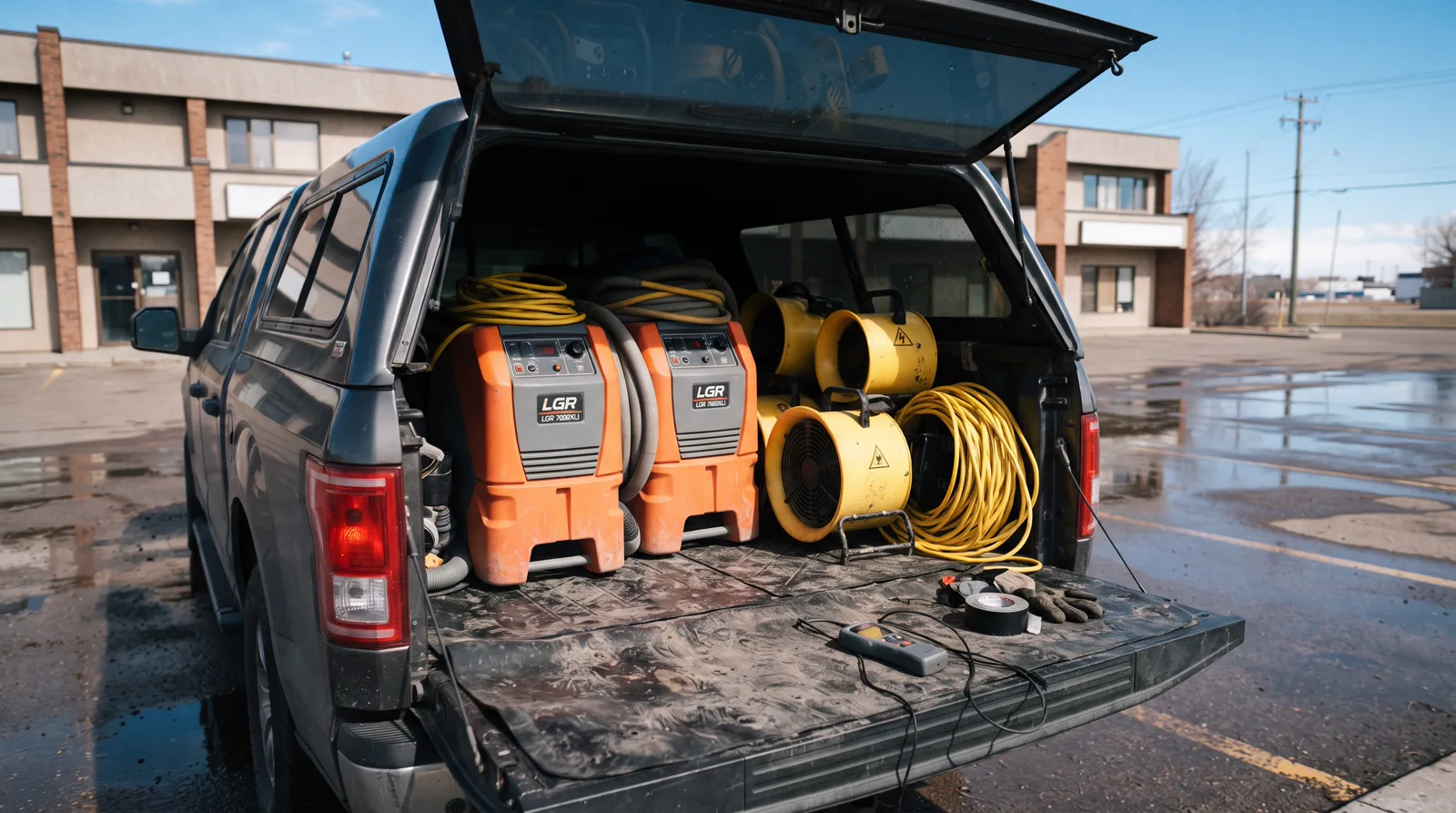
Structural Drying Services Certified. Scientific. Fast.
Advanced moisture removal and monitoring to dry saturated walls, floors and framing before mold takes hold. IICRC certified technicians use thermal imaging and moisture meters to track every pocket of water.
Full-Structure Moisture Removal
Every building material dries differently. We match equipment and airflow to what got wet.
Wall Cavity Drying
Drying saturated insulation and framing inside walls without demolition, using injecti-dry systems and negative air. Prevents hidden mold growth behind drywall. Critical for burst pipe and ice dam floods.
Hardwood & Subfloor Drying
Specialized mat systems and dehumidification to save hardwood floors and dry plywood subfloors. Alberta's dry winter air helps, but controlled drying prevents cupping and buckling. Moisture monitored daily until stable.
Concrete & Basement Slab Drying
Deep moisture removal from concrete using low-grain refrigerant dehumidifiers. Concrete in Alberta basements can hold water for weeks. Local pros dry to below 4% moisture before any flooring goes back down.
Frozen Pipe Flood Drying
Rapid response for Alberta's freeze-thaw burst pipes. Extract standing water, then deploy air movers and dehumidifiers to dry soaked insulation, drywall and framing. Thermal imaging finds every wet pocket.
Roof Leak & Attic Drying
Drying waterlogged attic insulation and roof decking from ice dams, hail damage or shingle failure. Ventilation and dehumidification prevent rot and mold in confined spaces. Common after chinook wind and spring melt.
Moisture Monitoring & Documentation
Daily moisture readings logged and photographed for your insurance claim. We track walls, floors and air humidity until readings hit safe levels. Full report with before and after readings, equipment logs and photos.
Why Alberta Buildings Need Different Drying
❄️ Freeze-Thaw & Burst Pipes
Spruce Grove sees pipes burst when chinook winds swing temps 30 degrees in a day. Water floods finished basements, soaks insulation and hides in wall cavities. Local pros respond fast and know where Alberta builders run plumbing.
🏔️ Deep Frost & Slab Moisture
Alberta frost goes 6 feet deep. Spring melt and sump failures push groundwater up through basement slabs. Concrete here stays cold and wet longer. We use heated drying to speed the process and prevent efflorescence.
🌨️ Ice Dams & Roof Leaks
Heavy snow loads and poor attic ventilation cause ice dams that back water under shingles. Parkland County and Stony Plain see this every winter. Local pros dry attic insulation and roof decking before rot starts, and coordinate with roofers.
🏠 Newer Builds & Poly Vapor Barriers
Tri-Region homes built after 2000 have poly vapor barriers in walls. Water trapped behind poly does not evaporate naturally. We inject dry air or carefully remove sections to access wet insulation, then reseal to code.
What it costs here
How Structural Drying Actually Works
The science, equipment and timeline behind getting your building dry and safe.
What Structural Drying Actually Is and Why Standard Methods Fail in Alberta Winters
Structural drying is the controlled removal of moisture from building materials like framing lumber, subfloors, drywall, insulation, and concrete using commercial dehumidifiers, air movers, and monitoring equipment. Unlike simply mopping up visible water or opening windows, structural drying targets the water that has soaked into porous materials where it will cause rot, mold growth, and structural damage if left untreated. A restoration technician uses moisture meters to measure water content deep inside walls and floors, then deploys equipment to create conditions that pull that moisture out faster than it would naturally evaporate. In Spruce Grove and Parkland County, where winter temperatures sit below freezing for months and summer humidity swings wildly, the physics of moisture evaporation work against homeowners who try to air dry a flooded basement or saturated wall cavity.
Standard air drying fails in Alberta's climate for several reasons that directly contradict what works in warmer regions. When outdoor temperatures drop below zero, opening windows or doors to 'air out' a wet basement actually brings in cold, dense air that holds almost no moisture. That cold air settles into the space, lowers the temperature of already wet materials, and slows evaporation to a crawl. Meanwhile, any moisture that does evaporate condenses on cold surfaces like rim joists, concrete walls, and metal ductwork, spreading the problem instead of solving it. Homeowners in Stony Plain who have tried running a household dehumidifier in a flooded basement during January or February often find the unit freezing up, shutting down, or pulling almost nothing from the air because the evaporation rate is too slow to generate humidity the machine can capture.
The science of moisture migration explains why saturated materials need active intervention rather than passive waiting. Water moves through wood, drywall, and concrete along a moisture gradient, traveling from areas of high moisture content toward areas of lower moisture content. In a typical Spruce Grove home with 2x6 or 2x4 framing, water from a burst pipe or sewer backup can soak into studs, plates, and sheathing within hours, penetrating half an inch to several inches depending on the material and how long the water sat. That moisture will not simply evaporate out on its own unless the surrounding air is warm enough and dry enough to create the gradient that pulls it out. Professional structural drying equipment creates that ideal environment by raising air temperature, lowering humidity, and increasing air movement across wet surfaces, which accelerates evaporation by 10 to 20 times compared to doing nothing. A wet 2x6 stud that would take three weeks to dry naturally in an unheated Alberta basement can reach safe moisture levels in three to five days with proper equipment and monitoring.
Alberta Conditions That Make Structural Drying Critical and Common
Freeze thaw cycles in Parkland County and the Tri Region area create one of the most common pathways to water intrusion that requires structural drying. When temperatures swing from minus 20 Celsius to plus 5 in a single week, which happens multiple times each winter, the expansion and contraction of soil, concrete, and building materials opens cracks and gaps that allow water entry. Foundation walls poured in the 1980s and 1990s, common in older Spruce Grove and Stony Plain neighborhoods, often develop hairline cracks that go unnoticed until a rapid thaw sends meltwater straight through into the basement. That water does not pool visibly on the floor in many cases. Instead, it saturates the bottom plate of framed walls, soaks into drywall from the back side, and wicks up into insulation, creating a hidden moisture problem that homeowners only discover when they smell mildew or see paint bubbling months later.
Chinook winds and ice damming hit homes in Acheson, Spruce Grove, and west Parkland County harder than areas further east because of elevation changes and exposure to warm Pacific air masses pushing over the Rockies. A chinook event can dump 10 to 15 centimeters of wet, heavy snow on a roof, then spike temperatures to plus 8 or plus 10 Celsius within 24 hours, creating an avalanche of meltwater that overwhelms eavestroughs, backs up under shingles, and penetrates roof sheathing or finds its way into attic spaces. If that meltwater reaches insulation or soaks into roof trusses, it will not dry on its own once temperatures drop again at night. Ice dams form when refrozen meltwater blocks drainage, forcing subsequent melt to pond and seep under roofing materials. Structural drying becomes necessary when water has entered wall cavities from above, saturating insulation and framing that is otherwise inaccessible without demolition.
Deep frost lines in Alberta require footings and foundation walls to extend four feet or more below grade, which means any water that enters a foundation crack or poorly sealed window well has a long vertical path to travel before it emerges inside the basement. Homes in Spruce Grove built in the 1970s and 1980s often have rubble or gravel foundation backfill rather than proper drainage aggregate and weeping tile, so spring snowmelt or heavy summer rain accumulates against foundation walls instead of draining away. That hydrostatic pressure forces water through any available opening, including mortar joints, control joints in poured walls, and the cold joint where a footing meets the foundation wall. Sump pumps in Parkland County basements run almost continuously during March and April thaw periods, and when a pump fails or loses power during a storm, a basement can take on several inches of water in a matter of hours. The water that floods across a basement floor is visible and can be extracted with pumps or a wet vacuum, but the water that has soaked into the concrete slab, into the bottom two feet of drywall, and into any wood framing in contact with the slab requires structural drying to prevent long term damage.
The Warning Signs You Need Professional Structural Drying Right Now
Standing water, soaked carpets, and visibly wet walls are the obvious indicators, but many situations that require structural drying start with subtler signs that homeowners in Stony Plain and Spruce Grove often dismiss as minor issues until the damage spreads. A musty or earthy smell in a basement, even when no water is visible, usually means moisture is trapped inside walls, under flooring, or in insulation where air cannot reach it. That smell is the volatile organic compounds released by mold colonies growing on organic materials like drywall paper, wood framing, or carpet backing. If you notice the smell intensifies near exterior walls, around floor drains, or in corners where two foundation walls meet, moisture is very likely present at levels high enough to support active mold growth. A homeowner who ignores that smell for weeks or months will eventually see visible mold, warped baseboards, or buckled flooring, at which point the cost of remediation has multiplied several times over.
Warped or cupped hardwood floors, laminate that has lifted at the seams, or vinyl plank flooring that feels spongy underfoot all indicate moisture has reached the subfloor and is causing dimensional changes in the materials above it. In Parkland County homes with engineered hardwood installed over concrete slabs, moisture wicking up from the slab due to a failed vapor barrier or external water intrusion will cause the wood to swell, cup, and eventually delaminate. That process happens slowly, over weeks or months, so homeowners often assume the floor was installed poorly rather than recognizing it as evidence of an ongoing moisture problem. Structural drying in these cases means removing the finished flooring, drying the subfloor and slab to safe moisture levels, identifying and fixing the source of water entry, and then reinstalling or replacing the floor. Waiting to address the problem allows moisture to spread into floor joists, rim joists, and wall framing, turning a localized issue into a whole room or whole basement problem.
Peeling paint, bubbling drywall texture, or brown water stains on ceilings and walls are red flags that water has been present long enough to break the bond between paint and substrate or to leach tannins and minerals out of building materials. A water stain that appears suddenly after a known plumbing leak or roof issue is straightforward, but stains that appear gradually or seem to grow and shrink with weather changes indicate chronic moisture intrusion that needs both source repair and structural drying. Stony Plain homeowners who see stains on exterior walls near grade level, around windows, or at the top of foundation walls should assume water is traveling through the wall assembly and saturating insulation, sheathing, or framing. A moisture meter reading taken on the interior drywall surface will show elevated levels, but the real problem is often hidden behind the drywall where a restoration technician must take invasive readings by drilling small access holes or using a non invasive scanner to map the extent of saturation. Insurance adjusters in Alberta expect to see moisture documentation before approving structural drying claims, so calling a professional early not only prevents further damage but also creates the paper trail required for a successful claim.
- Musty or earthy smell in basement or main floor rooms, especially near exterior walls
- Warped, cupped, or spongy flooring that has changed since installation
- Peeling paint, bubbling texture, or brown stains on walls or ceilings
- Visible condensation on windows, cold water pipes, or basement walls even when no leak is obvious
- Increased allergies, asthma symptoms, or respiratory irritation in family members who spend time in affected areas
The Complete Structural Drying Process From Emergency Call to Final Verification
The process starts with an emergency call to a restoration company that serves Spruce Grove, Stony Plain, and Parkland County, typically available 24 hours because water damage does not wait for business hours. A technician will arrive within one to four hours depending on distance and weather, equipped with moisture meters, thermal imaging cameras, and extraction equipment. The first step is always source control, meaning stopping the water if it is still flowing, whether that requires shutting off a main water line, clamping a broken pipe, or placing tarps over a damaged roof section. Once the source is controlled, the technician performs a moisture assessment using a pin type or pinless moisture meter to measure water content in floors, walls, and ceilings. Readings above 15 percent in wood framing or above 1.5 percent in concrete indicate saturation that requires drying. Thermal imaging helps identify hidden moisture in wall cavities, under flooring, or in ceilings without destructive testing, though invasive moisture probes are often necessary to confirm the extent of saturation in critical structural areas.
After assessment and documentation, the technician begins water extraction if standing water is present, using truck mounted or portable extractors that pull hundreds of liters per hour. Extraction alone cannot reach the water absorbed into porous materials, so the next step is placing air movers and dehumidifiers strategically throughout the affected area to create controlled drying conditions. Commercial air movers are not the same as household fans. They move 1,000 to 3,000 cubic feet of air per minute at focused angles designed to create airflow across wet surfaces and inside wall cavities where drywall or baseboards have been removed. Low grain refrigerant dehumidifiers or desiccant dehumidifiers pull moisture from the air, lowering humidity to 30 to 40 percent, which accelerates evaporation from saturated materials. In a typical Spruce Grove basement drying job, a technician might place six to ten air movers and two to four dehumidifiers, running on dedicated circuits to avoid overloading household electrical panels. Breaker capacity is checked before equipment is plugged in, and heaters may be added if ambient temperature is too low to support efficient evaporation.
Monitoring happens daily or every other day depending on the severity of the damage and the rate of drying. A technician returns to take fresh moisture readings at the same locations measured during the initial assessment, tracking the downward trend in moisture content and adjusting equipment placement if certain areas are drying slower than expected. Drywall that measured 35 percent moisture on day one should drop to 20 percent by day three and reach 12 percent or lower by day five to seven. Wood framing follows a similar curve but may take longer if the saturation was deep or if the wood species is dense. The technician documents every reading, updates the insurance claim file, and takes photos showing equipment placement and drying progress. Homeowners are often surprised that drying takes multiple days even after visible water is gone, but the goal is to reach equilibrium moisture content, meaning the building materials have released enough moisture that they will not support mold growth or structural degradation once equipment is removed.
Final verification includes taking readings in all previously wet areas to confirm moisture content is at or below safe thresholds, typically 12 percent for wood and 1.0 percent or lower for concrete. Equipment is removed once readings have stabilized for 24 hours, meaning two consecutive days of readings show no further moisture reduction. At that point, the structure is considered dry and ready for rebuild if demolition was necessary, or ready for monitoring if materials were saved. The restoration company provides a detailed report documenting initial moisture levels, daily progress readings, equipment used, and final dry readings, which the homeowner submits to their insurance company along with invoices for equipment rental and technician labor. Total cost for structural drying in Parkland County typically ranges from $2,000 to $8,000 depending on the size of the affected area, the severity of saturation, and how long equipment must run, but insurance covers most or all of that cost if the homeowner filed a claim promptly and followed the adjuster's instructions. Homes that skip professional drying and attempt DIY methods often discover mold growth six to twelve months later, at which point insurance may deny the claim because the homeowner failed to mitigate damage properly.
What Structural Drying Really Costs in Spruce Grove and the Tri-Region
A typical residential structural drying job in the Tri-Region runs between $1,200 and $4,500, though the final bill depends heavily on how much material got wet, what kind of materials they are, and how long water sat before discovery. A small bathroom flood caught within hours might cost $800 to $1,500 for localized drying. A burst pipe that soaked an entire basement over a weekend can easily climb to $6,000 or more once you factor in commercial dehumidifiers, air movers, wall cavity drying systems, and the labor to monitor moisture levels daily for a week or longer. Insurance adjusters in Alberta typically cover emergency mitigation including structural drying when the loss is sudden and accidental, but you will pay out of pocket for gradual leaks or maintenance issues that were not addressed promptly.
The single biggest cost driver is saturation depth and the type of building assembly that got wet. Drywall and insulation hold enormous amounts of water and dry slowly, especially in exterior walls where cold Alberta temperatures create condensation risk on the backside of the sheathing. Hardwood flooring can cost $15 to $30 per square meter just for drying services because technicians must lift sections, insert drying mats underneath, and run equipment for days to prevent cupping and crowning. Concrete slabs and basement floors are deceptive because water wicks into the porous surface and spreads laterally under flooring and baseboards. Specialized concrete drying systems that inject warm dry air under vinyl or laminate can add $800 to $2,000 to a project, but skipping that step leads to mold growth under the floor within two weeks.
Equipment rental is billed per day or per week, and most jobs require multiple units running simultaneously. A mid-sized job typically uses two to four industrial dehumidifiers at $60 to $120 per unit per day, plus six to ten air movers at $15 to $35 each per day. Desiccant dehumidifiers, which work better in cold basements or unheated spaces common in rural Parkland County properties, cost more to run but dry faster in low-temperature environments. Technicians visit daily to swap out full dehumidifier reservoirs, reposition air movers, and take moisture readings with pin and pinless meters. Labor for monitoring and adjustments runs $100 to $150 per visit. A job that takes five days of drying involves five site visits, which alone accounts for $500 to $750 of the bill before equipment charges. Legitimate contractors provide detailed daily logs showing moisture content trends in every affected material, and those logs become critical documentation if your insurance company questions the duration or scope of work.
Comparing Drying Methods, Equipment and Approaches
The two workhorse tools in structural drying are refrigerant dehumidifiers and air movers, but how they are deployed makes the difference between a successful dry-out and hidden moisture that festers into mold. Refrigerant dehumidifiers work like your air conditioner in reverse. They pull humid air over cold coils, condense the moisture into a reservoir, then exhaust drier air back into the room. These units are effective when indoor temperatures stay above 15 degrees Celsius, which is fine for heated living spaces but problematic in crawlspaces, unheated garages, or basements during a Spruce Grove winter. Air movers are high-velocity fans positioned to create airflow across wet surfaces and inside wall cavities. The goal is to replace the saturated air layer touching wet drywall or wood with drier air, which accelerates evaporation. A skilled technician angles air movers to avoid simply blowing moisture deeper into porous materials or forcing it into adjacent rooms.
Desiccant dehumidifiers use a chemical rotor that absorbs moisture from the air without relying on refrigeration coils, so they work effectively in cold and low-humidity conditions. This makes them the better choice for unheated basements, detached shops, or properties where the furnace was shut off during a winter vacation and pipes burst. Desiccant units cost more per day to rent, but they pull moisture even when ambient temperature drops near freezing. For hardwood floors, injection drying systems and drying mats are often necessary. Injection systems use flexible hoses or panels slid under the flooring to blow warm dry air across the subfloor and the underside of the hardwood. Drying mats work similarly but create a sealed chamber using weighted edges and vacuum pressure to hold the mat tight against the floor surface. Both methods prevent the need to remove and reinstall flooring, which saves thousands in labor and material costs but requires several extra days of continuous operation.
Wall cavity drying is another specialized method required when water penetrates behind drywall or paneling. Technicians drill small holes near the baseboard and insert plastic nozzles connected to air movers or negative pressure systems that pull moisture out of the stud cavity. This approach is essential in Tri-Region homes with poly vapor barrier behind the drywall, which traps water between the barrier and the exterior sheathing. If cavity drying is skipped, the wood studs and bottom plates stay wet for weeks, creating ideal conditions for mold colonization and wood rot. Some contractors skip this step to save equipment costs and time, gambling that surface drying is enough. That gamble fails most of the time in Alberta's climate, where exterior sheathing stays cold and condensation reforms nightly even after interior surfaces feel dry to the touch.
Common Mistakes, Contractor Traps and What Goes Wrong
The most expensive mistake property owners make is assuming a wet basement or flooded room can be dried with a couple of box fans from Canadian Tire and a residential dehumidifier. Household dehumidifiers are designed to manage ambient humidity in a dry home, not to extract the hundreds of liters of water absorbed into drywall, insulation, and framing. Running inadequate equipment for a few days gives the illusion of progress because surface moisture evaporates, but moisture trapped in wall cavities and under flooring remains. Mold colonies establish within 48 to 72 hours in wet organic materials, and once growth begins, the remediation cost jumps from a $2,000 drying job to an $8,000 mold abatement and reconstruction project. Insurance companies deny coverage for mold damage that results from inadequate mitigation after a covered loss, leaving you holding the bill because you tried to save money by skipping professional help.
Another common trap is hiring the cheapest quote without verifying credentials, insurance, and references. Alberta requires anyone performing water damage restoration work for compensation to carry general liability insurance if they have employees. Many fly-by-night operators show up with rented equipment and no insurance, offering prices 30% below legitimate contractors. If a worker is injured on your property and the contractor has no WCB, you can be held personally liable for medical costs and lost wages. If their work causes secondary damage such as mold growth or structural failure, and they carry no liability coverage, you have no recourse except small claims court against someone with no assets. Legitimate contractors provide proof of insurance on request and gladly supply references from recent projects. If a contractor hesitates or makes excuses, walk away immediately.
Rushing the drying process is a trap set by both desperate property owners and unethical contractors. Drying saturated materials properly takes time, sometimes a full week or more depending on the extent of water intrusion and the building materials involved. Some contractors declare a structure dry after three days to save equipment costs and move on to the next job, even when moisture meters still show elevated readings in subfloors or wall studs. The moisture comes back as the building equalizes, or it migrates to cooler areas and condenses, creating new wet spots. Property owners anxious to get their lives back to normal sometimes pressure contractors to wrap up early so furniture can be moved back in and repairs can start. That impatience costs more in the long run when drywall has to be torn out again two weeks later because mold appeared, or when hardwood floors buckle because the subfloor was not fully dry before reinstallation.
Failing to document the process thoroughly is another critical error, especially when insurance is involved. Every day of drying should include written moisture readings for each affected area, photographs of equipment placement, and notes on any changes or discoveries such as hidden water damage in adjacent spaces. If your insurance adjuster disputes the bill or questions whether five days of drying was necessary, detailed logs provide the proof. Some contractors do not bother with documentation, which makes it nearly impossible to justify charges after the fact. Others provide vague summaries instead of specific readings. Insist on daily detailed reports, and take your own photos of equipment setup and moisture meter readings if the contractor does not. If a dispute arises later, you will be glad you have a paper trail that shows the work was done properly and the timeline was justified by measurable progress.
How to Hire the Right Structural Drying Professional in the Tri-Region
Start by verifying the contractor holds at least two million dollars in general liability insurance. Ask for the WCB account number and call WCB Alberta directly to confirm coverage is active and in good standing. Request a certificate of insurance from their insurer rather than taking their word that coverage exists. Legitimate restoration companies expect these requests and provide proof within hours. If a contractor balks or says the paperwork is at the office and they will send it later, assume they are uninsured and move on. Structural drying work involves heavy equipment, electricity, and water, all of which create risk. An injury or property damage claim without insurance protection can bankrupt you personally if the contractor has no coverage and a court assigns liability to the property owner for allowing uninsured work.
Ask detailed questions about their process and equipment, and pay attention to how they answer. A qualified technician should explain the difference between refrigerant and desiccant dehumidifiers and why one might be preferred for your specific situation. They should describe how they will monitor progress, how often they will visit the site, what moisture levels they consider dry, and how long they estimate the job will take based on the materials and conditions. If the contractor gives vague answers or says everything will be fine without explaining why, they likely lack the training and experience to handle complicated drying scenarios. Certified restorers often hold IICRC credentials such as Water Damage Restoration Technician or Applied Structural Drying Technician. These certifications are not legally required in Alberta, but they indicate the person has formal training and understands the science of psychrometrics, moisture migration, and microbial growth.
Red Flags in Quotes and Initial Conversations
Be cautious of any contractor who offers a flat fixed price before inspecting the site and measuring moisture levels. Structural drying costs depend on the extent of saturation, and no one can give an accurate quote over the phone or from a few photos. A proper quote requires an on-site assessment with moisture meters, thermal imaging if available, and a written scope detailing equipment, estimated duration, and daily monitoring. Contractors who provide lowball estimates to win the job often add surprise charges midway through or cut corners to stay within the quoted price. Get everything in writing, including the daily equipment list, monitoring frequency, estimated timeline, and total cost range. If the scope changes because hidden damage is discovered, insist on a written change order before any additional work begins.
Watch out for high-pressure tactics or contractors who say they need to start immediately or the damage will become catastrophic. While it is true that faster mitigation reduces secondary damage, a legitimate contractor will take an hour to assess the situation, explain the options, and provide a written quote before starting. Anyone who insists you sign a blank work authorization or a contract with no detailed scope is likely planning to inflate the bill or perform unnecessary work. Insurance restoration is a competitive industry, and some operators exploit distressed property owners who are overwhelmed and willing to sign anything. Take a breath, get two or three quotes if time allows, and choose based on credentials and communication quality rather than whoever showed up first or promised the fastest turnaround.
How Tri-Region Services Helps
Tri-Region Services connects you directly to one carefully vetted, fully insured structural drying professional in your area. Every contractor in our network tells us they carry liability insurance, and has been verified through reference checks and past project reviews. You get a free, no-obligation written quote based on a thorough on-site inspection. No high-pressure sales tactics, no surprise fees, and no runaround. Local pros handle the vetting so you do not have to guess whether the person showing up at your door is qualified and trustworthy. Reach out today and get matched with a local expert who will treat your property with the care and professionalism it deserves.
Why Tri-Region Homeowners Trust Us
Credentials, transparency and results you can verify.
IICRC Certified Technicians
All techs hold Water Damage Restoration and Applied Structural Drying certifications, the industry standard for insurance claims.
Photo & Moisture Logs Every Visit
You get daily photos, moisture meter readings and equipment status reports, exactly what your insurance adjuster needs.
Thermal Imaging Included
We use FLIR cameras to find hidden moisture in walls, ceilings and floors that moisture meters alone miss.
WCB Covered & Liability Insured
Full Alberta liability insurance and commercial liability insurance, required for most homeowner policies to approve the work.
We Work With Your Adjuster
Direct communication with your insurance company, detailed estimates in Xactimate format, and we wait for approval before starting.
Completion Certificate
You receive a signed certificate confirming all materials are dry to IICRC standards, required before reconstruction starts.
This page is not tied to a contractor's brand. Leads route straight to your one local partner. Verified reviews can appear here once that partner has them (never fabricated).
Serving the whole Tri-Region
8 Questions About Structural Drying
How long does structural drying take in Spruce Grove?+
Can you dry my walls without cutting them open?+
What moisture level is safe before I can rebuild?+
Does insurance cover structural drying in Alberta?+
What equipment do you use for structural drying?+
Can I stay in my home during structural drying?+
What happens if structural drying is not done properly?+
Do you remove water damaged materials or just dry them?+
Get your free quote
Tell us what you need and a local pro will get right back to you.
- ✓ Sent straight to a local business
- ✓ You choose who you hire
- ✓ Free, with no obligation