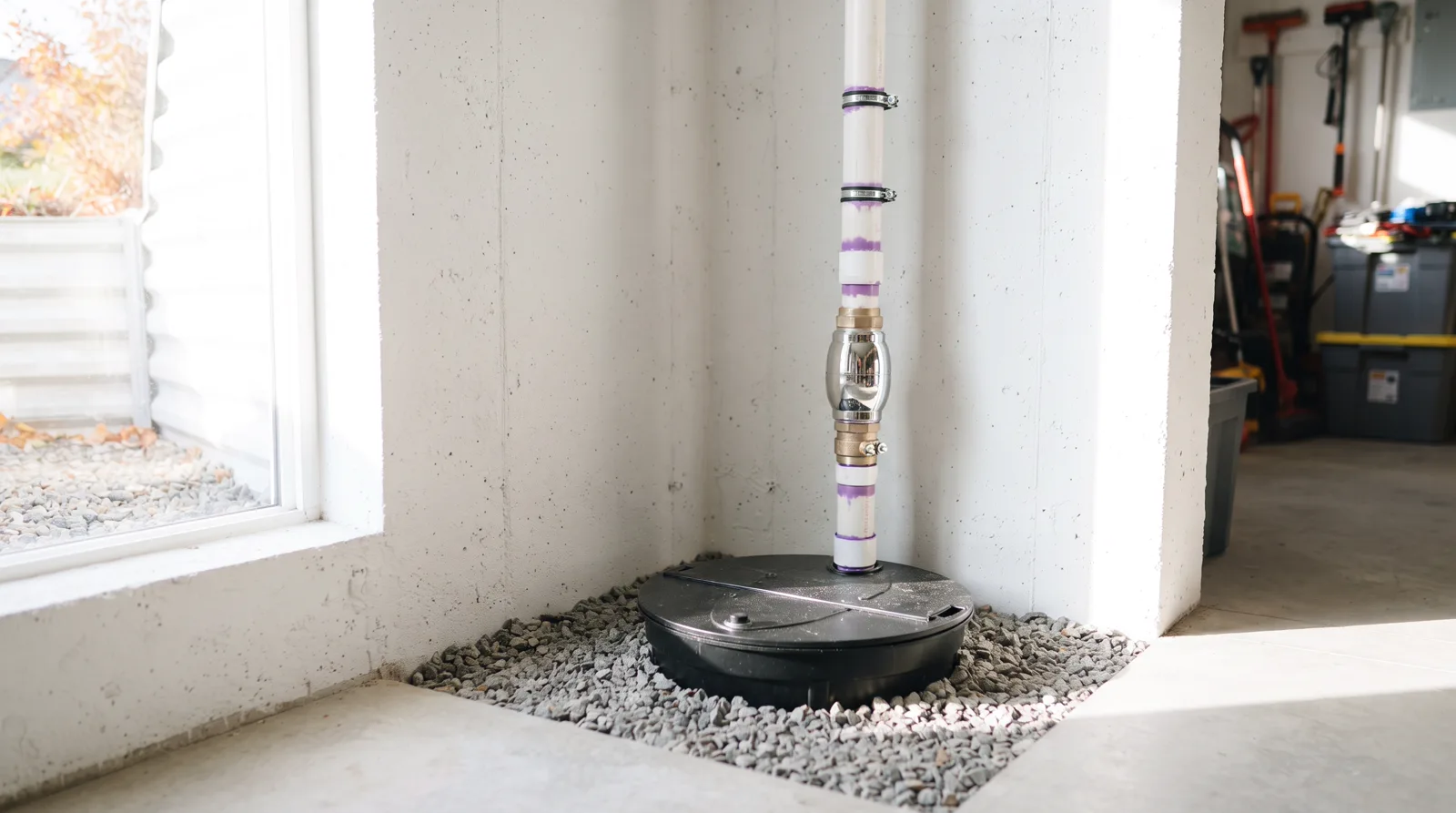
Sump Pump Installation Spruce Grove: Stop Basement Flooding Before It Starts
Professional sump pump systems designed for Alberta's freeze-thaw cycles, high water tables, and spring melt. Licensed plumbers serving Spruce Grove, Stony Plain, Parkland County and Acheson.
Complete Sump Pump Solutions for Tri-Region Homes
From new installations to emergency repairs, local pros handle every aspect of basement water management.
New Sump Pump Installation
Complete system including pit excavation, pump selection for your water volume, discharge line routing to meet Alberta setback rules, and backflow prevention. We size pumps for spring melt and clay soil conditions common in Parkland County. Includes electrical hookup and code inspection coordination.
Battery Backup Sump Pump Systems
Critical protection when power fails during storms or chinook wind events that knock out grid power. Local pros install DC battery systems or water-powered backup pumps that run without electricity. Your basement stays dry even when the lights go out, which is essential given rural outage frequency west of Spruce Grove.
Sump Pump Repair & Troubleshooting
Float switch failures, clogged discharge lines, burned-out motors, or check valve problems diagnosed and fixed fast. The plumbers we dispatch carry common replacement parts for Zoeller, Wayne, and Liberty pumps. Most repairs completed same-visit to get your system back online before the next rainfall.
Sump Pump Replacement
Swap out aging or undersized pumps without full system teardown. We assess your existing pit, discharge setup, and typical water inflow to recommend the right horsepower and head capacity. Includes removal of the old unit, new pump installation, testing under load, and disposal of replaced equipment.
Sump Pit Cleaning & Maintenance
Annual service to remove sediment, gravel, and clay buildup that reduces pump efficiency. We test float operation, inspect check valves, verify discharge line integrity, and confirm your weeping tile inflow is adequate. Preventive maintenance that extends pump life and catches problems before failure during peak demand.
Weeping Tile & Drainage Connection
Interior or exterior perimeter drain tile installation that feeds groundwater to your sump pit instead of through foundation cracks. Essential for older Spruce Grove homes built before modern drainage standards or properties with high water tables near wetlands. Includes trenching, perforated pipe, gravel bed, and sump connection.
Why Spruce Grove Basements Need Sump Pumps
❄️ Spring Melt and Rapid Thaw Cycles
Parkland County gets significant snow accumulation, and chinook winds can melt it fast, overwhelming soil absorption. Groundwater surges in March and April, especially in low-lying areas near Stony Plain and Acheson. A properly sized sump system handles these seasonal spikes without flooding your mechanical room or storage areas.
🏔️ Clay Soil and Poor Drainage
The heavy clay throughout the Tri-Region drains slowly, keeping water tables elevated for weeks after precipitation. Older subdivisions in Spruce Grove often lack modern weeping tile, so groundwater presses against foundations. Sump pumps are the most reliable retrofit solution for homes built in the 1970s and 1980s.
💧 Rural Well Water and High Tables
Properties in Parkland County on private wells often sit in areas with naturally high groundwater. Combined with septic field proximity rules and lot grading, basements are vulnerable. We route discharge lines to meet the 3-metre setback from property lines and ensure pumps can lift water the vertical distance required by your lot topography.
🏗️ New Construction and Code Requirements
Alberta Building Code now mandates sump systems in many new builds, but not all builders install adequate capacity or backup power. We upgrade builder-grade pumps to handle real-world conditions and add battery backups that weren't included. Acheson industrial-residential developments especially benefit from commercial-grade components given soil disturbance from nearby construction.
What it costs here
Everything Spruce Grove Homeowners Should Know About Sump Pump Systems
How they work, when you need one, and what separates reliable systems from basement disasters.
How Sump Pump Installation Works in Spruce Grove Basements
A sump pump installation is a targeted excavation and plumbing project designed to collect groundwater before it floods your basement floor. The system centers on a basin, typically 18 to 24 inches deep and 18 inches in diameter, carved into your basement's lowest point. Water that seeps through foundation walls, weeper tiles, or rises through the floor slab flows by gravity into this basin. When the water level reaches a preset trigger point, a float switch or pressure sensor activates an electric pump that pushes the water through discharge piping up and away from your foundation, usually exiting 10 to 20 feet from the house into a drainage swale, storm sewer connection, or surface grade. The entire mechanism sits below your finished floor, invisible until you lift the lid, but it operates continuously during spring melt, heavy rainfall, or anytime the water table climbs above your foundation footing.
In Spruce Grove and Parkland County, clay-heavy soils complicate groundwater movement. Glacial till and bentonite seams create layers that trap moisture rather than draining it efficiently, so even properties on slight slopes can experience hydrostatic pressure against basement walls. Weeper tile systems installed during original construction are meant to relieve this pressure, but after 20 or 30 years those perforated pipes often silt up or collapse. A sump pump becomes the secondary defense, catching water that bypasses or overwhelms the weeper network. Because local frost depth reaches 1.8 meters, freeze and thaw cycles crack foundation concrete over time, opening pathways for groundwater intrusion that were not present when the home was new.
The installation process requires coordination between excavation, electrical work, and plumbing discharge. A qualified plumber will assess your basement layout to locate the natural collection point, usually near a floor drain or against an exterior wall where weeper tiles terminate. If your home has no existing sump basin, the crew uses a concrete saw and jackhammer to cut through the floor slab, then digs the pit down to the level of your weeper tiles or below the footing, depending on the water source. Crushed gravel lines the pit for drainage, and a plastic or concrete liner prevents soil from collapsing inward. The pump itself is a submersible pedestal or centrifugal model rated for continuous duty, paired with a check valve on the discharge line to prevent backflow. A dedicated 15-amp GFCI circuit is standard, and battery backup systems are strongly recommended given how often spring storms knock out power in rural Parkland County when you need the pump most.
Why Alberta's Climate and Soil Conditions Make Sump Pumps Essential
Spruce Grove sits in a climatic zone where rapid temperature swings create relentless pressure on foundations. Chinook winds can raise temperatures by 15 degrees Celsius in a few hours during winter, melting snowpack that refreezes when the chinook passes, forming ice lenses in the soil. These freeze and thaw cycles heave foundation walls, crack mortar joints, and shift weeper tile connections. Spring runoff in late March and April often coincides with saturated ground that has nowhere to drain because the subsoil remains frozen a meter down. Water pools against your foundation, finds the smallest crack, and seeps into the basement. A sump pump intercepts this seasonal surge before it spreads across your floor and damages furnaces, hot water tanks, electrical panels, or finished living space.
Clay content in Parkland County soils compounds the problem. Expansive clays absorb water and swell, then shrink as they dry, creating ongoing movement that no foundation can fully resist. Older homes built in the 1970s and 1980s often have poured concrete walls without proper dampproofing or drainage mats, relying entirely on weeper tiles that were undersized by modern standards. When a heavy June rainstorm drops 40 millimeters in two hours, the clay surface sheds water faster than it can percolate down, flooding window wells and saturating the backfill zone. Without a functioning sump basin to collect this inflow, you are left bailing water with a shop vacuum or watching it wick into drywall and insulation.
Stony Plain and Acheson properties near industrial zones face additional groundwater challenges. Grading changes from road construction, utility trenching, and neighboring development can redirect surface runoff toward your lot. A new subdivision uphill from your home may reduce natural absorption areas, concentrating water flow. Municipal storm sewers have capacity limits, and during peak events they surcharge, meaning water backs up through floor drains if you lack a backwater valve and sump system. Alberta's building code now requires sump provisions in new construction for these reasons, but thousands of existing homes predate these standards and depend on retrofitted pumps to stay dry.
Clear Warning Signs You Need Sump Pump Installation or Repair
The most obvious signal is visible water on your basement floor, but by the time you see pooling near the furnace or along baseboards, damage is already underway. Earlier warnings include a damp, musty odor that intensifies after rain, efflorescence (white mineral deposits) on concrete walls, or rust stains at the base of steel support columns. You may notice that your dehumidifier runs constantly or that stored cardboard boxes feel soft and sag at the corners. These symptoms indicate moisture intrusion that a sump pump could intercept before it becomes a flooding event. In Spruce Grove's spring season, if your neighbors report wet basements or if you hear sump pumps running on adjacent properties, your own risk is elevated even if you have not yet seen water.
Another critical sign is an existing sump pump that cycles erratically or fails to keep the basin empty. If you hear the motor running for extended periods without the water level dropping, the impeller may be clogged with silt or the discharge line could be frozen or blocked. A pump that short-cycles, turning on and off every few minutes, often has a failed check valve allowing water to drain back into the pit, or a float switch stuck in the up position. Any burning smell, loud grinding noise, or visible rust on the pump housing means replacement is overdue. Pedestal pumps older than seven years and submersible units past ten years are living on borrowed time, and spring is the worst season to discover a dead pump when you wake up to three inches of water at 2 a.m.
Homes without any sump system should evaluate their risk based on age, location, and history. If your house was built before 1990 and you have never seen water, you may have been fortunate with local drainage or a high water table that has not yet risen. However, climate patterns are shifting, and Parkland County has recorded wetter springs in recent years. If your lot slopes toward the house, if downspouts discharge within five feet of the foundation, or if you have window wells that collect snow and rain, a sump pump is cheap insurance compared to the cost of flood remediation. A single basement flood can easily exceed $15,000 in drywall replacement, mold abatement, and lost belongings, plus you risk insurance premium increases or coverage exclusions for future water damage.
The Complete Sump Pump Installation Process from Start to Finish
Site Assessment and Preparation
A licensed plumber begins with a basement walkthrough to identify the lowest point and trace existing floor drains and weeper tile outlets. In Spruce Grove homes, the lowest spot is often a corner farthest from the sewer connection or near a cold room. The plumber checks for electrical access, measuring the distance to your panel to ensure a dedicated circuit can be run without exceeding voltage drop limits. If you have a finished basement, drywall or ceiling tiles may need selective removal to route discharge piping and electrical conduit. The crew also inspects your exterior grading to plan the discharge route, confirming it will not direct water toward a neighbor's property or back toward your foundation, both of which violate municipal bylaws.
Before cutting concrete, the plumber uses a metal detector or ground-penetrating radar to locate rebar, radiant floor tubing, or utilities embedded in the slab. Spruce Grove enforces setback rules for discharge points, typically requiring the outlet to be at least three meters from the property line and away from sidewalks where ice buildup would create a slip hazard. If your home is on a septic system rather than municipal sewer, discharge must route to a surface drainage area and never into the septic field. The plumber will obtain any necessary permits from Parkland County or the City of Spruce Grove, though a straightforward replacement in an existing basin usually does not trigger a permit requirement.
Basin Excavation and Pump Installation
The crew marks a 20-inch square on the floor, then uses a concrete saw with dust suppression to cut through the 4 to 6 inch slab. A jackhammer or electric demolition tool breaks out the concrete, and the team digs down 22 to 30 inches, depending on whether weeper tiles need to be intercepted or if the goal is simply to reach the water table. Excavated soil is hauled out in buckets, and if groundwater is already seeping in, a temporary pump keeps the hole dry during construction. A perforated plastic basin liner drops into the pit, surrounded by three to four inches of three-quarter inch clear gravel that allows water to flow in from all sides. The top edge of the basin sits flush with or slightly below the finished floor.
The pump is lowered into the basin and secured so it cannot tip or shift during operation. Submersible models rest on the basin floor, while pedestal pumps have a base plate and a vertical shaft that keeps the motor above water. A length of Schedule 40 PVC or ABS discharge pipe connects to the pump outlet, running vertically to penetrate the rim joist or foundation wall. The plumber installs a check valve within two feet of the pump to prevent backflow, and a ball valve above it for service isolation. PVC cement joints are carefully primed and glued, with each connection tested before backfilling. The discharge line slopes continuously downward once it exits the house, draining to daylight or connecting to a storm sewer if municipal code allows.
Electrical Work and Backup Power Options
A dedicated 15-amp circuit is wired from your electrical panel to a GFCI receptacle mounted on the wall within four feet of the sump basin. This circuit must not serve any other loads, ensuring the pump has uninterrupted power. In Parkland County, code requires GFCI protection for all basement receptacles in damp locations, and the sump outlet is no exception. The plumber or electrician secures the cord with a strain relief connector so it cannot be accidentally unplugged, and labels the breaker clearly in the panel. If your panel is already at capacity, a subpanel or breaker upgrade may be necessary, adding $400 to $900 to the project cost but ensuring safe operation.
Battery backup systems are critical in Spruce Grove, where spring storms regularly cause outages lasting several hours or longer. A typical backup consists of a marine-grade deep-cycle battery connected to an inverter and a secondary DC pump. When grid power fails, the system automatically switches to battery, providing three to seven hours of runtime depending on inflow rate and battery capacity. Some homeowners invest in a water-powered backup pump that uses municipal water pressure to eject sump water, requiring no electricity or battery maintenance. However, these are only viable if you are on city water, not a well, and they consume treated water at a rate of one gallon per gallon pumped. Installation costs for battery backup range from $800 to $1,800, while water-powered units run $350 to $700 plus annual backflow preventer testing.
Testing, Cleanup, and Final Adjustments
Once all connections are complete, the plumber pours several five-gallon buckets of water into the basin to simulate an actual flooding event. The float or sensor should trigger the pump when the water reaches the preset level, and the motor should evacuate the basin down to the low-water shutoff point in under 60 seconds for a half-horsepower pump. The crew watches the discharge outlet to confirm steady flow with no leaks or airlocks, and listens for unusual vibration or noise. If the pump short-cycles or fails to shut off, the float may need repositioning or the check valve could be installed backward.
The area around the basin is cleaned, and if the floor was cut cleanly, the concrete edges are patched with hydraulic cement or non-shrink grout to restore a smooth surface. Dust is vacuumed, and any debris from drilling or cutting is bagged and removed. The plumber provides a brief walkthrough, explaining how to test the pump monthly by pouring water into the basin, how to recognize warning signs like increased cycle frequency, and when to call for service. You receive documentation of the pump model, electrical circuit location, and discharge route, which is valuable information for future service calls or home sales. In Spruce Grove, quality installations come with a one-year labor warranty and the manufacturer's warranty on the pump itself, typically two to five years depending on brand and horsepower.
What Sump Pump Installation Really Costs in Spruce Grove, Stony Plain and Parkland County
A basic pedestal sump pump installation in the Tri-Region typically runs $600 to $1,200 when you already have a prepared sump pit and decent drainage routing. That price includes a standard 1/3 horsepower pump, check valve, PVC discharge piping to an exterior grade location, and electrical connection to an existing dedicated circuit. If your basement floor needs breaking, a pit excavated through clay soil, gravel backfill placed, and a new concrete patch poured around the liner, expect the total to climb to $1,800 to $3,200. The soil here varies wildly: river-bench gravel near the Sturgeon allows faster digging, but heavy clay in south Parkland County or Acheson's industrial zone means jackhammer rental, disposal fees, and significantly more labour hours.
Submersible pumps with cast-iron housings and sealed motors cost more upfront but handle continuous duty cycles better during spring melt and summer downpours. A quality 1/2 horsepower submersible system installed in an existing pit ranges from $900 to $1,600, while a premium 3/4 horsepower model with a backup battery system and alarm pushes the job to $2,400 to $4,200. Battery backup units matter here because Epcor and Fortis outages during ice storms or high wind events leave standard AC pumps useless exactly when you need them most. A marine-grade deep-cycle battery with an inverter and trickle charger adds $700 to $1,400 to any installation, but it buys you 6 to 10 hours of pumping capacity during a blackout, which can mean the difference between a dry basement and six inches of standing water.
Discharge line work drives costs when code-compliant routing isn't straightforward. Running 1.5-inch Schedule 40 PVC through a rim joist to daylight on the north side of your home might cost $150 to $300 in materials and labour, but if the only practical route requires boring under a concrete patio, trenching across 40 feet of frozen lawn in March, or tying into a deeper storm lateral, that portion alone can hit $800 to $1,800. Spruce Grove and Stony Plain municipal codes prohibit discharging into sanitary sewers, and Parkland County inspectors enforce strict setback rules from property lines and septic fields. Some older homes in Heritage Park or around Eastlink Centennial Centre have combined weeping tile and sump systems that require backflow preventers and more complex plumbing, adding another $300 to $700. Always get a written scope that separates pump supply, pit work, electrical, and discharge costs so you can see exactly where your money goes.
Comparing Pedestal vs Submersible Pumps and Backup Power Options
Pedestal sump pumps mount the motor on a column above the pit, keeping electrical components out of the water. They cost less, typically $180 to $380 for a reliable unit, and you can service the motor or replace the float switch without pulling the entire assembly. The downside is noise: the motor runs openly in your mechanical room, and during heavy pumping cycles the sound echoes through floor joists. Pedestal pumps also have longer float arms that need clearance, so narrow pits or tight installations can cause the float to catch on the liner or debris. In Tri-Region homes with unfinished basements used for storage or laundry, the noise and visibility rarely matter, making pedestals a practical choice for budget-conscious homeowners who check their equipment regularly.
Submersible pumps sit entirely underwater inside the pit liner, using sealed housings and oil-filled motors designed for continuous immersion. They run quieter, take up less floor space, and handle solids better because the intake design pulls from the bottom of the pit rather than relying on a separate float. Quality submersibles from established manufacturers cost $350 to $850 depending on horsepower and construction, with cast-iron models outlasting plastic alternatives by years in high-cycle environments. The major trade-off is serviceability: when a submersible fails, you lift the entire unit, often coated in silt and mud, to diagnose the problem. Homes in low-lying areas near Jennifer Heil Way or along the old CN rail corridor in Stony Plain see frequent water table fluctuations, and submersibles handle those conditions without the motor exposure issues that shorten pedestal lifespan.
Backup power systems fall into three categories, each with distinct pros and cons. Battery backup pumps use a separate DC pump and deep-cycle battery that kicks in when AC power fails, providing 4,000 to 12,000 gallons of pumping capacity depending on battery size and head height. These systems cost $600 to $1,500 installed and require annual battery replacement every three to five years at $150 to $300 per battery. Water-powered backup pumps connect to your municipal water line and use supply pressure to create suction, requiring no electricity or batteries but consuming roughly one gallon of city water for every two gallons pumped. They work well in Spruce Grove and Stony Plain where municipal pressure stays above 40 psi, but they add $40 to $90 per major pumping event to your water bill and won't function in homes on private wells or low-pressure zones. Dual-pump systems install two independent AC pumps at different float heights, giving redundancy without backup power, but both fail simultaneously in an outage, making them useful only for capacity needs during extreme flow, not true emergency backup.
Common Mistakes and Contractor Traps That Cost Homeowners in the Tri-Region
Undersized Pumps and Incorrect Head Calculations
Many contractors install 1/3 horsepower pumps as a default without measuring actual lift requirements or inflow volume. If your discharge line climbs eight feet vertically from pit to exit point, travels 30 feet horizontally, and includes two 90-degree elbows, the effective head exceeds what most small pumps can handle efficiently. The pump runs constantly during heavy inflow, overheats, and burns out within two years instead of lasting eight to twelve. Proper sizing requires measuring total vertical lift, adding equivalent footage for horizontal runs and fittings (typically 1 foot per 10 feet horizontal, 1 foot per elbow), then choosing a pump whose performance curve delivers adequate flow at that head. A plumber who shows up with a truck-stock pump and never asks about discharge routing is cutting corners that you'll pay for in premature replacements.
Parkland County acreages and rural Spruce Grove properties with long discharge runs to drainage ditches or dugouts need 1/2 or 3/4 horsepower pumps even when pit inflow seems modest. The friction loss in 50 or 80 feet of piping effectively doubles the work the pump must do. Similarly, homes with below-grade window wells or exterior stairwells that drain into the sump pit see surge volumes during cloudbursts that overwhelm undersized pumps. A competent installer measures pit refill rates during a test pour, calculates the gallons-per-minute inflow, and matches pump capacity with a safety margin. Skipping this step is the single most common reason systems fail during the spring melt when snow pack around foundations releases hundreds of gallons over a few hours.
Poor Discharge Routing and Freeze-Up Issues
Contractors who terminate discharge lines too close to the foundation, against property lines, or into undersized drainage swales create chronic re-entry problems. Water pumped out in November freezes into ice dams that block flow by January, or it simply soaks back through the soil and re-enters the weeping tile within hours. Spruce Grove and Stony Plain frost depths reach 6 feet in cold winters, and any above-grade piping without heat trace or adequate slope will freeze solid. Proper discharge design routes water at least 10 feet from the foundation on a minimum 1% grade, using buried line below frost depth or insulated above-grade pipe with a freeze-proof termination point. Some Tri-Region lots have high water tables or poor drainage that require pumping into a surface drainage feature like a rear-lane swale or municipal storm tie-in, and those connections need engineered backflow prevention and proper permitting.
Another trap is using corrugated flex pipe for permanent discharge lines. The ribbed interior creates turbulence and friction loss, reducing effective pump performance by 20% or more compared to smooth-wall PVC. Flex line also sags in trenches, creating low spots where water pools and freezes. It costs $30 to $60 less than rigid PVC for a typical run, so budget-focused contractors push it, but you'll spend far more over time dealing with freeze-ups and reduced pump life. Insist on Schedule 40 PVC for buried runs and smooth-bore hose only for short above-grade connections where flexibility is genuinely necessary.
Unlicensed Electrical Work and Code Violations
Sump pumps must connect to a dedicated 15-amp circuit with GFCI protection per the Alberta Electrical Code, yet handymen and unlicensed contractors routinely plug them into shared basement circuits or install improper outlet types. When the pump shares a circuit with your freezer, workshop tools, or dehumidifier, nuisance tripping becomes common, or worse, the breaker fails during an overload and your basement floods while you're at work. GFCI outlets near sump pits are prone to false trips from moisture and vibration unless the device is mounted above the pit at a safe height and the pump is plugged into a GFCI-protected circuit rather than a GFCI outlet directly. A licensed electrician knows to install the GFCI breaker at the panel and run a dedicated home-run circuit, avoiding the outlet-level issues that plague DIY and handyman installations.
Insurance claims get denied when investigators find unpermitted electrical work or code violations contributed to damage. If a pump fails because a shared circuit tripped, or a fire starts from an overloaded connection, your insurer will document the non-compliant installation and reduce or reject the claim. Parkland County, Spruce Grove, and Stony Plain all require electrical permits for new circuits, and inspectors specifically check sump pump connections during home sales and renovation final inspections. Paying $150 to $300 for proper permitted electrical work protects your coverage and ensures the system will function when it matters. Any contractor who says 'we don't need a permit for this' is waving a red flag.
How to Hire the Right Sump Pump Contractor in Spruce Grove and the Tri-Region
Start by verifying the contractor holds a valid Alberta journeyman plumber ticket and active liability insurance that specifically covers water damage and flooding-related work. Request a copy of their certificate of insurance showing at least two million in general liability, and call the insurer directly to confirm the policy is active and the coverage amounts match what they claim. Plumbing contractors in the Tri-Region often subcontract electrical work, so ask who will do that portion and verify that person is a licensed Alberta electrician or working under the supervision of one. Any resistance to providing license numbers or insurance documentation should end the conversation immediately. The cost difference between a legitimate contractor and an uninsured handyman might be $300 to $600, but the risk difference is tens of thousands of dollars in unrecoverable flood damage or liability if someone gets hurt on your property.
Get at least three written quotes that break down labour, materials, permits, and electrical work as separate line items. The quote should specify pump brand and model, horsepower, pit liner type and size, discharge pipe material and routing, and whether site preparation like concrete cutting or excavation is included. Vague quotes that just say 'sump pump installation, $1,500' leave room for change orders and surprise bills once the job starts. Ask how they handle unexpected conditions like discovering the existing pit is too shallow, finding contaminated soil that needs special disposal, or encountering conflicts with existing plumbing or floor drains. A contractor who has done dozens of installs in older Tri-Region homes around Calahoo Road, Highway 16A, or the Westridge subdivision will have contingency answers ready because they've seen these issues before.
Check references specifically from jobs done in the past 18 months, and prioritize talking to homeowners who had similar work done, such as new pit excavation in clay soil or battery backup installation in a finished basement. Ask those references whether the contractor showed up on the promised dates, left the work area clean, handled permit applications, and responded to any callback issues. Spruce Grove and Stony Plain community Facebook groups and Parkland County local forums often have candid reviews and warnings about contractors who ghosted jobs or did substandard work. Pay attention to how the contractor communicates during the estimate process: if they return calls promptly, answer technical questions clearly, and provide a detailed scope without pressure tactics, that behavior will likely continue through the job. Contractors who rush you to sign, offer steep discounts for 'today only,' or can start immediately despite being in peak spring season are usually desperate for work because their reputation has dried up their referral pipeline.
Understand the payment structure and never pay the full amount upfront. A reasonable deposit is 20% to 30% to cover material orders and scheduling, with the balance due upon completion and your approval of the finished work. For larger projects involving excavation, extensive discharge line work, or electrical panel upgrades, a three-stage payment tied to milestones (deposit, rough-in complete, final) protects both parties. Insist on written warranties that cover both labour and materials, with clear terms about what triggers the warranty and how long it lasts. Quality sump pumps come with manufacturer warranties of two to five years, and reputable contractors add a one- or two-year labour warranty covering installation defects. If a pump fails because of improper wiring or discharge line freeze-up within that window, the contractor should return and fix it at no charge. Get every warranty promise in writing on company letterhead, because verbal assurances evaporate when you call about a problem six months later.
How Tri-Region Services Helps
Tri-Region Services routes you directly to one fully vetted, insured local plumbing contractor who serves Spruce Grove, Stony Plain, Parkland County, and Acheson. Contractors state that they carry liability insurance when they sign up, and we show that on their listing, along with their licensing. And we only work with companies that have consistent track records of quality work and fair pricing in the Tri-Region. You'll receive one free written quote with transparent line-item pricing and a clear scope of work, eliminating the hassle of vetting multiple contractors yourself or wondering if you're getting honest answers. Our referred professional will assess your specific basement conditions, water table, soil type, and discharge options, then recommend a system properly sized for your property. There's no obligation, no runaround, and no coordination headaches, just a straightforward path to a reliable sump pump installation that protects your home and meets all local code requirements.
Why Tri-Region Homeowners Trust Us With Their Basements
Licensed, insured, and experienced in Alberta's unique plumbing challenges.
Certified Alberta Journeyman Plumbers
Every installation meets Alberta plumbing and building codes, with proper permitting and inspection coordination when required.
Liability coverage
Liability insurance protects your property, means you're never liable if someone is injured on your job.
Emergency Requests Prioritized
Flooded-basement requests are flagged urgent and routed to available local plumbers first, day or night.
Transparent Diagnostics and Pricing
We explain what failed, why it happened, and give you options with upfront costs before starting any repair or replacement work.
Stocked Trucks for Common Repairs
The plumber carries pumps, float switches, check valves, and discharge fittings so most service calls are completed same-visit without parts delays.
Local Reputation in Spruce Grove
The plumbers in our network have installed and serviced sump systems in subdivisions from Grove Pointe to Westview Village, and their work holds up through Alberta winters.
This page is not tied to a contractor's brand. Leads route straight to your one local partner. Verified reviews can appear here once that partner has them (never fabricated).
Serving the whole Tri-Region
8 questions homeowners ask
Do I need a permit to install a sump pump in Spruce Grove?+
What size sump pump do I need for a Spruce Grove basement?+
How long do sump pumps last in Alberta?+
Where does the sump pump water go in Spruce Grove?+
Why does my sump pump run constantly even when it's dry outside?+
Should I get a battery backup sump pump in Spruce Grove?+
Can I install a sump pump myself or do I need a plumber?+
What's the difference between a pedestal and submersible sump pump?+
Get your free quote
Tell us what you need and a local pro will get right back to you.
- ✓ Sent straight to a local business
- ✓ You choose who you hire
- ✓ Free, with no obligation