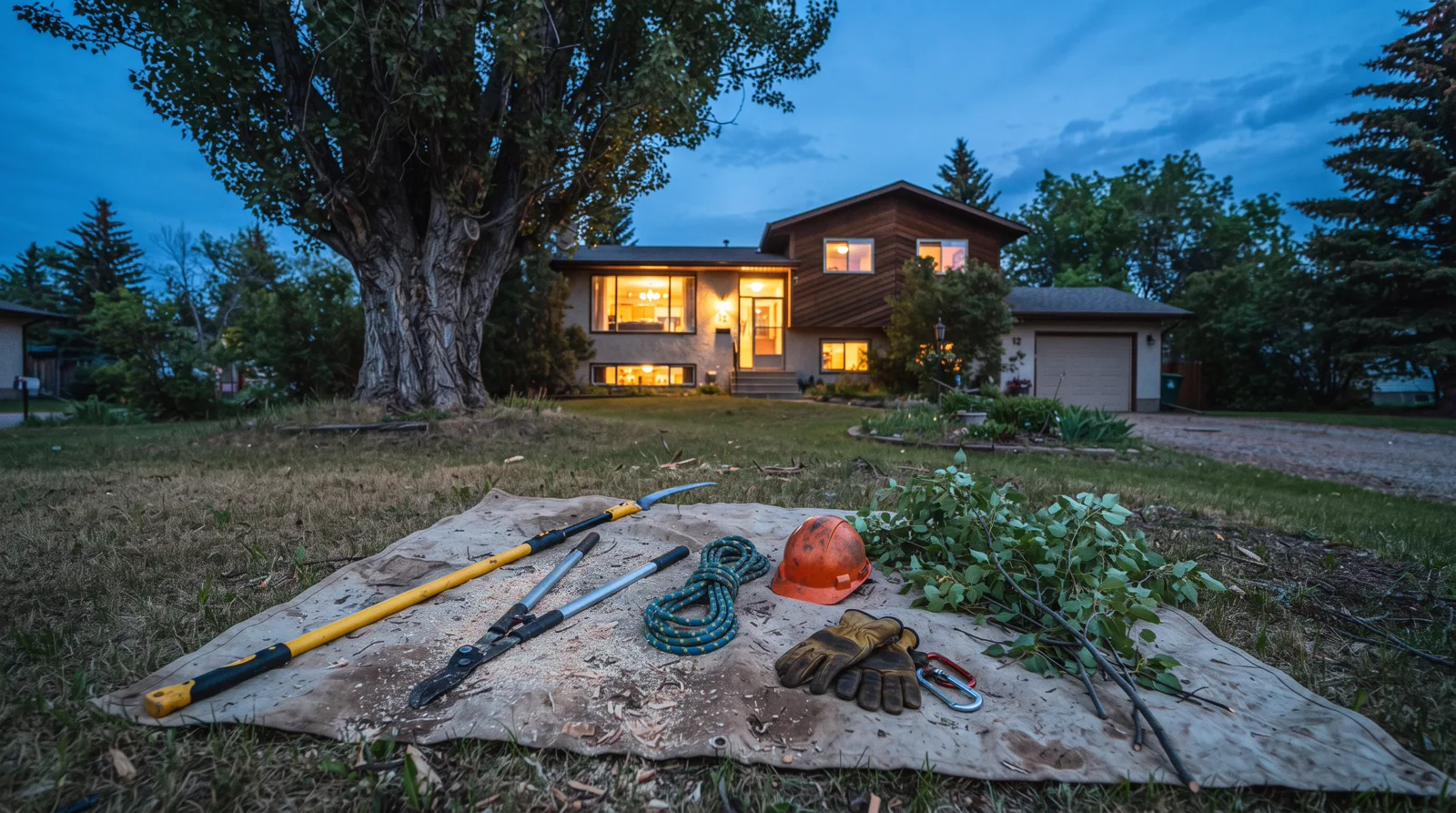
Tree Pruning That Protects Your Property and Your Trees.
Certified arborists who understand Alberta's freeze-thaw cycles, chinook wind stress, and snow load limits. Proper cuts, proper timing, Insured.
Full-Scope Tree and Shrub Care
From crown thinning to emergency storm cleanup, tailored to Tri-Region weather and your property goals.
Crown Thinning & Shaping
Selective branch removal to reduce wind resistance, improve light penetration, and lower snow load stress. Preserves tree health while reducing chinook wind damage risk. Includes cleanup and chipping.
Deadwood & Hazard Removal
Remove broken, diseased, or dead branches before they fall on vehicles, roofs, or people. Critical after freeze-thaw cycles crack limbs. Rope work and rigging included where needed.
Storm Damage Cleanup
Emergency response for trees damaged by wind, hail, or heavy snow. Safe removal of hanging limbs, split trunks, and uprooted sections. Same-week service during storm season, full site cleanup.
Shrub Pruning & Rejuvenation
Shape overgrown hedges, restore flowering shrubs, and remove winter dieback. Timed to Alberta growing seasons for best regrowth. Haul-away and compost disposal included.
Clearance Pruning (Structures & Lines)
Trim branches away from roofs, siding, fences, and overhead power lines to prevent damage and meet insurance clearance requirements. Coordinated with Fortis if near utility lines.
Young Tree Training & Structural Pruning
Early pruning to establish strong scaffold branches, correct weak crotches, and prevent future splits. Sets trees up for decades of safe growth in Alberta wind and snow.
Why Alberta Trees Need Alberta Arborists
🌬️ Chinook Wind & Branch Failure
Sudden warm chinooks followed by hard freezes create brittle wood and weak unions. We identify high-risk crotches and thin canopies to reduce sail area before the next windstorm hits Spruce Grove.
❄️ Snow Load & Crown Structure
Heavy wet snow in April and October can snap branches or split multi-leader trunks. Strategic pruning reduces load points and redirects weight to stronger scaffold limbs, especially critical for older poplars and spruce.
🧊 Freeze-Thaw Crack Propagation
Parkland County sees 40 to 60 freeze-thaw cycles per winter. Cracks in bark and cambium expand each cycle. Local pros remove compromised limbs before internal decay spreads or the branch fails during leaf-out weight.
🏡 Insurance Clearance Requirements
Most Alberta home insurers require minimum 2-meter clearance from roofs and 3 meters from power lines. We document clearance work with photos and measurements to satisfy adjuster requests after wind or hail claims.
What it costs here
Everything You Need to Know About Tree Pruning in Spruce Grove
When to prune, what cuts matter, and how Alberta weather shapes tree care decisions.
What Tree Pruning Actually Involves in Spruce Grove
Tree pruning is the selective removal of branches to improve tree health, safety, and structure. In Spruce Grove and Parkland County, this work goes beyond basic trimming because Alberta's extreme weather puts unusual stress on trees. Arborists remove dead, diseased, or damaged wood first, then address structural problems like co-dominant stems, crossing branches, and weight imbalances that make trees vulnerable to snow load and wind. The goal is a tree that can handle chinook gusts in January, ice accumulation in March, and hailstorms in summer without dropping limbs on your roof, fence, or power lines.
Professional pruning follows the three-cut method to prevent bark tearing. The arborist makes an undercut six to twelve inches from the branch collar, then a top cut slightly farther out to remove the bulk of the limb, and finally a precise collar cut that preserves the tree's natural healing zone. Cuts are made at specific angles to shed water and discourage rot. In Alberta's freeze-thaw climate, a bad cut can channel moisture into the heartwood and start decay that hollows the tree over five to ten years. Certified arborists understand branch collar biology and dormant bud placement, so pruning wounds close faster and new growth emerges in the right spots.
Timing matters as much as technique. Most deciduous pruning in Spruce Grove happens late winter or early spring while trees are dormant and before sap starts running. Pruning during dormancy minimizes stress, reduces disease transmission, and lets you see the branch structure clearly without leaves. Elm pruning is banned April 1 to September 30 across Alberta to prevent Dutch elm disease spread by beetles active in warm months. Evergreens like spruce and pine are often pruned in late June after the spring flush hardens off but before fall growth starts. Storm damage gets pruned any time of year because a broken branch is a bigger risk than pruning out of season.
Why Alberta's Climate Demands Regular Tree Pruning
Chinook Winds and Sudden Temperature Swings
Spruce Grove sits in chinook country, where winter temperatures can jump from negative twenty to plus five Celsius in six hours. These warm Pacific winds create violent gusts that test every weak branch union and crack in your trees. A tree that looks fine in calm August weather can shed a 400-pound limb during a January chinook because the wood never adapted to the uneven load distribution. Pruning removes the mechanical weak points before wind finds them. Arborists thin dense canopies to reduce wind resistance and shorten end-weight on long horizontal branches that act like levers in gusts.
Chinooks also drive rapid freeze-thaw cycling that splits bark and opens frost cracks in trunks and branches. When a tree has been pruned correctly, there are fewer moisture pockets and weak angles where ice can form and expand. Proper pruning promotes taper and flexibility in the canopy, so branches bend and shed wind load instead of snapping. In mature neighborhoods around Spruce Grove like Heritage Park or Westwind, you will notice that well-pruned trees lose far fewer branches during wind events than neglected ones.
Heavy Snow and Ice Accumulation
Parkland County can see snow from October through April, and wet spring snow in March carries enormous weight. A mature spruce with a dense, unpruned canopy can hold 2,000 pounds of wet snow, enough to snap scaffold branches or split the leader. Pruning reduces surface area and opens the canopy so snow falls through instead of piling up. Arborists remove branches with tight V-shaped crotches that trap snow and ice, favoring wide U-shaped unions that shed loads naturally. They also reduce end weight by shortening lateral branches, so even when snow does accumulate, the leverage is lower and breakage risk drops.
Ice storms are less common here than in eastern Canada, but freezing rain events do happen, and the results are catastrophic for unpruned trees. A quarter inch of ice can add 500 pounds to a large tree, and if the structure is weak, you will hear branches cracking all night. Regular pruning keeps the crown balanced and ensures no single limb carries disproportionate weight. In Stony Plain and Acheson, where acreage properties have larger, older trees, proactive pruning is the difference between a tree that survives an ice storm and one that loses half its canopy.
Disease Pressure and Pest Cycles
Black knot fungus, fire blight, and cytospora canker all spread faster in Alberta's dry summers and cold winters when trees are stressed. Pruning removes infected wood before spores spread, and it opens the canopy to improve airflow and sunlight penetration, which suppresses fungal growth. Every cut must be made in healthy tissue well below visible symptoms, and tools must be disinfected between cuts when working on diseased trees. In Spruce Grove, where newer developments plant a lot of Schubert chokecherry and Mayday trees, black knot is endemic, and annual pruning is the only way to keep it under control without removing the tree.
Bark beetles and wood-boring insects target stressed, weakened, or damaged trees. A tree with deadwood, broken branches, or poor structure is an open invitation. Pruning removes the dead and dying tissue that beetles colonize, and it improves overall tree vigor so the tree can produce enough resin to pitch out attackers. In the spruce budworm and forest tent caterpillar cycles that hit Alberta every seven to ten years, well-pruned trees recover faster because they have better light distribution and reserve energy to push new growth after defoliation.
Warning Signs Your Trees Need Pruning Now
Dead branches are the most obvious signal. If you see gray, brittle wood with no buds or leaves while the rest of the tree is green, that wood is dead and needs to come out. Deadwood does not heal, it only decays, and it becomes a falling hazard in every windstorm. In spruce and pine, dead branches often stay attached for years because resin hardens around the union, but they are still loose enough to drop without warning. Check trees after every major storm in Spruce Grove, especially in spring and fall when winds peak. If you find broken stubs, hanging branches, or torn bark, call an arborist before the next weather event finishes the job.
Crossing or rubbing branches create wounds that never heal and provide entry points for disease and insects. When two branches rub together in the wind, they wear through the bark and expose the cambium layer. In Alberta's dry summer air, those wounds dry out and crack, and in winter they collect moisture and freeze. You will see dark staining, sunken bark, or oozing sap where branches touch. The fix is simple: prune out one of the two competing branches before the wound becomes a canker. In young trees, this kind of corrective pruning shapes future structure and prevents problems that would require major surgery ten years later.
Lopsided or leaning growth is a structural red flag. Trees naturally grow toward light, but if one side of the canopy is twice the size of the other, the center of gravity shifts and the tree becomes unstable. This is common in Spruce Grove where trees are planted too close to buildings or fences and only get light from one direction. Heavy snow or wind can tip a lopsided tree right out of the ground, especially in clay soils that stay wet in spring and lose holding strength. Pruning rebalances the canopy by reducing weight on the heavy side and encouraging growth on the sparse side. In severe cases, cabling or bracing may be needed along with pruning, but catching the problem early usually means pruning alone is enough.
- Branches hanging over roofs, driveways, or power lines where they scrape, drop debris, or create hazards
- Dense interior growth with no light penetration, leading to weak, spindly branches and increased disease risk
- Suckers and water sprouts growing vertically from the trunk or main branches, wasting energy and cluttering structure
- Visible decay, cavities, mushrooms, or conks on branches or the trunk, signaling advanced rot that requires immediate assessment
- Recent construction or soil disturbance near the tree that damaged roots and triggered dieback in the canopy
The Professional Pruning Process from Start to Finish
Initial Assessment and Pruning Plan
A certified arborist walks the property and evaluates each tree's health, structure, and risk factors. They look at branch angles, collar integrity, dead wood percentage, lean, root flare visibility, and proximity to structures or utilities. In Spruce Grove, they also check for local issues like black knot on ornamental cherries, fire blight on crabapples, or spruce needle cast on Colorado blue spruce. The arborist identifies which branches need removal for safety, which ones for health, and which for structure or clearance. They explain the pruning objectives and show you exactly what will be cut and why, so there are no surprises when the work is done.
The arborist also confirms whether the work requires a permit. In Spruce Grove, no permit is needed for routine pruning on private property, but if the tree is on a municipal boulevard or in a conservation reserve, you need town approval before cutting anything. Trees near power lines require coordination with Fortis Alberta, and the utility may do the work themselves or need to de-energize lines while a contractor works. The arborist handles those calls and schedules the work so you do not end up with a violation or a safety incident.
Pruning Execution and Safety Protocols
On the day of the job, the crew arrives with a bucket truck or climbing gear, chainsaws, pole saws, ropes, and chippers. They set up safety zones, lay down tarps or plywood to protect your lawn and landscaping, and confirm the plan one more time before cutting starts. Climbers use three-point contact and are tied in with friction hitches or mechanical devices at all times. Ground crew members wear hard hats, gloves, and high-visibility vests, and they manage the drop zone so falling branches do not hit structures, people, or parked vehicles. In tight residential lots common around Spruce Grove, arborists rig branches down with ropes instead of free-dropping them, which adds time but prevents damage.
The crew prunes from the top down and the outside in, removing deadwood and hazard branches first, then making structural cuts. They follow ISA standards for pruning cuts, leaving the branch collar intact and avoiding flush cuts that damage the trunk. Cuts larger than two inches in diameter are inspected and left clean with no ragged edges or torn bark. In Alberta, wound dressing or paint is not recommended because it traps moisture and slows healing, so cuts are left exposed to air-dry and seal naturally. As branches come down, they are fed into a chipper or cut into firewood rounds if you want to keep the wood. Brush and debris go into a truck or a bin for disposal.
Cleanup, Inspection, and Follow-Up Care
After the pruning is complete, the crew rakes up sawdust and small debris, blows off driveways and walkways, and removes all tarps and equipment. They walk the site with you to confirm the work matches the plan and answer any questions about what was done. The arborist points out any new observations, like early signs of disease or structural issues that were not visible from the ground, and recommends follow-up actions if needed. You receive a written summary of the work, including species, size, and scope of pruning, which is useful for insurance records and future care planning.
Most trees need watering after heavy pruning, especially in Spruce Grove's dry summers. The arborist will tell you to deep-water the tree once a week for the first month, applying water slowly at the drip line so it soaks down to the roots rather than running off. Mulching around the base helps retain moisture and moderate soil temperature, but mulch should never touch the trunk because it encourages rot and rodent damage. Fertilization is usually not recommended right after pruning because it pushes new growth that the tree may not be able to support while healing. The arborist schedules a return visit in one or two years to assess healing, remove any new deadwood, and continue structural training if the tree is young.
What Tree Pruning Really Costs in Spruce Grove and Parkland County
Tree pruning prices in the Tri-Region vary widely based on species, size, location and access. A small ornamental crabapple or mountain ash under 15 feet might cost $150 to $350 for a light canopy clean and deadwood removal. Medium trees like a mature spruce or linden in the 20 to 35 foot range typically run $400 to $900, especially if the arborist needs to climb or set rigging. Large deciduous shade trees over 40 feet, such as a boulevard elm or a backyard poplar, can easily reach $1,200 to $2,500 for a full structural prune, and removing a hazardous limb over your roof or power line adds another $300 to $800 depending on rigging complexity and liability.
Several factors push costs higher in this climate. Winter pruning (November through March) is ideal for most deciduous species because disease spread is minimal and branch structure is visible, but frozen wood is harder to cut and daylight hours are short, so some contractors charge a premium or require better access for equipment. Spring and summer work on species like oak, elm or apple must account for disease risk: many certified arborists will only prune oak between October and March to avoid oak wilt vectors, and elm pruning outside the October to March window requires immediate wound sealing and branch disposal to comply with Dutch elm disease bylaws in Parkland County and Spruce Grove. If your tree sits near overhead Fortis Alberta lines, the utility may prune for clearance at no charge, but they cut for safety, not aesthetics, and you will lose significant canopy. Hiring your own ISA certified arborist to work around the line (with Fortis approval) costs more but preserves tree form.
Access and cleanup drive the final bill as much as the tree itself. If the crew can park a truck next to the tree, drop branches into a chipper and leave in two hours, you pay for labour and equipment time. If they must haul gear through a back gate, rig every cut to avoid a fence, a deck, or a neighbour's garage, then rake, chip and vacuum debris from lawn and garden beds, expect 30 to 50 percent more. Properties in older Spruce Grove neighborhoods with narrow lanes, overhead wires and mature canopy often require bucket truck rental or advanced rigging, each adding $200 to $600 to the job. Stump grinding is usually quoted separately: $100 to $200 for a small stump, $300 to $600 for anything over 24 inches. Always ask whether the quote includes limb disposal, stump grinding, and haul-away, because some crews pile brush at the curb and leave cleanup to you.
Comparing Your Pruning Options: Methods, Timing and Tree Types
Crown cleaning removes dead, diseased, broken and crossing branches to improve health and reduce storm damage risk. This is the minimum recommended maintenance for most mature trees and costs the least because you are only cutting problem wood, not reshaping the canopy. Crown thinning selectively removes interior branches to increase light penetration and air flow, which reduces fungal disease pressure and wind resistance. Thinning is especially useful for dense species like spruce, pine and poplar in Parkland County, where late summer humidity and fall chinook winds create both mildew risk and breakage risk. Crown reduction cuts back the outer canopy to reduce height or spread, often necessary when a tree has outgrown its space or threatens a roof, but reduction must be done carefully to avoid topping, which causes rapid, weakly attached regrowth and decay.
Timing your pruning to species and goal makes a significant difference in cost, recovery and disease risk. Deciduous shade trees like ash, linden, maple and elm are best pruned in late fall through early spring when dormant. Pruning a mature elm in July violates Parkland County's Dutch elm disease prevention bylaw, which prohibits elm cutting from April 1 to September 30, and contractors who ignore this can be fined. Fruit trees including crabapple, cherry and apple should be pruned in late winter (February or March) to shape and stimulate fruiting wood, but any fire blight infected branches must be cut back 12 inches into healthy wood and tools disinfected between cuts to prevent spread. Evergreens like spruce and pine tolerate light pruning year-round but heavy work is best done in late winter before spring flush. Never remove more than 25 percent of a conifer's live canopy in a single season or you risk killing the tree.
Different tree types demand different approaches and that affects both cost and outcome. Fast-growing poplars and willows produce abundant water sprouts and suckers, so they need frequent light pruning rather than infrequent heavy cuts. Many Spruce Grove properties have Boulevard poplars planted in the 1980s that now exceed 50 feet and drop limbs in windstorms: crown reduction combined with cabling or bracing costs $1,500 to $3,000 but extends the tree's safe life by a decade. Ornamental species like Japanese tree lilac, Amur cherry and Schubert chokecherry need minimal pruning, usually just deadwood and sucker removal every two or three years at $200 to $400 per visit. Spruce and pine are slow-growing and structurally strong, so a well-placed young tree might go 10 or 15 years with no pruning beyond removing a broken branch. Investing in proper pruning early in a tree's life, especially between years three and ten, builds strong structure and reduces the need for expensive corrective work later.
Common Mistakes and Contractor Red Flags to Avoid
Topping is the single worst mistake in tree care and remains surprisingly common in the Tri-Region. A contractor who offers to "top" your tree, cut it back to stubs, or reduce height by removing the central leader is either unqualified or dishonest. Topping destroys the tree's natural form, removes most of its food-producing foliage, creates large wounds that invite decay, and triggers a flush of weak, upright sprouts that break easily under snow load or wind. A topped tree becomes a permanent maintenance problem and a liability. Legitimate arborists use crown reduction, which involves cutting branches back to a lateral limb at least one third the diameter of the removed section, preserving the tree's structure and health. If someone quotes you $600 to "take the top ten feet off," walk away and find an ISA certified arborist.
Hiring an uninsured crew is a costly gamble that homeowners lose every time something goes wrong. Tree work is dangerous: a climber falls, a limb drops onto a vehicle, a saw kicks back, or a tree splits unexpectedly and crushes a fence. If the crew has no liability insurance and no liability insurance, you are personally liable for injuries to workers and damage to your property or your neighbour's. In Alberta is mandatory for most tree service businesses, and legitimate companies carry at least two million dollars in commercial general liability insurance. Always ask for proof of both before signing a contract, and verify the WCB account is active by calling WCB Alberta directly. A crew that hedges, delays, or offers a cash discount to skip paperwork is operating illegally and putting you at serious financial risk.
Lowball quotes that seem too good to be true usually are. If one arborist quotes $1,200 to prune your mature spruce and another quotes $400, the second contractor is either inexperienced, cutting corners, or planning to disappear after taking a deposit. Cheap quotes often come with no cleanup, no insurance, poor cuts that harm the tree, or incomplete work. Some operators move through neighborhoods in spring with a truck and a chainsaw, knock on doors, demand cash, and leave debris piles or damaged trees. Parkland County and Spruce Grove have no licensing requirement for tree services, so anyone can print business cards and advertise. Protect yourself by checking references, verifying credentials (ISA certification, Alberta arborist registration), reviewing insurance documents, and insisting on a written contract that specifies scope of work, timeline, total cost, cleanup and disposal.
Hiring the Right Tree Care Professional in the Tri-Region
Start by confirming the contractor holds ISA (International Society of Arboriculture) certification or is a registered consulting arborist in Alberta. Certification demonstrates that the individual has passed rigorous exams on tree biology, pruning standards, safety and pest management, and maintains continuing education. Not every crew member needs certification, but the person planning and supervising the work should have credentials you can verify on the ISA website. Ask whether the company employs certified climbers or relies on bucket trucks, because difficult trees near structures often require skilled climbers with rigging experience. A qualified arborist will assess your tree, explain what needs to be cut and why, show you where cuts will be made, and tell you what the tree will look like afterward. If someone walks your property for three minutes, quotes a price with no explanation, and pressures you to decide on the spot, keep looking.
Get at least three written quotes that break down labour, equipment, disposal and any additional services like stump grinding or cabling. The quote should specify which pruning type will be performed (cleaning, thinning, reduction, restoration), how much canopy will be removed, whether climbing or machinery will be used, and the timeline for completion and cleanup. Compare not just the total price but the scope and detail: a higher quote from an ISA arborist who includes wound treatment, careful limb lowering, and full debris removal is usually better value than a low quote for rough cuts and a brush pile at the curb. Ask each contractor for three recent references in Spruce Grove or Parkland County and actually call them. Ask whether the crew showed up on time, completed the work as quoted, left the property clean, and whether the homeowner would hire them again.
Check reviews on Google, HomeStars and the Better Business Bureau, but read critically. A few negative reviews among dozens of positive ones are normal, but patterns of complaints about damage, incomplete work, surprise charges, or no-shows indicate a problem contractor. Verify that the business has a physical address, not just a cell number and a Gmail account. Established local companies with shop yards in Stony Plain, Spruce Grove or Edmonton have equipment, staff, insurance and a reputation to protect. Fly-by-night operators vanish when problems arise. Once you have chosen a contractor, insist on a signed contract before work begins, and never pay the full amount up front. A deposit of 25 to 50 percent is reasonable to secure the schedule and cover mobilization costs, with the balance due on completion after you have inspected the work and confirmed cleanup is finished.
How Tri-Region Services Helps
Tri-Region Services takes the risk and guesswork out of hiring by connecting you to one carefully vetted, fully insured local tree care professional who serves Spruce Grove, Stony Plain, Parkland County and Acheson. Every pro in our network tells us they carry commercial liability insurance of at least two million dollars, and ISA certification or equivalent demonstrated expertise. You get one free written quote with no obligation, a clear scope of work, and a contractor who shows up on time and cleans up completely. We do not post prices or list every provider because quality tree work is not a commodity: every tree, property and job is different. Our role is to match you to a trusted professional who will assess your specific situation, explain your options honestly, and deliver safe, skilled pruning that protects your investment and your property.
How We Verify Every Tree Care Pro
Height work and chainsaws demand real credentials. Here's what we confirm before a contractor appears in search results.
liability insurance in Good Standing
liability insurance account verified via Alberta online registry. No coverage means no listing.
$5 Million Liability Minimum
Certificate of insurance on file naming tree and property damage coverage, updated annually.
ISA or Alberta Certified Arborist
At least one crew lead holds International Society of Arboriculture or provincial certification, verified by credential number.
Parkland County Business License
Municipal business license confirmed for Spruce Grove, Stony Plain, or county operation where required.
Gear Inspection Records
Ropes, harnesses, and rigging equipment inspected per manufacturer intervals. Documented in safety logs.
Fortis Coordination for Line Clearance
Contractors working near power lines maintain Fortis contact protocols and know when to call for utility disconnect.
This page is not tied to a contractor's brand. Leads route straight to your one local partner. Verified reviews can appear here once that partner has them (never fabricated).
Serving the whole Tri-Region
7 Questions Spruce Grove Homeowners Ask
When is the best time to prune trees in Spruce Grove?+
How much does it cost to prune a large tree in Parkland County?+
Do I need a permit to prune trees on my property in Spruce Grove?+
What happens if a tree branch falls and damages my neighbor's fence?+
Can I prune my own trees or do I need a certified arborist?+
How do I know if a branch is dead or just dormant in winter?+
Will pruning hurt my tree or stunt its growth?+
What is the difference between tree pruning and tree trimming?+
Get your free quote
Tell us what you need and a local pro will get right back to you.
- ✓ Sent straight to a local business
- ✓ You choose who you hire
- ✓ Free, with no obligation