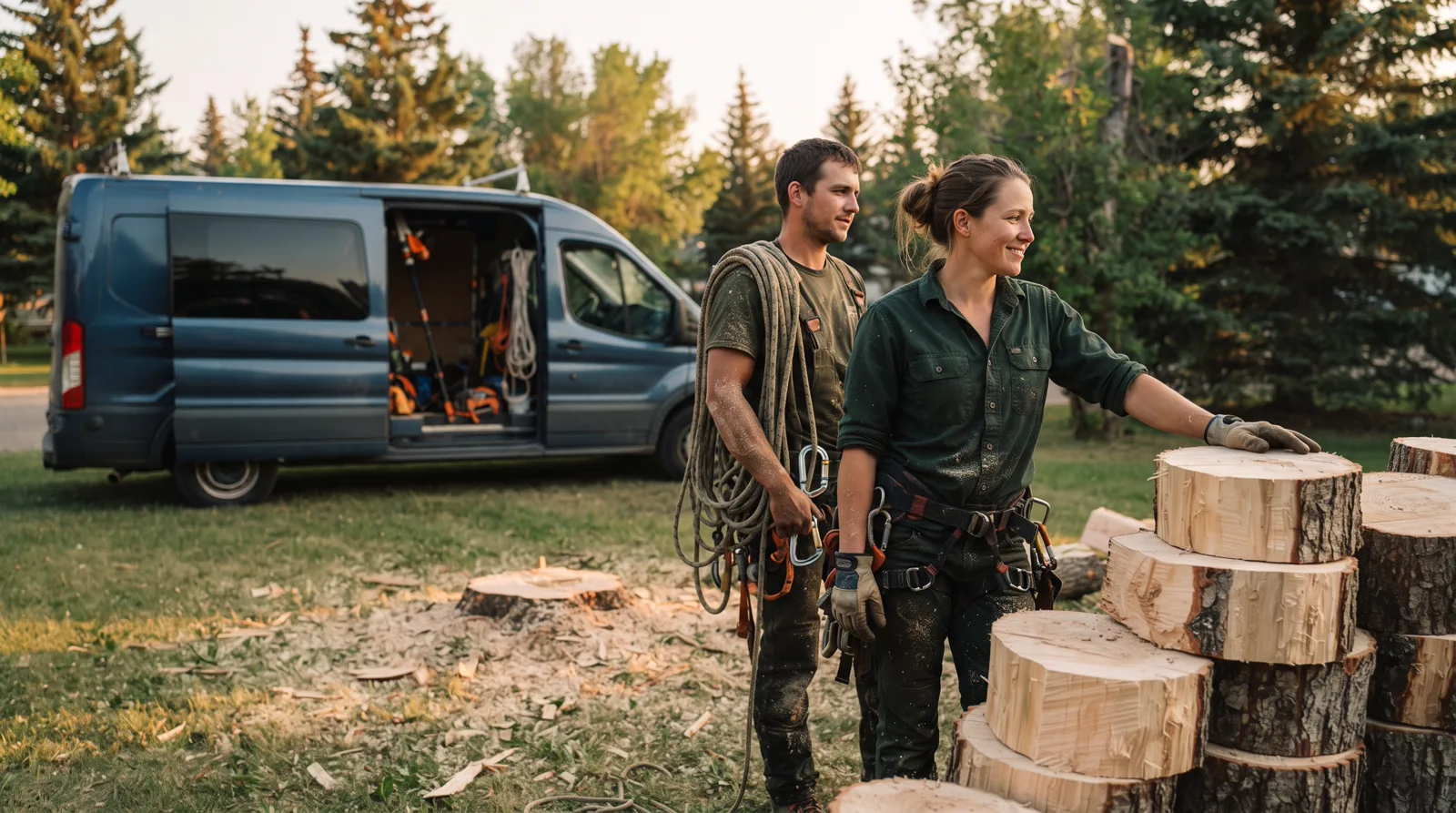
Tree Service Built for Alberta Weather.
From routine trimming to emergency storm cleanup, we connect you with certified arborists and tree crews who understand chinook winds, heavy snow load and the permit rules in your municipality.
Complete Tree Care for the Tri-Region
From single backyard spruce to multi-acre lot clearing, matched to crews with the right gear and tickets.
Tree Removal
Complete takedown including sectional rigging for trees near structures, power lines or tight access. Stump cut flush to grade or left high for grinding. Debris hauling and site cleanup included in every quote.
Tree Trimming & Pruning
Crown thinning, deadwood removal, clearance cuts for roofs and power lines. Timed for species and season to minimize stress. Chips hauled or mulched on site, your choice.
Stump Grinding
Stumps ground 8 to 12 inches below grade so you can seed, sod or build over the spot. Grindings left for fill or hauled away. Access for machines confirmed before dispatch.
Emergency Storm Service
Same day or next morning for trees on roofs, blocking driveways, or contact with power lines. Pros carry the liability limits and safety tickets insurers require. Documentation for claims provided.
Tree Health Assessment
ISA certified arborist inspects for disease, pest damage, structural defects and hazard risk. Written report with recommended treatment or removal timeline. Often required for insurance or permit applications.
Lot Clearing & Brush Removal
Multi-tree removal for new construction, acreage development or overgrown properties. Includes grinding, brush chipping and rough grading. Burn permits arranged if required by county bylaws.
Tree Work That Understands Alberta
🌬️ Chinook Wind Damage
Warm chinook gusts snap frozen branches and uproot shallow-rooted species. Pros we dispatch know which trees fail first and how to spot the cracks before the next wind event. Post-storm triage prioritizes hazards over cosmetics.
❄️ Snow Load & Ice Accumulation
Heavy wet snow and freezing rain load branches past their breaking point, especially on spruce, poplar and willow. Preventive crown thinning before winter reduces the sail area and ice catch. Emergency callouts spike after every major dump.
📋 Municipal Permits & Protected Trees
Spruce Grove requires permits for trees over 20 cm diameter on private land. Stony Plain protects boulevard trees and trees in environmental reserves. Parkland County has wildfire fuel management zones near acreages. Crews confirm the rules before cutting.
⚡ Power Line Clearance Rules
Fortis Alberta mandates 3 meter clearance from primary lines, enforced by municipal bylaw officers. Crews working near wires carry the tickets and liability coverage Fortis requires. Homeowners cutting their own risk fines, outages and serious injury.
What it costs here
Everything You Need to Know About Tree Service in Spruce Grove
Costs, timing, permits, safety and how to choose the right crew for your property.
What Tree Service Actually Involves in Alberta
Tree service covers a range of work that keeps your property safe and your trees healthy. The most common jobs are pruning to remove dead or hazardous branches, full tree removal when a tree is dying or threatening a structure, stump grinding to clear the root mass after removal, and emergency response after storms knock limbs down or split trunks. In Spruce Grove, Stony Plain, Parkland County and Acheson, the mix leans heavily toward storm cleanup from May through September and preventive pruning in late winter before the sap runs. Every job requires a site visit first because no two trees fail the same way, and quoting over the phone without seeing the canopy, the lean, the proximity to power lines and the access for equipment leads to surprises no one wants.
Alberta law treats tree work as high-risk construction. Anyone climbing above three metres or operating a chainsaw near power lines must carry active Workers Compensation Board coverage and general liability insurance, typically two million dollars minimum but often five million when working near homes or commercial buildings. Parkland County and the City of Spruce Grove both require permits for removing any tree over a certain diameter, usually twelve inches measured four feet from the ground, and some residential lots have covenant restrictions that forbid cutting certain species without replacing them. The pro you hire is responsible for pulling the permit, not the homeowner, but you need to confirm that step is part of the quote or the city can issue a stop-work order and fine you for the violation.
Professional tree work uses specialized equipment that most landscapers do not own. A bucket truck costs over one hundred thousand dollars, a stump grinder runs fifteen to thirty thousand, and a twelve-inch capacity chipper adds another twenty thousand to the fleet. Climbing gear, rigging ropes, pulleys and safety harnesses are mandatory when no truck access exists, and the climber must be trained and certified under Alberta Occupational Health and Safety standards. This is why tree service costs more than mowing: the capital investment, the liability exposure, the training requirements and the physical danger are all in a different category. A crew of two or three can handle most residential jobs, but large removals near houses often need four people and a full day to rig sections down safely without damaging your roof, your fence or your neighbor's garage.
Why Alberta Climate Makes Tree Work Essential
Hail is the single largest driver of tree damage across the Tri-Region. A severe hailstorm can shred the canopy of a mature poplar or ash in fifteen minutes, stripping bark, cracking branches and creating entry points for disease and insects. The June 2020 storm that hit northeast Spruce Grove left thousands of trees with canopy loss over thirty percent, and many homeowners delayed cleanup only to watch those trees decline over the next two years as fungal rot spread through the wounds. Hail does not always mean removal, but it does mean assessment within a few weeks of the event, because a tree that looks survivable in July can be dead by the following spring if the cambium layer took a beating and the sapwood dried out.
Chinook winds in winter put mechanical stress on tree crowns that eastern Canada never sees. A chinook can push seventy kilometers per hour in January with no warning, and when it hits frozen wood that has lost flexibility in the cold, branches snap at the collar or the entire crown can shear off a trunk weakened by old storm damage. Spruce, pine and older poplars are the most vulnerable because their structure relies on a strong central leader, and once that leader cracks the tree loses its wind resistance and becomes a liability. The windward side of your property, usually the west or northwest exposure, takes the worst of it, and if you have a row of trees planted as a windbreak twenty years ago, expect to lose one or two per decade as the canopy grows tall enough to catch the full force of a winter blow.
Freeze-thaw cycles and snow load add cumulative damage that does not show up in one season but compounds over five or ten years. Water infiltrates cracks in the bark during a thaw, freezes overnight when the temperature drops back to minus fifteen, expands and splits the wood deeper with every cycle. By the time you notice a vertical crack running up the trunk, the tree has been failing internally for years. Snow load is less dramatic but just as destructive: a wet spring snow can weigh down the crown of a mature spruce until the top third bends horizontal, and even if it does not break immediately the wood stays bent and the tree grows crooked from that point forward. Parkland County sees this pattern every April when a late dump drops twelve inches of wet snow onto trees that have already started budding and lost their winter flexibility.
Warning Signs You Need a Tree Pro
Dead branches in the upper canopy are the clearest indicator that a tree is declining and needs attention. If more than a quarter of the crown shows no leaf growth in late May, the root system or the trunk has sustained damage and the tree is shutting down from the top. Poplars and ash are fast to show this pattern because they grow aggressively in youth and then hit a biological wall around age thirty, while spruce and pine decline more slowly but are harder to save once the needle loss begins. A single dead limb overhanging your driveway or your neighbor's yard is enough to justify a service call, because a six-inch diameter branch weighs over one hundred pounds and will go through a windshield or a roof without slowing down.
Visible trunk damage such as splits, cankers, holes or peeling bark means the structural integrity is compromised and you are on borrowed time. A vertical split wider than your finger that runs more than three feet up the trunk will not heal and will only spread wider with each freeze-thaw cycle. Fungal brackets growing out of the bark or the root flare indicate internal rot, and once the fungus is visible on the outside the decay inside is already extensive. Woodpecker holes are a secondary sign: the birds are feeding on insects that moved into dead or dying wood, and if you see a cluster of holes in one area the tree has lost enough live tissue in that section to attract boring beetles or carpenter ants. Leaning trees are obvious risks, but the lean you need to worry about is the one that develops suddenly after a storm, not the gradual lean a tree has held for ten years.
Timing matters as much as the signs themselves. Late winter, from February through early April, is the best window for pruning and removal because the sap is down, the wood is dormant and the ground is still frozen enough to support heavy equipment without tearing up your lawn. Waiting until June means the tree is fully leafed out, the canopy is twice as heavy, the sap makes everything slippery and the ground is soft enough that a bucket truck will leave ruts a foot deep. Emergency work happens whenever the tree comes down, but if you are planning elective removal or major pruning, book it for late winter and you will get better scheduling, better pricing and less property damage.
- More than twenty-five percent canopy dieback or missing leaf growth by late May
- Vertical trunk splits longer than three feet or wider than one centimeter
- Fungal brackets, cankers or peeling bark at the base or on the main trunk
- Sudden lean after a storm, especially if soil is heaving on one side of the root ball
- Dead branches overhanging structures, driveways, power lines or neighboring property
- Woodpecker damage concentrated in one area, indicating insect infestation in dead wood
The Tree Service Process Step by Step
The first step is always an on-site assessment. A qualified arborist or tree service operator will walk your property, measure the tree, check for hazards such as overhead power lines or buried utility flags, and assess access for equipment. If the tree is within ten feet of a structure or if removal requires rigging sections down in pieces, the quote will reflect the extra labor and time. If a bucket truck can reach the work and drop sections straight down into a clear zone, the price drops significantly. You should expect this visit to take fifteen to thirty minutes for a single tree, and the written quote should break down the cost by task: removal, stump grinding, hauling debris, and any permit fees that apply under municipal bylaws.
Permit requirements vary by location within the Tri-Region. The City of Spruce Grove requires a tree removal permit for any tree over fifteen centimeters diameter at breast height on residential lots, with a fee around one hundred twenty dollars and a processing time of two to three weeks. Parkland County has similar rules for trees in setbacks or conservation areas, and some subdivisions have restrictive covenants that require you to replant a tree of equivalent size or pay into a community fund. The contractor you hire should know these requirements and include permit costs in the quote, but it is your responsibility to ask the question up front and confirm the permit is pulled before work starts, because the municipality will come after the property owner if the cut was illegal.
Work execution depends on the size and location of the tree. A simple backyard removal with truck access can be finished in three to five hours by a two-person crew: one climber or bucket operator, one ground worker to feed the chipper and manage debris. Complex jobs near houses or power lines take a full day and require rigging: the climber ascends with ropes and a harness, cuts sections in controlled lengths, lowers them with a pulley system to avoid dropping anything, and the ground crew moves each piece to the chipper or stacks it for firewood if you requested that option. Stump grinding is usually a separate visit because the grinder is a different machine, and most companies charge by stump diameter, typically one hundred fifty to four hundred dollars for a standard residential stump twelve to twenty-four inches wide.
Debris cleanup and haul-away should be part of the base quote, not an add-on surprise. Standard practice is to chip all branches under six inches, haul the chips and the trunk wood offsite, rake the work area clean and leave your yard in the same condition they found it aside from the missing tree. Some homeowners ask to keep the trunk wood for firewood, which reduces cost slightly because the company does not have to haul it, but poplar and aspen are poor firewood species and you will be stuck with a pile that takes two years to season. If the tree is near a garden bed or a sprinkler system, flag those areas before the crew arrives so the equipment does not crush your perennials or snap an irrigation line buried three inches down.
What Tree Service Really Costs in Spruce Grove and the Tri-Region
Tree removal in Spruce Grove typically runs between $400 and $3,500 depending on size, species, location and access. A small ornamental crabapple or mountain ash under 25 feet with clear access might cost $400 to $900. A mature spruce or poplar between 40 and 60 feet averages $1,200 to $2,200. Large cottonwoods or willows over 70 feet near power lines, fences or structures can push $2,800 to $4,500 because of rigging complexity, crane rental and the hours required to dismantle sections safely. Stump grinding adds $150 to $400 per stump depending on diameter and root spread.
Pruning and trimming cost less but vary widely by scope. Light crown thinning or deadwood removal on a backyard spruce might cost $250 to $600. Structural pruning on a mature elm to reduce wind sail and prevent limb failure during chinook windstorms runs $500 to $1,400. Cabling and bracing to stabilize split trunks or codominant leaders adds $300 to $800 per installation. Emergency storm cleanup after a heavy wet snow or spring hailstorm that snaps branches is often billed hourly at $150 to $250 per hour plus disposal, so a half day of cleanup can reach $800 to $1,500.
What drives the price is tree height, diameter, lean, proximity to structures and access for equipment. A tree leaning over a garage or close to power lines requires careful rigging, sectional lowering and more labor hours. Poor access means hand carrying sections to the chipper instead of using a grapple truck, doubling the time. Species matters: brittle poplars and Manitoba maples are faster to drop and chip than dense elms or thick spruces. Disposal costs are real. Parkland County and Spruce Grove charge tipping fees at the composting facility, and some pros pass those directly to you. Stump depth matters for grinding: surface grinding to six inches below grade is standard, but grinding deeper for replanting or paving costs more because of extra wear on carbide teeth and time.
Permits are rare for private residential trees in Spruce Grove and Stony Plain unless the tree sits in a municipal right of way or is protected under a local bylaw. Removing a tree within three meters of a property line sometimes requires neighbor notification under the Alberta Forests Act to avoid liability for root or branch encroachment damage. Always confirm before cutting. Alberta spring weather creates timing premiums: pros book solid in May and June when homeowners want cleanup and planting prep done before summer, so last minute requests can carry rush fees of 15 to 25 percent.
Comparing Methods: Removal, Pruning and Stump Options
Full removal versus selective pruning is the first decision. Removal makes sense when a tree is dead, diseased beyond recovery, structurally unsound or planted in the wrong spot and threatening a foundation, septic field or overhead service line. Pruning extends the life of healthy trees, improves structure, reduces hazard and maintains canopy benefits like shade and windbreak. A mature spruce shading your south windows in summer saves real cooling costs, and a row of poplars blocking north wind cuts winter heating demand. Pruning every three to five years keeps mature trees safe and attractive. Removing a 50 year old spruce because a few lower branches touch the roof is short sighted when crown lifting and thinning solves the problem for $400 and preserves the tree.
Stump removal has three common approaches: grinding, chemical decomposition and full extraction. Grinding is standard. A tracked grinder chews the stump and surface roots to wood chips six to twelve inches below grade, enough to lay sod or replant. The chips can be removed or left as mulch. Chemical decomposition uses potassium nitrate to accelerate rot over months, then you break apart the soft wood and backfill. It works but takes a full season and still leaves debris. Full extraction with a backhoe or stump puller rips the entire root ball out and is only justified when clearing land for construction or when roots threaten underground utilities. Grinding costs $150 to $400 per stump. Extraction runs $500 to $1,200 because of equipment, excavation and disposal of heavy root masses and soil.
Tree service pros use different equipment levels, and that affects price and quality. A one person operation with a pickup, chainsaw and rental chipper can handle small removals and pruning but lacks capacity for large or complex jobs. A full crew with a bucket truck, grapple truck, large chipper and climbing gear can remove a 70 foot cottonwood in a day with minimal property disturbance. Crane service is sometimes needed for trees with no safe rigging points or tight access, adding $800 to $2,000 to the job but protecting structures and cutting labor time in half. The cheapest quote is not always the best value: underbid jobs often mean shortcuts, no cleanup or damage you pay to fix later.
Contractor Traps and Mistakes That Cost You Money
Hiring uninsured tree service is the biggest risk. A climber falls from 40 feet, or a widow maker limb drops onto a parked vehicle, or a tree kicks back during felling and crushes a fence. Without liability coverage and liability insurance, you are exposed. Alberta WCB rules are strict: any contractor performing tree work must carry coverage for workers, and if they do not, the homeowner can be held liable for injury costs. Asking for proof of insurance and current WCB clearance before any work starts is not rude, it is protecting your property and finances. A legitimate pro provides certificates without hesitation. If someone deflects, lowballs the quote to undercut insured competitors or offers a cash discount to avoid documentation, walk away.
Vague quotes lead to bill shock. A verbal estimate of $1,200 to remove a tree sounds clear until the pro adds $400 for stump grinding you assumed was included, $250 for hauling branches you thought were part of the deal, and $180 for filling the stump hole. A proper written quote specifies exactly what is included: tree removal to ground level, stump grinding to X inches depth, all debris chipped or hauled away, site raked and left clean. It states start and end dates, payment terms and any exclusions. If the quote says removal only and you want grinding, clarify and get the combined price in writing before signing. Surprises during the job happen, like discovering rot or embedded wire fence inside the trunk, but change orders should be discussed and approved before the work continues and the price adjusts.
Topping trees is still pushed by a few low knowledge operators as a way to reduce height or risk. Topping means cutting main limbs back to stubs with no regard for branch structure or growth response. It destroys the tree's natural form, creates large wounds that invite decay and insects, and triggers a flush of weak water sprouts that grow fast, attach poorly and become new hazards within a few years. Certified arborists never top. Proper crown reduction removes limbs back to lateral branches large enough to assume the terminal role, maintaining structure and health. If a quote mentions topping, that is a red flag the person does not follow arborist standards. You will pay again in five years to fix the problem and possibly remove a tree that could have been managed correctly from the start.
Timing mistakes waste money. Removing a poplar in late April when sap is rising and the wood is waterlogged adds weight, makes chainsaw work slower and creates more cleanup than cutting in January when the tree is dormant and frozen solid. Pruning elms during the active growing season in spring and summer violates Alberta Forest Health regulations designed to limit spread of Dutch elm disease: elm pruning is restricted from April 1 to August 31 unless you have a certified arborist with a permit, and violations carry fines. Pruning maples in early spring when sap flows heavily causes excessive bleeding that stresses the tree and makes a mess. Late fall and winter are ideal for most pruning and removals: trees are dormant, visibility is better without leaves, ground is frozen for equipment access and pros have more availability.
How to Hire the Right Tree Service Pro in the Tri-Region
Start by checking qualifications and credentials. ISA Certified Arborists have passed exams covering tree biology, pruning standards, risk assessment and safety. The credential does not guarantee perfect work, but it proves baseline knowledge. Ask if the company employs certified climbers or arborists and verify the certification number on the ISA website. liability insurance is mandatory for any contractor with workers. Request a clearance letter dated within the last 60 days. Liability insurance should be at least $2,000,000 for residential tree work. Ask for a certificate of insurance naming you as an additional insured for the job duration. Legitimate pros provide this documentation as standard practice.
Get at least three written quotes for any significant job and compare scope, not just price. A $900 quote that includes removal, grinding, haul away and cleanup is better value than a $700 quote for removal only. Look for detail: how deep will the stump be ground, will low branches be pruned or chipped, is site restoration included, what is the timeline and payment structure. Ask what happens if unexpected issues arise, like underground utility conflicts or discovering a wasp nest in the canopy. A good quote anticipates contingencies and explains how change orders are handled. Avoid quotes with round numbers and no breakdown. An estimate of exactly $2,000 with no line items is a guess, not a calculated bid.
Ask specific questions before hiring. How will you protect my lawn, garden beds and driveway during the job? What cleanup is included and what is extra? Do you carry the debris away or leave chips on site? Will you backfill and level the stump hole? What is your plan if weather delays the work? How do you handle damage if equipment or a falling limb hits something? The answers reveal professionalism and planning. A pro who has done hundreds of removals will describe plywood protection for driveways, tarps for garden beds, and a clear debris plan. Someone winging it will give vague answers or promise to figure it out on site. Trust your instincts: if communication is poor before the job starts, it will not improve once chainsaws are running.
How Tri-Region Services Helps You Find the Right Pro
Tri-Region Services takes the guesswork out of hiring by connecting you with one carefully local tree service professional who serves Spruce Grove, Stony Plain, Parkland County and Acheson. Every pro in the network has confirmed liability coverage and references before being approved for dispatch. You do not need to call five companies, compare vague estimates and verify credentials yourself. Submit one request with your tree location, size and what you need done. The system matches you with a qualified pro based on specialty, availability and proximity. That pro contacts you directly to schedule a free on site assessment and provide a written quote with clear scope, timeline and pricing. You review the quote and decide whether to proceed with no pressure and no obligation. The goal is one qualified option, fast, so you can make an informed decision and move forward with confidence.
How We Screen Tree Crews Before Dispatch
Every arborist and climbing crew in the network clears these checks before we share your contact details.
Insurance on file Current
Minimum $2 million general liability confirmed within 30 days of dispatch, not just at signup.
Tickets & Certifications on File
ISA arborist credentials, aerial lift tickets, chainsaw safety and fall protection confirmed for the work type you need.
Municipal Permit Knowledge
Crew confirms permit requirements for your address and species before quoting, avoiding fines and stop-work orders.
Written Quotes & Scope Documentation
Every job gets a line-item quote with disposal, stump treatment and cleanup spelled out, no verbal-only pricing.
Equipment Match Confirmed
Bucket truck, crane, rigging gear and stump grinder availability verified before dispatch so the crew shows up ready.
Homeowner Feedback Loop
After every job you rate the crew and flag any issues, creating accountability that one-off Kijiji ads never face.
This page is not tied to a contractor's brand. Leads route straight to your one local partner. Verified reviews can appear here once that partner has them (never fabricated).
Serving the whole Tri-Region
7 Questions About Tree Service in the Tri-Region
Do I need a permit to remove a tree on my own property in Spruce Grove?+
How much does it cost to remove a large tree in Stony Plain or Parkland County?+
When is the best time of year to trim or prune trees in Alberta?+
What happens to the wood and branches after a tree is removed?+
Does the tree crew carry insurance, and will my homeowner policy cover damage?+
Can you remove a tree touching power lines, or do I need to call Fortis?+
How do I know if a tree is hazardous and needs to come down right away?+
What is the difference between tree topping and proper crown pruning?+
Get your free quote
Tell us what you need and a local pro will get right back to you.
- ✓ Sent straight to a local business
- ✓ You choose who you hire
- ✓ Free, with no obligation