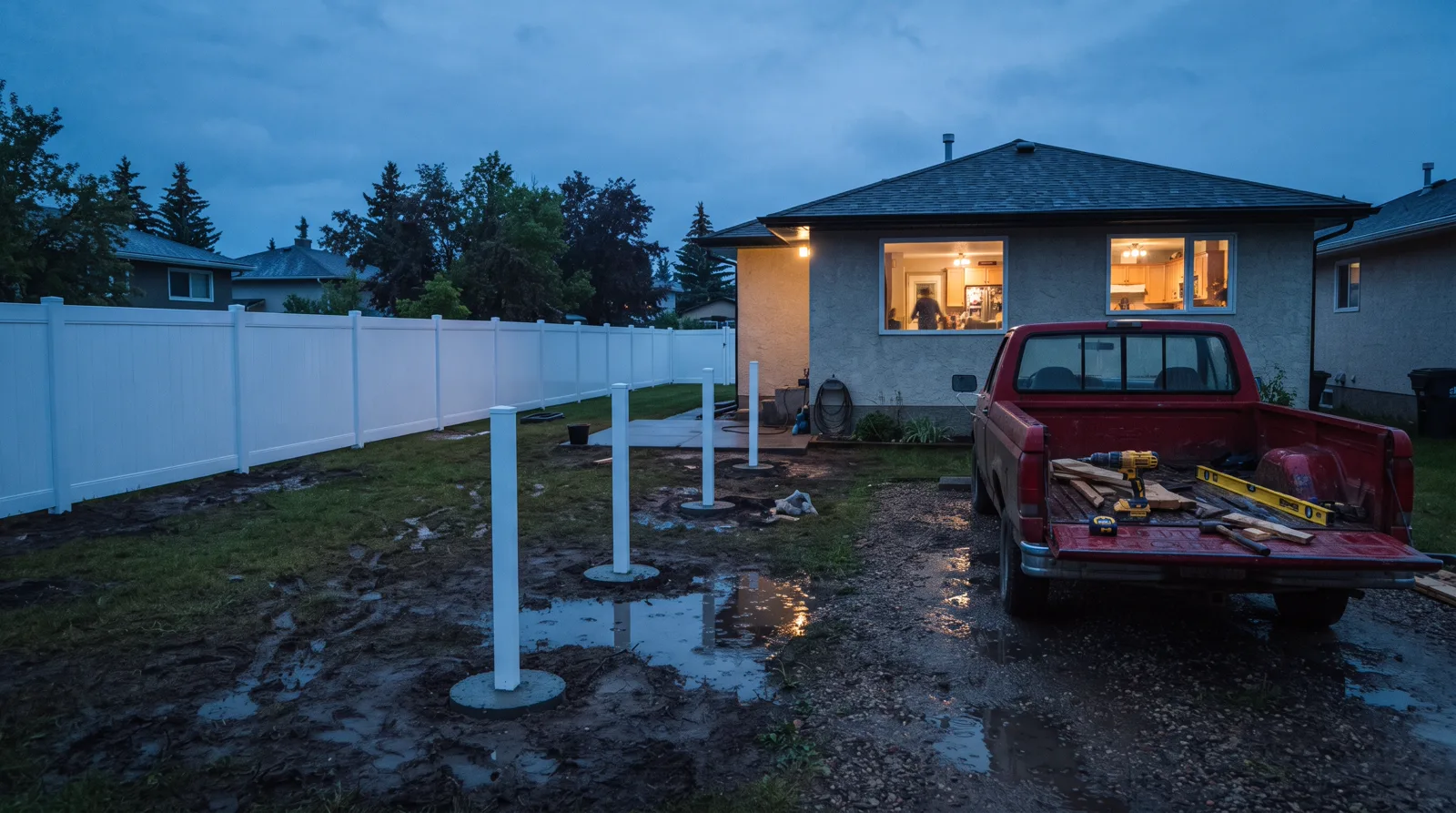
Vinyl Fence Installation in Spruce Grove Zero Rot, Zero Paint, Built for Alberta.
Low-maintenance PVC fencing engineered for freeze-thaw cycles, chinook winds, and decades of Alberta weather. Privacy, picket, ranch rail, and custom gates installed to frost-proof depth.
Vinyl Fence Styles for Every Yard
Privacy, picket, ranch rail, and semi-privacy in white, tan, or grey. Custom gates, accent tops, and post caps included.
Privacy Vinyl Fence
Six-foot solid panels with tongue-and-groove slats. No gaps, no sightlines. Ideal for backyard privacy, hot tubs, and noise reduction. Reinforced posts every eight feet, heavy-duty aluminum reinforcement in top and bottom rails.
Picket Vinyl Fence
Traditional pointed or flat-top pickets spaced three to four inches apart. Front yard charm with airflow. Standard heights: three, four, or five feet. Scalloped or straight top rail options available.
Ranch Rail Vinyl Fence
Two, three, or four horizontal rails. Open sightlines, acreage-friendly. Common for properties backing onto greenspace or rural parcels. Post-and-rail construction, no digging individual pickets.
Semi-Privacy Vinyl Fence
Spaced picket panels with one to two inch gaps. Partial privacy, full airflow. Popular for side yards and pool enclosures. Shadowbox or lattice-top styles available for added height and design interest.
Vinyl Gate Installation
Single or double swing gates to match fence style. Self-closing hinges, gravity latches, or keyed locks. Diagonal bracing and steel frame inserts prevent sagging. Walk gates and drive gates both available.
Vinyl Fence Repair & Post Replacement
Cracked posts, blown-out panels, or frost-heaved sections repaired or replaced. Color-matched panels sourced from major suppliers. Post straightening and re-concreting for wind or vehicle damage.
Why Alberta Demands Better Vinyl
❄️ Freeze-Thaw & Frost Heave
Fence posts must reach 48 inches deep to sit below the frost line. Shallower installs shift, lean, or pop out after the first winter. We use oversized concrete footers and gravel backfill to let moisture drain instead of freeze and expand around the post.
🌬️ Chinook Winds & UV Exposure
Tri-Region properties face southwest into prevailing winds and intense sun. We spec virgin PVC with UV stabilizers and titanium dioxide, not recycled material that fades to yellow or becomes brittle. Posts are spaced tight, rails are internally reinforced with aluminum.
❄️ Snow Load & Drift Management
Solid privacy panels trap snow and create massive drifts. We account for this with stronger post embedment and optional wind-relief gaps or lattice tops. Ranch rail and picket styles let wind and snow pass through, reducing load on the structure.
📋 Spruce Grove & Parkland County Permits
Fences under six feet typically do not require a permit in Spruce Grove, but setback rules apply. Corner lots have sightline restrictions. Parkland County has similar rules but enforces setbacks from road allowances strictly. We confirm local bylaws before installation and can pull permits if required.
What it costs here
Everything You Need to Know About Vinyl Fencing in Spruce Grove
Material science, installation method, permit rules, maintenance, and how to choose the right style for your property and Alberta's climate.
What Vinyl Fence Installation Actually Involves in Spruce Grove
Vinyl fence installation in Spruce Grove means building a permanent barrier using extruded polyvinyl chloride (PVC) panels and posts that are engineered to withstand Alberta's extreme temperature swings, high winds, and UV exposure. Unlike wood fences that require annual staining, scraping, and board replacement, vinyl fencing is manufactured with UV inhibitors and impact modifiers that maintain structural integrity through freeze-thaw cycles ranging from minus 40°C in January to plus 30°C in July. The material does not rot, warp, splinter, or attract insects, which makes it ideal for properties in Spruce Grove, Stony Plain, and Parkland County where wood fences typically fail within eight to twelve years due to moisture infiltration and seasonal ground movement.
A proper vinyl fence installation requires posts set to a minimum depth of 48 inches below grade to reach below the frost line, which in this region sits between 42 and 54 inches depending on soil type and drainage. Posts are anchored in concrete footings that extend below the frost line to prevent heaving during spring thaw, a common failure mode for shallow-set fences. The vinyl panels interlock with the posts using a tongue-and-groove or routed post system, and each panel is secured with stainless steel screws or locking clips that allow slight thermal expansion and contraction without cracking. Professional installers account for the coefficient of thermal expansion in PVC, leaving approximately one-quarter inch of clearance per eight-foot panel to accommodate summer heat expansion.
Vinyl fencing comes in multiple profile styles including privacy (solid panels with no gaps), semi-privacy (panels with decorative spacing), picket (vertical slats with gaps), and ranch rail (horizontal rails). Wall thickness in quality vinyl fencing ranges from 0.090 inches to 0.160 inches, with thicker profiles recommended for wind-exposed sites near Highway 16A or open fields in Parkland County. The material density and reinforcement structure determine how well the fence withstands chinook wind events, which can produce gusts exceeding 90 kilometers per hour in this region. Gates require heavy-duty hinges rated for the panel weight, and self-closing mechanisms must be adjusted seasonally because cold temperatures affect spring tension and hydraulic gate closers.
Alberta Climate Conditions That Drive the Need for Vinyl Fencing
Spruce Grove and Stony Plain experience some of the most aggressive freeze-thaw cycling in North America, with temperatures crossing the freezing point an average of 40 to 60 times per winter. This constant expansion and contraction destroys wood fences by forcing moisture into cracks, which then freezes and expands, splitting boards and posts from the inside out. Cedar and pressure-treated pine, the most common wood fence materials, develop checking (surface cracks) within two to three years and full splits within five to seven years in this climate. Vinyl fencing eliminates this failure mode entirely because PVC does not absorb water, and the material flexibility allows it to expand and contract without cracking or splitting even after decades of thermal cycling.
Chinook winds create sudden temperature rises of 10 to 20 degrees Celsius within hours, often accompanied by sustained winds of 50 to 70 kilometers per hour and gusts reaching 100 kilometers per hour. These wind events impose lateral loads on fences that can snap wooden posts at ground level or tear entire panels off the rails. Vinyl fence systems designed for Alberta conditions use reinforced posts with internal aluminum or steel channels, and the panels are engineered with ribbing or corrugation that increases bending stiffness without adding weight. Wind load calculations for this region typically assume a minimum design wind speed of 120 kilometers per hour for exposed locations, which requires posts spaced no more than eight feet apart and concrete footings sized to resist overturning moments.
Hail is a recurring threat in Parkland County, with severe hailstorms producing stones 20 to 40 millimeters in diameter nearly every summer. Wood fences show pockmarking and splintering after hail impact, and repeated damage accelerates rot by creating entry points for moisture. Vinyl fencing manufactured with impact modifiers can absorb hail strikes without cracking, and the smooth surface sheds water immediately rather than holding it against the material. UV degradation is another critical factor, as Alberta receives high solar radiation at this latitude during long summer days. Quality vinyl fencing includes titanium dioxide or other UV stabilizers that prevent the chalking, fading, and brittleness that plagued earlier generations of vinyl products. Snow load during winter months can pile drifts three to five feet high against fences near open fields, and the structural design must account for this lateral pressure without bowing or collapsing.
Soil Movement and Frost Heave in Parkland County
The clay-rich soils common in Spruce Grove, Stony Plain, and Parkland County are highly expansive, meaning they swell when wet and shrink when dry. This seasonal movement is amplified by frost penetration, which can extend 54 inches deep during extreme winters. Shallow-set fence posts heave upward as frozen soil expands, then settle unevenly during spring thaw, leaving the fence twisted and unlevel. Vinyl fencing must be installed with posts extending below the maximum frost depth and anchored in concrete footings that are poured below the frost line, typically 48 to 60 inches deep depending on site-specific soil analysis. The flexibility of vinyl panels allows them to tolerate slight post movement without catastrophic failure, unlike rigid wooden rails that snap when posts shift out of alignment.
Signs You Need Vinyl Fence Installation on Your Property
The most obvious indicator is a failing wood fence with visible rot, leaning posts, or broken boards that no longer provide privacy or security. If you are removing and replacing fence boards every two to four years, or if posts are soft and punky at ground level, the cumulative cost of repairs and maintenance has likely exceeded the upfront investment in vinyl fencing. Wood rot starts at the soil line where moisture wicks into the post grain, and once rot compromises the structural core, the post cannot be salvaged. Leaning sections indicate that posts have heaved or that the concrete footings were poured above the frost line, both of which require complete removal and reinstallation to correct. Homeowners in Spruce Grove who have repaired the same fence sections three or more times typically find that vinyl installation costs less over a ten-year horizon than continued wood fence maintenance.
Frequent staining or painting is another strong signal. Wood fences in Alberta require staining every 18 to 24 months to prevent UV damage, moisture intrusion, and insect activity. Each staining cycle involves pressure washing, sanding rough spots, and applying two coats of semi-transparent or solid stain, which costs $800 to $2,000 in materials and labor for a typical residential lot. Over a 15-year period, this maintenance totals $6,000 to $15,000, whereas vinyl fencing requires only occasional washing with a garden hose. If you find yourself scheduling fence staining every spring or if the previous stain is peeling and flaking after just one winter, vinyl eliminates this recurring expense and time commitment entirely.
Privacy concerns often drive vinyl fence installation when an existing chain-link or deteriorating wood fence no longer screens the yard from neighbors or street traffic. Vinyl privacy panels with no gaps between pickets provide complete visual screening, and the material does not shrink or warp to create sight lines over time. Pet containment is another critical factor, especially for households with dogs that can chew through wood boards or push under gaps created by ground-level rot. Vinyl fencing with reinforced bottom rails and posts set in concrete prevents digging escapes, and the smooth surface offers no toeholds for climbing. Property line disputes or boundary definition needs also justify vinyl installation, as a clearly marked, permanent fence establishes the legal boundary and satisfies municipal bylaws in Spruce Grove and Parkland County that require fences to be setback a minimum of four to six inches from the property line.
The Vinyl Fence Installation Process from Permit to Completion
The first step is a site assessment and accurate measurement of the fence run, including identification of property corners, utility line locations, and grade changes that affect post placement. Professional installers use a surveyor's measurement or property legal description to verify the exact boundary line, which is critical because fences built over the property line can trigger neighbor disputes or require costly removal and relocation. The City of Spruce Grove and Parkland County both require permits for fences over six feet in height, and even shorter fences may need permits if they are located in a front yard or corner lot where visibility and setback regulations apply. Permit applications require a site plan showing fence location, height, style, and distance from property lines, and approval typically takes five to ten business days.
Once permits are approved, the installer marks post locations using stakes and string line, spacing posts at intervals of six to eight feet depending on panel width and wind load requirements. Post holes are excavated to a depth of 48 to 60 inches using a power auger or manual post hole digger, and the diameter is typically 10 to 12 inches to accommodate a concrete footing. Posts are set in the holes, leveled and braced, then surrounded with concrete mixed to a 20 to 25 megapascal compressive strength. The concrete is poured to within four to six inches of the surface, allowed to cure for 24 to 48 hours, then topped with soil and tamped to promote drainage away from the post base. In clay soils common to this region, installers often add a gravel base at the bottom of the hole to improve drainage and reduce frost heave risk.
After posts are set and cured, the vinyl panels are slid into the routed channels or attached using brackets, starting from a corner or gate location and working outward. Each panel is checked for level and plumb, and shims or adjustment screws are used to compensate for minor grade variations. Gates are hung using heavy-duty hinges rated for the weight and size of the gate, and self-closing mechanisms or drop bolts are installed according to local pool enclosure bylaws if the fence surrounds a swimming pool. The final step is a walkthrough inspection to verify that all panels are secure, gates operate smoothly, post caps are installed to prevent water infiltration, and the site is cleaned of excavation debris. Most vinyl fence installations in Spruce Grove are completed in one to three days for typical residential lots, and the fence is immediately ready for use with no curing, staining, or finishing required.
Material Selection and Quality Differences
Not all vinyl fencing is manufactured to the same standard, and material quality directly determines lifespan and performance in Alberta's climate. Virgin vinyl (never recycled PVC) with UV inhibitors and impact modifiers costs more upfront but resists fading, brittleness, and cracking for 25 to 30 years or longer. Recycled vinyl or lower-grade compounds may discolor to yellow or gray within five to ten years, and cold-weather brittleness can cause cracking during impact events. Wall thickness is another critical spec: fencing with 0.125-inch or thicker walls withstands wind and impact better than thin-walled products that flex excessively or crack under stress. Premium vinyl fencing often includes internal reinforcement such as aluminum or steel channels inside the posts and rails, which prevents bowing and sagging over time. Homeowners should verify the product warranty, which for quality vinyl fencing typically covers 25 to 30 years for material defects and may include transferable coverage if the property is sold.
What Vinyl Fence Installation Really Costs in Spruce Grove and the Tri-Region
In Spruce Grove, Stony Plain and Parkland County, a professionally installed vinyl fence typically runs between $35 and $65 per linear foot, depending on style and site conditions. A standard 150-foot privacy fence for a residential backyard generally costs between $5,000 and $9,000, including materials, labor, concrete footings and one gate. That price assumes level ground, accessible yard access and no old fence to remove. Semi-privacy or picket styles run slightly less, usually $30 to $55 per linear foot, because the panels use less material and weigh less during installation.
Several factors push costs up or down. Fence height is the most obvious driver: a six-foot privacy panel costs more than a four-foot picket, both in material and the extra concrete needed for taller posts. Style matters too. Decorative lattice tops, routed rails and scalloped picket profiles add $5 to $12 per linear foot compared to flat-top privacy. Gates are another line item. A standard walk gate adds $300 to $600, while a double drive gate can add $800 to $1,500, depending on width and hardware. Terrain plays a role as well. Sloped yards require stepped or racked panels, and the extra layout time and custom cutting increases labor cost by 15 to 25 percent over flat installs.
Hidden costs catch homeowners off guard if they are not spelled out in the estimate. Permit fees in Spruce Grove and Parkland County typically run $50 to $150, depending on fence length and whether you are near a property line or utility easement. Removing an old fence adds $3 to $8 per linear foot for demolition and disposal. Alberta's frost line sits around four feet, so every post needs a concrete footing that reaches below frost depth to prevent heave. Some contractors quote a base price and then add footing cost as a separate line item, which can total $800 to $1,500 for a typical residential project. Always ask for an itemized written estimate so you know what is included and what costs extra.
- Fence height and style: privacy, picket, ranch rail
- Linear footage and number of gates
- Terrain slope and soil conditions
- Old fence removal and disposal
- Permit fees and inspection requirements
- Post footing depth and concrete volume
- Brand and quality of vinyl material
- Accessibility for equipment and material delivery
Vinyl vs. Wood vs. Chain-Link: Choosing the Right Fence Material
Vinyl's main advantage is zero maintenance. You never paint, stain or seal a vinyl fence, and it will not rot, warp or attract carpenter ants the way wood does in Alberta's wet spring thaw. Vinyl resists UV fade for decades if you buy quality material with titanium dioxide stabilizers baked into the resin. The tradeoff is upfront cost, which runs 40 to 60 percent higher than equivalent wood, and brittleness in extreme cold. A vinyl panel can crack if hit with force during a chinook to deep freeze swing or heavy ice buildup, though quality brands reinforce their rails and pickets with aluminum inserts to prevent this. Over a 25-year lifespan, vinyl costs less than wood when you factor in restaining every three years and board replacement from rot.
Wood remains the most common residential fence in the Tri-Region because the material cost is low and homeowners like the natural look. A spruce or pine privacy fence costs $20 to $35 per linear foot installed, roughly half the price of vinyl. The downside is ongoing work. Alberta's freeze-thaw cycles, spring rain and summer UV hammer untreated wood, causing boards to cup, split and gray within five years. Even pressure-treated cedar or premium stain needs reapplication every two to four years to maintain appearance and prevent rot. Loose boards and sagging gates become common after year seven, requiring repairs that add up. If you value low upfront cost and do not mind weekend maintenance, wood is a solid choice. If you want to install it and forget it, vinyl wins.
Chain-link costs the least, typically $12 to $25 per linear foot installed, and it is nearly indestructible in Alberta weather. Galvanized steel will not rot, crack or fade, and it handles frost heave better than rigid panels because the fabric flexes. The catch is visibility and aesthetics. Chain-link offers no privacy, minimal noise reduction and a utilitarian look that does not add curb appeal or resale value the way vinyl or wood does. It works well for containing pets, securing equipment yards or marking property lines where appearance is secondary. For backyard living spaces or street-facing curb appeal, most homeowners choose vinyl or wood.
Popular Vinyl Fence Styles in the Tri-Region
Privacy fences are the top seller in Spruce Grove residential neighborhoods. Six-foot tall panels with tongue-and-groove design block sightlines completely, reduce road noise and create enclosed outdoor living areas. They run $40 to $60 per linear foot installed. Semi-privacy styles use spaced pickets or horizontal slats that allow airflow and filtered light while still blocking most views, and they cost $35 to $50 per linear foot. Picket fences, either straight-top or scalloped, work well for front yards and garden borders where you want boundary definition without blocking curb appeal. They typically run $30 to $45 per linear foot. Ranch rail, with two or three horizontal rails, is the least expensive vinyl style at $25 to $40 per linear foot, often used for acreage perimeter or decorative accents.
Common Mistakes and Contractor Red Flags to Avoid
The biggest installation mistake in Alberta is shallow post footings. Some contractors set posts only two or three feet deep to save time and concrete, but Alberta's frost line reaches four feet in the Tri-Region. When the ground freezes and expands each winter, shallow posts heave upward, leaving panels crooked and gates misaligned by spring. By year three, the fence leans and posts pull free. Proper installation means digging every post hole to at least 48 inches, setting the post in six inches of gravel for drainage, then pouring concrete to grade and letting it cure fully before attaching panels. Skipping any of these steps leads to premature failure. Always ask your contractor what depth they dig and how much concrete they use per post. If the answer is vague or less than four feet, walk away.
Not all vinyl is equal, and choosing the cheapest material often means replacing panels within ten years instead of 25. Budget vinyl uses recycled content with thin wall profiles, minimal UV stabilizers and weak internal reinforcement. Panels flex under wind load, pickets crack during installation and color fades to chalky gray within five years. Quality vinyl costs more upfront but uses virgin resin with titanium dioxide UV protection, thicker walls, typically 0.160 inches or more in the rail profile, and aluminum or steel inserts in the bottom rail for rigidity. The best brands offer lifetime limited warranties that cover cracking, peeling and color fade. If your contractor cannot or will not name the vinyl brand and provide spec sheets, you are likely getting bottom-tier material that will disappoint.
Contractor red flags are easy to spot if you know what to look for. No liability insurance is the biggest warning sign. In Alberta, fence contractors are required to carry WCB if they have employees, and homeowners can be held liable for injuries on their property if the contractor is not covered. Always ask for a WCB clearance letter before work starts. No liability insurance is another dealbreaker. If the contractor damages your sprinkler line, gas meter or neighbor's property, you want their insurance to cover it, not your homeowner policy. Cash-only pressure is a third red flag. Legitimate contractors accept checks or e-transfer and provide itemized invoices for warranty and tax purposes. Finally, if a contractor says permits are not needed or offers to skip them to save money, that is a sign they cut corners elsewhere too. Parkland County and Spruce Grove both require permits for fences over a certain height or within setback zones, and inspections verify proper installation.
Warning Signs During the Estimate Visit
Pay attention to how the contractor conducts the estimate visit. A professional will measure the entire fence line, mark corners and gate locations, check for underground utilities using Alberta One Call, inspect soil conditions and note any obstacles like trees, slopes or buried concrete. They will ask about your style preferences, gate swing direction and whether you need to match existing fencing. If a contractor walks the yard for five minutes, eyeballs the distance and gives you a round number without measuring, that is a red flag. Accurate estimates require accurate measurements, and contractors who skip this step often underbid to win the job, then hit you with change orders when reality does not match their guess.
How to Hire the Right Vinyl Fence Contractor in Spruce Grove
Start by verifying credentials. Ask every contractor for their WCB clearance letter, proof of liability insurance with minimum two million dollars coverage, which is standard in Alberta, and business registration. A legitimate pro will provide these without hesitation. Next, ask for local references, ideally from projects completed in the last two years in Spruce Grove, Stony Plain or Parkland County. Call those references and ask specific questions: Did the contractor show up on time? Did the final cost match the estimate? How did the fence hold up through the first winter? Were there any issues with frost heave or panel cracking? A contractor with a strong local track record will happily connect you with past clients. If they hesitate or only offer generic online reviews, that is a yellow flag.
Ask detailed questions during the estimate appointment. How deep will you dig post holes, and what is Alberta's frost line depth in this area? What brand of vinyl will you install, and can I see the spec sheet and warranty? Will you pull the permit, or is that on me? How long will the project take from start to final cleanup? What happens if we hit rock or a buried utility line during digging? How do you handle sloped ground or corners? A knowledgeable contractor will answer all of these clearly and explain the plan in terms you understand. Vague answers or irritation at questions means they either lack experience or are cutting corners. Also ask about the warranty. Quality installers offer at least a one-year labor warranty on top of the manufacturer's material warranty, covering post alignment, gate function and panel fit.
Get at least three written estimates and compare them line by line, not just the bottom number. The lowest bid often omits concrete footings, permits, gate hardware or old fence removal, making it look cheap until surprise costs appear mid-project. A complete estimate should list linear footage, fence style and height, number of gates, post hole depth, concrete volume, permit fees, removal and haul-away if applicable, brand of vinyl and total cost broken into material and labor. It should also include a timeline, payment schedule and warranty terms. Once you have comparable estimates, the decision becomes easier. Choose the contractor who demonstrates experience with Alberta climate, uses quality materials, communicates clearly and backs their work with a written warranty.
How Tri-Region Services Helps You Find the Right Vinyl Fence Pro
Tri-Region Services connects Spruce Grove, Stony Plain and Parkland County homeowners with one pre-vetted, insured local vinyl fence contractor for a free, no-pressure written quote. They have told us about their liability insurance, liability insurance, permit knowledge and local references, so you skip the vetting work and avoid the risk of hiring a fly-by-night installer. You describe your project, timeline and budget, and we route your request to a trusted pro who knows Alberta building codes, frost depth requirements and climate-specific installation techniques. There is no obligation, no pushy sales calls and no cost to you. Just a straightforward quote from a contractor who has proven they do quality work and stand behind it. That is how fencing should be: simple, reliable and built to last.
What Sets Quality Vinyl Installers Apart
Not all vinyl fence jobs are equal. Here is what separates proper installation from the kind that leans or cracks after one winter.
Proper Concrete Footer Depth for Alberta Frost
Posts must reach 48 inches to sit below frost line. Shallower footers heave and lean within one freeze cycle.
Virgin PVC, Not Recycled Material
Recycled vinyl fades to yellow, cracks in cold, and voids most warranties. Quality installers use virgin resin with UV stabilizers.
Transferable Lifetime Material Warranty
Major brands like Bufftech, CertainTeed, and Durables offer lifetime warranties against cracking, peeling, and fading. Verify coverage before deposit.
Licensed
Verify general liability. Unlicensed crews leave you liable for injuries and code violations.
Local References from Recent Tri-Region Jobs
Ask for addresses of completed projects in Spruce Grove or Parkland County. Drive by and inspect post alignment, panel fit, and gate operation.
Reinforced Rails & Proper Post Spacing
Aluminum inserts in top and bottom rails prevent sagging. Posts should be eight feet apart maximum, six feet for privacy panels in high-wind zones.
This page is not tied to a contractor's brand. Leads route straight to your one local partner. Verified reviews can appear here once that partner has them (never fabricated).
Serving the whole Tri-Region
8 Questions Homeowners Ask About Vinyl Fence
Will vinyl fence crack in Alberta winters?+
Do I need a permit for a vinyl fence in Spruce Grove?+
How deep do fence posts need to be in Alberta?+
Vinyl fence vs wood fence in Alberta climate?+
How long does a vinyl fence last in Alberta?+
Can vinyl fence handle chinook winds in the Tri-Region?+
Does vinyl fence fade in the sun?+
What is the cost difference between privacy and picket vinyl fence?+
Get your free quote
Tell us what you need and a local pro will get right back to you.
- ✓ Sent straight to a local business
- ✓ You choose who you hire
- ✓ Free, with no obligation