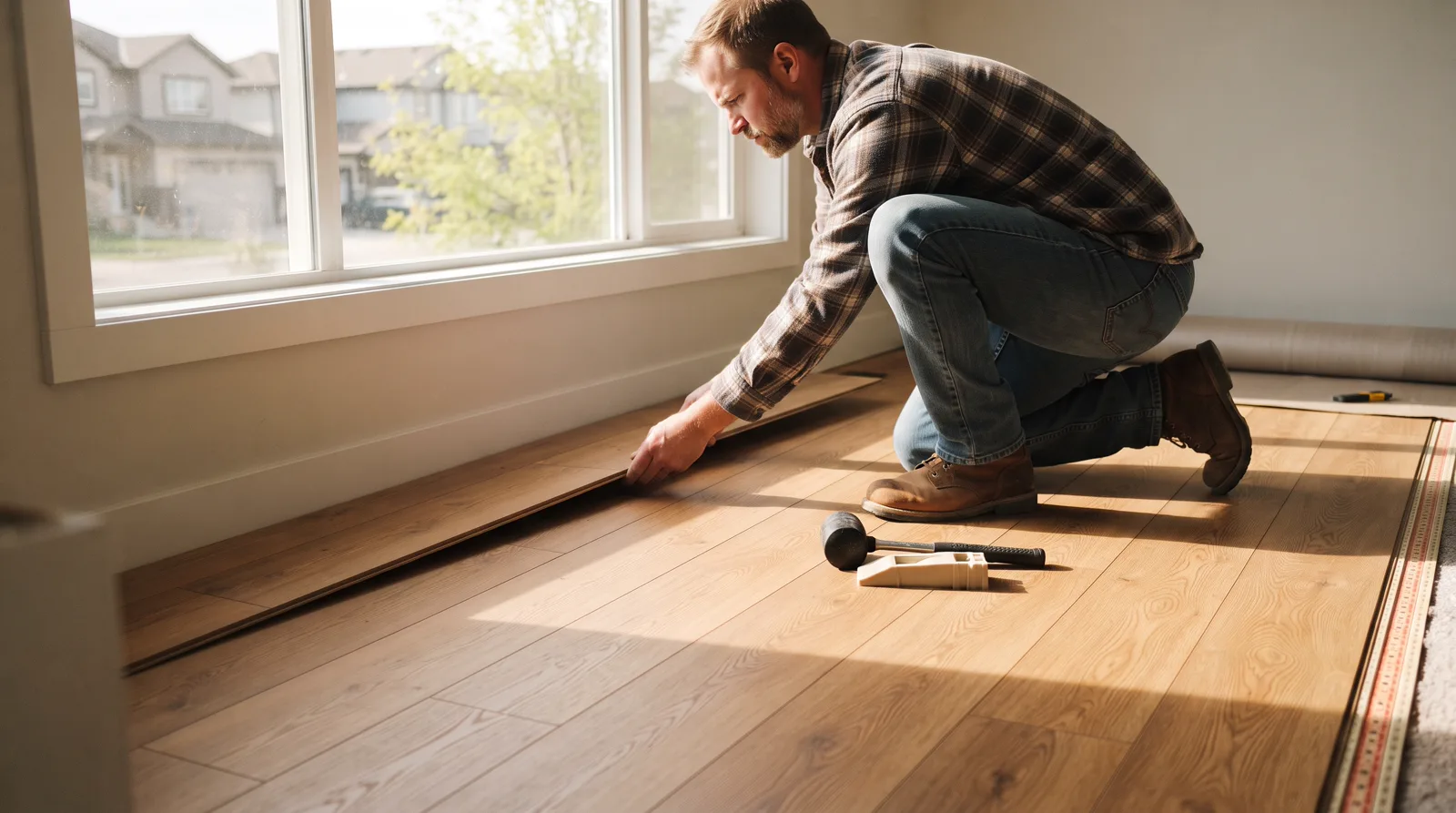
Waterproof Vinyl Flooring That Survives Alberta Basements and Real Life.
Luxury vinyl plank and tile built for freeze-thaw cycles, basement moisture, mudroom traffic and the occasional sump pump failure.
Vinyl Flooring Services for Every Room and Subfloor
From concrete basements to main floor over hardwood, local pros handle prep, moisture barriers, transitions and the finish work that separates a weekend DIY disaster from a floor you'll stand on for 20 years.
Luxury Vinyl Plank (LVP) Installation
Click-lock or glue-down rigid core LVP over concrete, plywood or existing flooring. Includes subfloor prep, underlayment if needed, and all transitions. We level, we fill voids, we test for moisture before we lay a single plank.
Waterproof Vinyl Tile (LVT) for Bathrooms & Laundry
Sheet vinyl or luxury vinyl tile with heat-welded seams or tight-lock joints for wet areas. Alberta basements flood. Washing machines leak. Local pros install knowing that water will test every seam, so we prep and seal accordingly.
Basement Vinyl Over Concrete
Moisture testing, vapor barrier if slab is damp, self-leveling compound for low spots, then rigid core LVP or sheet vinyl. We've seen chinook melt events push groundwater through cracks, so we test, we barrier, local pros install dry.
Vinyl Plank Over Existing Floors (No Tear-Out)
Install LVP directly over old hardwood, laminate or tile if subfloor is flat and sound. Saves demo cost, saves landfill, saves time. We check for loose boards, high spots and transitions, then lay new vinyl right over top.
Heavy-Duty Vinyl for Mudrooms & High Traffic
Commercial-grade 20 mil or 30 mil wear layer vinyl for entryways, mudrooms and rental properties. Scratch-resistant, gouge-resistant, stands up to snow melt, road salt, dog claws and the gravel that comes off work boots in February.
Pattern Matching, Borders & Inlays
Diagonal layouts, herringbone patterns, contrasting borders or medallion inlays. Takes longer, wastes more material, requires a craftsman who can measure twice and cut once. We do it for clients who want a floor that looks intentional, not just installed.
Why Vinyl Works in Alberta's Freeze-Thaw, Flood-Prone Climate
❄️ Freeze-Thaw Cycles Don't Crack Vinyl Like Tile Grout
Alberta basements shift. Concrete slabs heave in winter, settle in spring. Tile grout cracks, hardwood cups, but rigid core vinyl floats on an underlayment and flexes without breaking. We see it survive slab movement that would shatter ceramic.
💧 Basement Moisture and Sump Pump Overflow Insurance
Parkland County water tables rise fast in spring melt. Vinyl with a waterproof core won't warp, swell or delaminate if a sump pump quits overnight. Local pros install knowing your basement might see water, so we choose materials and prep methods that survive it.
🧊 Winter Mud, Road Salt and Snow Melt in the Entryway
Spruce Grove mudrooms take a beating from November to April. Vinyl handles the freeze-thaw puddles, the calcium chloride tracked in from driveways, and the grit that comes off boots. It wipes clean, it doesn't stain, and the wear layer is thick enough to last decades under real Alberta use.
🔨 No Permit Required for Flooring, But Subfloor Matters
Replacing flooring doesn't trigger a Parkland County or Spruce Grove building permit, but if we're adding a moisture barrier or leveling a basement slab, we follow Alberta Building Code for vapor control and fire rating. Most installers skip this. We don't.
What it costs here
Everything You Need to Know About Vinyl Flooring in Spruce Grove
Waterproof cores, wear layers, subfloor prep, Alberta moisture realities and why some vinyl lasts 25 years while other vinyl peels in three.
What Vinyl and LVP Flooring Installation Actually Involves in Spruce Grove Homes
Vinyl flooring installation in Spruce Grove means removing your old flooring, preparing the subfloor to handle Alberta's extreme temperature swings, and laying down either luxury vinyl plank (LVP), luxury vinyl tile (LVT), or sheet vinyl that can withstand our freeze-thaw cycles and indoor humidity changes. Professional installers assess your subfloor for levelness, moisture issues, and structural integrity before any material goes down. In older homes around Spruce Grove and Stony Plain, subfloors often need leveling compound or moisture barriers because concrete slabs can wick moisture during spring thaw, and wood subfloors in crawlspaces may have settled unevenly over decades. The installer maps out the layout to minimize seams, avoid awkward cuts around doorways and cabinets, and ensure plank or tile patterns run in the direction that makes your rooms look larger and more cohesive.
Luxury vinyl plank has become the most requested option in Parkland County because it mimics hardwood or stone but handles our climate far better than real wood, which expands and contracts dramatically when indoor humidity drops to 15 percent in winter and climbs to 50 percent in summer. LVP comes in floating, glue-down, and click-lock formats. Floating floors sit on an underlayment and are not attached to the subfloor, so they can expand and contract as a single unit without buckling. Glue-down LVP is adhered directly to the subfloor with moisture-resistant adhesive, which works well in basements or areas with high foot traffic because the bond prevents individual planks from shifting. Click-lock systems use tongue-and-groove edges that snap together without glue or nails, making them the fastest to install and the easiest to replace if a single plank gets damaged years later.
Sheet vinyl is still common in kitchens, bathrooms, and laundry rooms because it has fewer seams where water can penetrate. A skilled installer heat-welds seams in commercial-grade sheet vinyl to create a completely waterproof surface, which matters in Alberta homes where melting snow tracked in from boots, washing machine overflows, and dishwasher leaks are routine. The installer cuts the sheet to fit the room precisely, leaving a small expansion gap at the walls that gets hidden under baseboards or quarter-round trim. In Spruce Grove, installers often see homeowners who chose cheap peel-and-stick vinyl tiles years ago and now have edges curling up, grout lines collecting dirt, and water damage underneath because the adhesive failed during a cold snap. Professional installation with proper adhesive and subfloor prep prevents those failures and typically adds 10 to 20 years to the floor's lifespan compared to DIY methods.
How Alberta's Climate and Local Conditions Drive the Need for Vinyl Flooring
Spruce Grove sits in a climate zone where January temperatures routinely hit minus 25 Celsius and July highs reach plus 25, creating a 50-degree annual swing that punishes flooring materials. Indoor relative humidity in winter can drop below 20 percent when furnaces run constantly, then spike to 60 percent during spring and summer when windows open and rain is frequent. Hardwood floors cup, crack, and separate at the seams under these conditions unless you run a whole-home humidifier in winter and a dehumidifier in summer, which many homeowners find costly and impractical. Vinyl and LVP are dimensionally stable across that humidity range because they are made from PVC and composite cores that do not absorb moisture or dry out like wood. This makes them ideal for Alberta homes where you cannot control indoor humidity perfectly and where subfloor moisture from concrete slabs or crawlspaces is a persistent issue.
Freeze-thaw cycles in Parkland County cause another problem. Concrete slabs poured directly on grade can wick moisture upward during spring thaw, even in homes built in the 1990s and 2000s that should have vapor barriers under the slab. If moisture moves through the concrete and reaches a glued-down hardwood or laminate floor, the adhesive fails and the floor delaminates or buckles. Vinyl flooring adhesives are formulated to remain flexible and moisture-resistant, and many LVP products have an attached moisture barrier on the bottom of each plank. Installers in Spruce Grove often see basements where laminate flooring buckled after one spring because the homeowner did not realize the slab was damp. Replacing that laminate with glue-down LVP or a floating vinyl floor over a 6-mil polyethylene moisture barrier solves the problem permanently.
Chinook winds in winter create rapid temperature changes that can cause frost heave in the ground under your home's slab or foundation. This movement is subtle but over years it can create unlevel subfloors, cracks in concrete, and gaps between the subfloor and the bottom plate of walls. Vinyl flooring is more forgiving of minor subfloor imperfections than rigid materials like ceramic tile or natural stone, which will crack if the subfloor flexes or settles. A professional installer will still level the subfloor before laying vinyl, but small dips or humps that would doom a tile job can be addressed with self-leveling compound or sanding, and the vinyl will perform well as long as the surface is smooth. Homeowners replacing old linoleum or carpet in 1970s-era bungalows around Stony Plain often discover that the subfloor has settled near interior load-bearing walls, and vinyl installation gives them a chance to correct that unevenness without tearing out the entire subfloor structure.
Warning Signs Your Current Flooring Needs Replacement with Vinyl or LVP
Visible water damage is the clearest signal. If you see dark stains, warping, or soft spots in your flooring after a plumbing leak, dishwasher overflow, or spring basement seepage, the subfloor underneath is likely damaged and the flooring material has absorbed moisture it cannot release. Laminate and engineered hardwood swell permanently when wet, and carpet padding becomes a mold incubator if it stays damp for more than 48 hours. In Spruce Grove homes, installers often find black mold growing on the underside of carpet or laminate in basements and main-floor bathrooms because a slow leak went unnoticed for months. Replacing the damaged flooring with waterproof LVP or sheet vinyl and addressing the moisture source stops the cycle. If you smell musty odors near your flooring, pull up a corner or remove a floor register to inspect the subfloor and padding, because that smell usually means mold or mildew is already established.
Cracks, chips, and deep scratches in your existing floor indicate the wear layer is gone and the subfloor is exposed or the flooring material is brittle from age. Vinyl flooring from the 1980s and 1990s becomes brittle over time, especially if it was exposed to direct sunlight through west-facing windows, which breaks down the plasticizers in the vinyl. You will see cracks radiating from high-traffic areas like doorways and in front of the kitchen sink. Laminate flooring chips easily once the top layer is worn through, and those chips expose the particle board core to moisture, which causes rapid deterioration. LVP products sold today have wear layers measured in mils, with 12-mil and 20-mil wear layers common in residential products and 30-mil or higher in commercial grades. A 20-mil wear layer can handle decades of foot traffic, pet claws, and dropped objects without showing through to the print layer underneath.
Loose or curling edges on vinyl tiles, planks, or sheet goods mean the adhesive has failed or was never applied correctly. Peel-and-stick tiles are notorious for this in Alberta because the adhesive loses tack when indoor temperatures fluctuate and humidity drops in winter. You will trip on lifted edges, dirt and moisture will work underneath, and eventually the tiles will come loose entirely. If more than a few tiles or planks are affected, replacement is more cost-effective than trying to re-glue each piece individually. Click-lock LVP that was installed without proper expansion gaps can buckle in the middle of the room when the flooring expands during summer humidity, creating a hump that is both ugly and a tripping hazard. A professional installer will remove the baseboards, pull up the flooring, trim the edges to create the correct expansion gap (usually 6 to 8 millimeters around the perimeter), and reinstall the planks so they can move freely without buckling.
The Professional Vinyl Flooring Installation Process Step by Step
The process starts with a site visit and subfloor assessment. The installer measures each room, checks for level using a long straightedge or laser level, and tests the subfloor for moisture using a moisture meter or calcium chloride test kit. Concrete slabs should read below 4.5 percent moisture content for most vinyl adhesives, and wood subfloors should be below 12 percent. If moisture levels are high, the installer will recommend a remediation plan, which might include improving basement drainage, sealing the concrete with a moisture barrier primer, or installing a vapor barrier over the subfloor. In Spruce Grove, basements often show elevated moisture in early spring, so scheduling installation for late spring or summer when the subfloor has dried out can avoid delays. The installer also notes any damaged subfloor sections, protruding nails or screws, old adhesive residue, or transitions to other flooring types that will need custom trim pieces.
Next, the installer removes the old flooring and prepares the subfloor. Carpet, pad, and tack strips are pulled up and disposed of. Old vinyl or linoleum is scraped off if it is not well-bonded, or left in place and used as a base layer if it is smooth and firmly adhered. Hardwood or laminate is pried up, and any staples or nails are removed. The subfloor is then swept, vacuumed, and inspected for damage. Low spots deeper than 3 millimeters are filled with self-leveling compound, which is a cement-based liquid that flows into dips and hardens to create a flat surface. High spots are sanded down or ground with a concrete grinder. If the subfloor is oriented strand board (OSB) or plywood, the installer checks for squeaks and screws down any loose sections. In older homes around Stony Plain, subfloors may have multiple layers of old flooring or patches from past plumbing work, so preparation can take a full day before any new vinyl is installed.
Once the subfloor is ready, the installer begins the layout. For LVP, this means snapping a chalk line to establish a straight starting row, because walls are rarely perfectly straight. The first row is critical because every subsequent row will follow it. Installers typically start along the longest wall or the most visible wall when you enter the room, and they dry-lay the first few rows to check the pattern and confirm that the last row will not be a narrow sliver. If the last row would be less than half a plank wide, the installer adjusts the starting point so the first and last rows are balanced. For sheet vinyl, the installer unrolls the material, makes rough cuts oversized by a few inches, and then uses a straightedge and utility knife to trim it to fit precisely against walls, cabinets, and door frames. In kitchens and bathrooms, the installer cuts around toilets, vanities, and appliances, leaving a small gap that gets covered by trim or caulked if it is a wet area.
The final steps are securing the vinyl and finishing the edges. Floating LVP is installed over an underlayment, and each plank clicks into the previous one at an angle and drops flat. The installer uses a tapping block and rubber mallet to close the seams tightly. No adhesive is used, so the floor can be walked on immediately. Glue-down LVP or sheet vinyl requires spreading adhesive with a notched trowel, working in sections to keep the adhesive from skinning over. The installer presses the vinyl into the adhesive using a 100-pound roller to ensure full contact and eliminate air bubbles. Excess adhesive that squeezes up between seams is wiped away immediately. After the flooring is down, the installer reinstalls baseboards or installs new quarter-round trim to cover the expansion gap. Transition strips are installed at doorways to bridge the height difference between vinyl and carpet, tile, or hardwood in adjacent rooms. In Spruce Grove, installers often use T-molding transitions at doorways and reducer strips where vinyl meets a lower surface like concrete in a garage. The entire installation for an average 1,200 square foot bungalow typically takes two to three days, including subfloor prep, and the floor is ready for furniture and normal use within 24 hours for glue-down installations or immediately for floating floors.
What Vinyl Flooring Really Costs in Spruce Grove and the Tri-Region
Material costs for vinyl flooring in the Spruce Grove area typically range from $2 to $8 per square foot, depending on quality and product type. Budget sheet vinyl starts around $2 per square foot, mid-range luxury vinyl plank runs $3.50 to $5 per square foot, and premium waterproof LVP with thick wear layers can reach $6 to $8 per square foot. These are supply-only prices. The material you choose matters enormously for durability in Alberta homes, where basement moisture, temperature swings, and heavy winter boot traffic demand more than the cheapest option. A 200 square foot basement room in vinyl material alone might cost anywhere from $400 to $1,600 before a single plank is laid.
Professional installation labour in Parkland County and the Tri-Region generally runs $3 to $6 per square foot, depending on the complexity of the job, the installer's experience, and how much subfloor preparation is required. A straightforward install over a clean, level concrete slab in a rectangular room will land at the lower end. A job requiring extensive floor levelling, removal of old tile, custom cuts around cabinetry, or glue-down installation over plywood will cost more. Expect to pay toward the higher end if your installer is fully insured, carries and has verifiable references. That insurance and liability protection is not optional in Alberta, and cheaper quotes often skip it entirely.
Hidden costs add up quickly and catch homeowners off guard. Subfloor preparation can add $1 to $3 per square foot if your concrete is uneven or your plywood subfloor has dips and squeaks. Underlayment, essential for moisture protection and sound dampening in Alberta basements, costs another $0.50 to $1.50 per square foot. Removing and disposing of old flooring adds $1 to $2 per square foot. Transition strips, quarter-round trim, and baseboards are rarely included in initial quotes. Budget another $100 to $300 for a typical room. Many contractors will quote the install only and reveal these extras once the job starts, so ask for an all-in price that includes prep, underlayment, removal, and finishing touches.
For a complete project, a 150 square foot bedroom in Spruce Grove will generally cost between $1,200 and $2,800 installed, including mid-range LVP, basic subfloor prep, underlayment, and trim. A 300 square foot basement family room typically runs $2,400 to $5,500 depending on material choice and prep needs. Whole-home installs of 1,000 square feet or more can range from $7,000 to $15,000. These are realistic all-in numbers for quality work by insured, experienced installers. If a quote comes in dramatically lower, ask exactly what is excluded, whether the installer carries and what corners are being cut. Cheap quotes in this trade almost always mean trouble later.
Comparing Your Vinyl Flooring Options
Luxury Vinyl Plank vs Sheet Vinyl vs Luxury Vinyl Tile
Luxury vinyl plank, or LVP, is the most popular choice in the Tri-Region right now for good reasons. It mimics hardwood with realistic grain patterns, installs as individual planks, and handles moisture far better than laminate or engineered wood. LVP is available in floating click-lock systems that go down fast over existing floors, or glue-down versions for commercial-grade stability. Most homeowners in Spruce Grove choose LVP for main floors, bedrooms, and basements because it looks high-end, feels warmer underfoot than tile, and stands up to dogs, kids, and wet boots. Expect to pay $3.50 to $7 per square foot for quality LVP材料.
Sheet vinyl is the budget option, sold in wide rolls and heat-welded or glued at seams. It is completely waterproof, easy to clean, and costs less than LVP, typically $2 to $4 per square foot installed. Sheet vinyl works well in laundry rooms, mudrooms, and rental properties where durability and cost matter more than aesthetics. The downside is limited design options and a visibly synthetic appearance. Installation requires skill to avoid bubbles and visible seams. In Alberta's dry winter air, cheaper sheet vinyl can shrink slightly and pull away from edges. For homeowners prioritizing style and resale value, sheet vinyl is usually passed over in favor of LVP.
Luxury vinyl tile, or LVT, offers the same waterproof resilience as LVP but in tile shapes instead of plank formats. LVT is ideal for bathrooms, entryways, and kitchens where a tile aesthetic fits better than wood-look flooring. Installation and cost are nearly identical to LVP. The choice between LVP and LVT comes down to design preference. Some homeowners in Stony Plain mix both, using LVP in living areas and bedrooms, and LVT in wet zones. If your goal is a cohesive look, stick to one product line from a single manufacturer so the wear layer, finish, and thickness match throughout the home.
Wear Layer Thickness and Why It Matters in Alberta
The wear layer is the transparent protective coating on top of the vinyl, measured in mils (thousandths of an inch). Residential LVP typically ranges from 6 mil to 20 mil or more. Thicker wear layers resist scratches, scuffs, and dents far better over time. In Alberta homes, where sand, gravel, and salt get tracked in all winter, and where dogs with untrimmed nails roam freely, a thin wear layer will show damage within a couple of years. Budget products with 6 to 8 mil wear layers are fine for low-traffic bedrooms or short-term rentals. For kitchens, hallways, mudrooms, and basements, choose 12 mil or thicker. Premium 20 mil products are overkill for most homes but make sense in commercial settings or households with large dogs and heavy use.
Manufacturers rate their products for residential or commercial use based on wear layer thickness and core construction. A product rated for light commercial use will outlast a residential-only rating in a busy family home. Pay attention to warranty terms as well. Quality LVP with a 12 mil or thicker wear layer usually carries a 15 to 25 year residential warranty. If the warranty is under 10 years, the wear layer is likely thin and the product will not age well. In the Tri-Region, where flooring takes a beating from temperature extremes and heavy seasonal use, investing in a thicker wear layer pays off. The cost difference between 8 mil and 12 mil LVP is usually $0.50 to $1 per square foot, a small premium for significantly better durability.
Installation Methods: Floating, Glue-Down, and Click-Lock
Floating click-lock LVP is the easiest and fastest installation method. Planks snap together with tongue-and-groove edges and rest on top of underlayment without adhesive. The entire floor floats as one piece, expanding and contracting with temperature and humidity changes. This method works well over concrete, existing vinyl, or plywood subfloors, and allows for easier repairs or removal later. Floating floors do require expansion gaps around the perimeter, covered by baseboards or quarter-round. In Alberta basements where concrete slabs can be cold and prone to minor moisture, floating LVP over a vapour barrier underlayment is the standard approach. Installation is fast, often completed in a day or two for an average-sized room.
Glue-down LVP is adhered directly to the subfloor with trowel-applied adhesive. This method provides the most stable, permanent installation and eliminates any hollow sound or slight movement underfoot. Glue-down is preferred in commercial settings, high-traffic areas, or over radiant heated floors where the flooring must sit tight to the slab. The tradeoff is longer installation time, higher labour cost, and much harder removal if you ever want to change the floor. Subfloor prep must be flawless because any imperfection will telegraph through the vinyl. In residential settings in Spruce Grove, glue-down is less common unless the homeowner specifically wants that rock-solid feel or is installing over a heated slab.
Some vinyl products use a hybrid system with built-in adhesive strips or pads, or a loose-lay design that relies on weight and friction rather than glue or clicking. These are niche options and rarely the best choice for Alberta homes. Stick with floating click-lock for basements, bedrooms, and living areas, and consider glue-down only if you have radiant heat or specific performance needs. Ask your installer which method they recommend for your subfloor type and moisture conditions. A quality contractor will explain the pros and cons of each approach based on your specific home, not just push the method they find easiest.
Mistakes and Contractor Traps to Avoid
Skipping proper subfloor preparation is the single most common mistake in vinyl flooring projects, and it leads to failure every time. Vinyl flooring is thin and flexible, which means it will follow every dip, hump, and crack in the subfloor below. If your concrete slab in a Stony Plain basement has a low spot, the vinyl will sag into it and eventually crack or separate at the seams. If your plywood subfloor has loose spots or squeaks, those will transmit through the vinyl and worsen over time. Professional subfloor prep includes grinding down high spots, filling low areas with levelling compound, securing loose plywood, and ensuring the surface is clean and dry. This prep work is not glamorous and adds cost, but it is absolutely non-negotiable. Any installer who skips it or rushes through it is setting you up for premature failure.
Using the wrong underlayment, or skipping it entirely, is another frequent error, especially in Alberta basements. Concrete slabs can wick moisture even in dry climates, and without a proper vapour barrier underlayment, that moisture will eventually damage the vinyl and cause mold or odour issues. Quality underlayment designed for LVP includes a vapour barrier, sound dampening, and minor levelling properties. It costs $0.50 to $1.50 per square foot and is essential for any installation over concrete. Some LVP products have attached underlayment pads, which simplifies installation but may not provide adequate moisture protection for basement slabs. Ask your installer specifically what underlayment they plan to use and why. If the answer is vague or dismissive, that is a red flag.
Contractor red flags to watch for include no liability insurance, no liability insurance, and refusal to provide references or a written contract. In Alberta, any contractor doing paid work is required to carry WCB unless they are a confirmed independent operator with a clearance letter. If your installer is hurt on your property and has no WCB, you can be held liable for their medical costs and lost wages. Liability insurance protects you if the installer damages your home during the job. Any legitimate flooring contractor will provide proof of both without hesitation. Another warning sign is a contractor who rushes the acclimation period. Vinyl flooring must sit in the room where it will be installed for 24 to 48 hours to adjust to the temperature and humidity. Skipping this step leads to expansion, contraction, and gapping after install.
Low-ball quotes followed by surprise upsells are a classic contractor trap. An installer quotes $3 per square foot for labour, then discovers your subfloor needs levelling, your old flooring must be removed, and you need underlayment, none of which were included in the original quote. Suddenly the price doubles. Protect yourself by asking for an itemized, all-in quote that includes subfloor inspection and prep, underlayment, removal and disposal of old flooring, installation, and all trim and finishing work. If the contractor cannot or will not provide that level of detail up front, move on. DIY installation is another mistake unless you have real experience. Floating click-lock LVP looks easy in videos, but achieving straight lines, tight seams, proper expansion gaps, and clean cuts around doorways and obstacles takes skill. A botched DIY job costs more to fix than hiring a pro in the first place.
How to Hire the Right Vinyl Flooring Installer
Start by verifying that any contractor you consider carries at least $2 million in liability insurance. Ask to see the certificates and confirm the coverage is current. In Alberta, you can verify WCB clearance through the WCB website if you have the business name or account number. This step alone will eliminate most fly-by-night operators who work under the table. Next, ask for at least three recent references from jobs similar to yours, ideally in the Tri-Region. Call those references and ask specific questions: Was the job completed on time? Did the quote match the final cost? How did the floor look a year later? Were there any issues with moisture, gapping, or seams? A quality installer will have happy customers who are willing to vouch for their work.
During the quoting process, ask the installer how they handle subfloor prep, what underlayment they recommend for your specific situation, and how they manage moisture concerns on concrete slabs. Ask how long they have been installing vinyl flooring, what brands they prefer and why, and whether they warranty their labour separately from the product warranty. A good installer will inspect your subfloor in person before quoting, not give a price over the phone based on square footage alone. They should explain what prep work is needed, how long the job will take, and what you need to do to prepare the space. If the installer seems rushed, dismissive, or unwilling to answer questions, that is a sign to walk away.
A professional quote should be detailed and in writing. It should specify the exact product by brand and model number, the total square footage, the cost per square foot for materials and labour broken out separately, and line items for subfloor prep, underlayment, removal, and trim. It should state the timeline, payment terms, and what warranty or guarantee the installer offers on their workmanship. Avoid contractors who demand large deposits up front or only accept cash. Standard practice is a small deposit to order materials, with the balance due on completion. Compare at least three quotes, but do not automatically choose the cheapest. The middle quote from a well-reviewed, insured, experienced installer is almost always the best value. Rock-bottom pricing usually means cut corners, and the most expensive quote is not necessarily better work, just higher overhead.
How Tri-Region Services Helps
Tri-Region Services connects you with one fully vetted, insured, and experienced vinyl flooring installer in Spruce Grove, Stony Plain, or Parkland County for a free written quote. You get one local pro instead of gambling on online reviews. Every professional in our network has verifiable local references, carries proper coverage, and has passed our quality screening. You will get a detailed, transparent quote with no surprise fees and no pressure. Whether you need 100 square feet in a bathroom or 1,500 square feet throughout your home, we will connect you with the right local pro for the job.
How We Screen Vinyl Flooring Installers
Contractors state that they carry liability insurance when they sign up, and we show that on their listing, along with their licensing. You get installers who know how to prep Alberta subfloors, not just snap planks together.
WCB and Liability Insurance stated at signup, Before Quote
Every installer carries minimum $2 million liability insurance. We check before we refer.
Subfloor Moisture Testing, Not Guesswork
Installers test concrete for moisture and use barriers when readings exceed manufacturer limits. No guessing, no skipping, no callbacks.
Self-Leveling Compound and Transition Strips Included in Bids
Quotes itemize prep work so you know what you're paying for. No surprise charges when the slab needs leveling.
Portfolio of Local Installs, Not Stock Photos
We ask for photos of finished basements and mudrooms in Spruce Grove and Stony Plain, not manufacturer marketing materials.
Written Warranty on Labor, Plus Manufacturer Product Warranty
Labor warranty covers installation defects for one to five years. Material warranty transfers with the house if you sell.
Client References from Parkland County and Tri-Region
We provide contact info for past clients who agreed to be references. Call them, ask about prep quality and how the floor held up.
This page is not tied to a contractor's brand. Leads route straight to your one local partner. Verified reviews can appear here once that partner has them (never fabricated).
Serving the whole Tri-Region
7 Questions Homeowners Ask Before Installing Vinyl
Will vinyl plank flooring survive an Alberta basement flood or sump pump failure?+
Can I install vinyl flooring over old hardwood or tile without ripping it out?+
How thick should the wear layer be for a mudroom or kitchen with heavy traffic?+
Does vinyl flooring need an underlayment, or can I install it directly on concrete?+
Will vinyl flooring off-gas or smell bad after installation in a closed-up house?+
How long does vinyl plank flooring last in Alberta's climate with freeze-thaw and moisture?+
Can vinyl flooring be installed in winter when my house is cold or the basement is unheated?+
What is the difference between LVP, LVT, WPC and SPC vinyl flooring?+
Get your free quote
Tell us what you need and a local pro will get right back to you.
- ✓ Sent straight to a local business
- ✓ You choose who you hire
- ✓ Free, with no obligation