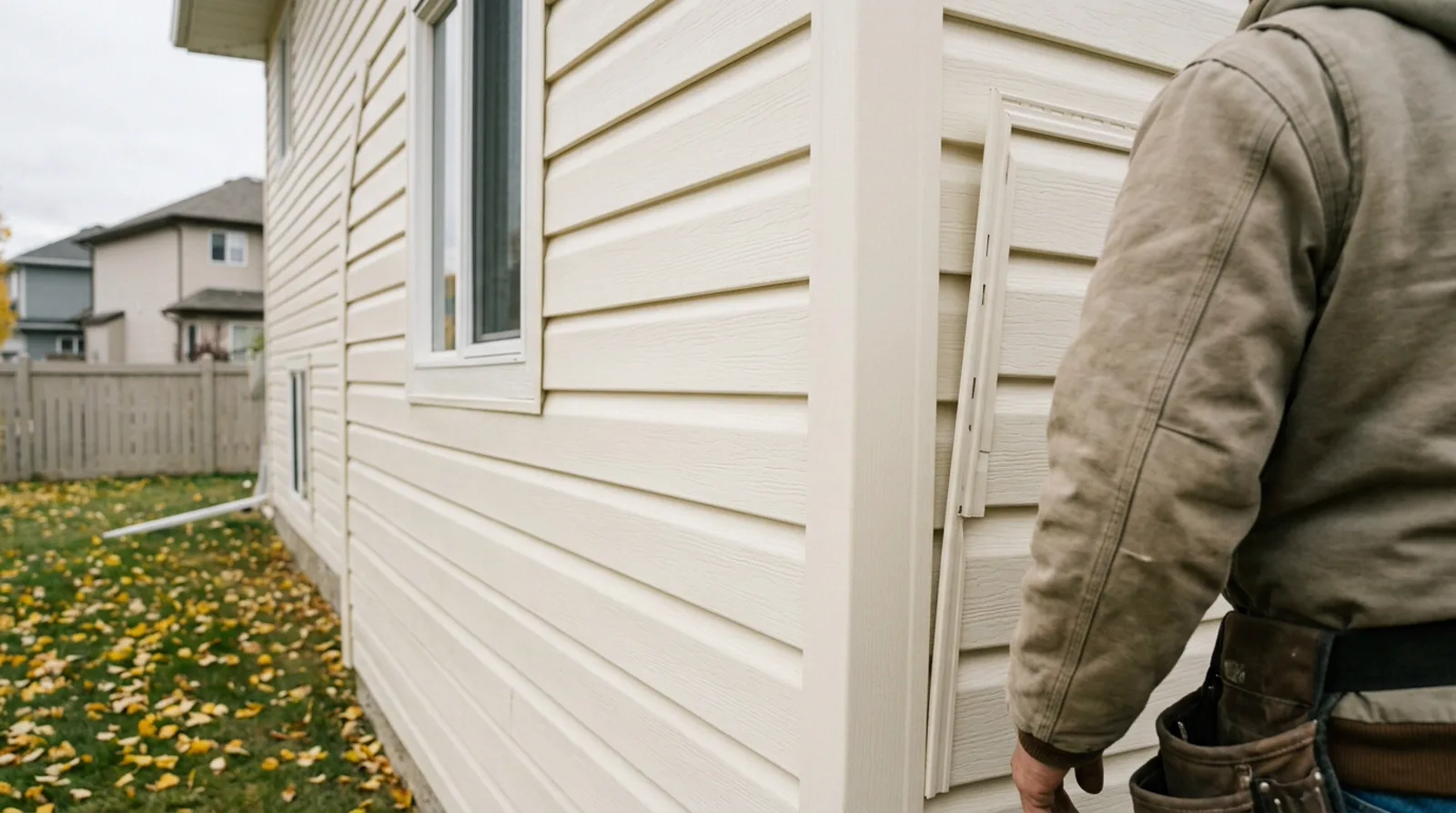
Vinyl Siding Installation Built for Alberta Weather.
Impact-rated vinyl engineered for hail, freeze-thaw cycles and chinook winds. Installed by WCB-insured local crews who handle permits and respect your timeline.
Complete Vinyl Siding Solutions
From material selection to final inspection, local pros handle every step of your exterior transformation.
Full-Home Vinyl Siding Installation
Complete exterior siding replacement with house wrap, insulation board, trim and finishing. Includes removal and disposal of old siding, permit application, and final municipal inspection. Typical bungalow takes 5 to 7 days depending on complexity and weather.
Insulated Vinyl Siding Installation
Foam-backed vinyl siding that adds R-value to your exterior walls, reducing heating costs during Alberta winters. Thicker profile resists wind noise during chinooks and improves impact resistance. Popular choice for older homes with minimal wall insulation.
Partial Siding Replacement
Replace damaged sections from hail strikes, wind damage or ice dam leaks. We match existing color and profile where possible, or coordinate a fresh accent wall. Common after insurance claims or when updating a single elevation before resale.
Color and Profile Consultation
Walk through material samples at your home in natural light. Compare fade resistance, texture options and impact ratings. We explain the performance difference between builder grade and premium lines, and show you how color choice affects resale value in the Tri-Region.
Soffit, Fascia and Trim Installation
Vented soffit panels for attic airflow, wrapped fascia boards and color-matched trim to complete the look. Properly vented soffits prevent ice damming and extend shingle life. We match trim profile to your window and door casings for a cohesive finish.
Siding Repair and Patch Work
Fix cracked panels, reattach loose sections, or replace hail-damaged pieces without a full tearoff. The installer carries common profiles and can source discontinued colors through specialty suppliers. Fast turnaround for small repairs, often completed in one visit.
Vinyl Siding That Survives Alberta
🧊 Freeze-Thaw Expansion Gaps
Alberta swings from minus 30 to plus 15 in a single chinook cycle. We leave calculated expansion gaps at J-channels and trim so panels can contract in deep cold without buckling or cracking when temperatures climb. Rookie installers from milder climates nail too tight and create waves.
⛈️ Hail Impact Ratings for Insurance
Spruce Grove and Parkland County see damaging hail every few years. We stock Class 3 and Class 4 impact-rated vinyl that qualifies for insurance discounts and resists denting from golf ball sized hail. Your insurance broker can confirm eligibility before you order materials.
🌬️ Wind Lock and Secure Fastening
Chinook winds and spring gusts hit 70 to 90 km/h regularly in open areas west of Spruce Grove. We use wind-lock panels and proper nailing schedules to meet Alberta Building Code wind load tables. Every panel gets mechanically fastened, no adhesive shortcuts.
❄️ Winter Installation Considerations
Vinyl becomes brittle below minus 10 Celsius, so we avoid cutting and nailing in deep cold to prevent stress cracks. Fall and spring are ideal windows. If you need winter work, we use climate-controlled staging and specialized cold-weather fasteners that flex with the material.
What it costs here
Everything You Need to Know About Vinyl Siding in Spruce Grove
Material science, installation details, climate performance and cost factors explained in plain language.
Why Vinyl Siding Works for Alberta Homes
Vinyl siding is an engineered exterior cladding system made from polyvinyl chloride (PVC) panels that lock together horizontally across your home's exterior walls. Each panel overlaps the one below it, creating a weather barrier that sheds rain, snow, and wind while allowing your home's structure to breathe. The material itself is manufactured to withstand temperature swings from minus 40°C winter nights to plus 30°C summer afternoons without cracking, warping, or losing its shape. In Spruce Grove and Parkland County, where freeze-thaw cycles happen dozens of times each winter, vinyl's flexibility prevents the stress fractures that rigid materials suffer when moisture expands and contracts inside them.
Alberta's climate poses four major challenges that vinyl siding is specifically designed to handle. First, the freeze-thaw cycle: water seeps into cracks, freezes overnight, expands, and splits materials apart. Vinyl doesn't absorb water, so there's nothing to freeze and expand. Second, hail storms: Spruce Grove sits in hail alley, and a single July storm can pockmark or crack brittle siding materials. Quality vinyl has impact modifiers mixed into the PVC that let it flex on impact rather than shatter. Third, chinook winds: those sudden warm blasts in January create dramatic temperature swings that make wood warp and metal expand, but vinyl's thermal movement is engineered into the installation with expansion gaps at every seam. Fourth, intense UV exposure: Alberta gets more sunny days than most of Canada, and ultraviolet light breaks down unprotected materials. Modern vinyl siding includes UV stabilizers and titanium dioxide that prevent the chalking and fading that plagued earlier products.
The building science behind vinyl siding installation in this region starts with understanding that your home's exterior is a layered system, not just a cosmetic shell. Behind the vinyl panels, a proper installation includes a weather-resistant barrier (typically housewrap like Tyvek), an air gap created by furring strips or the siding's built-in channels, and then your home's existing sheathing and insulation. This layered approach lets moisture vapor escape from inside your home while blocking liquid water from outside. In Stony Plain's cold winters, this vapor management prevents the condensation that rots wall cavities from the inside out. The vinyl itself is the sacrificial outer layer, taking the beating from hail, wind-driven rain, and UV so your structural walls stay dry and intact.
Alberta building code doesn't specifically mandate vinyl siding, but it does require exterior cladding to meet performance standards for water penetration, wind resistance, and fire spread. Most vinyl siding products are tested to ASTM D3679 and Canadian Standards Association A126.1, which verify they can handle wind loads up to 200 kilometers per hour and won't wick water behind the cladding plane. In Parkland County, your building permit application will reference these standards, and your inspector will check that the installation includes proper flashing around windows and doors, a minimum 15 centimeter clearance above grade to prevent snow and splash-back from soaking the bottom edge, and correct fastening patterns that allow the siding to move without buckling. These aren't suggestions. They're code minimums that protect your insurance coverage and resale value.
Warning Signs Your Home Needs New Siding
The most obvious warning sign is visible damage you can see from the curb: cracked panels, missing sections, or areas where the siding has pulled away from the house and is flapping in the wind. These failures usually start small after a hail storm or a winter where ice dams formed along your roofline, and they grow every season as water gets behind the damaged area and spreads the problem sideways. If you see a single cracked panel on your south-facing wall in Spruce Grove, that crack is letting water soak the housewrap and sheathing behind it right now. By next spring, the rot will have spread to adjacent panels, and by the following year, you might be looking at sheathing replacement on top of new siding. Catching damage early turns a $1,200 repair into a preventable expense instead of a $8,000 to $15,000 tear-off and rebuild.
Fading and chalking are cosmetic at first, but they signal that the UV stabilizers in your siding have broken down and the material is becoming brittle. Run your hand across a faded panel on the west side of your home. If it leaves a chalky residue on your fingers, the surface layer is degrading and that panel will crack under the next hailstorm or hard freeze. Fading happens faster on dark colors (navy, forest green, deep red) because they absorb more heat, and it's worse on walls that face south or west where UV exposure is highest. If your siding was installed in the early 2000s or before, it likely uses older PVC formulations without the titanium dioxide and acrylic cap layers that modern products have. That vintage of vinyl typically lasts 20 to 25 years in Alberta before it becomes unreliable.
Performance failures show up inside your home as problems that seem unrelated to siding. Cold drafts along exterior walls in winter mean air is leaking through gaps where siding panels have shrunk, warped, or pulled away from J-channels and corner trim. Higher heating bills without a corresponding increase in thermostat settings often trace back to wind washing through your wall cavity because the siding system is no longer airtight. Water stains on interior walls near windows or along the bottom of exterior walls indicate that your siding is letting rain or snowmelt penetrate to the sheathing, and once water is inside your wall cavity, you're facing mold, rot, and insulation damage that costs far more to fix than the siding itself. In Acheson and Stony Plain, where winter temperatures sit below freezing for weeks at a time, a drafty wall isn't just uncomfortable. It's actively damaging your home's structure as warm interior air meets cold exterior air inside the wall cavity and condenses into liquid water.
Insurance and structural triggers are the final category of warning signs, and these override every other consideration. If your insurance company sends a renewal notice stating that your exterior cladding must be replaced to maintain coverage, that's not a negotiation. Insurers in Alberta have tightened underwriting standards after major hail events, and homes with visibly damaged or aging siding are being moved to higher-risk pools or dropped entirely. Similarly, if you're planning to sell your home in the next two years, a pre-listing inspection that flags siding damage will either kill your sale or force you into a last-minute replacement at the worst possible negotiating position. Finally, if you notice soft or spongy spots when you press on your exterior walls near ground level, you have water infiltration that's rotting your rim joists and bottom plates. At that point, siding replacement is just one piece of a larger structural repair, and delaying it lets the damage spread upward into your wall studs and floor system.
How Vinyl Siding Installation Actually Works
Inspection, Measurement, and Material Selection
A professional installation starts with a detailed inspection of your existing exterior to identify what's hiding under the old siding and what preparation work the job will require. The contractor removes a small section of siding in an inconspicuous area to examine the sheathing, check for rot or insect damage, verify that housewrap or building paper is present, and confirm that your wall cavity insulation is intact. In older Spruce Grove homes built before 1990, it's common to find no housewrap at all, just bare plywood or fiberboard sheathing, which means the job will need a full wrap installation before the new siding goes on. The inspector also checks your soffit and fascia condition, measures roof overhangs to determine if additional flashing or trim will be needed, and photographs any areas where stucco, brick, or stone transitions meet the siding so those interfaces can be properly sealed.
Accurate measurement determines material quantities and costs, and it's more complex than just calculating square footage. The estimator measures each wall section separately, accounts for window and door openings (which reduce siding area but increase trim requirements), notes the number and type of corners (inside corners and outside corners use different profiles), and maps out where j-channels, starter strips, and finishing trim will run. A typical 1,500 square foot bungalow in Stony Plain might have 1,800 square feet of wall area once you account for gable ends, but it will also need 120 linear feet of corner trim, 200 linear feet of j-channel around windows and doors, and specialized pieces for soffit transitions and utility penetrations. The estimator adds 10 percent overage for cuts, waste, and future repairs, because vinyl siding color lots vary slightly and you want extra pieces from the same manufacturing run stored in your garage for the inevitable day when you need to replace a damaged panel.
Material selection goes beyond picking a color from a sample chip. You'll choose a thickness (0.040 inch is builder grade, 0.044 to 0.046 inch is standard residential, 0.050 inch and up is premium), a profile (traditional clapboard, dutch lap with a shadow line, or board and batten vertical), and a finish (matte, satin, or gloss, with matte being the most common in this region because it hides minor imperfections). You'll also decide between solid vinyl and insulated vinyl, which has a foam backer that increases the panel's rigidity and adds a small R-value boost. Insulated vinyl costs about 30 percent more (a full house might be $12,000 instead of $9,000), but in Parkland County's cold climate, the improved wind resistance and thermal performance can be worth it if your existing wall insulation is marginal. Finally, you'll confirm the warranty: most manufacturers offer 25 years to lifetime on the vinyl itself, but only against manufacturing defects like warping or unusual fading, not against hail damage, installation errors, or normal weathering.
Tear-Off, Preparation, and Weather Barrier Installation
Tear-off begins by removing all existing siding, trim, and accessories down to the sheathing. On a vinyl-over-vinyl job, this is straightforward: the crew unzips the old panels starting from the top course and working down, pulling nails as they go, and stacking the waste in a trailer for disposal. On a vinyl-over-wood or vinyl-over-aluminum job, removal is slower because old materials don't come off in clean sections. Wood clapboard is often nailed every 15 centimeters and painted over dozens of times, so each piece has to be pried off carefully to avoid damaging the sheathing underneath. Aluminum siding is typically face-nailed through the panel (rather than nailed through the hem like vinyl), and pulling those nails without bending the sheathing requires a flat bar and patience. In Spruce Grove, a full tear-off on a 1,500 square foot home takes one to two days depending on the crew size and what they find underneath.
Once the old siding is off, the crew inspects every square inch of sheathing for rot, water damage, and structural integrity. Any soft spots, stained areas, or sections where fasteners pull through easily get cut out and replaced with new plywood or OSB sheathing that matches the existing thickness. Window and door openings are checked for level and square, and any gaps larger than six millimeters get shimmed or filled so the trim will sit flat. Flashing is installed or replaced around every window, door, and roof-to-wall transition using aluminum or vinyl-coated steel that laps at least 10 centimeters over the housewrap and extends at least five centimeters up behind the window frame. This step is invisible once the siding is on, but it's the primary defense against water infiltration, and skipping it or doing it wrong is the number one cause of callback repairs on siding jobs in this climate.
Housewrap installation comes next: rolls of spun polyethylene like Tyvek or Typar are stapled horizontally across the sheathing, starting at the bottom and overlapping each upper course over the lower one by at least 15 centimeters so water sheds downward. Seams are taped with manufacturer-approved tape (not hardware store duct tape, which fails in six months), and the wrap is cut and folded carefully around window and door openings so it integrates with the flashing installed earlier. The housewrap's job is to block liquid water from reaching the sheathing while allowing water vapor to pass through from inside the house, which prevents condensation from being trapped in the wall cavity. In Acheson and Stony Plain, where winter humidity from cooking, showers, and breathing tries to migrate outward through your walls, a proper vapor-permeable barrier is the difference between a wall system that dries out naturally and one that rots from the inside. The crew also installs furring strips or uses the siding's built-in drainage channels to create an air gap behind the vinyl, which gives any incidental moisture a path to drain and evaporate instead of sitting against the sheathing.
Panel Installation, Fastening, and Quality Checkpoints
Installation starts at the lowest point of each wall with a starter strip: a narrow metal or vinyl channel that the first course of siding locks into. The starter strip is leveled with a laser or four-foot level and nailed every 25 to 30 centimeters along a chalkline that's exactly level, because if the starter is off even three millimeters, that error compounds over 20 courses and your siding ends up visibly crooked at the roofline. Once the starter is secure, the first panel is snapped into it and nailed through the center of the elongated nail slots (not at the ends, and never through the face of the panel) using roofing nails with large heads and enough shank length to penetrate the sheathing by at least two centimeters. Each nail is driven snug but not tight: you should be able to slide the panel sideways a few millimeters after nailing, because vinyl expands and contracts with temperature changes and needs room to move. A panel nailed tight will buckle and warp within one season.
Successive courses overlap the lower panel by about 2.5 centimeters and are staggered so vertical seams don't line up, which would create a weak column where wind-driven rain could penetrate. The installer checks every few courses with a level to ensure the rows are staying horizontal, and adjusts by micro-shimming the starter or using slightly longer or shorter panels to bring things back into alignment. Corner posts are installed first and the siding butts into them with a six millimeter gap for expansion, and j-channel around windows and doors receives the cut ends of siding panels with the same expansion gap. At the top of each wall, the final course is locked into a finishing trim piece or tucked under the soffit channel, and any remaining gap is sealed with a bead of paintable caulk that remains flexible in cold weather. Around utility penetrations like dryer vents, electrical meters, and hose bibs, the siding is cut to fit and the edges are sealed with caulk or snap-on mounting blocks that integrate with the siding profile.
Quality checkpoints happen throughout the install, not just at the end. After the first wall is complete, the homeowner or site supervisor walks the wall from 10 feet back to check that the reveal (the visible portion of each panel) is consistent, that corners are plumb and tight, and that there are no waves, buckles, or obvious color mismatches between panels. The installer checks fastener spacing and tightness on random panels by tugging gently to confirm the panel can move but won't pull free in high wind. At the end of the job, every window and door is opened and closed to verify that nothing is binding because a panel was installed too tightly against the trim, and a final walk-around confirms that all trim is sealed, all penetrations are caulked, and all waste and old material has been removed from the site. In Spruce Grove's unpredictable weather, the crew also watches the forecast to avoid installing in high wind (panels can blow off before they're fully secured), during heavy rain (housewrap adhesive needs dry conditions), or when temperatures are below minus 10°C (vinyl becomes brittle and can crack during cutting and nailing).
What Makes a Professional Installation in Spruce Grove
A professional installation begins with proper permitting and building code compliance, which protects you legally and financially even though it feels like bureaucratic overhead. In Spruce Grove, any re-siding project requires a building permit from the town's Planning and Development department, and the permit application must include a site plan, a description of materials being used, and confirmation that the contractor holds valid liability insurance . The permit fee is typically $150 to $250 depending on the project value, and the town will schedule an inspection after the housewrap is installed but before the siding goes on, and sometimes a final inspection after completion. Skipping the permit to save a few hundred dollars is a costly mistake: if you sell your home and the buyer's lawyer discovers unpermitted work, you'll be forced to either rip off the siding for a retroactive inspection (which may not be granted) or reduce your sale price by thousands of dollars to compensate the buyer for the risk they're assuming.
Verifying your contractor's WCB and liability insurance isn't optional paperwork, it's your financial shield against catastrophic risk. If a worker falls off your roof and is seriously injured, and the contractor doesn't have that worker can sue you personally as the homeowner for medical costs, lost wages, and pain and suffering. Awards in Alberta have exceeded $500,000 for serious falls, and your homeowner's insurance specifically excludes coverage for contractor injuries on your property. Similarly, if the contractor's crew damages your neighbor's fence, breaks a window, or causes a fire, and the contractor has no liability insurance, you're the one paying for the damage because the work happened on your property. Before you sign a contract, ask for the contractor's WCB clearance letter (it's a one-page document that shows their account is in good standing) and a certificate of insurance from their insurer listing you as an additional insured for the duration of the project. Legitimate contractors provide these within 24 hours. Contractors who stall, make excuses, or offer to knock $1,000 off the price if you skip this step are the ones who put you at risk.
Material selection affects long-term performance more than installation skill in many cases, because even a perfectly installed inferior product will fail prematurely in Alberta's climate. You want siding rated for Canadian climate zones and tested to CSA standards, not just the minimum ASTM specs that work fine in Ohio but fail here. Look for virgin vinyl (not recycled content, which is more brittle), a minimum thickness of 0.044 inches, and a matte or low-gloss finish with UV inhibitors and impact modifiers listed in the product specs. Ask what the warranty actually covers: some manufacturers warrant the color for 25 years but only against fading beyond a certain delta-E measurement that's invisible to the human eye, and they exclude hail damage, wind damage, and installation errors. A good warranty is transferable to the next homeowner (which protects your resale value), is prorated rather than all-or-nothing (so you get partial credit even in year 20), and covers both materials and labor for at least the first 10 years. Budget vinyl from a big-box store might cost $400 to $600 per square installed, while premium brands run $800 to $1,200 per square, but that gap narrows when you factor in repainting costs (vinyl never needs it) and expected lifespan (premium lasts 40 years, budget lasts 20).
Weather timing and seasonal considerations determine when your job can happen and how long it will take. Vinyl siding can technically be installed in any weather above minus 10°C, but the ideal window in Spruce Grove and Parkland County is May through September when temperatures are consistently above 10°C and rain is less frequent. Spring and fall are the busy seasons because homeowners want the work done before winter, so booking in February or March for a June install gets you better pricing and crew availability than calling in May for immediate work. Winter installs are possible but slower: crews work shorter days, panels must be stored in a heated space overnight so they're pliable during cutting, and caulk and adhesive products require special cold-weather formulations. If you're replacing siding in winter because of storm damage or an insurance claim, expect the job to take 50 percent longer than the same work in July, and expect your contractor to charge a premium for the difficult conditions. Summer installs move fast but compete with every other exterior project, so you'll wait longer for your start date unless you book early.
What Vinyl Siding Installation Really Costs in Spruce Grove and the Tri-Region
A typical vinyl siding installation on a 1,500 square foot bungalow in Spruce Grove runs between $8,000 and $16,000, while a two storey home of similar square footage can cost $12,000 to $22,000 because of scaffolding, additional labour hours, and the complexity of working at height. These ranges assume mid-grade vinyl, removal of one layer of old siding, basic trim work, and a straightforward layout without extensive gables or complex rooflines. Premium insulated vinyl, intricate architectural details, or the need to repair sheathing discovered during tear-off can push costs into the $25,000 to $35,000 range for larger homes. Material accounts for roughly 30 to 40 percent of the total invoice, with the remainder covering labour, disposal, permits, and contractor overhead.
Several factors unique to the Tri-Region drive pricing higher than you might see in milder climates. Alberta's freeze-thaw cycles demand proper expansion gaps and fastener placement, which adds precision labour time. Hail-resistant profiles with thicker gauges cost more upfront but save you from filing insurance claims every few years. Chinook winds in winter can rip poorly fastened panels off the wall, so experienced installers here use stainless fasteners and double-check nailing patterns, practices that add cost but prevent catastrophic failures. Deep frost penetration means any water that gets behind the siding can freeze and buckle panels, so flashing details and vapour management are non-negotiable, not optional upsells.
Permit fees in Parkland County and the Town of Stony Plain typically run $150 to $300 for a re-siding project, and the inspection process can catch deficiencies in the original build that you are now required to fix, such as missing building paper or inadequate ventilation. Disposal costs for old siding, especially asbestos-containing materials common in homes built before 1990, can add $1,500 to $3,000 if abatement is required. Scaffolding rental for a two storey home runs $800 to $1,500 for a typical two week installation window. WCB coverage and liability insurance are legally required in Alberta, and any contractor quoting significantly below market is likely cutting corners on coverage, leaving you exposed if someone gets hurt on your property.
Comparing Vinyl Siding Options: Thickness, Profile, and Quality Tiers
Vinyl siding is sold in gauges, with thicker panels offering better impact resistance and longer warranties. Builder-grade vinyl at 0.040 inches is the thinnest you will find, adequate for rental properties or tight budgets but prone to cracking in hail and fading within ten years. Mid-grade vinyl at 0.044 to 0.046 inches is the sweet spot for most Tri-Region homeowners, balancing cost and durability with a realistic 20 to 30 year lifespan if installed correctly. Premium vinyl at 0.050 inches or thicker, often sold as "impact-resistant" or "hail-rated," can withstand Alberta's severe weather better and typically carries a lifetime limited warranty, though you pay 20 to 35 percent more per square foot.
Profile choice affects both aesthetics and performance. Traditional horizontal lap siding in 4 inch or 5 inch exposure is the most common and cost-effective, with straightforward installation and wide availability of matching trim and accessories. Vertical board-and-batten profiles create a modern farmhouse look but require more complex flashing at the top and bottom, adding labour cost. Shake and shingle profiles mimic cedar but use vinyl's low-maintenance advantages; these profiles have more surface texture, which can trap dirt and require occasional power washing in dusty rural areas near Acheson or along grid roads. Insulated vinyl, which has a foam backer laminated to the panel, adds R-value and rigidity, reducing heating costs and panel oil-canning, but it costs 30 to 50 percent more than non-insulated and requires installers experienced with the thicker profile to avoid buckling.
Colour selection has real-world performance implications in Alberta. Darker colours absorb more heat, which can cause expansion and contraction issues during chinooks when temperatures swing 20 degrees in a few hours. Lighter colours reflect heat and stay dimensionally stable but show dirt and pollen more readily in spring. Many manufacturers now offer "cool-toned" dark colours engineered to reflect infrared light, reducing thermal movement while keeping the rich appearance homeowners want. Warranties vary by colour, with some manufacturers excluding coverage on their darkest shades or reducing the fade warranty from lifetime to 25 years. Any contractor who does not discuss colour performance and warranty differences is either inexperienced or hoping you do not ask the hard questions.
Common Mistakes and Contractor Traps That Cost You Thousands
The most expensive mistake is hiring a contractor who does not remove the old siding and inspect the sheathing beneath. Vinyl is designed to shed water, not be a waterproof barrier, so any rot, mould, or missing building paper on the substrate must be addressed before new siding goes up. Contractors who quote "siding over siding" to save labour are trapping moisture against your wall assembly, a recipe for structural rot that can cost $15,000 to $40,000 to remediate once discovered. Alberta's building code requires a weather-resistive barrier, and inspectors can red-tag a job that skips this step, forcing you to tear off the new siding and start over at your expense if the contractor has disappeared.
Another trap is contractors who do not carry liability insurance or liability insurance. If an uninsured worker falls off your roof, Alberta law can hold you personally liable for their medical costs and lost wages, claims that can exceed $100,000. Always ask for a WCB clearance letter dated within 30 days and a certificate of liability insurance naming you as an additional insured for the project duration. Contractors who hesitate or offer excuses are operating illegally and should be shown the door immediately. Legitimate contractors provide this documentation without prompting because they know informed homeowners demand it.
Lowball quotes that seem too good to be true always are. A contractor quoting $5,000 for a whole-house re-side is either planning to use the thinnest vinyl available, skip critical steps like flashing and vapour barrier, pay workers under the table, or take your deposit and vanish. The Tri-Region has seen its share of fly-by-night crews who work a neighbourhood for a season and then fold the company, leaving homeowners with no warranty and no recourse when panels start falling off the following spring. Verify business registration with Alberta Corporate Registry, check references from jobs completed at least two years ago, and never pay more than 10 percent upfront. Any contractor demanding 50 percent down or full payment before completion is a red flag that should end the conversation.
Finally, avoid contractors who rush the installation to move on to the next job. Proper vinyl siding installation in Alberta requires attention to expansion gaps, especially in shoulder seasons when temperatures fluctuate. Panels installed too tight in cool weather will buckle when summer heat expands them. Fasteners driven too deep or at the wrong angle will restrict movement and cause waves or ripples. Flashing around windows, doors, and roof intersections must be layered correctly to shed water away from the building, and any shortcut here leads to leaks and interior damage. A crew that finishes a whole house in two days is not efficient, they are reckless, and you will pay for their speed when problems emerge.
How to Hire a Vinyl Siding Contractor in the Tri-Region
Start by verifying the contractor holds a valid business license in the municipality where you live and carries liability insurance and liability insurance. Ask for at least three references from projects completed in the past two to three years, and actually call those homeowners to ask about communication, cleanliness, timeline adherence, and whether any problems emerged after the crew left. Drive by those completed projects if possible to see how the siding has weathered through at least one Alberta winter. A contractor who has been operating locally for five years or more has a reputation to protect and is far less likely to disappear or deliver substandard work than a new crew with no track record.
Get detailed written quotes from at least two contractors, and make sure each quote specifies the vinyl brand, thickness, profile, colour, and warranty details. The quote should also itemize removal and disposal of old siding, installation of new building paper or house wrap, flashing and trim materials, and any sheathing repairs discovered during tear-off, with a clear process for approving additional costs if hidden damage is found. Verbal quotes or one-page estimates that lump everything into a single line item are not acceptable because they give the contractor room to substitute cheaper materials or add surprise charges mid-project. A professional quote runs two to four pages and reads like a contract, because it is the foundation of one.
Ask how the contractor handles Alberta-specific installation requirements. Do they leave proper expansion gaps for thermal movement during chinooks? Do they use stainless or hot-dipped galvanized fasteners that will not rust out in five years? How do they flash around windows and doors to prevent ice damming and water intrusion? What is their process if the building inspector flags an issue mid-project? Contractors who give vague answers or insist "we have always done it this way" are not keeping up with building science or code changes and are not worth your time. The right contractor will walk you through their process, explain why each step matters in Alberta's climate, and show you photos of past projects with similar challenges to yours.
How Tri-Region Services Helps
Tri-Region Services routes your inquiry to one vetted, insured local vinyl siding contractor who has demonstrated proven experience working in Spruce Grove, Stony Plain, Parkland County, and Acheson. Every contractor in our network tells us they carry liability insurance, pulls permits where required, and has completed projects we have personally verified for quality and code compliance. You will receive a free written quote that specifies materials, timelines, and warranty details, with no obligation to proceed. We eliminate the guesswork and risk of hiring a stranger off the internet, connecting you directly to a professional who understands Alberta's climate challenges and has a local reputation to protect.
Why Tri-Region Homeowners Choose Us
Local accountability, proper insurance and transparent pricing.
Insurance on file
Every crew member tells us they carry protecting you from liability if someone is injured on your property.
Permits Pulled and Inspected
Local pros handle permit applications for Spruce Grove, Stony Plain and Parkland County, and schedule the final inspection so your work is code compliant.
Liability Insurance Current
Two million dollar general liability coverage protects your home and neighboring properties during installation.
Written Quotes with Scope Detail
Every quote breaks down materials, labor, permit fees and disposal costs so you know exactly what you are paying for.
Manufacturer Warranty Registration
The installer registers your siding warranty directly with the manufacturer and gives you the confirmation, ensuring coverage if you ever need a claim.
Two Year Workmanship Guarantee
If a panel lifts, a seam opens or trim comes loose due to installation error, we return and fix it at no charge within two years of completion.
This page is not tied to a contractor's brand. Leads route straight to your one local partner. Verified reviews can appear here once that partner has them (never fabricated).
Serving the whole Tri-Region
8 Questions Homeowners Ask
How long does vinyl siding last in Alberta's climate?+
Will vinyl siding crack from hail in Spruce Grove?+
Can you install vinyl siding in winter in Alberta?+
Do I need a building permit for vinyl siding in Spruce Grove?+
What is the difference between insulated and standard vinyl siding?+
How much does vinyl siding cost for an average bungalow in Spruce Grove?+
Does vinyl siding need maintenance in Alberta?+
Will vinyl siding color fade in the Alberta sun?+
Get your free quote
Tell us what you need and a local pro will get right back to you.
- ✓ Sent straight to a local business
- ✓ You choose who you hire
- ✓ Free, with no obligation