Wasp Nest Removal Before Someone Gets Stung.
Connect with a verified pest control pro who safely removes wasp and hornet nests from your property, confirms treatment coverage, and prevents re-nesting.
Complete Wasp & Hornet Control
Every pro in the network handles removal, treatment and prevention, not just knockdown.
Aerial Nest Removal
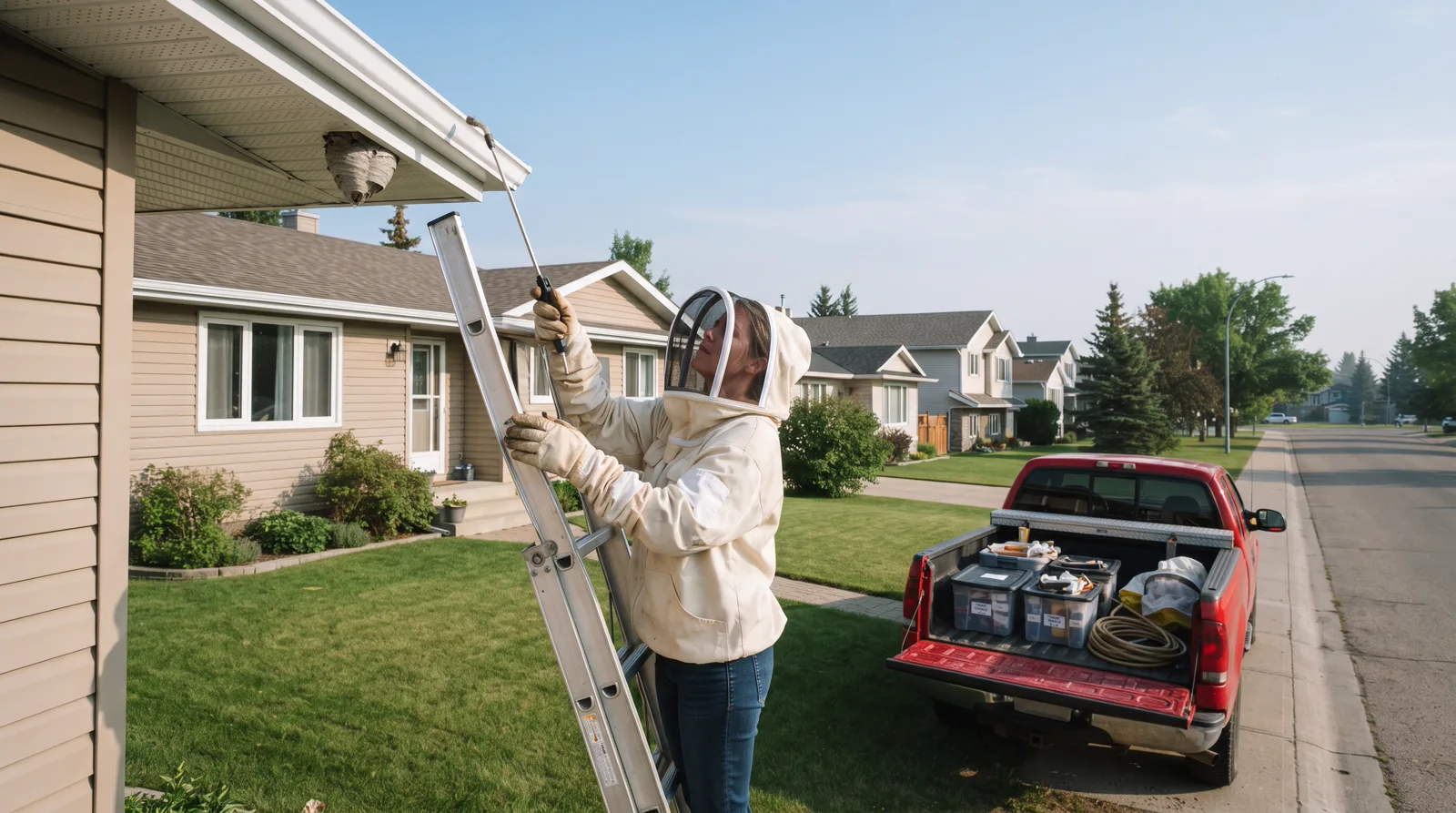
Nests hanging from eaves, soffits, tree branches or shed corners. Pro confirms safe ladder access or brings extended pole equipment. Nest bagged and disposed of after knockdown treatment applied.
Ground Nest Elimination
Yellow jacket colonies in lawn burrows, flower beds or under deck footings. Treatment pumped directly into entry hole, then sealed after colony collapse confirmed. Prevents re-emergence.
Wall Cavity Nest Extraction
Wasps entering through soffit gaps, wall vents or fascia cracks into hidden cavities. Pro locates entry point, applies targeted treatment, confirms no live activity, then seals access to prevent future nesting.
Shed & Outbuilding Clearance
Nests built inside barns, garages, garden sheds or equipment shelters. Pro treats active nests, removes abandoned paper structures, and identifies attractant conditions like open food or standing water.
High-Access Nest Removal
Nests on second-story eaves, chimney caps, or tall outbuildings requiring extension ladders or lift equipment. Pro confirms fall protection gear and provides photos of completed removal.
Prevention & Exclusion Work
Sealing soffit gaps, screening vents, removing old nest remnants and applying deterrent to previous nesting sites. Scheduled after freeze when all colony activity has stopped for the season.
Alberta Wasp Realities
🌡️ Short, Intense Season
Wasp activity peaks July through September in Parkland County, then dies off with the first hard freeze. Nests found in May or June are small and easier to remove. Late-season nests in August can hold hundreds of wasps and require more aggressive treatment.
🏡 Acreage & Rural Properties
Larger lots with outbuildings, woodpiles and open fields see higher wasp activity. Ground-nesting yellow jackets favor undisturbed grass and garden edges. Pros matched through the network understand rural access and bring equipment suited to larger properties.
🌬️ Chinook Wind Exposure
Sudden warm spells in spring can trigger early nest building in sheltered eaves and soffits. Fall chinooks sometimes bring a late-season surge in activity before the final freeze. Timing removal during cooler morning hours reduces sting risk.
🪵 Old Structures & Firewood
Aging barns, sheds and stacked firewood provide ideal nesting sites. Paper wasps build under loose fascia boards, bald-faced hornets attach to shed corners. Prevention work includes sealing gaps and relocating wood piles away from structures.
What it costs here
Everything You Need to Know About Wasp Removal in Spruce Grove
From identification to prevention, here's how safe removal works in the Tri-Region.
Why Wasp and Hornet Removal Matters in Spruce Grove and Parkland County
Alberta's warm summers bring yellowjackets, bald-faced hornets, and paper wasps into residential areas across Spruce Grove, Stony Plain, and the acreages scattered throughout Parkland County. The wasp season here typically runs from May through late September, with colony populations peaking in August and early September when nests can house hundreds or even thousands of individuals. Unlike solitary bees, social wasps defend their nests aggressively, and a single disturbance can trigger mass stinging events that send people and pets to urgent care. The proximity to Wabamun Lake, wooded lots, and the mix of older homes with gaps in soffits or fascia creates ideal conditions for nest establishment in this region.
Yellowjackets are the most common culprit in Spruce Grove. They build paper nests in wall voids, attics, underground burrows, and occasionally inside BBQ covers or lawn equipment left idle for a few weeks. Bald-faced hornets construct the large, football-shaped grey nests you see hanging from tree branches or under eaves, and they are extremely territorial within a 10-meter radius of the nest. Paper wasps build smaller, umbrella-shaped nests under eaves, deck railings, and porch ceilings. Each species has different aggression thresholds, but all three will sting repeatedly when they perceive a threat, and Alberta's dry summer heat makes them more irritable and defensive than wasps in more humid climates.
The health risk is real. Wasp stings inject venom that causes immediate pain, swelling, and in some cases severe allergic reactions requiring epinephrine and emergency transport. Even for those without allergies, multiple stings can cause systemic reactions, especially in children and elderly adults. Stings near the face, neck, or throat are particularly dangerous. Beyond the direct sting hazard, wasps become a barrier to normal use of your property: decks, playsets, garden sheds, and entry doors all become no-go zones when a nest is nearby. Trying to wait out the season is risky, because nests grow larger and more aggressive as summer progresses, and by late August the colony is at peak strength and maximum defensiveness.
Warning Signs You Need Professional Removal in Spruce Grove
The most obvious sign is a visible nest. Check the eaves and soffits around your roofline, especially on the south and west sides where sun exposure makes the location attractive for early-season nest building. Look under deck railings, inside meter boxes, around exterior light fixtures, and in any sheltered corner where wasps can anchor the initial comb. Bald-faced hornet nests are hard to miss once they reach soccer-ball size, but yellowjacket nests inside wall voids or underground are harder to spot until you see heavy traffic at a single entry point. Paper wasp nests start small in May and June, often just a few cells attached to a surface, but by July they can grow to the size of a dinner plate with dozens of wasps actively tending the brood.
Increased wasp activity in one specific area is a red flag. If you notice wasps hovering persistently near a particular section of your home, shed, or yard, they are likely defending a nearby nest. Ground nests are especially dangerous because you often don't see them until you mow over the entrance or step too close, triggering a mass defensive response. Watch for wasps entering and exiting a hole in the ground, a crack in your foundation, or a gap where siding meets the soffit. In Parkland County acreages with older outbuildings, abandoned vehicles, or stacked firewood, wasps frequently nest in hidden cavities that only become apparent when someone disturbs the area.
Multiple stings or aggressive behavior toward people or pets is a clear signal that a nest is nearby and the colony is large enough to mount a coordinated defense. Wasps don't sting unless provoked, but their definition of provocation includes vibrations from lawn mowers, weed trimmers, or even heavy foot traffic near the nest. If you or your family members have been stung more than once in the same general area over a few days, there is almost certainly a nest within 10 to 20 meters. Late-season nests, from mid-August onward, are the most dangerous because the colony is at maximum population and food sources are dwindling, making the wasps more aggressive and less predictable in their defensive range.
How Wasp and Hornet Removal Actually Works
Professional removal starts with species identification and nest location assessment. The approach for a ground-dwelling yellowjacket colony is completely different from the method used for a bald-faced hornet nest hanging three meters up in a spruce tree. The technician dispatched to your property will inspect the area during daylight to confirm the nest location, estimate the colony size, and identify the species. This assessment determines the treatment method, timing, and equipment required. For nests in wall voids or other hidden locations, the technician may need to trace wasp flight paths or use a thermal camera to pinpoint the exact nest location before treatment can begin. The goal is always to treat the nest when the entire colony is present, which means timing the treatment for dusk or early morning when wasps are least active and most likely to be inside the nest.
Treatment methods vary by nest type and location. Aerial nests like those built by bald-faced hornets are typically treated with a long-range spray that delivers insecticidal foam or liquid directly into the nest entrance. The chemical acts quickly to knock down the wasps inside and prevent them from emerging to defend. Ground nests and wall void nests are treated with insecticidal dust, which the wasps carry into the nest on their bodies, spreading it throughout the colony. Dust formulations work well in confined spaces and remain active for several days, ensuring that wasps returning from foraging trips are also eliminated. Physical removal of the nest structure itself usually happens 24 to 48 hours after treatment, once the technician has confirmed that all wasp activity has ceased. For nests in high or hard-to-reach locations, ladders, extension poles, and sometimes lift equipment may be required.
Safety protocols are non-negotiable. The technician will arrive with a full protective suit, gloves, face protection, and in some cases respiratory equipment if the nest is in an enclosed space where spray drift is a concern. The work area is flagged off to keep children, pets, and bystanders at a safe distance, and entry points to the home are typically closed to prevent wasps from retreating indoors during treatment. In Spruce Grove and Stony Plain, many older homes have gaps in soffits, vents without screens, or other openings that wasps exploit for wall void nesting. After the nest is removed, the technician should advise on sealing these entry points to prevent re-infestation the following year. Treatment timing is also critical: wasps are least aggressive and most sedentary at dusk or dawn, and cooler temperatures slow their reaction time. Mid-day treatments in full sun are avoided whenever possible because wasps are at peak alertness and aggression.
The Safe Removal Process from Call to Clear
The process begins when you contact a verified pest control technician through the referral network. You will describe the nest location, the wasp activity you have observed, and any stings or close encounters that have occurred. The technician will ask whether you have children, pets, or anyone in the household with known insect allergies, because this affects the urgency and safety planning. Most removals in the Spruce Grove area are scheduled within 24 to 48 hours, though emergency same-day service is available if the nest poses an immediate threat, such as a ground nest near a play area or a large aerial nest directly above a frequently used door. Pricing depends on nest size, location accessibility, and whether specialized equipment is needed, but typical residential wasp removal in Parkland County ranges from $180 to $450 for a single nest. Multiple nests, high-elevation removals, or wall-void extractions that require cutting into drywall or siding will fall at the higher end of that range or require a custom quote.
On-site assessment happens at the scheduled appointment. The technician will walk the property with you, confirm the nest location, and explain the treatment plan in plain terms. You will be told what chemical is being used, how long you and your family need to stay clear of the area, and what to expect in terms of wasp activity immediately after treatment. Some wasps will still be active for the first few hours post-treatment as the chemical takes effect, so re-entry to the area is typically delayed until the technician gives the all-clear. For ground nests or nests inside wall voids, the technician may mark the entry point and apply dust using a hand duster or power duster, depending on how deep the nest is located. For aerial nests, the technician will set up a ladder or extension pole, apply the treatment directly to the nest entrance, and often leave the nest in place for 24 hours to ensure complete colony elimination before physical removal.
Follow-up and prevention advice close the process. Once the nest is confirmed inactive, the technician will remove the structure if it is accessible and safe to do so. Bald-faced hornet nests are usually cut down and bagged for disposal, while yellowjacket nests in wall voids may remain in place if they are not causing a structural issue. The technician should point out any gaps, cracks, or entry points that allowed the nest to establish and recommend sealing them before next spring when queens emerge from hibernation to start new colonies. In some cases, a second visit is needed if wasp activity resumes within a few days, which can happen if a satellite nest was missed or if the initial treatment did not reach the entire colony. Reputable technicians include a short-term guarantee, typically 7 to 14 days, to address any residual activity at no additional charge.
What Wasp Removal Costs in Spruce Grove and Parkland County
A straightforward ground-level nest removal typically runs $150 to $300 in the Tri-Region, while a second-story eaves nest or multiple colonies on the same property can push the quote to $400 to $700. If the nest is inside a wall void, attic space or soffit that requires partial disassembly and exclusion work after treatment, expect $600 to $1,200. These ranges reflect what licensed Alberta operators charge for labour, product application and the liability they carry when working at height or entering confined spaces.
Location drives most of the price variation. A freestanding paper wasp nest hanging from a deck post is a 15-minute job with minimal product and zero access equipment. A bald-faced hornet colony tucked under the eaves of a two-story walkout in Spruce Grove's newer subdivisions means ladder work, possibly a lift rental and a second visit to remove the empty nest once the colony is dead. Accessibility matters more than nest size in Alberta pricing because fall risk and equipment costs are the real variables. A basketball-sized nest at eye level costs less to treat than a softball-sized colony 20 feet up a brick wall.
Timing also shifts the number. June and July are peak demand months when colonies are growing fast and stings are frequent, so some pros charge a premium for same-day or next-day dispatch. By late August and September, cooler nights slow wasp activity and urgency drops, which can soften pricing slightly. The species matters too: yellowjacket colonies that build inside wall voids or underground often require follow-up applications if the first treatment doesn't reach the queen, and that second visit is either included in the original quote or billed separately depending on the pro's terms. Always confirm whether the price covers one treatment or a guaranteed eradication, because a low quote that leaves you with a live nest in three days is no bargain.
Methods and Materials: What Works in Alberta Conditions
Most licensed wasp removal pros in Alberta use one of three application methods depending on nest location and species. Aerosol sprays with a jet nozzle are the go-to for exposed nests on eaves, soffits or tree branches. The active ingredient is usually a synthetic pyrethroid that knocks down wasps on contact and leaves a residual barrier that kills returning foragers. The range on these cans is typically 15 to 20 feet, which lets the applicator treat from the ground or a stable ladder position without standing directly under the nest. The downside is wind: a gusty afternoon in Parkland County can blow the spray sideways and waste half the can, so pros often schedule treatments for early morning or late evening when the air is calm and the colony is inactive.
For nests inside wall voids, attics or underground burrows, insecticidal dust is the better tool. Dust formulations drift into crevices and coat surfaces in ways that liquid sprays cannot, and they stay active for weeks in dry spaces. The applicator puffs the dust directly into the entry hole using a hand duster, and returning wasps track it back to the nest interior. This method works well for yellowjacket colonies that tunnel into siding gaps or foundation cracks, common entry points in older Stony Plain homes where settling and freeze-thaw cycles open up small voids. The limitation is moisture: if the void is damp or gets wet from a roof leak or condensation, the dust clumps and loses effectiveness, so a second application or a switch to liquid may be necessary.
Physical nest removal after treatment is the final step for paper wasp and bald-faced hornet colonies, but it's optional for underground yellowjacket nests where digging up the burrow adds cost without much benefit. Once the colony is dead, the empty nest is just paper and poses no threat, but many homeowners want it gone for peace of mind and to prevent future colonies from reusing the site. Some pros include removal in the base price, others charge $50 to $100 extra depending on height and attachment method. A nest glued to vinyl siding peels off easily; one built into a soffit vent or woven around a downspout bracket takes longer and risks minor cosmetic damage. Clarify removal terms up front so there's no surprise when the pro finishes the treatment and leaves the dead nest hanging.
Common Mistakes and Contractor Red Flags
The biggest DIY mistake is spraying a nest during the day when the colony is active and aggressive. Wasps defend the nest in numbers, and a partial knockdown leaves hundreds of agitated insects looking for the threat. Most stings happen in the first 30 seconds after the spray hits, before the chemical takes effect. Evening treatments are safer because the majority of the colony is inside the nest and sluggish from cooler temperatures. The second most common error is using a short-range household spray that forces you to stand within two feet of the nest. If you're going to attempt this yourself, buy a product with a 15-foot jet and treat from maximum distance, but understand that a missed shot or a sudden gust of wind can turn a $12 can of spray into a hospital visit.
On the contractor side, the red flag that signals the most risk is someone who shows up without proof of WCB coverage and liability insurance. Wasp removal involves ladder work, chemical application and a non-zero chance of a fall, an allergic reaction or incidental property damage. If the person doing the work isn't covered and something goes wrong, the homeowner's insurance may refuse the claim and you're left holding the bill. In Alberta, any paid service work that involves pesticide application legally requires the operator to hold a valid pesticide applicator certificate, is mandatory for anyone doing this commercially. Asking to see both before the work starts is not rude; it's the standard expectation, and any pro who bristles at the request is advertising their corner-cutting.
Another trap is the quote that doesn't specify what happens if the first treatment fails. Some wasp colonies, especially yellowjackets with a deep underground nest or a hidden wall void entry, survive an initial application because the product didn't reach the queen. A reputable pro builds a callback into the price or states clearly that a second visit costs extra. The problem quote is the one that's silent on this point, because when you call three days later to report wasps are still active, you're told the guarantee only covered application, not eradication, and a second treatment is another full-price visit. Get the terms in writing: does the price buy you one chemical application, or does it buy you a dead nest regardless of how many trips it takes?
Hiring the Right Wasp Removal Pro in Your Area
Start by confirming the basics: commercial liability insurance and a pesticide applicator certificate issued by Alberta Environment and Protected Areas. These three credentials are not optional extras for pros who take the work seriously. WCB protects you if the worker is injured on your property, liability covers accidental damage to your siding or windows during treatment, and the applicator certificate proves the person has passed the provincial exam on safe pesticide handling and environmental compliance. Any operator who can't produce all three on request is either uninsured, unlicensed or both, and that risk transfers directly to you the moment they step onto your property.
Ask how they plan to treat your specific nest situation and what product they'll use. A pro who takes 30 seconds to look at the nest location and immediately names a product and method has done this before. Someone who gives a vague answer or suggests a single approach for every scenario regardless of nest type is less experienced or less equipped. The right questions to ask: will you treat from the ground or do you need a ladder, what's the active ingredient in the product, how long before the colony is dead, do you remove the empty nest or is that a separate charge, and what happens if wasps are still active in three days? Clear answers to these five questions separate the pros who know the work from the ones winging it.
Local experience matters more than you'd expect. A pro who's worked in Spruce Grove and Parkland County has seen the common nest sites in the housing stock here: the gap behind aluminum fascia where it pulls away from the rake board, the soffit vent that's missing a screen, the ground burrow next to the deck footing that's a yellowjacket favourite. They know which products hold up in Alberta's temperature swings and which application methods work when the wind picks up in the afternoon. An operator from out of town can do the job, but they're learning your building details and your climate on your dime, and that learning curve sometimes shows up as a callback or a less-than-perfect application.
How Tri-Region Services Helps
Tri-Region Services routes your wasp removal request to one local pro who meets the standards above: liability insurance stated at signup, liability coverage and provincial applicator credentials stated at signup. You get a single free written quote with clear terms on what the price covers, whether nest removal is included and what the callback policy is if the colony survives the first treatment. No bidding process, no phone tag with five different operators, just one qualified match and a straightforward number. The pro doing the work carries their own insurance and warranty, and those terms are spelled out in writing before any treatment starts so there's no confusion when the invoice arrives.
Why Pros in This Network Pass the Gate
Every pest control operator cleared for dispatch meets these baseline standards.
Liability insurance
Workers compensation status confirmed current before any wasp removal work involving ladders or roof access.
Liability Insurance Verified
General liability coverage confirmed in writing, covering property damage and third-party injury during treatment.
Licensed Pesticide Application
Operator holds valid Alberta pesticide applicator certification for commercial exterior treatments.
Fall Protection Equipment
Pros working above six feet confirm proper ladder rating, stabilizers and spotter protocols before dispatch.
Photo Documentation Standard
Before and after photos provided showing nest location, treatment application and confirmed removal.
Callback Guarantee Confirmed
Re-treatment coverage window stated in writing before work starts, typically 14 to 30 days for the same nest location.
This page is not tied to a contractor's brand. Leads route straight to your one local partner. Verified reviews can appear here once that partner has them (never fabricated).
Serving the whole Tri-Region
7 Questions Homeowners Ask
How fast can someone get here if the nest is near my front door?+
What's the difference between wasps, hornets and yellow jackets in Alberta?+
Can I just knock the nest down myself with a hose or stick?+
Will they come back to the same spot next year?+
What if the nest is inside my wall and I can't see it?+
Is wasp removal safe around kids and pets?+
How much does it cost to remove multiple nests on one property?+
Do you handle bald-faced hornet nests in trees?+
Get your free quote
Tell us what you need and a local pro will get right back to you.
- ✓ Sent straight to a local business
- ✓ You choose who you hire
- ✓ Free, with no obligation