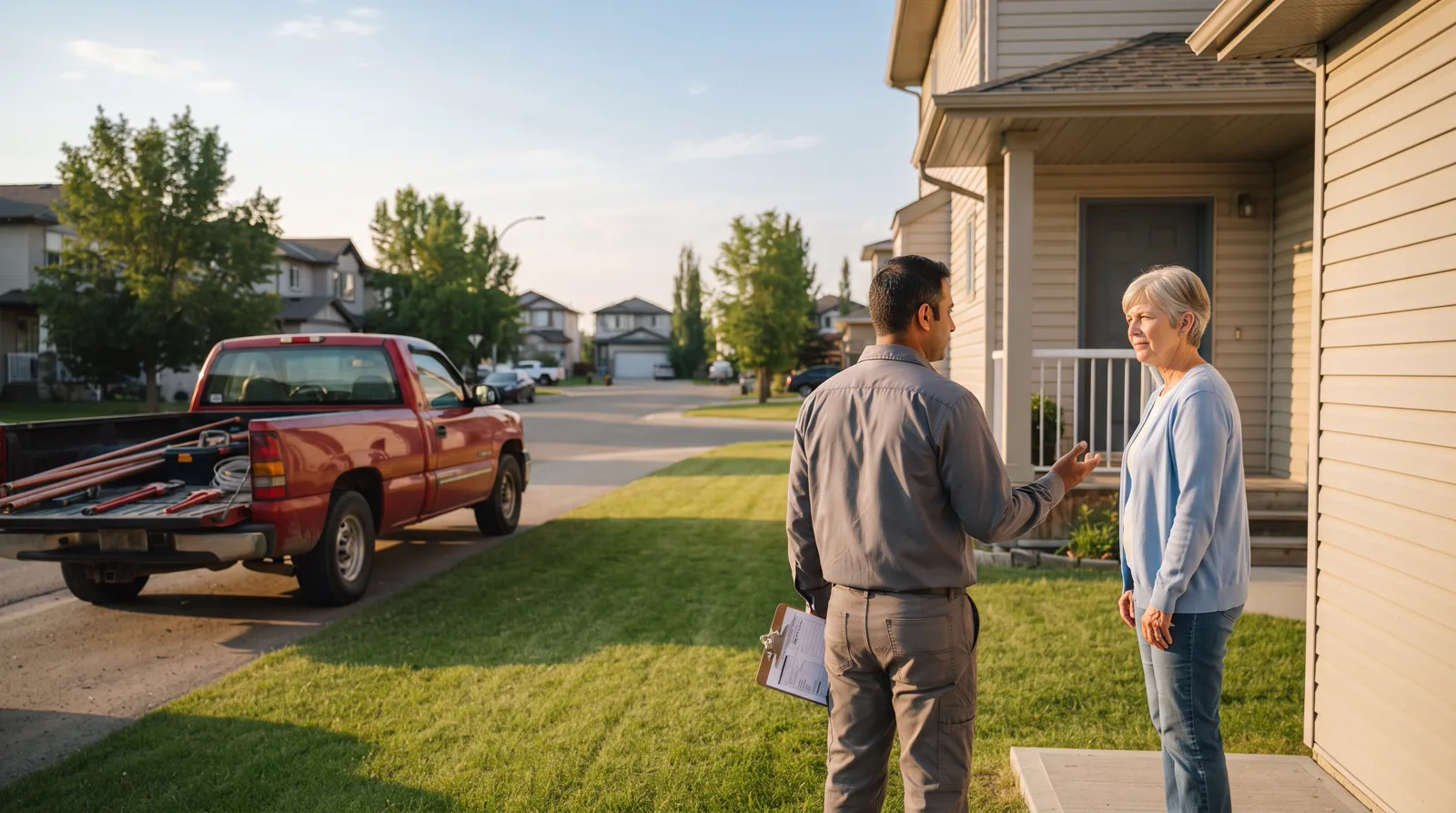
Water Heater Repair Spruce Grove: Fast, Local, Licensed
From no hot water emergencies to full replacements, local pros service all tank and tankless systems across Spruce Grove, Stony Plain, Parkland County and Acheson.
Complete Water Heater Services for Tri-Region Homes
Repair, replace, upgrade or maintain any residential water heating system
Emergency Repair
Diagnose and fix leaks, pilot light failures, thermostat issues, heating element burnout, sediment buildup and pressure relief valve problems. Most repairs completed same visit with parts on truck.
Tank Water Heater Replacement
Remove old unit, install new 40 or 50 gallon gas or electric tank, upgrade venting if needed, pull permit, pressure test all connections. Includes code-compliant drain pan, expansion tank and seismic strapping.
Tankless Installation
Full tankless conversion including gas line sizing, dedicated electrical, condensate drain, outdoor or indoor mounting, venting design and municipal permit. Navien, Rinnai, Noritz and Rheem models available.
Anode Rod & Flush Service
Drain and flush tank to remove sediment, inspect and replace sacrificial anode rod to extend tank life. Recommended every two to three years in Spruce Grove due to moderately hard municipal water.
Expansion Tank Install
Add or replace thermal expansion tank to protect your system from pressure spikes caused by heating cycles. Required by Alberta code on closed systems and strongly recommended for all tank heaters.
Sizing & Efficiency Upgrade
Calculate true hot water demand based on household size, fixtures and usage patterns. Recommend right-sized tank or tankless unit, insulation upgrades and timer controls to cut your energy bill.
Why Water Heater Work Here Is Different
❄️ Deep Frost and Freeze Risk
Spruce Grove sees January lows around negative 25°C, and unheated garages or crawlspaces can freeze supply lines or relief valve discharge pipes. We insulate all exposed piping, route discharge safely, and verify adequate heat trace where needed.
💧 Municipal Water Hardness
Spruce Grove and Stony Plain water runs 200 to 280 ppm hardness, which accelerates sediment buildup and anode rod corrosion. Regular flushing and anode replacement extend tank life from 8 years to 12 or more.
📋 Parkland County and City Permit Requirements
Replacement or relocation requires a plumbing permit through Spruce Grove, Stony Plain or Parkland County. The plumber pulls permits, books inspections and ensures venting, clearances and seismic strapping meet Alberta Building Code 2019.
🏠 Garage and Basement Installs
Many Tri-Region homes have water heaters in unfinished basements or attached garages. We verify combustion air supply, platform height for flood protection, and proper venting to handle chinook wind backdraft and winter static pressure.
What it costs here
Everything Spruce Grove Homeowners Need to Know About Water Heater Repair and Replacement
From recognizing early warning signs to choosing between tank and tankless, this guide covers the decisions, timelines and costs unique to our climate and building stock.
How Water Heater Repair Actually Works in Spruce Grove Homes
Water heater repair in Spruce Grove addresses failing components in gas, electric, or tankless systems that have stopped delivering reliable hot water. A licensed plumber starts with diagnostic testing to identify whether the problem stems from heating elements, thermostats, gas control valves, pressure relief valves, anode rods, or the tank itself. The technician checks incoming water pressure, tests electrical connections with a multimeter, inspects gas line pressure and burner operation, examines the flue vent for proper draft, and looks for sediment buildup or corrosion inside the tank. This diagnostic phase typically takes 30 to 45 minutes and determines whether repair makes financial sense or replacement is the better path.
Most repairs involve replacing specific components rather than fixing them. Electric water heaters commonly need new heating elements when water stays lukewarm, new thermostats when temperature becomes erratic, or new high-limit switches when the unit trips repeatedly. Gas models often require new thermocouples when the pilot light will not stay lit, new gas control valves when flame behaviour becomes irregular, or new burner assemblies when combustion efficiency drops. Tankless units typically need descaling to remove mineral buildup, new flow sensors when hot water delivery becomes inconsistent, or ignition system repairs when the unit fails to fire. The plumber shuts off water and power or gas, drains the necessary amount of water, removes the failed component, installs the replacement, refills and tests the system, then verifies proper operation across multiple taps.
Alberta's water chemistry and climate create specific repair patterns local plumbers recognize immediately. Hard water throughout the Parkland County region accelerates anode rod depletion and sediment accumulation, leading to premature tank corrosion and element failure. Pressure relief valves experience more cycling due to the freeze and thaw patterns that affect municipal water pressure. Gas water heaters face unique challenges from temperature extremes, with pilot lights and gas valves struggling during chinook wind events when barometric pressure drops rapidly. A qualified repair technician understands these regional factors and checks components that Alberta conditions stress most heavily, not just the obvious failed part.
Alberta Conditions That Cause Water Heater Problems
Spruce Grove's hard water contains 10 to 15 grains per gallon of dissolved calcium and magnesium, creating scale buildup inside tanks and on heating elements that significantly shortens equipment life. This mineral content precipitates out when water heats, forming a white or rust-coloured sediment layer at the tank bottom that insulates the heating source from the water. Electric elements encased in scale work three to four times harder to heat water, burning out months or years earlier than expected. Gas burners beneath sediment layers overheat the tank floor, accelerating corrosion and creating hot spots that compromise the steel. Water heaters serving Stony Plain and Parkland County homes without water softeners typically need their first major repair within five to seven years, while softened water systems often reach 10 to 12 years before significant intervention.
Winter temperatures that drop to minus 30 Celsius or colder stress water heater components in ways milder climates never experience. Incoming city water temperatures fall from around 10 Celsius in summer to 2 or 3 Celsius in January and February, forcing heating systems to work dramatically harder. Gas water heaters in uninsulated garages or utility rooms struggle to maintain temperature, with pilots blowing out and condensation forming inside the combustion chamber. Cold air infiltration around improperly sealed flue vents creates backdrafting risks and efficiency losses. Electric models draw maximum amperage for extended periods, stressing thermostats and contactors. The temperature differential between freezing ambient air and 60 Celsius tank water also accelerates thermal expansion and contraction cycles that fatigue pressure relief valves and tank fittings.
Municipal water pressure fluctuations throughout Acheson and Spruce Grove cause chronic strain on internal components. Pressure can swing from 40 PSI during peak summer demand to 90 PSI on cold winter mornings when usage drops, cycling the pressure relief valve and stressing tank seams. Spring runoff periods introduce temporary turbidity and sediment that clogs inlet screens and aerators. The expansion tank, which cushions thermal expansion forces, often fails after five to six years in Alberta systems because of the extreme pressure cycling. Failed expansion tanks transfer expansion forces directly to the water heater and household plumbing, causing leaks at fittings, premature pressure relief valve failure, and stress cracks in older tanks.
Real Warning Signs You Need Water Heater Repair Now
Water temperature inconsistency is often the first symptom homeowners notice, manifesting as showers that start hot then turn lukewarm after five minutes, or taps that never reach properly hot temperatures regardless of how long you run them. Electric water heater element failure typically affects either top or bottom element, resulting in reduced hot water volume or lukewarm water that never gets fully hot. A failed bottom element leaves you with a small amount of hot water heated only by the top element, while a failed top element prevents the tank from heating at all because the top thermostat controls power to both elements. Gas water heater thermocouple failure causes the pilot to extinguish randomly, leaving you without hot water until someone relights it. Thermostat drift in either system type creates wide temperature swings, with water alternating between scalding and tepid. These symptoms warrant immediate diagnosis because running a partially failed system often accelerates damage to other components.
Strange sounds coming from your water heater indicate internal problems that need professional assessment. Popping, crackling, or rumbling noises during heating cycles signal heavy sediment accumulation on the tank bottom, with water trapped beneath the mineral layer boiling and percolating through the deposits. This sediment acts as an insulator, causing the bottom of the tank to overheat and weaken while the water above stays cooler, forcing the system to run longer cycles. High-pitched whistling or screeching from electric models often indicates scale buildup on heating elements creating steam pockets. Hissing sounds near the pressure relief valve suggest the valve is weeping, either from excessive system pressure, a failed expansion tank, or a defective valve itself. Ticking or tapping sounds from tankless units typically indicate scale restricting the heat exchanger. None of these sounds resolve on their own, they only worsen as deposits grow and components deteriorate further.
Visible water around the base of your water heater demands immediate attention, though the source is not always immediately obvious. Condensation on cold supply lines during humid summer weather is normal and harmless, but water pooling on the floor indicates an active leak. Pressure relief valve discharge often creates puddles because the valve weeps intermittently when system pressure rises during heating cycles. This might indicate a failed expansion tank, excessive municipal pressure, or a defective valve. Slow leaks from the drain valve result from sediment preventing complete closure or deteriorated rubber washers. Corrosion around fittings where pipes connect to the tank suggests failing gaskets or electrochemical corrosion from dissimilar metals. Water leaking from the tank body itself, particularly near the bottom or from seams, means the tank has corroded through and requires immediate replacement rather than repair. Distinguishing between repairable leaks and catastrophic tank failure requires professional inspection, as seemingly minor seepage can indicate imminent tank rupture.
- Water stays lukewarm no matter how long you run it or never reaches comfortable shower temperature
- Hot water runs out much faster than usual, providing only 5 to 10 minutes of hot shower instead of 20 to 30
- Rumbling, popping, or banging noises during heating cycles that get progressively louder over weeks
- Pilot light goes out repeatedly on gas models, requiring frequent relighting
- Discoloured water with rust tint or metallic smell when you first turn on hot taps
- Moisture, dampness, or standing water around the water heater base
- Age over 10 years combined with any performance change, as multiple components often fail in sequence
The Complete Water Heater Repair Process From Diagnosis to Testing
Emergency calls for no hot water or active leaks are prioritized in Spruce Grove and surrounding areas, and plumbers typically arrive in fully stocked service vehicles containing common repair parts. The technician first establishes safe working conditions by shutting off power at the breaker panel for electric models or closing the gas valve for gas units. They verify the shutoff visually and test for voltage with a multimeter before touching any electrical components. For leaking units, they close the cold water supply valve and may drain the tank partially to reduce pressure. The initial safety protocol takes five to ten minutes but prevents electrocution, gas leaks, scalding injuries, and flood damage. Plumbers working in occupied homes lay drop cloths to protect flooring and contain any water spillage from the repair work.
Systematic diagnosis proceeds through electrical, mechanical, and water flow testing to isolate the failed component. For electric water heaters, the plumber tests voltage at the breaker, then at the high-limit switch, then at each thermostat, and finally at each heating element. This sequence identifies whether the problem stems from building electrical supply, safety cutouts, control components, or heating elements themselves. Testing includes measuring element resistance with an ohmmeter, as elements can fail open circuit with infinite resistance or short circuit with near-zero resistance. Gas water heater diagnosis checks gas supply pressure, thermocouple voltage output, burner flame pattern and colour, draft through the flue, and combustion air supply. Weak yellow flames indicate insufficient air or gas pressure issues, while lifting or floating flames suggest draft problems. The technician inspects the anode rod condition through the hot outlet using a borescope, as heavy corrosion signals approaching tank failure that might make repair economically unwise.
Component replacement requires draining only the necessary portion of the tank in most cases, saving time and reducing thermal stress on the system. Replacing a heating element, thermostat, or pressure relief valve requires draining the tank only until water level drops below that component, typically 20 to 40 litres. The plumber connects a garden hose to the drain valve and runs it to a floor drain, sump, or outside location that can handle 60 Celsius water. They remove the failed part, inspect the tank interior through the opening when possible, clean threads and gasket surfaces, install the new component with proper sealants, and refill slowly while opening a hot tap to bleed air from the system. Gas valve or thermocouple replacement requires shutting off gas, disconnecting the gas line, replacing the component, reassembling connections, performing a bubble test for leaks using soapy water, then carefully relighting the pilot following manufacturer procedures. Repairs typically take 90 minutes to three hours depending on part accessibility and whether sediment flushing is included.
Testing and Quality Verification After Repair
Professional repair service includes thorough operational testing before the plumber leaves your property. For electric water heaters, this means verifying voltage at both thermostats, confirming elements draw proper amperage, setting temperature to 55 or 60 Celsius, and observing at least one complete heating cycle. The technician checks that the high-limit safety switch resets properly and that both thermostats cycle heating elements in proper sequence. They measure outlet water temperature at multiple taps to confirm even heat distribution and adequate capacity. Gas water heater testing verifies stable pilot flame, proper main burner ignition, correct flame appearance, adequate draft through the flue using a draft gauge, and absence of gas odours. The plumber adjusts air shutters if needed to achieve clean blue flames with minimal yellow tipping.
Final testing includes running multiple hot water taps simultaneously to confirm the system meets household demand, checking all connections for leaks using visual inspection and touch, verifying the pressure relief valve test lever operates freely, and confirming proper temperature at fixtures. The technician documents baseline settings, part serial numbers, and system performance metrics for future reference. They explain what was repaired, why it failed, what normal operation looks and sounds like, and how to monitor performance going forward. Professional service includes a 90-day to one-year warranty on parts and labour, giving you recourse if the same problem recurs or if diagnosis missed a secondary issue. The plumber should leave the work area cleaner than found, with all packaging and old parts removed unless you request to see failed components.
What Water Heater Repair and Replacement Really Costs in Spruce Grove, Stony Plain and Parkland County
Water heater work in the Tri-Region ranges from simple diagnostic visits around $150 to $250 up to full system replacements that can reach $5,500 or more for premium equipment and complex installations. A typical tank repair for a failed thermostat, relief valve, or heating element usually lands between $300 and $650 including parts and labour. If your Edmonton-region plumber quotes significantly below this range, ask what corners are being cut. If they're far above, get a second opinion with an itemized breakdown. Alberta's freeze-thaw cycles and hard water conditions accelerate wear on components, so maintenance-related repairs tend to cluster in the $400 to $700 zone for mid-range units.
Tank water heater replacement costs depend heavily on fuel type, capacity, and venting complexity. A standard 40-gallon electric replacement typically runs $1,800 to $2,800 installed, while a 50-gallon natural gas unit with power-vented exhaust sits between $2,400 and $3,800. If you're in rural Parkland County on propane, expect the upper end of that range or higher due to fuel-specific components and code compliance details. Tankless systems represent a larger upfront investment, usually $3,200 to $5,500 installed for gas models, though electric tankless units (less common in Alberta due to high electrical loads) may start around $2,200. These figures assume straightforward replacement in an existing location with adequate venting and no structural changes.
Several factors push costs higher in our region. If your Spruce Grove home has an older atmospheric-vented tank and current code requires power venting or direct venting, add $600 to $1,200 for new exhaust hardware and possible condensate drain lines. Homes built before 1990 often lack adequate combustion air, requiring vent modifications or makeup air systems. Garage installations demand cold-weather protection and code-compliant clearances, especially if you store vehicles or flammable materials. Hard water in Stony Plain and Acheson accelerates sediment buildup, so budget $150 to $300 for a quality water softener connection or pre-filter if you're replacing a unit. Emergency weekend or after-hours service typically adds $150 to $300 to any repair or replacement quote, but waiting until Monday when you have no hot water in February is rarely realistic.
Repair Versus Replace: The Real Math
Plumbers often suggest a six-year rule: if your water heater is older than six years and the repair exceeds half the cost of replacement, invest in a new unit. In practice, this means a $700 repair on a nine-year-old tank rarely makes sense, while a $350 element replacement on a three-year-old unit is straightforward. Alberta's mineral-heavy water shortens tank lifespan compared to national averages, so expect 8 to 12 years from a quality gas tank and 10 to 15 from electric models with regular maintenance. If you're facing a second repair within 18 months, the tank is telling you it's done.
Calculate total cost of ownership, not just the repair bill. An aging tank loses efficiency as sediment accumulates, often costing an extra $15 to $30 monthly in wasted energy. Over two years, that inefficiency equals $360 to $720, money that could fund part of a new high-efficiency unit. Factor in the risk of a catastrophic leak. A failed tank dumping 200 litres into your Spruce Grove basement causes flooring, drywall and belongings damage easily reaching $8,000 to $15,000, and insurance deductibles swallow the first $1,000 to $2,500. Replacing a marginal eight-year-old tank proactively costs far less than emergency replacement plus flood remediation at two in the morning.
Comparing Tank, Tankless and Heat Pump Water Heaters for Tri-Region Homes
Traditional tank water heaters remain the most common choice in Spruce Grove, Stony Plain and Parkland County because they're affordable, simple to install, and handle Alberta's winter temperature swings without drama. A gas tank delivers reliable hot water even during power outages (ignition systems often run on battery backup or pilot light), critical when chinook winds knock out rural lines for hours. Electric tanks cost less upfront, around $1,400 to $2,200 installed for 40 to 50 gallon models, but operate at roughly double the monthly cost of gas in our region. Recovery rate matters: a family of four in a 1,800 square-foot home typically needs a 50-gallon gas tank or 60-gallon electric to avoid cold showers during peak morning use. Tanks last 8 to 12 years with annual flushing and anode rod replacement, routine maintenance many homeowners skip until it's too late.
Tankless (on-demand) water heaters appeal to homeowners focused on efficiency and endless hot water, but they're not universally superior in Alberta conditions. Gas tankless units achieve energy factors around 0.90 to 0.96 compared to 0.65 to 0.75 for standard tanks, translating to 20 to 30 percent lower operating costs. You'll never run out mid-shower, and the compact wall-mounted design frees up floor space in tight utility rooms. However, tankless systems struggle in Parkland County's minus 30 Celsius winters when incoming water temperature drops to 2 or 3 degrees. Flow rate falls dramatically in extreme cold, sometimes requiring a larger unit than calculators suggest. Installation costs run higher because most homes need upgraded gas lines (from half-inch to three-quarter-inch), new venting systems, and sometimes electrical service for the control board and blower. Budget $3,500 to $5,200 installed for a whole-home gas tankless in the Tri-Region.
Heat pump water heaters represent emerging technology that extracts warmth from ambient air to heat water, achieving energy factors above 3.0 in ideal conditions. These units can cut water heating costs by 50 to 65 percent compared to electric resistance tanks, a compelling number if you're on an all-electric rural property. The catch: they need a consistently warm installation space (ideally 10 to 30 degrees Celsius) and adequate air volume, typically 1,000 cubic feet minimum. Most Spruce Grove basements meet this requirement, but unheated garages and crawlspaces don't. Units cost $2,800 to $4,200 installed, more than conventional electric but less than gas tankless. Heat pumps also dehumidify and cool the surrounding space, a minor benefit in summer but a drawback in winter when you're heating the same air. They operate quietly but require filter maintenance every few months. In Alberta, they're a niche solution best suited to new builds or homes with basement utility rooms and time-of-use electricity billing.
Critical Mistakes and Contractor Traps to Avoid in Water Heater Work
Undersizing a water heater to save a few hundred dollars is the most common mistake homeowners make, leading to years of frustration. Contractors sometimes recommend a 40-gallon tank for a four-person household when a 50-gallon unit is appropriate, banking on the smaller upfront cost to win the bid. In Stony Plain's cold climate, incoming water temperature drops 5 to 8 degrees in winter compared to summer, directly reducing effective capacity and recovery speed. A properly sized unit accounts for simultaneous demand: if your teenagers shower while the dishwasher runs and the washing machine fills, peak draw can hit 12 to 15 gallons in ten minutes. Use first-hour rating (FHR), not just tank capacity, to match your household's actual usage. A quality plumber measures peak demand rather than guessing based on family size alone.
Skipping permit and inspection processes seems like a money saver but creates serious liability and resale problems. Alberta requires permits for water heater replacement in most municipalities, including Spruce Grove and Stony Plain, with fees typically $75 to $150. The permit ensures code-compliant venting, proper combustion air, earthquake strapping (yes, even in Alberta, to prevent movement during house settling), drainage pan installation, and correct temperature and pressure relief valve piping. Inspectors catch dangerous shortcuts like undersized gas lines, improper venting that could cause carbon monoxide buildup, and missing expansion tanks on closed water systems. If you sell your home without permit records, title insurance companies and shrewd buyers will demand replacement or significant price concessions. Some fly-by-night contractors offer cash deals with no permit to undercut licensed competition, leaving you with an illegal installation and zero recourse when problems surface.
Ignoring the condition of related systems during replacement is another costly error. If your existing gas line is borderline for current demand, upgrading to a tankless unit or larger tank will cause pressure drops and incomplete combustion, voiding your warranty and creating a safety hazard. Similarly, old galvanized water lines throughout the house will contaminate a new tank within months through rust and sediment. A competent Parkland County plumber inspects your entire system during the estimate, recommending necessary upgrades like pressure regulators (if municipal pressure exceeds 80 psi), expansion tanks (required on backflow preventers and closed systems), or sediment filters. Deferring these items to save money now leads to premature failure and repeat service calls. Quality contractors also test your existing electrical panel capacity before installing electric tanks or tankless units, preventing breaker trips and fire hazards from overloaded circuits.
- Never accept a verbal estimate or pay the full amount upfront: reputable contractors provide written quotes and payment schedules tied to work completion and inspection approval.
- Verify the contractor pulls permits under their own license, not yours: if something goes wrong, you want their insurance and bond covering the claim, not your homeowner's policy.
- Ask about warranty coverage specifics: manufacturer warranties cover the tank itself, but labour warranties vary from 1 to 5 years, and some contractors charge trip fees even for warranty work.
- Confirm the disposal plan for your old tank: Alberta regulations require proper recycling, and some municipalities charge $50 to $100 for landfill disposal if you deliver it yourself.
How to Hire the Right Water Heater Professional in Spruce Grove and Stony Plain
Start with verified Alberta licensing and insurance rather than online reviews or the lowest bid. Every plumber working on gas systems must hold a valid Gas Fitter 2 ticket (Class B) or higher through Alberta's Safety Codes Council. Ask for the license number and verify it directly at https://www.scc.gov.ab.ca before signing anything. Liability insurance should carry at least two million dollars coverage, and if employees will be on your property, confirm liability insurance. Some sole proprietors operate without WCB legally, but you assume liability if they're injured during installation. Request certificates of insurance directly from the provider, not photocopies the contractor could have fabricated. Spruce Grove and Stony Plain are small communities where word of mouth matters, but personal recommendations don't substitute for documentation.
Get itemized written estimates from at least two contractors, comparing not just the total but the breakdown of equipment, labour, permits, disposal, and warranty terms. A legitimate estimate specifies the exact water heater model with make, model number, capacity, and efficiency rating, not just generic descriptions like 'standard 50-gallon gas tank.' Labour should be separated from materials, and any additional work like venting upgrades, gas line modifications, or drain pan installation should appear as line items with individual pricing. Vague quotes that lump everything into one number make it impossible to identify where costs escalate or what you're actually buying. Ask how long the quote remains valid, most hold prices for 30 days but material costs fluctuate, especially for specialty components like power vent motors or electronic ignition systems.
Interview contractors about their experience with Alberta-specific challenges and their approach to code compliance and efficiency. Ask how they handle condensate drainage in power-vented systems during minus 25 Celsius weather, a real issue in Parkland County where exterior drain lines freeze solid. Question their recommendation on anode rods (aluminum, magnesium, or powered), sediment flushing procedures, and thermal expansion management. A knowledgeable professional explains these details in plain language and tailors advice to your home's age, water quality, and usage patterns. Be cautious of contractors who push the most expensive option without discussing your actual needs, or who dismiss concerns about permits and inspections as unnecessary bureaucracy. Quality pros welcome questions and provide references from recent jobs within ten kilometers of your property, ideally with similar scope and home age.
How Tri-Region Services Helps
Tri-Region Services connects Spruce Grove, Stony Plain, Parkland County and Acheson homeowners with one carefully vetted, fully licensed and insured local plumbing professional for water heater repairs, replacements and installations. Local pros handle the screening work, verifying current Gas Fitter certification, WCB compliance, liability insurance, and permit history so you don't have to chase down paperwork or second-guess credentials. Instead of juggling multiple calls and conflicting quotes, you receive one free written estimate with transparent pricing, clear timelines, and a detailed scope of work tailored to your home and your budget.
Our process eliminates the guesswork and pressure that typically come with emergency water heater situations. Whether you're dealing with a leaking tank in the middle of February or planning a proactive upgrade before your current unit fails, you'll work with a trusted local contractor who understands Alberta building codes, regional water quality challenges, and the realities of heating water through prairie winters. No bidding wars, no upselling, just honest advice and professional installation backed by proper permits and manufacturer warranties. Request your free quote through Tri-Region Services and experience the difference of working with a contractor who's already earned our trust and proven their work throughout the communities we serve.
Why Tri-Region Homeowners Choose Us
Licensed, insured and committed to transparent pricing and code-compliant work
Alberta Licensed Journeyman Plumbers
Every technician holds a valid Alberta journeyman ticket and completes annual code update training.
Insurance on file
Comprehensive general liability protect your home and the crew on every job.
Permit Pulled, Inspection Booked
Local pros handle all permit applications and schedule municipal inspections so your insurance stays valid.
Written Quote Before We Start
You see the full price, parts, labour and permit fees upfront with no surprise charges.
Urgent Requests Prioritized
We keep trucks stocked and schedules flexible for urgent repairs across Spruce Grove and Stony Plain.
Old Tank Removal and Recycling
We haul away your old heater and deliver it to a certified scrap metal recycler in the Edmonton region.
This page is not tied to a contractor's brand. Leads route straight to your one local partner. Verified reviews can appear here once that partner has them (never fabricated).
Serving the whole Tri-Region
8 Questions Tri-Region Homeowners Ask About Water Heaters
How long does a water heater last in Spruce Grove?+
Do I need a permit to replace my water heater in Spruce Grove or Stony Plain?+
What size water heater do I need for a family of four?+
Why does my water heater make popping or rumbling noises?+
Should I repair or replace my 10-year-old water heater?+
Can a tankless water heater handle Alberta winters?+
What is an expansion tank and do I need one?+
How much does it cost to switch from tank to tankless in Spruce Grove?+
Get your free quote
Tell us what you need and a local pro will get right back to you.
- ✓ Sent straight to a local business
- ✓ You choose who you hire
- ✓ Free, with no obligation