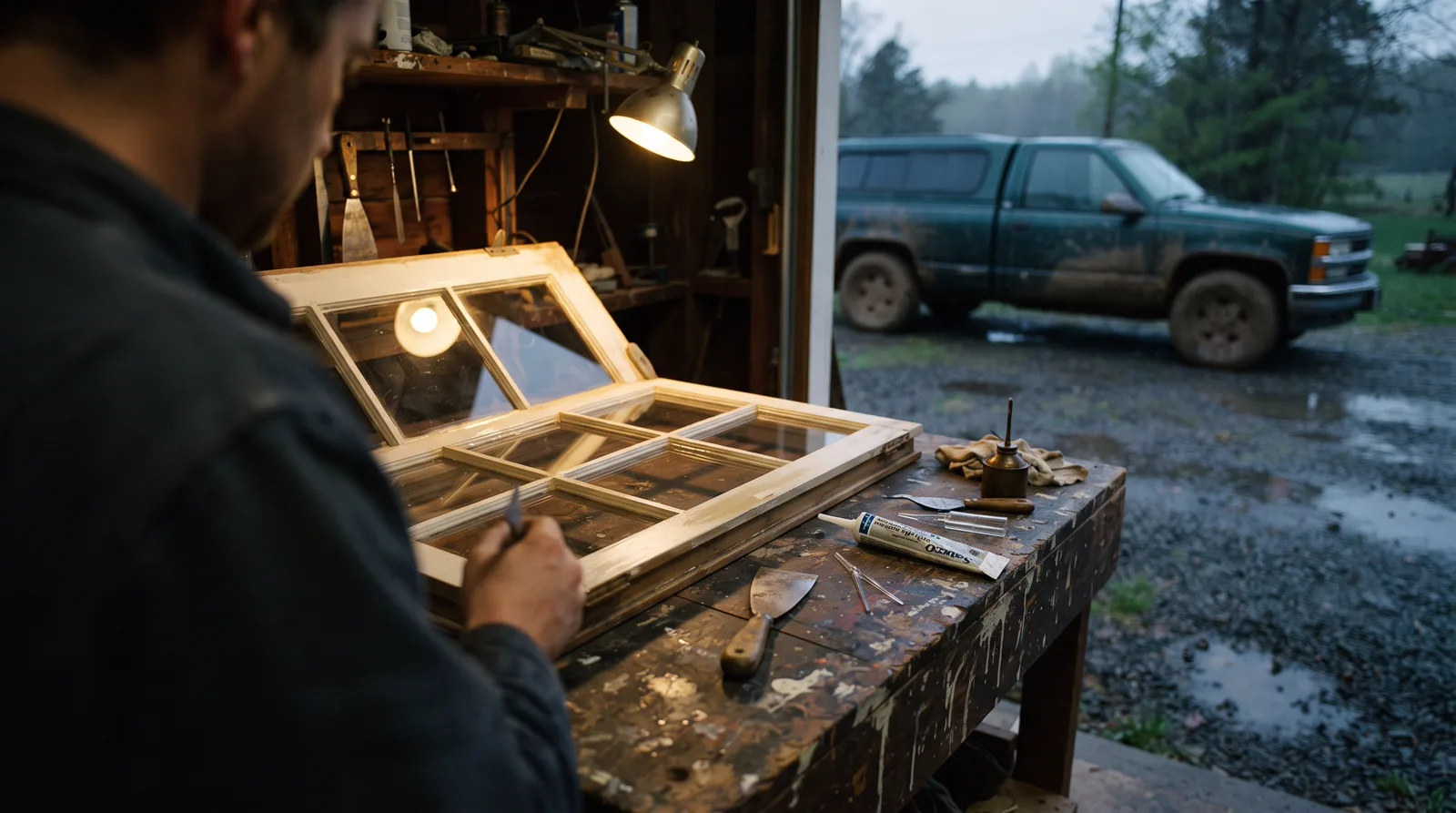
Window Repair That Lasts Through Alberta Winters.
Broken glass, failed seals, stuck cranks, or foggy panes? Local pros fix windows fast with repairs built for freeze-thaw cycles, hail, and chinook winds.
Window Repair Services in the Tri-Region
From cracked glass to failed seals, local pros repair what others replace.
Broken Glass Replacement
Single pane, double pane, and tempered glass replacement. We measure, order, and install with proper glazing for Alberta's temperature swings. Mobile service available for ground floor windows.
Failed Seal & Foggy Window Repair
Condensation or fog between panes means the insulated glass unit has failed. Local pros replace the IGU (not the whole window) with low-E glass rated for our climate. Restores R-value and clarity.
Hardware Repair & Replacement
Stuck cranks, broken locks, worn hinges, or stripped operators. The technician carries common brands (Pella, Andersen, Loewen) and can fabricate or source hard-to-find parts for older windows.
Weatherstripping & Seal Replacement
Drafts, ice buildup on frames, or high heating bills point to failed weatherstripping. Local pros install compression seals and gaskets rated for temperatures down to minus 40°C.
Wood Frame Rot & Vinyl Crack Repair
Moisture intrusion from failed flashing or seals causes wood rot in older frames. We cut out rot, treat with borate, epoxy fill, and prime. Vinyl cracks from chinook temperature swings are welded or replaced.
Screen Repair & Replacement
Torn mesh, bent frames, or missing spline. We rescreen on site or build new aluminum or fiberglass screens. Pet-resistant mesh available for high traffic windows.
Why Alberta Windows Fail Faster
❄️ Freeze-Thaw Seal Damage
Our 40°C to 50°C temperature swings between day and night (especially during chinooks) stress window seals. IGUs rated for milder climates fail in 8 to 12 years here. We use seals with silicone spacers and argon fill retention tested to minus 40°C.
🧊 Condensation & Ice Buildup
When indoor humidity hits cold glass in January (outdoor temps of minus 25°C to minus 35°C), condensation forms and freezes. Repeated freeze-thaw cycles rot wood frames and warp vinyl. Proper weatherstripping and balanced ventilation prevent this.
⛈️ Hail Damage Season
Parkland County and Spruce Grove see severe hailstorms May through August. Golf ball to baseball sized hail shatters glass and dents aluminum cladding. Most homeowner policies in Alberta cover glass replacement with $0 to $500 deductibles. We work directly with adjusters.
💨 Chinook Wind Pressure
Chinook winds gust to 80 km/h or more, creating pressure differentials that stress seals and hardware. Casement and awning windows take the most abuse. We torque hinges to manufacturer spec and use heavy-duty operators on exposed sides of homes.
What it costs here
Everything You Need to Know About Window Repair in Alberta
When to repair, when to replace, and what to expect from start to finish.
What Window Repair Actually Covers in Spruce Grove Homes
Window repair in Spruce Grove addresses damaged components on existing windows without full replacement. The most common repairs involve replacing broken or cracked glass panes, fixing failed thermal seals between double or triple pane units, repairing or replacing operating hardware like locks and cranks, addressing frame damage from impact or rot, and restoring weatherstripping that no longer creates an effective seal. A qualified technician assesses which components have failed and determines whether repair makes economic sense compared to full window replacement. For newer windows still under warranty or units with isolated damage, repair typically costs $200 to $800 per window depending on the issue, while full replacement runs $400 to $1,200 or more per window.
Alberta's climate creates specific repair needs that differ from milder regions. Hail damage to glass is extremely common in the Spruce Grove and Parkland County area, with severe storms capable of cracking or shattering panes that otherwise had years of life remaining. Freeze-thaw cycles cause seal failures in insulated glass units, leading to condensation between panes that ruins visibility and eliminates the thermal performance you paid for. Chinook winds create rapid temperature swings that stress window frames and hardware, causing cranks to bind, locks to misalign, and weatherstripping to separate from frames. Winter snow accumulation against windows can damage sills and frames if drainage isn't adequate, while deep frost penetration can crack older single-pane glass or stress mounting hardware.
Understanding what qualifies for repair versus replacement saves homeowners significant money. Single damage incidents like a cracked pane from a thrown rock, a broken crank mechanism, or a damaged lock can almost always be repaired for a fraction of replacement cost. Seal failure in one or two windows in a home with otherwise functional units makes repair the logical choice. Frame damage from minor rot or impact that hasn't compromised structural integrity can be repaired and reinforced. However, if multiple windows show seal failure, if frames have extensive rot or warping, if the window design is obsolete making parts unavailable, or if energy loss is severe across all units, full replacement typically makes better long-term financial sense than patching individual problems.
How Alberta Weather Drives the Need for Window Repair
The freeze-thaw cycle in the Spruce Grove region is the single biggest cause of window seal failure. Daytime temperatures in late winter and early spring can hit 5°C to 10°C while overnight lows drop to -15°C or colder. This daily expansion and contraction stresses the edge seals in insulated glass units, causing the butyl or polysulfide sealant to crack and separate over time. Once a seal fails, moisture enters the space between panes and condenses when temperatures drop, creating the foggy appearance that ruins both visibility and insulation value. Windows facing south and west experience the most extreme temperature swings and typically fail first, often within 10 to 15 years in lower-quality units or 15 to 25 years in premium windows with better edge seal systems.
Hail storms in Parkland County and the greater Edmonton area cause thousands of window damage claims every year. A severe hail event with stones 2 centimeters or larger can crack, chip, or completely shatter window glass in minutes. Even smaller hail can create divots and stress points in tempered glass that lead to spontaneous breakage weeks or months later due to temperature stress. Most homeowner insurance policies cover hail damage to windows with a deductible of $500 to $2,500, making professional repair financially viable for multiple damaged windows. Glass replacement after hail damage is straightforward if the frames and seals remain intact, typically completed in one to three hours per window once replacement glass is fabricated to match the existing unit specifications.
Chinook winds create unique stress on window assemblies that homeowners in milder climates never experience. When a chinook front arrives, temperatures can rise 20°C to 30°C in a few hours, creating intense thermal expansion in window frames and mounting hardware. Vinyl frames expand and contract more than wood or fiberglass, which can cause fasteners to loosen, weatherstripping to separate, and operating mechanisms to bind or misalign. Windows on the west side of homes take the brunt of chinook wind pressure, sometimes exceeding 90 kilometers per hour in exposed locations. This wind pressure can stress old caulking joints, work screws loose from frames, and reveal weaknesses in corner joints that weren't apparent during calmer conditions. Regular hardware tightening and weatherstripping inspection after major chinook events can prevent small issues from becoming expensive failures.
Warning Signs Your Windows Need Professional Repair
Condensation Between Panes and Seal Failure
When you see moisture, fog, or frost forming between the panes of a double or triple pane window, the thermal seal has failed and outside air is entering the sealed space. This moisture cannot be wiped away because it exists in the cavity between glass layers that you cannot access. In early stages, the condensation may appear only during extreme cold or after rapid temperature changes, then evaporate when conditions moderate. As the seal failure progresses, the moisture becomes permanent and may leave mineral deposits or streaks on the interior glass surfaces that cannot be cleaned. Once a seal has failed, the window has lost most of its insulating value and will allow significant heat loss in winter and heat gain in summer.
Seal failure cannot be reversed or patched. The only repair option is replacing the entire insulated glass unit while retaining the existing frame and hardware if they remain in good condition. A glass fabricator measures the frame opening, builds a new sealed unit to match the size and specifications, and a technician removes the old unit and installs the new one with fresh glazing and weatherstripping. This process costs $250 to $600 per window depending on size and glass specifications, compared to $400 to $1,200 for full window replacement. If only one or two windows in your home show seal failure and they're not too old, glass unit replacement makes excellent economic sense and restores full performance.
Drafts, Cold Spots, and Energy Loss
If you feel cold air movement near a closed window during winter, or notice frost forming on the interior frame or glass edges, air is leaking through failed weatherstripping, damaged seals, or frame gaps. Hold a lit incense stick or thin ribbon near the window edges, sash joints, and where the frame meets the wall on a windy day. Movement of the smoke or ribbon reveals exactly where air is infiltrating. Common leak points include the bottom sill where weatherstripping compresses over time, corner joints in older vinyl windows where the welding has separated, and the interface between window frame and rough opening if the original installation used inadequate insulation or the spray foam has shrunk.
Most draft issues can be repaired without replacing the window. Weatherstripping replacement costs $80 to $200 per window and immediately restores the seal between moving sash and frame. Failed exterior caulking around the frame perimeter can be removed and replaced with high-quality polyurethane or hybrid sealant for $100 to $300 depending on window size and accessibility. If the gap between frame and rough opening allows air infiltration, a technician can inject low-expansion foam or install backer rod and sealant from inside or outside depending on access. These repairs pay for themselves in reduced heating costs within one to three winters, and they prevent moisture infiltration that could rot framing or grow mold in wall cavities.
Operating Problems and Hardware Failure
When casement or awning windows become difficult to crank open or closed, or double-hung windows bind in the tracks and require excessive force to operate, the hardware or operating mechanism has worn out or been damaged. Casement window operators use a scissors-style arm and gear mechanism that can strip gears, bend arms, or seize from corrosion, especially if the window has been painted shut at some point and forced open. Double-hung windows rely on balance systems (spring balances, spiral balances, or block-and-tackle weights) that fail over time, causing the sash to drop when released or require two hands to lift. Sliding windows develop worn rollers and dirty tracks that make operation difficult and prevent proper sealing when closed.
Hardware repair or replacement is almost always more cost effective than window replacement. Casement operators cost $60 to $150 for the part plus $100 to $200 for installation, restoring smooth operation for another 10 to 20 years. Double-hung balance systems can be replaced for $80 to $200 per window including labor. Sliding window roller replacement runs $100 to $250 per window. Locks that no longer engage properly can be adjusted, repaired, or replaced for $60 to $150 depending on the mechanism type. These repairs extend window life significantly and improve both security and energy performance by ensuring the sash closes tightly against weatherstripping when latched.
The Window Repair Process from Assessment to Completion
Professional window repair begins with a thorough on-site inspection to identify all damage and determine the most cost-effective solution. The technician examines each affected window for seal failure by looking for condensation or staining between panes, tests operating hardware by cycling windows through their full range of motion, checks weatherstripping for compression damage or separation, inspects frames for rot or impact damage, and assesses caulking and exterior seals for cracks or gaps. They measure the windows if glass replacement is needed, photograph damage for insurance claims if applicable, and check the window manufacturer and model to determine parts availability. This assessment typically takes 30 to 60 minutes for a typical repair job involving one to four windows.
The technician provides a detailed written quote breaking down labor and materials for each repair. Glass unit replacement quotes specify the glass type (clear, low-E, tinted, or obscure), the number of panes (double or triple), any gas fill (argon or krypton), and fabrication time, which typically runs one to two weeks for custom sizes. Hardware replacement quotes identify the specific parts needed and confirm availability, since some older window brands have been discontinued and require aftermarket or universal replacement parts. The quote should also outline the warranty on both materials and labor, typically one year on labor and matching the manufacturer warranty on parts and glass units. Reputable companies provide multiple repair options when available, explaining the cost and performance trade-offs so you can make an informed decision.
Once you approve the quote, the company orders materials and schedules the repair visit. Glass fabrication takes one to three weeks depending on size, complexity, and the fabricator's workload, while hardware parts usually arrive within a few days unless the window brand is obsolete. On repair day, technicians protect the work area with drop cloths and remove interior window treatments if necessary for access. Glass replacement involves carefully removing interior or exterior stops, lifting out the failed insulated unit, cleaning the frame channel, installing the new unit with proper shimming and sealing, reinstalling stops, and applying fresh exterior caulking. Hardware replacement requires removing the old mechanism, sometimes enlarging or relocating mounting holes, installing and adjusting the new parts, and testing operation through multiple cycles to ensure smooth function and proper alignment.
After completing repairs, the technician cleans all glass surfaces, tests window operation, verifies weatherstripping contact and seal quality, and confirms that locks engage properly and hold the sash tight. They explain any maintenance requirements for the new components, such as annual lubrication points for operating hardware or caulking inspection schedules. You should receive written documentation of the work performed, warranty information for materials and labor, and care instructions. The job site should be left clean with all debris removed and protection materials taken up. Testing repaired windows during the next significant weather event, whether extreme cold, high wind, or heavy rain, confirms that the repairs are performing as expected and justifies the investment compared to full replacement cost.
What Window Repair Actually Costs in the Tri-Region
A single broken pane in a standard double-hung window typically runs $150 to $400 including labour and glass, but that range widens fast depending on what actually failed. If the seal between panes has blown and you see constant fog between the glass layers, you are replacing the entire insulated glass unit (IGU), not just a pane. That IGU swap costs $300 to $700 per window for a typical size, and the price climbs with low-E coatings, argon fill, or larger dimensions. Hardware repairs like replacing a broken crank, balance spring, or tilt latch usually land in the $100 to $250 range per window, though sourcing obsolete hardware for older Loewen, Marvin, or Duxton units can push parts costs higher and extend lead times to several weeks.
Frame rot or sill replacement is where pricing separates the quick fix from the proper repair. Cutting out a section of rotted wood sill, sistering in treated lumber, wrapping it in aluminum coil stock, and refinishing the interior typically costs $400 to $900 per window. If the rot has climbed the jambs or invaded the rough opening framing, you are into a $1,200 to $2,500 repair that involves pulling interior and exterior trim, addressing structural wood, re-insulating, and ensuring your new assembly meets current Alberta Building Code thermal performance and air barrier continuity. Spruce Grove and Stony Plain see wet spring runoff pooling against foundations and summer hail punching through aging caulk lines, so moisture-driven rot is common in homes built before 2005 when flashing details were less rigorous.
Travel and minimum charges matter in the Tri-Region. Most window repair companies based in Edmonton or Sherwood Park charge a $100 to $150 call-out fee to reach Spruce Grove or Stony Plain, and that fee often gets rolled into the job total only if you proceed. Mobile repair services that stock common glass sizes and hardware on the truck can complete single-pane replacements or simple hardware swaps in one visit, saving you a second trip charge. Multi-window projects or custom IGU orders require measurement, fabrication time (usually one to three weeks), and a return visit for installation, so budget for two service calls. Winter adds complexity: caulking and foam require temperatures above 5 degrees Celsius to cure properly, so repairs scheduled between November and March may involve temporary plastic sealing and a spring follow-up to finish exterior weatherproofing, sometimes at no extra cost if the contractor discloses that upfront.
Comparing Your Repair Options: Methods and Materials
When an IGU has failed and you see permanent condensation between panes, you face three paths: replace just the glass unit, replace the entire sash, or replace the whole window. Swapping the IGU alone is the most economical at $300 to $700 per window and preserves your existing frame and hardware, but it only works if the sash is structurally sound and the glazing channels are not cracked. Vinyl windows from the 1990s often have brittle glazing beads that snap during disassembly, forcing you into a full sash replacement whether you planned for it or not. Replacing the sash (the moving part that holds the glass) costs $500 to $1,200 and gives you fresh weather stripping, new locks, and a warranty on the entire assembly, but you are still married to the old frame. If that frame is out of square, has failing weatherstripping at the jambs, or shows rust staining from corroded fasteners, a sash swap just moves the problem up the road.
Full window replacement delivers new frame, sash, hardware, and glass in one shot for $600 to $1,800 per opening depending on size, style, and performance spec. You gain current energy ratings, factory warranties (typically ten years on glass seal, limited lifetime on vinyl extrusion), and the chance to upgrade to triple-pane, low-E, or impact-resistant glass if hail is a recurring concern in your area. The trade-off is higher upfront cost and a bigger disruption: interior and exterior trim comes off, insulation gets addressed, and the rough opening may need shimming or squaring. In older Parkland County acreages with out-of-plumb walls and hand-framed openings, that squaring work can add a half day of labour and $200 to $400 in materials. Replacement also triggers permit requirements in most Tri-Region municipalities when you are swapping more than two windows, so factor in the $150 to $250 permit fee and the inspections that come with it.
Glass choice drives both performance and price. Standard clear double-pane IGUs with air fill offer basic insulation and cost the least, but low-E coatings (a microscopically thin metallic layer that reflects infrared heat back into the room) improve winter comfort and cut heat loss by 30 to 40 percent for an added $50 to $100 per window. Argon gas fill between panes boosts insulation another small step for roughly $30 to $60 more per unit, and the combination of low-E plus argon is now standard in any quality replacement IGU. Tempered or laminated glass is mandatory for any pane within 600 millimeters of a walking surface or door, per Alberta Building Code, and adds $75 to $150 per lite. If you live along Highway 16A or near the rail yard in Acheson, laminated glass also cuts road noise and offers break-in resistance, though it doubles the glass cost compared to standard tempered. Triple-pane units with two low-E coatings and krypton fill hit the top of the performance curve but cost $400 to $800 more per window than double-pane, a premium that makes sense in an unheated sunroom or north-facing bedroom but overkill in a main-floor picture window in a well-insulated 2010s build.
Common Mistakes and Contractor Traps to Avoid
The biggest mistake homeowners make is accepting a quote without confirming what is actually covered in the scope. A verbal estimate that says "fix the window" can mean replacing just the broken glass, or it can mean addressing the rotted sill and flashing that caused the glass to crack in the first place. Ask for a written breakdown that lists glass type and thickness, whether new weather stripping is included, how exterior gaps will be sealed, and what warranty applies to both materials and labour. If the quote skips those details or the contractor waves you off with "we will take care of it," you have no recourse when the same window fogs again next spring because the real problem was never diagnosed. Reputable pros welcome specific questions and provide line-item quotes because they know it protects both parties.
Avoid any contractor who dismisses the need for a permit when the work clearly requires one. In Spruce Grove, replacing more than two windows or cutting into structural framing triggers a building permit, and in Parkland County, any window change in a lakefront or environmentally sensitive area may need additional setback or environmental review. A contractor who says "we do this all the time, no one checks" is setting you up for trouble during a future sale, refinance, or insurance claim. Unpermitted work can force you to open walls for a retroactive inspection, pay double permit fees, or even reverse the work entirely. The permit process exists to ensure your new windows meet energy code (currently NBC 9.36 and Alberta's energy efficiency requirements), are properly flashed to keep water out of your wall cavity, and are safely tempered where code requires it. Permits add time and cost, but they also create a documented trail that proves your home was upgraded to current standards.
Watch for low-ball pricing that leaves out critical steps. A $200 IGU replacement sounds appealing until you learn the price excludes exterior caulking, interior trim removal, or a second visit to install the glass once it arrives from the supplier. Some mobile repair services charge by the pane and quote only the glass cost, then add $100 to $150 in labour and trip fees at the end. Others include installation but not disposal, leaving you with a truck bed full of broken glass and old sashes. The honest price is the all-in price: glass, glazing materials, labour, cleanup, and any call-out or travel fee. If a quote is dramatically cheaper than two other bids, ask what was left out, because nothing in window repair is free.
Chinook wind cycles and extreme temperature swings in Alberta put extra stress on window seals and caulking, so any repair that skips proper exterior sealing is guaranteed to fail. A competent contractor removes old caulk completely rather than layering new over old, primes porous surfaces like raw wood or masking, uses a high-quality polyurethane or silicone caulk rated for Alberta's temperature range (typically negative 40 to positive 80 degrees Celsius), and tools the bead to ensure full contact with both surfaces. Watching a contractor smear a bead of bargain-bin latex caulk over dust and old residue is a red flag that the work will not last a season. Expect the caulking step to take nearly as long as the glass installation itself, and do not accept a rush job that skips surface prep.
How to Hire the Right Window Repair Pro
Start by confirming the contractor carries at least $2 million in general liability insurance, and ask to see the certificates before any work begins. Window repair involves ladders, heavy glass, and power tools, and an uninsured worker who falls off your second-story sill or drops a pane onto your deck becomes your financial and legal problem the moment they step onto your property. liability insurance is mandatory in Alberta for any business with employees, and sole proprietors can opt in. Liability insurance protects you if a repair fails and causes water damage, if a tool scratches your siding, or if a pane shatters during installation and injures someone. Legitimate contractors provide these documents without hesitation because they know informed clients are better clients.
Check references specifically for similar work in similar conditions. A company that excels at new construction window installation may have little experience diagnosing seal failure in 20-year-old Loewen wooden windows, and a glass shop that replaces storefront panels all day may not understand the flashing and air barrier integration required in a residential rough opening. Ask past clients whether the repair solved the problem long-term, whether the site was left clean, whether the timeline and budget held, and whether the contractor communicated clearly when delays or surprises came up. A reference list with only first names and no contact details is not a reference list. Expect full names, phone numbers, and addresses in the Tri-Region where you can drive past and see the work if you choose.
Meet the actual person who will do the work, not just the estimator or salesperson. In larger window companies, the friendly consultant who measures your windows and walks you through options may never set foot on your property again, and the installer who shows up may have no knowledge of what you were promised. Small to mid-sized outfits where the owner or lead tradesperson handles both the quote and the installation tend to deliver more consistent results because there is no communication gap between sales and execution. Ask during the estimate who will perform the work, how long they have been with the company, and what their trade background is. A 15-year journeyman glazier will approach a difficult repair very differently than a labourer with six months of experience, and you deserve to know which one is coming.
How Tri-Region Services Helps
We route you to one pre-vetted, fully insured local window repair professional who serves Spruce Grove, Stony Plain, Parkland County, and Acheson. Every pro in our network has stated they carry liability coverage, a track record of quality residential work in the Tri-Region, and a commitment to transparent written quotes with no hidden fees. You will receive one free, no-obligation estimate that breaks down exactly what needs repair, what materials will be used, and what the total cost will be before any work begins. No high-pressure sales, no endless competitor callbacks, just one qualified contractor who knows Alberta building conditions and stands behind the repair. Request your free quote today and get your windows fixed right the first time.
Why Homeowners Choose Our Window Repair Pros
Licensed contractors who show up on time and clean up when done.
Licensed & Insured in Alberta
Every technician tells us they carry $2 million liability insurance.
Warranty on All Repairs
5 years on IGU replacements, 2 years on hardware, 1 year on labor and weatherstripping.
Urgent Requests Prioritized
Broken window compromising security or letting in weather? Security and weather-exposure jobs are flagged urgent and routed to available local glaziers first.
Upfront Pricing, No Surprises
You get a written estimate before any work starts, including parts, labor, disposal, and travel fees.
Insurance Claim Assistance
We document hail damage with photos, provide itemized invoices for adjusters, and work with all major insurers serving Alberta.
Safe Glass Disposal
Broken glass and old IGUs are wrapped, removed from your property, and disposed of at permitted facilities in Parkland County.
This page is not tied to a contractor's brand. Leads route straight to your one local partner. Verified reviews can appear here once that partner has them (never fabricated).
Serving the whole Tri-Region
7 Window Repair Questions Tri-Region Homeowners Ask
When should I repair a window instead of replacing the whole unit?+
Does insurance cover window repair from hail damage in Alberta?+
Why is there fog or condensation between my window panes?+
How long does a window repair last in Alberta's freeze-thaw climate?+
Do I need a permit to repair a window in Spruce Grove or Stony Plain?+
Can a broken window be temporarily secured until a repair crew arrives?+
What causes ice buildup on the inside of my windows in winter?+
How quickly can I get a window repaired in Spruce Grove or Stony Plain?+
Get your free quote
Tell us what you need and a local pro will get right back to you.
- ✓ Sent straight to a local business
- ✓ You choose who you hire
- ✓ Free, with no obligation